MINIMAL INVASIVE
TECHNIQUES IN
PERIODONTAL SURGERY
Dr. Enas Elgendy
Ass. Professor of Oral Medicine,
Periodontology& Oral Diagnosis
Faculty of Dentistry
Kafrelsheikh University
Change is the only
thing that is
Constant.
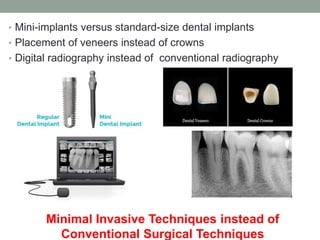
• Mini-implants versus standard-size dental implants
• Placement of veneers instead of crowns
• Digital radiography instead of conventional radiography
Minimal Invasive Techniques instead of
Conventional Surgical Techniques
Why minimally invasive surgical techniques (MIST) in
periodontal surgery
1. Less postoperative pain
2. Improvement healing
3. Chair time required to perform such a surgery is by far shorter than
the chair time required for more conventional surgical approaches
4. Improved retention of soft height and contour
5. Periodontal tissue regeneration
6. Good patient acceptance.
Disadvantages of MIST
1. Technique sensitive
2. MIST needs improved instruments for root and osseous defect
debridement, “micro” versions of the instruments.
3. Expensive
4. Cannot be universally applied, only in suitable case technique can be
performed.
Indications of MIST
1- Isolated, interproximal bone defect, not extending
beyond the interproximal site was considered ideal for this
technique .
2- Periodontal defects that border on an edentulous area
3- Multiple separate defect sites within a single quadrant.
1- Generalized horizontal bone defect.
2- Multiple interconnected vertical defects are thought to
be contraindicated for MIPS and are best handled with
more traditional surgical approaches.
Contraindication
General consideration for minimally
invasive surgery
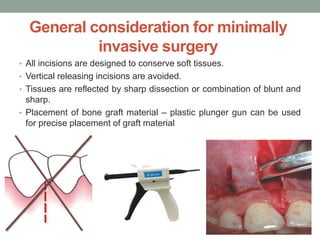
• All incisions are designed to conserve soft tissues.
• Vertical releasing incisions are avoided.
• Tissues are reflected by sharp dissection or combination of blunt and
sharp.
• Placement of bone graft material – plastic plunger gun can be used
for precise placement of graft material
General consideration for minimally
invasive surgery
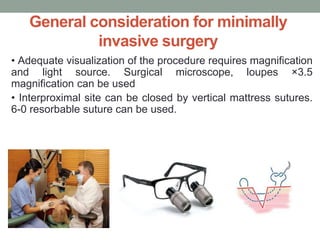
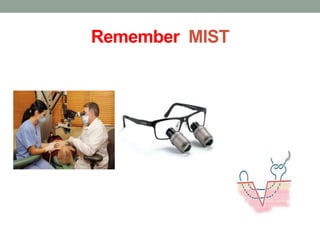
• Adequate visualization of the procedure requires magnification
and light source. Surgical microscope, loupes ×3.5
magnification can be used
• Interproximal site can be closed by vertical mattress sutures.
6-0 resorbable suture can be used.
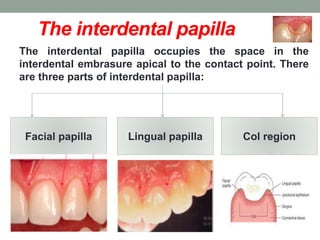
The interdental papilla
Facial papilla Lingual papilla Col region
The interdental papilla occupies the space in the
interdental embrasure apical to the contact point. There
are three parts of interdental papilla:
The interdental papilla
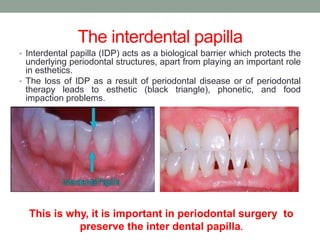
• Interdental papilla (IDP) acts as a biological barrier which protects the
underlying periodontal structures, apart from playing an important role
in esthetics.
• The loss of IDP as a result of periodontal disease or of periodontal
therapy leads to esthetic (black triangle), phonetic, and food
impaction problems.
This is why, it is important in periodontal surgery to
preserve the inter dental papilla.
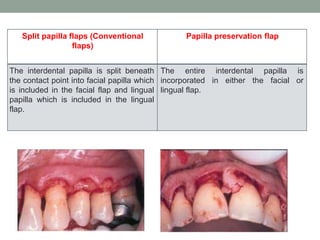
Split papilla flaps (Conventional
flaps)
Papilla preservation flap
The interdental papilla is split beneath
the contact point into facial papilla which
is included in the facial flap and lingual
papilla which is included in the lingual
flap.
The entire interdental papilla is
incorporated in either the facial or
lingual flap.
Papilla Preservation Flap
A] Conventional papilla preservation
B] Modified papilla preservation
C] Simplified papilla preservation flap
D] Whale’s tail technique
1- Conventional papilla preservation
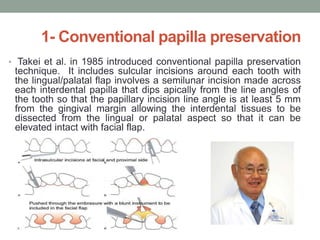
• Takei et al. in 1985 introduced conventional papilla preservation
technique. It includes sulcular incisions around each tooth with
the lingual/palatal flap involves a semilunar incision made across
each interdental papilla that dips apically from the line angles of
the tooth so that the papillary incision line angle is at least 5 mm
from the gingival margin allowing the interdental tissues to be
dissected from the lingual or palatal aspect so that it can be
elevated intact with facial flap.
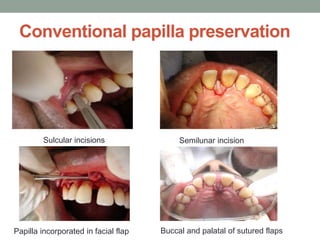
Conventional papilla preservation
Sulcular incisions Semilunar incision
Papilla incorporated in facial flap Buccal and palatal of sutured flaps
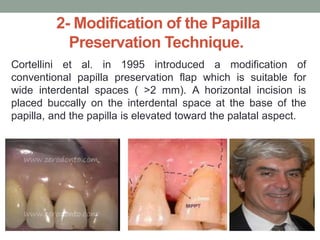
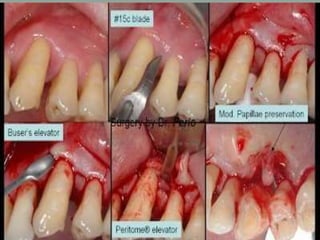
2- Modification of the Papilla
Preservation Technique.
Cortellini et al. in 1995 introduced a modification of
conventional papilla preservation flap which is suitable for
wide interdental spaces ( ˃2 mm). A horizontal incision is
placed buccally on the interdental space at the base of the
papilla, and the papilla is elevated toward the palatal aspect.
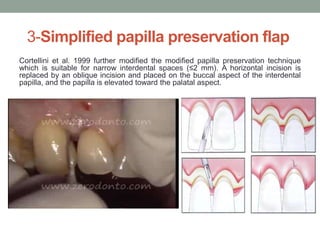
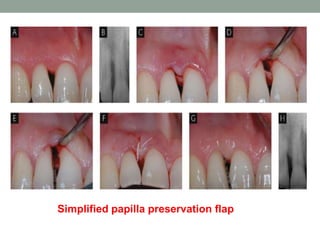
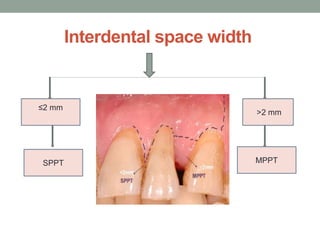
3-Simplified papilla preservation flap
Cortellini et al. 1999 further modified the modified papilla preservation technique
which is suitable for narrow interdental spaces (≤2 mm). A horizontal incision is
replaced by an oblique incision and placed on the buccal aspect of the interdental
papilla, and the papilla is elevated toward the palatal aspect.
Simplified papilla preservation flap
Interdental space width
≤2 mm
˃2 mm
SPPT MPPT
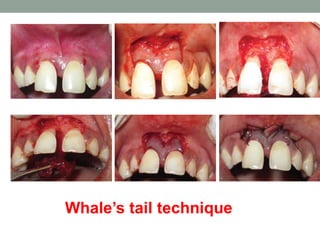
4- Whale’s tail technique
• Bianchi and Basseti in 2009 introduced a surgical technique to
preserve interdental tissue in guided tissue regeneration known as a
“whale’s tail” technique. It was used for the treatment of wide
intrabony defects in the esthetic zone involving the elevation of a
large flap from the buccal to the palatal side to allow accessibility as
well as visibility of the intrabony defect and to perform GTR while
maintaining interdental tissue over grafting material.
Whale’s tail technique
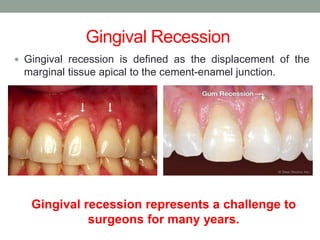
 Gingival recession is defined as the displacement of the
marginal tissue apical to the cement-enamel junction.
Gingival Recession
Gingival recession represents a challenge to
surgeons for many years.
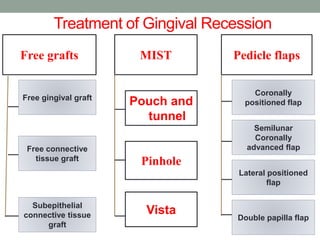
Treatment of Gingival Recession
Free grafts Pedicle flaps
Free gingival graft
Free connective
tissue graft
Subepithelial
connective tissue
graft
Double papilla flap
Coronally
positioned flap
Semilunar
Coronally
advanced flap
Lateral positioned
flap
MIST
Pouch and
tunnel
Pinhole
Vista
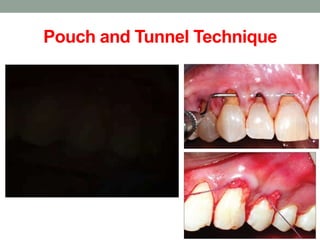
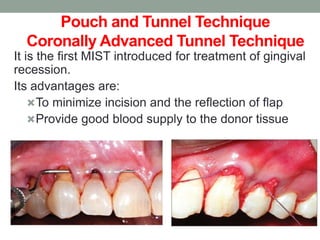
Pouch and Tunnel Technique
Coronally Advanced Tunnel Technique
It is the first MIST introduced for treatment of gingival
recession.
Its advantages are:
To minimize incision and the reflection of flap
Provide good blood supply to the donor tissue
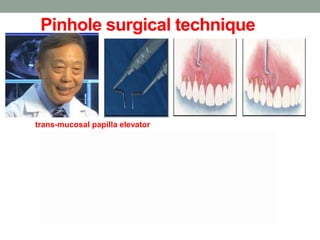
Pinhole surgical technique
trans-mucosal papilla elevator
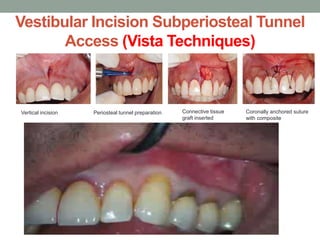
Vestibular Incision Subperiosteal Tunnel
Access (Vista Techniques)
Vertical incision Periosteal tunnel preparation Connective tissue
graft inserted
Coronally anchored suture
with composite
Ridge augmentation
• The anatomic limitations of the residual alveolar bone may cause problems for the
insertion of dental implants because implant placement requires an adequate quantity
and quality of bone. Ridge augmentation has been performed to reconstruct alveolar
ridges as support for the placement of dental implants with a high success rate.
Pouch and Tunnel Technique for ridge
augmentation
• The subperiosteal tunneling technique uses autologous bone,
which is still considered the gold standstandard for bone regeneration
• This approach ensures minimal discomfort for the patient after the
surgery and mostly steady coverage of the graft during the healing
time, with minimal risk of exposure, infection, and failure.
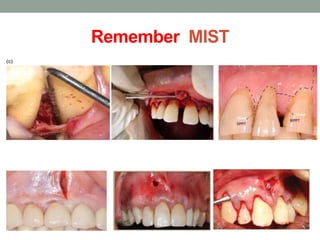
Remember MIST
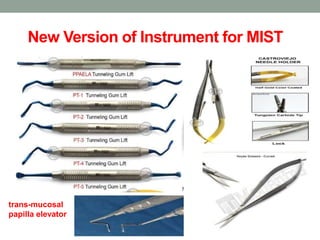
New Version of Instrument for MIST
trans-mucosal
papilla elevator
Remember MIST
Minimal invasive techniques

Minimal invasive techniques

  • 1.
    MINIMAL INVASIVE TECHNIQUES IN PERIODONTALSURGERY Dr. Enas Elgendy Ass. Professor of Oral Medicine, Periodontology& Oral Diagnosis Faculty of Dentistry Kafrelsheikh University
  • 2.
    Change is theonly thing that is Constant.
  • 3.
    • Mini-implants versusstandard-size dental implants • Placement of veneers instead of crowns • Digital radiography instead of conventional radiography Minimal Invasive Techniques instead of Conventional Surgical Techniques
  • 4.
    Why minimally invasivesurgical techniques (MIST) in periodontal surgery 1. Less postoperative pain 2. Improvement healing 3. Chair time required to perform such a surgery is by far shorter than the chair time required for more conventional surgical approaches 4. Improved retention of soft height and contour 5. Periodontal tissue regeneration 6. Good patient acceptance. Disadvantages of MIST 1. Technique sensitive 2. MIST needs improved instruments for root and osseous defect debridement, “micro” versions of the instruments. 3. Expensive 4. Cannot be universally applied, only in suitable case technique can be performed.
  • 5.
    Indications of MIST 1-Isolated, interproximal bone defect, not extending beyond the interproximal site was considered ideal for this technique . 2- Periodontal defects that border on an edentulous area 3- Multiple separate defect sites within a single quadrant. 1- Generalized horizontal bone defect. 2- Multiple interconnected vertical defects are thought to be contraindicated for MIPS and are best handled with more traditional surgical approaches. Contraindication
  • 6.
    General consideration forminimally invasive surgery • All incisions are designed to conserve soft tissues. • Vertical releasing incisions are avoided. • Tissues are reflected by sharp dissection or combination of blunt and sharp. • Placement of bone graft material – plastic plunger gun can be used for precise placement of graft material
  • 7.
    General consideration forminimally invasive surgery • Adequate visualization of the procedure requires magnification and light source. Surgical microscope, loupes ×3.5 magnification can be used • Interproximal site can be closed by vertical mattress sutures. 6-0 resorbable suture can be used.
  • 8.
    The interdental papilla Facialpapilla Lingual papilla Col region The interdental papilla occupies the space in the interdental embrasure apical to the contact point. There are three parts of interdental papilla:
  • 9.
    The interdental papilla •Interdental papilla (IDP) acts as a biological barrier which protects the underlying periodontal structures, apart from playing an important role in esthetics. • The loss of IDP as a result of periodontal disease or of periodontal therapy leads to esthetic (black triangle), phonetic, and food impaction problems. This is why, it is important in periodontal surgery to preserve the inter dental papilla.
  • 10.
    Split papilla flaps(Conventional flaps) Papilla preservation flap The interdental papilla is split beneath the contact point into facial papilla which is included in the facial flap and lingual papilla which is included in the lingual flap. The entire interdental papilla is incorporated in either the facial or lingual flap.
  • 11.
    Papilla Preservation Flap A]Conventional papilla preservation B] Modified papilla preservation C] Simplified papilla preservation flap D] Whale’s tail technique
  • 12.
    1- Conventional papillapreservation • Takei et al. in 1985 introduced conventional papilla preservation technique. It includes sulcular incisions around each tooth with the lingual/palatal flap involves a semilunar incision made across each interdental papilla that dips apically from the line angles of the tooth so that the papillary incision line angle is at least 5 mm from the gingival margin allowing the interdental tissues to be dissected from the lingual or palatal aspect so that it can be elevated intact with facial flap.
  • 13.
    Conventional papilla preservation Sulcularincisions Semilunar incision Papilla incorporated in facial flap Buccal and palatal of sutured flaps
  • 14.
    2- Modification ofthe Papilla Preservation Technique. Cortellini et al. in 1995 introduced a modification of conventional papilla preservation flap which is suitable for wide interdental spaces ( ˃2 mm). A horizontal incision is placed buccally on the interdental space at the base of the papilla, and the papilla is elevated toward the palatal aspect.
  • 16.
    3-Simplified papilla preservationflap Cortellini et al. 1999 further modified the modified papilla preservation technique which is suitable for narrow interdental spaces (≤2 mm). A horizontal incision is replaced by an oblique incision and placed on the buccal aspect of the interdental papilla, and the papilla is elevated toward the palatal aspect.
  • 17.
  • 18.
    Interdental space width ≤2mm ˃2 mm SPPT MPPT
  • 19.
    4- Whale’s tailtechnique • Bianchi and Basseti in 2009 introduced a surgical technique to preserve interdental tissue in guided tissue regeneration known as a “whale’s tail” technique. It was used for the treatment of wide intrabony defects in the esthetic zone involving the elevation of a large flap from the buccal to the palatal side to allow accessibility as well as visibility of the intrabony defect and to perform GTR while maintaining interdental tissue over grafting material.
  • 20.
  • 21.
     Gingival recessionis defined as the displacement of the marginal tissue apical to the cement-enamel junction. Gingival Recession Gingival recession represents a challenge to surgeons for many years.
  • 22.
    Treatment of GingivalRecession Free grafts Pedicle flaps Free gingival graft Free connective tissue graft Subepithelial connective tissue graft Double papilla flap Coronally positioned flap Semilunar Coronally advanced flap Lateral positioned flap MIST Pouch and tunnel Pinhole Vista
  • 23.
  • 24.
    Pouch and TunnelTechnique Coronally Advanced Tunnel Technique It is the first MIST introduced for treatment of gingival recession. Its advantages are: To minimize incision and the reflection of flap Provide good blood supply to the donor tissue
  • 25.
  • 26.
    Vestibular Incision SubperiostealTunnel Access (Vista Techniques) Vertical incision Periosteal tunnel preparation Connective tissue graft inserted Coronally anchored suture with composite
  • 27.
    Ridge augmentation • Theanatomic limitations of the residual alveolar bone may cause problems for the insertion of dental implants because implant placement requires an adequate quantity and quality of bone. Ridge augmentation has been performed to reconstruct alveolar ridges as support for the placement of dental implants with a high success rate.
  • 28.
    Pouch and TunnelTechnique for ridge augmentation • The subperiosteal tunneling technique uses autologous bone, which is still considered the gold standstandard for bone regeneration • This approach ensures minimal discomfort for the patient after the surgery and mostly steady coverage of the graft during the healing time, with minimal risk of exposure, infection, and failure.
  • 29.
  • 30.
    New Version ofInstrument for MIST trans-mucosal papilla elevator
  • 31.