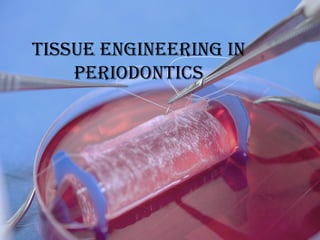
Tissue engineering In
periodontics
Introduction
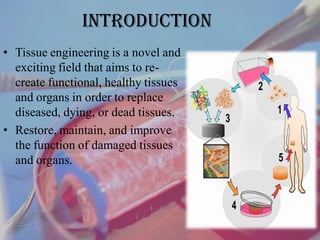
• Tissue engineering is a novel and
exciting field that aims to re-
create functional, healthy tissues
and organs in order to replace
diseased, dying, or dead tissues.
• Restore, maintain, and improve
the function of damaged tissues
and organs.
Basic Steps In Tissue
Engineering
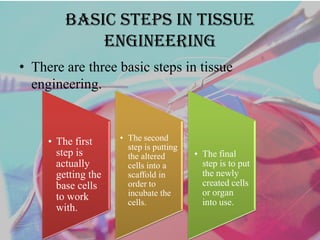
• There are three basic steps in tissue
engineering.
• The first
step is
actually
getting the
base cells
to work
with.
• The second
step is putting
the altered
cells into a
scaffold in
order to
incubate the
cells.
• The final
step is to put
the newly
created cells
or organ
into use.
Triad of tissue Engineering
Cell source for tissue
engineering
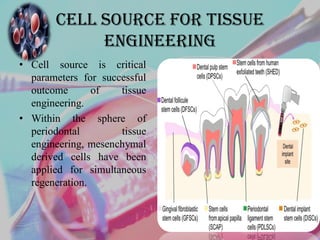
• Cell source is critical
parameters for successful
outcome of tissue
engineering.
• Within the sphere of
periodontal tissue
engineering, mesenchymal
derived cells have been
applied for simultaneous
regeneration.
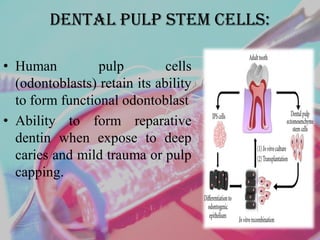
Dental Pulp Stem Cells:
• Human pulp cells
(odontoblasts) retain its ability
to form functional odontoblast
• Ability to form reparative
dentin when expose to deep
caries and mild trauma or pulp
capping.
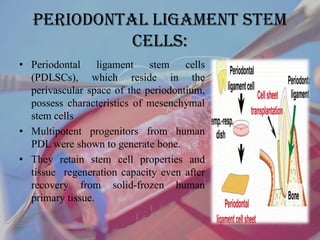
Periodontal Ligament Stem
Cells:
• Periodontal ligament stem cells
(PDLSCs), which reside in the
perivascular space of the periodontium,
possess characteristics of mesenchymal
stem cells
• Multipotent progenitors from human
PDL were shown to generate bone.
• They retain stem cell properties and
tissue regeneration capacity even after
recovery from solid-frozen human
primary tissue.
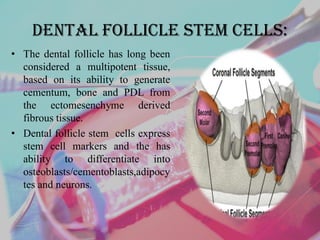
Dental Follicle Stem Cells:
• The dental follicle has long been
considered a multipotent tissue,
based on its ability to generate
cementum, bone and PDL from
the ectomesenchyme derived
fibrous tissue.
• Dental follicle stem cells express
stem cell markers and the has
ability to differentiate into
osteoblasts/cementoblasts,adipocy
tes and neurons.
Signaling molecules
• Signaling molecules and growth
factors are biological mediators
that play critical roles regulation of
wound healing..
• The incorporation of growth
factors and signaling molecule in
tissue engineered scaffolds
facilitates sustained release of
these molecules.
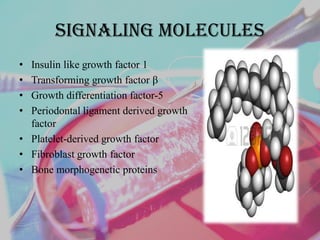
SIGNALING MOLECULES
• Insulin like growth factor 1
• Transforming growth factor β
• Growth differentiation factor-5
• Periodontal ligament derived growth
factor
• Platelet-derived growth factor
• Fibroblast growth factor
• Bone morphogenetic proteins
Growth factors and their
actions
• Insulin-like growthfactor-1:Cell migration, proliferation,
differentiation and matrix synthesis.
• Transforming growth factor- beta1: Proliferation of
cementoblasts and periodontal ligament fibroblasts.
• Growth differentiation factor-5:inhibits alkaline phosphatase
activity in human periodontal ligament cells.
• Platelet-derived growth factor:Migration, proliferation and
non-collagenous matrix synthesis.
• Fibroblast growth factor-2:Proliferation and attachment of
endothelial cells and periodontal ligament cells
• Bone Morphogenetic Protein :Proliferation, differentiation
of periodontal ligament cells into osteoblasts.
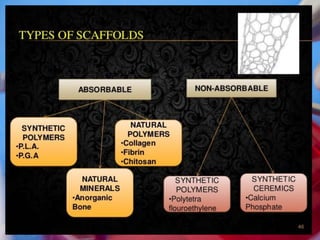
ScAffold
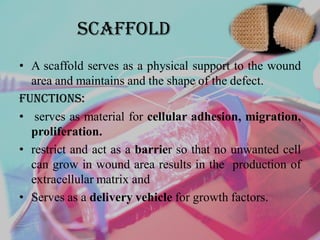
• A scaffold serves as a physical support to the wound
area and maintains and the shape of the defect.
Functions:
• serves as material for cellular adhesion, migration,
proliferation.
• restrict and act as a barrier so that no unwanted cell
can grow in wound area results in the production of
extracellular matrix and
• Serves as a delivery vehicle for growth factors.
Basic requirements of
scaffold
Bio-compatibility
Cell-occlusiveness
Tissue integration
Space-making
Clinical manageability –easy to trim and place
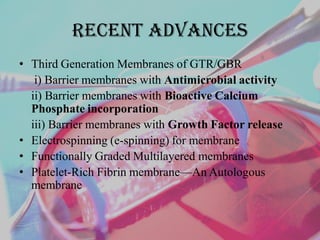
Recent advances
• Third Generation Membranes of GTR/GBR
i) Barrier membranes with Antimicrobial activity
ii) Barrier membranes with Bioactive Calcium
Phosphate incorporation
iii) Barrier membranes with Growth Factor release
• Electrospinning (e-spinning) for membrane
• Functionally Graded Multilayered membranes
• Platelet-Rich Fibrin membrane—An Autologous
membrane
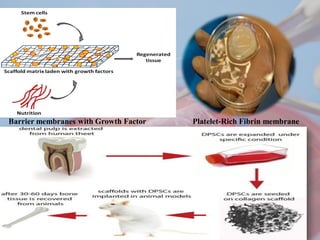
Barrier membranes with Growth Factor Platelet-Rich Fibrin membrane
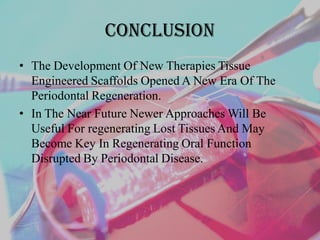
conclusion
• The Development Of New Therapies Tissue
Engineered Scaffolds Opened A New Era Of The
Periodontal Regeneration.
• In The Near Future Newer Approaches Will Be
Useful For regenerating Lost Tissues And May
Become Key In Regenerating Oral Function
Disrupted By Periodontal Disease.
THANK YOU

Tissue engineering in periodontics

  • 1.
  • 2.
    Introduction • Tissue engineeringis a novel and exciting field that aims to re- create functional, healthy tissues and organs in order to replace diseased, dying, or dead tissues. • Restore, maintain, and improve the function of damaged tissues and organs.
  • 3.
    Basic Steps InTissue Engineering • There are three basic steps in tissue engineering. • The first step is actually getting the base cells to work with. • The second step is putting the altered cells into a scaffold in order to incubate the cells. • The final step is to put the newly created cells or organ into use.
  • 4.
    Triad of tissueEngineering
  • 5.
    Cell source fortissue engineering • Cell source is critical parameters for successful outcome of tissue engineering. • Within the sphere of periodontal tissue engineering, mesenchymal derived cells have been applied for simultaneous regeneration.
  • 6.
    Dental Pulp StemCells: • Human pulp cells (odontoblasts) retain its ability to form functional odontoblast • Ability to form reparative dentin when expose to deep caries and mild trauma or pulp capping.
  • 7.
    Periodontal Ligament Stem Cells: •Periodontal ligament stem cells (PDLSCs), which reside in the perivascular space of the periodontium, possess characteristics of mesenchymal stem cells • Multipotent progenitors from human PDL were shown to generate bone. • They retain stem cell properties and tissue regeneration capacity even after recovery from solid-frozen human primary tissue.
  • 8.
    Dental Follicle StemCells: • The dental follicle has long been considered a multipotent tissue, based on its ability to generate cementum, bone and PDL from the ectomesenchyme derived fibrous tissue. • Dental follicle stem cells express stem cell markers and the has ability to differentiate into osteoblasts/cementoblasts,adipocy tes and neurons.
  • 9.
    Signaling molecules • Signalingmolecules and growth factors are biological mediators that play critical roles regulation of wound healing.. • The incorporation of growth factors and signaling molecule in tissue engineered scaffolds facilitates sustained release of these molecules.
  • 10.
    SIGNALING MOLECULES • Insulinlike growth factor 1 • Transforming growth factor β • Growth differentiation factor-5 • Periodontal ligament derived growth factor • Platelet-derived growth factor • Fibroblast growth factor • Bone morphogenetic proteins
  • 11.
    Growth factors andtheir actions • Insulin-like growthfactor-1:Cell migration, proliferation, differentiation and matrix synthesis. • Transforming growth factor- beta1: Proliferation of cementoblasts and periodontal ligament fibroblasts. • Growth differentiation factor-5:inhibits alkaline phosphatase activity in human periodontal ligament cells. • Platelet-derived growth factor:Migration, proliferation and non-collagenous matrix synthesis. • Fibroblast growth factor-2:Proliferation and attachment of endothelial cells and periodontal ligament cells • Bone Morphogenetic Protein :Proliferation, differentiation of periodontal ligament cells into osteoblasts.
  • 12.
    ScAffold • A scaffoldserves as a physical support to the wound area and maintains and the shape of the defect. Functions: • serves as material for cellular adhesion, migration, proliferation. • restrict and act as a barrier so that no unwanted cell can grow in wound area results in the production of extracellular matrix and • Serves as a delivery vehicle for growth factors.
  • 13.
    Basic requirements of scaffold Bio-compatibility Cell-occlusiveness Tissueintegration Space-making Clinical manageability –easy to trim and place
  • 15.
    Recent advances • ThirdGeneration Membranes of GTR/GBR i) Barrier membranes with Antimicrobial activity ii) Barrier membranes with Bioactive Calcium Phosphate incorporation iii) Barrier membranes with Growth Factor release • Electrospinning (e-spinning) for membrane • Functionally Graded Multilayered membranes • Platelet-Rich Fibrin membrane—An Autologous membrane
  • 16.
    Barrier membranes withGrowth Factor Platelet-Rich Fibrin membrane
  • 17.
    conclusion • The DevelopmentOf New Therapies Tissue Engineered Scaffolds Opened A New Era Of The Periodontal Regeneration. • In The Near Future Newer Approaches Will Be Useful For regenerating Lost Tissues And May Become Key In Regenerating Oral Function Disrupted By Periodontal Disease.
  • 18.