Stem Cell Therapy
In
Dentistry
Karim azizi
• The term stem cell was first proposed by Russian histologist
Alexander Maksimov in 1908
• New source of stem cell in children primary teeth was
discovered by Dr. Sang tao Shi of NHI in 2003
stem cells:
• Cells with a unique capacity for self-renewal and potency are called
stem cells.
• With appropriate biochemical signals stem cells can be
transformed into desirable cells
• These cells can give rise to one and sometimes many different type
of cells
• They are found in almost all multi-cellular organisms and are
characterized by the ability to renew through mitotic cell division
while maintaining the undifferentiated state
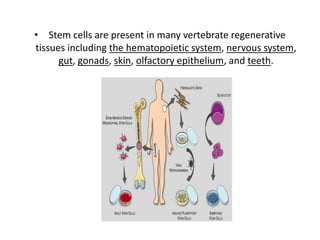
• Stem cells are present in many vertebrate regenerative
tissues including the hematopoietic system, nervous system,
gut, gonads, skin, olfactory epithelium, and teeth.
STEM CELL TYPES
Stem cells can be broadly divided into:
1. Embryonic stem cell
2. Adult stem cell which are further divided
into: (adult or post natal)
• • Hematopoietic stem cell
• • Mesenchymal stem cell (MSC).
3. Induced pluripotent stem (IPS) cell
IPS cell is an evolving concept in which 3-4 genes found in the stem cells are transfected into
the donor cells using appropriate vectors. The stem cells thus derived by culturing will have
properties almost like embryonic stem cells. This path breaking discovery may have a major
role in future stem cell therapy
SOURCES OF STEM CELLS
• Bone Marrow(BMSCs)
• Adipose Tissue(ADSCs)
• Stem Cells from the Oro-maxillofacial
Region
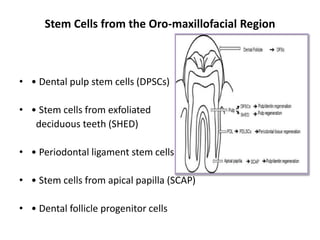
Stem Cells from the Oro-maxillofacial Region
• • Dental pulp stem cells (DPSCs)
• • Stem cells from exfoliated
deciduous teeth (SHED)
• • Periodontal ligament stem cells
• • Stem cells from apical papilla (SCAP)
• • Dental follicle progenitor cells
DENTAL STEM CELL ADVANTAGES
The advantages of stem cells from oral and maxillofacial region are that:
• • Stem cells have high plasticity
• • They can be cryopreserved for a longer period (ideal for
stem cell banking)
• • It showed good interaction with scaffold and growth
factors.
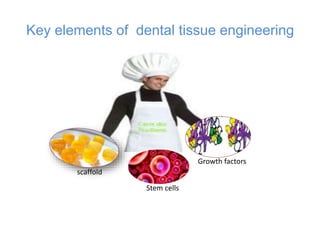
Key elements of dental tissue engineering
scaffold
Stem cells
Growth factors
Steps involved in regeneration of tooth are:
• 1. Harvesting and expansion of adult stem cells
• 2. Seeding the stem cells into the scaffold that provides optimized
the environment
• 3. Cells are instructed with targeted soluble molecular signals
spatially
• 4. Confirming the gene expression profile of the cells for the next
stage in odontogenesis
Current status of stem-cell-based therapy
1 tissue-engineered bony graft
In 2003, Schmelzeisen et al. first showed the feasibility of using a tissue-
engineered bony graft formed by periosteum-derived stem/osteoprogenitor cells
for augmentation in the posterior maxilla prior to implant insertion
Current status of stem-cell-based therapy
2 Chair-side cellular grafting approach
direct use of a patient-derived fresh cellular graft prepared at the chair-
side These procedures are relatively convenient for clinicians because they
do not require laboratory support or extensive training. In 2006, Smiler
and Soltan first reported a technique for chair-side cellular graft
preparation using fresh aspirated bone marrow from the ilium that was
mixed with a resorbable matrix, and biocompatible scaffolds.
Current status of stem-cell-based therapy
• 3. Cell-sheet-based tissue regeneration
• . In this technique, enzymatic cell digestion is not required and the cell-to-
cell contact in the engineered construct thus remains intact, which should
be beneficial for tissue regeneration. Additionally, ECM proteins that are
secreted from the embedded cells can be used conveniently without
requiring an additional scaffold. Ishikawa and his colleagues are the
pioneers in this field and first reported the fabrication of PDL cell sheets
retrieved from culture on unique temperature-responsive culture dishes
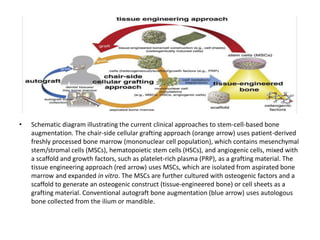
• Schematic diagram illustrating the current clinical approaches to stem-cell-based bone
augmentation. The chair-side cellular grafting approach (orange arrow) uses patient-derived
freshly processed bone marrow (mononuclear cell population), which contains mesenchymal
stem/stromal cells (MSCs), hematopoietic stem cells (HSCs), and angiogenic cells, mixed with
a scaffold and growth factors, such as platelet-rich plasma (PRP), as a grafting material. The
tissue engineering approach (red arrow) uses MSCs, which are isolated from aspirated bone
marrow and expanded in vitro. The MSCs are further cultured with osteogenic factors and a
scaffold to generate an osteogenic construct (tissue-engineered bone) or cell sheets as a
grafting material. Conventional autograft bone augmentation (blue arrow) uses autologous
bone collected from the ilium or mandible.
regeneration of the tooth root and its
associated periodontal tissue
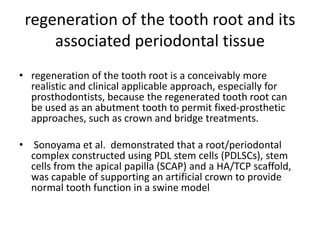
• regeneration of the tooth root is a conceivably more
realistic and clinical applicable approach, especially for
prosthodontists, because the regenerated tooth root can
be used as an abutment tooth to permit fixed-prosthetic
approaches, such as crown and bridge treatments.
• Sonoyama et al. demonstrated that a root/periodontal
complex constructed using PDL stem cells (PDLSCs), stem
cells from the apical papilla (SCAP) and a HA/TCP scaffold,
was capable of supporting an artificial crown to provide
normal tooth function in a swine model
Regeneration of the entire tooth
• demonstrated a fully functioning tooth replacement in a mouse through
the transplantation into the alveolar bone of bioengineered tooth germ
reconstituted from epithelial and mesenchymal progenitor/stem cells in a
collagen gel.
• Surprisingly, the unit comprised not only a mature tooth and periodontal
ligament but also alveolar bone. The unit provided a fully functional tooth
with vertical bone regeneration when the unit was transplanted into a
vertical alveolar bone defect in a mouse model.
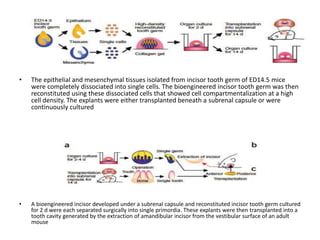
• The epithelial and mesenchymal tissues isolated from incisor tooth germ of ED14.5 mice
were completely dissociated into single cells. The bioengineered incisor tooth germ was then
reconstituted using these dissociated cells that showed cell compartmentalization at a high
cell density. The explants were either transplanted beneath a subrenal capsule or were
continuously cultured
• A bioengineered incisor developed under a subrenal capsule and reconstituted incisor tooth germ cultured
for 2 d were each separated surgically into single primordia. These explants were then transplanted into a
tooth cavity generated by the extraction of amandibular incisor from the vestibular surface of an adult
mouse
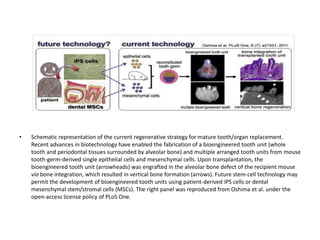
• Schematic representation of the current regenerative strategy for mature tooth/organ replacement.
Recent advances in biotechnology have enabled the fabrication of a bioengineered tooth unit (whole
tooth and periodontal tissues surrounded by alveolar bone) and multiple arranged tooth units from mouse
tooth-germ-derived single epithelial cells and mesenchymal cells. Upon transplantation, the
bioengineered tooth unit (arrowheads) was engrafted in the alveolar bone defect of the recipient mouse
via bone integration, which resulted in vertical bone formation (arrows). Future stem-cell technology may
permit the development of bioengineered tooth units using patient-derived iPS cells or dental
mesenchymal stem/stromal cells (MSCs). The right panel was reproduced from Oshima et al. under the
open-access license policy of PLoS One.
REFERENCES:
• Functional Tooth Regeneration Using a Bioengineered Tooth Unit as a Mature Organ
Replacement Regenerative Therapy. Masamitsu Oshima, Mitsumasa Mizuno , PLoS ONE, July
2011 | Volume 6 | Issue 7,1-11.
• Stem cells in dentistry – Part II: Clinical applications, Hiroshi Egusa DDS, PhDa,*, Wataru
Sonoyama DDS, PhD, Journal of Prosthodontic Research 56 (2012) 229–248.
• Growing bioengineered teeth from single cells: potential for dental regenerative medicine,
Etsuko Ikeda & Takashi Tsuji, Expert Opin. Biol. Ther. (2008) 8(6):735-744.
• The development of a bioengineered organ germ method, Kazuhisa Nakao, Ritsuko Morita,
NATURE METHODS | VOL.4 NO.3 | MARCH 2007,227-230.
• Stem Cell Therapy in Dentistry: An Overview, Manishkumar Shete, Raghavendra Byakodi, Avinash Kshar,
Arati Paranjpe, IJSS Case Reports & Reviews | January 2015 | Vol 1 | Issue 8,50-54.
THE END

Stem cell therapy in dentistry

  • 1.
  • 2.
    • The termstem cell was first proposed by Russian histologist Alexander Maksimov in 1908 • New source of stem cell in children primary teeth was discovered by Dr. Sang tao Shi of NHI in 2003
  • 3.
    stem cells: • Cellswith a unique capacity for self-renewal and potency are called stem cells. • With appropriate biochemical signals stem cells can be transformed into desirable cells • These cells can give rise to one and sometimes many different type of cells • They are found in almost all multi-cellular organisms and are characterized by the ability to renew through mitotic cell division while maintaining the undifferentiated state
  • 4.
    • Stem cellsare present in many vertebrate regenerative tissues including the hematopoietic system, nervous system, gut, gonads, skin, olfactory epithelium, and teeth.
  • 5.
    STEM CELL TYPES Stemcells can be broadly divided into: 1. Embryonic stem cell 2. Adult stem cell which are further divided into: (adult or post natal) • • Hematopoietic stem cell • • Mesenchymal stem cell (MSC). 3. Induced pluripotent stem (IPS) cell IPS cell is an evolving concept in which 3-4 genes found in the stem cells are transfected into the donor cells using appropriate vectors. The stem cells thus derived by culturing will have properties almost like embryonic stem cells. This path breaking discovery may have a major role in future stem cell therapy
  • 6.
    SOURCES OF STEMCELLS • Bone Marrow(BMSCs) • Adipose Tissue(ADSCs) • Stem Cells from the Oro-maxillofacial Region
  • 7.
    Stem Cells fromthe Oro-maxillofacial Region • • Dental pulp stem cells (DPSCs) • • Stem cells from exfoliated deciduous teeth (SHED) • • Periodontal ligament stem cells • • Stem cells from apical papilla (SCAP) • • Dental follicle progenitor cells
  • 8.
    DENTAL STEM CELLADVANTAGES The advantages of stem cells from oral and maxillofacial region are that: • • Stem cells have high plasticity • • They can be cryopreserved for a longer period (ideal for stem cell banking) • • It showed good interaction with scaffold and growth factors.
  • 9.
    Key elements ofdental tissue engineering scaffold Stem cells Growth factors
  • 10.
    Steps involved inregeneration of tooth are: • 1. Harvesting and expansion of adult stem cells • 2. Seeding the stem cells into the scaffold that provides optimized the environment • 3. Cells are instructed with targeted soluble molecular signals spatially • 4. Confirming the gene expression profile of the cells for the next stage in odontogenesis
  • 11.
    Current status ofstem-cell-based therapy 1 tissue-engineered bony graft In 2003, Schmelzeisen et al. first showed the feasibility of using a tissue- engineered bony graft formed by periosteum-derived stem/osteoprogenitor cells for augmentation in the posterior maxilla prior to implant insertion
  • 12.
    Current status ofstem-cell-based therapy 2 Chair-side cellular grafting approach direct use of a patient-derived fresh cellular graft prepared at the chair- side These procedures are relatively convenient for clinicians because they do not require laboratory support or extensive training. In 2006, Smiler and Soltan first reported a technique for chair-side cellular graft preparation using fresh aspirated bone marrow from the ilium that was mixed with a resorbable matrix, and biocompatible scaffolds.
  • 13.
    Current status ofstem-cell-based therapy • 3. Cell-sheet-based tissue regeneration • . In this technique, enzymatic cell digestion is not required and the cell-to- cell contact in the engineered construct thus remains intact, which should be beneficial for tissue regeneration. Additionally, ECM proteins that are secreted from the embedded cells can be used conveniently without requiring an additional scaffold. Ishikawa and his colleagues are the pioneers in this field and first reported the fabrication of PDL cell sheets retrieved from culture on unique temperature-responsive culture dishes
  • 14.
    • Schematic diagramillustrating the current clinical approaches to stem-cell-based bone augmentation. The chair-side cellular grafting approach (orange arrow) uses patient-derived freshly processed bone marrow (mononuclear cell population), which contains mesenchymal stem/stromal cells (MSCs), hematopoietic stem cells (HSCs), and angiogenic cells, mixed with a scaffold and growth factors, such as platelet-rich plasma (PRP), as a grafting material. The tissue engineering approach (red arrow) uses MSCs, which are isolated from aspirated bone marrow and expanded in vitro. The MSCs are further cultured with osteogenic factors and a scaffold to generate an osteogenic construct (tissue-engineered bone) or cell sheets as a grafting material. Conventional autograft bone augmentation (blue arrow) uses autologous bone collected from the ilium or mandible.
  • 16.
    regeneration of thetooth root and its associated periodontal tissue • regeneration of the tooth root is a conceivably more realistic and clinical applicable approach, especially for prosthodontists, because the regenerated tooth root can be used as an abutment tooth to permit fixed-prosthetic approaches, such as crown and bridge treatments. • Sonoyama et al. demonstrated that a root/periodontal complex constructed using PDL stem cells (PDLSCs), stem cells from the apical papilla (SCAP) and a HA/TCP scaffold, was capable of supporting an artificial crown to provide normal tooth function in a swine model
  • 17.
    Regeneration of theentire tooth • demonstrated a fully functioning tooth replacement in a mouse through the transplantation into the alveolar bone of bioengineered tooth germ reconstituted from epithelial and mesenchymal progenitor/stem cells in a collagen gel. • Surprisingly, the unit comprised not only a mature tooth and periodontal ligament but also alveolar bone. The unit provided a fully functional tooth with vertical bone regeneration when the unit was transplanted into a vertical alveolar bone defect in a mouse model.
  • 18.
    • The epithelialand mesenchymal tissues isolated from incisor tooth germ of ED14.5 mice were completely dissociated into single cells. The bioengineered incisor tooth germ was then reconstituted using these dissociated cells that showed cell compartmentalization at a high cell density. The explants were either transplanted beneath a subrenal capsule or were continuously cultured • A bioengineered incisor developed under a subrenal capsule and reconstituted incisor tooth germ cultured for 2 d were each separated surgically into single primordia. These explants were then transplanted into a tooth cavity generated by the extraction of amandibular incisor from the vestibular surface of an adult mouse
  • 19.
    • Schematic representationof the current regenerative strategy for mature tooth/organ replacement. Recent advances in biotechnology have enabled the fabrication of a bioengineered tooth unit (whole tooth and periodontal tissues surrounded by alveolar bone) and multiple arranged tooth units from mouse tooth-germ-derived single epithelial cells and mesenchymal cells. Upon transplantation, the bioengineered tooth unit (arrowheads) was engrafted in the alveolar bone defect of the recipient mouse via bone integration, which resulted in vertical bone formation (arrows). Future stem-cell technology may permit the development of bioengineered tooth units using patient-derived iPS cells or dental mesenchymal stem/stromal cells (MSCs). The right panel was reproduced from Oshima et al. under the open-access license policy of PLoS One.
  • 20.
    REFERENCES: • Functional ToothRegeneration Using a Bioengineered Tooth Unit as a Mature Organ Replacement Regenerative Therapy. Masamitsu Oshima, Mitsumasa Mizuno , PLoS ONE, July 2011 | Volume 6 | Issue 7,1-11. • Stem cells in dentistry – Part II: Clinical applications, Hiroshi Egusa DDS, PhDa,*, Wataru Sonoyama DDS, PhD, Journal of Prosthodontic Research 56 (2012) 229–248. • Growing bioengineered teeth from single cells: potential for dental regenerative medicine, Etsuko Ikeda & Takashi Tsuji, Expert Opin. Biol. Ther. (2008) 8(6):735-744. • The development of a bioengineered organ germ method, Kazuhisa Nakao, Ritsuko Morita, NATURE METHODS | VOL.4 NO.3 | MARCH 2007,227-230. • Stem Cell Therapy in Dentistry: An Overview, Manishkumar Shete, Raghavendra Byakodi, Avinash Kshar, Arati Paranjpe, IJSS Case Reports & Reviews | January 2015 | Vol 1 | Issue 8,50-54.
  • 21.