


PLATELET CONCENTRATES
An Update
OVERVIEW
MILESTONES
PROGRESS
ISSUES AND MANAGEMENT
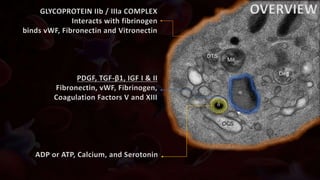
GLYCOPROTEIN IIb / IIIa COMPLEX
Interacts with fibrinogen
binds vWF, Fibronectin and Vitronectin
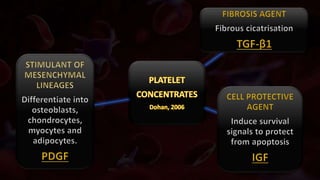
PDGF, TGF-β1, IGF I & II
Fibronectin, vWF, Fibrinogen,
Coagulation Factors V and XIII
ADP or ATP, Calcium, and Serotonin
OVERVIEW
OVERVIEW
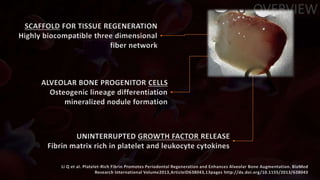
SCAFFOLD FOR TISSUE REGENERATION
Highly biocompatible three dimensional
fiber network
ALVEOLAR BONE PROGENITOR CELLS
Osteogenic lineage differentiation
mineralized nodule formation
UNINTERRUPTED GROWTH FACTOR RELEASE
Fibrin matrix rich in platelet and leukocyte cytokines
Li Q et al. Platelet-Rich Fibrin Promotes Periodontal Regeneration and Enhances Alveolar Bone Augmentation. BioMed
Research International Volume2013,ArticleID638043,13pages http://dx.doi.org/10.1155/2013/638043
MILESTONES
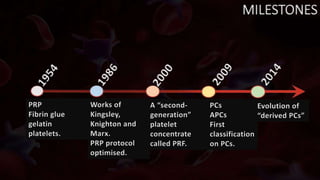
PRP
Fibrin glue
gelatin
platelets.
Works of
Kingsley,
Knighton and
Marx.
PRP protocol
optimised.
A ā€œsecond-
generationā€
platelet
concentrate
called PRF.
PCs
APCs
First
classification
on PCs.
Evolution of
ā€œderived PCsā€
MILESTONES
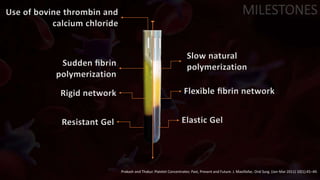
Use of bovine thrombin and
calcium chloride
Sudden fibrin
polymerization
Slow natural
polymerization
Rigid network Flexible fibrin network
Resistant Gel Elastic Gel
Prakash and Thakur. Platelet Concentrates: Past, Present and Future. J. Maxillofac. Oral Surg. (Jan-Mar 2011) 10(1):45–49.
III
MILESTONES
MILESTONES
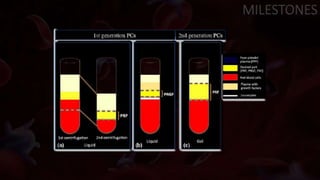
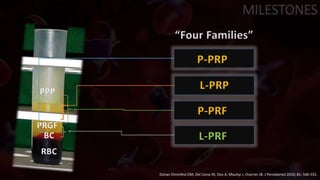
RBC
PRGF
PPP
BC
P-PRP
ā€œFour Familiesā€
L-PRP
P-PRF
L-PRF
Dohan Ehrenfest DM, Del Corso M, Diss A, Mouhyi J, Charrier JB. J Periodontol 2010; 81: 546-555.
PROGRESS
Classification
Products & Protocols
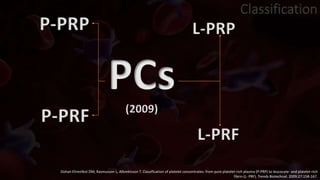
PCs
(2009)
P-PRP L-PRP
P-PRF
L-PRF
Dohan Ehrenfest DM, Rasmusson L, Albrektsson T. Classification of platelet concentrates: from pure platelet-rich plasma (P-PRP) to leucocyte- and platelet-rich
fibrin (L- PRF). Trends Biotechnol. 2009;27:158-167.
Classification
Classification
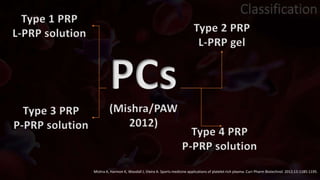
PCs
(Mishra/PAW
2012)
Type 1 PRP
L-PRP solution Type 2 PRP
L-PRP gel
Type 3 PRP
P-PRP solution
Type 4 PRP
P-PRP solution
Mishra A, Harmon K, Woodall J, Vieira A. Sports medicine applications of platelet rich plasma. Curr Pharm Biotechnol. 2012;13:1185-1195.
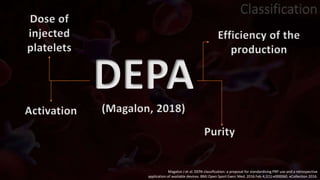
DEPA
(Magalon, 2018)
Dose of
injected
platelets
Efficiency of the
production
Activation
Purity
Magalon J et al. DEPA classification: a proposal for standardising PRP use and a retrospective
application of available devices. BMJ Open Sport Exerc Med. 2016 Feb 4;2(1):e000060. eCollection 2016.
Classification
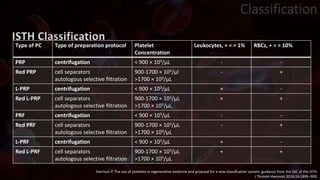
Type of PC Type of preparation protocol Platelet
Concentration
Leukocytes, + = > 1% RBCs, + = > 10%
PRP centrifugation < 900 Ɨ 103/µL - -
Red PRP cell separators
autologous selective filtration
900-1700 Ɨ 103/µl
>1700 Ɨ 103/µL
- +
L-PRP centrifugation < 900 Ɨ 103/µL + -
Red L-PRP cell separators
autologous selective filtration
900-1700 Ɨ 103/µL
>1700 Ɨ 103/µL
+ +
PRF centrifugation < 900 Ɨ 103/µL - -
Red PRF cell separators
autologous selective filtration
900-1700 Ɨ 103/µL
>1700 Ɨ 103/µL
- +
L-PRF centrifugation < 900 Ɨ 103/µL + -
Red L-PRF cell separators
autologous selective filtration
900-1700 Ɨ 103/µL
>1700 Ɨ 103/µL
+ +
Harrison P. The use of platelets in regenerative medicine and proposal for a new classification system: guidance from the SSC of the ISTH.
J Thromb Haemost 2018;16:1895–900.
ISTH Classification
Classification
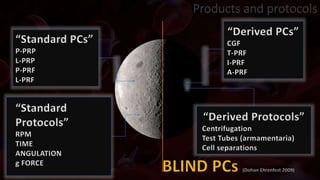
Products and protocols
ā€œDerived Protocolsā€
Centrifugation
Test Tubes (armamentaria)
Cell separations
ā€œDerived PCsā€
CGF
T-PRF
I-PRF
A-PRF
ā€œStandard PCsā€
P-PRP
L-PRP
P-PRF
L-PRF
ā€œStandard
Protocolsā€
RPM
TIME
ANGULATION
g FORCE
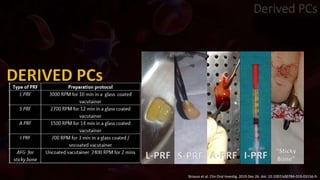
Derived PCs
L-PRF S-PRF A-PRF I-PRF
ā€œSticky
Boneā€
Strauss et al. Clin Oral Investig. 2019 Dec 26. doi: 10.1007/s00784-019-03156-9.
Alessandro Crisci, Silvana Manfredi and Michela Crisci. J Stem Cell Rep 2019 | Vol 1: 101. 1-11.
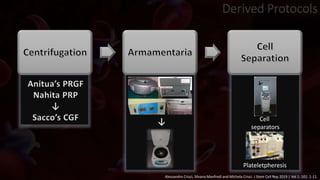
Derived Protocols
Anitua’s PRGF
Nahita PRP
↓
Sacco’s CGF ↓ Cell
separators
Plateletpheresis
ISSUES AND MANAGEMENT
Limitations of PCs
Quality of PCs
Disinfection of PCs
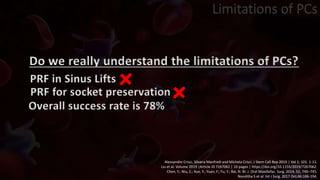
Do we really understand the limitations of PCs?
Alessandro Crisci, Silvana Manfredi and Michela Crisci. J Stem Cell Rep 2019 | Vol 1: 101. 1-11.
Liu et al. Volume 2019 |Article ID 7267062 | 10 pages | https://doi.org/10.1155/2019/7267062.
Chen, Y.; Niu, Z.; Xue, Y.; Yuan, F.; Fu, Y.; Bai, N. Br. J. Oral Maxillofac. Surg. 2014, 52, 740–745.
Nanditha S et al. Int J Surg. 2017 Oct;46:186-194.
PRF in Sinus Lifts
PRF for socket preservation
Overall success rate is 78%
Limitations of PCs
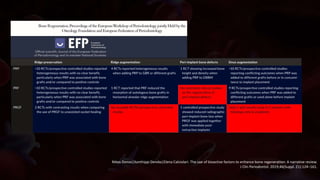
Nikos Donos|Xanthippi Dereka|Elena Calciolari. The use of bioactive factors to enhance bone regeneration: A narrative review.
J Clin Periodontol. 2019;46(Suppl. 21):124–161.
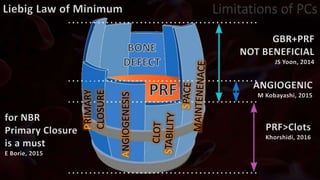
ANGIOGENESIS
PRIMARY
CLOSURE
PRF>Clots
Khorshidi, 2016
ANGIOGENIC
M Kobayashi, 2015
GBR+PRF
NOT BENEFICIAL
JS Yoon, 2014
for NBR
Primary Closure
is a must
E Borie, 2015
Limitations of PCs
Limitations of PCs
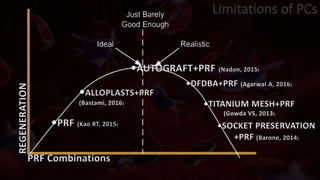
•PRF (Kao RT, 2015)
REGENERATION
PRF Combinations
•SOCKET PRESERVATION
+PRF (Barone, 2014)
•ALLOPLASTS+PRF
(Bastami, 2016) •TITANIUM MESH+PRF
(Gowda VS, 2013)
•AUTOGRAFT+PRF (Nadon, 2015)
•DFDBA+PRF (Agarwal A, 2016)
Limitations of PCs
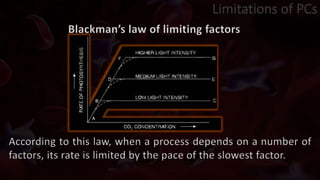
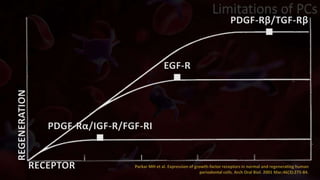
According to this law, when a process depends on a number of
factors, its rate is limited by the pace of the slowest factor.
Limitations of PCs
REGENERATION
RECEPTOR
PDGF-Rβ/TGF-Rβ
ā– 
EGF-R
ā– 
PDGF-Rα/IGF-R/FGF-RI
ā– 
Limitations of PCs
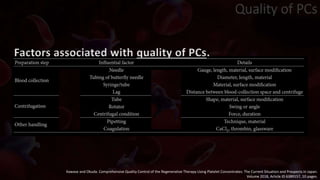
Kawase and Okuda. Comprehensive Quality Control of the Regenerative Therapy Using Platelet Concentrates: The Current Situation and Prospects in Japan.
Volume 2018, Article ID 6389157, 10 pages.
Factors associated with quality of PCs.
Quality of PCs
Quality of PCs
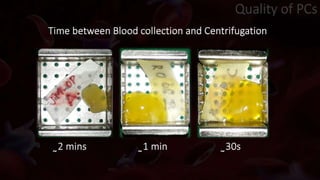
Time between Blood collection and Centrifugation
̰2 mins ̰1 min ̰30s
Quality of PCs
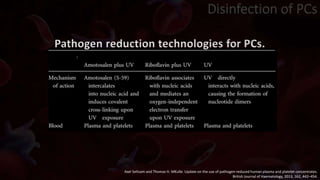
Pathogen reduction technologies for PCs.
Axel Seltsam and Thomas H. M€ulle. Update on the use of pathogen-reduced human plasma and platelet concentrates.
British Journal of Haematology, 2013, 162, 442–454.
Disinfection of PCs
Disinfection of PCs
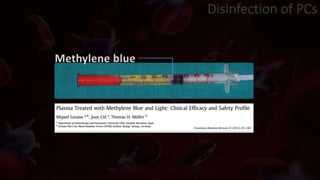
Methylene blue
THANK YOU

Platelet concentrates

  • 1.
  • 3.
  • 4.
    GLYCOPROTEIN IIb /IIIa COMPLEX Interacts with fibrinogen binds vWF, Fibronectin and Vitronectin PDGF, TGF-β1, IGF I & II Fibronectin, vWF, Fibrinogen, Coagulation Factors V and XIII ADP or ATP, Calcium, and Serotonin OVERVIEW
  • 5.
    OVERVIEW SCAFFOLD FOR TISSUEREGENERATION Highly biocompatible three dimensional fiber network ALVEOLAR BONE PROGENITOR CELLS Osteogenic lineage differentiation mineralized nodule formation UNINTERRUPTED GROWTH FACTOR RELEASE Fibrin matrix rich in platelet and leukocyte cytokines Li Q et al. Platelet-Rich Fibrin Promotes Periodontal Regeneration and Enhances Alveolar Bone Augmentation. BioMed Research International Volume2013,ArticleID638043,13pages http://dx.doi.org/10.1155/2013/638043
  • 7.
    MILESTONES PRP Fibrin glue gelatin platelets. Works of Kingsley, Knightonand Marx. PRP protocol optimised. A ā€œsecond- generationā€ platelet concentrate called PRF. PCs APCs First classification on PCs. Evolution of ā€œderived PCsā€
  • 8.
  • 9.
    Use of bovinethrombin and calcium chloride Sudden fibrin polymerization Slow natural polymerization Rigid network Flexible fibrin network Resistant Gel Elastic Gel Prakash and Thakur. Platelet Concentrates: Past, Present and Future. J. Maxillofac. Oral Surg. (Jan-Mar 2011) 10(1):45–49. III MILESTONES
  • 10.
    MILESTONES RBC PRGF PPP BC P-PRP ā€œFour Familiesā€ L-PRP P-PRF L-PRF Dohan EhrenfestDM, Del Corso M, Diss A, Mouhyi J, Charrier JB. J Periodontol 2010; 81: 546-555.
  • 11.
  • 12.
    PCs (2009) P-PRP L-PRP P-PRF L-PRF Dohan EhrenfestDM, Rasmusson L, Albrektsson T. Classification of platelet concentrates: from pure platelet-rich plasma (P-PRP) to leucocyte- and platelet-rich fibrin (L- PRF). Trends Biotechnol. 2009;27:158-167. Classification
  • 13.
    Classification PCs (Mishra/PAW 2012) Type 1 PRP L-PRPsolution Type 2 PRP L-PRP gel Type 3 PRP P-PRP solution Type 4 PRP P-PRP solution Mishra A, Harmon K, Woodall J, Vieira A. Sports medicine applications of platelet rich plasma. Curr Pharm Biotechnol. 2012;13:1185-1195.
  • 14.
    DEPA (Magalon, 2018) Dose of injected platelets Efficiencyof the production Activation Purity Magalon J et al. DEPA classification: a proposal for standardising PRP use and a retrospective application of available devices. BMJ Open Sport Exerc Med. 2016 Feb 4;2(1):e000060. eCollection 2016. Classification
  • 15.
    Type of PCType of preparation protocol Platelet Concentration Leukocytes, + = > 1% RBCs, + = > 10% PRP centrifugation < 900 Ɨ 103/µL - - Red PRP cell separators autologous selective filtration 900-1700 Ɨ 103/µl >1700 Ɨ 103/µL - + L-PRP centrifugation < 900 Ɨ 103/µL + - Red L-PRP cell separators autologous selective filtration 900-1700 Ɨ 103/µL >1700 Ɨ 103/µL + + PRF centrifugation < 900 Ɨ 103/µL - - Red PRF cell separators autologous selective filtration 900-1700 Ɨ 103/µL >1700 Ɨ 103/µL - + L-PRF centrifugation < 900 Ɨ 103/µL + - Red L-PRF cell separators autologous selective filtration 900-1700 Ɨ 103/µL >1700 Ɨ 103/µL + + Harrison P. The use of platelets in regenerative medicine and proposal for a new classification system: guidance from the SSC of the ISTH. J Thromb Haemost 2018;16:1895–900. ISTH Classification Classification
  • 16.
    Products and protocols ā€œDerivedProtocolsā€ Centrifugation Test Tubes (armamentaria) Cell separations ā€œDerived PCsā€ CGF T-PRF I-PRF A-PRF ā€œStandard PCsā€ P-PRP L-PRP P-PRF L-PRF ā€œStandard Protocolsā€ RPM TIME ANGULATION g FORCE
  • 17.
    Derived PCs L-PRF S-PRFA-PRF I-PRF ā€œSticky Boneā€ Strauss et al. Clin Oral Investig. 2019 Dec 26. doi: 10.1007/s00784-019-03156-9.
  • 18.
    Alessandro Crisci, SilvanaManfredi and Michela Crisci. J Stem Cell Rep 2019 | Vol 1: 101. 1-11. Derived Protocols Anitua’s PRGF Nahita PRP ↓ Sacco’s CGF ↓ Cell separators Plateletpheresis
  • 19.
    ISSUES AND MANAGEMENT Limitationsof PCs Quality of PCs Disinfection of PCs
  • 20.
    Do we reallyunderstand the limitations of PCs? Alessandro Crisci, Silvana Manfredi and Michela Crisci. J Stem Cell Rep 2019 | Vol 1: 101. 1-11. Liu et al. Volume 2019 |Article ID 7267062 | 10 pages | https://doi.org/10.1155/2019/7267062. Chen, Y.; Niu, Z.; Xue, Y.; Yuan, F.; Fu, Y.; Bai, N. Br. J. Oral Maxillofac. Surg. 2014, 52, 740–745. Nanditha S et al. Int J Surg. 2017 Oct;46:186-194. PRF in Sinus Lifts PRF for socket preservation Overall success rate is 78% Limitations of PCs
  • 21.
    Nikos Donos|Xanthippi Dereka|ElenaCalciolari. The use of bioactive factors to enhance bone regeneration: A narrative review. J Clin Periodontol. 2019;46(Suppl. 21):124–161.
  • 22.
    ANGIOGENESIS PRIMARY CLOSURE PRF>Clots Khorshidi, 2016 ANGIOGENIC M Kobayashi,2015 GBR+PRF NOT BENEFICIAL JS Yoon, 2014 for NBR Primary Closure is a must E Borie, 2015 Limitations of PCs
  • 23.
  • 24.
    •PRF (Kao RT,2015) REGENERATION PRF Combinations •SOCKET PRESERVATION +PRF (Barone, 2014) •ALLOPLASTS+PRF (Bastami, 2016) •TITANIUM MESH+PRF (Gowda VS, 2013) •AUTOGRAFT+PRF (Nadon, 2015) •DFDBA+PRF (Agarwal A, 2016) Limitations of PCs
  • 25.
    According to thislaw, when a process depends on a number of factors, its rate is limited by the pace of the slowest factor. Limitations of PCs
  • 26.
  • 27.
    Kawase and Okuda.Comprehensive Quality Control of the Regenerative Therapy Using Platelet Concentrates: The Current Situation and Prospects in Japan. Volume 2018, Article ID 6389157, 10 pages. Factors associated with quality of PCs. Quality of PCs
  • 28.
    Quality of PCs Timebetween Blood collection and Centrifugation ̰2 mins ̰1 min ̰30s
  • 29.
  • 30.
    Pathogen reduction technologiesfor PCs. Axel Seltsam and Thomas H. M€ulle. Update on the use of pathogen-reduced human plasma and platelet concentrates. British Journal of Haematology, 2013, 162, 442–454. Disinfection of PCs
  • 31.
  • 33.

Editor's Notes

  • #8Ā 1954 Kingsley[15] first used the term PRP to earmark thrombocyte concentrate during experiments related to blood coagulation. Kingsley et al[15] and Knighton et al[19] used a slightly different term ā€œplatelet-derived wound healing formula (PDWHF)ā€. Simultaneously, Choukroun et al[22] developed another form of PC in France which was labeled as PRF, based on the strong fibrin gel polymerization found in this preparation. It was stamped as a ā€œsecond-generationā€ platelet concentrate because it was obviously different from other PRPs. This proved an important milestone in the evolution of terminology.
  • #9Ā 1 gen: cPRP is then mixed with bovine thrombin and calcium chloride at the time of application, with the help of a mixing syringe. Gelling of platelet concentrate will then quickly occur: Fibrinogen is also concentrated during the cPRP preparation, and its polymerization will constitute a fibrin matrix with particularly interesting hemostatic and adhesive properties 2 gen: . This second generation platelet concentrate eliminates the risk associated with the use of bovine thrombin [20].
  • #11Ā P-PRP=Platelet poor layer (1 mL) is discarded and the PRGF layer above buffy coat layer is pipetted out from all tubes and collected in one tube. Calcium chloride is added for clotting L-PRP= Using air pressure, upper layer PPP and buffy coat are transferred into second compartment and centrifuged for a longer time. PPP is transferred back to first compartment and final product - leukocyte and PRP is left behind. It is no longer available. P-PRF=Consists of two tubes, one for blood collection and another for PRFM clotting. Around 9 mL blood is collected in a tube containing tri-sodium citrate anticoagulant and a separator gel and centrifuged for 6 min at high speed. Buffy coat and PPP are transferred in second tube containing calcium chloride and centrifuged for 15 min and then stable PRFM clot can be collected. Very low amount of leucocytes are obtained due to the specific separator gel used, however the fibrin matrix is more denser and stable than PRP’s
  • #13Ā Pure Platelet-Rich Plasma (P-PRP) – or Leukocyte-Poor Platelet-Rich Plasma – products are preparations without leukocytes and with a low-density fibrin network after activation. Per definition, all the products of this family can be used as liquid solutions or in an activated gel form. It can therefore be injected (for example in sports medicine) or placed during gelling on a skin wound or suture (similar to the use of fibrin glues). Many methods of preparation exist, particularly using cell separators (continuous flow plasmapheresis) from hematology laboratory as suggested by many authors, even if this method is much too heavy to be used frequently and easily in daily practice. One largely advertised method of P-PRP is known under the commercial name PRGF26 [Plasma Rich in Growth Factors or Preparations Rich in Growth Factors or EndoRet, Biotechnology Institute BTI (dental implant company), Vitoria, Spain] and was tested in many clinical situations, particularly in sports medicine. Significant issues of the technique are its lack of ergonomics and the need for approximate pipetting steps during the preparation2. The literature on this technique remains very difficult to evaluate, as most articles were produced by the company promoting it21. Another technique of P-PRP was widely promoted for skin ulcers and is known under the commercial name Vivostat PRF (Platelet-Rich Fibrin, Vivostat A/S, Alleroed, Denmark), what can be a source of confusion as this technique is not a PRF following the terminology, but clearly a P-PRP product2. Leukocyte-and Platelet-Rich Plasma (L-PRP) products are preparations with leukocytes and with a low-density fibrin network after activation. Per definition, like the P-PRP, all the products of this family-can be used as liquid solutions or in an activated gel form17. It can therefore be injected (for example in sports medicine) or placed during gelling on a skin wound or suture (similar to the use of fibrin glues). It is in this family that the largest number of commercial or experimental systems exists with many interesting results in general surgery27, orthopaedic and sports medicine28. Particularly many automated protocols have been developed in the last years, requiring the use of specific kits that allow minimum handling of the blood samples and maximum standardization of the preparations, for example Harvest Smart-PreP (Harvest Technologies, Plymouth, MA, USA) and Biomet GPS III (Biomet Inc., Warsaw, IN, USA). Other kits with more handling also exist, such as Plateltex (Prague, Czech Republic) or Regen PRP (RegenLab, Le Mont-sur-Lausanne, Switzerland)2. Pure Platelet-Rich Fibrin (P-PRF) – or Leukocyte-Poor Platelet-Rich Fibrin – are preparations without leukocytes and with a high-density fibrin network. Per definition, these products only exist in a strongly activated gel form, and cannot be injected or used like traditional fibrin glues. However, because of their strong fibrin matrix, they can be handled like a real solid material for other applications. There is only one product in this family, commercially known as Fibrinet PRFM (Platelet-Rich Fibrin Matrix, Cascade Medical, Wayne, NJ, USA, also marketed for orthopedic applications by Vertical Spine, Marconi Road Wall, NJ, USA). The main inconvenient of this technique remains its cost and relative complexity in comparison to the other forms of PRF available, the L-PRF (Leukocyte- and Platelet-Rich Fibrin)2. Leukocyte- and Platelet-Rich Fibrin (L-PRF) products are preparations with leukocytes and with a high-density fibrin network25. Per definition, these products only exist in a strongly activated gel form, and cannot be injected or used like traditional fibrin glues. However, because of their strong fibrin matrix, they can be handled like a real solid material for other applications.
  • #14Ā Mishra et al.23 proposed a classification only for sports medicine applications and taking into consideration the platelets and leukocytes concentrations. This classification creates 4 types of PRP, depending on the presence or absence of leukocytes and on the activation or not of the PRP. Following this proposal, type 1 PRP is a L-PRP solution, type 2 PRP is a L-PRP gel, type 3 PRP is PPRP solution, type 4 PRP is a P-PRP gel. This classification follows therefore the same idea than the general classification published in 20092, but is more limited (PRP only) and less intuitive (types of PRPs are less obvious than clear terminology). Another system called PAW (Platelets, Activation, White cells)
  • #15Ā In 2016, Magalon et al. [41] proposed the DEPA classification (Dose, Efficiency, Purity, Activation) that focuses on the quantity of platelets obtained by the PRP kits as well as on product purity and on platelet activation prior to injection. The DEPA classification is based on 4 different components: 1. Dose of injected platelets: calculated by multiplying the platelet concentration in PRP by the obtained volume of PRP. According to the injected dose (measured in billions or millions of platelets), it should be categorized into (a) very high dose of injected platelets of >5 billion; (b) high dose of injected platelets, from 3 to 5 billion; (c) medium dose of injected platelets, from 1 to 3 billion, and (d) low dose of injected platelets, <1 billion. 2. Efficiency of the production: corresponds to the percentage of platelets recovered in the PRP from the blood. It is categorized as follows: (a) high device efficiency, if the recovery rate in platelets is >90%; (b) medium device efficiency, if the recovery rate in platelets is between 70 and 90%; (c) low device efficiency, if the recovery rate is between 30 and 70%, and (d) poor device efficiency, if the recovery rate is <30% and corresponds to the relative composition of platelets, leucocytes, and RBCs in the obtained PRP. 3. Purity of the PRP obtained: correlates to the relative composition of platelets, leucocytes, and RBCs in the obtained PRP. It is described as (a) very pure PRP, if the percentage of platelets in the PRP, compared with RBCs and leucocytes, is >90%; (b) pure PRP, between 70 and 90% of the platelets; (c) heterogeneous PRP, if the percentage of platelets is between 30 and 70%, and (d) whole-blood PRP, if the percentage of platelets in the PRP is <30% compared with RBCs and leucocytes. 4. Activation process: if an exogenous clotting factor was used to activate platelets, such as autologous thrombin or calcium chloride.
  • #16Ā International Society on Thrombosis and Haemostasis PRP: one or two steps/centrifugation forces (g) range from 100 to 1,000g/one step centrifugation protocol is Anitua’s PRGF/ PPP layer, and the upper part of the BC layer exposed to a second centrifugation. Red-PRP: (LR)-PPP+RBCs with cell separators and autologous selective filtration L-PRP: the PPP, the whole BC, and part of RBCs layer are transferred to another tube and centrifuged. red L-PRP: the PPP, the whole BC, and part of RBCs layer with cell separators and autologous selective filtration PRF- centrifuged at 1,100 rpm for 6min L-PRF-2700 RPM, 12 MINS
  • #18Ā standard platelet-rich fibrin (S-PRF) 2014 Choukroun[32] introduced an advanced PRF called A- PRF (claimed to contain more monocytes). Tunalı et al[33] introduced a new product called T-PRF (Titaniumprepared PRF). 2015 MourĆ£o et al[34] gave detailed technical note on preparation of i-PRF. 2010 Concept of sticky bone (autologous fibrin glue mixed with bone graft) was introduced by Sohn[29] in 2010. Advanced platelet-rich fibrin: a new concept for cell-based tissue engineering by means of inflammatory cells. Ghanaati S1, Concentrated Growth Factors (CGF) (Sacco, 2006). This therapeutic presidium is obtained from blood by a particular device with a special program of centrifugation: acceleration x 30ā€, 2,700 rpm x 2’, 2,400 rpm x 4’, 2,700 rpm x 4’, 3,000 rpm x 3’, deceleration x 36ā€ and stop (Sacco).
  • #19Ā Concentrated Growth Factors (CGF) (Sacco, 2006). This therapeutic presidium is obtained from blood by a particular device with a special program of centrifugation: acceleration x 30ā€, 2,700 rpm x 2’, 2,400 rpm x 4’, 2,700 rpm x 4’, 3,000 rpm x 3’, deceleration x 36ā€ and stop (Sacco). a[43] Citrated blood is collected in 5 mL tubes and softly centrifuged for 8 min at 460 g Platelet poor layer (1 mL) is discarded and the PRGF layer above buffy coat layer is pipetted out from all tubes and collected in one tube. Calcium chloride is added for clotting. However there are problem in ergonomy and reproducibility of the procedure Nahita PRP (Manual) Tamimi et al[44] Protocol similar to Anitua’s PRGF L-PRP PCCS PRP (Automated) Weibrich et al[45] Consists of two compartments, citrated bl