PERIODONTAL PLASTIC SURGERIES– PART 1
RECESSION AND MANAGEMENT METHODS TO INCREASE WIDTH OF ATTACHED G INGIVA
BY
DR. ANTARLEENA SENGUPTA
PG, DEPT OF PERIODONTOLOGY
MCODS, MANGALORE
2021
CONTENTS
• GINGIVAL RECESSION AND THE ROLE OF PERIODONTAL PLASTIC SURGERIES
• INTRODUCTION
• CLASSIFICATION
• OBJECTIVES
• TISSUE BARRIER CONCEPT
• PROBLEMS ASSOCIATED WITH ATTACHED GINGIVA
• SELECTION CRITERIA and DECISION TREE
• TECHNIQUES TO INCREASE WIDTH OF ATTACHED GINGIVA
• GINGIVAL AUGMENTATION APICAL TO RECESSION
• GINGIVAL AUGMENTATION CORONAL TO RECESSION
• OTHER TECHNIQUES
• CONCLUSION
GINGIVAL RECESSION AND THE ROLE OF
PERIODONTAL PLASTIC SURGERIES
INTRODUCTION: GINGIVAL RECESSION
- Clinical definition: exposure of the root surface by an apical shift in the position of the gingiva. (Carranza,
2015)
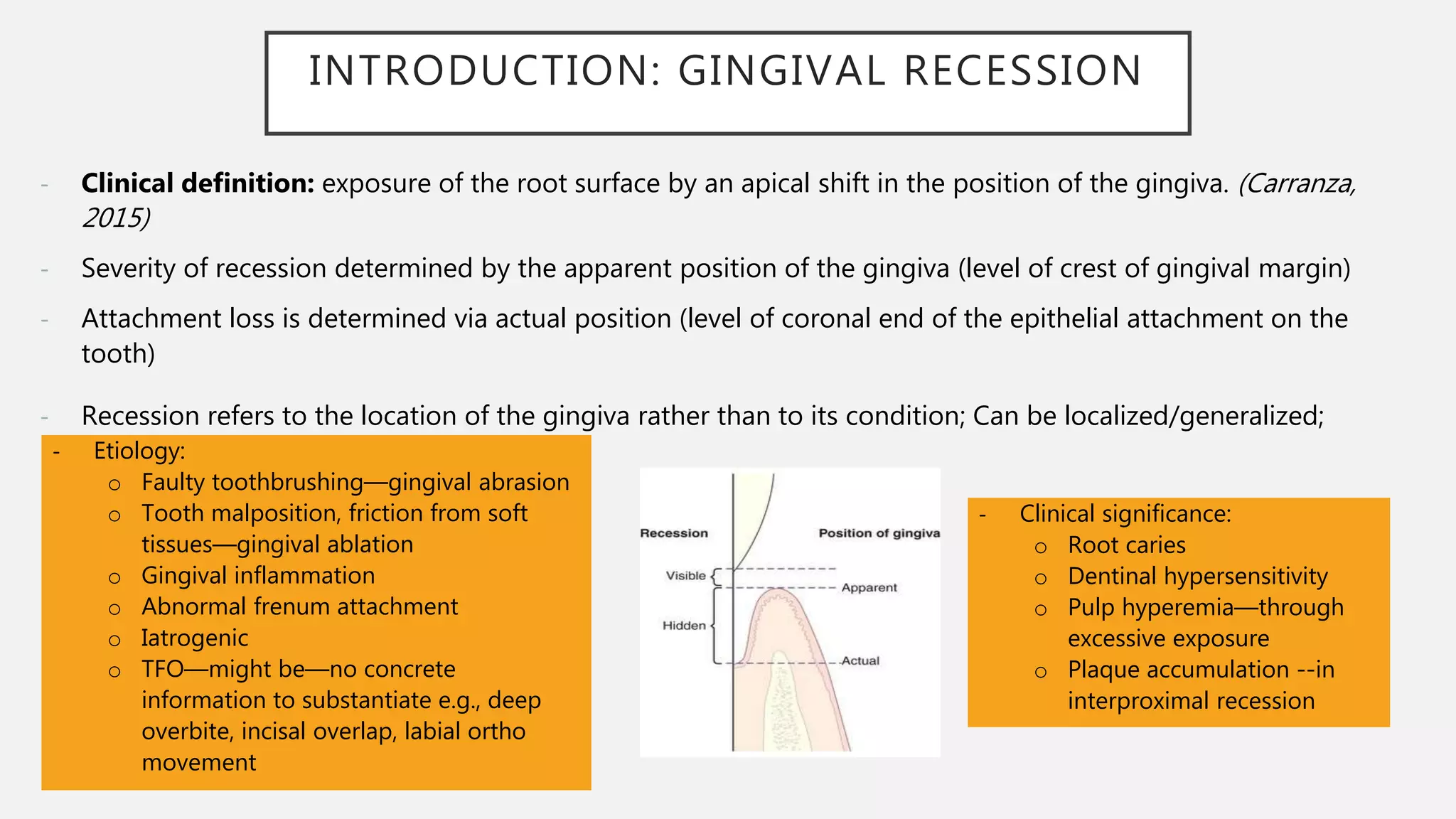
- Severity of recession determined by the apparent position of the gingiva (level of crest of gingival margin)
- Attachment loss is determined via actual position (level of coronal end of the epithelial attachment on the
tooth)
- Recession refers to the location of the gingiva rather than to its condition; Can be localized/generalized;
increases with age
- Etiology:
o Faulty toothbrushing—gingival abrasion
o Tooth malposition, friction from soft
tissues—gingival ablation
o Gingival inflammation
o Abnormal frenum attachment
o Iatrogenic
o TFO—might be—no concrete
information to substantiate e.g., deep
overbite, incisal overlap, labial ortho
movement
- Clinical significance:
o Root caries
o Dentinal hypersensitivity
o Pulp hyperemia—through
excessive exposure
o Plaque accumulation --in
interproximal recession
Class 1IA
Class 1IB
CLASSIFICATION OF GINGIVAL RECESSION
1. Sullivan and Atkins (1968) 2. PD Miller (1985)
Class 1 Class I1
CLASSIFICATION OF GINGIVAL RECESSION
1. Sullivan and Atkins (1968) 2. PD Miller (1985)
Class 1 Class I1
Class 1II Class 1V
 Gingival recession doesn’t extend to MGJ but there is associated hard and soft
tissue loss in the inter dental areas adjacent to the defects
 Class III or Class IV–(Subjective criteria)
 No objective criteria to assess the severity of bone / soft tissue loss.
MAHAJAN’S MODIFICATION OF MILLER’S CLASSIFICATION (2010)
Class I
Class III
Class II
Class IV
CLASSIFICATION OF GINGIVAL RECESSION (CAIRO et al., 2011)
RT 3
RT 2
RT 1
Amine K, El Kholti W, Kissa J. Gingival Recessions: Definition and Classification. In Periodontal Root Coverage 2019 (pp. 3-7). Springer, Cham.
PERIODONTAL PLASTIC SURGERIES
- Previously called mucogingival surgery—FRIEDMAN, 1957
- Correction of relationships b/w gingiva and oral mucosa—special reference to 3 areas:
o Attached gingiva—widening of attached gingiva
o Shallow vestibules—deepening of shallow vestibules
o Aberrant frenum- interfering w the marginal gingiva—resection of the aberrant frenum
- Renamed by 1996 World Workshop in Clinical Periodontics to Periodontal Plastic Surgery—proposed by
MILLER, 1993
- Includes:
o Periodontal-prosthetic corrections
o Crown lengthening
o Ridge augmentation
o Aesthetic surgical corrections
o Coverage of denuded root surface
o Papilla reconstruction
o Aesthetic surgical correction around implants
o Surgical exposure of unerupted teeth for orthodontics
- DEFINITION: surgical procedures performed to correct or eliminate anatomic, developmental, or
traumatic deformities of the gingiva or alveolar mucosa. (1996 WWCP)
- Perio-plastic surgery only includes the surgical procedures whereas MUCOGINGIVAL THERAPY is a
broader term that includes non-surgical procedures such as papilla reconstruction via ortho/resto
therapy.
- CLASSIFICATION OF PERIODONTAL SURGERY:
PERIODONTAL PLASTIC SURGERIES
OBJECTIVES OF PERIODONTAL PLASTIC SURGERY
1. Problems associated with ATTACHED GINGIVA
2. Problems associated with a SHALLOW VESTIBULE
3. Problems associated with an ABERRANT FRENUM
4. Aesthetic surgical therapy
5. Tissue engineering

• GOAL: creation or widening of the zone of attached gingiva around teeth and implants.
• RATIONALE FOR MUCOGINGIVAL SURGERY: assumption that a minimal width of attached gingiva is
required to maintain optimal gingival health
• CHALLENGE EXISTS AGAINST THIS ASSUMPTION CARRANZA, 10TH Edn.
• People who practice good, atraumatic oral hygiene may maintain excellent gingival health with
almost no attached gingiva.
• Presence of adequate zone of gingiva is CRITICAL to maintain marginal tissue health & to prevent
continued LOA (Nabers, 1954; Ochsenbein, 1960)
Width of attached gingiva ≤1
mm is sufficient. (Dorfman et al.,
1982)
PROBLEMS ASSOCIATED WITH ATTACHED GINGIVA
INDICATIONS FOR ROOT COVERAGE PROCEDURES
1. Aesthetic reasons
2. Hypersensitivity
3. Keratinized tissue augmentation
4. Root abrasion/caries
5. Inconsistency/disharmony of gingival margin.
Perio 2000 Vol 68, 2015
TISSUE BARRIER CONCEPT
Hall et al, 1977 
critical factors to be considered
other than lack
of AG
Kennedy et al, 1985 
6 yrs longitudinal study on
patients undergone FGG
 GOLDMAN and COHEN, 1979
 Dense collagenous band of connective tissue- retards or obstructs the spread of inflammation better than
does the loose fibre arrangement of the alveolar mucosa.
 RECOMMENDATION:  zone of attached gingiva – adequate tissue barrier.
OPINIONS IN LITERATURE ABOUT SUFFICIENT/INSUFFICIENT
WIDTH OF ATTACHED GINGIVA
SUFFICIENT WIDTH:
1) to protect periodontium from injury caused by friction forces encountered during mastication --
FRIEDMAN 1957
2) to dissipate the pull on the gingival margin created by the muscles of the adjacent alveolar
mucosa—OCHSENBEIN, 1960
INSUFFICIENT WIDTH:
1) to facilitate subgingival plaque formation because of improper pocket closure resulting from the
movability of marginal tissue—FRIEDMAN, 1962
2) favour attachment loss and soft tissue recession because of less tissue resistance to apical spread
of plaque-associated gingival lesions.
3) also considered that a narrow gingiva in combination with a shallow vestibular fornix might :
1) favor accumulation of food particles during mastication
2) impede proper oral hygiene measures (GOTTSEGEN 1954; ROSENBERG 1960; CORN 1962; CARRANZA &
CARRARO 1970).
CRITERIA FOR SELECTION OF TECHNIQUE
Criteria for selection of mucogingival techniques are as follows:
1. Surgical site free of plaque, calculus, and inflammation
2. Adequate blood supply to the donor tissue
3. Anatomy of the recipient and donor sites
4. Stability of the grafted tissue to the recipient site
5. Minimal trauma to the surgical site.
Sato 2000
Carranza 12th
edition,
2015
Naoshi S. Periodontal surgery: a clinical atlas. Quintessence; 2000.
DECISION TREE
BY
WANG &
LEONG, 2011
TECHNIQUES TO INCREASE WIDTH OF
ATTACHED GINGIVA
TECHNIQUES TO INCREASE WIDTH OF ATTACHED GINGIVA
GINGIVAL AUGMENTATION APICAL TO AREA OF RECESSION
 Free gingival grafts
 Free connective tissue grafts
 Apically displaced flaps
• FGG
• Free CTG
• Pedicle autografts
• Laterally positioned
• Coronally positioned
• SCTG (Langer’s
technique)
• GTR
• Pouch-and-tunnel
Widening the attached gingiva accomplishes the following 4 objectives:
Enhances plaque removal around the gingival margin
Improves aesthetics
Reduces inflammation around restored teeth
Gingival margin binds better around teeth and implants with attached gingiva
GINGIVAL AUGMENTATION CORONAL TO THE RECESSION
(ROOT COVERAGE)
Newman MG, Takei H, Klokkevold PR, Carranza FA. Newman and Carranza's Clinical Periodontology E-Book. Elsevier Health Sciences; 2018 May 29.
CLASSIFICATION OF INCISION DESIGN FOR SOFT TISSUE
GRAFTING FROM PALATE– LIU & WEISGOLD 2002
• The classification of incision design from the palatal site is based
upon:
1. The graft size required by the recipient site
2. The anatomy of the palatal vault, which is divided into high,
average, and shallow
3. The possibility of an exostosis
4. Wound healing from the donor site (primary or secondary
intention healing)
5. Blood supply for the overlying flap
6. Postoperative discomfort
7. Whether sutures, stents, or hemostatic agents are required
8. Visibility of the procedure.
Liu classification:
 Class I: one incision line
 Class II: two incision lines
 Class III: three incision lines (U shape)
Sub-classification (horizontal
incision):
 Type A: one horizontal incision
 Type B: two horizontal incisions
CLASSIFICATION OF INCISION DESIGN FOR SOFT TISSUE
GRAFTING FROM PALATE– LIU & WEISGOLD 2002
FREE GINGIVAL AUTOGRAFT
• BJORN, 1963– term Free gingival graft (FGG) given by NABERS
• CLASSIC TECHNIQUE
• VARIANT TECHNIQUES: ACCORDION and STRIP
• USE OF ALTERNATIVE DONOR TISSUE
GINGIVAL AUGMENTATION APICAL TO RECESSION
FREE GINGIVAL AUTOGRAFTS– THE GOLD STANDARD
CLASSIC TECHNIQUE (BJORN, 1963)
STEPS
1. Prepare recipient site
2. Obtain graft from donor site
3. Transfer and immobilize the
graft
4. Protect donor site
Ideal graft thickness = 1.0-1.5mm
(thin enough to permit diffusion of fluid from recipient bed—essential
for immediate post-transplant period)
Too thin graft
Necrosis and exposure of recipient site
Too thick graft
> Peripheral layer is jeopardized due to excessive tissue
that separated it from new circulation and nutrients
> Also creates a deeper wound at the donor site, with
the possibility of injuring major palatal arteries
GINGIVAL AUGMENTATION CORONAL TO RECESSION
 FREE GINGIVAL AUTOGRAFT
- Successful and predictable root coverage
- CLASSIC TECHNIQUE modified by MILLER, 1985:
STEP 1: ROOT PLANING
STEP 2.: RECIPIENT SITE PREPARATION
STEP 3&4: continue with classic technique
 HOLBROOK-OCHSENBEIN TECHNIQUE (1983) FOR SUTURING AT
RECIPIENT SITE OF FGG:
1. A continuous horizontal suture—mesial to distal: stretch and tie down graft
to lateral periosteum
2. Circumferential sutures are placed.
3. Periosteum apical to graft border is engaged, suture is carried around the
cervical margin of the tooth and tied to itself with positive pressure–
minimize dead space-- chances of graft adaptation.
4. Additional vertical sutures may be placed to achieve greater adaptation of
the graft to any underlying concavities.
• BJORN, 1963– term Free gingival graft (FGG) given by NABERS
• CLASSIC TECHNIQUE
• VARIANT TECHNIQUES: ACCORDION and STRIP
• USE OF ALTERNATIVE DONOR TISSUE
STRIP TECHNIQUE,
HAN et al., 1993
ACCORDION TECHNIQUE,
RATEITSCHAK et al., 1985
• USE OF ALTERNATIVE DONOR TISSUE
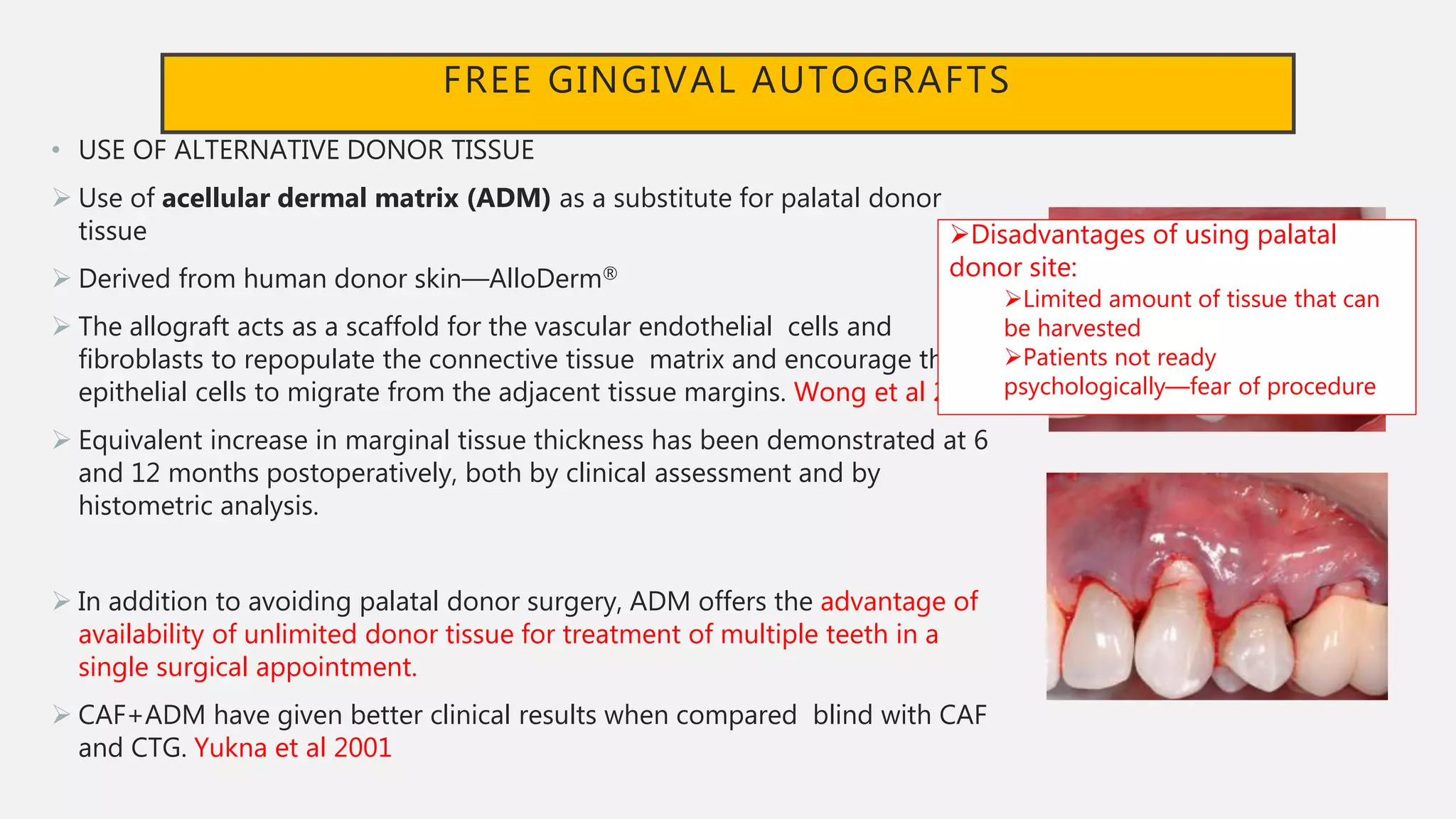
 Use of acellular dermal matrix (ADM) as a substitute for palatal donor
tissue
 Derived from human donor skin—AlloDerm®
 The allograft acts as a scaffold for the vascular endothelial cells and
fibroblasts to repopulate the connective tissue matrix and encourage the
epithelial cells to migrate from the adjacent tissue margins. Wong et al 2008
 Equivalent increase in marginal tissue thickness has been demonstrated at 6
and 12 months postoperatively, both by clinical assessment and by
histometric analysis.
 In addition to avoiding palatal donor surgery, ADM offers the advantage of
availability of unlimited donor tissue for treatment of multiple teeth in a
single surgical appointment.
 CAF+ADM have given better clinical results when compared blind with CAF
and CTG. Yukna et al 2001
FREE GINGIVAL AUTOGRAFTS
Disadvantages of using palatal
donor site:
Limited amount of tissue that can
be harvested
Patients not ready
psychologically—fear of procedure
RATIONALE FOR USE OF ADM
• Safe and effective biomaterial
• Good substitute for palatal CT in root coverage grafting procedures-- Proven equivalence to
palatal CT in terms of thickness post-op
• No reports of disease transmission in medical/dental applications since inception (~ 20 yrs+)
• ADVANTAGE: single surgical site, unlimited material available for grafting. 
• MOA:
1. Supports tissue regeneration by allowing rapid revascularization, WBC migration and cell
population– ultimately being transformed into host tissue for a strong, natural repair.
2. Provides scaffold for gingival fibroblasts and endothelial calls to regenerate from the neodermis.
1. Alternate papilla tunnel (APT) 2. Papilla retention pouch (PRP)
Unique feature: suturing of the allograft with a
continuous subgingival, double-back sling suture.
ADVANTAGES OF PRP TECHNIQUE: enhanced retraction
resistance, graft containment, wound stability.
POST-OP CARE INSTRUCTIONS (similar for both techniques)
1. Systemic antibiotics for 10 days
2. CHX mouthrinse for 2-3 weeks
3. Analgesic SOS
4. Inactivity for 24 hours
5. Ice applied to face for 24 hrs
6. Cold liquids for the first 3 meals
7. No mastication/toothbrushing at the surgical site for 2-3 wks
8. Removal of surface sutures at 2-4 wks
9. Removal of subgingival graft suture at 2 months
Carranza 13th Edition
SURGICAL TECHNIQUE FOR ADM TO TREAT RECESSION:
HEALING OF FGG (OLIVER et al., 1968)
• RECIPIENT SITE
• Thin layer of exudate b/w graft and recipient
bed
• Avascular plasmatic circulation (FORMAN,
1960)
• Desquamation of epithelium of free graft
INITIAL PHASE (0-3 days)
• Anastomosis b/w graft and recipient site blood
vessels
• Capillaries proliferate in graft tissue
• Fibrous union b/w graft and CT bed
• Re-epithelialization of graft
REVASCULARISATION (2-11 days)
•  no. of blood vessels to normal by day 14
• Epithelial maturation- formation of keratin layer
• Functional integration- by day 17
• Morphologically distinguishable for several
months (GHOST GRAFT)
TISSUE MATURATION (11-42 days)
• DONOR SITE
Granulation tissue fills the donor site
INITIAL HEALING is usually complete within 2-3
wks after removing 4-5mm thick graft
Patients should wear surgical stent for about 2
weeks to protect the healing wound
Palate returns to its pre-surgical contour in
about 3 months
(GOLDMAN & COHEN, 1980)
• Loose clot established 6-12 hrs post-op
• Rapidly builds amorphous character—quickly
spreads
• ~12 hours: active movement and relocation
of PMNLs to collagen and fibrin strands of
graft
• 24-36 hours: epithelial cell migration over
graft margins– formation of “caterpillar
track” (rolling over pattern of epithelial cells)
LINDHE 6th Edition
CONNECTIVE TISSUE GRAFT
FREE CONNECTIVE TISSUE AUTOGRAFTS
• EDEL, 1974
• RATIONALE: connective tissue carries the genetic message for the overlying epithelium to
become keratinized. Only connective tissue from beneath a keratinized zone can be used as a
graft.
ADVANTAGE:
- Donor tissue is obtained from the undersurface of
the palatal flap
- Sutured in primary closure
- Healing is by primary intention
- Less patient discomfort at donor site
- Improved aesthetics—better color match
FREE CONNECTIVE TISSUE AUTOGRAFT
 LEVINE, 1991
 TECHNIQUE:
1. Divergent
vertical incisions
2. Suturing 3. SRP
4. Obtaining
the graft
5. Transferring
the graft
6. Covering the
graft
Agrawal et al.: Different techniques of harvesting connective tissue graft: an update, 2020
 LANGER & LANGER, 1985
- Favourable aesthetic results
- Donor site heals by primary intention.
SUBEPTHELIAL CONNECTIVE TISSUE GRAFT
(Langer ’s technique)
CARRANZA’s Clinical Periodontology, 13° Edn
VARIANT
TECHNIQUE
OF SCTG
SUBPEDICLE (BILAMINAR) CONNECTIVE TISSUE GRAFT – NELSON,
1987
HEALING FOLLOWING CTG SURGERY
• DAY 1: CT becomes disorganized and edematous and experiences lysis and degeneration.
As healing takes place, degenerated CT is replaced by new GT.
•DAY 2-3: revascularization of the graft starts. Recipient bed capillaries proliferate into graft to form
new capillaries and anastomose with pre-existing vessels.
•DAY 4: a thin layer of new epithelium is formed
•DAY 7: rete pegs are developed
•DAY 10: central portion vascularizes. Vascular plexus get formed in graft directly below epithelium
•DAY 17: functional integration of graft occurs.
•After 1 MONTH: graft eventually blends with adjacent tissues.
•As seen microscopically, healing of intermediate thickness graft (0.75 mm) is completed by 10.5 weeks;
thicker graft (1.75 mm) is completed by 16 weeks or longer.
•On gross appearance, at transplantation, the graft vessels are empty and the graft is pale. In first 2
days, the pallor changes to an ischemic greyish white, until vascularization begins, and a pink colour
appears.
Del Pizzo et al, 2002
APICALLY DISPLACED FLAP
• FRIEDMAN, 1962
• Selected for cases that present with <3 mm of attached gingiva.
• Can be full or partial thickness flap
• ADVANTAGE: avoids 2nd surgical site
DISADVANTAGES:
- Higher risk of bone resorption
- Regional accelerated phenomenon in coronal denuded part
- Requires adequate vestibular depth to allow apical
repositioning
- CANNOT predictably deepen the vestibule with attached
gingiva
Final position of the flap irt bone:
A. Slightly coronal to crest
B. At the crest
C. 2 mm short of the crest
FRIEDMAN & LEVIN CLASSIFICATION , 1962
Class I: more than adequate KG width.
Labial or buccal incision 1-3mm from crest of gingiva.
Flap apically positioned to cover 1-2mm of cementum
Class II: adequate KG.
Crestal incision used.
Flap apically positioned to the crest of the bone.
Class III: insufficient width of KG.
Sulcular incision.
Flap is positioned 1-2mm below crest of bone to increase
width of keratinized gingiva.
MODIFIED APICALLY REPOSITIONED FLAP
(MARF)– CARNIO & MILLER, 1999
- Single horizontal incision
- Easy to execute, simple, less chairside time
- Allows repositioning of flap WITHOUT VERTICAL
RELEASING INCISIONS
HEALING AFTER APF
 1 week: There is transient acute inflammation with reorganisation of the blood
clot between the tooth and flap into GT.
 2 – 5 weeks: There is replacement of GT by CT.
 Approximately 4 weeks: epithelial migration commences from the margin of the
flap and gives rise to new junctional epithelium.
 There is some resorption of the alveolar bone margin resulting from raising a
flap. This is minimised by a careful surgical technique.
 Gingival margin shifts 1 mm coronally with long term period.
Clerehugh V, Tugnait A, Genco R. Types of periodontal surgery. In: 2009
LATERALLY DISPLACED FLAP
HISTORY:
• GRUPE and WARREN (1956)
• aka laterally sliding flap operation
FEATURES:
• Reflection of a full thickness flap in a donor area adjacent to the defect and subsequent lateral displacement of
the pedicled flap to cover denuded root surface
• Poor aesthetics—scar tissue by 2° intention
• Excellent post-op healing course
- Coverage of the exposed root surface with the sliding flap technique has been successful in
- 60% of cases in one study (Gargiulo et al, 1967)
- 61-72% in another (Rateitschak et al, 1985)
• The extent to which the flap establishes a new attachment to the root surface with the formation of new
cementum and new CT fibres has not been established.
INDICATIONS:
o Adequate vestibular depth to facilitate lateral
movement of pedicle
o Isolated denuded root surface with adequate
donor tissue adjacent to recipient site
o Recession with narrow mesiodistal width
CONTRAINDICATIONS:
o Insufficient KTW at donor site
o Deep interproximal pockets
o Excessive root prominences
o Deep/extensive root abrasion or erosion
o Significant loss of interproximal bone height
o Narrow vestibule
ADVANTAGES:
o Single surgical site
o Good vascularity of pedicle
o Ability to cover denuded root surface
DISADVANTAGES:
o Limited by amount of adjacent keratinized tissue
o Possible recession at donor site
o Dehiscence/fenestration at donor site
o Limited scope of coverage of recession
PEDICLE AUTOGRAFT
LATERALLY DISPLACED PEDICLE FLAP
MODIFICATIONS:
1. Use of split-thickness flap– minimized risk for development of dehiscence at donor area STAFFILENO, 1964
and
2. Cutback incision to release tension CORN, 1964
3. Oblique rotational flap PENNEL et al., 1965
4. Sub-marginal incision at donor site– preserve marginal integrity of adjacent tooth GRUPE, 1966
5. Double-papilla flap COHEN & ROSS, 1968
6. Use of engineering principles: cutback incision not required DAHLBERG, 1969
7. Use of a mixed-thickness flap (full-split) RUBEN et al., 1976
8. Rotation flap PATUR, 1977
9. Transpositional flap BAHAT et al., 1990
MODIFICATION (for multiple teeth):
REASONS FOR FAILURE OF LPF
1. Tension at base of distal incision– corrected by use of releasing/cutback incision
2. Too narrow pedicle flap– donor flap should be 1.5x wider than RW
3. Bone exposed– dehiscence
4. Excessive flap movement because of poor stabilization
PFEIFER & HELLER, 1971
TECHNIQUE
 LATERAL SLIDING FLAP with FREE GINGIVAL GRAFT
 MODIFICATION (ZUCHELLI, 2004)
Knowles J, Ramfjord S. The lateral sliding flap with the free gingival graft. The University of Michigan Dental School, video cassette. 1971
VARIANT TECHNIQUES OF LPF
• COHEN and ROSS, 1968
• Bilateral interdental papilla used as donor tissue
• Localized root coverage
• Indication: sufficient width and length of IDP on both sides adjacent to area of recession
DOUBLE PAPILLA FLAP
Less chance of flap necrosis because IDP is thicker + wider than
labial gingiva on the root surface
 DOUBLE PAPILLA FLAP
• TECHNIQUE:
 OBLIQUE ROTATED PEDICLE FLAP (PENNEL et al., 1965)
• TECHNIQUE:
 TRANSPOSITIONAL FLAP (BAHAT et al., 1990)
ADVANTAGES:
- Predictability in narrow
recession
- Avoids recession at donor
site
DISADVANTAGES:
- Sufficient length + width of
adjacent IDP required
- Unsuited for multiple
recessions
TRANSPOSITION OF PERIOSTEAL PEDICLE FLAP
Swathi et al., Clinical Adv in Per, 2020
HEALING AFTER PEDICLE SOFT TISSUE AUTOGRAFTS
 WILDEMAN & WENTZ (1965) divided the into four stages:
1. Adaptation stage (0–4 days). The surgical flap is separated from the root by a thin
fibrin layer, and proliferating epithelial cells start to make contact with the root
surface.
2. Proliferation stage (4–21 days). Connective tissue invades the fibrin layer from the
basal level of the flap, and fibroblasts are detectable near the root surface and
differentiate into cementoblasts. Epithelium is detected over the root at the coronal
level of the wound, while a thin connective tissue is detectable more apically, even if
fibers are not inserted into the root at this stage.
3. Attachment stage (21–28 days). Fibers are inserted into a layer of new cementum in
the apical part of the recession defect.
4. Maturation stage (1–6 months). An increase in formation of collagen fibers occurs in
this period, leading to a variable amount of connective tissue.
CORONALLY DISPLACED FLAP
 NORBERG, 1926- technique of choice for treatment of isolated gingival recession
 BERNIMOULIN et al., 1975– single and multiple recessions
 ALLEN & MILLER, 1989- split-thickness flap with 2 vertical release incisions
 PINI PRATO et al., 1992- CAF + nonresorbable barrier membranes under trapezoidal flap
CORONALLY DISPLACED FLAP
FIRST TECHNIQUE
Perio 2000 Vol 75, 2017
CAF by ALLEN & MILLER,
1989
CAF + GTR membranes,
PINIPRATO et al, 1992

ADVANTAGES
Technically simple, well tolerated
Treatment of single or multiple areas of root exposure
No need for involvement of adjacent teeth
High degree of success
Good esthetics
CONTRAINDICATIONS OF CAF :
absence of keratinized tissue apical to the recession defect,
the presence of a gingival cleft (Stillman’s cleft) extending into the alveolar
mucosa, and a very shallow vestibulum depth.
MODIFICATIONS OF CAF
CAF by ALLEN &
MILLER, 1989
Envelope CAF by RAETZKE,
1985 for CT
Modified by ALLEN, 1994 for
multiple adjacent recessions-
“Tunnel or supraperiosteal
envelope technique”
MAHN, 2003- adapted
tunnel for grafting using
ADM
SANTARELLI et al, 2001-
modified tunnel with SINGLE
VERTICAL INCISION
ZUCHELLI & SANCTIS, 2007-
‘split-full-split’ approach-
Modified coronally advanced
flap (MCAF)
MIST (Cortellini 2007): POUCH-AND-TUNNEL, PINHOLE, VISTA, m-MIST(2009)
Vestibular Incision Subperiosteal Tunnel
Access (VISTA)- ZADEH, 2011
Pouch-and-tunnel technique- AZZI, et al 2001
 ADVANTAGE:
 thickening of gingival margin post-healing
 Use of small, contoured blades precise
incision technique.
MODIFICATIONS OF CAF
PINHOLE surgical technique- CHAO, 2012 Modified Vestibular Incision Subperiosteal
Tunnel Access (mVISTA)- LEE et al., 2015
Modified Minimally invasive surgical technique (m-MIST)-
CORTELLINI 2009
• An enhancement of MIST, the modified
minimally invasive surgical technique (m-
MIST), has been designed to further reduce
the surgical invasiveness.
• 4X-16X MICROSCOPE
BI-DIRECTIONALLY POSITIONED FLAP– IWANO et al., 2013
• Alternative to using connective tissue grafts
• ADVANTAGE OF PERIOSTEAL FLAP: inherent blood supply
(huge regenerative potential)
• Essential requirement: thick gingival biotype
 TECHNIQUE:
1. Initial sulcular incision w #15c blade
2. Mesial and distal full thickness vertical releasing incision
are made
3. Trapezoidal partial thickness flap is reflected.
4. Underlying periosteal pedicle flap is reflected up to the
mucogingival junction connected with mesial and distal
vertical releasing incisions
5. At its base, a horizontal releasing incision is made to join
the periosteal flap into the outer trapezoidal partial
thickness flap.
6. After degranulation and placement of biomembrane if
required, periosteal pedicle flap is coronally advanced,
sutured with 4-0 resorbable sutures using one sling suture
7. The coronally positioned outer partial thickness flap is
sutured with 5-0 non-resorbable silk suture using simple
interrupted sutures for vertical releasing incisions and the
first horizontal incisions
8. Periodontal dressing placed to cover the surgical site
completely.
PERIOSTEAL EVERSION TECHNIQUE
• aka Perioplasty- GAGGL et al., 2005
• RATIONALE: periosteum contains cytokines and various
growth factors such as TGF-β, PDGF, IGF, BMP2 and 7.
Periosteum itself acting as a scaffold with various cells
possessing in it and numerous growth factors is an ideal
source of tissue engineering.
• TECHNIQUE: periosteum is used to cover the denuded root
surfaces.
• Involves the partial thickness flap reflection, eversion and
reposition of flap coronally and is placed on the denuded
root surfaces.
Singh & Kiran, JISP
2015
PERIOSTEAL INVERSION TECHNIQUE
 This technique utilized the periosteum as an autograft for
the treatment of gingival recession defects.
 The inner layer contains numerous osteoblasts and
osteoprogenitor cells (Simon TM, 2003) and the outer
layer is composed of dense collagen fibre, fibroblasts and
their progenitor cells (Youn I et al 2005); hence the
regenerative potential of the periosteum is immense.
 TECHNIQUE:
 Horizontal basal incision was given at the baseline to
incise the periosteum at its apical end, and then, it was
reflected from the alveolar bone, but margin remains
pedicled crestally.
 pedicle periosteum is inverted coronally on exposed root
surface and sutured by sling suturing technique around
the neck of tooth with 5-0 absorbable suture
 partial-thickness flap is coronally advanced over the
inverted periosteum and sutured by sling technique
around the neck of tooth and by direct loop suturing
technique on vertical incisions with 5-0 absorbable suture
ROSENFELD, 2014
ADVANTAGES:
1. preserves the vestibular depth
2. maintains the existing dimension of the buccal
keratinized gingiva
3. creates additional length in the flap—allows for
completely tension-free coverage
4. eliminate the need for a collagen membrane—
economic
SEMILUNAR CORONALLY REPOSITIONED FLAP- TARNOW, 1986
STEP 1: semilunar incision
STEP 2: split-thickness dissection apical to coronal- connect via intrasulcular incision
STEP 3: tissue collapses coronally, no tension
INDICATIONS:
• <3 mm recession on single tooth
• THICK gingival biotype
• Successful outcomes at maxillary anterior areas
CAF: SECOND TECHNIQUE
CARRANZA’s Clinical Periodontology, 13° Edn
 MODIFIED SEMILUNAR CORONALLY REPOSITIONED FLAP- HAGHIGHAT, 2006
INDICATION: gingival recession present on adjacent teeth
TECHNIQUE:
1. Semilunar incision is made apically, following the curvature of the
gingival margins of the teeth exhibiting gingival recession
2. Partial thickness intrasulcular incision made along the gingival
margins of the two adjacent teeth.
3. A partial-thickness flap, extending from the marginal tissue
coronally to the double semilunar incision apically, is mobilized.
4. The mesial and distal papillae are left intact; over the middle
papilla, incision along the gingival margin is extended to create a
new middle papilla tip located apical to that of the original, at a
distance equal to that of the recession defect.
5. Following a partial-thickness flap reflection over the midline
papilla, the remaining original papilla is subsequently
deepithelialized.
6. The partial-thickness flap is coronally advanced, with the newly
created papilla positioned over the deepithelialized segment.
7. The flap is sutured through the midline papilla to stabilize it
coronally.
HEALING AFTER FLAP SURGERY
 FULL-THICKNESS FLAP
- CAFFESE, RAMFJORD & NASJELETI, 1968
 SPLIT-THICKNESS FLAP
- RAMFJORD & COSTICH, 1968
REGENERATIVE APPROACHES
• GUIDED TISSUE REGENERATION (GTR) with Barrier Membranes
• Pini-Prato et al., 1992
• RATIONALE: GTR results in reconstruction of the attachment
apparatus, along with coverage of the denuded root surface.
• Good results for root coverage, esp. in deep recessions– generate
new CT and bone
• PTFE membranes: mean 74% RC obtained
• At present, appears to be inadvisable due to high risk of
complications (e.g., membrane exposure)– Lins et al, 2003
• ENAMEL MATRIX DERIVATIVE
• EMD+CAF: improved %CRC, increased height of keratinized tissue
and better reduction of recession Chambrone et al, 2012
• Contradictory reports from histological studies–predominant
attachment of collagen fibers running parallel to root surface
without new cementum/Sharpey’s fibers Carnio et a 2002
• Application of enamel matrix derivative during mucogingival surgery
may be recommended in situations in which a wider extension of
new attachment formation between the soft tissue and the root
surface could be of clinical relevance.
• ACELLULAR DERMAL MATRIX (ADM)
• CAF+ADM>> CAF+CTG Yukna et al 2001
• Randomized, controlled clinical trials have demonstrated
outcomes with ADM equivalent to palatal donor tissue in
treatment of gingival recession. Allen et al 1973, Sullivan et
al 1968
• XENOGENEIC COLLAGEN MATRIX (XCM)
• PORCINE OR BOVINE ORIGIN acts as a 3D scaffold
• As effective and predictable as CTG Sanz 2009
• CAF+XCM vs CAF+CTG
• 84% 89% (6 mo.)
• 97% 99% (1 yr.) McGuire & Schreyer, 2010
• 94% efficacy – Cardaropoli et al, 2012
OTHER TECHNIQUES: VESTIBULAR DEEPENING
aka vestibuloplasty or sulculoplasty or sulcular deepening procedure
• Deepening of vestibule without any addition of bone
• Mucosal advancement techniques
CLARKE’S TECHNIQUE
CLINICAL TEST- with the lips in a relaxed position, a
mouth mirror is inserted into the vestibule to the
depth required for adequate root coverage. If the lip
is not displaced upward/drawn inward, it can be
assumed that there is sufficient mucosa for
advancement procedures
CONCLUSION
Periodontal plastic surgery refers to soft tissue relationships and manipulations.
In all the previously mentioned procedures, most significant concern is BLOOD
SUPPLY and can influence surgical approach.
Crucial for survival of all therapeutic modalities formation of a circulation
through anastomosis and angiogenesis.
Critical analysis of recently presented techniques should guide the evolution
towards better management of such cases.
Decision Tree.
AAP Regeneration
workshop;
2015
Perioplastic surgeries- width of attached gingiva

Perioplastic surgeries- width of attached gingiva

  • 1.
    PERIODONTAL PLASTIC SURGERIES–PART 1 RECESSION AND MANAGEMENT METHODS TO INCREASE WIDTH OF ATTACHED G INGIVA BY DR. ANTARLEENA SENGUPTA PG, DEPT OF PERIODONTOLOGY MCODS, MANGALORE 2021
  • 2.
    CONTENTS • GINGIVAL RECESSIONAND THE ROLE OF PERIODONTAL PLASTIC SURGERIES • INTRODUCTION • CLASSIFICATION • OBJECTIVES • TISSUE BARRIER CONCEPT • PROBLEMS ASSOCIATED WITH ATTACHED GINGIVA • SELECTION CRITERIA and DECISION TREE • TECHNIQUES TO INCREASE WIDTH OF ATTACHED GINGIVA • GINGIVAL AUGMENTATION APICAL TO RECESSION • GINGIVAL AUGMENTATION CORONAL TO RECESSION • OTHER TECHNIQUES • CONCLUSION
  • 3.
    GINGIVAL RECESSION ANDTHE ROLE OF PERIODONTAL PLASTIC SURGERIES
  • 4.
    INTRODUCTION: GINGIVAL RECESSION -Clinical definition: exposure of the root surface by an apical shift in the position of the gingiva. (Carranza, 2015) - Severity of recession determined by the apparent position of the gingiva (level of crest of gingival margin) - Attachment loss is determined via actual position (level of coronal end of the epithelial attachment on the tooth) - Recession refers to the location of the gingiva rather than to its condition; Can be localized/generalized; increases with age - Etiology: o Faulty toothbrushing—gingival abrasion o Tooth malposition, friction from soft tissues—gingival ablation o Gingival inflammation o Abnormal frenum attachment o Iatrogenic o TFO—might be—no concrete information to substantiate e.g., deep overbite, incisal overlap, labial ortho movement - Clinical significance: o Root caries o Dentinal hypersensitivity o Pulp hyperemia—through excessive exposure o Plaque accumulation --in interproximal recession
  • 5.
    Class 1IA Class 1IB CLASSIFICATIONOF GINGIVAL RECESSION 1. Sullivan and Atkins (1968) 2. PD Miller (1985) Class 1 Class I1
  • 6.
    CLASSIFICATION OF GINGIVALRECESSION 1. Sullivan and Atkins (1968) 2. PD Miller (1985) Class 1 Class I1 Class 1II Class 1V  Gingival recession doesn’t extend to MGJ but there is associated hard and soft tissue loss in the inter dental areas adjacent to the defects  Class III or Class IV–(Subjective criteria)  No objective criteria to assess the severity of bone / soft tissue loss.
  • 7.
    MAHAJAN’S MODIFICATION OFMILLER’S CLASSIFICATION (2010) Class I Class III Class II Class IV
  • 8.
    CLASSIFICATION OF GINGIVALRECESSION (CAIRO et al., 2011) RT 3 RT 2 RT 1 Amine K, El Kholti W, Kissa J. Gingival Recessions: Definition and Classification. In Periodontal Root Coverage 2019 (pp. 3-7). Springer, Cham.
  • 9.
    PERIODONTAL PLASTIC SURGERIES -Previously called mucogingival surgery—FRIEDMAN, 1957 - Correction of relationships b/w gingiva and oral mucosa—special reference to 3 areas: o Attached gingiva—widening of attached gingiva o Shallow vestibules—deepening of shallow vestibules o Aberrant frenum- interfering w the marginal gingiva—resection of the aberrant frenum - Renamed by 1996 World Workshop in Clinical Periodontics to Periodontal Plastic Surgery—proposed by MILLER, 1993 - Includes: o Periodontal-prosthetic corrections o Crown lengthening o Ridge augmentation o Aesthetic surgical corrections o Coverage of denuded root surface o Papilla reconstruction o Aesthetic surgical correction around implants o Surgical exposure of unerupted teeth for orthodontics
  • 10.
    - DEFINITION: surgicalprocedures performed to correct or eliminate anatomic, developmental, or traumatic deformities of the gingiva or alveolar mucosa. (1996 WWCP) - Perio-plastic surgery only includes the surgical procedures whereas MUCOGINGIVAL THERAPY is a broader term that includes non-surgical procedures such as papilla reconstruction via ortho/resto therapy. - CLASSIFICATION OF PERIODONTAL SURGERY: PERIODONTAL PLASTIC SURGERIES
  • 11.
    OBJECTIVES OF PERIODONTALPLASTIC SURGERY 1. Problems associated with ATTACHED GINGIVA 2. Problems associated with a SHALLOW VESTIBULE 3. Problems associated with an ABERRANT FRENUM 4. Aesthetic surgical therapy 5. Tissue engineering 
  • 12.
    • GOAL: creationor widening of the zone of attached gingiva around teeth and implants. • RATIONALE FOR MUCOGINGIVAL SURGERY: assumption that a minimal width of attached gingiva is required to maintain optimal gingival health • CHALLENGE EXISTS AGAINST THIS ASSUMPTION CARRANZA, 10TH Edn. • People who practice good, atraumatic oral hygiene may maintain excellent gingival health with almost no attached gingiva. • Presence of adequate zone of gingiva is CRITICAL to maintain marginal tissue health & to prevent continued LOA (Nabers, 1954; Ochsenbein, 1960) Width of attached gingiva ≤1 mm is sufficient. (Dorfman et al., 1982) PROBLEMS ASSOCIATED WITH ATTACHED GINGIVA
  • 13.
    INDICATIONS FOR ROOTCOVERAGE PROCEDURES 1. Aesthetic reasons 2. Hypersensitivity 3. Keratinized tissue augmentation 4. Root abrasion/caries 5. Inconsistency/disharmony of gingival margin. Perio 2000 Vol 68, 2015 TISSUE BARRIER CONCEPT Hall et al, 1977  critical factors to be considered other than lack of AG Kennedy et al, 1985  6 yrs longitudinal study on patients undergone FGG  GOLDMAN and COHEN, 1979  Dense collagenous band of connective tissue- retards or obstructs the spread of inflammation better than does the loose fibre arrangement of the alveolar mucosa.  RECOMMENDATION:  zone of attached gingiva – adequate tissue barrier.
  • 14.
    OPINIONS IN LITERATUREABOUT SUFFICIENT/INSUFFICIENT WIDTH OF ATTACHED GINGIVA SUFFICIENT WIDTH: 1) to protect periodontium from injury caused by friction forces encountered during mastication -- FRIEDMAN 1957 2) to dissipate the pull on the gingival margin created by the muscles of the adjacent alveolar mucosa—OCHSENBEIN, 1960 INSUFFICIENT WIDTH: 1) to facilitate subgingival plaque formation because of improper pocket closure resulting from the movability of marginal tissue—FRIEDMAN, 1962 2) favour attachment loss and soft tissue recession because of less tissue resistance to apical spread of plaque-associated gingival lesions. 3) also considered that a narrow gingiva in combination with a shallow vestibular fornix might : 1) favor accumulation of food particles during mastication 2) impede proper oral hygiene measures (GOTTSEGEN 1954; ROSENBERG 1960; CORN 1962; CARRANZA & CARRARO 1970).
  • 15.
    CRITERIA FOR SELECTIONOF TECHNIQUE Criteria for selection of mucogingival techniques are as follows: 1. Surgical site free of plaque, calculus, and inflammation 2. Adequate blood supply to the donor tissue 3. Anatomy of the recipient and donor sites 4. Stability of the grafted tissue to the recipient site 5. Minimal trauma to the surgical site. Sato 2000 Carranza 12th edition, 2015
  • 16.
    Naoshi S. Periodontalsurgery: a clinical atlas. Quintessence; 2000.
  • 17.
  • 18.
    TECHNIQUES TO INCREASEWIDTH OF ATTACHED GINGIVA
  • 19.
    TECHNIQUES TO INCREASEWIDTH OF ATTACHED GINGIVA GINGIVAL AUGMENTATION APICAL TO AREA OF RECESSION  Free gingival grafts  Free connective tissue grafts  Apically displaced flaps • FGG • Free CTG • Pedicle autografts • Laterally positioned • Coronally positioned • SCTG (Langer’s technique) • GTR • Pouch-and-tunnel Widening the attached gingiva accomplishes the following 4 objectives: Enhances plaque removal around the gingival margin Improves aesthetics Reduces inflammation around restored teeth Gingival margin binds better around teeth and implants with attached gingiva GINGIVAL AUGMENTATION CORONAL TO THE RECESSION (ROOT COVERAGE) Newman MG, Takei H, Klokkevold PR, Carranza FA. Newman and Carranza's Clinical Periodontology E-Book. Elsevier Health Sciences; 2018 May 29.
  • 20.
    CLASSIFICATION OF INCISIONDESIGN FOR SOFT TISSUE GRAFTING FROM PALATE– LIU & WEISGOLD 2002 • The classification of incision design from the palatal site is based upon: 1. The graft size required by the recipient site 2. The anatomy of the palatal vault, which is divided into high, average, and shallow 3. The possibility of an exostosis 4. Wound healing from the donor site (primary or secondary intention healing) 5. Blood supply for the overlying flap 6. Postoperative discomfort 7. Whether sutures, stents, or hemostatic agents are required 8. Visibility of the procedure. Liu classification:  Class I: one incision line  Class II: two incision lines  Class III: three incision lines (U shape) Sub-classification (horizontal incision):  Type A: one horizontal incision  Type B: two horizontal incisions
  • 21.
    CLASSIFICATION OF INCISIONDESIGN FOR SOFT TISSUE GRAFTING FROM PALATE– LIU & WEISGOLD 2002
  • 22.
  • 23.
    • BJORN, 1963–term Free gingival graft (FGG) given by NABERS • CLASSIC TECHNIQUE • VARIANT TECHNIQUES: ACCORDION and STRIP • USE OF ALTERNATIVE DONOR TISSUE GINGIVAL AUGMENTATION APICAL TO RECESSION FREE GINGIVAL AUTOGRAFTS– THE GOLD STANDARD CLASSIC TECHNIQUE (BJORN, 1963) STEPS 1. Prepare recipient site 2. Obtain graft from donor site 3. Transfer and immobilize the graft 4. Protect donor site Ideal graft thickness = 1.0-1.5mm (thin enough to permit diffusion of fluid from recipient bed—essential for immediate post-transplant period) Too thin graft Necrosis and exposure of recipient site Too thick graft > Peripheral layer is jeopardized due to excessive tissue that separated it from new circulation and nutrients > Also creates a deeper wound at the donor site, with the possibility of injuring major palatal arteries
  • 24.
    GINGIVAL AUGMENTATION CORONALTO RECESSION  FREE GINGIVAL AUTOGRAFT - Successful and predictable root coverage - CLASSIC TECHNIQUE modified by MILLER, 1985: STEP 1: ROOT PLANING STEP 2.: RECIPIENT SITE PREPARATION STEP 3&4: continue with classic technique  HOLBROOK-OCHSENBEIN TECHNIQUE (1983) FOR SUTURING AT RECIPIENT SITE OF FGG: 1. A continuous horizontal suture—mesial to distal: stretch and tie down graft to lateral periosteum 2. Circumferential sutures are placed. 3. Periosteum apical to graft border is engaged, suture is carried around the cervical margin of the tooth and tied to itself with positive pressure– minimize dead space-- chances of graft adaptation. 4. Additional vertical sutures may be placed to achieve greater adaptation of the graft to any underlying concavities.
  • 25.
    • BJORN, 1963–term Free gingival graft (FGG) given by NABERS • CLASSIC TECHNIQUE • VARIANT TECHNIQUES: ACCORDION and STRIP • USE OF ALTERNATIVE DONOR TISSUE STRIP TECHNIQUE, HAN et al., 1993 ACCORDION TECHNIQUE, RATEITSCHAK et al., 1985
  • 26.
    • USE OFALTERNATIVE DONOR TISSUE  Use of acellular dermal matrix (ADM) as a substitute for palatal donor tissue  Derived from human donor skin—AlloDerm®  The allograft acts as a scaffold for the vascular endothelial cells and fibroblasts to repopulate the connective tissue matrix and encourage the epithelial cells to migrate from the adjacent tissue margins. Wong et al 2008  Equivalent increase in marginal tissue thickness has been demonstrated at 6 and 12 months postoperatively, both by clinical assessment and by histometric analysis.  In addition to avoiding palatal donor surgery, ADM offers the advantage of availability of unlimited donor tissue for treatment of multiple teeth in a single surgical appointment.  CAF+ADM have given better clinical results when compared blind with CAF and CTG. Yukna et al 2001 FREE GINGIVAL AUTOGRAFTS Disadvantages of using palatal donor site: Limited amount of tissue that can be harvested Patients not ready psychologically—fear of procedure
  • 27.
    RATIONALE FOR USEOF ADM • Safe and effective biomaterial • Good substitute for palatal CT in root coverage grafting procedures-- Proven equivalence to palatal CT in terms of thickness post-op • No reports of disease transmission in medical/dental applications since inception (~ 20 yrs+) • ADVANTAGE: single surgical site, unlimited material available for grafting.  • MOA: 1. Supports tissue regeneration by allowing rapid revascularization, WBC migration and cell population– ultimately being transformed into host tissue for a strong, natural repair. 2. Provides scaffold for gingival fibroblasts and endothelial calls to regenerate from the neodermis.
  • 28.
    1. Alternate papillatunnel (APT) 2. Papilla retention pouch (PRP) Unique feature: suturing of the allograft with a continuous subgingival, double-back sling suture. ADVANTAGES OF PRP TECHNIQUE: enhanced retraction resistance, graft containment, wound stability. POST-OP CARE INSTRUCTIONS (similar for both techniques) 1. Systemic antibiotics for 10 days 2. CHX mouthrinse for 2-3 weeks 3. Analgesic SOS 4. Inactivity for 24 hours 5. Ice applied to face for 24 hrs 6. Cold liquids for the first 3 meals 7. No mastication/toothbrushing at the surgical site for 2-3 wks 8. Removal of surface sutures at 2-4 wks 9. Removal of subgingival graft suture at 2 months Carranza 13th Edition SURGICAL TECHNIQUE FOR ADM TO TREAT RECESSION:
  • 29.
    HEALING OF FGG(OLIVER et al., 1968) • RECIPIENT SITE • Thin layer of exudate b/w graft and recipient bed • Avascular plasmatic circulation (FORMAN, 1960) • Desquamation of epithelium of free graft INITIAL PHASE (0-3 days) • Anastomosis b/w graft and recipient site blood vessels • Capillaries proliferate in graft tissue • Fibrous union b/w graft and CT bed • Re-epithelialization of graft REVASCULARISATION (2-11 days) •  no. of blood vessels to normal by day 14 • Epithelial maturation- formation of keratin layer • Functional integration- by day 17 • Morphologically distinguishable for several months (GHOST GRAFT) TISSUE MATURATION (11-42 days) • DONOR SITE Granulation tissue fills the donor site INITIAL HEALING is usually complete within 2-3 wks after removing 4-5mm thick graft Patients should wear surgical stent for about 2 weeks to protect the healing wound Palate returns to its pre-surgical contour in about 3 months (GOLDMAN & COHEN, 1980) • Loose clot established 6-12 hrs post-op • Rapidly builds amorphous character—quickly spreads • ~12 hours: active movement and relocation of PMNLs to collagen and fibrin strands of graft • 24-36 hours: epithelial cell migration over graft margins– formation of “caterpillar track” (rolling over pattern of epithelial cells) LINDHE 6th Edition
  • 30.
  • 31.
    FREE CONNECTIVE TISSUEAUTOGRAFTS • EDEL, 1974 • RATIONALE: connective tissue carries the genetic message for the overlying epithelium to become keratinized. Only connective tissue from beneath a keratinized zone can be used as a graft. ADVANTAGE: - Donor tissue is obtained from the undersurface of the palatal flap - Sutured in primary closure - Healing is by primary intention - Less patient discomfort at donor site - Improved aesthetics—better color match
  • 32.
    FREE CONNECTIVE TISSUEAUTOGRAFT  LEVINE, 1991  TECHNIQUE: 1. Divergent vertical incisions 2. Suturing 3. SRP 4. Obtaining the graft 5. Transferring the graft 6. Covering the graft Agrawal et al.: Different techniques of harvesting connective tissue graft: an update, 2020
  • 33.
     LANGER &LANGER, 1985 - Favourable aesthetic results - Donor site heals by primary intention. SUBEPTHELIAL CONNECTIVE TISSUE GRAFT (Langer ’s technique) CARRANZA’s Clinical Periodontology, 13° Edn
  • 34.
    VARIANT TECHNIQUE OF SCTG SUBPEDICLE (BILAMINAR)CONNECTIVE TISSUE GRAFT – NELSON, 1987
  • 35.
    HEALING FOLLOWING CTGSURGERY • DAY 1: CT becomes disorganized and edematous and experiences lysis and degeneration. As healing takes place, degenerated CT is replaced by new GT. •DAY 2-3: revascularization of the graft starts. Recipient bed capillaries proliferate into graft to form new capillaries and anastomose with pre-existing vessels. •DAY 4: a thin layer of new epithelium is formed •DAY 7: rete pegs are developed •DAY 10: central portion vascularizes. Vascular plexus get formed in graft directly below epithelium •DAY 17: functional integration of graft occurs. •After 1 MONTH: graft eventually blends with adjacent tissues. •As seen microscopically, healing of intermediate thickness graft (0.75 mm) is completed by 10.5 weeks; thicker graft (1.75 mm) is completed by 16 weeks or longer. •On gross appearance, at transplantation, the graft vessels are empty and the graft is pale. In first 2 days, the pallor changes to an ischemic greyish white, until vascularization begins, and a pink colour appears. Del Pizzo et al, 2002
  • 36.
  • 37.
    APICALLY DISPLACED FLAP •FRIEDMAN, 1962 • Selected for cases that present with <3 mm of attached gingiva. • Can be full or partial thickness flap • ADVANTAGE: avoids 2nd surgical site DISADVANTAGES: - Higher risk of bone resorption - Regional accelerated phenomenon in coronal denuded part - Requires adequate vestibular depth to allow apical repositioning - CANNOT predictably deepen the vestibule with attached gingiva Final position of the flap irt bone: A. Slightly coronal to crest B. At the crest C. 2 mm short of the crest FRIEDMAN & LEVIN CLASSIFICATION , 1962 Class I: more than adequate KG width. Labial or buccal incision 1-3mm from crest of gingiva. Flap apically positioned to cover 1-2mm of cementum Class II: adequate KG. Crestal incision used. Flap apically positioned to the crest of the bone. Class III: insufficient width of KG. Sulcular incision. Flap is positioned 1-2mm below crest of bone to increase width of keratinized gingiva.
  • 38.
    MODIFIED APICALLY REPOSITIONEDFLAP (MARF)– CARNIO & MILLER, 1999 - Single horizontal incision - Easy to execute, simple, less chairside time - Allows repositioning of flap WITHOUT VERTICAL RELEASING INCISIONS HEALING AFTER APF  1 week: There is transient acute inflammation with reorganisation of the blood clot between the tooth and flap into GT.  2 – 5 weeks: There is replacement of GT by CT.  Approximately 4 weeks: epithelial migration commences from the margin of the flap and gives rise to new junctional epithelium.  There is some resorption of the alveolar bone margin resulting from raising a flap. This is minimised by a careful surgical technique.  Gingival margin shifts 1 mm coronally with long term period. Clerehugh V, Tugnait A, Genco R. Types of periodontal surgery. In: 2009
  • 39.
  • 40.
    HISTORY: • GRUPE andWARREN (1956) • aka laterally sliding flap operation FEATURES: • Reflection of a full thickness flap in a donor area adjacent to the defect and subsequent lateral displacement of the pedicled flap to cover denuded root surface • Poor aesthetics—scar tissue by 2° intention • Excellent post-op healing course - Coverage of the exposed root surface with the sliding flap technique has been successful in - 60% of cases in one study (Gargiulo et al, 1967) - 61-72% in another (Rateitschak et al, 1985) • The extent to which the flap establishes a new attachment to the root surface with the formation of new cementum and new CT fibres has not been established. INDICATIONS: o Adequate vestibular depth to facilitate lateral movement of pedicle o Isolated denuded root surface with adequate donor tissue adjacent to recipient site o Recession with narrow mesiodistal width CONTRAINDICATIONS: o Insufficient KTW at donor site o Deep interproximal pockets o Excessive root prominences o Deep/extensive root abrasion or erosion o Significant loss of interproximal bone height o Narrow vestibule ADVANTAGES: o Single surgical site o Good vascularity of pedicle o Ability to cover denuded root surface DISADVANTAGES: o Limited by amount of adjacent keratinized tissue o Possible recession at donor site o Dehiscence/fenestration at donor site o Limited scope of coverage of recession PEDICLE AUTOGRAFT LATERALLY DISPLACED PEDICLE FLAP
  • 41.
    MODIFICATIONS: 1. Use ofsplit-thickness flap– minimized risk for development of dehiscence at donor area STAFFILENO, 1964 and 2. Cutback incision to release tension CORN, 1964 3. Oblique rotational flap PENNEL et al., 1965 4. Sub-marginal incision at donor site– preserve marginal integrity of adjacent tooth GRUPE, 1966 5. Double-papilla flap COHEN & ROSS, 1968 6. Use of engineering principles: cutback incision not required DAHLBERG, 1969 7. Use of a mixed-thickness flap (full-split) RUBEN et al., 1976 8. Rotation flap PATUR, 1977 9. Transpositional flap BAHAT et al., 1990 MODIFICATION (for multiple teeth): REASONS FOR FAILURE OF LPF 1. Tension at base of distal incision– corrected by use of releasing/cutback incision 2. Too narrow pedicle flap– donor flap should be 1.5x wider than RW 3. Bone exposed– dehiscence 4. Excessive flap movement because of poor stabilization PFEIFER & HELLER, 1971 TECHNIQUE
  • 42.
     LATERAL SLIDINGFLAP with FREE GINGIVAL GRAFT  MODIFICATION (ZUCHELLI, 2004) Knowles J, Ramfjord S. The lateral sliding flap with the free gingival graft. The University of Michigan Dental School, video cassette. 1971 VARIANT TECHNIQUES OF LPF
  • 43.
    • COHEN andROSS, 1968 • Bilateral interdental papilla used as donor tissue • Localized root coverage • Indication: sufficient width and length of IDP on both sides adjacent to area of recession DOUBLE PAPILLA FLAP Less chance of flap necrosis because IDP is thicker + wider than labial gingiva on the root surface
  • 44.
     DOUBLE PAPILLAFLAP • TECHNIQUE:
  • 45.
     OBLIQUE ROTATEDPEDICLE FLAP (PENNEL et al., 1965) • TECHNIQUE:
  • 46.
     TRANSPOSITIONAL FLAP(BAHAT et al., 1990) ADVANTAGES: - Predictability in narrow recession - Avoids recession at donor site DISADVANTAGES: - Sufficient length + width of adjacent IDP required - Unsuited for multiple recessions
  • 47.
    TRANSPOSITION OF PERIOSTEALPEDICLE FLAP Swathi et al., Clinical Adv in Per, 2020
  • 48.
    HEALING AFTER PEDICLESOFT TISSUE AUTOGRAFTS  WILDEMAN & WENTZ (1965) divided the into four stages: 1. Adaptation stage (0–4 days). The surgical flap is separated from the root by a thin fibrin layer, and proliferating epithelial cells start to make contact with the root surface. 2. Proliferation stage (4–21 days). Connective tissue invades the fibrin layer from the basal level of the flap, and fibroblasts are detectable near the root surface and differentiate into cementoblasts. Epithelium is detected over the root at the coronal level of the wound, while a thin connective tissue is detectable more apically, even if fibers are not inserted into the root at this stage. 3. Attachment stage (21–28 days). Fibers are inserted into a layer of new cementum in the apical part of the recession defect. 4. Maturation stage (1–6 months). An increase in formation of collagen fibers occurs in this period, leading to a variable amount of connective tissue.
  • 49.
  • 50.
     NORBERG, 1926-technique of choice for treatment of isolated gingival recession  BERNIMOULIN et al., 1975– single and multiple recessions  ALLEN & MILLER, 1989- split-thickness flap with 2 vertical release incisions  PINI PRATO et al., 1992- CAF + nonresorbable barrier membranes under trapezoidal flap CORONALLY DISPLACED FLAP FIRST TECHNIQUE Perio 2000 Vol 75, 2017 CAF by ALLEN & MILLER, 1989 CAF + GTR membranes, PINIPRATO et al, 1992  ADVANTAGES Technically simple, well tolerated Treatment of single or multiple areas of root exposure No need for involvement of adjacent teeth High degree of success Good esthetics CONTRAINDICATIONS OF CAF : absence of keratinized tissue apical to the recession defect, the presence of a gingival cleft (Stillman’s cleft) extending into the alveolar mucosa, and a very shallow vestibulum depth.
  • 51.
    MODIFICATIONS OF CAF CAFby ALLEN & MILLER, 1989 Envelope CAF by RAETZKE, 1985 for CT Modified by ALLEN, 1994 for multiple adjacent recessions- “Tunnel or supraperiosteal envelope technique” MAHN, 2003- adapted tunnel for grafting using ADM SANTARELLI et al, 2001- modified tunnel with SINGLE VERTICAL INCISION ZUCHELLI & SANCTIS, 2007- ‘split-full-split’ approach- Modified coronally advanced flap (MCAF)
  • 52.
    MIST (Cortellini 2007):POUCH-AND-TUNNEL, PINHOLE, VISTA, m-MIST(2009) Vestibular Incision Subperiosteal Tunnel Access (VISTA)- ZADEH, 2011 Pouch-and-tunnel technique- AZZI, et al 2001  ADVANTAGE:  thickening of gingival margin post-healing  Use of small, contoured blades precise incision technique. MODIFICATIONS OF CAF PINHOLE surgical technique- CHAO, 2012 Modified Vestibular Incision Subperiosteal Tunnel Access (mVISTA)- LEE et al., 2015 Modified Minimally invasive surgical technique (m-MIST)- CORTELLINI 2009 • An enhancement of MIST, the modified minimally invasive surgical technique (m- MIST), has been designed to further reduce the surgical invasiveness. • 4X-16X MICROSCOPE
  • 53.
    BI-DIRECTIONALLY POSITIONED FLAP–IWANO et al., 2013 • Alternative to using connective tissue grafts • ADVANTAGE OF PERIOSTEAL FLAP: inherent blood supply (huge regenerative potential) • Essential requirement: thick gingival biotype  TECHNIQUE: 1. Initial sulcular incision w #15c blade 2. Mesial and distal full thickness vertical releasing incision are made 3. Trapezoidal partial thickness flap is reflected. 4. Underlying periosteal pedicle flap is reflected up to the mucogingival junction connected with mesial and distal vertical releasing incisions 5. At its base, a horizontal releasing incision is made to join the periosteal flap into the outer trapezoidal partial thickness flap. 6. After degranulation and placement of biomembrane if required, periosteal pedicle flap is coronally advanced, sutured with 4-0 resorbable sutures using one sling suture 7. The coronally positioned outer partial thickness flap is sutured with 5-0 non-resorbable silk suture using simple interrupted sutures for vertical releasing incisions and the first horizontal incisions 8. Periodontal dressing placed to cover the surgical site completely.
  • 54.
    PERIOSTEAL EVERSION TECHNIQUE •aka Perioplasty- GAGGL et al., 2005 • RATIONALE: periosteum contains cytokines and various growth factors such as TGF-β, PDGF, IGF, BMP2 and 7. Periosteum itself acting as a scaffold with various cells possessing in it and numerous growth factors is an ideal source of tissue engineering. • TECHNIQUE: periosteum is used to cover the denuded root surfaces. • Involves the partial thickness flap reflection, eversion and reposition of flap coronally and is placed on the denuded root surfaces. Singh & Kiran, JISP 2015
  • 55.
    PERIOSTEAL INVERSION TECHNIQUE This technique utilized the periosteum as an autograft for the treatment of gingival recession defects.  The inner layer contains numerous osteoblasts and osteoprogenitor cells (Simon TM, 2003) and the outer layer is composed of dense collagen fibre, fibroblasts and their progenitor cells (Youn I et al 2005); hence the regenerative potential of the periosteum is immense.  TECHNIQUE:  Horizontal basal incision was given at the baseline to incise the periosteum at its apical end, and then, it was reflected from the alveolar bone, but margin remains pedicled crestally.  pedicle periosteum is inverted coronally on exposed root surface and sutured by sling suturing technique around the neck of tooth with 5-0 absorbable suture  partial-thickness flap is coronally advanced over the inverted periosteum and sutured by sling technique around the neck of tooth and by direct loop suturing technique on vertical incisions with 5-0 absorbable suture ROSENFELD, 2014 ADVANTAGES: 1. preserves the vestibular depth 2. maintains the existing dimension of the buccal keratinized gingiva 3. creates additional length in the flap—allows for completely tension-free coverage 4. eliminate the need for a collagen membrane— economic
  • 56.
    SEMILUNAR CORONALLY REPOSITIONEDFLAP- TARNOW, 1986 STEP 1: semilunar incision STEP 2: split-thickness dissection apical to coronal- connect via intrasulcular incision STEP 3: tissue collapses coronally, no tension INDICATIONS: • <3 mm recession on single tooth • THICK gingival biotype • Successful outcomes at maxillary anterior areas CAF: SECOND TECHNIQUE CARRANZA’s Clinical Periodontology, 13° Edn  MODIFIED SEMILUNAR CORONALLY REPOSITIONED FLAP- HAGHIGHAT, 2006 INDICATION: gingival recession present on adjacent teeth TECHNIQUE: 1. Semilunar incision is made apically, following the curvature of the gingival margins of the teeth exhibiting gingival recession 2. Partial thickness intrasulcular incision made along the gingival margins of the two adjacent teeth. 3. A partial-thickness flap, extending from the marginal tissue coronally to the double semilunar incision apically, is mobilized. 4. The mesial and distal papillae are left intact; over the middle papilla, incision along the gingival margin is extended to create a new middle papilla tip located apical to that of the original, at a distance equal to that of the recession defect. 5. Following a partial-thickness flap reflection over the midline papilla, the remaining original papilla is subsequently deepithelialized. 6. The partial-thickness flap is coronally advanced, with the newly created papilla positioned over the deepithelialized segment. 7. The flap is sutured through the midline papilla to stabilize it coronally.
  • 57.
    HEALING AFTER FLAPSURGERY  FULL-THICKNESS FLAP - CAFFESE, RAMFJORD & NASJELETI, 1968  SPLIT-THICKNESS FLAP - RAMFJORD & COSTICH, 1968
  • 58.
    REGENERATIVE APPROACHES • GUIDEDTISSUE REGENERATION (GTR) with Barrier Membranes • Pini-Prato et al., 1992 • RATIONALE: GTR results in reconstruction of the attachment apparatus, along with coverage of the denuded root surface. • Good results for root coverage, esp. in deep recessions– generate new CT and bone • PTFE membranes: mean 74% RC obtained • At present, appears to be inadvisable due to high risk of complications (e.g., membrane exposure)– Lins et al, 2003 • ENAMEL MATRIX DERIVATIVE • EMD+CAF: improved %CRC, increased height of keratinized tissue and better reduction of recession Chambrone et al, 2012 • Contradictory reports from histological studies–predominant attachment of collagen fibers running parallel to root surface without new cementum/Sharpey’s fibers Carnio et a 2002 • Application of enamel matrix derivative during mucogingival surgery may be recommended in situations in which a wider extension of new attachment formation between the soft tissue and the root surface could be of clinical relevance. • ACELLULAR DERMAL MATRIX (ADM) • CAF+ADM>> CAF+CTG Yukna et al 2001 • Randomized, controlled clinical trials have demonstrated outcomes with ADM equivalent to palatal donor tissue in treatment of gingival recession. Allen et al 1973, Sullivan et al 1968 • XENOGENEIC COLLAGEN MATRIX (XCM) • PORCINE OR BOVINE ORIGIN acts as a 3D scaffold • As effective and predictable as CTG Sanz 2009 • CAF+XCM vs CAF+CTG • 84% 89% (6 mo.) • 97% 99% (1 yr.) McGuire & Schreyer, 2010 • 94% efficacy – Cardaropoli et al, 2012
  • 59.
    OTHER TECHNIQUES: VESTIBULARDEEPENING aka vestibuloplasty or sulculoplasty or sulcular deepening procedure • Deepening of vestibule without any addition of bone • Mucosal advancement techniques CLARKE’S TECHNIQUE CLINICAL TEST- with the lips in a relaxed position, a mouth mirror is inserted into the vestibule to the depth required for adequate root coverage. If the lip is not displaced upward/drawn inward, it can be assumed that there is sufficient mucosa for advancement procedures
  • 60.
    CONCLUSION Periodontal plastic surgeryrefers to soft tissue relationships and manipulations. In all the previously mentioned procedures, most significant concern is BLOOD SUPPLY and can influence surgical approach. Crucial for survival of all therapeutic modalities formation of a circulation through anastomosis and angiogenesis. Critical analysis of recently presented techniques should guide the evolution towards better management of such cases. Decision Tree. AAP Regeneration workshop; 2015