Increase 
motivation
Question # 1 
To what extent do you find 
what you do interesting?
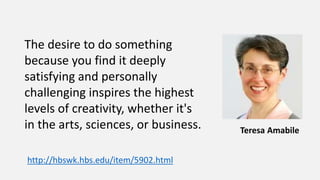
The desire to do something 
because you find it deeply 
satisfying and personally 
challenging inspires the highest 
levels of creativity, whether it's in 
the arts, sciences, or business. 
http://hbswk.hbs.edu/item/5902.html 
Teresa Amabile
When curiosity is guiding discoveries and 
learning, people are more likely to experience 
a sense of astonishment and sincere surprise, 
which forms the impetus for the quick 
absorption of new material and skills, thereby 
contributing to building their competence. 
http://www.selfdeterminationtheory.org/wp-content/uploads/2014/07/2013_VansteenkisteRyan_JOPI2.pdf
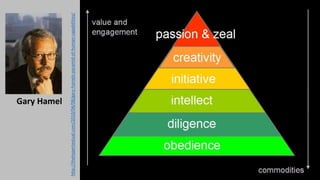
Gary Hamel 
http://thehypertextual.com/2010/04/08/gary-hamels-pyramid-of-human-capabilities/
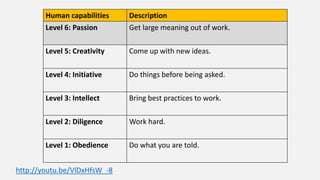
Human capabilities Description 
Level 6: Passion Get large meaning out of work. 
Level 5: Creativity Come up with new ideas. 
Level 4: Initiative Do things before being asked. 
Level 3: Intellect Bring best practices to work. 
Level 2: Diligence Work hard. 
Level 1: Obedience Do what you are told. 
http://youtu.be/VlDxHfsW_-8
Enjoyment based intrinsic motivation, i.e. 
how a person feels when working 
on a task, is the strongest and most 
pervasive driver. 
Survey of 684 open-source developers by Karim Lakhani and Bob Wolf. 
https://www.goodreads.com/review/show/1065405301 
Daniel H. Pink: Drive, p. 23.
Frederick Herzberg's 2-factor theory, which focuses on the idea 
that the factors that determine job dissatisfaction ("hygiene 
factors") are completely separate from those that determine 
true satisfaction ("motivators"). Insufficient financial 
compensation, for example, falls into the former camp. But 
having sufficient compensation will not lead to passion for a job; 
it just takes away the dissatisfaction. 
Motivation, according to the theory, is determined not by 
material incentives, but rather by interesting work, 
recognition, and personal growth. 
http://hbswk.hbs.edu/item/6991.html
In a now classical experiment (see Deci, 1975), college 
students were either paid or not paid to work for a 
certain time on an interesting puzzle. 
Those in the no-reward condition played with the 
puzzle significantly more in a later unrewarded “free-time” 
period than paid subjects, and also reported a 
greater interest in the task. 
http://www.princeton.edu/~rbenabou/papers/RES2003.pdf
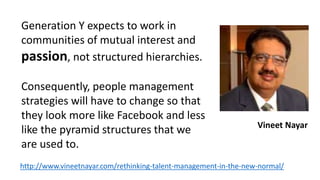
Generation Y expects to work in 
communities of mutual interest and 
passion, not structured hierarchies. 
Consequently, people management 
strategies will have to change so that 
they look more like Facebook and less 
like the pyramid structures that we 
are used to. 
Vineet Nayar 
http://www.vineetnayar.com/rethinking-talent-management-in-the-new-normal/
Have conversations with staff about 
 their likes and dislikes of their current work. 
 their strengths and how to dedicate more of 
their time on things they love. 
http://www.managementexchange.com/story/atlassians-big-experiment-performance-reviews
Studies show that people who are intrinsically 
motivated, i.e. motivated by, for example, 
satisfying own curiosity, learning new skills and/or 
having fun, are 3 times more engaged than 
people who are motivated primarily by extrinsic 
rewards such as money. 
http://intl-rop.sagepub.com/content/early/2011/10/19/0734371X11421495 
http://blogs.hbr.org/cs/2013/04/does_money_really_affect_motiv.html
Further inspiration 
http://www.slideshare.net/frankcalberg/questions-to-discover-your-values 
http://www.slideshare.net/frankcalberg/how-do-you-manage-your-emotions 
http://www.scribd.com/doc/36349465/Capital
Question # 2 
To what extent is what 
you do meaningful?
Motivation is the act or process of 
providing a motive that causes a 
person to take some action. 
http://www.jblearning.com/samples/076373473X/3473X_CH02_4759.pdf
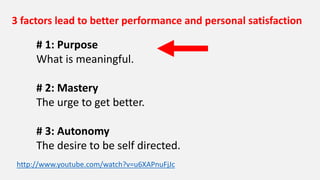
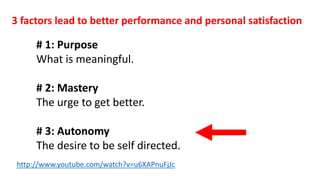
3 factors lead to better performance and personal satisfaction 
# 1: Purpose 
What is meaningful. 
# 2: Mastery 
The urge to get better. 
# 3: Autonomy 
The desire to be self directed. 
http://www.youtube.com/watch?v=u6XAPnuFjJc
Herzberg’s theory of motivation suggests you need to 
ask yourself, for example, these questions: 
 Is this work meaningful to me? 
 Will I have an opportunity for recognition 
and achievement? 
 Am I going to learn new things? 
http://www.fastcompany.com/1836982/clayton-christensen-how-find-work-you-love
Further inspiration 
http://www.slideshare.net/frankcalberg/what-is-the-company-purpose
Question # 3 
To what extent is what 
you do needed?
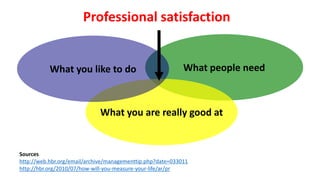
Professional satisfaction 
What people need 
What you find interesting 
What you are really good at 
Sources 
http://web.hbr.org/email/archive/managementtip.php?date=033011 
http://hbr.org/2010/07/how-will-you-measure-your-life/ar/pr
Further inspiration 
http://www.slideshare.net/frankcalberg/pestel 
http://www.slideshare.net/frankcalberg/customer-needs
Question # 4 
To what extent do you 
set goals for what you 
want to achieve?
When people set goals for themselves, 
healthy things usually happen. 
But goals imposed by others, for example sales 
targets, quarterly returns, standardized testscores, 
can sometimes have dangerous side effects. 
Daniel H. Pink: Drive, p. 50. 
https://www.goodreads.com/review/show/1065405301
On his theory y, Douglas Mcgregor notes 
that if people are committed to a goal, 
they will seek responsibility. 
Daniel H. Pink: Drive, p. 195. https://www.goodreads.com/review/show/1065405301 
http://faculty.haas.berkeley.edu/kurkoski/ba105/readings/basic%20motivation%20concepts.pdf
Locke’s goal setting theory hypothesizes 
that by establishing goals, individuals are 
motivated to take action to achieve those 
goals. 
http://www.jblearning.com/samples/076373473X/3473X_CH02_4759.pdf
Goal setting has a positive 
effect on student motivation. 
http://blogs.edweek.org/teachers/classroom_qa_with_larry_ferlazzo/2012/01/matt_townsley_asked_carol_boston.html
Studies show that to think and produce creatively, 
people must forget about pleasing an audience, or 
pleasing critics, or winning prizes, or earning 
royalties. All such thoughts stifle creativity. 
Instead they must focus fully on the product they 
are trying to create, as if creating it for its own sake. 
http://www.alternet.org/books/why-students-learn-better-playful-environment
Goal setting increases extrinsic motivation. 
However, it can harm intrinsic motivation – by 
engaging people in a task for its own sake. 
http://www.hbs.edu/research/pdf/09-083.pdf
Setting goals is an effective method to track 
achievement. 
Too much emphasis on performance goals 
may encourage unethical or unnecessarily 
risky behavior. 
http://www.strategy-business.com/re/recentresearch/re00064
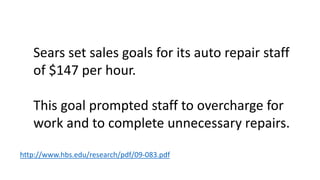
Sears set sales goals for its auto repair staff 
of $147 per hour. 
This goal prompted staff to overcharge for 
work and to complete unnecessary repairs. 
http://www.hbs.edu/research/pdf/09-083.pdf
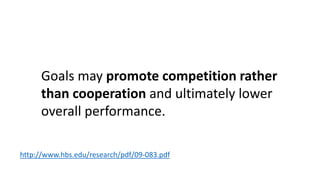
Goals may promote competition rather 
than cooperation and ultimately lower 
overall performance. 
http://www.hbs.edu/research/pdf/09-083.pdf
Further inspiration 
http://www.slideshare.net/frankcalberg/strategy-paradoxes-3551177
Question # 5 
To what extent are you free 
to do what you want to do?
3 factors lead to better performance and personal satisfaction 
# 1: Purpose 
What is meaningful. 
# 2: Mastery 
The urge to get better. 
# 3: Autonomy 
The desire to be self directed. 
http://www.youtube.com/watch?v=u6XAPnuFjJc
When a person can do a task in his/her own 
way, i.e. decide herself/himself how 
she/he wants to do the task, she/he will be 
more motivated to do the task. 
https://www.goodreads.com/review/show/1065405301 
Daniel H. Pink: Drive, p. 63.
Hundred of studies show that when people are free to 
do something, they 
 become more creative, 
 solve problems better, 
 perform better, 
 have more positive emotions, and 
 have a better psychological and physical wellness. 
http://youtu.be/VGrcets0E6I 
Daniel H. Pink: Drive, p. 63. https://www.goodreads.com/review/show/1065405301
To support a person in becoming more autonomously 
motivated, you need to 
 find out how the person sees the situation, 
 provide the person with choices to decide from, 
 helping her/him try new ways, 
 encouraging her/him to take initiative, 
 provide her/him with a meaningful rationale. 
http://youtu.be/VGrcets0E6I
Further inspiration 
http://www.slideshare.net/frankcalberg/good-leadership 
http://www.slideshare.net/frankcalberg/listening-tips 
http://www.slideshare.net/frankcalberg/social-competence 
http://www.scribd.com/doc/32211076/Power-distance 
http://www.slideshare.net/frankcalberg/power-to-the-people-34722633
Question # 6 
To what extent do you 
give and/or receive 
useful information?
Teresa Amabile found out that when people 
get specific, meaningful information about 
their work, they become more motivated. 
Daniel H. Pink: Drive, p. 67. 
https://www.goodreads.com/review/show/1065405301
Question # 7 
To what extent do you give 
and/or receive feedback?
Feedback is great motivation. 
http://howwelead.org/2011/04/02/feedback-is-great-motivation/
Herzberg’s approach suggests that individuals 
have desires behind hygienes such as salary, 
and that motivators such as recognition for 
achievement are very important to them. 
http://www.jblearning.com/samples/076373473X/3473X_CH02_4759.pdf
We should praise effort and strategy rather than 
praising intelligence. 
When we praise, for example, a child's effort on 
learning something, the kid will understand that 
effort will lead to mastery and growth and will 
take on new tasks to progress further. 
Research by Carol Dweck. 
https://www.goodreads.com/review/show/1065405301 
Daniel H. Pink: Drive, p. 178.
Further inspiration 
http://www.slideshare.net/frankcalberg/feedback-tips
Question # 8 
What kind of work and 
living environments do you 
need to do your best work?
Don’t ask “How can you motivate other 
people?”. Instead, ask “How can you 
create the conditions within which 
people will motivate themselves?” 
http://youtu.be/VGrcets0E6I 13:25.
Further inspiration 
http://www.pinterest.com/frankcalberg/outdoor-work-and-living-environments/ 
http://www.pinterest.com/frankcalberg/indoor-work-and-living-spaces/
Question # 9 
How often do you ask 
people questions?
Lead with questions, not with answers. 
Advice by Jim Collins. 
https://www.goodreads.com/review/show/1065405301 
Daniel H. Pink: Drive, p. 198.
Further inspiration 
http://www.slideshare.net/frankcalberg/questions-that-challenge-the-way-you-think 
http://www.slideshare.net/frankcalberg/question-types
Question # 10 
How easy is it for you to 
speak up when you see 
a problem?
Build red flag mechanisms. 
In other words, make it easy for people to 
speak up when they identify a problem. 
Advice by Jim Collins. 
https://www.goodreads.com/review/show/1065405301 
Daniel H. Pink: Drive, p. 198.
Question # 11 
To what extent do you 
give and/or receive 
unexpected rewards?
The highest levels of creativity were produced 
by people who received a reward as a kind of 
bonus, an unexpected reward. 
Research by Teresa Amabile. 
https://www.goodreads.com/review/show/1065405301 
Daniel H. Pink: Drive, p. 66.
B. F. Skinner proposed that individuals 
are motivated when their behaviors 
are reinforced. 
http://www.jblearning.com/samples/076373473X/3473X_CH02_4759.pdf
When you're talking about rote simple tasks, 
using rewards can be effective. 
Richard Ryan 
http://www.rochestercitynewspaper.com/news/articles/2010/12/PSYCHOLOGY-Cracking-the-mystery-of-motivation/
B. F. Skinner found that he could motivate a rat 
to complete the boring task of negotiating a 
maze by 
 providing the right incentive - corn at 
the maze’s center. 
 punishing the rat with an electric shock 
each time it took a wrong turn. 
https://www.mckinseyquarterly.com/Organization/Change_Management/The_psychology_of_change_management_1316
Over time, Skinner’s rats became bored with corn and 
began to ignore the electric shocks. 
In our experience, a similar phenomenon often prevents 
organizations from sustaining higher performance: 
structures and processes that initially reinforce or 
condition the new behavior do not guarantee that 
it will endure. 
https://www.mckinseyquarterly.com/Organization/Change_Management/The_psychology_of_change_management_1316
As far back as 1911, Frederick Taylor and his 
scientific management associate described 
money as the most important factor in 
motivating the industrial workers 
to achieve greater productivity. 
http://www.webpages.uidaho.edu/~mbolin/tella2.pdf
We are all motivated by both intrinsic 
and extrinsic factors in all our decisions. 
http://principlesoffailure.blogspot.com/2010/09/discover-what-motivates-you.html
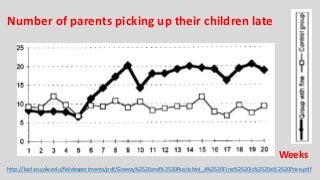
Be careful 
Offering money can be counterproductive.
A study in Sweden, which has a purely voluntary blood 
donation system, showed that women’s contributions 
decreased when they were offered payments. 
Donating blood is a way for people to signal that they 
are the kind willing to sacrifice for the good 
of others; offering money spoiled that effect. 
http://hbr.org/2011/07/the-unselfish-gene/ar/6
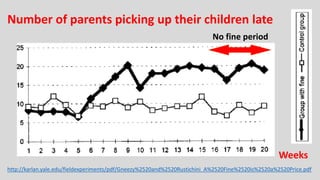
Weeks 
Number of parents picking up their children late 
http://karlan.yale.edu/fieldexperiments/pdf/Gneezy%2520and%2520Rustichini_A%2520Fine%2520is%2520a%2520Price.pdf
Further inspiration 
http://www.slideshare.net/frankcalberg/how-are-people-paid-for-what-they-do
Question # 12 
How often do you 
evaluate yourself?
Were you better today than you 
were yesterday? Why / why not? 
Daniel H. Pink: Drive, p. 154. 
https://www.goodreads.com/review/show/1065405301
Further inspiration 
http://youtu.be/vldjedAashA
Thank you for your interest. For further inspiration and 
personalized services, feel welcome to visit 
http://www.frankcalberg.com 
Have a great day.

Increase motivation

  • 1.
  • 2.
    Question # 1 To what extent do you find what you do interesting?
  • 3.
    The desire todo something because you find it deeply satisfying and personally challenging inspires the highest levels of creativity, whether it's in the arts, sciences, or business. http://hbswk.hbs.edu/item/5902.html Teresa Amabile
  • 4.
    When curiosity isguiding discoveries and learning, people are more likely to experience a sense of astonishment and sincere surprise, which forms the impetus for the quick absorption of new material and skills, thereby contributing to building their competence. http://www.selfdeterminationtheory.org/wp-content/uploads/2014/07/2013_VansteenkisteRyan_JOPI2.pdf
  • 5.
  • 6.
    Human capabilities Description Level 6: Passion Get large meaning out of work. Level 5: Creativity Come up with new ideas. Level 4: Initiative Do things before being asked. Level 3: Intellect Bring best practices to work. Level 2: Diligence Work hard. Level 1: Obedience Do what you are told. http://youtu.be/VlDxHfsW_-8
  • 7.
    Enjoyment based intrinsicmotivation, i.e. how a person feels when working on a task, is the strongest and most pervasive driver. Survey of 684 open-source developers by Karim Lakhani and Bob Wolf. https://www.goodreads.com/review/show/1065405301 Daniel H. Pink: Drive, p. 23.
  • 8.
    Frederick Herzberg's 2-factortheory, which focuses on the idea that the factors that determine job dissatisfaction ("hygiene factors") are completely separate from those that determine true satisfaction ("motivators"). Insufficient financial compensation, for example, falls into the former camp. But having sufficient compensation will not lead to passion for a job; it just takes away the dissatisfaction. Motivation, according to the theory, is determined not by material incentives, but rather by interesting work, recognition, and personal growth. http://hbswk.hbs.edu/item/6991.html
  • 9.
    In a nowclassical experiment (see Deci, 1975), college students were either paid or not paid to work for a certain time on an interesting puzzle. Those in the no-reward condition played with the puzzle significantly more in a later unrewarded “free-time” period than paid subjects, and also reported a greater interest in the task. http://www.princeton.edu/~rbenabou/papers/RES2003.pdf
  • 10.
    Generation Y expectsto work in communities of mutual interest and passion, not structured hierarchies. Consequently, people management strategies will have to change so that they look more like Facebook and less like the pyramid structures that we are used to. Vineet Nayar http://www.vineetnayar.com/rethinking-talent-management-in-the-new-normal/
  • 11.
    Have conversations withstaff about  their likes and dislikes of their current work.  their strengths and how to dedicate more of their time on things they love. http://www.managementexchange.com/story/atlassians-big-experiment-performance-reviews
  • 12.
    Studies show thatpeople who are intrinsically motivated, i.e. motivated by, for example, satisfying own curiosity, learning new skills and/or having fun, are 3 times more engaged than people who are motivated primarily by extrinsic rewards such as money. http://intl-rop.sagepub.com/content/early/2011/10/19/0734371X11421495 http://blogs.hbr.org/cs/2013/04/does_money_really_affect_motiv.html
  • 13.
    Further inspiration http://www.slideshare.net/frankcalberg/questions-to-discover-your-values http://www.slideshare.net/frankcalberg/how-do-you-manage-your-emotions http://www.scribd.com/doc/36349465/Capital
  • 14.
    Question # 2 To what extent is what you do meaningful?
  • 15.
    Motivation is theact or process of providing a motive that causes a person to take some action. http://www.jblearning.com/samples/076373473X/3473X_CH02_4759.pdf
  • 16.
    3 factors leadto better performance and personal satisfaction # 1: Purpose What is meaningful. # 2: Mastery The urge to get better. # 3: Autonomy The desire to be self directed. http://www.youtube.com/watch?v=u6XAPnuFjJc
  • 17.
    Herzberg’s theory ofmotivation suggests you need to ask yourself, for example, these questions:  Is this work meaningful to me?  Will I have an opportunity for recognition and achievement?  Am I going to learn new things? http://www.fastcompany.com/1836982/clayton-christensen-how-find-work-you-love
  • 18.
  • 19.
    Question # 3 To what extent is what you do needed?
  • 20.
    Professional satisfaction Whatpeople need What you find interesting What you are really good at Sources http://web.hbr.org/email/archive/managementtip.php?date=033011 http://hbr.org/2010/07/how-will-you-measure-your-life/ar/pr
  • 21.
    Further inspiration http://www.slideshare.net/frankcalberg/pestel http://www.slideshare.net/frankcalberg/customer-needs
  • 22.
    Question # 4 To what extent do you set goals for what you want to achieve?
  • 23.
    When people setgoals for themselves, healthy things usually happen. But goals imposed by others, for example sales targets, quarterly returns, standardized testscores, can sometimes have dangerous side effects. Daniel H. Pink: Drive, p. 50. https://www.goodreads.com/review/show/1065405301
  • 24.
    On his theoryy, Douglas Mcgregor notes that if people are committed to a goal, they will seek responsibility. Daniel H. Pink: Drive, p. 195. https://www.goodreads.com/review/show/1065405301 http://faculty.haas.berkeley.edu/kurkoski/ba105/readings/basic%20motivation%20concepts.pdf
  • 25.
    Locke’s goal settingtheory hypothesizes that by establishing goals, individuals are motivated to take action to achieve those goals. http://www.jblearning.com/samples/076373473X/3473X_CH02_4759.pdf
  • 26.
    Goal setting hasa positive effect on student motivation. http://blogs.edweek.org/teachers/classroom_qa_with_larry_ferlazzo/2012/01/matt_townsley_asked_carol_boston.html
  • 27.
    Studies show thatto think and produce creatively, people must forget about pleasing an audience, or pleasing critics, or winning prizes, or earning royalties. All such thoughts stifle creativity. Instead they must focus fully on the product they are trying to create, as if creating it for its own sake. http://www.alternet.org/books/why-students-learn-better-playful-environment
  • 28.
    Goal setting increasesextrinsic motivation. However, it can harm intrinsic motivation – by engaging people in a task for its own sake. http://www.hbs.edu/research/pdf/09-083.pdf
  • 29.
    Setting goals isan effective method to track achievement. Too much emphasis on performance goals may encourage unethical or unnecessarily risky behavior. http://www.strategy-business.com/re/recentresearch/re00064
  • 30.
    Sears set salesgoals for its auto repair staff of $147 per hour. This goal prompted staff to overcharge for work and to complete unnecessary repairs. http://www.hbs.edu/research/pdf/09-083.pdf
  • 31.
    Goals may promotecompetition rather than cooperation and ultimately lower overall performance. http://www.hbs.edu/research/pdf/09-083.pdf
  • 32.
  • 33.
    Question # 5 To what extent are you free to do what you want to do?
  • 34.
    3 factors leadto better performance and personal satisfaction # 1: Purpose What is meaningful. # 2: Mastery The urge to get better. # 3: Autonomy The desire to be self directed. http://www.youtube.com/watch?v=u6XAPnuFjJc
  • 35.
    When a personcan do a task in his/her own way, i.e. decide herself/himself how she/he wants to do the task, she/he will be more motivated to do the task. https://www.goodreads.com/review/show/1065405301 Daniel H. Pink: Drive, p. 63.
  • 36.
    Hundred of studiesshow that when people are free to do something, they  become more creative,  solve problems better,  perform better,  have more positive emotions, and  have a better psychological and physical wellness. http://youtu.be/VGrcets0E6I Daniel H. Pink: Drive, p. 63. https://www.goodreads.com/review/show/1065405301
  • 37.
    To support aperson in becoming more autonomously motivated, you need to  find out how the person sees the situation,  provide the person with choices to decide from,  helping her/him try new ways,  encouraging her/him to take initiative,  provide her/him with a meaningful rationale. http://youtu.be/VGrcets0E6I
  • 38.
    Further inspiration http://www.slideshare.net/frankcalberg/good-leadership http://www.slideshare.net/frankcalberg/listening-tips http://www.slideshare.net/frankcalberg/social-competence http://www.scribd.com/doc/32211076/Power-distance http://www.slideshare.net/frankcalberg/power-to-the-people-34722633
  • 39.
    Question # 6 To what extent do you give and/or receive useful information?
  • 40.
    Teresa Amabile foundout that when people get specific, meaningful information about their work, they become more motivated. Daniel H. Pink: Drive, p. 67. https://www.goodreads.com/review/show/1065405301
  • 41.
    Question # 7 To what extent do you give and/or receive feedback?
  • 42.
    Feedback is greatmotivation. http://howwelead.org/2011/04/02/feedback-is-great-motivation/
  • 43.
    Herzberg’s approach suggeststhat individuals have desires behind hygienes such as salary, and that motivators such as recognition for achievement are very important to them. http://www.jblearning.com/samples/076373473X/3473X_CH02_4759.pdf
  • 44.
    We should praiseeffort and strategy rather than praising intelligence. When we praise, for example, a child's effort on learning something, the kid will understand that effort will lead to mastery and growth and will take on new tasks to progress further. Research by Carol Dweck. https://www.goodreads.com/review/show/1065405301 Daniel H. Pink: Drive, p. 178.
  • 45.
  • 46.
    Question # 8 What kind of work and living environments do you need to do your best work?
  • 47.
    Don’t ask “Howcan you motivate other people?”. Instead, ask “How can you create the conditions within which people will motivate themselves?” http://youtu.be/VGrcets0E6I 13:25.
  • 48.
    Further inspiration http://www.pinterest.com/frankcalberg/outdoor-work-and-living-environments/ http://www.pinterest.com/frankcalberg/indoor-work-and-living-spaces/
  • 49.
    Question # 9 How often do you ask people questions?
  • 50.
    Lead with questions,not with answers. Advice by Jim Collins. https://www.goodreads.com/review/show/1065405301 Daniel H. Pink: Drive, p. 198.
  • 51.
  • 52.
    Question # 10 How easy is it for you to speak up when you see a problem?
  • 53.
    Build red flagmechanisms. In other words, make it easy for people to speak up when they identify a problem. Advice by Jim Collins. https://www.goodreads.com/review/show/1065405301 Daniel H. Pink: Drive, p. 198.
  • 54.
    Question # 11 To what extent do you give and/or receive unexpected rewards?
  • 55.
    The highest levelsof creativity were produced by people who received a reward as a kind of bonus, an unexpected reward. Research by Teresa Amabile. https://www.goodreads.com/review/show/1065405301 Daniel H. Pink: Drive, p. 66.
  • 56.
    B. F. Skinnerproposed that individuals are motivated when their behaviors are reinforced. http://www.jblearning.com/samples/076373473X/3473X_CH02_4759.pdf
  • 57.
    When you're talkingabout rote simple tasks, using rewards can be effective. Richard Ryan http://www.rochestercitynewspaper.com/news/articles/2010/12/PSYCHOLOGY-Cracking-the-mystery-of-motivation/
  • 58.
    B. F. Skinnerfound that he could motivate a rat to complete the boring task of negotiating a maze by  providing the right incentive - corn at the maze’s center.  punishing the rat with an electric shock each time it took a wrong turn. https://www.mckinseyquarterly.com/Organization/Change_Management/The_psychology_of_change_management_1316
  • 59.
    Over time, Skinner’srats became bored with corn and began to ignore the electric shocks. In our experience, a similar phenomenon often prevents organizations from sustaining higher performance: structures and processes that initially reinforce or condition the new behavior do not guarantee that it will endure. https://www.mckinseyquarterly.com/Organization/Change_Management/The_psychology_of_change_management_1316
  • 60.
    As far backas 1911, Frederick Taylor and his scientific management associate described money as the most important factor in motivating the industrial workers to achieve greater productivity. http://www.webpages.uidaho.edu/~mbolin/tella2.pdf
  • 61.
    We are allmotivated by both intrinsic and extrinsic factors in all our decisions. http://principlesoffailure.blogspot.com/2010/09/discover-what-motivates-you.html
  • 62.
    Be careful Offeringmoney can be counterproductive.
  • 63.
    A study inSweden, which has a purely voluntary blood donation system, showed that women’s contributions decreased when they were offered payments. Donating blood is a way for people to signal that they are the kind willing to sacrifice for the good of others; offering money spoiled that effect. http://hbr.org/2011/07/the-unselfish-gene/ar/6
  • 64.
    Weeks Number ofparents picking up their children late http://karlan.yale.edu/fieldexperiments/pdf/Gneezy%2520and%2520Rustichini_A%2520Fine%2520is%2520a%2520Price.pdf
  • 65.
  • 66.
    Question # 12 How often do you evaluate yourself?
  • 67.
    Were you bettertoday than you were yesterday? Why / why not? Daniel H. Pink: Drive, p. 154. https://www.goodreads.com/review/show/1065405301
  • 68.
  • 69.
    Thank you foryour interest. For further inspiration and personalized services, feel welcome to visit http://www.frankcalberg.com Have a great day.