Rethinking
organization
Serve yourself, pay what you think is fair.
When you give a tip / pay / donate, you help to
1. keep content openly accessible for anyone.
2. keep content free of advertisements.
3. support ongoing development - including
updates to existing content as well as creation
of new content.
http://www.frankcalberg.com/thankyou
Question # 1
What if people outside
the company participate?
If you expect your organization to be more
responsive, your team needs context - they need
to know what's going on in your company and in
the market.
Transparency becomes increasingly important.
http://www.inc.com/First-Round-Review/letting-go-of-efficiency-can-accelerate-your-company.html
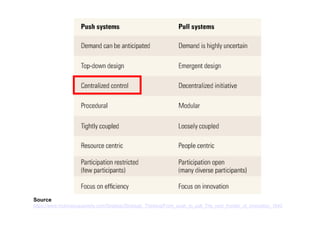
https://www.mckinseyquarterly.com/Strategy/Strategic_Thinking/From_push_to_pull_The_next_frontier_of_innovation_164
What about
inviting people in?
How much
do you
share
publicly? http://jarche.com/2015/01/are-you-prepared/
Further inspiration
http://www.slideshare.net/frankcalberg/facilitationmoderation-of-meetings
http://www.slideshare.net/frankcalberg/email-tips
Question # 2
Should a person do
1 specialized job or
do different types of work?
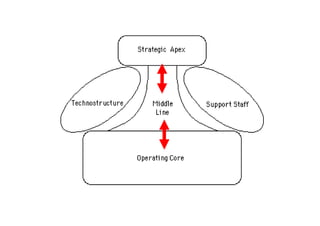
In a sense, the crowning
accomplishment of the hierarchy
and its management processes is
the enterprise on autopilot,
everyone ideally situated as a cog
whirring on a steady, unthinking
and predictable machine.
John Kotter
http://blogs.hbr.org/kotter/2011/05/two-structures-one-organizatio.html
An
assembly
line
https://media.ford.com/content/fordmedia/fna/us/en/features/game-changer--100th-anniversary-of-the-moving-assembly-line.html
http://www.janbosch.com/Jan_Bosch/Presentations_files/ESA2010-Keynote.pdf
Someone else’s job
Malone, Thomas W.: The Future of Work, p. 53.
Specialization prevents people from doing
more jobs which could create more value.
Whether contributing to a
blog, working on an open
source project, or sharing
advice in a forum, people
choose to work on the things
that interest them. Everyone is
an independent contractor.
Gary Hamel
http://blogs.wsj.com/management/2009/03/24/the-facebook-generation-vs-the-fortune-500/
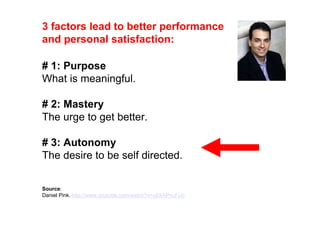
# 1: Purpose
What is meaningful.
# 2: Mastery
The urge to get better.
# 3: Autonomy
The desire to be self directed.
3 factors lead to better performance
and personal satisfaction:
Daniel Pink
http://www.youtube.com/watch?v=u6XAPnuFjJc
Further inspiration
http://www.slideshare.net/frankcalberg/tips-to-increase-motivation
http://www.slideshare.net/frankcalberg/what-is-the-company-purpose
Question # 3
What if people have
no titles, and what if there
is no formal hierarchy?
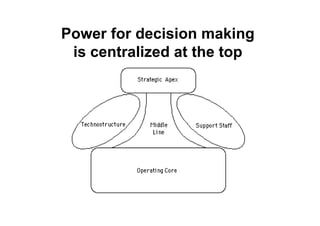
In large organizations, resources
get allocated top-down.
http://blogs.wsj.com/management/2009/03/24/the-facebook-generation-vs-the-fortune-500/
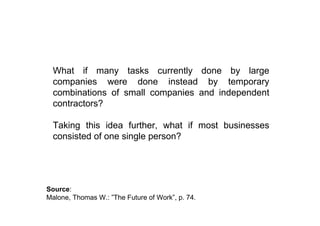
Imagine if there was only 1 venture capital
company in the world, and it was led by, well let’s
say Bill Gates. How much innovation would we
have if there was only 1 place to go for funding?
And yet, inside most organizations, there is only 1
place to go for funding, and that is up the chain of
command.
http://knowledge.ckgsb.edu.cn/2014/12/15/china-business-strategy/the-gary-hamel-interview-unleashing-another-revolution/
http://mixmashup.org/blog/mix-mashup-live-blog
What happens over time is you end up with many
people in leadership positions who aren’t actually
leaders. They’re there because they had good
political skills, they’re there because they had
connections, they’re there because they added
value last year or 5 years ago.
But they’re not there because they are true leaders
and individuals that people want to follow.
http://knowledge.ckgsb.edu.cn/2014/12/15/china-business-strategy/the-gary-hamel-interview-unleashing-another-revolution/
Source
Conversation between Terri Kelly and Gary Hamel.
http://youtu.be/47yk2upT7tM
People, who work for Gore, have no titles.
Those closest to the
front line are going to be
better placed to understand
the increasing demands of
an informed customer and
need to be able to respond
to those demands.
Peter Russian
http://www.mixhackathon.org/hackathon/contribution/how-leaders-and-managers-see-their-purpose
http://www.mixhackathon.org/hackathon/contribution/12-enemies-organizational-adaptability
At Red Hat, the software company, the
strategy making process is open
to the entire organization.
It is a company-wide conversation.
http://knowledge.ckgsb.edu.cn/2014/12/15/china-business-strategy/the-gary-hamel-interview-unleashing-another-revolution/
http://youtu.be/5sddabEDuvw
 People have no titles.
 There is no formal hierarchy.
http://youtu.be/5sddabEDuvw
Initiatives for you to try
Further inspiration
http://www.slideshare.net/frankcalberg/3-ways-of-organizing
http://www.slideshare.net/frankcalberg/good-leadership
https://delicious.com/frankcalberg/crowdfunding
Question # 4
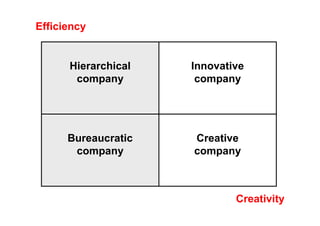
What if creativity is
as important as efficiency?
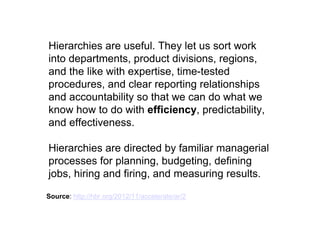
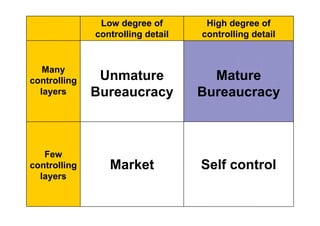
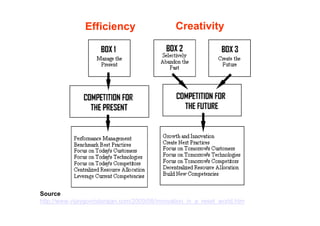
Hierarchies are useful. They let us sort work into
departments, product divisions, regions, and the like with
expertise, time-tested procedures, and clear reporting
relationships and accountability so that we can do what we
know how to do with efficiency, predictability, and
effectiveness.
Hierarchies are directed by familiar managerial processes
for planning, budgeting, defining jobs, hiring and firing, and
measuring results.
http://hbr.org/2012/11/accelerate/ar/2
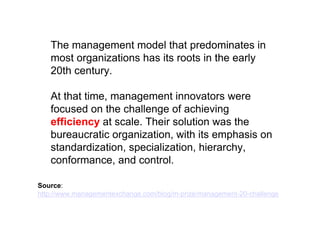
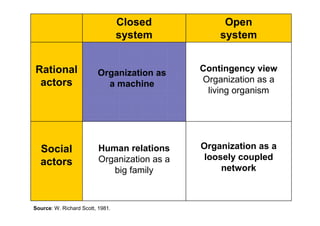
The management model that predominates in most
organizations has its roots in the early 20th century.
At that time, management innovators were focused on
the challenge of achieving efficiency at scale. Their
solution was the bureaucratic organization, with its
emphasis on standardization, specialization, hierarchy,
conformance, and control.
http://www.managementexchange.com/blog/m-prize/management-20-challenge
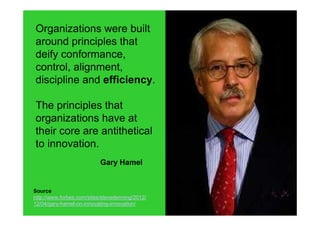
Organizations were built around
principles that deify conformance,
control, alignment, discipline and
efficiency.
The principles that organizations
have at their core are antithetical
to innovation.
Gary Hamel
http://www.forbes.com/sites/stevedenning/2012/12/04/gary-hamel-on-innovating-innovation/
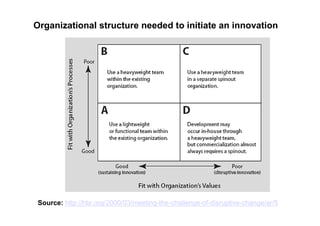
The reason that innovation often seems to be
so difficult for established companies is that
they employ highly capable people and then
set them to work within organizational
structures whose processes and values
weren’t designed for the task at hand.
http://hbr.org/2000/03/meeting-the-challenge-of-disruptive-change/ar/7
http://blogs.hbr.org/kotter/2011/05/two-structures-one-organizatio.html
http://hbr.org/2012/11/accelerate/ar/1
John Kotter.
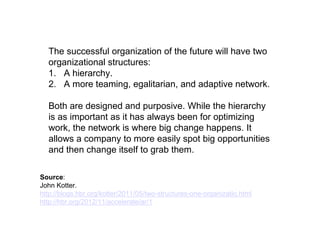
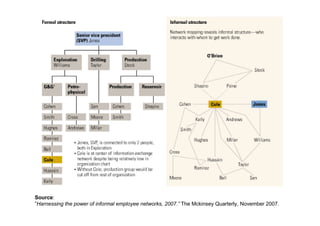
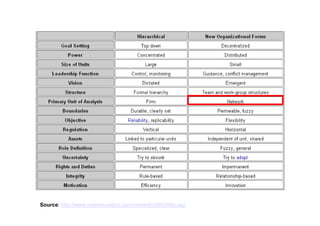
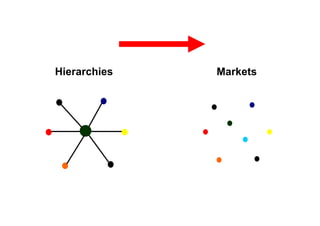
The successful organization of the future will have 2 organizational
structures:
1. A hierarchy.
2. A more teaming, egalitarian, and adaptive network.
Both are designed and purposive. While the hierarchy is as
important as it has always been for optimizing work, the network
is where big change happens. It allows a company to more
easily spot big opportunities and then change itself to grab them.
Further inspiration
http://www.slideshare.net/frankcalberg/creativity-exercises
http://issuu.com/frankcalberg/docs/brainstormingdisney
http://www.slideshare.net/frankcalberg/six-thinking-hats-9989762
http://www.slideshare.net/frankcalberg/brainstorming-the-scamper-method
Question # 5
What if people
try their ideas out?
Because strategic planning generally happens
annually, it shares the same shortcomings for
companies as for countries with centrally planned
economies: misallocation of resources when market
conditions change and difficulty responding to
changed realities.
http://sloanreview.mit.edu/article/how-strategic-is-your-board/
In an era that demands you leverage the
benefits of unpredictability, you need to
create a culture of hypothesis-testing and
quickly change course based on results.
http://www.inc.com/First-Round-Review/letting-go-of-efficiency-can-accelerate-your-company.html
experiments require short-term losses for long-term gains
Experiments require short-term
losses for long-term gains.
http://hbr.org/2010/04/column-why-businesses-dont-experiment/ar/1
http://www.managementexchange.com/hack/%22quests%22-organizing-principles
A person, who is excited about
an idea, tries it out.
Further inspiration
http://www.slideshare.net/frankcalberg/inputs-to-become-more-agile
http://www.slideshare.net/frankcalberg/strategy-paradoxes-3551177
Question # 6
What if people take
decisions themselves?
Top-down, control-based hierarchical
structures discourage individual initiative
and reduce autonomy.
http://www.mixhackathon.org/hackathon/contribution/12-enemies-organizational-adaptability
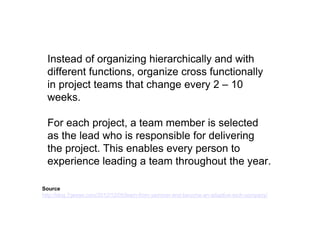
Instead of organizing hierarchically and with different
functions, organize cross functionally in project
teams that change every 2 – 10 weeks.
For each project, a team member is selected as the
lead who is responsible for delivering the project.
This enables every person to experience
leading a team throughout the year.
http://blog.7geese.com/2012/12/05/learn-from-yammer-and-become-an-adaptive-tech-company/
In an adaptive organization, the decision-
making is pushed to the edges. This
reduces communication barriers and
empowers the employees on the front-line
to make decisions.
Supercell is organized as a collection of small, independent
teams called cells tasked with developing new games or
building new deep features for existing games.
Cells have complete autonomy in terms of how they
organize themselves, prioritize ideas, distribute work and
determine what they ultimately produce. The company as
a whole is merely an aggregation of these cells; a
Supercell.
http://blog.idonethis.com/post/48277151394/least-powerful-ceo
At a plant of General Electric in Durham, North
Carolina, USA, a plant that does the final assembly
for the largest jet engines in the world, they have
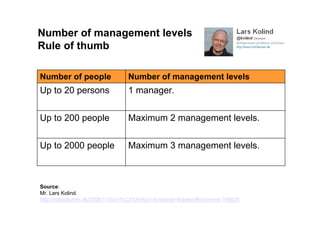
400 employees and 1 plant manager.
So those employees are doing, for example,
production scheduling, quality control and training –
tasks that, historically, we saw as managerial work.
http://knowledge.ckgsb.edu.cn/2014/12/15/china-business-strategy/the-gary-hamel-interview-unleashing-another-revolution/
# 1: Purpose
What is meaningful.
# 2: Mastery
The urge to get better.
# 3: Autonomy
The desire to be self directed.
3 factors lead to better performance
and personal satisfaction:
Daniel Pink
http://www.youtube.com/watch?v=u6XAPnuFjJc
 Leaders are chosen by people they lead.
 The span of control is 400 to 1 or greater.
 Compensation decisions are peer based.
http://youtu.be/5sddabEDuvw
Initiatives for you to try
Further inspiration
http://www.slideshare.net/frankcalberg/questions-to-discover-your-values
http://www.slideshare.net/frankcalberg/values-43202941
http://www.slideshare.net/frankcalberg/how-are-people-paid-for-what-they-do
http://www.slideshare.net/frankcalberg/inputs-to-become-more-agile
http://www.slideshare.net/frankcalberg/power-distance-34895063
http://www.slideshare.net/frankcalberg/power-to-the-people-34722633
http://www.slideshare.net/frankcalberg/questions-about-organization
Serve yourself, pay what you think is fair.
When you give a tip / pay / donate, you help to
1. keep content openly accessible for anyone.
2. keep content free of advertisements.
3. support ongoing development - including
updates to existing content as well as creation
of new content.
http://www.frankcalberg.com/thankyou
Thank you for your interest. For further inspiration
and personalized services, please feel welcome to visit
http://frankcalberg.com
Have a great day.

Rethinking organization