How can we
rethink
education?
Question # 1
What if learning is
happening anytime?
The digital generation is constantly exchanging
messages, surfing the web, and openly
participating in social networks.
https://www.td.org/Publications/Newsletters/Links/2015/05/Challenge-Your-Assumptions-About-Learners
Further inspiration
http://www.slideshare.net/frankcalberg/11-advantages-of-using-a-blog-for-teaching
Question # 2
What if learning is
happening anywhere?
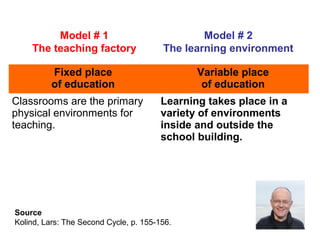
Model # 1
The teaching factory
Model # 2
The learning environment
The lecture hall / classroom
are the primary physical
environments for teaching.
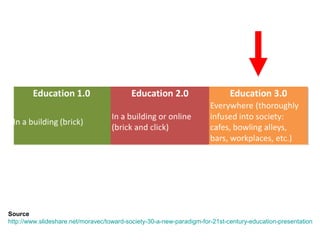
Learning takes place in many
different environments.
Adapted from
Lars Kolind: The Second Cycle, p. 155-156.
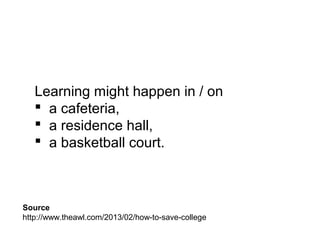
Places where learning might happen
 Where people live.
 Where people work.
 Where people eat.
 Where people do sports.
 Where people have a cup of coffee.
Adapted from
http://www.theawl.com/2013/02/how-to-save-college
http://www.slideshare.net/moravec/toward-society-30-a-new-paradigm-for-21st-century-education-presentation
Further inspiration
https://www.teacherspayteachers.com/Product/Learning-strategies-1487708
Question # 3
What if
education is individualized?
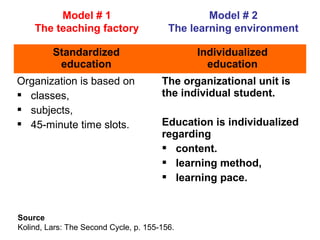
Model # 1
The teaching factory
Model # 2
The learning environment
Education is standardized.
Ways of standardizing
 Subjects.
 Classes.
 45-minute time slots.
Education is individualized.
Ways of individualizing
 Choice of what to learn.
 Choice of where to learn.
 Choice of when to learn.
Adapted from
Lars Kolind: The Second Cycle, p. 155-156.
We actually find that our students personalize
their education much more than it might
seem. They quite selectively access specific
content and quite selectively do background
readings.
http://blog.ted.com/2014/01/28/in-conversation-salman-khan-sebastian-thrun-talk-online-education/
Sebastian Thrun
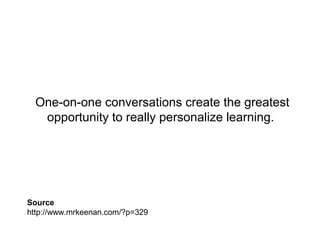
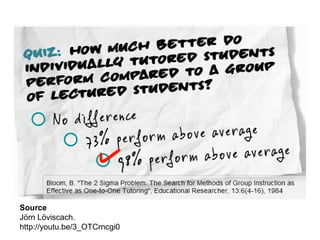
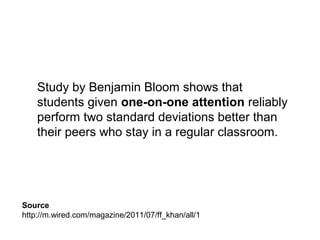
Study shows that students given 1-on-1
attention reliably perform two standard
deviations better than their peers who stay
in a regular classroom.
http://m.wired.com/magazine/2011/07/ff_khan/all/1
We need to enhance every child's
strengths - not fix their deficits.
http://youtu.be/Wk--J3E8yqc
Minute 8:02
Yong Zhao
Question # 4
What if students lead?
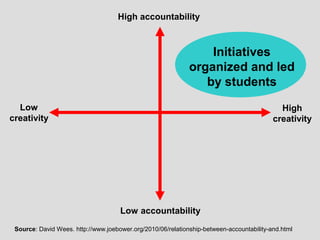
High accountability
Low accountability
High
creativity
Low
creativity
http://www.joebower.org/2010/06/relationship-between-accountability-and.html
Initiatives organized
and led by students
The daily affairs of Sudbury Valley school are
managed by the weekly school meeting, at which
each student and staff member has one vote.
Rules of behavior, use of facilities, expenditures,
staff hiring, and all the routines of running an
institution are determined by debate and vote at
the school meeting.
http://youtu.be/jg9lf7wyQRo
https://www.mckinseyquarterly.com/Strategy/Strategic_Thinking/Reshaping_business_education_in_a_new_era_2500
You’ve got to let the students run the school.
Blair Sheppard
Further inspiration
https://www.teacherspayteachers.com/Product/What-is-good-leadership-1489536
Question # 5
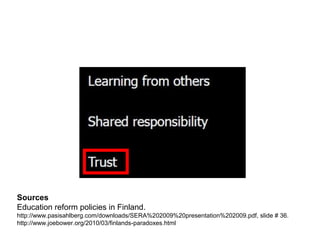
What if
students are trusted?
http://www.joebower.org/2010/03/finlands-paradoxes.html
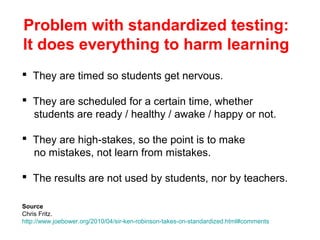
1. Tests are timed, so students get nervous.
2. The point with tests is to make no mistakes
– not learn from mistakes.
3. The results are neither used by students,
nor by teachers.
http://www.joebower.org/2010/04/sir-ken-robinson-takes-on-standardized.html#comments
Some problems with standardized testing
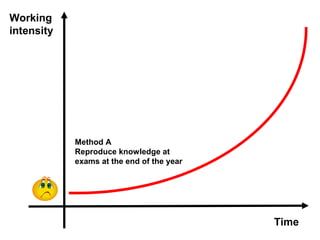
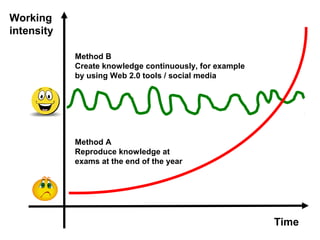
Method A
Reproduce knowledge at exams
at the end of the year
Working
intensity
Time
Method B
Create continuously, for example by
using digital technologies.
Further inspiration
https://www.teacherspayteachers.com/Product/Trust-1957173
Question # 6
What if teachers spend
more time asking questions
than talking / lecturing?
Lectures originate from the
Middle Ages when only 1
person had a book, and the
rest could not read.
Richard David Precht
http://youtu.be/Gewb3-DUlJs
37:45
Research shows that lectures cannot be expected to
lead to comprehension or application of knowledge
and are inefficient in any combination with other
teaching methods.
http://www.brookes.ac.uk/services/ocsld/resources/20reasons.html
Research shows that lectures are very widely
disliked and felt to be inefficient by students.
http://www.brookes.ac.uk/services/ocsld/resources/20reasons.html
Results of a wide range of studies show that
lectures are ineffective for
1. changing attitudes or values,
2. inspiring interest in a subject,
3. teaching behavioural skills.
http://www.tonybates.ca/2014/07/27/why-lectures-are-dead-or-soon-will-be/
Further inspiration
https://www.teacherspayteachers.com/Product/What-do-teachers-do-2178430
Question # 7
What if
students are also teachers?
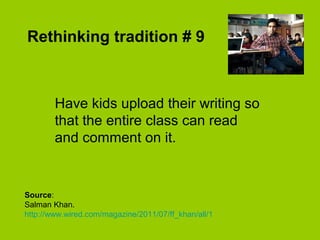
Have kids upload their
writing, so that the entire
class can read and
comment on it.
http://www.wired.com/magazine/2011/07/ff_khan/all/1
Salman Khan
http://youtu.be/RzkwtIMPkrs minute 18.
Peer grading works
Further inspiration
https://www.teacherspayteachers.com/Product/How-do-we-give-and-receive-feedback-1761017
Question # 8
What if there are
no grades, degrees,
or diplomas?
When people are not there yet, i.e. when
they do not have x competencies yet, try
giving them the grade "not yet”.
https://youtu.be/Yl9TVbAal5s
Minute 8:45
The transcript coming out of an
engineering school should be the
things that you have created
along with some feedback from
professors and peers.
http://youtu.be/cj1vGXWMMvs
From 28:30.
Sal Khan
Imagine a world where higher education
doesn't end with a diploma, but starts at
18 and continues through life, as
the world changes around us.
http://www.huffingtonpost.com/tara-lemmey/rethinking-higher-educati_b_387851.html
Question # 9
What if
education = creating things?
Yong Zhao
We need to engage students in
making things – making
books, movies etc. and using
all kinds of technologies /
media in that process.
http://youtu.be/Wk--J3E8yqc
Start finding ways to engage students in
understanding real-world problems,
and then support them in solving those
problems.
http://www.edutopia.org/blog/stop-start-continue-conceptual-meets-applied-david-hawley
More and more people are being hired on their
work samples, on the projects they’ve done,
the type of portfolios they’ve developed.
http://blog.ted.com/2014/01/28/in-conversation-salman-khan-sebastian-thrun-talk-online-education/
Sebastian Thrun
We recently hired two people and we didn’t even
know what their degrees were, if they even had
degrees.
We hired them because of the work they did on
the computer science platform on Khan Academy.
http://blog.ted.com/2014/01/28/in-conversation-salman-khan-sebastian-thrun-talk-online-education/
Salman Khan
http://donaldclarkplanb.blogspot.ch/2015/03/finland-to-scrap-subject-teaching.html
A real business problem, such as running
a café, would be an opportunity to bring
in maths, nutrition, and communications.
Thank you for your interest. For further inspiration
and personalized services, please feel welcome to visit
http://frankcalberg.com
Have a great day.

How can we rethink education?