The Progress Principle
Executive Summary
Managers and clients are always seeking ways to improve a teams
performance, as well as an individuals’ motivation.
Teresa M. Amabile and Steven J. Kramer of Harvard Business Review
provides data driven insight and the tools to help managers and
Scrum Masters to improve team and team member performance
through a principle they coined – “Progress Principle”.
Unknowingly, the Progress Principle is supported in Agile through
rituals: sprint demos, retrospectives and even the daily stand-up. It is
also achieved through Lean and Agile philosophies as well as the
focus on continuous improvement.
Executive Summary Continued
What Teresa and Steven discovered was that, ….“Of all the things that can
boost emotions, motivation, perceptions and ultimately result in higher
performance, the single most important factor is making progress in
meaningful work”.
“The more frequently people experience the sense of progress, the more
likely they are to be creatively productive”…
….“The power of progress is fundamental to human nature, but few
managers understand it or know how to leverage progress to boost
motivation.” In fact, the study reveals that the progress principle is rarely
understood and practiced by leadership.
Executive Summary (Cont.) / Hypotheses
….”A central driver of creative, productive performance was the quality of a
person’s “inner-work life” – the mix of emotions, motivations and perceptions over
the course of a workday”…… in the realm of knowledge work, people are more
creative and productive when the inner work lives are positive…. …….they are
intrinsically motivated.
I would like to hypothesis that the challenge that teams and organizations have
to fully reap the benefits of the Progress Principle; is Executives, Managers and
Scrum Masters need to become more methodical in there approach and
behavior towards:
1. Daily visualizing meaningful progress
2. Removing obstacles/impediments, especially external organizational-
wide issues (Teresa & Steve refer to these as Inhibitors)
3. Emotionally support the individual (Teresa & Steve refer to these as
Nourishers)
The Research
669 Managers surveyed around the world are asked with a survey: What
managerial approaches/tools that can affect employees motivation and
emotions.
7 companies, 26 project teams, 238 individuals, 12,000 diary entries.
In one section of research respondents were asked to rank the following
managerial behaviors/tools that affect employee motivations and emotions
that drives performance:
• Support for making progress in work: (Power of Progress)
• Recognition for good work
• Incentives
• Interpersonal support
• Clear goals
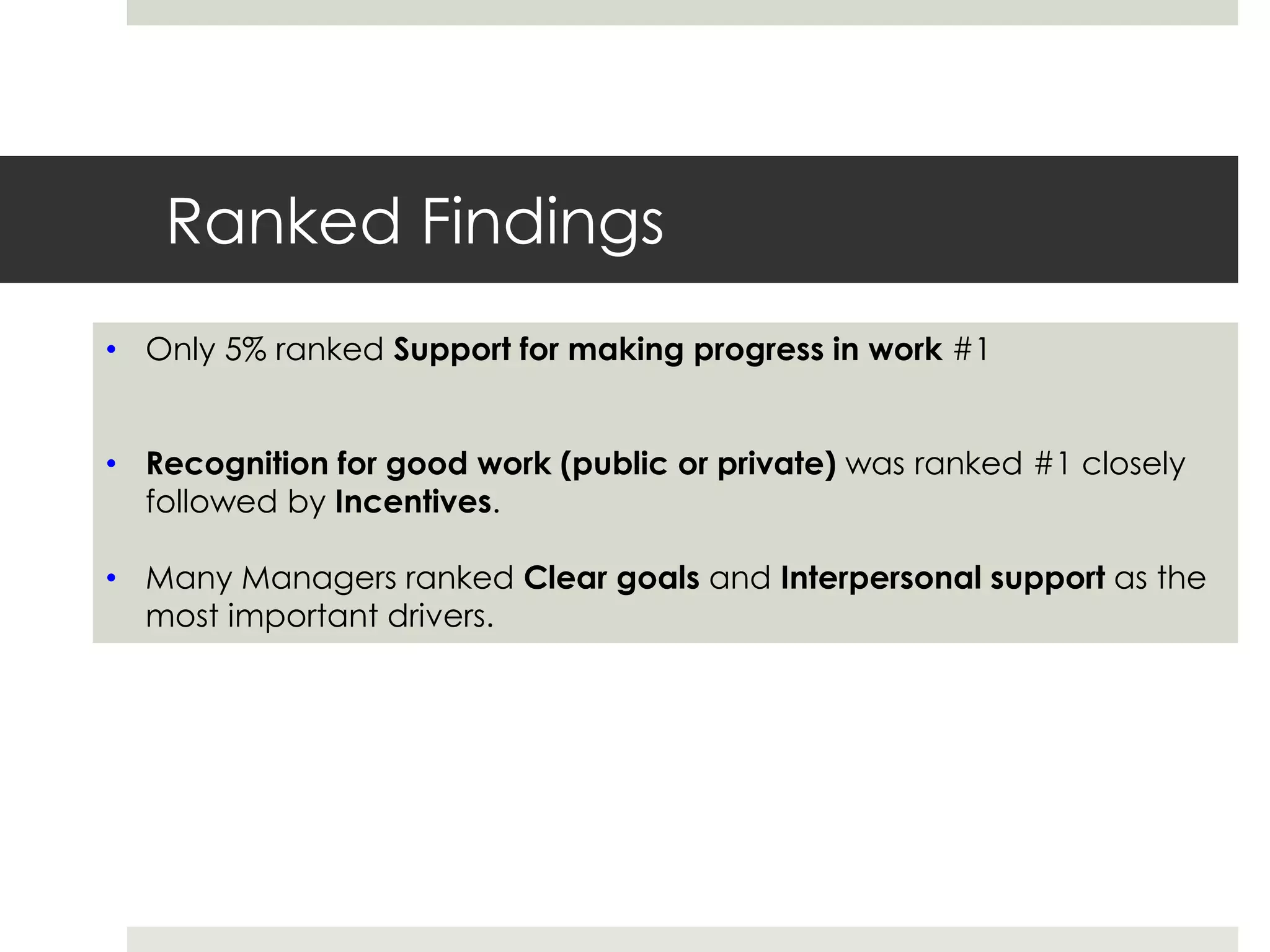
Ranked Findings
• Only 5% ranked Support for making progress in work #1
• Recognition for good work (public or private) was ranked #1 closely
followed by Incentives.
• Many Managers ranked Clear goals and Interpersonal support as the
most important drivers.
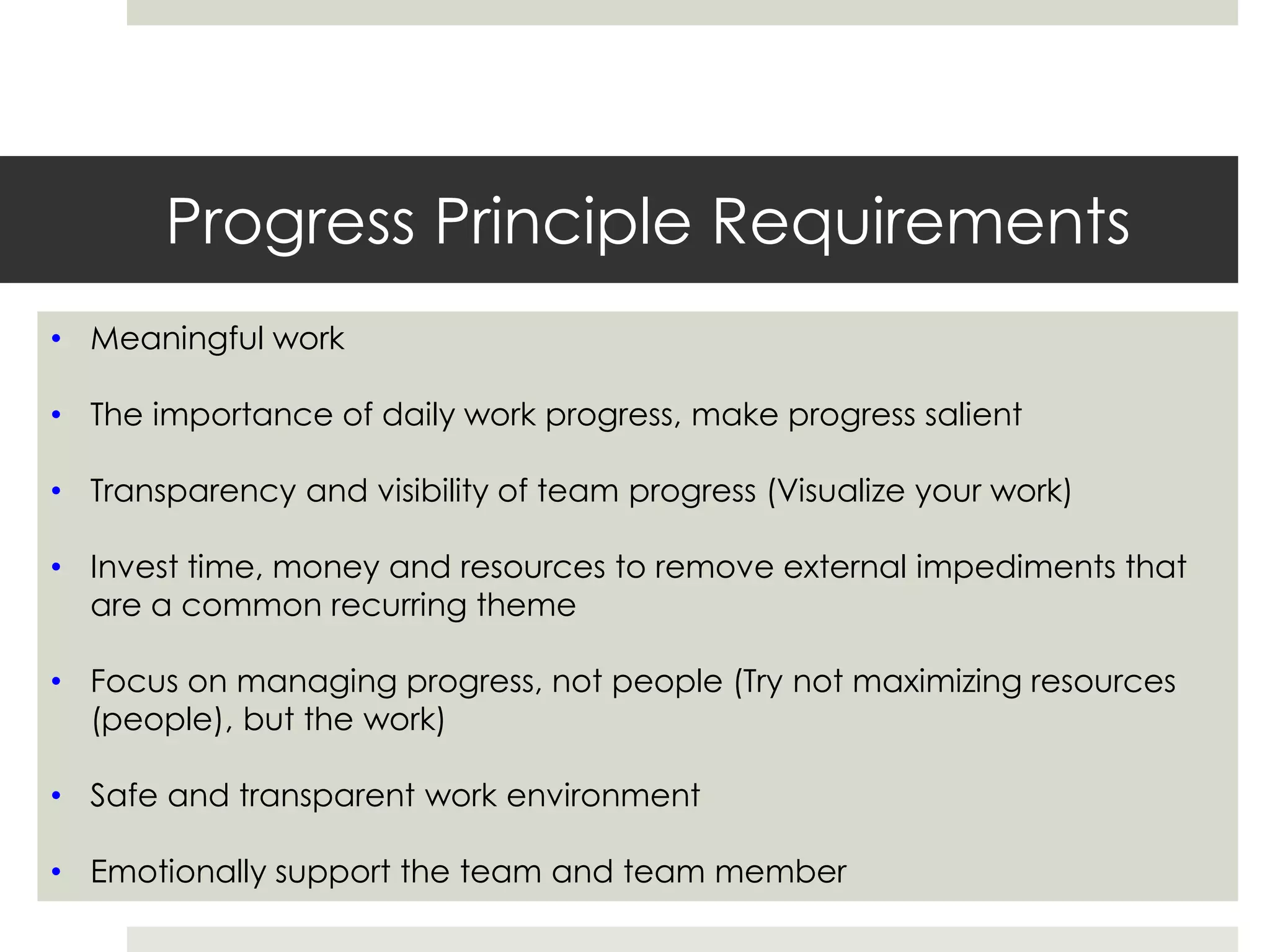
Progress Principle Requirements
• Meaningful work
• The importance of daily work progress, make progress salient
• Transparency and visibility of team progress (Visualize your work)
• Invest time, money and resources to remove external impediments that
are a common recurring theme
• Focus on managing progress, not people (Try not maximizing resources
(people), but the work)
• Safe and transparent work environment
• Emotionally support the team and team member
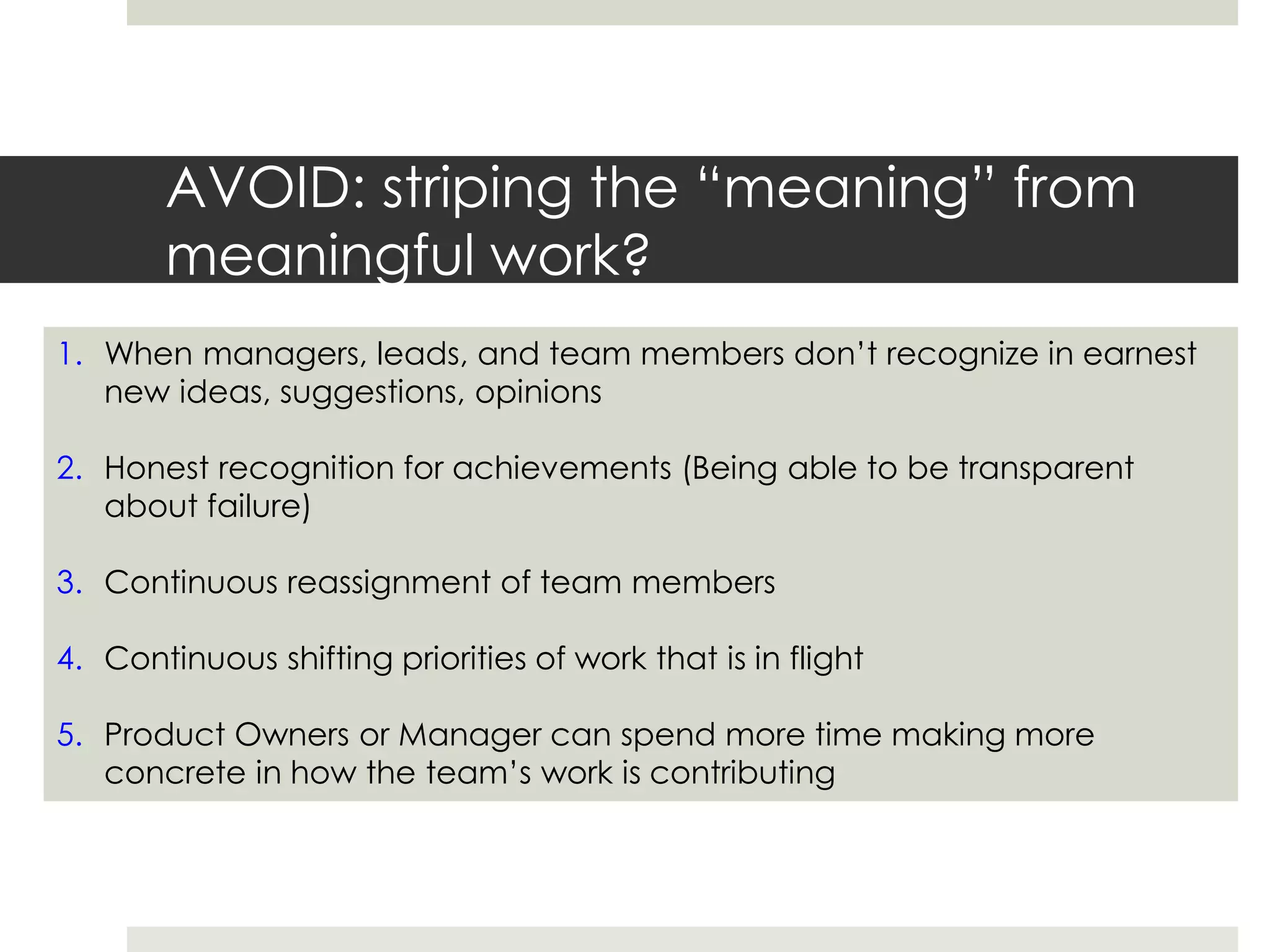
AVOID: striping the “meaning” from
meaningful work?
1. When managers, leads, and team members don’t recognize in earnest
new ideas, suggestions, opinions
2. Honest recognition for achievements (Being able to be transparent
about failure)
3. Continuous reassignment of team members
4. Continuous shifting priorities of work that is in flight
5. Product Owners or Manager can spend more time making more
concrete in how the team’s work is contributing
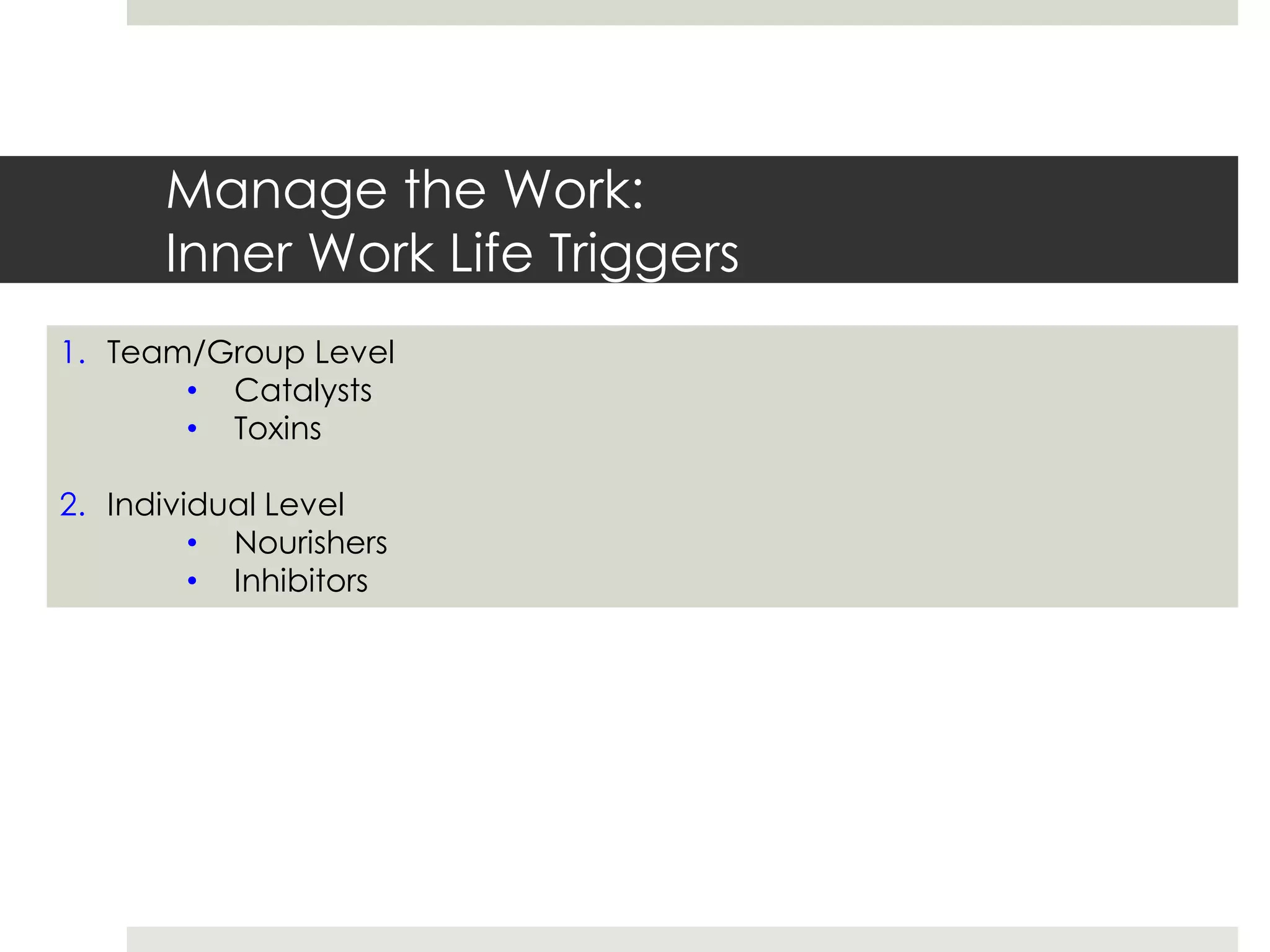
Manage the Work:
Inner Work Life Triggers
1. Team/Group Level
• Catalysts
• Toxins
2. Individual Level
• Nourishers
• Inhibitors
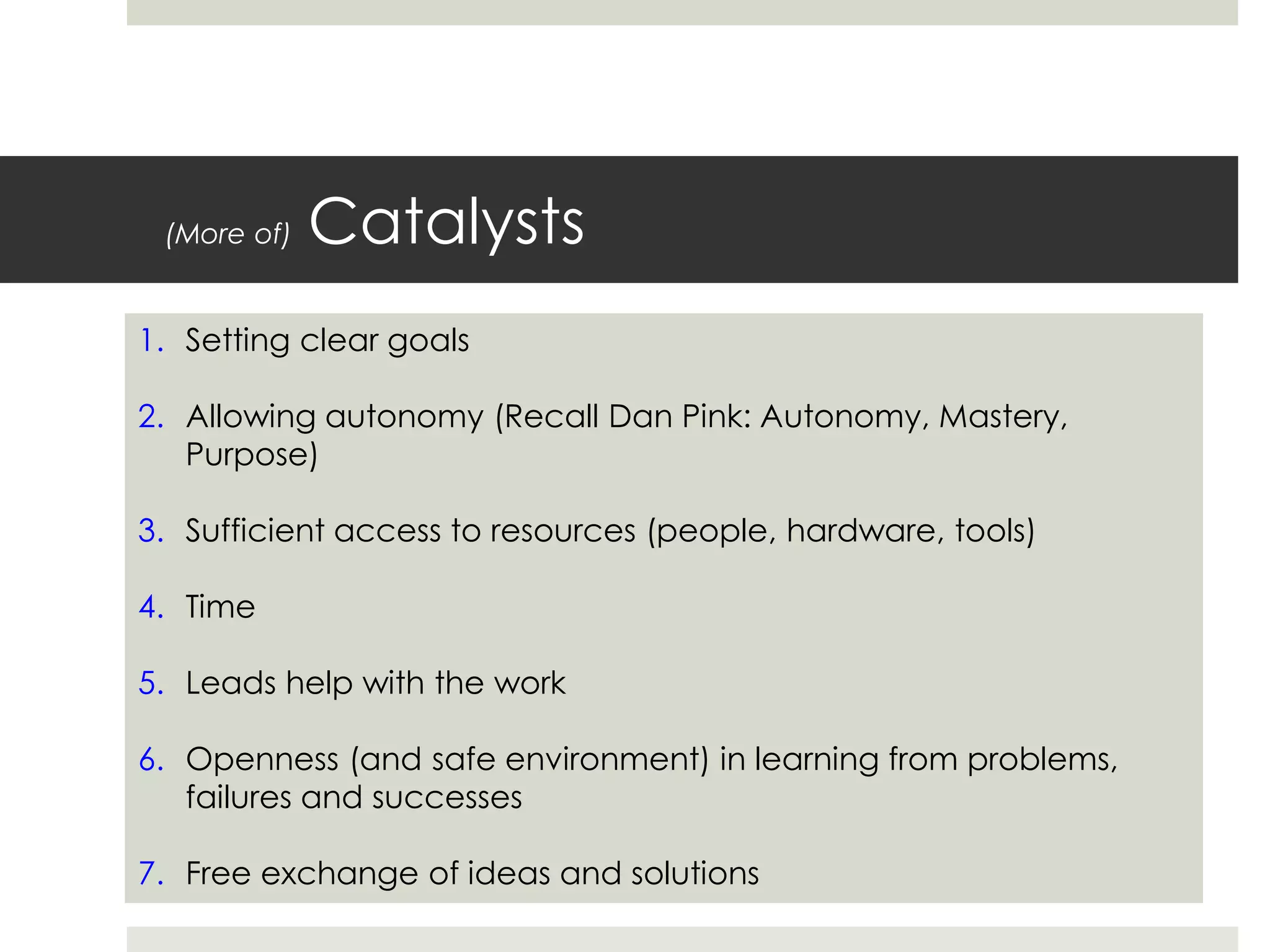
(More of) Catalysts
1. Setting clear goals
2. Allowing autonomy (Recall Dan Pink: Autonomy, Mastery,
Purpose)
3. Sufficient access to resources (people, hardware, tools)
4. Time
5. Leads help with the work
6. Openness (and safe environment) in learning from problems,
failures and successes
7. Free exchange of ideas and solutions
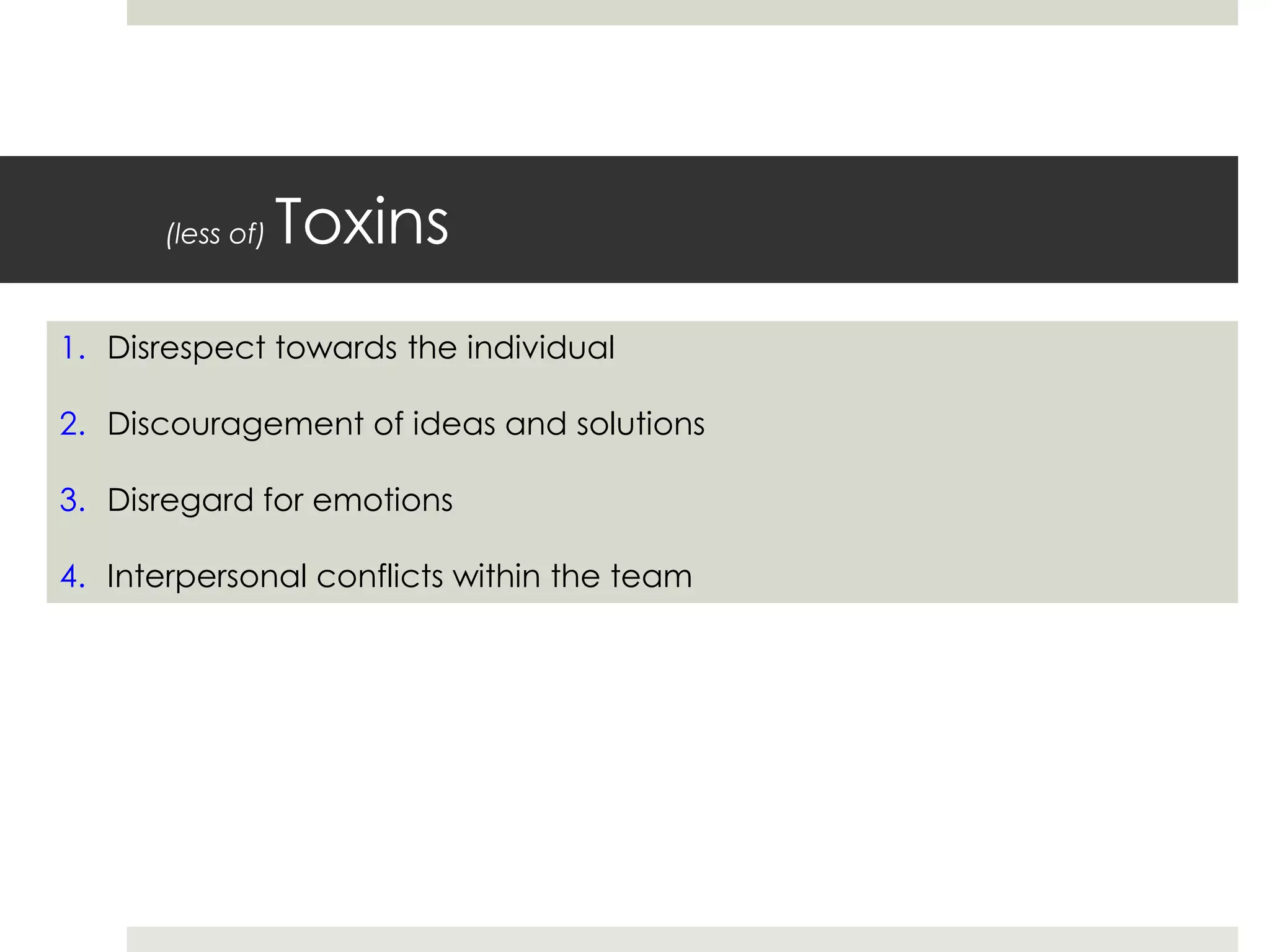
(less of) Toxins
1. Disrespect towards the individual
2. Discouragement of ideas and solutions
3. Disregard for emotions
4. Interpersonal conflicts within the team
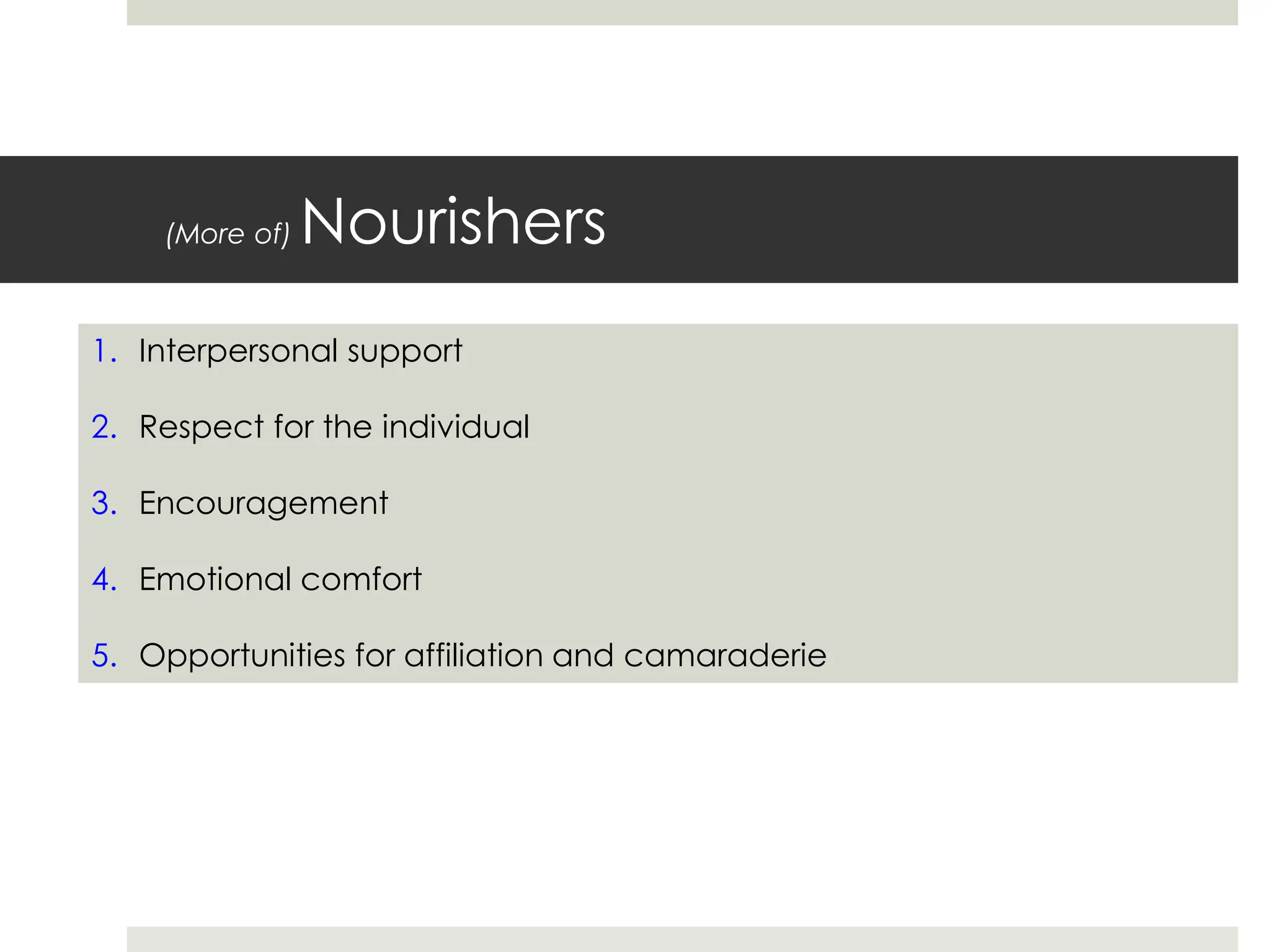
(More of) Nourishers
1. Interpersonal support
2. Respect for the individual
3. Encouragement
4. Emotional comfort
5. Opportunities for affiliation and camaraderie
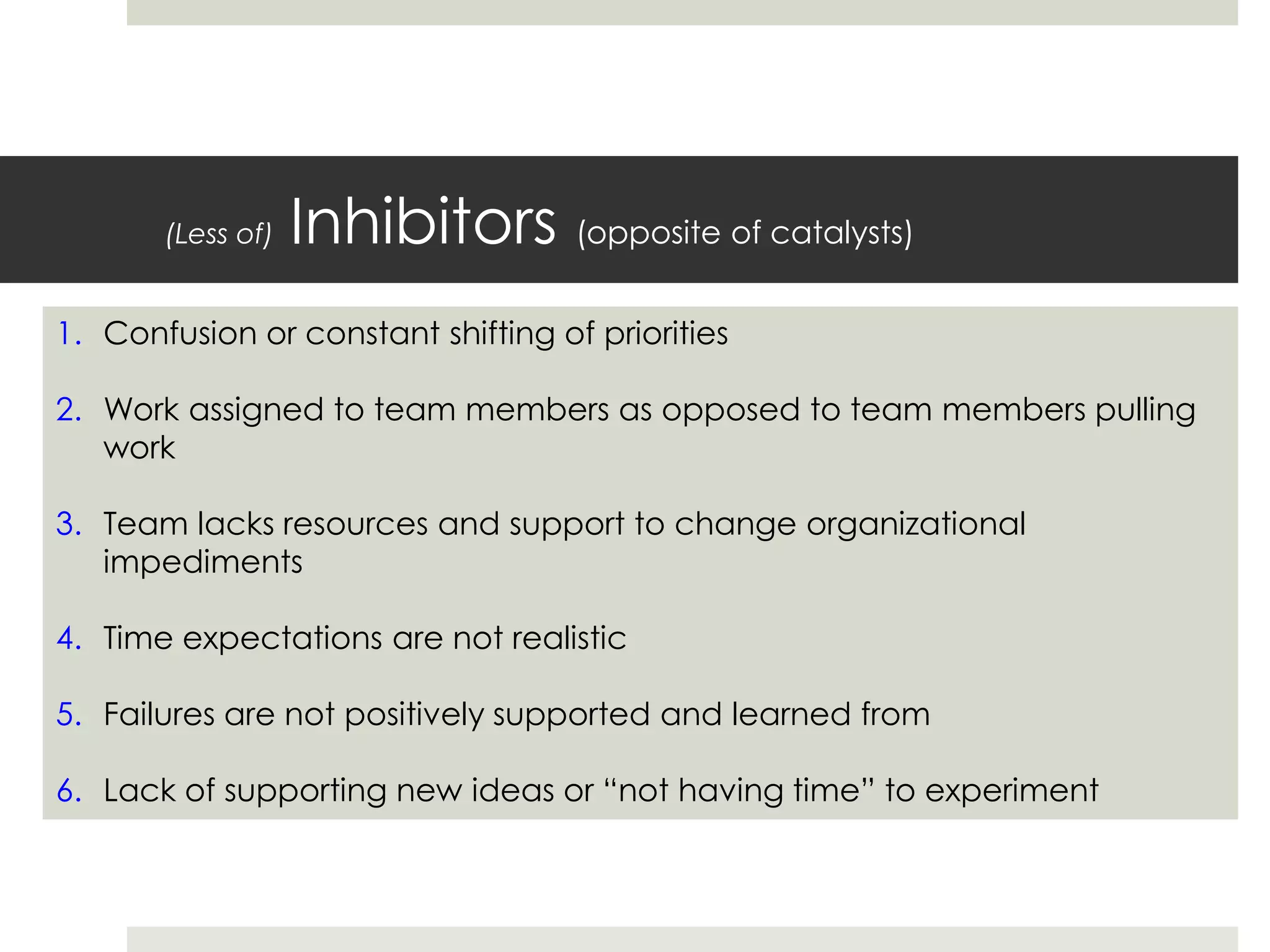
(Less of) Inhibitors (opposite of catalysts)
1. Confusion or constant shifting of priorities
2. Work assigned to team members as opposed to team members pulling
work
3. Team lacks resources and support to change organizational
impediments
4. Time expectations are not realistic
5. Failures are not positively supported and learned from
6. Lack of supporting new ideas or “not having time” to experiment
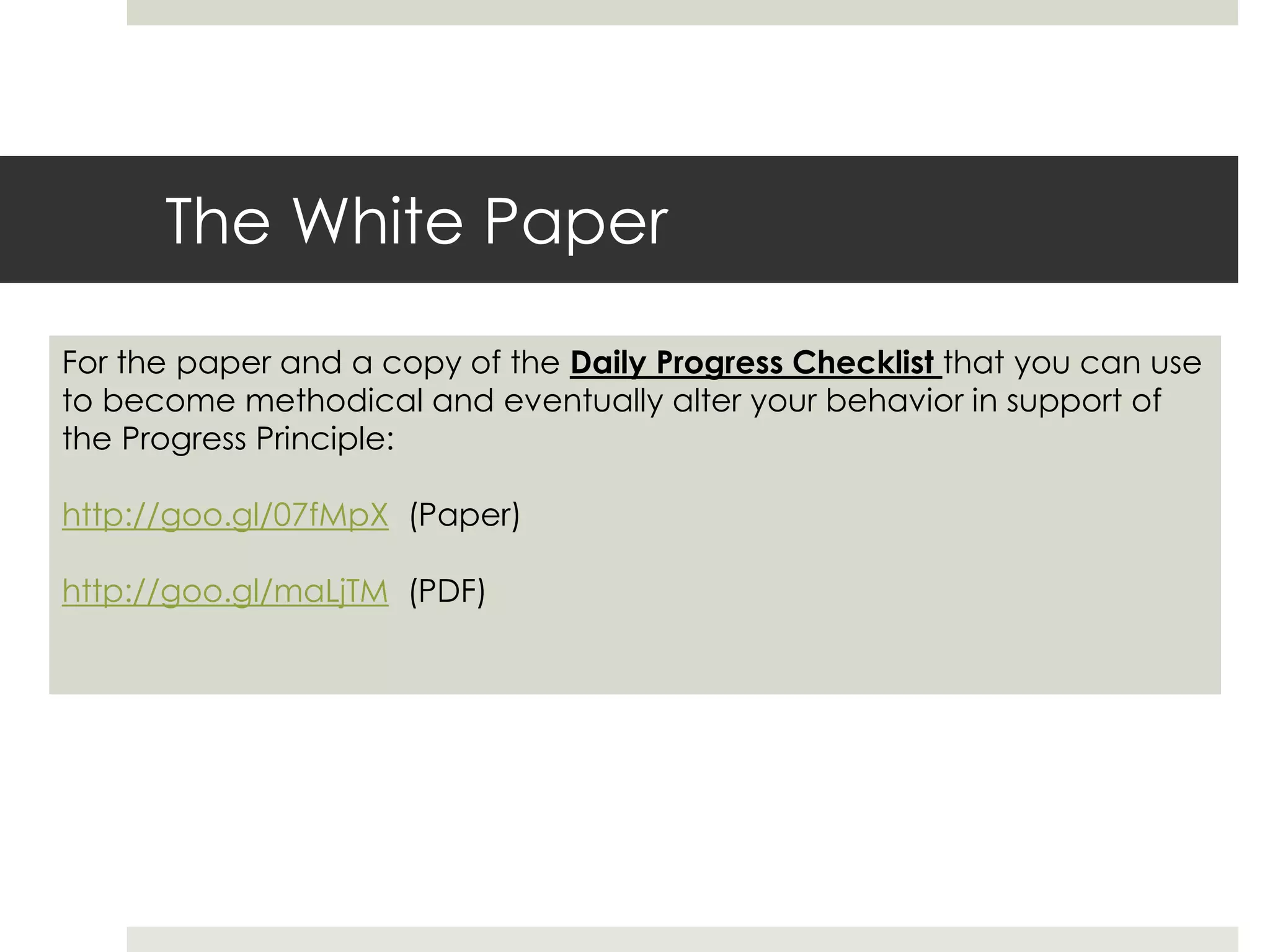
The White Paper
For the paper and a copy of the Daily Progress Checklist that you can use
to become methodical and eventually alter your behavior in support of
the Progress Principle:
http://goo.gl/07fMpX (Paper)
http://goo.gl/maLjTM (PDF)
Credits
All information is credited to Teresa M. Amabile, Steven J. Kramer and
Harvard Business Review.

The Progress Principle - Its relationship to Agile and Lean

  • 1.
    The Progress Principle ExecutiveSummary Managers and clients are always seeking ways to improve a teams performance, as well as an individuals’ motivation. Teresa M. Amabile and Steven J. Kramer of Harvard Business Review provides data driven insight and the tools to help managers and Scrum Masters to improve team and team member performance through a principle they coined – “Progress Principle”. Unknowingly, the Progress Principle is supported in Agile through rituals: sprint demos, retrospectives and even the daily stand-up. It is also achieved through Lean and Agile philosophies as well as the focus on continuous improvement.
  • 2.
    Executive Summary Continued WhatTeresa and Steven discovered was that, ….“Of all the things that can boost emotions, motivation, perceptions and ultimately result in higher performance, the single most important factor is making progress in meaningful work”. “The more frequently people experience the sense of progress, the more likely they are to be creatively productive”… ….“The power of progress is fundamental to human nature, but few managers understand it or know how to leverage progress to boost motivation.” In fact, the study reveals that the progress principle is rarely understood and practiced by leadership.
  • 3.
    Executive Summary (Cont.)/ Hypotheses ….”A central driver of creative, productive performance was the quality of a person’s “inner-work life” – the mix of emotions, motivations and perceptions over the course of a workday”…… in the realm of knowledge work, people are more creative and productive when the inner work lives are positive…. …….they are intrinsically motivated. I would like to hypothesis that the challenge that teams and organizations have to fully reap the benefits of the Progress Principle; is Executives, Managers and Scrum Masters need to become more methodical in there approach and behavior towards: 1. Daily visualizing meaningful progress 2. Removing obstacles/impediments, especially external organizational- wide issues (Teresa & Steve refer to these as Inhibitors) 3. Emotionally support the individual (Teresa & Steve refer to these as Nourishers)
  • 4.
    The Research 669 Managerssurveyed around the world are asked with a survey: What managerial approaches/tools that can affect employees motivation and emotions. 7 companies, 26 project teams, 238 individuals, 12,000 diary entries. In one section of research respondents were asked to rank the following managerial behaviors/tools that affect employee motivations and emotions that drives performance: • Support for making progress in work: (Power of Progress) • Recognition for good work • Incentives • Interpersonal support • Clear goals
  • 5.
    Ranked Findings • Only5% ranked Support for making progress in work #1 • Recognition for good work (public or private) was ranked #1 closely followed by Incentives. • Many Managers ranked Clear goals and Interpersonal support as the most important drivers.
  • 6.
    Progress Principle Requirements •Meaningful work • The importance of daily work progress, make progress salient • Transparency and visibility of team progress (Visualize your work) • Invest time, money and resources to remove external impediments that are a common recurring theme • Focus on managing progress, not people (Try not maximizing resources (people), but the work) • Safe and transparent work environment • Emotionally support the team and team member
  • 7.
    AVOID: striping the“meaning” from meaningful work? 1. When managers, leads, and team members don’t recognize in earnest new ideas, suggestions, opinions 2. Honest recognition for achievements (Being able to be transparent about failure) 3. Continuous reassignment of team members 4. Continuous shifting priorities of work that is in flight 5. Product Owners or Manager can spend more time making more concrete in how the team’s work is contributing
  • 8.
    Manage the Work: InnerWork Life Triggers 1. Team/Group Level • Catalysts • Toxins 2. Individual Level • Nourishers • Inhibitors
  • 9.
    (More of) Catalysts 1.Setting clear goals 2. Allowing autonomy (Recall Dan Pink: Autonomy, Mastery, Purpose) 3. Sufficient access to resources (people, hardware, tools) 4. Time 5. Leads help with the work 6. Openness (and safe environment) in learning from problems, failures and successes 7. Free exchange of ideas and solutions
  • 10.
    (less of) Toxins 1.Disrespect towards the individual 2. Discouragement of ideas and solutions 3. Disregard for emotions 4. Interpersonal conflicts within the team
  • 11.
    (More of) Nourishers 1.Interpersonal support 2. Respect for the individual 3. Encouragement 4. Emotional comfort 5. Opportunities for affiliation and camaraderie
  • 12.
    (Less of) Inhibitors(opposite of catalysts) 1. Confusion or constant shifting of priorities 2. Work assigned to team members as opposed to team members pulling work 3. Team lacks resources and support to change organizational impediments 4. Time expectations are not realistic 5. Failures are not positively supported and learned from 6. Lack of supporting new ideas or “not having time” to experiment
  • 13.
    The White Paper Forthe paper and a copy of the Daily Progress Checklist that you can use to become methodical and eventually alter your behavior in support of the Progress Principle: http://goo.gl/07fMpX (Paper) http://goo.gl/maLjTM (PDF)
  • 14.
    Credits All information iscredited to Teresa M. Amabile, Steven J. Kramer and Harvard Business Review.