Generation Y at work.Presented by: Ryan PaughBlog: ryanpaugh.comTwitter: @paughginney
Did you read this!?Did you read this?!GEN-Y ACCORDING TO NYT:FREELOADERS:  40% move back home with parents at least once.Parents give an average 10% of their income to their 18-21 year-old children.DISLOYAL:  7 job changes on average before their 30th b-day.CONFUSED:  Options seem to be limitless.  It would almost be easier if we were given a range of choices instead …TRANSIENT:  One third of 20-somethings change their address ever year.
My view on the NYT and Gen Y.WE’RE NOT THAT DIFFERENT, BUT THE WORLD CERTAINLY IS. The way we communicate has changed.
 Social media technology.
 A more transparent culture.
 The job market sucks.  A lot.
 Current unemployment rate = 9.2%
 Only 44% of employers plan to hire recent grads.
 What we value about people has changed.
 Boring, mundane jobs =  outsourced.
 Creativity and individualism matter more.WHAT I THINK:Don’t focus on age.  Focus on creating a forward-thinking learning/work STYLE that anybody can embrace.
Who is this guy?HI, MY NAME IS RYAN PAUGH AND I BUILD COMMUNITIES.Blogged about being a Gen Y professional in the Fortune 500. Started Brazen Careerist and become Community Manager.Help lost Gen Y professionals not make the same mistakes that I did.Today I speak/consult with companies on building online communities + manage the Brazen Careerist network.
The Young Entrepreneur CouncilOur nonprofit organization provides young entrepreneurs with access to tools, mentorship, community and educational resources that support each stage of their business’s development and growth.  We promote entrepreneurship as a solution to youth unemployment and underemployment.
Most commonly asked questions.THESE ARE THE QUESTIONS THAT MOST PEOPLE ASK ME: When was Gen Y born?
 Nobody can make up their mind.
 ≈ 1980 through 1995.
 What is the population of Gen Y?
 81MM last time I checked.
 75% of the workplace by 2025.
 Do all Gen Yers have ADD?
 Probably not.
 Why Gen Y quits: 37% say “Just needed a change”THIS STUFF WILL NOT MAKE GENERATION RELATIONS EASIER.BUT IT’S GOOD TO KNOW…
Rundown:  What can we do?WE’RE GOING TO TALK ABOUT SOME OF THE FORWARD-THINKING IDEAS THAT ARE CHANGING HOW WE LEARN/WORKPART 1: SOCIAL MEDIAShould I start a blog?  Yes, you should!Making sense of Twitter.  Using it to find opportunity.Facebook.  Not just for personal use anymore. LinkedIn.  Why aren’t more students using this?PART 2: WORK/LEARNING CULTUREEmbracing entrepreneurship early on.Teaching social media etiquette for the “real” world.Encouraging a culture of positive feedback.
Why should I start a blog?“Job seeker passion has become the deciding factor in employment.”  ~ Dan Schawbel, author of Me 2.0EXPERIENCE VS. IDEAS:In a world where experience matters most, new ideas are what entry-level professionals have to bring to the table. Career bloggers are often recognized as top performers because they’ve taken initiative to talk about work at home.Writing is a skill that hiring managers agree to be a lost art among college grads.Unmatched networking opportunities.
Success!“It wasn’t the blog itself — how pretty it was, or how many readers subscribed to the feed, or who had linked to us.  It was merely the evidence that I cared about these things enough to write about them in my free time.”~ Jared Taylor, former Googler & Law Student“Blogging is what introduced me to my Brazen Careerist co-founders and, consequently, entrepreneurship & speaking.  If I had not taken the initiative to share my ideas and get to know other ‘thinkers’ I would be in a different place today. ”~ Me (Ryan Paugh), Entrepreneur & Speaker
The easiest way to start …Ignore buzzwords. SEO, RSS, AdSense, Technorati, etc.
 Not sure if it matters?  Assume it doesn’t.Pick a topic. You can change it later.
 Does it interest you?
 Do you have a lot to say.Spend 2 seconds choosing software. Here are a couple: Blogger, TypePad, WordPress
 I use WordPress.Post something today. Blogging is about having courage to say something.

Presentation for SAIT

  • 1.
    Generation Y atwork.Presented by: Ryan PaughBlog: ryanpaugh.comTwitter: @paughginney
  • 2.
    Did you readthis!?Did you read this?!GEN-Y ACCORDING TO NYT:FREELOADERS: 40% move back home with parents at least once.Parents give an average 10% of their income to their 18-21 year-old children.DISLOYAL: 7 job changes on average before their 30th b-day.CONFUSED: Options seem to be limitless. It would almost be easier if we were given a range of choices instead …TRANSIENT: One third of 20-somethings change their address ever year.
  • 3.
    My view onthe NYT and Gen Y.WE’RE NOT THAT DIFFERENT, BUT THE WORLD CERTAINLY IS. The way we communicate has changed.
  • 4.
    Social mediatechnology.
  • 5.
    A moretransparent culture.
  • 6.
    The jobmarket sucks. A lot.
  • 7.
  • 8.
    Only 44%of employers plan to hire recent grads.
  • 9.
    What wevalue about people has changed.
  • 10.
    Boring, mundanejobs = outsourced.
  • 11.
    Creativity andindividualism matter more.WHAT I THINK:Don’t focus on age. Focus on creating a forward-thinking learning/work STYLE that anybody can embrace.
  • 12.
    Who is thisguy?HI, MY NAME IS RYAN PAUGH AND I BUILD COMMUNITIES.Blogged about being a Gen Y professional in the Fortune 500. Started Brazen Careerist and become Community Manager.Help lost Gen Y professionals not make the same mistakes that I did.Today I speak/consult with companies on building online communities + manage the Brazen Careerist network.
  • 13.
    The Young EntrepreneurCouncilOur nonprofit organization provides young entrepreneurs with access to tools, mentorship, community and educational resources that support each stage of their business’s development and growth. We promote entrepreneurship as a solution to youth unemployment and underemployment.
  • 14.
    Most commonly askedquestions.THESE ARE THE QUESTIONS THAT MOST PEOPLE ASK ME: When was Gen Y born?
  • 15.
    Nobody canmake up their mind.
  • 16.
    ≈ 1980through 1995.
  • 17.
    What isthe population of Gen Y?
  • 18.
    81MM lasttime I checked.
  • 19.
    75% ofthe workplace by 2025.
  • 20.
    Do allGen Yers have ADD?
  • 21.
  • 22.
    Why GenY quits: 37% say “Just needed a change”THIS STUFF WILL NOT MAKE GENERATION RELATIONS EASIER.BUT IT’S GOOD TO KNOW…
  • 23.
    Rundown: Whatcan we do?WE’RE GOING TO TALK ABOUT SOME OF THE FORWARD-THINKING IDEAS THAT ARE CHANGING HOW WE LEARN/WORKPART 1: SOCIAL MEDIAShould I start a blog? Yes, you should!Making sense of Twitter. Using it to find opportunity.Facebook. Not just for personal use anymore. LinkedIn. Why aren’t more students using this?PART 2: WORK/LEARNING CULTUREEmbracing entrepreneurship early on.Teaching social media etiquette for the “real” world.Encouraging a culture of positive feedback.
  • 24.
    Why should Istart a blog?“Job seeker passion has become the deciding factor in employment.” ~ Dan Schawbel, author of Me 2.0EXPERIENCE VS. IDEAS:In a world where experience matters most, new ideas are what entry-level professionals have to bring to the table. Career bloggers are often recognized as top performers because they’ve taken initiative to talk about work at home.Writing is a skill that hiring managers agree to be a lost art among college grads.Unmatched networking opportunities.
  • 25.
    Success!“It wasn’t theblog itself — how pretty it was, or how many readers subscribed to the feed, or who had linked to us. It was merely the evidence that I cared about these things enough to write about them in my free time.”~ Jared Taylor, former Googler & Law Student“Blogging is what introduced me to my Brazen Careerist co-founders and, consequently, entrepreneurship & speaking. If I had not taken the initiative to share my ideas and get to know other ‘thinkers’ I would be in a different place today. ”~ Me (Ryan Paugh), Entrepreneur & Speaker
  • 26.
    The easiest wayto start …Ignore buzzwords. SEO, RSS, AdSense, Technorati, etc.
  • 27.
    Not sureif it matters? Assume it doesn’t.Pick a topic. You can change it later.
  • 28.
    Does itinterest you?
  • 29.
    Do youhave a lot to say.Spend 2 seconds choosing software. Here are a couple: Blogger, TypePad, WordPress
  • 30.
    I useWordPress.Post something today. Blogging is about having courage to say something.
  • 31.
    Nobody isreading your blog.Practice, practice, practice. Set aside time every day to write.
  • 32.
    It’s okayif it sucks.Ignore your lack of readers. Nobody is reading your blog during the first month.
  • 33.
    Don’t distractyourself with promotion. Just write.IF YOU CAN BLOG REGULARLY FOR A MONTH, THEN YOU CAN BE A BLOGGER.http://blog.penelopetrunk.com
  • 34.
    Don’t blog aboutyour company.Your blog should be an extension of YOUR brand. Not your company’s brand. Shows people that you’re not available.
  • 35.
    Takes thefocus off of what’s important – YOU!
  • 36.
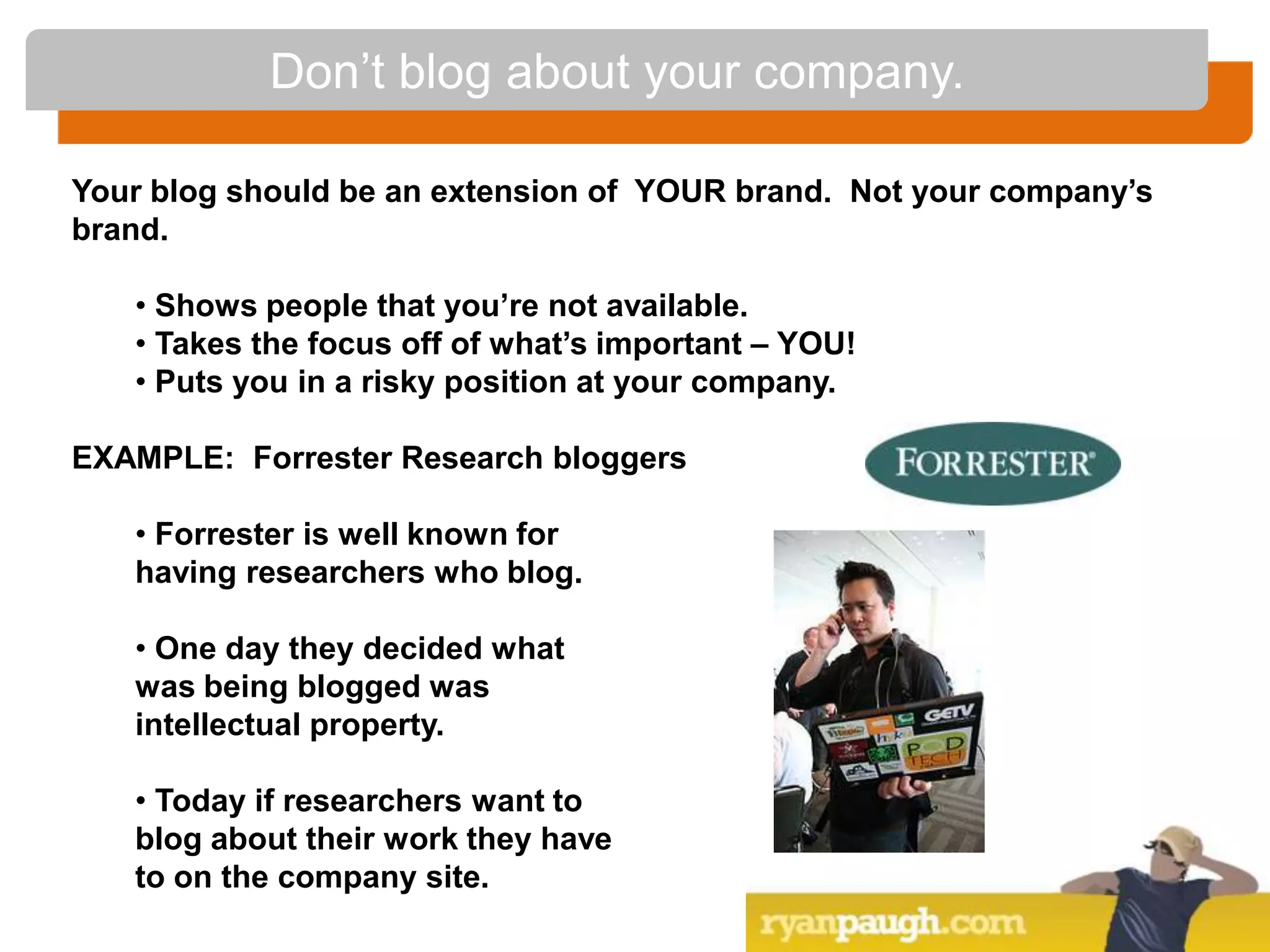
    Puts youin a risky position at your company.EXAMPLE: Forrester Research bloggers Forrester is well known forhaving researchers who blog. One day they decided whatwas being blogged wasintellectual property. Today if researchers want to blog about their work they haveto on the company site.
  • 37.
    What is Twittergood for?Twitter is often seen as a big, noisy machine, but really it’s the Internet’s version of Want Ads happening in real time.The #1 way for opportunity seekers to use Twitter:Search for smart people in your industry.Use Twitters basic search
  • 38.
    Or use Twellow.comGetto know these people through following their tweets, reading their blogs, watching their videos, etc.Send @replies that are smart, engaging, fun
  • 39.
    Be prepared tobe let downJust like the traditional job search this process can be discouraging, but tweeting is low impact. Quick.One tweet can have big impact.
  • 40.
    How I useTwitter.Average time managing my personal Twitter account each day:≈ 5 minutesFor my personal brand I don’t use …
  • 41.
    Some good randomadvice …“Answer: What has your attention?”“Don’t be a self-centered Twitterer.”“Focus on quality over quantity.”“Don’t overuse … compulsion to please.”“Seeking approval from others is a full time job with no vacations or benefits.”@karmakorrupt
  • 42.
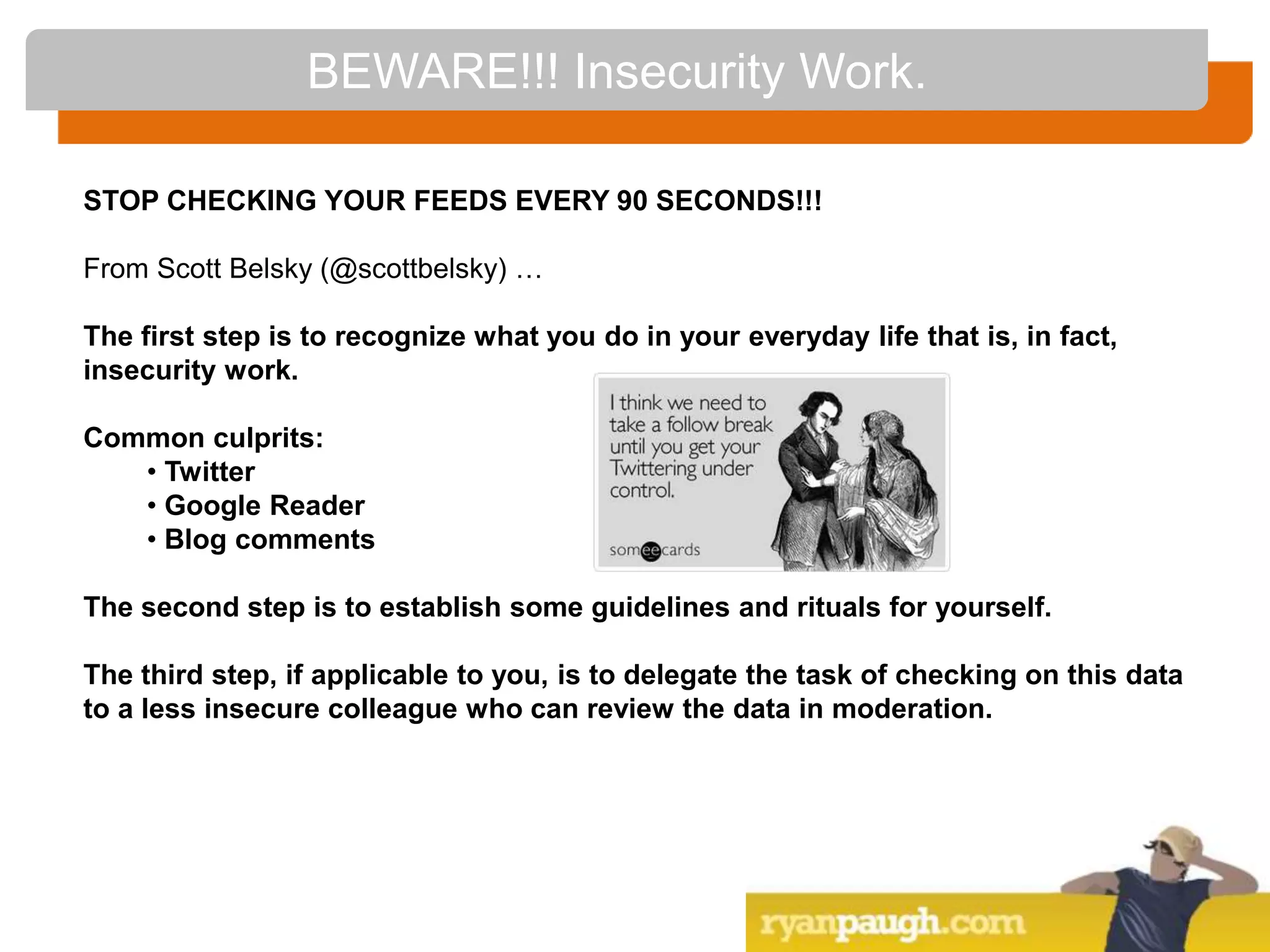
    BEWARE!!! Insecurity Work.STOPCHECKING YOUR FEEDS EVERY 90 SECONDS!!!From Scott Belsky (@scottbelsky) …The first step is to recognize what you do in your everyday life that is, in fact, insecurity work.Common culprits: Twitter
  • 43.
  • 44.
    Blog commentsThesecond step is to establish some guidelines and rituals for yourself.The third step, if applicable to you, is to delegate the task of checking on this data to a less insecure colleague who can review the data in moderation.
  • 45.
    Making use ofFacebookFor a long time, Facebook has been a place solely for personal connections, but this is changing! Better privacy settings (if you know how to use them!)
  • 46.
    Brands interactingwith customers via pages
  • 47.
    Adults graspingtech: Fasting growing demo = 35+
  • 48.
    Facebook groups!Accordingto Study Blue (online note taking software)“Students are becoming more willing to share their educational achievements with family/friends online.”
  • 49.
    How to getstarted…Make use of Facebook Groups: It’s an easy way to communicate with students/coworkers outside your normal environment without having to “friend” each other. “Friending” a professor/coworker is intimidating.
  • 50.
    Make yourgroup a forum for classroom discussion.
  • 51.
    Keep itprivate to your students.How I use Facebook groups…In a world where privacy is rare, I’ve set up an invite-only community on Facebook where my community-building peers can crowdsource advice/ideas without the noise.You can do this, too!
  • 52.
    Proof of Facebook’svalue. “Facebook is worth $2.52, Twitter only 43 cents.”
  • 53.
    LinkedIn: Pros &Cons WHAT LINKEDIN IS GOOD FOR: LinkedIn is a great scorecard for how connected you are.
  • 54.
    Employers loveit because of this.
  • 55.
    They cansee how much you are worth.
  • 56.
    60% ofsocial networkers have high incomes.
  • 57.
    Keeps peopleinformed of your employment status.WHAT LINKEDIN IS NOT GOOD FOR: Building a network.
  • 58.
    Networks arebuild on relationships.
  • 59.
    Relationships arebuilt on conversations.LINKEDIN FAVORS THOSE WITH AN ESTABLISHED NETWORK.
  • 60.
    You MUST beon LinkedInLINKEDIN WON’T SOLVE ALL OF YOUR PROBLEMS, BUT… Recruiters use it everyday to source candidates
  • 61.
    It’s thenext generation of passive job seeking
  • 62.
    Replacing Monsterand CareerBuilder
  • 63.
    More efficient,less time consuming
  • 64.
    LinkedIn’s mostactive age group is 40+
  • 65.
    These arethe people who are hiring!
  • 66.
    LinkedIn’s newResume Builder tool is gearing up to eliminate the traditional paper resume within 10 yearsI’M ALWAYS SURPRISED HOW FEW STUDENTS RAISE THEIR HANDS WHEN I ASK: “Who has a LinkedIn profile?”We NEED to teach this!
  • 67.
    Why is theresume is going away?5 REASONS:LinkedIn’s “Resume Builder”Social networking is rising while email use plummets90% of U.S. visit a social network site each month
  • 68.
    The 35+ agegroup had the highest growthYou can’t find jobs using traditional tactics anymoreOnly 23% of job seekers found jobs via ads (Forbes)
  • 69.
    Need to bemore creative to get employer attentionJob-seeker passion is becoming a deciding factor83% of job seekers would rather have a job that they love rather than one that pays well (SimplyHired)
  • 70.
    Traditional resumes tocommunicate passionPeople are managing their careers as entrepreneurs
  • 71.
    Next-Generation EntrepreneurshipNew researchfrom the Young Entrepreneur Council and the Buzz Marketing group about Gen Y & Entrepreneurship: 79% of Gen Yers are interested in entrepreneurship
  • 72.
    27% arealready self employed
  • 73.
    21% havestarted a business because of unemployment
  • 74.
    35% ofrespondent with jobs started a side business to supplement their own income, provide new opportunities“The biggest obstacle for young entrepreneurs is culture. Most young people don't have parents or friends who are entrepreneurs and have never been taught it in school”~ Michael Simmons, Extreme Entrepreneur Tour
  • 75.
    Entrepreneurship in EVERYclassroomBeyond basic job-hunting tips, we should be educating students on the basics of creating their own jobs.Things they need to know…The basics:Building a business plan
  • 76.
    Setting up anLLC or Corporation
  • 77.
  • 78.
    Finding the rightbusiness partner
  • 79.
    Bootstrapping versus raisingcapitalThese are things that even big corporations are looking for in job candidates. They call it “intrapreneurship.”
  • 80.
    Using social technology.IBM’semployee bloggers allow them to share insights on company culture with the outside world.It's helped drive innovation and build community at Deloitte, and we're finding new value in the tool every day.(Talking about Yammer)
  • 81.
    Using social technology.“Ithink of social media at work as a virtual water cooler. Some conversation will be about business and some will be about the plans for the weekend.” – Eric Bensley, Gen YerHOW TO CONTROL SOCIAL MEDIA AT WORK:Creating a social media policy: You should have several, says Jason Falls, SM strategist
  • 82.
    One foreach major network.
  • 83.
    Talk aboutboth personal and professional use.Social media is a huge opportunity for your company. Harness employee creativity for company good.
  • 84.
    Create amazingWOM marketing opportunities.
  • 85.
    They aregoing to do it anyway. Why not embrace it?Frequent Feedback.42% OF EMPLOYEES DON’T TRUST THEIR MANAGER?! Only 1/3 receive recognition for a job well done.
  • 86.
    Recognizing employeeperformance increases engagement by almost 60%“With Rypple we've finally found a service that helps drive team performance by focusing on our people and our work rather than on process and administration.”  
  • 87.
    Frequent Feedback.WHAT WECAN LEARN FROM MOZILLA: Importance of 1 on 1(from an employee’s blog) * Every week my manager and I go over … Accomplishments & status
  • 88.
  • 89.
    To doover the next week
  • 90.
    Areas todevelop
  • 91.
    Quarterly goaltrackingOTHER IMPORTANT THINGS ABOUT FEEDBACK: Quarterly reviewsaren’.
  • 92.
    Many timesthey don’t even happen or get delayed.
  • 93.
    Real-time feedbackis what works best for employees.
  • 94.
    Try outRypple.What can you do today?CHANGE DOESN’T HAPPEN OVERNIGHT, TAKE SMALL STEPS:IN YOUR OFFICETry a conference call instead of an in-person meeting.Try using Skype’s new group video chat.Create an online community for you and your employees.Yammer is a good place to start. Maybe a team blog.Send an employee real-time feedback today.Try out Rypple.IN THE CLASSROOMCreate a private Facebook group to communicate w/ students.Strongly urge students to start using LinkedIn in.Take a Survey: How many students would be interested in a lecture on entrepreneurship?
  • 95.
    Wrapup.QUESTIONS? COMMENTS? NOW’S YOUR CHANCE …WANT TO SEE THESE SLIDES AGAIN?http://www.ryanpaugh.com/slides
  • 96.
    Why change ifthe job market sucks?THE DOWN ECONOMY HAS MADE PEOPLE MORE CREATIVE ABOUT HOW THEY MAKE MONEY – THEY WILL FIND WORK.72% of Gen Yers said that they were optimistic about their business prospects.WSJ reports that applications to business schools are down by about 2%.If we can’t find a good job, we’ll start our own business. Based on my interactions with top-performing Gen Ys.CALL IT DELUSIONAL, ENTITLED OR SELF-CENTERED IF YOU MUST, BUT THIS IS HOW YOUNG PROS ARE THINKING.OPTIMISTIC PEOPLE ARE MORE LIKELY TO CREATE THEIR OWN LUCK!

Editor's Notes