Towards a Creative Thinking & Innovation Pavilion for a  Virtual Museum of the Future: Synectics, “Everywhere,” and …? NMC Creativity Symposium in Second Life Ted M. Kahn, Ph.D. DesignWorlds for Learning, Inc. &  DesignWorlds for College NMC Fellow ©  2007 by DesignWorlds for Learning, Inc .
What is DesignWorlds? 10-year old company dedicated to developing and supporting new kinds of collaborative, creative learning & knowledge-making communities Web-based Lifelong Learning  Collaboratories DesignWorlds for College, Grad School and Careers
“ Every great advance in science has issued from a new audacity of the imagination” —John Dewey “ Imagination is more important than knowledge.” —Albert Einstein “ Reality leaves a lot to the imagination.”—John Lennon
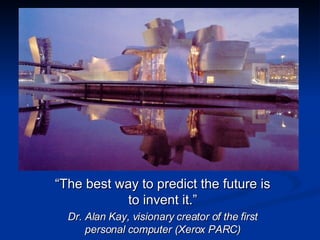
“ The best way to predict the future is to invent it.” Dr. Alan Kay, visionary creator of the first personal computer (Xerox PARC)
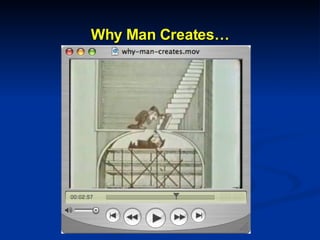
Why Man Creates…
 
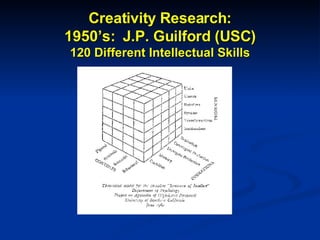
Creativity Research: 1950’s:  J.P. Guilford (USC) 120 Different Intellectual Skills
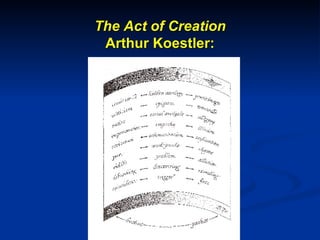
The Act of Creation Arthur Koestler:
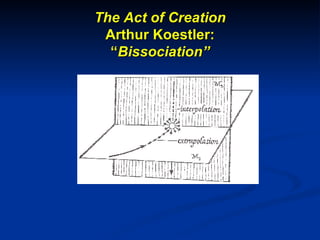
The Act of Creation Arthur Koestler: “ Bissociation”
Creativity Research: 1960’s Creative Personality and Development of Creative Thinking in Education •  Institute for Personality Assessment & Research  (Psychology Dept., U.C. Berkeley)--funded by Carnegie Corporation •  Development of Creative Thinking Curricular Products for K-12  (e.g, Edward de Bono, Covington, Crutchfield,  et al.) •  Creative Thinking Tests  (e.g, Paul Torrance)
Creativity: 1970’s •  Computer models/simulation of creative thinking and problem-solving (e.g., Newell & Simon’s General Problem-Solver (GPS) program •  Birth of Cognitive Science--and dominance of Information Processing Models of all kinds of thinking and cognitive tasks
Creativity: 1980’s •  Intrinsic Motivation and social psychology of creativity (Teresa Amabile, now at Harvard Business School) •  Creative expression tools and explorations using personal computers
Creativity: 1990’s •  Creativity and Creative Thinking are  situated   activities :  Social, Temporal and Environmental   (IRL/Lave & Wenger: Situated Learning and Cognition; “Communities of Practice”) •  Systems views of Creativity and “Flow”: Interactions between Knowledge Domains and Social Practices (Mihalyi Csikszentmihalyi)
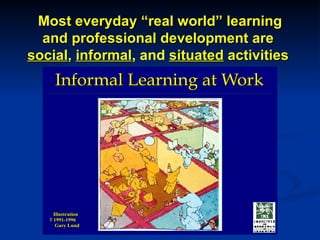
Most everyday “real world” learning and professional development are  social ,  informal , and  situated  activities
 
 
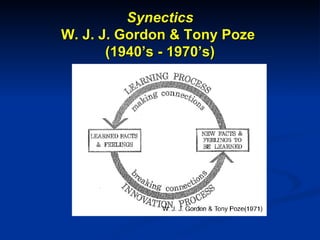
Synectics W. J. J. Gordon & Tony Poze  (1940’s - 1970’s)
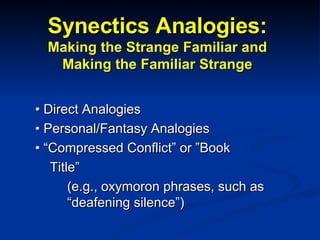
Synectics Analogies: Making the Strange Familiar and Making the Familiar Strange •  Direct Analogies •  Personal/Fantasy Analogies • “ Compressed Conflict” or ”Book    Title”  (e.g., oxymoron phrases, such as  “deafening silence”)
Making the Familiar Strange…
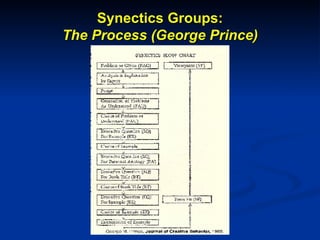
Synectics Groups: The Process (George Prince)
Everywhere (Moshe D. Caspi, 1977) •  Different spaces have different qualities to develop and stimulate thinking and creative self-education: •  Fantasy Room •  Common Sense Room •  Room of digging into the past •  Room of projecting into the future •  Connections/analogy room •  etc..
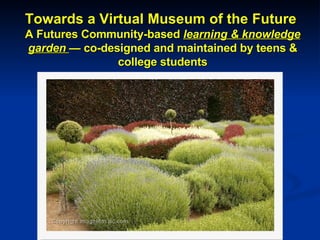
Towards a Virtual Museum of the Future  A Futures Community-based  learning & knowledge garden  —  co-designed and maintained by teens & college students
Some Important Related Web Links & Resources •  For more information on the Virtual Museum of the Future and Creativity in Education, Synectics and “Everywhere”: Email:  [email_address] Web:  http://www.designworlds.com/creativity/ Dr. Ted M. Kahn DesignWorlds for Learning, Inc.  (408) 252-2285

Synectics & Creativity Ted Kahn

  • 1.
    Towards a CreativeThinking & Innovation Pavilion for a Virtual Museum of the Future: Synectics, “Everywhere,” and …? NMC Creativity Symposium in Second Life Ted M. Kahn, Ph.D. DesignWorlds for Learning, Inc. & DesignWorlds for College NMC Fellow © 2007 by DesignWorlds for Learning, Inc .
  • 2.
    What is DesignWorlds?10-year old company dedicated to developing and supporting new kinds of collaborative, creative learning & knowledge-making communities Web-based Lifelong Learning Collaboratories DesignWorlds for College, Grad School and Careers
  • 3.
    “ Every greatadvance in science has issued from a new audacity of the imagination” —John Dewey “ Imagination is more important than knowledge.” —Albert Einstein “ Reality leaves a lot to the imagination.”—John Lennon
  • 4.
    “ The bestway to predict the future is to invent it.” Dr. Alan Kay, visionary creator of the first personal computer (Xerox PARC)
  • 5.
  • 6.
  • 7.
    Creativity Research: 1950’s: J.P. Guilford (USC) 120 Different Intellectual Skills
  • 8.
    The Act ofCreation Arthur Koestler:
  • 9.
    The Act ofCreation Arthur Koestler: “ Bissociation”
  • 10.
    Creativity Research: 1960’sCreative Personality and Development of Creative Thinking in Education • Institute for Personality Assessment & Research (Psychology Dept., U.C. Berkeley)--funded by Carnegie Corporation • Development of Creative Thinking Curricular Products for K-12 (e.g, Edward de Bono, Covington, Crutchfield, et al.) • Creative Thinking Tests (e.g, Paul Torrance)
  • 11.
    Creativity: 1970’s • Computer models/simulation of creative thinking and problem-solving (e.g., Newell & Simon’s General Problem-Solver (GPS) program • Birth of Cognitive Science--and dominance of Information Processing Models of all kinds of thinking and cognitive tasks
  • 12.
    Creativity: 1980’s • Intrinsic Motivation and social psychology of creativity (Teresa Amabile, now at Harvard Business School) • Creative expression tools and explorations using personal computers
  • 13.
    Creativity: 1990’s • Creativity and Creative Thinking are situated activities : Social, Temporal and Environmental (IRL/Lave & Wenger: Situated Learning and Cognition; “Communities of Practice”) • Systems views of Creativity and “Flow”: Interactions between Knowledge Domains and Social Practices (Mihalyi Csikszentmihalyi)
  • 14.
    Most everyday “realworld” learning and professional development are social , informal , and situated activities
  • 15.
  • 16.
  • 17.
    Synectics W. J.J. Gordon & Tony Poze (1940’s - 1970’s)
  • 18.
    Synectics Analogies: Makingthe Strange Familiar and Making the Familiar Strange • Direct Analogies • Personal/Fantasy Analogies • “ Compressed Conflict” or ”Book Title” (e.g., oxymoron phrases, such as “deafening silence”)
  • 19.
  • 20.
    Synectics Groups: TheProcess (George Prince)
  • 21.
    Everywhere (Moshe D.Caspi, 1977) • Different spaces have different qualities to develop and stimulate thinking and creative self-education: • Fantasy Room • Common Sense Room • Room of digging into the past • Room of projecting into the future • Connections/analogy room • etc..
  • 22.
    Towards a VirtualMuseum of the Future A Futures Community-based learning & knowledge garden — co-designed and maintained by teens & college students
  • 23.
    Some Important RelatedWeb Links & Resources • For more information on the Virtual Museum of the Future and Creativity in Education, Synectics and “Everywhere”: Email: [email_address] Web: http://www.designworlds.com/creativity/ Dr. Ted M. Kahn DesignWorlds for Learning, Inc. (408) 252-2285