Dialogue or
discussion?
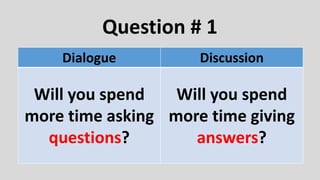
Dialogue Discussion
Will you spend
more time asking
questions?
Will you spend
more time giving
answers?
Question # 1
Hi, what are you
curious about
today?
https://www.teacherspayteachers.com/Product/Question-types-1567673
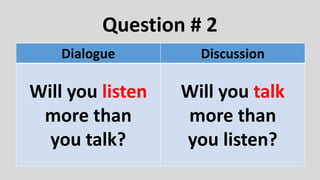
Dialogue Discussion
Will you listen
more than
you talk?
Will you talk
more than
you listen?
Question # 2
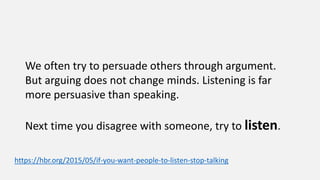
We often try to persuade others through argument.
But arguing does not change minds. Listening is far
more persuasive than speaking.
Next time you disagree with someone, try to listen.
https://hbr.org/2015/05/if-you-want-people-to-listen-stop-talking
https://www.teacherspayteachers.com/Product/How-can-we-listen-better-1485898
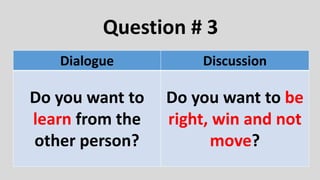
Dialogue Discussion
Do you want to
learn from the
other person?
Do you want to be
right, win and not
move?
Question # 3
Further inspiration
https://www.teacherspayteachers.com/Product/Learning-strategies-1487708
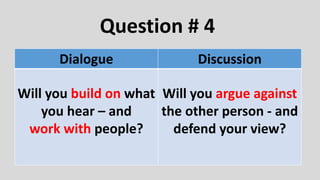
Dialogue Discussion
Will you build on what
you hear – and
work with people?
Will you argue against
the other person - and
defend your view?
Question # 4
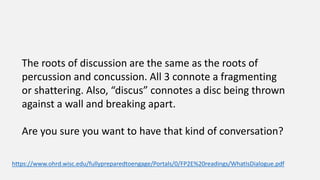
The roots of discussion are the same as the roots of
percussion and concussion. All 3 connote a fragmenting
or shattering. Also, “discus” connotes a disc being thrown
against a wall and breaking apart.
Are you sure you want to have that kind of conversation?
https://www.ohrd.wisc.edu/fullypreparedtoengage/Portals/0/FP2E%20readings/WhatIsDialogue.pdf
Further inspiration
https://www.teacherspayteachers.com/Product/Six-thinking-hats-1455136
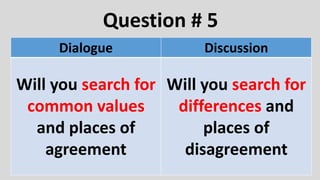
Dialogue Discussion
Will you search for
common values
and places of
agreement
Will you search for
differences and
places of
disagreement
Question # 5
To refocus on agreement say, for example, this:
Can I pause for a moment and point out what
we both agree on?
Then try to find values you share.
https://hbr.org/2016/03/what-to-do-if-a-conversation-is-turning-loud-and-aggressive
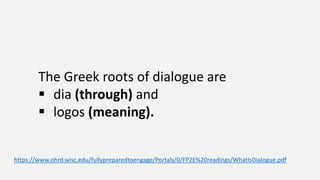
The Greek roots of dialogue are
 dia (through) and
 logos (meaning).
https://www.ohrd.wisc.edu/fullypreparedtoengage/Portals/0/FP2E%20readings/WhatIsDialogue.pdf
Further inspiration
https://www.teacherspayteachers.com/Product/Questions-to-discover-your-values-1329394
Dialogue Discussion
Will you welcome the
showing of emotions to
deepen understanding?
Will you prefer that
focus is on content and
that emotions are not
shown?
Question # 6
Further inspiration
https://www.teacherspayteachers.com/Product/How-can-we-manage-our-emotions-1678947
Dialogue Discussion
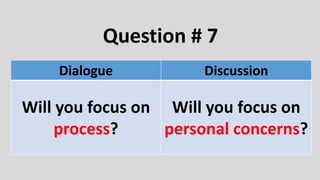
Will you focus on
process?
Will you focus on
personal concerns?
Question # 7
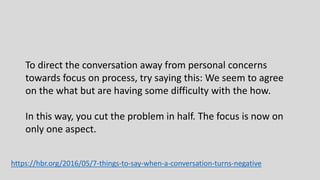
To direct the conversation away from personal concerns
towards focus on process, try saying this: We seem to agree
on the what but are having some difficulty with the how.
In this way, you cut the problem in half. The focus is now on
only one aspect.
https://hbr.org/2016/05/7-things-to-say-when-a-conversation-turns-negative
Dialogue Discussion
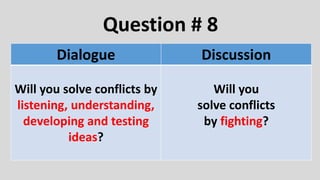
Will you solve conflicts by
listening, understanding,
developing and testing
ideas?
Will you
solve conflicts
by fighting?
Question # 8
https://www.teacherspayteachers.com/Product/How-can-we-manage-conflicts-2016263
Other sources of inspiration
https://www.emich.edu/facdev/docs/Dialogue,Debate,Discussion.pdf
http://www.greatplacetowork.com/publications-and-events/blogs-and-news/1064
http://www.greece.k12.ny.us/academics.cfm?subpage=1557
http://www.hendersongroup.com/articles/tips-for-effective-dialogue-dialogue-vs-discussion.asp
http://oregonstate.edu/oei/sites/default/files/comparing_debate_discussions_dialogue.pdf
http://www.pkwy.k12.mo.us/inside/staffDev/certified/File/Administrator/DOC112508.pdf
http://www.slideshare.net/frankcalberg/facilitationmoderation-of-meetings

Dialogue or discussion?