Ritika Dhameja
 To begin managing your time you first need a
clear idea of how you are using your time daily.
 To get a more accurate estimate, you might keep
a track of how you spend your time for a week.
 This will help you get a better idea of how much
time you need to prepare for each subject.
 It will help you identify your time wasters.
2Ritika Dhameja
Sr No Activity Hours/ Week Total
hrs/wk
1 No. of hours of sleep each night 8 X 7 56
2 No. of grooming hours per day 2 X 7 14
3 No. of hours of meal/snack per day 3 X 7 21
4 Total travel time per day 0.5 X 7 3.5
5 No. of hours for T.V/playing per day 2 X 7 14
6 No. of hours per week for functions 3 3
7 No. of hours per week for shopping 2 2
8 No. of hours per day for tuition 1 X 7 7
9 No. of hours per week for school 6 X 6 36
Total 156.5
Subtract Total from 168 168 - 156.5 11.5
Total Hours for self study 11.5
Ritika Dhameja 3
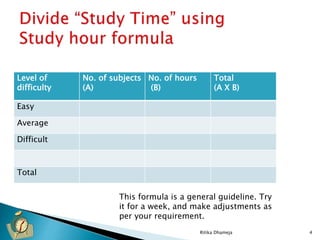
Level of
difficulty
No. of subjects
(A)
No. of hours
(B)
Total
(A X B)
Easy
Average
Difficult
Total
Ritika Dhameja 4
This formula is a general guideline. Try
it for a week, and make adjustments as
per your requirement.
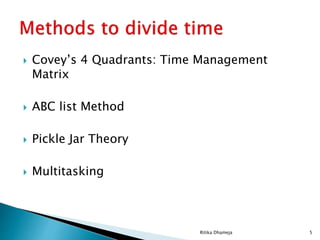
 Covey’s 4 Quadrants: Time Management
Matrix
 ABC list Method
 Pickle Jar Theory
 Multitasking
Ritika Dhameja 5
Ritika Dhameja 6
Covey’s quadrants will help you organize your life
activities into 4 different quadrants, that differ in
importance and urgency.
 1st Quadrant: QUADRANT OF NECCESSITY
The first one represent the things that are both
important and urgent for us to do (you need to do
them now)
eg: preparing for a test for tomorrow, assignment
submission

Ritika Dhameja 7
 2nd Quadrant: QUADRANT OF CHOICE
 The second represent the things that
are important, but not urgent (you can decide when
to do them).
 Eg: exercising, preparing for a test/exam to be
held after a 15 days.
Ritika Dhameja 8
 3rd Quadrant: QUADRANT OF DELEGATION
 It represents the things that are not important, but
urgent (you should try to delegate it to others if
possible)
 Eg: Purchasing of stationary or gift etc
Ritika Dhameja 9
 4th Quadrant: QUADRANT OF WASTE
 The last quadrant represents the things that
are neither important or urgent (you should dump
them!)
 Identify your time wasters
 Eg: If you have a time crunch that day & you decide
to watch a movie, unnecessary phone calls etc
Ritika Dhameja 10
◦ Quadrant 1: Learn to manage
◦ Quadrant 2: Learn to maintain focus
◦ Quadrant 3: Learn to get it done
◦ Quadrant 4: Learn to ignore/avoid
Ritika Dhameja 11
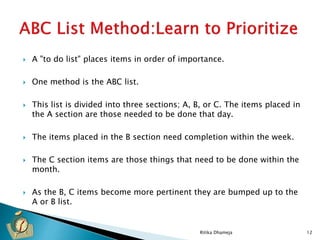
 A "to do list" places items in order of importance.
 One method is the ABC list.
 This list is divided into three sections; A, B, or C. The items placed in
the A section are those needed to be done that day.
 The items placed in the B section need completion within the week.
 The C section items are those things that need to be done within the
month.
 As the B, C items become more pertinent they are bumped up to the
A or B list.
Ritika Dhameja 12
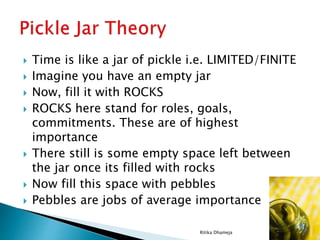
 Time is like a jar of pickle i.e. LIMITED/FINITE
 Imagine you have an empty jar
 Now, fill it with ROCKS
 ROCKS here stand for roles, goals,
commitments. These are of highest
importance
 There still is some empty space left between
the jar once its filled with rocks
 Now fill this space with pebbles
 Pebbles are jobs of average importance
Ritika Dhameja 13
 Now, There is still some space left so fill it
with Sand.
 Sand refers to the less important activities
 Now, if there is still some space left then pour
in some water.
 Water stands for the least important tasks.
 These should be done only if there is some
room left.
THE IMPORTANCE OF THE ACTIVITY DECREASES
IF IT IS SMALLER & EASIER TO POUR.
Ritika Dhameja 14
 Combine several activities together at one time
 Eg: While commuting to school, review your
notes.
 Eg: While showering make a mental list of the
things that need to be done.
 These are just suggestions of what you can do to
combine your time, but there are many others,
above all be creative, and let it work for you.
Ritika Dhameja 15
 It is easier to find something to do with extra
time then to find extra time to do something.
 Learn to identify time wasters & stick to your
schedule.
 Keep room for uncertainty
Ritika Dhameja 16
 Calculate Study Time
 Allot Study Time using Study Hour Formula
Ritika Dhameja 17
Ritika Dhameja 18
Ritika Dhameja 19

Time management

  • 1.
  • 2.
     To beginmanaging your time you first need a clear idea of how you are using your time daily.  To get a more accurate estimate, you might keep a track of how you spend your time for a week.  This will help you get a better idea of how much time you need to prepare for each subject.  It will help you identify your time wasters. 2Ritika Dhameja
  • 3.
    Sr No ActivityHours/ Week Total hrs/wk 1 No. of hours of sleep each night 8 X 7 56 2 No. of grooming hours per day 2 X 7 14 3 No. of hours of meal/snack per day 3 X 7 21 4 Total travel time per day 0.5 X 7 3.5 5 No. of hours for T.V/playing per day 2 X 7 14 6 No. of hours per week for functions 3 3 7 No. of hours per week for shopping 2 2 8 No. of hours per day for tuition 1 X 7 7 9 No. of hours per week for school 6 X 6 36 Total 156.5 Subtract Total from 168 168 - 156.5 11.5 Total Hours for self study 11.5 Ritika Dhameja 3
  • 4.
    Level of difficulty No. ofsubjects (A) No. of hours (B) Total (A X B) Easy Average Difficult Total Ritika Dhameja 4 This formula is a general guideline. Try it for a week, and make adjustments as per your requirement.
  • 5.
     Covey’s 4Quadrants: Time Management Matrix  ABC list Method  Pickle Jar Theory  Multitasking Ritika Dhameja 5
  • 6.
  • 7.
    Covey’s quadrants willhelp you organize your life activities into 4 different quadrants, that differ in importance and urgency.  1st Quadrant: QUADRANT OF NECCESSITY The first one represent the things that are both important and urgent for us to do (you need to do them now) eg: preparing for a test for tomorrow, assignment submission  Ritika Dhameja 7
  • 8.
     2nd Quadrant:QUADRANT OF CHOICE  The second represent the things that are important, but not urgent (you can decide when to do them).  Eg: exercising, preparing for a test/exam to be held after a 15 days. Ritika Dhameja 8
  • 9.
     3rd Quadrant:QUADRANT OF DELEGATION  It represents the things that are not important, but urgent (you should try to delegate it to others if possible)  Eg: Purchasing of stationary or gift etc Ritika Dhameja 9
  • 10.
     4th Quadrant:QUADRANT OF WASTE  The last quadrant represents the things that are neither important or urgent (you should dump them!)  Identify your time wasters  Eg: If you have a time crunch that day & you decide to watch a movie, unnecessary phone calls etc Ritika Dhameja 10
  • 11.
    ◦ Quadrant 1:Learn to manage ◦ Quadrant 2: Learn to maintain focus ◦ Quadrant 3: Learn to get it done ◦ Quadrant 4: Learn to ignore/avoid Ritika Dhameja 11
  • 12.
     A "todo list" places items in order of importance.  One method is the ABC list.  This list is divided into three sections; A, B, or C. The items placed in the A section are those needed to be done that day.  The items placed in the B section need completion within the week.  The C section items are those things that need to be done within the month.  As the B, C items become more pertinent they are bumped up to the A or B list. Ritika Dhameja 12
  • 13.
     Time islike a jar of pickle i.e. LIMITED/FINITE  Imagine you have an empty jar  Now, fill it with ROCKS  ROCKS here stand for roles, goals, commitments. These are of highest importance  There still is some empty space left between the jar once its filled with rocks  Now fill this space with pebbles  Pebbles are jobs of average importance Ritika Dhameja 13
  • 14.
     Now, Thereis still some space left so fill it with Sand.  Sand refers to the less important activities  Now, if there is still some space left then pour in some water.  Water stands for the least important tasks.  These should be done only if there is some room left. THE IMPORTANCE OF THE ACTIVITY DECREASES IF IT IS SMALLER & EASIER TO POUR. Ritika Dhameja 14
  • 15.
     Combine severalactivities together at one time  Eg: While commuting to school, review your notes.  Eg: While showering make a mental list of the things that need to be done.  These are just suggestions of what you can do to combine your time, but there are many others, above all be creative, and let it work for you. Ritika Dhameja 15
  • 16.
     It iseasier to find something to do with extra time then to find extra time to do something.  Learn to identify time wasters & stick to your schedule.  Keep room for uncertainty Ritika Dhameja 16
  • 17.
     Calculate StudyTime  Allot Study Time using Study Hour Formula Ritika Dhameja 17
  • 18.
  • 19.