



Procrastination
     2013
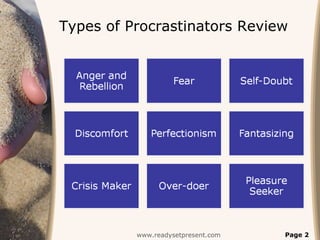
Types of Procrastinators Review


          www.readysetpresent.com   Page 2
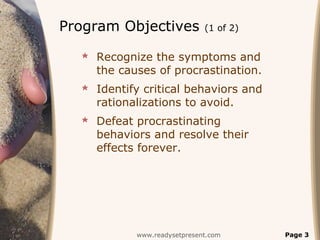
Program Objectives            (1 of 2)


   Recognize the symptoms and
    the causes of procrastination.
   Identify critical behaviors and
    rationalizations to avoid.
   Defeat procrastinating
    behaviors and resolve their
    effects forever.


            www.readysetpresent.com      Page 3
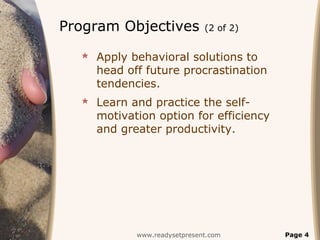
Program Objectives           (2 of 2)


   Apply behavioral solutions to
    head off future procrastination
    tendencies.
   Learn and practice the self-
    motivation option for efficiency
    and greater productivity.


           www.readysetpresent.com      Page 4
Definition
    The act of postponing, delaying
     or putting off, especially out of
     habitual carelessness or
     laziness.
    Procrastination is the
     deferment or putting-off of an
     action which requires
     immediate attention, usually by
     focusing on some other
     distraction.


             www.readysetpresent.com     Page 5
Procrastination Leads To
   Wasted Time.
   Missed Opportunities.
   Poor Performance.
   Self-Deprecation.
   Increased Stress.


           www.readysetpresent.com   Page 6
Overcoming Procrastination

  Gives you peace of mind
   Empowers you with strength
    and purpose.
   Allows you to take charge of
    your life.
   Brings you feelings of being
       strong, capable and
    confident.


            www.readysetpresent.com   Page 7
An Insight


             www.readysetpresent.com   Page 8
An Insight

  Procrastination is reinforcing.
  Every time you put off a task,
  you:
  Avoid a project that could bring
  you knowledge and success.
  Pass up acquisition of training
  and skills.
  Establish yourself with failure
  and fear.


                www.readysetpresent.com   Page 9
Learning Procrastination

  There are three different ways in
  which procrastination is learned:
  The way you think (thoughts,
  attitudes, emotions).
  The way you speak (remarks,
  conversations, self-talk).
  The way you act.


            www.readysetpresent.com   Page 10
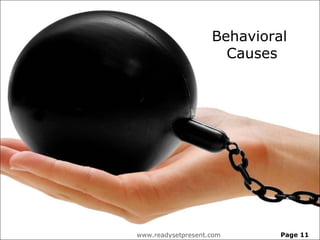
Behavioral
                      Causes


www.readysetpresent.com      Page 11
Behavioral Causes           (1 of 8)


  1. Perfectionism
   Spending more time than
    allowable.
   Waiting for all resources to be
    available before acting.


            www.readysetpresent.com    Page 12
Behavioral Causes           (2 of 8)


  2. Self-Inadequacies
   Avoiding putting your own
    skills to a test due to belief of
    failure.
   Putting a stop to what needs to
    be done whenever anxiety,
    uncertainty or discomfort
    arises.


            www.readysetpresent.com     Page 13
Behavioral Causes          (3 of 8)


  3. Lack Of Motivation
   The tendency for body at rest
    to stay at rest. Greater forces
    are needed to start change
    than to maintain change.


           www.readysetpresent.com    Page 14
Behavioral Causes          (6 of 8)


  6. Daydreaming/Fantasizing
   Putting the effects of problem
    causations in the real world
    and thus leading to poorly or
    non-existent developed
    solutions.


           www.readysetpresent.com    Page 15
Behavioral Causes          (7 of 8)


  7. Fear and Anxiety
   Feeling overwhelmed with
    the task.
   Spending more time worrying
    than figuring out a way to start
    the task.


           www.readysetpresent.com     Page 16
Behavioral Causes           (8 of 8)


  8. Physical Conditions
   Fatigue.
   Hunger, etc.


            www.readysetpresent.com    Page 17
Procrastinating Signs            (2 of 2)


  4. You think you are ill so that
     you can put off work until the
     next day.
  5. You manage to start late and
     then convince yourself that
     there isn’t enough time to do
     the task that day.
  6. You conveniently forget to
     have needed materials at hand
     to do a task.


            www.readysetpresent.com         Page 18
Change
                            Your
                          Thoughts


www.readysetpresent.com       Page 19
Time
Management


             www.readysetpresent.com   Page 20
Download “Procrastination”
            PowerPoint presentation at
             ReadySetPresent.com

150 slides include: the procrastination cycle, 8 questions
  to analyze if you are a procrastinator, 14 points on why
 people procrastinate, 8 types of procrastinators, 6 points
  on distractions, 5 slides on the id, ego, and superego, 5
     points on what procrastination leads to, 3 points on
learning procrastination, 22 points on 8 behavioral causes,
6 procrastinating signs, 16 points on time management, 16
points on changing your thoughts, 9 rationales to avoid, 37
do’s and don’ts, 4 points on spotting procrastination for the
    employer, 4 points on spotting procrastination for the
  employee, 64 points on how to approach procrastination
   for the employer, 61 points on behavioral solutions, 13
points on two strategies, 46 points on remedies, 18 points
 on a final call for action, 16 action steps and much more!
      Royalty Free – Use Them Over and Over Again.
            Updated & Expanded 2013
     Now: more content, graphics, and diagrams
                   www.readysetpresent.com              Page 21

Procrastination PowerPoint PPT Content Modern Sample

  • 1.
  • 2.
    Types of ProcrastinatorsReview www.readysetpresent.com Page 2
  • 3.
    Program Objectives (1 of 2)  Recognize the symptoms and the causes of procrastination.  Identify critical behaviors and rationalizations to avoid.  Defeat procrastinating behaviors and resolve their effects forever. www.readysetpresent.com Page 3
  • 4.
    Program Objectives (2 of 2)  Apply behavioral solutions to head off future procrastination tendencies.  Learn and practice the self- motivation option for efficiency and greater productivity. www.readysetpresent.com Page 4
  • 5.
    Definition  The act of postponing, delaying or putting off, especially out of habitual carelessness or laziness.  Procrastination is the deferment or putting-off of an action which requires immediate attention, usually by focusing on some other distraction. www.readysetpresent.com Page 5
  • 6.
    Procrastination Leads To  Wasted Time.  Missed Opportunities.  Poor Performance.  Self-Deprecation.  Increased Stress. www.readysetpresent.com Page 6
  • 7.
    Overcoming Procrastination Gives you peace of mind  Empowers you with strength and purpose.  Allows you to take charge of your life.  Brings you feelings of being strong, capable and confident. www.readysetpresent.com Page 7
  • 8.
    An Insight www.readysetpresent.com Page 8
  • 9.
    An Insight Procrastination is reinforcing. Every time you put off a task, you: Avoid a project that could bring you knowledge and success. Pass up acquisition of training and skills. Establish yourself with failure and fear. www.readysetpresent.com Page 9
  • 10.
    Learning Procrastination There are three different ways in which procrastination is learned: The way you think (thoughts, attitudes, emotions). The way you speak (remarks, conversations, self-talk). The way you act. www.readysetpresent.com Page 10
  • 11.
    Behavioral Causes www.readysetpresent.com Page 11
  • 12.
    Behavioral Causes (1 of 8) 1. Perfectionism  Spending more time than allowable.  Waiting for all resources to be available before acting. www.readysetpresent.com Page 12
  • 13.
    Behavioral Causes (2 of 8) 2. Self-Inadequacies  Avoiding putting your own skills to a test due to belief of failure.  Putting a stop to what needs to be done whenever anxiety, uncertainty or discomfort arises. www.readysetpresent.com Page 13
  • 14.
    Behavioral Causes (3 of 8) 3. Lack Of Motivation  The tendency for body at rest to stay at rest. Greater forces are needed to start change than to maintain change. www.readysetpresent.com Page 14
  • 15.
    Behavioral Causes (6 of 8) 6. Daydreaming/Fantasizing  Putting the effects of problem causations in the real world and thus leading to poorly or non-existent developed solutions. www.readysetpresent.com Page 15
  • 16.
    Behavioral Causes (7 of 8) 7. Fear and Anxiety  Feeling overwhelmed with the task.  Spending more time worrying than figuring out a way to start the task. www.readysetpresent.com Page 16
  • 17.
    Behavioral Causes (8 of 8) 8. Physical Conditions  Fatigue.  Hunger, etc. www.readysetpresent.com Page 17
  • 18.
    Procrastinating Signs (2 of 2) 4. You think you are ill so that you can put off work until the next day. 5. You manage to start late and then convince yourself that there isn’t enough time to do the task that day. 6. You conveniently forget to have needed materials at hand to do a task. www.readysetpresent.com Page 18
  • 19.
    Change Your Thoughts www.readysetpresent.com Page 19
  • 20.
    Time Management www.readysetpresent.com Page 20
  • 21.
    Download “Procrastination” PowerPoint presentation at ReadySetPresent.com 150 slides include: the procrastination cycle, 8 questions to analyze if you are a procrastinator, 14 points on why people procrastinate, 8 types of procrastinators, 6 points on distractions, 5 slides on the id, ego, and superego, 5 points on what procrastination leads to, 3 points on learning procrastination, 22 points on 8 behavioral causes, 6 procrastinating signs, 16 points on time management, 16 points on changing your thoughts, 9 rationales to avoid, 37 do’s and don’ts, 4 points on spotting procrastination for the employer, 4 points on spotting procrastination for the employee, 64 points on how to approach procrastination for the employer, 61 points on behavioral solutions, 13 points on two strategies, 46 points on remedies, 18 points on a final call for action, 16 action steps and much more! Royalty Free – Use Them Over and Over Again. Updated & Expanded 2013 Now: more content, graphics, and diagrams www.readysetpresent.com Page 21