Time
Management
Rohit Pinto – Adarsha
Institute of Management
“I wish I had more time!!”
Time is money – Benjamin
Franklin
 Timeis not money, time is much more
 valuable
    it is rationed out
    You can’t earn more no matter how hard
     you work
    The only way is to manage it.
 Everyonehas 24 hours in a day, how do
 you spend yours?
At this talk you will learn to:
 Clarifyyour goals and achieve them
 Handle people and projects that waste your
  time
 Be involved in better delegation
 Work more efficiently with your boss/advisor
 Learn specific skills and tools to save you
  time
 Overcome stress and procrastination
5


Outline
 Why is Time Management Important?
 Goals, Priorities, and Planning
 TO DO Lists
 Obstacles to Time management
 Scheduling Yourself
 Delegation
 Meetings
 Technology
6


The Problem is Severe
By some estimates, people waste about 2 hours
  per day. Signs of time wasting:
   Messy  desk and cluttered (or no) files
   Can’t find things
   Miss appointments, need to reschedule
    them late and/or unprepared for
    meetings
   Volunteer to do things other people
    should do
   Tired/unable to concentrate
7


Hear me Now, Believe me Later

 Being successful doesn’t
  make you manage your
  time well.
 Managing your time
  well makes you
  successful.
8


Goals, Priorities, and Planning
 Why   am I doing this?

 What   is the goal?

 Why   will I succeed?

 What   happens if I chose not to do it?
9


The 80/20 Rule
 Critical   few and the trivial many

 Having     the courage of your convictions

 Good   judgment comes from experience

 Experiences     comes from bad judgment
10


Inspiration
“If you can dream it, you can
             do it”
                               Walt Disney

 Disneyland
           was built in 366 days, from
 ground-breaking to first day open to the
 public.
11


Planning
 Failing   to plan is planning to fail

 Plan
     Each Day, Each Week, Each
  Semester

 You can always change your plan, but
  only once you have one!
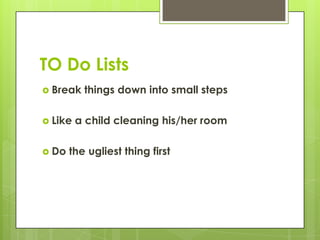
TO Do Lists
 Break   things down into small steps

 Like   a child cleaning his/her room

 Do   the ugliest thing first
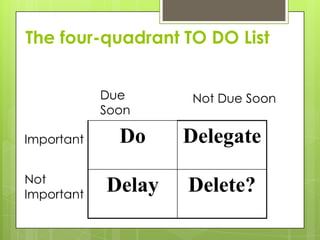
The four-quadrant TO DO List


            Due     Not Due Soon
            Soon

Important     Do    Delegate
Not
Important
            Delay   Delete?
Obstacles to effective time
   management
   Unclear
   objectives
       Disorganization


Inability to say
“no”
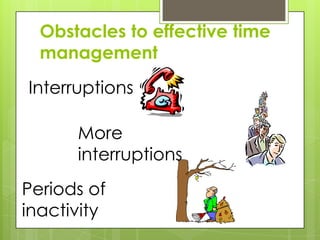
Obstacles to effective time
  management
Interruptions

      More
      interruptions
Periods of
inactivity
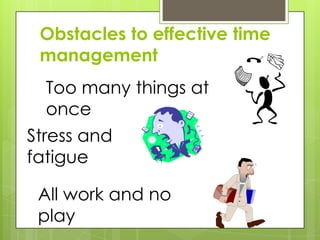
Obstacles to effective time
 management
  Too many things at
  once
Stress and
fatigue

 All work and no
 play
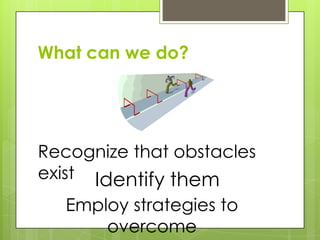
What can we do?


Recognize that obstacles
exist Identify them
   Employ strategies to
       overcome
18


Scheduling Yourself
 Youdon’t find time for important things,
 you make it

 Everything   you do is an opportunity cost

 Learn   to say “No”
19


Learn to say “No”
 Will   this help me get tenure?

 Will   this help me get my masters?

 Will   this help me get my Ph.D?

 Keep    “help me” broadly defined
20


Gentle No’s
 “I’ll do it if nobody else steps forward” or
  “I’ll be your deep fall back,” but you have
  to keep searching.

 Moving   parties in grad school…
21


Everyone has Good and Bad Times

    Find your creative/thinking time. Defend
    it ruthlessly, spend it alone, maybe at
    home.

    Find
        your dead time. Schedule meetings,
    phone calls, and mundane stuff during it.
22


Interruptions
 6-9minutes, 4-5 minute recovery – five
 interruptions shoots an hour

 You must reduce frequency and
 length of interruptions (turn phone calls
 into email)

 E-mailnoise on new mail is an
 interruption -> TURN IT OFF!!
23


Cutting Things Short
 “I’m    in the middle of something now…”

 Start
     with “I only have 5 minutes” – you
 can always extend this

 Stand
      up, stroll to the door,
 complement, thank, shake hands

 Clock-watching;    on wall behind them
24


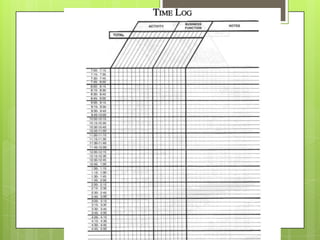
Time Journals
 It’s   amazing what you learn!

 Monitor yourself in 15 minute increments
  for between 3 days and two weeks.

 Update     every ½ hour: not at end of day
25
26


Using Time Journal Data
 Whatam I doing that doesn’t really
 need to be done?

 Whatam I doing that could be done
 by someone else?

 Whatam I doing that could be done
 more efficiently?

 What   do I do that wastes others’ time?
27


Procrastination
  “Procrastination is the
       thief of time”
                    Edward Young
              Night Thoughts, 1742
28


Balancing Act
“Work expands so as to fill
 the time available for its
       completion”
                      Parkinson’s Law
                Cyril Parkinson, 1957
29


Avoiding Procrastination
 Doingthings at the last minute is much
 more expensive than just before the last
 minute

 Deadlines
          are really important: establish
 them yourself!
30


Comfort Zones
 Identify   why you aren’t enthusiastic

 Fear   of embarrassment

 Fear   of failure?

 Get   a spine!
31


Delegation
 No   one is an island

 You   can accomplish a lot more with help

 Most delegation in your life is from faculty
 to graduate student
32


  Delegation is not dumping
 Grant   authority with responsibility.

 Concrete    goal, deadline, and consequences.

 Treat   your people well

 Grad  students and secretaries are a faculty member’s
 lifeline; they should be treated well!
33


Challenge People
 People rise to the challenge: You
  should delegate “until they complain”

 Communication     Must Be Clear: “Get it
  in writing” – Judge Wapner

 Give    objectives, not procedures

 Tell   the relative importance of this task
34


Sociology
 Beware   upward delegation!

 Reinforce   behavior you want repeated

 Ignorance is your friend – I do not know
 how to run the photocopier or the fax
 machine
35


 Meetings
 Average   executive: > 40% of time
 Lock the door, unplug the phone
 Maximum of 1 hour
 Prepare: there must be an agenda
 1 minute minutes: an efficient way to keep
  track of decisions made in a meeting: who is
  responsible for what by when?
36


Technology
 “Computers are faster but they take
 longer” --Janitor, UCF

 Secretaries
            are better than answering
 machines; where are the costs & benefits
 of a technology? (transcription)
37


Technology
  Laptop   computer (and docking station)
     You can scavenge time & work anywhere
     At CMU, you still have internet access
     one machine in your life is the right number

  WWW;    only do things once (post them)

  Google     (now with image search!)

 I   haven’t been to the library in years!!
38


Randy’s Magic E-Mail Tips
     Save all of it; no exceptions
     If you want somebody to do    something,
      make them the only recipient. Otherwise,
      you have diffusion of responsibility. Give
      a concrete request/task and a deadline.
     If you really want somebody to do
      something, CC someone powerful.
     Nagging is okay; if someone doesn’t
      respond in 48 hours, they’ll probably
      never respond. (True for phone as well as
      email).
Have an Efficient time!

Time management

  • 1.
    Time Management Rohit Pinto –Adarsha Institute of Management
  • 2.
    “I wish Ihad more time!!”
  • 3.
    Time is money– Benjamin Franklin  Timeis not money, time is much more valuable  it is rationed out  You can’t earn more no matter how hard you work  The only way is to manage it.  Everyonehas 24 hours in a day, how do you spend yours?
  • 4.
    At this talkyou will learn to:  Clarifyyour goals and achieve them  Handle people and projects that waste your time  Be involved in better delegation  Work more efficiently with your boss/advisor  Learn specific skills and tools to save you time  Overcome stress and procrastination
  • 5.
    5 Outline  Why isTime Management Important?  Goals, Priorities, and Planning  TO DO Lists  Obstacles to Time management  Scheduling Yourself  Delegation  Meetings  Technology
  • 6.
    6 The Problem isSevere By some estimates, people waste about 2 hours per day. Signs of time wasting:  Messy desk and cluttered (or no) files  Can’t find things  Miss appointments, need to reschedule them late and/or unprepared for meetings  Volunteer to do things other people should do  Tired/unable to concentrate
  • 7.
    7 Hear me Now,Believe me Later Being successful doesn’t make you manage your time well. Managing your time well makes you successful.
  • 8.
    8 Goals, Priorities, andPlanning  Why am I doing this?  What is the goal?  Why will I succeed?  What happens if I chose not to do it?
  • 9.
    9 The 80/20 Rule Critical few and the trivial many  Having the courage of your convictions  Good judgment comes from experience  Experiences comes from bad judgment
  • 10.
    10 Inspiration “If you candream it, you can do it” Walt Disney  Disneyland was built in 366 days, from ground-breaking to first day open to the public.
  • 11.
    11 Planning  Failing to plan is planning to fail  Plan Each Day, Each Week, Each Semester  You can always change your plan, but only once you have one!
  • 12.
    TO Do Lists Break things down into small steps  Like a child cleaning his/her room  Do the ugliest thing first
  • 13.
    The four-quadrant TODO List Due Not Due Soon Soon Important Do Delegate Not Important Delay Delete?
  • 14.
    Obstacles to effectivetime management Unclear objectives Disorganization Inability to say “no”
  • 15.
    Obstacles to effectivetime management Interruptions More interruptions Periods of inactivity
  • 16.
    Obstacles to effectivetime management Too many things at once Stress and fatigue All work and no play
  • 17.
    What can wedo? Recognize that obstacles exist Identify them Employ strategies to overcome
  • 18.
    18 Scheduling Yourself  Youdon’tfind time for important things, you make it  Everything you do is an opportunity cost  Learn to say “No”
  • 19.
    19 Learn to say“No”  Will this help me get tenure?  Will this help me get my masters?  Will this help me get my Ph.D?  Keep “help me” broadly defined
  • 20.
    20 Gentle No’s  “I’lldo it if nobody else steps forward” or “I’ll be your deep fall back,” but you have to keep searching.  Moving parties in grad school…
  • 21.
    21 Everyone has Goodand Bad Times  Find your creative/thinking time. Defend it ruthlessly, spend it alone, maybe at home.  Find your dead time. Schedule meetings, phone calls, and mundane stuff during it.
  • 22.
    22 Interruptions  6-9minutes, 4-5minute recovery – five interruptions shoots an hour  You must reduce frequency and length of interruptions (turn phone calls into email)  E-mailnoise on new mail is an interruption -> TURN IT OFF!!
  • 23.
    23 Cutting Things Short “I’m in the middle of something now…”  Start with “I only have 5 minutes” – you can always extend this  Stand up, stroll to the door, complement, thank, shake hands  Clock-watching; on wall behind them
  • 24.
    24 Time Journals  It’s amazing what you learn!  Monitor yourself in 15 minute increments for between 3 days and two weeks.  Update every ½ hour: not at end of day
  • 25.
  • 26.
    26 Using Time JournalData  Whatam I doing that doesn’t really need to be done?  Whatam I doing that could be done by someone else?  Whatam I doing that could be done more efficiently?  What do I do that wastes others’ time?
  • 27.
    27 Procrastination “Procrastinationis the thief of time” Edward Young Night Thoughts, 1742
  • 28.
    28 Balancing Act “Work expandsso as to fill the time available for its completion” Parkinson’s Law Cyril Parkinson, 1957
  • 29.
    29 Avoiding Procrastination  Doingthingsat the last minute is much more expensive than just before the last minute  Deadlines are really important: establish them yourself!
  • 30.
    30 Comfort Zones  Identify why you aren’t enthusiastic  Fear of embarrassment  Fear of failure?  Get a spine!
  • 31.
    31 Delegation  No one is an island  You can accomplish a lot more with help  Most delegation in your life is from faculty to graduate student
  • 32.
    32 Delegationis not dumping  Grant authority with responsibility.  Concrete goal, deadline, and consequences.  Treat your people well  Grad students and secretaries are a faculty member’s lifeline; they should be treated well!
  • 33.
    33 Challenge People  Peoplerise to the challenge: You should delegate “until they complain”  Communication Must Be Clear: “Get it in writing” – Judge Wapner  Give objectives, not procedures  Tell the relative importance of this task
  • 34.
    34 Sociology  Beware upward delegation!  Reinforce behavior you want repeated  Ignorance is your friend – I do not know how to run the photocopier or the fax machine
  • 35.
    35 Meetings  Average executive: > 40% of time  Lock the door, unplug the phone  Maximum of 1 hour  Prepare: there must be an agenda  1 minute minutes: an efficient way to keep track of decisions made in a meeting: who is responsible for what by when?
  • 36.
    36 Technology  “Computers arefaster but they take longer” --Janitor, UCF  Secretaries are better than answering machines; where are the costs & benefits of a technology? (transcription)
  • 37.
    37 Technology  Laptop computer (and docking station)  You can scavenge time & work anywhere  At CMU, you still have internet access  one machine in your life is the right number  WWW; only do things once (post them)  Google (now with image search!) I haven’t been to the library in years!!
  • 38.
    38 Randy’s Magic E-MailTips  Save all of it; no exceptions  If you want somebody to do something, make them the only recipient. Otherwise, you have diffusion of responsibility. Give a concrete request/task and a deadline.  If you really want somebody to do something, CC someone powerful.  Nagging is okay; if someone doesn’t respond in 48 hours, they’ll probably never respond. (True for phone as well as email).
  • 39.