Time Management
• Objectives (Learning outcomes)
 Define time management
 Recognize benefits of time Management
 Determine obstacles to effective time management
 Know how to manage your time effectively
 Illustrate “SMART “ goal
 Know How to prioritize tasks
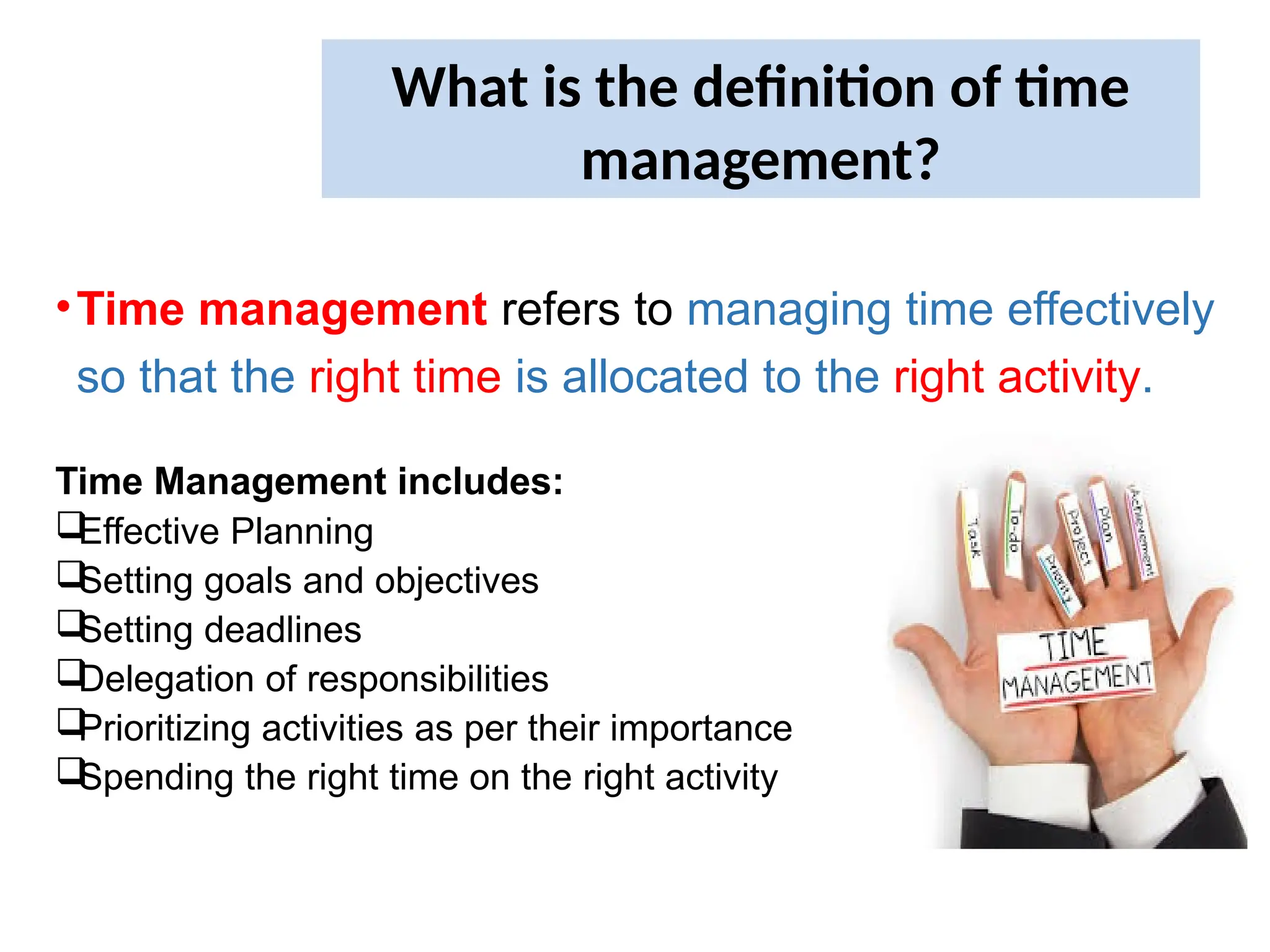
•Time management refers to managing time effectively
so that the right time is allocated to the right activity.
Time Management includes:

Effective Planning

Setting goals and objectives

Setting deadlines

Delegation of responsibilities

Prioritizing activities as per their importance

Spending the right time on the right activity
What is the definition of time
management?
By utilizing these strategies, individuals can:-
 Optimize their productivity and ensure that they are
making the most efficient use of their time.
 Reduces stress.
 Improves self-esteem.
 Helps achieve balance in life.
 Increases self-confidence
 Helps you reach your goals!
Obstacles to effective time
management
1. Unclear objectives
2. Disorganization
3. Inability to say “no”
4. Interruptions
5. Too many things at once
6. Stress and fatigue
7. Periods of inactivity
1. Set smart goals
2. Set reasonable expectations (and remember
that no one’s perfect)
3. Prioritize your tasks
4. Make a schedule
5. Get Organized
6. Overcome procrastination
7. Tackle time wasters
8. Avoid taking on too much
9. Consider your personal prime time
10. Celebrate success
10 Steps to managing your time
• Make your goals smart . Don’t be vague.
• Set both long-term goals and short-term
ones to support them.
• Set a deadline for your goals.
• Integrate your goals: school, personal
and career.
• Realize that goals change but know
which goals to stick to!
Where to start? Set Goals!
What is Important?
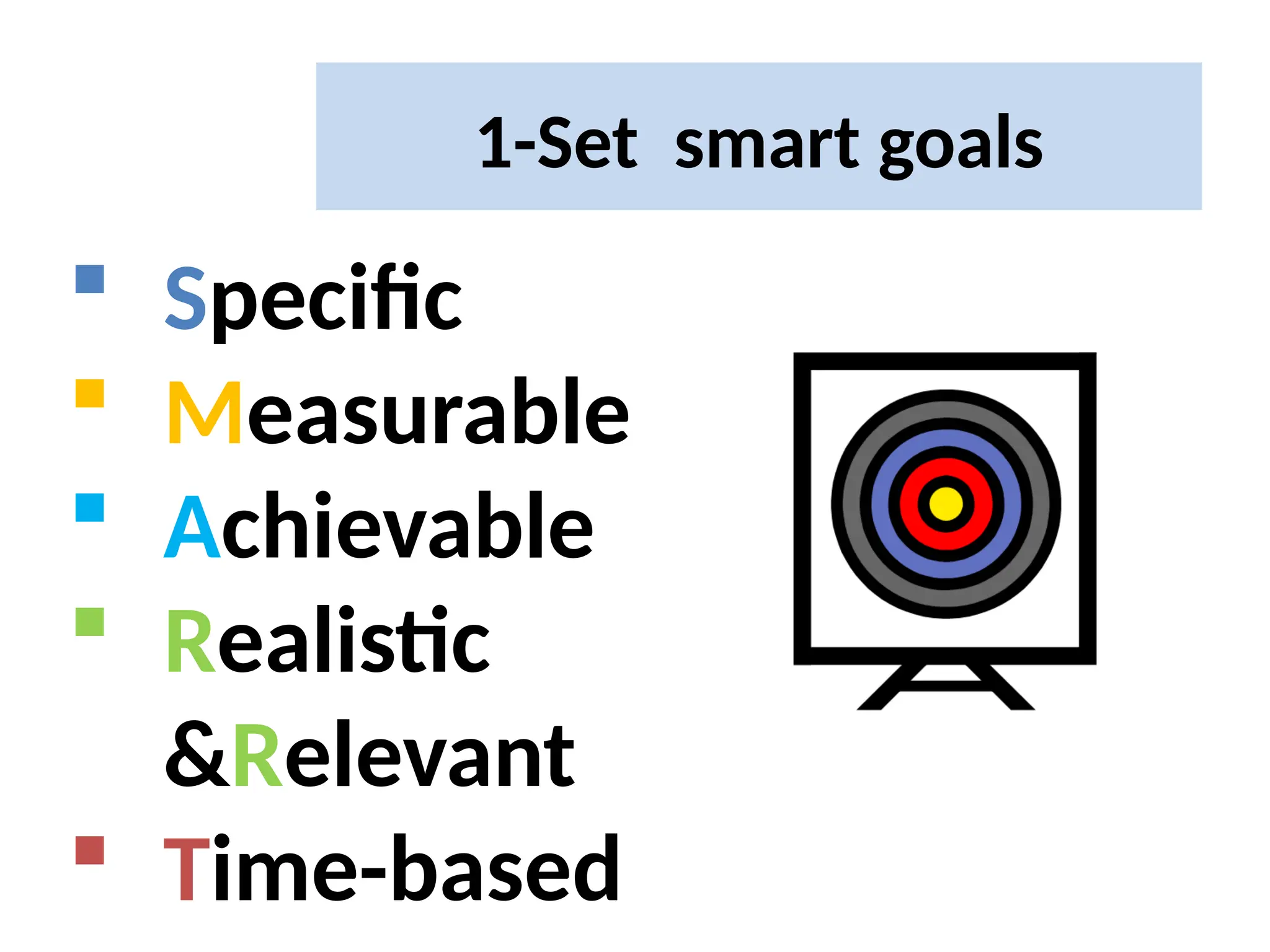
1-Set smart goals
 Specific
 Measurable
 Achievable
 Realistic
&Relevant
 Time-based
 Specific: Precise statement of what needs to be
accomplished: exactly what are you going do, how much?
When? How often?
 Measurable: Concrete criteria for measuring progress
help you to manage and evaluate your goal.
 Achievable: Assurance your goal fits your ability.
Something you can accomplish. Not too easy or too hard
 Realistic & Relevant: Personalization of your goal.
Supports your interests, values, needs and talents.
Critical to motivation.
 Timed based : Beginning point and deadlines. Gets your
started and keeps you on track.
 Specific: Precise statement of what needs to be
accomplished: exactly what are you going do, how much?
When? How often?
 Measurable: Concrete criteria for measuring progress
help you to manage and evaluate your goal.
 Achievable: Assurance your goal fits your ability.
Something you can accomplish. Not too easy or too hard
 Realistic & Relevant: Personalization of your goal.
Supports your interests, values, needs and talents.
Critical to motivation.
 Timed based : Beginning point and deadlines. Gets your
started and keeps you on track.
2- Set reasonable expectations
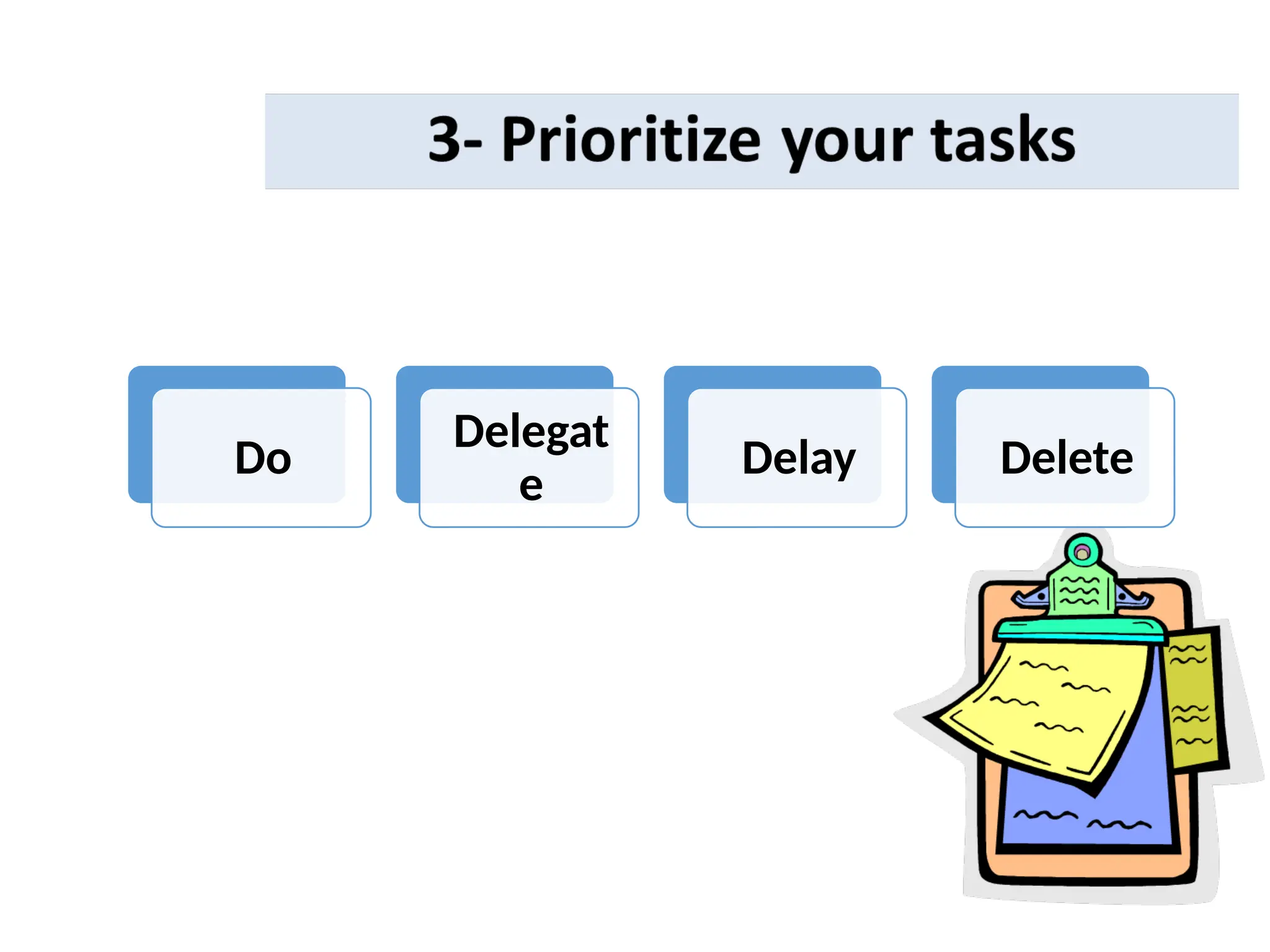
3- Prioritize your tasks
• What’s important and what
isn’t?
• What order do things need to
be done in?
• Once you know what your
priorities are, you need to plan
out a schedule for the
semester, the week and the
day.
Do
Delegat
e
Delay Delete
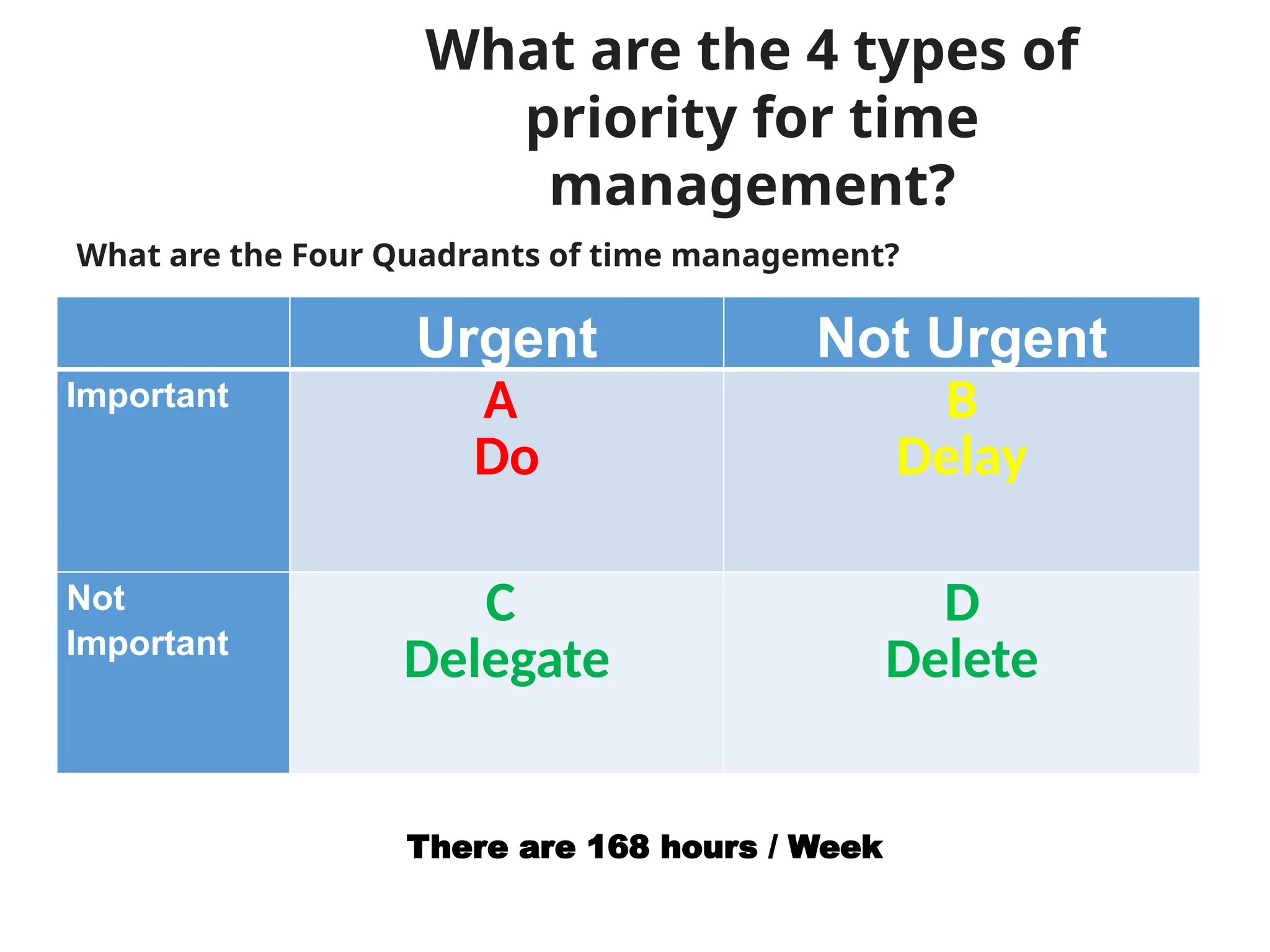
What are the 4 types of
priority for time
management?
Urgent Not Urgent
Important A
Do
B
Delay
Not
Important
C
Delegate
D
Delete
What are the Four Quadrants of time management?
There are 168 hours / Week
15
APriorities
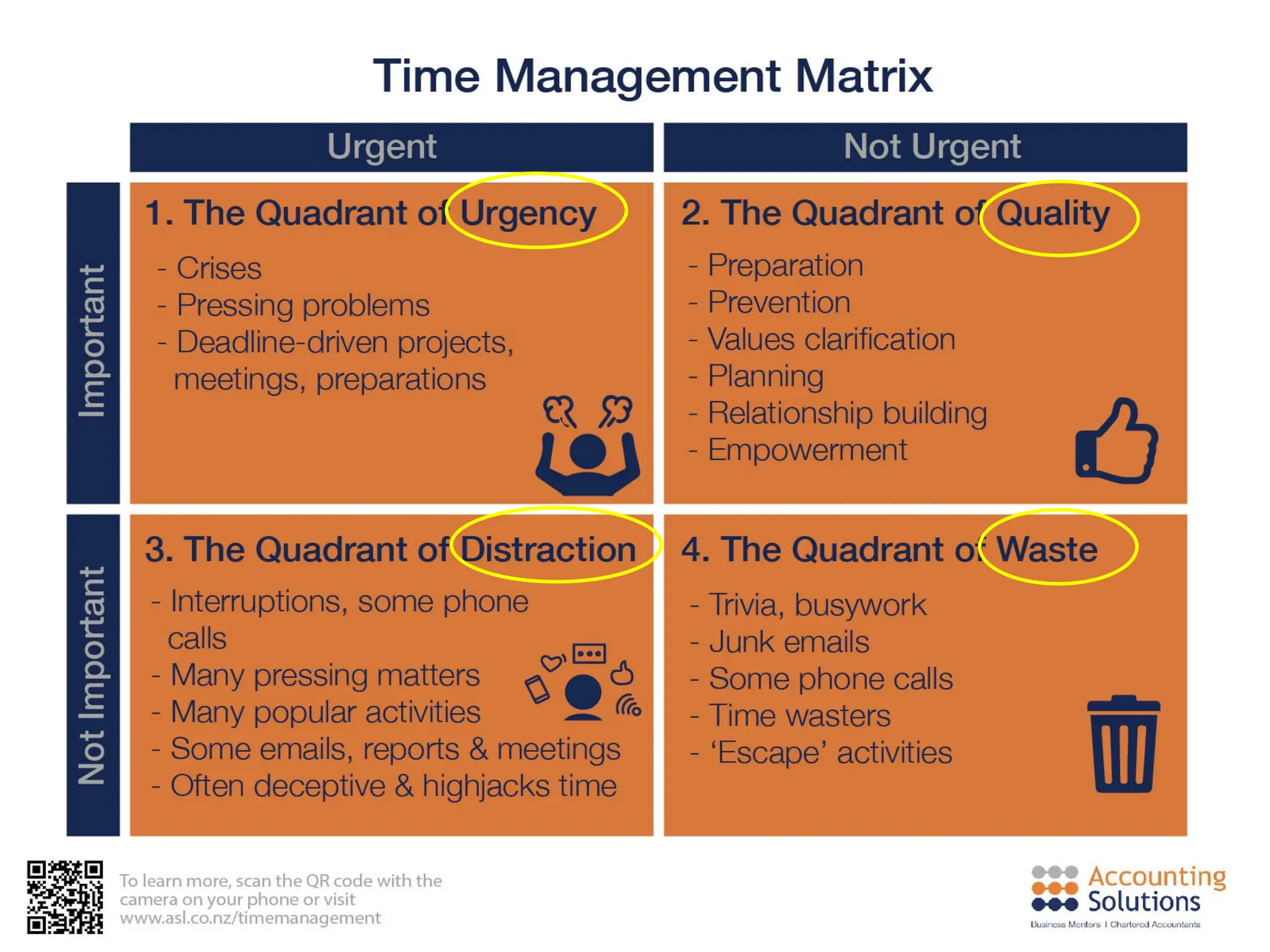
Tasks that are both urgent & important
(Quadrant 1) should be given top priority.
These are the things that must be done
right away and can’t be put off. Examples
might include
• Meeting a deadline,
• Responding to a patient complaint
BPriorities
Tasks that are important but not urgent (Quadrant
2)
• These are things that aren’t time-sensitive but still
need to be done eventually. They can usually be
scheduled for later without major consequences.
• Never do a B task when there is an A task the needs to
be finished
• Example:-
Long term project
Studying in advance
CPriorities
 Sometimes are not important but are urgent
(Quadrant 3) like Interruptions, distractions, fun
events that come up, social invitations with no
consequences for not doing this ……. DELEGATE
01/25/2025 Prof. Eman M. Araby 19
• Not important or urgent (Quadrant 4)
like Time waster friends , Gaming&
Facebook ..DELETE
DPriorities
Steven Covey
recommends
that we should
spend most of
our time in
Quadrants 1 & 2
and as little time
as possible in
Quadrant 4.
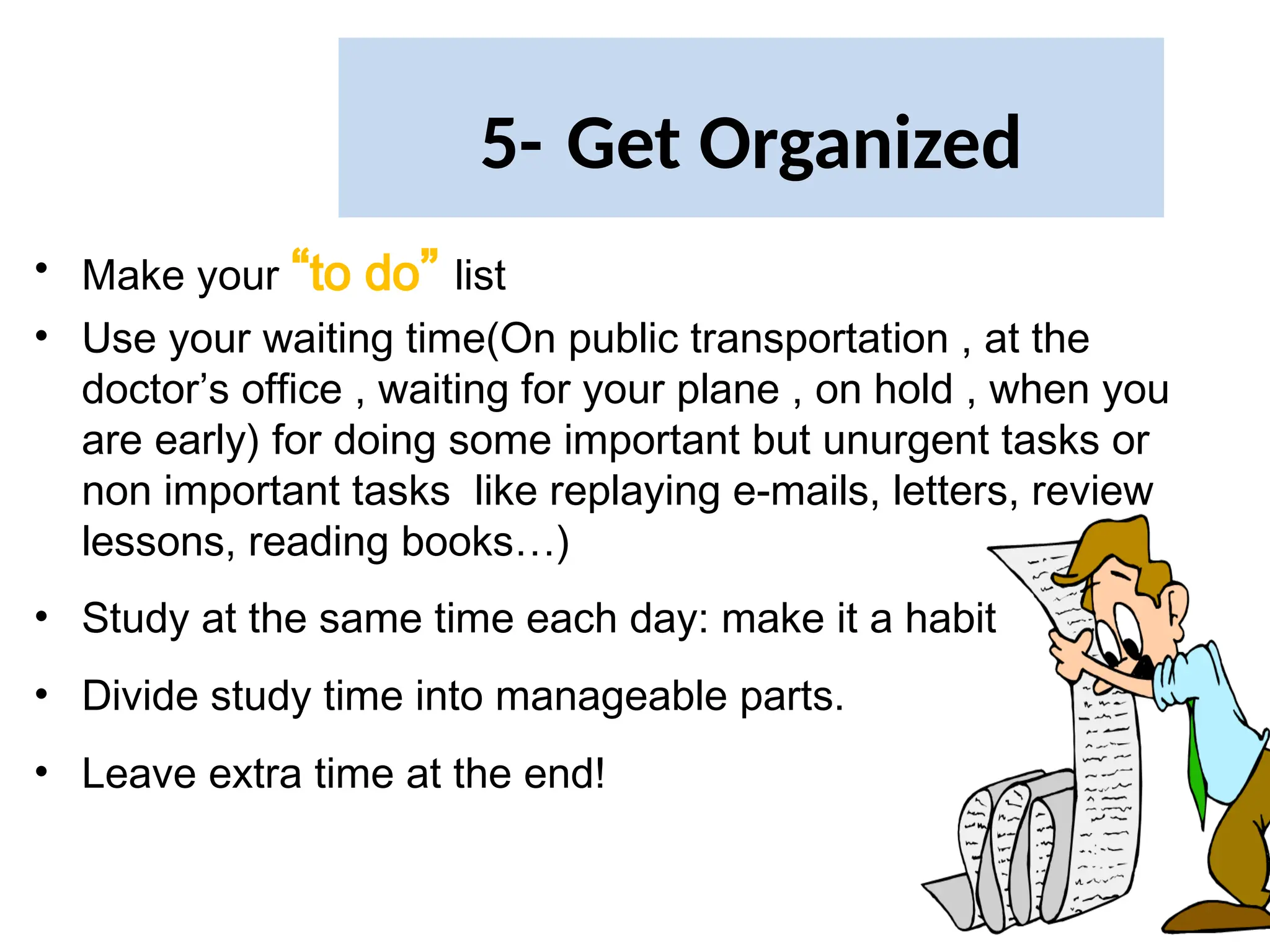
5- Get Organized
• Make your “to do” list
• Use your waiting time(On public transportation , at the
doctor’s office , waiting for your plane , on hold , when you
are early) for doing some important but unurgent tasks or
non important tasks like replaying e-mails, letters, review
lessons, reading books…)
• Study at the same time each day: make it a habit
• Divide study time into manageable parts.
• Leave extra time at the end!
6- Overcome procrastination
Do not postpone today’s work to tomorrow
•Forms of procrastination:
1. Ignoring the task, hoping it will go away
2. Underestimating how long it will take/overestimating your abilities and
resources
3. Telling yourself that poor performance is okay/insisting on perfection
4. Doing something else that isn’t very important
5. Believing that repeated “minor” delays won’t hurt you
6. Talking about rather than doing it
7. Putting all your work on only one part of the task
8. Becoming paralyzed when having to make choices
23
7-Tackle Time Wasters
24
01/25/2025 Prof. Eman M. Araby 25
Time Wasters
8- Avoid taking on too much
• Learn how to say “NO” when you don’t have time.
• Have a self-discipline.
• Learn to delegate, share work, let others help
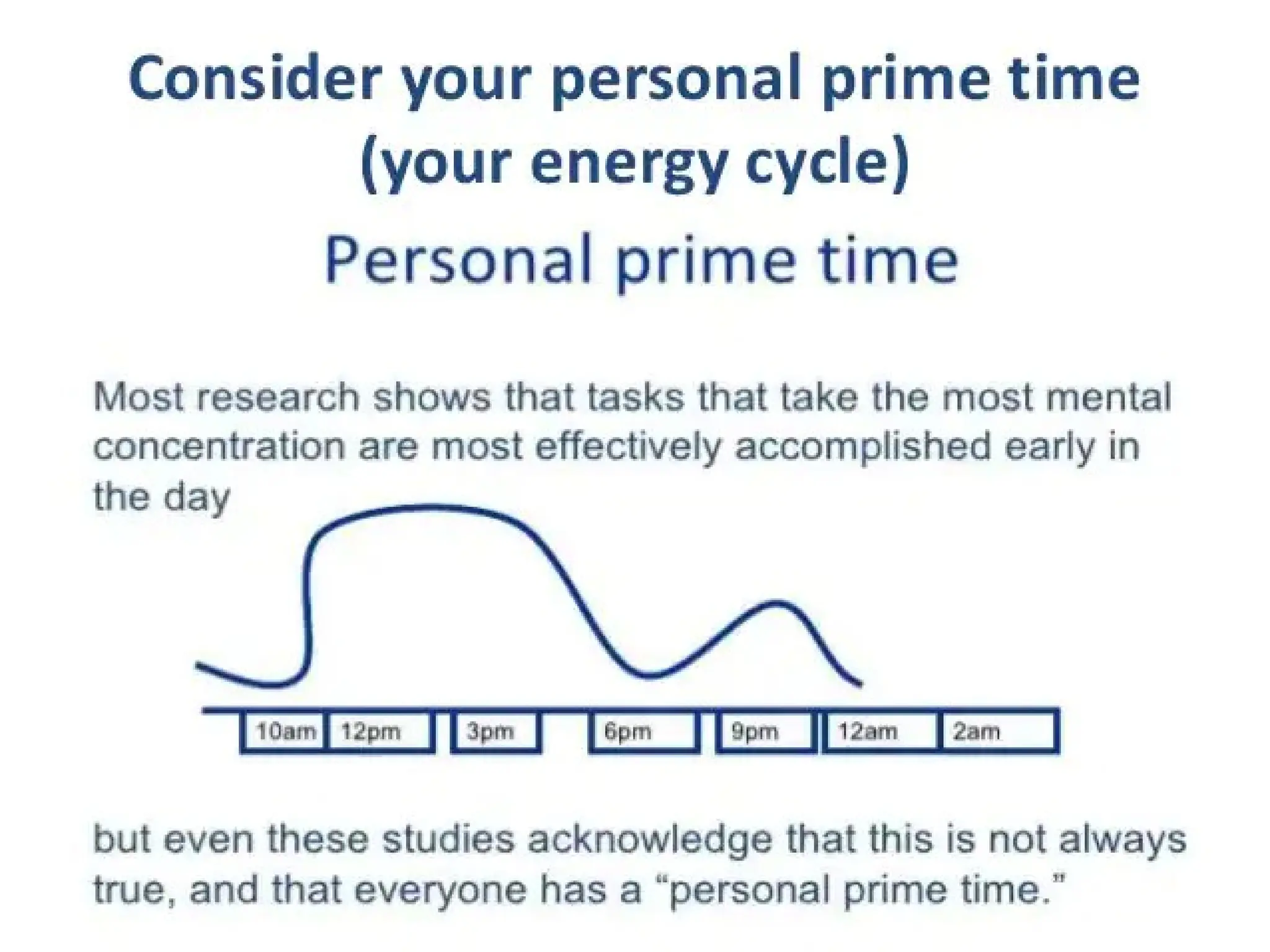
It is advisable to do the worst tasks first while you are alert
and not tired because it allows you to tackle them with more
focus and energy.
As the day progresses, fatigue may set in, making it harder to
accomplish difficult tasks. Therefore, prioritizing the worst
tasks while you are alert increases productivity and helps in
managing your workload effectively.
9- Consider your personal prime
time
28
10-Celebrate success
Enjoy your time as a graduate student!
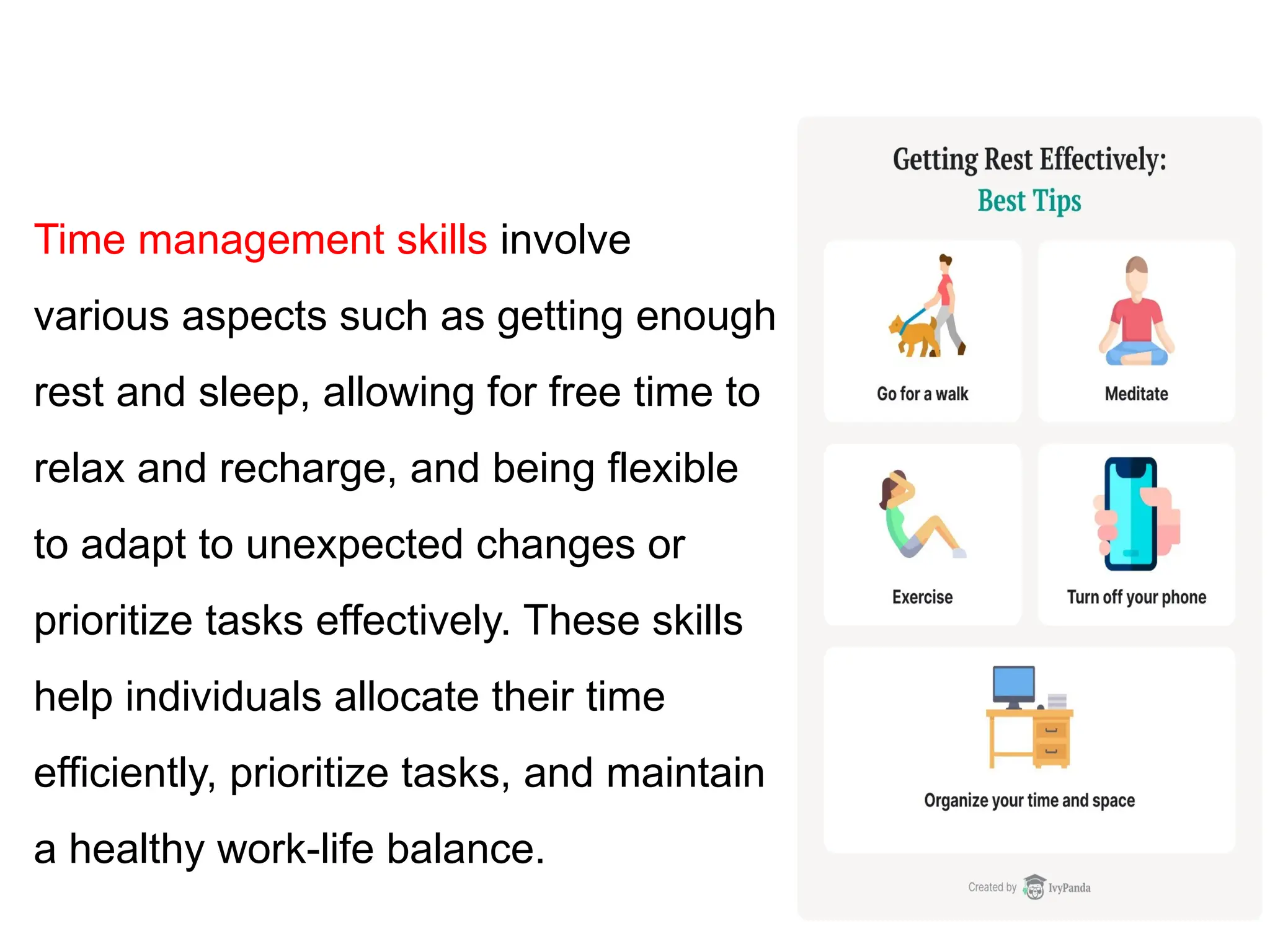
Time management skills involve
various aspects such as getting enough
rest and sleep, allowing for free time to
relax and recharge, and being flexible
to adapt to unexpected changes or
prioritize tasks effectively. These skills
help individuals allocate their time
efficiently, prioritize tasks, and maintain
a healthy work-life balance.
01/25/2025
Prof. Eman M. Araby 31
Thank you
32

Time management skills and professionalism

  • 1.
  • 2.
    • Objectives (Learningoutcomes)  Define time management  Recognize benefits of time Management  Determine obstacles to effective time management  Know how to manage your time effectively  Illustrate “SMART “ goal  Know How to prioritize tasks
  • 3.
    •Time management refersto managing time effectively so that the right time is allocated to the right activity. Time Management includes:  Effective Planning  Setting goals and objectives  Setting deadlines  Delegation of responsibilities  Prioritizing activities as per their importance  Spending the right time on the right activity What is the definition of time management?
  • 4.
    By utilizing thesestrategies, individuals can:-  Optimize their productivity and ensure that they are making the most efficient use of their time.  Reduces stress.  Improves self-esteem.  Helps achieve balance in life.  Increases self-confidence  Helps you reach your goals!
  • 5.
    Obstacles to effectivetime management 1. Unclear objectives 2. Disorganization 3. Inability to say “no” 4. Interruptions 5. Too many things at once 6. Stress and fatigue 7. Periods of inactivity
  • 6.
    1. Set smartgoals 2. Set reasonable expectations (and remember that no one’s perfect) 3. Prioritize your tasks 4. Make a schedule 5. Get Organized 6. Overcome procrastination 7. Tackle time wasters 8. Avoid taking on too much 9. Consider your personal prime time 10. Celebrate success 10 Steps to managing your time
  • 7.
    • Make yourgoals smart . Don’t be vague. • Set both long-term goals and short-term ones to support them. • Set a deadline for your goals. • Integrate your goals: school, personal and career. • Realize that goals change but know which goals to stick to! Where to start? Set Goals! What is Important?
  • 8.
    1-Set smart goals Specific  Measurable  Achievable  Realistic &Relevant  Time-based
  • 9.
     Specific: Precisestatement of what needs to be accomplished: exactly what are you going do, how much? When? How often?  Measurable: Concrete criteria for measuring progress help you to manage and evaluate your goal.  Achievable: Assurance your goal fits your ability. Something you can accomplish. Not too easy or too hard  Realistic & Relevant: Personalization of your goal. Supports your interests, values, needs and talents. Critical to motivation.  Timed based : Beginning point and deadlines. Gets your started and keeps you on track.
  • 10.
     Specific: Precisestatement of what needs to be accomplished: exactly what are you going do, how much? When? How often?  Measurable: Concrete criteria for measuring progress help you to manage and evaluate your goal.  Achievable: Assurance your goal fits your ability. Something you can accomplish. Not too easy or too hard  Realistic & Relevant: Personalization of your goal. Supports your interests, values, needs and talents. Critical to motivation.  Timed based : Beginning point and deadlines. Gets your started and keeps you on track.
  • 11.
    2- Set reasonableexpectations
  • 12.
    3- Prioritize yourtasks • What’s important and what isn’t? • What order do things need to be done in? • Once you know what your priorities are, you need to plan out a schedule for the semester, the week and the day.
  • 13.
  • 14.
    What are the4 types of priority for time management? Urgent Not Urgent Important A Do B Delay Not Important C Delegate D Delete What are the Four Quadrants of time management? There are 168 hours / Week
  • 15.
  • 16.
    APriorities Tasks that areboth urgent & important (Quadrant 1) should be given top priority. These are the things that must be done right away and can’t be put off. Examples might include • Meeting a deadline, • Responding to a patient complaint
  • 17.
    BPriorities Tasks that areimportant but not urgent (Quadrant 2) • These are things that aren’t time-sensitive but still need to be done eventually. They can usually be scheduled for later without major consequences. • Never do a B task when there is an A task the needs to be finished • Example:- Long term project Studying in advance
  • 18.
    CPriorities  Sometimes arenot important but are urgent (Quadrant 3) like Interruptions, distractions, fun events that come up, social invitations with no consequences for not doing this ……. DELEGATE
  • 19.
    01/25/2025 Prof. EmanM. Araby 19 • Not important or urgent (Quadrant 4) like Time waster friends , Gaming& Facebook ..DELETE DPriorities
  • 20.
    Steven Covey recommends that weshould spend most of our time in Quadrants 1 & 2 and as little time as possible in Quadrant 4.
  • 21.
    5- Get Organized •Make your “to do” list • Use your waiting time(On public transportation , at the doctor’s office , waiting for your plane , on hold , when you are early) for doing some important but unurgent tasks or non important tasks like replaying e-mails, letters, review lessons, reading books…) • Study at the same time each day: make it a habit • Divide study time into manageable parts. • Leave extra time at the end!
  • 22.
    6- Overcome procrastination Donot postpone today’s work to tomorrow •Forms of procrastination: 1. Ignoring the task, hoping it will go away 2. Underestimating how long it will take/overestimating your abilities and resources 3. Telling yourself that poor performance is okay/insisting on perfection 4. Doing something else that isn’t very important 5. Believing that repeated “minor” delays won’t hurt you 6. Talking about rather than doing it 7. Putting all your work on only one part of the task 8. Becoming paralyzed when having to make choices
  • 23.
  • 24.
  • 25.
    01/25/2025 Prof. EmanM. Araby 25 Time Wasters
  • 26.
    8- Avoid takingon too much • Learn how to say “NO” when you don’t have time. • Have a self-discipline. • Learn to delegate, share work, let others help
  • 27.
    It is advisableto do the worst tasks first while you are alert and not tired because it allows you to tackle them with more focus and energy. As the day progresses, fatigue may set in, making it harder to accomplish difficult tasks. Therefore, prioritizing the worst tasks while you are alert increases productivity and helps in managing your workload effectively. 9- Consider your personal prime time
  • 28.
  • 29.
    10-Celebrate success Enjoy yourtime as a graduate student!
  • 30.
    Time management skillsinvolve various aspects such as getting enough rest and sleep, allowing for free time to relax and recharge, and being flexible to adapt to unexpected changes or prioritize tasks effectively. These skills help individuals allocate their time efficiently, prioritize tasks, and maintain a healthy work-life balance.
  • 31.
  • 32.