Thyroiditis
• Hashimoto thyroiditis
• De- quervain thyroiditis
• Acute thyroiditis
• Riedel thyroiditis
Thyroiditis
• Inflammation of the thyroid gland
• Acute illness
• Severe thyroid pain
• Manifested primarily by thyroid dysfunction
Types
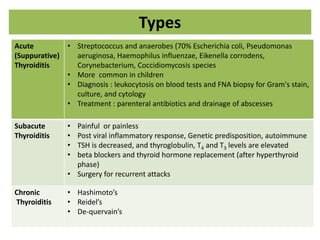
Acute
(Suppurative)
Thyroiditis
• Streptococcus and anaerobes (70% Escherichia coli, Pseudomonas
aeruginosa, Haemophilus influenzae, Eikenella corrodens,
Corynebacterium, Coccidiomycosis species
• More common in children
• Diagnosis : leukocytosis on blood tests and FNA biopsy for Gram's stain,
culture, and cytology
• Treatment : parenteral antibiotics and drainage of abscesses
Subacute
Thyroiditis
• Painful or painless
• Post viral inflammatory response, Genetic predisposition, autoimmune
• TSH is decreased, and thyroglobulin, T4 and T3 levels are elevated
• beta blockers and thyroid hormone replacement (after hyperthyroid
phase)
• Surgery for recurrent attacks
Chronic
Thyroiditis
• Hashimoto’s
• Reidel’s
• De-quervain’s
Hashimoto Thyroiditis
• First described by hashimoto, in 1912, as struma
lymphomatosa—
• Transformation of thyroid tissue to lymphoid tissue
• Most common inflammatory disorder of the thyroid
• Leading cause of hypothyroidism
Etiology
• Autoimmune process
• Increased intake of iodine
• Medications: interferon, lithium, and amiodarone
• Inherited predisposition
• Chromosomal abnormalities : turner's syndrome and
down syndrome.
• Associations with hla-b8, dr3, and dr5 haplotypes
Pathogenesis
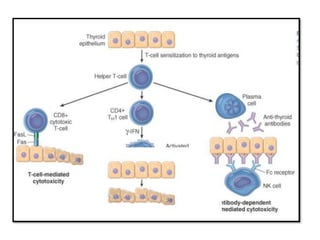
Activation of CD4+T (helper) lymphocytes
T cells recruit cytotoxic CD8+T cells to the thyroid.
Hypothyroidism results from:
– destruction of thyrocytes by cytotoxic t cells
– autoantibodies, which lead to complement fixation and killing by natural
killer cells or block the TSH receptor
Antibodies are directed against the three main antigens
– Tg (60%)
– TPO (95%)
– TSH-R (60%)
– sodium/iodine symporter (25%)
Apoptosis (programmed cell death) also implicated
Pathology
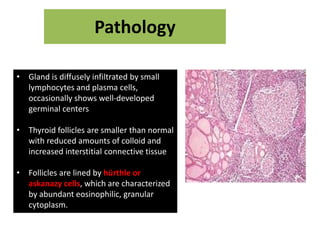
• Gland is diffusely infiltrated by small
lymphocytes and plasma cells,
occasionally shows well-developed
germinal centers
• Thyroid follicles are smaller than normal
with reduced amounts of colloid and
increased interstitial connective tissue
• Follicles are lined by hürthle or
askanazy cells, which are characterized
by abundant eosinophilic, granular
cytoplasm.
Clinical Presentation
• Male: female ratio 1:10 to 20)
• Ages of 30 and 50 years.
• Minimally or moderately enlarged firm gland
• 20% of patients present with hypothyroidism
• 5% present with hyperthyroidism ( hashitoxicosis)
Diagnostic Studies
TSH T4 and T3 levels
Thyroid autoantibodies
FNA biopsy if solitary suspicious nodule or a
rapidly enlarging goiter
Treatment
Overtly hypothyroid:
• Thyroid hormone replacement therapy
Subclinical hypothyroidism:
• Male patients
• TSH greater than 10 mu/L
• Euthyroid patients to shrink large goiters
• Surgery may occasionally be indicated for suspicion of malignancy
or for goiters causing compressive symptoms or cosmetic
deformity
Complications of hashimoto
• Overt hypothyroidism
• Goitre
• Rarely cancer thyroid lymphoma
• Compresssive symptoms
• Heart diseases n neurological manifestations
De Quervain’s thyroiditis
• First described in 1904
• Granulomatous thyroiditis
• Viral infections: Adenovirus, Coxsackievirus, Influenza
virus, Epstein barr virus, Mumps, Echovirus & Enterovirus
• Less common than Hashimoto's thyroiditis
• Gland swells up is very painful and tender
• Patient becomes hyperthyroid but the gland cannot take
up iodine so the radioactive iodine uptake is very low
• Absence of thyroid antibodies differentiates this
condition from autoimmune thyroiditis
• Recovery is invariably complete and response to
prednisolone is so dramatic that it is almost diagnostic
Facts of de quervain thyroditis
• a/k/a sub acute thyroiditis
• Abs absent and ESR is raised.
• Resembles infectious but no agent has been
identified thus no ole of antibiotics.
• Few pts develop hypothyroidism.
Riedel's Thyroiditis
• Riedel's struma or invasive fibrous thyroiditis
• Replacement of all or part of the thyroid parenchyma by
fibrous tissue
Etiology :
• Autoimmune diseases, such as pernicious anemia and
graves' disease
• Mediastinal, retroperitoneal, periorbital, and retro-orbital
fibrosis
• Sclerosing cholangitis
• Women between the ages of 30 and 60 years.
Presentation:
• Painless, hard anterior neck mass
• Dysphagia
• Dyspnea
• Choking
• Hoarseness
• Symptoms of hypothyroidism & hypoparathyroidism
• Hard, "woody" thyroid gland
Diagnosis:
• Open thyroid biopsy
Treatment:
• Surgery
• Thyroid hormone replacement
• Corticosteroids and tamoxifen
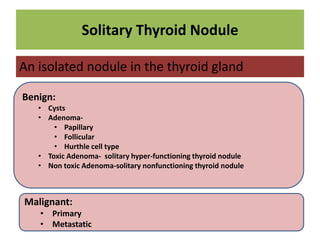
An isolated nodule in the thyroid gland
Solitary Thyroid Nodule
Benign:
• Cysts
• Adenoma-
• Papillary
• Follicular
• Hurthle cell type
• Toxic Adenoma- solitary hyper-functioning thyroid nodule
• Non toxic Adenoma-solitary nonfunctioning thyroid nodule
Malignant:
• Primary
• Metastatic
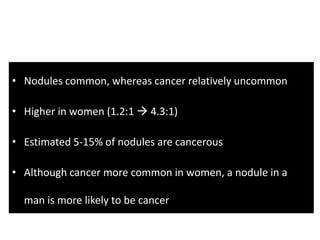
• Nodules common, whereas cancer relatively uncommon
• Higher in women (1.2:1  4.3:1)
• Estimated 5-15% of nodules are cancerous
• Although cancer more common in women, a nodule in a
man is more likely to be cancer
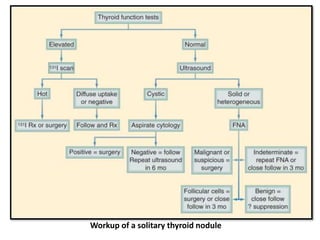
Workup of a solitary thyroid nodule
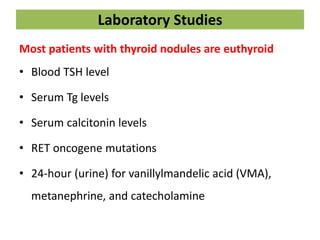
Laboratory Studies
Most patients with thyroid nodules are euthyroid
• Blood TSH level
• Serum Tg levels
• Serum calcitonin levels
• RET oncogene mutations
• 24-hour (urine) for vanillylmandelic acid (VMA),
metanephrine, and catecholamine
Imaging
Ultrasound is helpful for:
– detecting nonpalpable thyroid nodules
– differentiating solid from cystic nodules
– identifying adjacent lymphadenopathy
– Follow up of size of suspected benign nodules
CT and MRI are unnecessary in the routine evaluation
of thyroid tumors, except for large, fixed, or substernal
lesions.
Scanning the thyroid with 123I or 99mTc for evaluating
patients for "hot" or autonomous thyroid nodules
Management
• Malignant tumors are treated by thyroidectomy
• Simple thyroid cysts: aspiration
If the cyst persists after three attempts at aspiration,
unilateral thyroid lobectomy is recommended.
• Lobectomy is also recommended for:
– cysts greater than 4 cm in diameter
– complex cysts with solid and cystic components
Management
• If a colloid nodule is diagnosed by FNA biopsy, patients should
still be observed with serial ultrasound and Tg measurements.
• l-thyroxine in doses sufficient to maintain a serum TSH level
between 0.1 and 1.0 U/mL may also be administered.
• Thyroidectomy should be performed if:
– Nodule enlarges on TSH suppression, compressive symptoms
– Cosmetic reasons
– H/o previous irradiation of the thyroid gland
– Family history of thyroid cancer

thyroiditis ent in neck throat swelling .pptx

  • 1.
    Thyroiditis • Hashimoto thyroiditis •De- quervain thyroiditis • Acute thyroiditis • Riedel thyroiditis
  • 2.
    Thyroiditis • Inflammation ofthe thyroid gland • Acute illness • Severe thyroid pain • Manifested primarily by thyroid dysfunction
  • 3.
    Types Acute (Suppurative) Thyroiditis • Streptococcus andanaerobes (70% Escherichia coli, Pseudomonas aeruginosa, Haemophilus influenzae, Eikenella corrodens, Corynebacterium, Coccidiomycosis species • More common in children • Diagnosis : leukocytosis on blood tests and FNA biopsy for Gram's stain, culture, and cytology • Treatment : parenteral antibiotics and drainage of abscesses Subacute Thyroiditis • Painful or painless • Post viral inflammatory response, Genetic predisposition, autoimmune • TSH is decreased, and thyroglobulin, T4 and T3 levels are elevated • beta blockers and thyroid hormone replacement (after hyperthyroid phase) • Surgery for recurrent attacks Chronic Thyroiditis • Hashimoto’s • Reidel’s • De-quervain’s
  • 4.
    Hashimoto Thyroiditis • Firstdescribed by hashimoto, in 1912, as struma lymphomatosa— • Transformation of thyroid tissue to lymphoid tissue • Most common inflammatory disorder of the thyroid • Leading cause of hypothyroidism
  • 5.
    Etiology • Autoimmune process •Increased intake of iodine • Medications: interferon, lithium, and amiodarone • Inherited predisposition • Chromosomal abnormalities : turner's syndrome and down syndrome. • Associations with hla-b8, dr3, and dr5 haplotypes
  • 6.
    Pathogenesis Activation of CD4+T(helper) lymphocytes T cells recruit cytotoxic CD8+T cells to the thyroid. Hypothyroidism results from: – destruction of thyrocytes by cytotoxic t cells – autoantibodies, which lead to complement fixation and killing by natural killer cells or block the TSH receptor Antibodies are directed against the three main antigens – Tg (60%) – TPO (95%) – TSH-R (60%) – sodium/iodine symporter (25%) Apoptosis (programmed cell death) also implicated
  • 8.
    Pathology • Gland isdiffusely infiltrated by small lymphocytes and plasma cells, occasionally shows well-developed germinal centers • Thyroid follicles are smaller than normal with reduced amounts of colloid and increased interstitial connective tissue • Follicles are lined by hürthle or askanazy cells, which are characterized by abundant eosinophilic, granular cytoplasm.
  • 9.
    Clinical Presentation • Male:female ratio 1:10 to 20) • Ages of 30 and 50 years. • Minimally or moderately enlarged firm gland • 20% of patients present with hypothyroidism • 5% present with hyperthyroidism ( hashitoxicosis)
  • 10.
    Diagnostic Studies TSH T4and T3 levels Thyroid autoantibodies FNA biopsy if solitary suspicious nodule or a rapidly enlarging goiter
  • 11.
    Treatment Overtly hypothyroid: • Thyroidhormone replacement therapy Subclinical hypothyroidism: • Male patients • TSH greater than 10 mu/L • Euthyroid patients to shrink large goiters • Surgery may occasionally be indicated for suspicion of malignancy or for goiters causing compressive symptoms or cosmetic deformity
  • 12.
    Complications of hashimoto •Overt hypothyroidism • Goitre • Rarely cancer thyroid lymphoma • Compresssive symptoms • Heart diseases n neurological manifestations
  • 13.
    De Quervain’s thyroiditis •First described in 1904 • Granulomatous thyroiditis • Viral infections: Adenovirus, Coxsackievirus, Influenza virus, Epstein barr virus, Mumps, Echovirus & Enterovirus • Less common than Hashimoto's thyroiditis • Gland swells up is very painful and tender • Patient becomes hyperthyroid but the gland cannot take up iodine so the radioactive iodine uptake is very low
  • 14.
    • Absence ofthyroid antibodies differentiates this condition from autoimmune thyroiditis • Recovery is invariably complete and response to prednisolone is so dramatic that it is almost diagnostic
  • 15.
    Facts of dequervain thyroditis • a/k/a sub acute thyroiditis • Abs absent and ESR is raised. • Resembles infectious but no agent has been identified thus no ole of antibiotics. • Few pts develop hypothyroidism.
  • 16.
    Riedel's Thyroiditis • Riedel'sstruma or invasive fibrous thyroiditis • Replacement of all or part of the thyroid parenchyma by fibrous tissue Etiology : • Autoimmune diseases, such as pernicious anemia and graves' disease • Mediastinal, retroperitoneal, periorbital, and retro-orbital fibrosis • Sclerosing cholangitis • Women between the ages of 30 and 60 years.
  • 17.
    Presentation: • Painless, hardanterior neck mass • Dysphagia • Dyspnea • Choking • Hoarseness • Symptoms of hypothyroidism & hypoparathyroidism • Hard, "woody" thyroid gland Diagnosis: • Open thyroid biopsy Treatment: • Surgery • Thyroid hormone replacement • Corticosteroids and tamoxifen
  • 18.
    An isolated nodulein the thyroid gland Solitary Thyroid Nodule Benign: • Cysts • Adenoma- • Papillary • Follicular • Hurthle cell type • Toxic Adenoma- solitary hyper-functioning thyroid nodule • Non toxic Adenoma-solitary nonfunctioning thyroid nodule Malignant: • Primary • Metastatic
  • 19.
    • Nodules common,whereas cancer relatively uncommon • Higher in women (1.2:1  4.3:1) • Estimated 5-15% of nodules are cancerous • Although cancer more common in women, a nodule in a man is more likely to be cancer
  • 20.
    Workup of asolitary thyroid nodule
  • 21.
    Laboratory Studies Most patientswith thyroid nodules are euthyroid • Blood TSH level • Serum Tg levels • Serum calcitonin levels • RET oncogene mutations • 24-hour (urine) for vanillylmandelic acid (VMA), metanephrine, and catecholamine
  • 22.
    Imaging Ultrasound is helpfulfor: – detecting nonpalpable thyroid nodules – differentiating solid from cystic nodules – identifying adjacent lymphadenopathy – Follow up of size of suspected benign nodules CT and MRI are unnecessary in the routine evaluation of thyroid tumors, except for large, fixed, or substernal lesions. Scanning the thyroid with 123I or 99mTc for evaluating patients for "hot" or autonomous thyroid nodules
  • 23.
    Management • Malignant tumorsare treated by thyroidectomy • Simple thyroid cysts: aspiration If the cyst persists after three attempts at aspiration, unilateral thyroid lobectomy is recommended. • Lobectomy is also recommended for: – cysts greater than 4 cm in diameter – complex cysts with solid and cystic components
  • 24.
    Management • If acolloid nodule is diagnosed by FNA biopsy, patients should still be observed with serial ultrasound and Tg measurements. • l-thyroxine in doses sufficient to maintain a serum TSH level between 0.1 and 1.0 U/mL may also be administered. • Thyroidectomy should be performed if: – Nodule enlarges on TSH suppression, compressive symptoms – Cosmetic reasons – H/o previous irradiation of the thyroid gland – Family history of thyroid cancer