BY
Dr.A.KRISHNAMOORTHI
Assistant professor ,
Department of zoology
Arignar Anna Government Arts
College ,Namakkal
INTRODUCTION
 Thyroid gland is the largest of all other endocrine
glands.
 It sits at the front of the neck , lie left and right, on
either side of the trachea.
 The gland is usually larger in women, and
increases in size in pregnancy and lactation .
 Thyroid gland secrete the following hormones
 i.Thyroxine (T4): ii. Tri-iodothyronine (T3) and iii.
Thyro-calcitonin (calcitonin)
 The thyroid gland is a butterfly-shaped organ .
 It is composed of two lobes, The two lopes are connected by
a narrow band called isthmus.
 The thyroid weights about 15 to 30 grams. In adult, it is 25
grams with each lobe being about 5 cm long, 3 cm wide and
2 cm thick, and the isthmus about 1.25 cm in height and
width.
 The thyroid gland is covered by a thin fibrous capsule, which
has an inner and an outer layer.
 The outer layer is continuous with the pretracheal fascia,
attaching the gland to the cricoids and thyroid cartilages, via a
thickening of the fascia to form the posterior suspensory
ligament of thyroid gland also known as Berry's ligament.
 This causes the thyroid to move up and down with
swallowing.
 The inner layer extrudes into the gland and forms
the septae that divides the thyroid tissue into
microscopic lobules.
 Typically four parathyroid glands, two on each side, lie
on each side between the two layers of the capsule, at
the back of the thyroid lobes.
 Under microscopic study
 The human thyroid gland composed of three cells, a
large number of spherical or oval vesicle or
follicles, follicular cells and para-follicular cells.
Follicles or acini
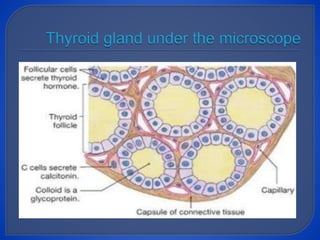
 Thyroid gland contains numerous small spherical
groupings of cells called acini or follicles about 0.02–
0.9mm (200µ) in diameter .
 Each spherical follicle is lined by a single layer of
cubical epithelial cells they form a rim.
 In the centre, each follicle contains a cavity filled with a
clear, viscid, proteinaceous semi-fluid called colloid.
 The colloid consists mostly of thyroid hormone precursor
proteins called thyroglobulin and
an iodinated glycoprotein.
 It is surrounded by rich blood supply, nerve and
lymphatic vessels.
 The aciner or follicle has three functions.
 (i) They synthesis thyroglobulin and store as colloid in
follicle.
 (ii) They collect and transport I2 for synthesis of thyroxin
hormone.
 (iii) They secrete T3, T4 hormones into the circulation.
 The core of a follicle is surrounded by a single layer
of follicular cells.
 When stimulated by thyroid stimulating hormone
(TSH), these secrete the thyroid hormones T3 and
T4.
 They do this by transporting and metabolising the
thyroglobulin contained in the colloid.
 Follicular cells vary in shape from flat to cuboid to
columnar, depending on how active they are.
 Scattered among follicular cells and in spaces between
the spherical follicles is another type of thyroid cell, called
para-follicular cells.
 These cells secrete calcitonin and so are also called C-
cells.
 Thyroid gland C-cell secreting calcitonin is called
thyrocalcitonin.
 There are two materials required by thyroid gland to
synthesis the thyroid hormone are thyroglobulin and
iodine.
The steps in the biosynthesis of the
hormone
 i. Iodide trapping
 ii. Oxidation of iodine:
 iii. Organification or iodination of tyrosine:
 iv. Coupling:
 Iodide trapping that is the uptake of iodide
by the follicular cells from the plasma.
 The tissues of thyroid gland have high affinity
towards iodine.
 Iodine is essential for the production of the
thyroid hormones. Iodine (I0) travels in the
blood as iodide (I−), which is taken up into the
follicular cells by active transport mechanism
(sodium-iodide pump).
The hormone TSH secreted by the anterior
pituitary gland affects this step.
 Substances, like thiocyanate,
pertechnetate and perchlorate that are
examples of antithyroid drugs can inhibit
iodide trapping.
 Inside the follicular cells by the action of
the enzyme peroxidise the ionic iodide
oxidized and converted into elemental
iodine.
 Drugs like thiouracil and carbimazole can
inhibit this step and act as antithyroid
drugs.
 This elemental active iodine combined with
amino acid tyrosine in the thyroglobulin first in
the C-3 position of the aromatic nucleus present
in the colloid and leads to the formation of MIT
(3-Monoiodotyrosine).
 On further iodination of MIT in the position C-5,
there is formation of DIT (3,5-Diiodotyrosine).
 This process is called organification.
 Further oxidative condensation of DIT in the
presence of the enzyme thyroperoxydase
causing coupling with two DIT molecules will
lead to loss of one alanine side chain and the
formation of tetraiodothyrosine (T4) called
thyroxine.
 If the DIT coupling with MIT loss of one alanine
side chain will results in formation of
triiodothyrosine (T3).
 After the synthesis, the hormone combined with
the protein part globulin called thyroglobulin is
stored in the colloid.
 About 80-95 µg of thyroxine is secreted daily
under normal physiological conditions.
 At the time of release of the hormones into
circulation, the acinar cells will engulf the thyro-
globulin along with the hormones by endocytosis.
 In the cells, the hormone will be separated by
proteolysis and released into the circulation and
thyroglobulin will be retained for further use.
 There are many substances which have the
ability to decrease the amount of thyroxin
secreted by the gland. These drugs will be of
choice when there is a necessity to decrease the
amount of thyroxine secretion in certain
pathological situations.
It is brought about
by the negative
feedback
mechanism. There
is involvement of
hypothalamo-
pituitary-thyroid axis
 The production of thyroxine and
triiodothyronine is primarily regulated by
thyroid-stimulating hormone (TSH), released
by the anterior pituitary gland.
 TSH release in turn is stimulated
by thyrotropin releasing hormone (TRH),
released in a pulsatile manner from
the hypothalamus.
 The thyroid hormones provide negative
feedback to the thyrotropes TSH and TRH:
 when the thyroid hormones are high, TSH
production is suppressed.
 This negative feedback also occurs when levels
of TSH are high, causing TRH production to be
suppressed.
 TRH is secreted at an increased rate in
situations such as cold exposure in order to
stimulate thermogenesis. In addition to being
suppressed by the presence of thyroid
hormones, TSH production is blunted
by dopamine, somatostatin, and glucocorticoids.
 The thyroid hormones increase the basal
metabolic rate and have effects on almost all body
tissues except brain, gonads, lymph node, spleen
and lungs.
 Appetite, digestive juice secretion, the absorption
of substances, and gut motility are all influenced
by thyroid hormones.
 They increase the absorption of glucose in the
gut, and may cause hyperglycemia.
 They stimulate the breakdown of fats, and
increase the number of free fatty acids. Thyroid
hormones have the tendency to decrease serum
cholesterol levels, perhaps by increasing the rate
of secretion of cholesterol in bile.
THYROID HORMONES FUNCTIONS
 They increase the rate of breathing, intake and
consumption of oxygen, and increase the activity
of mitochondria.
 Thyroid hormones are important for normal
development. They increase the growth rate of
young people, and cells of the developing brain
are a major target for the Thyroid hormones
T3 and T4. Thyroid hormones play a particularly
crucial role in brain maturation during foetal
development and first few years of postnatal life.
 The normal texture of the skin is maintained due
to thyroid hormone.
 Excess thyroxin causes withdrawal of calcium
and phoaphates from bone leading to
Osteophorosis. Calcium loss in urine and faeces
is increased but serum calcium does not
increase significantly.
 In hypothyroidism in lactating women milk
secretion is decreased.
 In female the excess secretion causes menorrhoea
or poly-menorrhoea which means excessive and
frequent menstrual bleeding respectively, in other
hands lack of secretion causes irregular period or
even total amenorrhoea.
 The thyroid hormones also play a role in maintaining
normal sexual function, sleep, and thought patterns.
Increased levels are associated with increased
speed of thought generation but decreased focus.
Normal development of gonads and the
maintenance of a normal menstrual cycle, are
influenced by thyroid hormones.
People of all ages and races can get
thyroid disease. However, women are 5 to
8 times more likely than men to have
thyroid problems.
 There are several different causes of thyroid
disease. The following conditions cause
hypothyroidism:
 Thyroiditis is an inflammation of the thyroid
gland. This can lower the amount of
hormones produced.
 Hashimoto's thyroiditis is a painless
disease of the immune system that is
hereditary.
 Postpartum thyroiditis occurs in 5% to 9%
of women after giving birth. It is usually a
temporary condition.
 Iodine deficiency is a problem affecting
approximately 100 million people around the world.
Iodine is used by the thyroid to produce hormones.
Although prevalent before the 1950s in the United
States, iodine deficiency has been virtually wiped
out by the use of iodized salt.
 A non-functioning thyroid gland affects one in
4,000 newborns. If the problem isn't corrected, the
child will be physically and mentally retarded. All
newborns are given a screening blood test in the
hospital to evaluate thyroid function.
Grave’s disease or thyrotoxicosis
 Excessive production of the thyroid hormones is
called hyperthyroidism, which is most commonly a result
of Graves' disease also called exopthalmic goitre.
 It is due to over secretions of thyroxine. This disease is
mainly characterised by the enlargement of the thyroid
gland and protrusion of eyeballs.
 It is an autoimmune disease.
 It is caused by a substance called long acting thyroid
stimulator (LATS), that is an antibody formed by the
immune system to stimulate the thyroid gland to secrete
thyroxine.
Thyroid gland is enlarged
The eyeballs protruded with a staring look,
due to degeneration of eye muscles and
the deposition of fat in the ocular region.
Increases BMR by 50 to 100%.
Heart rate is increased (100 to 160 per
minutes), cardiac out put increased.
Body temperature raise.
Osteoporosis occurs in the skeleton,
causes to excessive loss of calcium and
potassium through urine.
Blood sugar level and iodine level are
raised, but cholesterol level is lowered.
Muscles weak, skin become soft, weight
loss.
Cutaneous vasodilation and skin is warm
and moist with increasing sweating and
intolerance to heat’
 Swelling in the neck due to an enlargement of thyroid
gland is called goitre.
 Goitres are present in some form in about 5% of
people, and are the result of a large number of causes,
including iodine deficiency, autoimmune disease (both
Grave's disease and Hashimoto's thyroiditis), infection
and inflammation.
 Sometimes no cause can be found, a state called
"simple goitre.
 Simple goitre is occurs in regions where the iodine
content in the soil is very low, and are called endemic
goitres.
 Inadequate iodine results in reduce thyroid hormone
synthesis causing increased TSH and gland
enlargement.
 Taking iodized salt is recomented to prevent simple
goitre.
 Goitrogens are substances which can produce
goitre. Anti-thyroid drugs are goitrogens. They inhibit
thyroid hormone synthesis and the low hormone
levels increases the pituitary TSH and cause
glandular enlargement.
 Some forms of goitre are associated with pain,
whereas many do not cause any symptoms.
Enlarged goitres may extend beyond the normal
position of the thyroid gland to below the sternum,
around the airway or oesophagus.
 An underactive thyroid gland results in hypothyroidism.
 Typical symptoms are abnormal weight gain,
tiredness, constipation, heavy menstrual bleeding, hair
loss, cold intolerance, and a slow heart rate.
 Iodine deficiency is the most common cause of
hypothyroidism worldwide, and the autoimmune
disease Hashimoto's thyroiditis is the most common cause
in the developed world.
 Other causes include congenital abnormalities, diseases
causing transient inflammation, surgical removal or
radioablation of the thyroid, the
drugs amiodarone and lithium, amyloidosis
and sarcoidosis.
 Cretinism is a disease produced in children
(infant) as a result of hypothyroidism.
 It is a congenital disorder.
 The child affected by cretinism is called cretin.
 Children affecting from this disorder are normal
at time of birth, but effects appears after six
months.
 Because, they received maternal hormones
while in the uterus, after birth enough hormones
is present in the mother’s milk.
 The milestone of the child development such as
holding up the head (3 months), closure of
anterior fontanelle (5 months), sitting and
dentition (6-7 months), standing, walking and
speech (12 months) etc, are delayed.
 Cretin is a dwarf.
 Skeleton growth is retarded, with short and thick
hands and legs and broad nose.
 Dentition is delayed and deformed.
 The skin is dry, thick, rough and wrinkled.
 The tongue is thick, protruding and saliva is
dribbling.
 The belly is pot like and the umbilicus is
protruding.
 Mental development is generally retarted and
child appears to be a idiot.
 BMR is low (20-40%).
 Blood contains low level of sugar and iodine and
high level of cholesterol.
 If treatment is not started with in first few weeks,
the mental retardation is irreversible.
THANk
YOU

Thyroid gland

  • 1.
    BY Dr.A.KRISHNAMOORTHI Assistant professor , Departmentof zoology Arignar Anna Government Arts College ,Namakkal
  • 2.
    INTRODUCTION  Thyroid glandis the largest of all other endocrine glands.  It sits at the front of the neck , lie left and right, on either side of the trachea.  The gland is usually larger in women, and increases in size in pregnancy and lactation .  Thyroid gland secrete the following hormones  i.Thyroxine (T4): ii. Tri-iodothyronine (T3) and iii. Thyro-calcitonin (calcitonin)
  • 4.
     The thyroidgland is a butterfly-shaped organ .  It is composed of two lobes, The two lopes are connected by a narrow band called isthmus.  The thyroid weights about 15 to 30 grams. In adult, it is 25 grams with each lobe being about 5 cm long, 3 cm wide and 2 cm thick, and the isthmus about 1.25 cm in height and width.  The thyroid gland is covered by a thin fibrous capsule, which has an inner and an outer layer.  The outer layer is continuous with the pretracheal fascia, attaching the gland to the cricoids and thyroid cartilages, via a thickening of the fascia to form the posterior suspensory ligament of thyroid gland also known as Berry's ligament.
  • 5.
     This causesthe thyroid to move up and down with swallowing.  The inner layer extrudes into the gland and forms the septae that divides the thyroid tissue into microscopic lobules.  Typically four parathyroid glands, two on each side, lie on each side between the two layers of the capsule, at the back of the thyroid lobes.
  • 6.
     Under microscopicstudy  The human thyroid gland composed of three cells, a large number of spherical or oval vesicle or follicles, follicular cells and para-follicular cells. Follicles or acini  Thyroid gland contains numerous small spherical groupings of cells called acini or follicles about 0.02– 0.9mm (200µ) in diameter .  Each spherical follicle is lined by a single layer of cubical epithelial cells they form a rim.  In the centre, each follicle contains a cavity filled with a clear, viscid, proteinaceous semi-fluid called colloid.
  • 8.
     The colloidconsists mostly of thyroid hormone precursor proteins called thyroglobulin and an iodinated glycoprotein.  It is surrounded by rich blood supply, nerve and lymphatic vessels.  The aciner or follicle has three functions.  (i) They synthesis thyroglobulin and store as colloid in follicle.  (ii) They collect and transport I2 for synthesis of thyroxin hormone.  (iii) They secrete T3, T4 hormones into the circulation.
  • 9.
     The coreof a follicle is surrounded by a single layer of follicular cells.  When stimulated by thyroid stimulating hormone (TSH), these secrete the thyroid hormones T3 and T4.  They do this by transporting and metabolising the thyroglobulin contained in the colloid.  Follicular cells vary in shape from flat to cuboid to columnar, depending on how active they are.
  • 10.
     Scattered amongfollicular cells and in spaces between the spherical follicles is another type of thyroid cell, called para-follicular cells.  These cells secrete calcitonin and so are also called C- cells.  Thyroid gland C-cell secreting calcitonin is called thyrocalcitonin.
  • 11.
     There aretwo materials required by thyroid gland to synthesis the thyroid hormone are thyroglobulin and iodine. The steps in the biosynthesis of the hormone  i. Iodide trapping  ii. Oxidation of iodine:  iii. Organification or iodination of tyrosine:  iv. Coupling:
  • 13.
     Iodide trappingthat is the uptake of iodide by the follicular cells from the plasma.  The tissues of thyroid gland have high affinity towards iodine.  Iodine is essential for the production of the thyroid hormones. Iodine (I0) travels in the blood as iodide (I−), which is taken up into the follicular cells by active transport mechanism (sodium-iodide pump).
  • 14.
    The hormone TSHsecreted by the anterior pituitary gland affects this step.  Substances, like thiocyanate, pertechnetate and perchlorate that are examples of antithyroid drugs can inhibit iodide trapping.
  • 15.
     Inside thefollicular cells by the action of the enzyme peroxidise the ionic iodide oxidized and converted into elemental iodine.  Drugs like thiouracil and carbimazole can inhibit this step and act as antithyroid drugs.
  • 16.
     This elementalactive iodine combined with amino acid tyrosine in the thyroglobulin first in the C-3 position of the aromatic nucleus present in the colloid and leads to the formation of MIT (3-Monoiodotyrosine).  On further iodination of MIT in the position C-5, there is formation of DIT (3,5-Diiodotyrosine).  This process is called organification.
  • 17.
     Further oxidativecondensation of DIT in the presence of the enzyme thyroperoxydase causing coupling with two DIT molecules will lead to loss of one alanine side chain and the formation of tetraiodothyrosine (T4) called thyroxine.  If the DIT coupling with MIT loss of one alanine side chain will results in formation of triiodothyrosine (T3).
  • 18.
     After thesynthesis, the hormone combined with the protein part globulin called thyroglobulin is stored in the colloid.  About 80-95 µg of thyroxine is secreted daily under normal physiological conditions.  At the time of release of the hormones into circulation, the acinar cells will engulf the thyro- globulin along with the hormones by endocytosis.  In the cells, the hormone will be separated by proteolysis and released into the circulation and thyroglobulin will be retained for further use.
  • 19.
     There aremany substances which have the ability to decrease the amount of thyroxin secreted by the gland. These drugs will be of choice when there is a necessity to decrease the amount of thyroxine secretion in certain pathological situations.
  • 20.
    It is broughtabout by the negative feedback mechanism. There is involvement of hypothalamo- pituitary-thyroid axis
  • 21.
     The productionof thyroxine and triiodothyronine is primarily regulated by thyroid-stimulating hormone (TSH), released by the anterior pituitary gland.  TSH release in turn is stimulated by thyrotropin releasing hormone (TRH), released in a pulsatile manner from the hypothalamus.  The thyroid hormones provide negative feedback to the thyrotropes TSH and TRH:  when the thyroid hormones are high, TSH production is suppressed.
  • 22.
     This negativefeedback also occurs when levels of TSH are high, causing TRH production to be suppressed.  TRH is secreted at an increased rate in situations such as cold exposure in order to stimulate thermogenesis. In addition to being suppressed by the presence of thyroid hormones, TSH production is blunted by dopamine, somatostatin, and glucocorticoids.
  • 23.
     The thyroidhormones increase the basal metabolic rate and have effects on almost all body tissues except brain, gonads, lymph node, spleen and lungs.  Appetite, digestive juice secretion, the absorption of substances, and gut motility are all influenced by thyroid hormones.  They increase the absorption of glucose in the gut, and may cause hyperglycemia.  They stimulate the breakdown of fats, and increase the number of free fatty acids. Thyroid hormones have the tendency to decrease serum cholesterol levels, perhaps by increasing the rate of secretion of cholesterol in bile. THYROID HORMONES FUNCTIONS
  • 24.
     They increasethe rate of breathing, intake and consumption of oxygen, and increase the activity of mitochondria.  Thyroid hormones are important for normal development. They increase the growth rate of young people, and cells of the developing brain are a major target for the Thyroid hormones T3 and T4. Thyroid hormones play a particularly crucial role in brain maturation during foetal development and first few years of postnatal life.
  • 25.
     The normaltexture of the skin is maintained due to thyroid hormone.  Excess thyroxin causes withdrawal of calcium and phoaphates from bone leading to Osteophorosis. Calcium loss in urine and faeces is increased but serum calcium does not increase significantly.  In hypothyroidism in lactating women milk secretion is decreased.
  • 26.
     In femalethe excess secretion causes menorrhoea or poly-menorrhoea which means excessive and frequent menstrual bleeding respectively, in other hands lack of secretion causes irregular period or even total amenorrhoea.  The thyroid hormones also play a role in maintaining normal sexual function, sleep, and thought patterns. Increased levels are associated with increased speed of thought generation but decreased focus. Normal development of gonads and the maintenance of a normal menstrual cycle, are influenced by thyroid hormones.
  • 27.
    People of allages and races can get thyroid disease. However, women are 5 to 8 times more likely than men to have thyroid problems.
  • 28.
     There areseveral different causes of thyroid disease. The following conditions cause hypothyroidism:  Thyroiditis is an inflammation of the thyroid gland. This can lower the amount of hormones produced.  Hashimoto's thyroiditis is a painless disease of the immune system that is hereditary.  Postpartum thyroiditis occurs in 5% to 9% of women after giving birth. It is usually a temporary condition.
  • 29.
     Iodine deficiencyis a problem affecting approximately 100 million people around the world. Iodine is used by the thyroid to produce hormones. Although prevalent before the 1950s in the United States, iodine deficiency has been virtually wiped out by the use of iodized salt.  A non-functioning thyroid gland affects one in 4,000 newborns. If the problem isn't corrected, the child will be physically and mentally retarded. All newborns are given a screening blood test in the hospital to evaluate thyroid function.
  • 30.
    Grave’s disease orthyrotoxicosis  Excessive production of the thyroid hormones is called hyperthyroidism, which is most commonly a result of Graves' disease also called exopthalmic goitre.  It is due to over secretions of thyroxine. This disease is mainly characterised by the enlargement of the thyroid gland and protrusion of eyeballs.  It is an autoimmune disease.  It is caused by a substance called long acting thyroid stimulator (LATS), that is an antibody formed by the immune system to stimulate the thyroid gland to secrete thyroxine.
  • 31.
    Thyroid gland isenlarged The eyeballs protruded with a staring look, due to degeneration of eye muscles and the deposition of fat in the ocular region. Increases BMR by 50 to 100%. Heart rate is increased (100 to 160 per minutes), cardiac out put increased.
  • 32.
    Body temperature raise. Osteoporosisoccurs in the skeleton, causes to excessive loss of calcium and potassium through urine. Blood sugar level and iodine level are raised, but cholesterol level is lowered. Muscles weak, skin become soft, weight loss. Cutaneous vasodilation and skin is warm and moist with increasing sweating and intolerance to heat’
  • 33.
     Swelling inthe neck due to an enlargement of thyroid gland is called goitre.  Goitres are present in some form in about 5% of people, and are the result of a large number of causes, including iodine deficiency, autoimmune disease (both Grave's disease and Hashimoto's thyroiditis), infection and inflammation.  Sometimes no cause can be found, a state called "simple goitre.  Simple goitre is occurs in regions where the iodine content in the soil is very low, and are called endemic goitres.
  • 34.
     Inadequate iodineresults in reduce thyroid hormone synthesis causing increased TSH and gland enlargement.  Taking iodized salt is recomented to prevent simple goitre.  Goitrogens are substances which can produce goitre. Anti-thyroid drugs are goitrogens. They inhibit thyroid hormone synthesis and the low hormone levels increases the pituitary TSH and cause glandular enlargement.  Some forms of goitre are associated with pain, whereas many do not cause any symptoms. Enlarged goitres may extend beyond the normal position of the thyroid gland to below the sternum, around the airway or oesophagus.
  • 35.
     An underactivethyroid gland results in hypothyroidism.  Typical symptoms are abnormal weight gain, tiredness, constipation, heavy menstrual bleeding, hair loss, cold intolerance, and a slow heart rate.  Iodine deficiency is the most common cause of hypothyroidism worldwide, and the autoimmune disease Hashimoto's thyroiditis is the most common cause in the developed world.  Other causes include congenital abnormalities, diseases causing transient inflammation, surgical removal or radioablation of the thyroid, the drugs amiodarone and lithium, amyloidosis and sarcoidosis.
  • 36.
     Cretinism isa disease produced in children (infant) as a result of hypothyroidism.  It is a congenital disorder.  The child affected by cretinism is called cretin.  Children affecting from this disorder are normal at time of birth, but effects appears after six months.  Because, they received maternal hormones while in the uterus, after birth enough hormones is present in the mother’s milk.
  • 37.
     The milestoneof the child development such as holding up the head (3 months), closure of anterior fontanelle (5 months), sitting and dentition (6-7 months), standing, walking and speech (12 months) etc, are delayed.  Cretin is a dwarf.  Skeleton growth is retarded, with short and thick hands and legs and broad nose.  Dentition is delayed and deformed.  The skin is dry, thick, rough and wrinkled.
  • 38.
     The tongueis thick, protruding and saliva is dribbling.  The belly is pot like and the umbilicus is protruding.  Mental development is generally retarted and child appears to be a idiot.  BMR is low (20-40%).  Blood contains low level of sugar and iodine and high level of cholesterol.  If treatment is not started with in first few weeks, the mental retardation is irreversible.
  • 39.