Thyroid Eye Diseases
Dr.Mohammad Dmour- PGY1
Supervised by : Dr.Sami Rezeq
Ophthalmology Department- Islamic Hospital
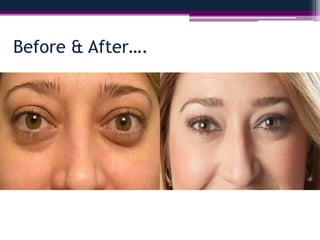
Before & After….
Outlines…
1. What is TED ?
2. Epidemiology
3. Thyrotoxicosis
4. Risk factors for ophthalmopathy
5. Pathogenesis and rule of orbital fibroblasts
6. Clinical features
7. Investigations
8. Treatment
9. The Rundle Curve and Prognosis
10.Key points in TED
Introduction
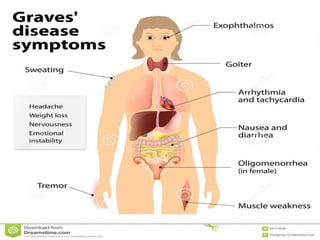
• Thyroid eye disease (TED) is also known as
Graves' ophthalmopathy / orbitopathy, thyroid
associated ophthalmopathy / orbitopathy (TAO),
or thyrotoxic/ endocrine exophthalmos.
• It is the most important extrathyroidal
manifestation of autoimmune thyroid diseases.
• It is also the most common orbital disorder in
adults worldwide and the commonest causes of
unilateral or bilateral axial proptosis.
Epidemiology
• In the United States , the overall age-adjusted
incidence rate for women was 16 cases per 100,000
population per year, whereas the rate for men was
3 cases per 100,000 population per year.
• TED affects women approximately 6 times as
frequently as men.
• The median age at the time of diagnosis of TED
was 43 years.
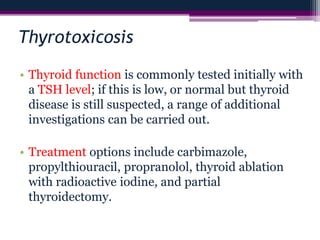
Thyrotoxicosis
• Thyroid function is commonly tested initially with
a TSH level; if this is low, or normal but thyroid
disease is still suspected, a range of additional
investigations can be carried out.
• Treatment options include carbimazole,
propylthiouracil, propranolol, thyroid ablation
with radioactive iodine, and partial
thyroidectomy.
But….
• Among patients with TED, approximately
90% have Graves hyperthyroidism, 6% are
euthyroid, 3% have Hashimoto thyroiditis,
and 1% have primary hypothyroidism.
• The course of the eye disease does not
necessarily parallel the activity of the
thyroid gland or the treatment of thyroid
abnormalities.
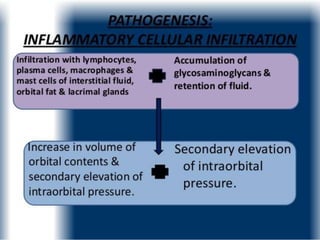
Risk factors
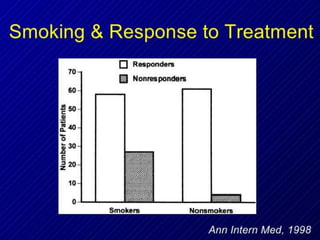
• Once a patient has Graves disease, the major
clinical risk factor for developing TED is
Smoking.
• Women are six times more likely to be affected
by TED than men, but this largely reflects the
increased incidence of Graves disease in women.
• Radioactive iodine used to treat hyperthyroidism
can worsen TED.
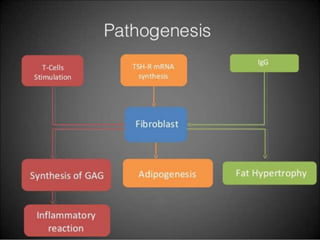
Potential novel therapeutic targets in
Graves’ ophthalmopathy. [1] Inhibition of T
and B cell activation: costimulation
inhibitors (CTLA4-Ig, alefacept). [2]
Inhibition of B cell maturation,
autoantibody production: rituximab. [3]
Inhibition of autoantibody binding to
insulin-like growth factor-1 receptor (IGF-
1r) and thyroid-stimulating hormone
receptor (TSHr): specific anti-IGF-1r or
TSHr antibodies, inhibitors of IGF-1r
tyrosine kinase, antisense RNA. [4]
Inhibition of adipogenesis: peroxisome
proliferator–activated receptor-
γ antagonists. [5] Decrease inflammation:
(NSAIDs) or anticytokine agents (infliximab,
adalimumab, etanercept, and anakinra).
Pathogenesis of Graves’ Ophthalmopathy: The
Role of Autoantibodies
Teck Kim Khoo and Rebecca S. Bahn
Thyroid. Author manuscript; available in PMC
2014 Jan 25.
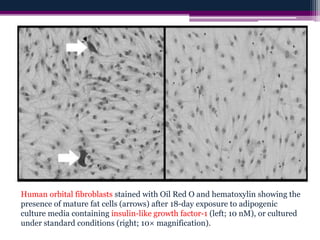
Human orbital fibroblasts stained with Oil Red O and hematoxylin showing the
presence of mature fat cells (arrows) after 18-day exposure to adipogenic
culture media containing insulin-like growth factor-1 (left; 10 nM), or cultured
under standard conditions (right; 10× magnification).
Clinical features
• There is a close relationship between the development of
hyperthyroidism and the development of TED: in about
20% of patients, the diagnoses are made at the same time;
in approximately 60% of patients, the eye disease occurs
within 1 year of onset of the thyroid disease.
• For patients who have no history of abnormal thyroid
function or regulation at the time of diagnosis of TED, the
risk for development of thyroid disease is approximately
25% within 1 year and 50% within 5 years.
• Although hyperthyroidism is present or will develop in
most patients with TED, TED is present or will develop in
only about 30% of patients with autoimmune
hyperthyroidism.
Clinical features
• TED typically proceeds through a congestive
(inflammatory) stage in which the eyes are red
and painful; this tends to remit within 1–3 years
and only about 10% of patients develop serious
long term ocular problems.
• A fibrotic (quiescent) stage follows in which the
eyes are white, although a painless motility
defect may be present.
Clinical features
• Clinical features broadly can be categorized into :
1. Soft tissue involvement
2. Lid retraction
3. Proptosis
4. Optic neuropathy
5. Restrictive myopathy
• Only 5% of patients have the complete
constellation of these classic findings !
1-Soft tissue involvement
• Symptoms :
1. Grittiness
2. Red eyes
3. Lacrimation
4. Photophobia
5. Puffy lids
6. Retrobulbar discomfort.
1- Soft tissue involvement
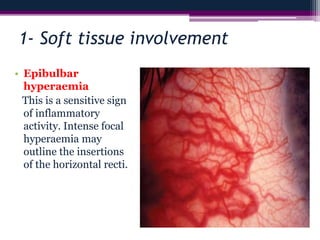
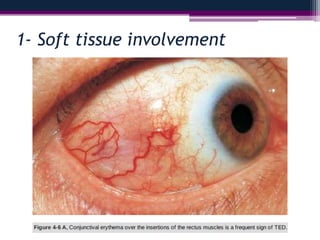
• Epibulbar
hyperaemia
This is a sensitive sign
of inflammatory
activity. Intense focal
hyperaemia may
outline the insertions
of the horizontal recti.
1- Soft tissue involvement
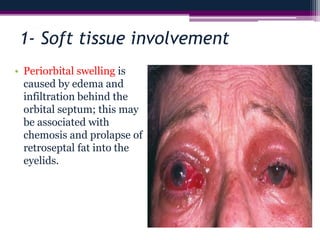
• Periorbital swelling is
caused by edema and
infiltration behind the
orbital septum; this may
be associated with
chemosis and prolapse of
retroseptal fat into the
eyelids.
1- Soft tissue involvement
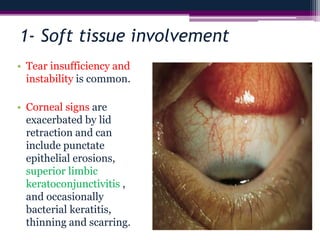
• Tear insufficiency and
instability is common.
• Corneal signs are
exacerbated by lid
retraction and can
include punctate
epithelial erosions,
superior limbic
keratoconjunctivitis ,
and occasionally
bacterial keratitis,
thinning and scarring.
2- Lid retraction
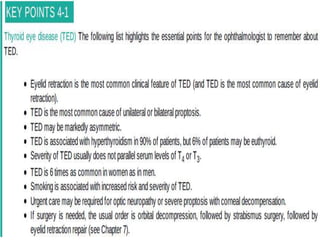
• Eyelid retraction is the most common ophthalmic
feature of TED.
• Humorally induced overaction of Müller muscle is
postulated to occur as a result of sympathetic
overstimulation secondary to high levels of thyroid
hormones.
• Fibrotic contracture of the levator palpebrae and
inferior rectus muscles associated with adhesion to
overlying orbital tissues is another probable
mechanism.
2- Lid retraction
• Upper eyelid retraction, either unilateral or
bilateral, is documented in approximately 75% of
patients at the time of diagnosis of TED.
• Symptoms :
1. A staring or bulging eyed appearance
2. difficulty closing the eyes
3. Ocular surface symptoms
2- Lid retraction
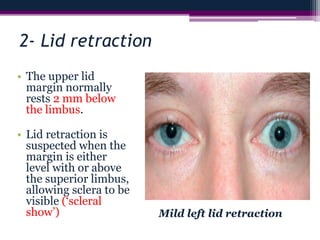
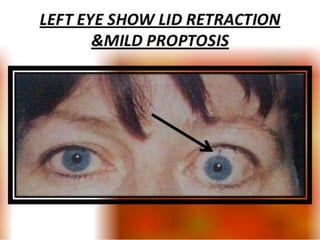
• The upper lid
margin normally
rests 2 mm below
the limbus.
• Lid retraction is
suspected when the
margin is either
level with or above
the superior limbus,
allowing sclera to be
visible (‘scleral
show’) Mild left lid retraction
2- Lid retraction
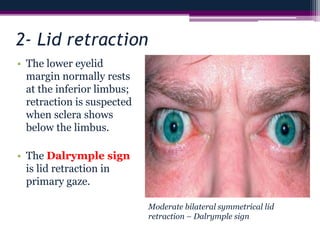
• The lower eyelid
margin normally rests
at the inferior limbus;
retraction is suspected
when sclera shows
below the limbus.
• The Dalrymple sign
is lid retraction in
primary gaze.
Moderate bilateral symmetrical lid
retraction – Dalrymple sign
2- Lid retraction
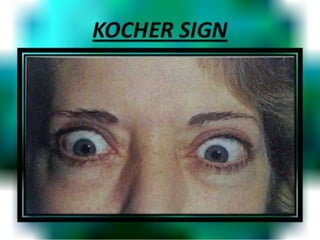
• The Kocher sign
describes a staring and
frightened appearance
of the eyes which is
particularly marked on
attentive fixation.
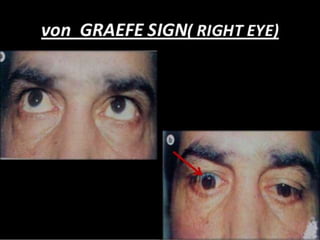
• The von Graefe sign
signifies retarded
descent of the upper
lid on downgaze (lid
lag).
Right lid lag on downgaze – von Graefe sign
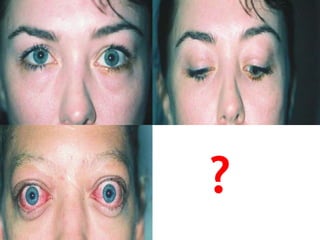
?
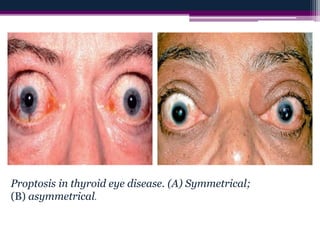
3- Proptosis
• Proptosis of one or both eyes affects
approximately 60% of patients.
• Signs :
1. Proptosis is axial, unilateral or bilateral,
symmetrical or asymmetrical and frequently
permanent.
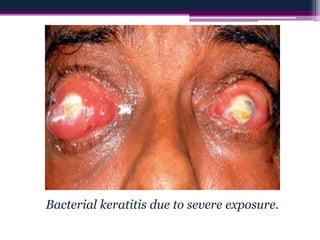
2. Severe proptosis may compromise lid closure
and along with lid retraction and tear
dysfunction can lead to exposure keratopathy,
corneal ulceration and infection.
Proptosis in thyroid eye disease. (A) Symmetrical;
(B) asymmetrical.
Bacterial keratitis due to severe exposure.
4- Restrictive myopathy
• Between 30% and 50% of patients with TED
develop ophthalmoplegia and this may be
permanent.
• Ocular motility is restricted initially by
inflammatory oedema, and later by fibrosis.
• Symptoms :Double vision, and often discomfort
in some positions of gaze.
4- Restrictive myopathy
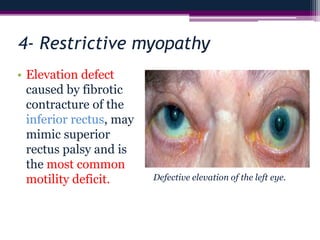
• Elevation defect
caused by fibrotic
contracture of the
inferior rectus, may
mimic superior
rectus palsy and is
the most common
motility deficit. Defective elevation of the left eye.
4- Restrictive myopathy
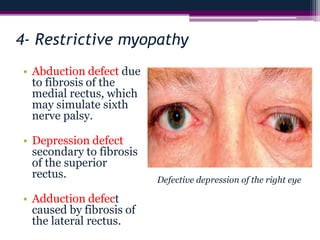
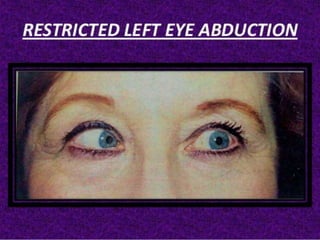
• Abduction defect due
to fibrosis of the
medial rectus, which
may simulate sixth
nerve palsy.
• Depression defect
secondary to fibrosis
of the superior
rectus.
• Adduction defect
caused by fibrosis of
the lateral rectus.
Defective depression of the right eye
Keep in your mind….
• The inferior rectus is the most
commonly involved muscle followed
by medial rectus and superior rectus.
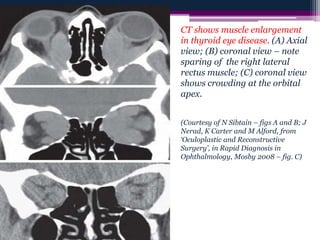
CT shows muscle enlargement
in thyroid eye disease. (A) Axial
view; (B) coronal view – note
sparing of the right lateral
rectus muscle; (C) coronal view
shows crowding at the orbital
apex.
(Courtesy of N Sibtain – figs A and B; J
Nerad, K Carter and M Alford, from
‘Oculoplastic and Reconstructive
Surgery’, in Rapid Diagnosis in
Ophthalmology, Mosby 2008 – fig. C)
5- Optic neuropathy
• Optic neuropathy is a fairly common (up to 6%)
serious complication caused by compression of
the optic nerve or its blood supply at the orbital
apex by the congested and enlarged recti and
swollen orbital tissue.
5- Optic neuropathy
• Symptoms :
• Impairment of central vision occurs in
conjunction with other symptoms of TED.
• In order to detect early involvement, patients
should be advised to monitor their own visual
function by alternately occluding each eye,
reading small print and assessing the intensity
of colours, for example on a television screen.
5- Optic neuropathy
• Signs:
1. Visual acuity (VA) is usually reduced, but not invariably.
2. Colour desaturation is a sensitive feature.
3. There may be diminished light brightness appreciation.
4. A relative afferent pupillary defect, if present, should give
cause for marked concern.
5. Visual field defects can be central or paracentral and may
be combined with nerve fibre bundle defects. These
findings, in concert with elevated IOP, may be confused
with primary open-angle glaucoma.
6. The optic disc may be normal, swollen or, rarely,
atrophic.
Keep in your mind…
• Pretibial myxedema and acropachy accompany
TED in approximately 4% and 1% of patients,
respectively, and are associated with a poor
prognosis for the orbitopathy.
Investigation
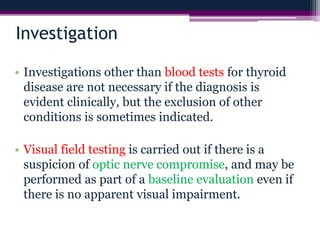
• Investigations other than blood tests for thyroid
disease are not necessary if the diagnosis is
evident clinically, but the exclusion of other
conditions is sometimes indicated.
• Visual field testing is carried out if there is a
suspicion of optic nerve compromise, and may be
performed as part of a baseline evaluation even if
there is no apparent visual impairment.
Investigation
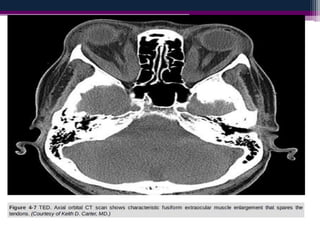
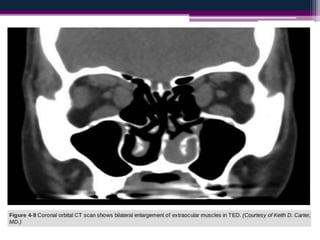
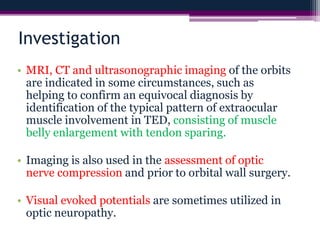
• MRI, CT and ultrasonographic imaging of the orbits
are indicated in some circumstances, such as
helping to confirm an equivocal diagnosis by
identification of the typical pattern of extraocular
muscle involvement in TED, consisting of muscle
belly enlargement with tendon sparing.
• Imaging is also used in the assessment of optic
nerve compression and prior to orbital wall surgery.
• Visual evoked potentials are sometimes utilized in
optic neuropathy.
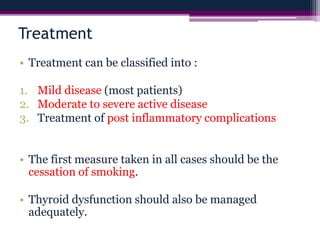
Treatment
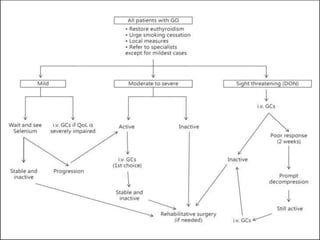
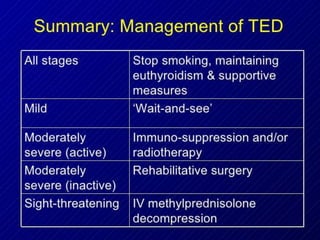
• Treatment can be classified into :
1. Mild disease (most patients)
2. Moderate to severe active disease
3. Treatment of post inflammatory complications
• The first measure taken in all cases should be the
cessation of smoking.
• Thyroid dysfunction should also be managed
adequately.
Treatment-Moderate to severe active disease
• EUGOGO suggests calculating a ‘clinical activity score’ to
aid in determining a threshold for the use of
immunosuppressives, assigning one point for each feature
present from the following list and considering treatment
for a score of 3 or more out of 7.
1. Spontaneous orbital pain.
2. Gaze-evoked orbital pain.
3. Eyelid swelling considered to be due to active
(inflammatory phase) TED.
4. Eyelid erythema.
5. Conjunctival redness considered to be due to active
(inflammatory phase) TED.
6. Chemosis.
7. Inflammation of caruncle or plica.
Treatment-Moderate to severe active disease
• During subsequent review, a point is allocated
for an increase in proptosis of 2 mm or more, a
decrease in uniocular excursion in any one
direction of 8° or more, or a decrease in
Snellen acuity of one line.
Treatment-Moderate to severe active disease
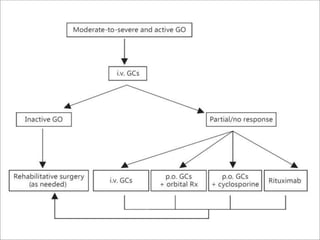
• Systemic steroids are the mainstay of treatment for
moderate to severe disease.
• Oral prednisolone 60–80 mg/day (1 mg/kg )may be
given initially, and tapered depending on response.
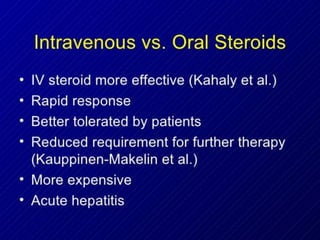
• Intravenous methylprednisolone is often reserved for
acute compressive optic neuropathy , but tolerability
is better and outcomes may be superior compared
with oral treatment; a lower-intensity regimen in the
absence of acute sight-threatening disease is 0.5 g
once weekly for 6 weeks followed by 0.25 g once
weekly for 6 weeks.
Treatment-Moderate to severe active disease
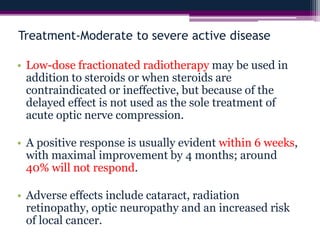
• Low-dose fractionated radiotherapy may be used in
addition to steroids or when steroids are
contraindicated or ineffective, but because of the
delayed effect is not used as the sole treatment of
acute optic nerve compression.
• A positive response is usually evident within 6 weeks,
with maximal improvement by 4 months; around
40% will not respond.
• Adverse effects include cataract, radiation
retinopathy, optic neuropathy and an increased risk
of local cancer.
Treatment-Moderate to severe active disease
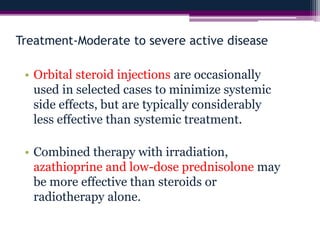
• Orbital steroid injections are occasionally
used in selected cases to minimize systemic
side effects, but are typically considerably
less effective than systemic treatment.
• Combined therapy with irradiation,
azathioprine and low-dose prednisolone may
be more effective than steroids or
radiotherapy alone.
Treatment-Moderate to severe active disease
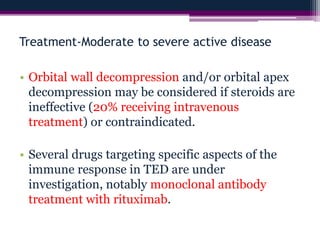
• Orbital wall decompression and/or orbital apex
decompression may be considered if steroids are
ineffective (20% receiving intravenous
treatment) or contraindicated.
• Several drugs targeting specific aspects of the
immune response in TED are under
investigation, notably monoclonal antibody
treatment with rituximab.
Treatment - Post-inflammatory complications
• Eyelid surgery should be performed only after
any necessary orbital and then strabismus
procedures have been undertaken, as orbital
decompression may impact both ocular motility
and eyelid position, and extraocular muscle
surgery may affect eyelid position.
Proptosis
• After active inflammation has remitted, the patient
can be left with cosmetically and functionally
significant proptosis, the treatment of which is
essentially surgical.
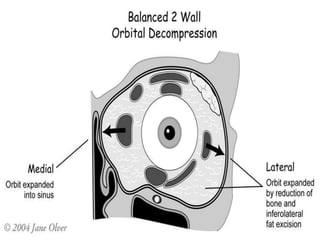
• Surgical decompression increases the volume of the
orbit by removing the bony walls and may be
combined with removal of orbital fat.
• Most surgery is undertaken via an external
approach, though the medial wall and the medial
part of the floor can be reached endoscopically.
Proptosis
• One-wall (deep lateral) decompression is effective
(approximately 4–5 mm reduction in proptosis) and may
reduce the risk of postoperative diplopia.
• Two-wall (balanced medial and lateral decompression
provides a greater effect but with a significant risk of
inducing diplopia;
• Three-wall decompression includes the floor with a
reduction in proptosis of 6–10 mm but may lead to
hypoglobus and carries a higher risk of infraorbital nerve
damage and diplopia.
• Very severe proptosis may require removal of part of the
orbital roof in addition (four-wall decompression).
Restrictive myopathy
• Surgery is required in most cases experiencing
persistent diplopia in the primary or reading positions
of gaze, provided the inflammatory stage has subsided
and the angle of deviation has been stable for at least
6–12 months.
• Until these criteria are met, diplopia may be alleviated,
if possible, with prisms or sometimes Botulinum toxin.
• Recession of the inferior and/or medial recti is the
most commonly indicated surgery (a rectus muscle is
never resected, only recessed in TED), generally
utilizing adjustable sutures .
Lid retraction
• Mild lid retraction frequently improves spontaneously so does
not require treatment. Control of hyperthyroidism may also
be beneficial.
• Botulinum toxin injection to the levator aponeurosis and
Müller muscle may be used as a temporary measure in
patients awaiting definitive correction.
• Müllerotomy (disinsertion of Müller muscle) is effective for
mild lid retraction, but more severe cases may also require
recession/disinsertion of the levator aponeurosis and the
suspensory ligament of the superior conjunctival fornix.
• Recession of the lower lid retractors, with or without a hard
palate graft, can be used when retraction of the lower lid is 2
mm or more.
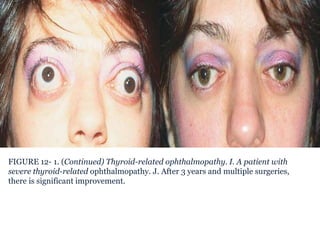
FIGURE 12- 1. (Continued) Thyroid-related ophthalmopathy. I. A patient with
severe thyroid-related ophthalmopathy. J. After 3 years and multiple surgeries,
there is significant improvement.
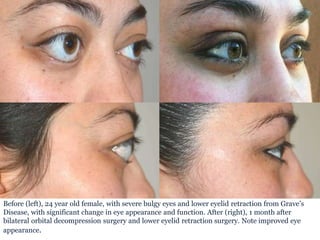
Before (left), 24 year old female, with severe bulgy eyes and lower eyelid retraction from Grave’s
Disease, with significant change in eye appearance and function. After (right), 1 month after
bilateral orbital decompression surgery and lower eyelid retraction surgery. Note improved eye
appearance.
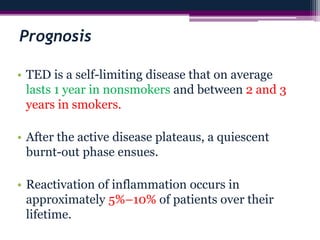
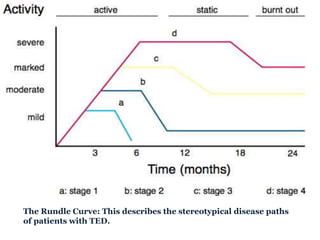
Prognosis
• TED is a self-limiting disease that on average
lasts 1 year in nonsmokers and between 2 and 3
years in smokers.
• After the active disease plateaus, a quiescent
burnt-out phase ensues.
• Reactivation of inflammation occurs in
approximately 5%–10% of patients over their
lifetime.
The Rundle Curve: This describes the stereotypical disease paths
of patients with TED.
Resources…
• Kanski's Clinical Ophthalmology 8th edition-2016,Chapter 3 ( Orbit ) pages
82-84.
• American Academy of Ophthalmology – BCSC- 2015-2016 , Section 7
(orbit , eyelid & Lacrimal system )
• Color Atlas and Synopsis of Clinical Ophthalmology - Wills Eye Institute
Oculoplastics , 2nd edition.
• Thyroid Eye Disease- 2015 , Raymond S. Douglas Allison N. McCoy ,Shivani
Gupta.
• Thyroid Eye Disease: a Comprehensive Review Dr. Kelvin KL CHONG , VOL.15
NO.10 OCTOBER 2010.
• The 2016 European Thyroid Association/European Group on Graves'
Orbitopathy Guidelines for the Management of Graves' Orbitopathy. Eur
Thyroid J. 2016 Mar; 5(1): 9–26. Published online 2016 Mar
2. doi: 10.1159/000443828 . Available on
https://www.ncbi.nlm.nih.gov/pmc/articles/PMC4836120/
Thyroid eye disease

Thyroid eye disease

  • 1.
    Thyroid Eye Diseases Dr.MohammadDmour- PGY1 Supervised by : Dr.Sami Rezeq Ophthalmology Department- Islamic Hospital
  • 6.
  • 7.
    Outlines… 1. What isTED ? 2. Epidemiology 3. Thyrotoxicosis 4. Risk factors for ophthalmopathy 5. Pathogenesis and rule of orbital fibroblasts 6. Clinical features 7. Investigations 8. Treatment 9. The Rundle Curve and Prognosis 10.Key points in TED
  • 8.
    Introduction • Thyroid eyedisease (TED) is also known as Graves' ophthalmopathy / orbitopathy, thyroid associated ophthalmopathy / orbitopathy (TAO), or thyrotoxic/ endocrine exophthalmos. • It is the most important extrathyroidal manifestation of autoimmune thyroid diseases. • It is also the most common orbital disorder in adults worldwide and the commonest causes of unilateral or bilateral axial proptosis.
  • 9.
    Epidemiology • In theUnited States , the overall age-adjusted incidence rate for women was 16 cases per 100,000 population per year, whereas the rate for men was 3 cases per 100,000 population per year. • TED affects women approximately 6 times as frequently as men. • The median age at the time of diagnosis of TED was 43 years.
  • 12.
    Thyrotoxicosis • Thyroid functionis commonly tested initially with a TSH level; if this is low, or normal but thyroid disease is still suspected, a range of additional investigations can be carried out. • Treatment options include carbimazole, propylthiouracil, propranolol, thyroid ablation with radioactive iodine, and partial thyroidectomy.
  • 13.
    But…. • Among patientswith TED, approximately 90% have Graves hyperthyroidism, 6% are euthyroid, 3% have Hashimoto thyroiditis, and 1% have primary hypothyroidism. • The course of the eye disease does not necessarily parallel the activity of the thyroid gland or the treatment of thyroid abnormalities.
  • 14.
    Risk factors • Oncea patient has Graves disease, the major clinical risk factor for developing TED is Smoking. • Women are six times more likely to be affected by TED than men, but this largely reflects the increased incidence of Graves disease in women. • Radioactive iodine used to treat hyperthyroidism can worsen TED.
  • 19.
    Potential novel therapeutictargets in Graves’ ophthalmopathy. [1] Inhibition of T and B cell activation: costimulation inhibitors (CTLA4-Ig, alefacept). [2] Inhibition of B cell maturation, autoantibody production: rituximab. [3] Inhibition of autoantibody binding to insulin-like growth factor-1 receptor (IGF- 1r) and thyroid-stimulating hormone receptor (TSHr): specific anti-IGF-1r or TSHr antibodies, inhibitors of IGF-1r tyrosine kinase, antisense RNA. [4] Inhibition of adipogenesis: peroxisome proliferator–activated receptor- γ antagonists. [5] Decrease inflammation: (NSAIDs) or anticytokine agents (infliximab, adalimumab, etanercept, and anakinra). Pathogenesis of Graves’ Ophthalmopathy: The Role of Autoantibodies Teck Kim Khoo and Rebecca S. Bahn Thyroid. Author manuscript; available in PMC 2014 Jan 25.
  • 21.
    Human orbital fibroblastsstained with Oil Red O and hematoxylin showing the presence of mature fat cells (arrows) after 18-day exposure to adipogenic culture media containing insulin-like growth factor-1 (left; 10 nM), or cultured under standard conditions (right; 10× magnification).
  • 22.
    Clinical features • Thereis a close relationship between the development of hyperthyroidism and the development of TED: in about 20% of patients, the diagnoses are made at the same time; in approximately 60% of patients, the eye disease occurs within 1 year of onset of the thyroid disease. • For patients who have no history of abnormal thyroid function or regulation at the time of diagnosis of TED, the risk for development of thyroid disease is approximately 25% within 1 year and 50% within 5 years. • Although hyperthyroidism is present or will develop in most patients with TED, TED is present or will develop in only about 30% of patients with autoimmune hyperthyroidism.
  • 23.
    Clinical features • TEDtypically proceeds through a congestive (inflammatory) stage in which the eyes are red and painful; this tends to remit within 1–3 years and only about 10% of patients develop serious long term ocular problems. • A fibrotic (quiescent) stage follows in which the eyes are white, although a painless motility defect may be present.
  • 24.
    Clinical features • Clinicalfeatures broadly can be categorized into : 1. Soft tissue involvement 2. Lid retraction 3. Proptosis 4. Optic neuropathy 5. Restrictive myopathy • Only 5% of patients have the complete constellation of these classic findings !
  • 25.
    1-Soft tissue involvement •Symptoms : 1. Grittiness 2. Red eyes 3. Lacrimation 4. Photophobia 5. Puffy lids 6. Retrobulbar discomfort.
  • 26.
    1- Soft tissueinvolvement • Epibulbar hyperaemia This is a sensitive sign of inflammatory activity. Intense focal hyperaemia may outline the insertions of the horizontal recti.
  • 27.
    1- Soft tissueinvolvement
  • 28.
    1- Soft tissueinvolvement • Periorbital swelling is caused by edema and infiltration behind the orbital septum; this may be associated with chemosis and prolapse of retroseptal fat into the eyelids.
  • 29.
    1- Soft tissueinvolvement • Tear insufficiency and instability is common. • Corneal signs are exacerbated by lid retraction and can include punctate epithelial erosions, superior limbic keratoconjunctivitis , and occasionally bacterial keratitis, thinning and scarring.
  • 30.
    2- Lid retraction •Eyelid retraction is the most common ophthalmic feature of TED. • Humorally induced overaction of Müller muscle is postulated to occur as a result of sympathetic overstimulation secondary to high levels of thyroid hormones. • Fibrotic contracture of the levator palpebrae and inferior rectus muscles associated with adhesion to overlying orbital tissues is another probable mechanism.
  • 31.
    2- Lid retraction •Upper eyelid retraction, either unilateral or bilateral, is documented in approximately 75% of patients at the time of diagnosis of TED. • Symptoms : 1. A staring or bulging eyed appearance 2. difficulty closing the eyes 3. Ocular surface symptoms
  • 32.
    2- Lid retraction •The upper lid margin normally rests 2 mm below the limbus. • Lid retraction is suspected when the margin is either level with or above the superior limbus, allowing sclera to be visible (‘scleral show’) Mild left lid retraction
  • 33.
    2- Lid retraction •The lower eyelid margin normally rests at the inferior limbus; retraction is suspected when sclera shows below the limbus. • The Dalrymple sign is lid retraction in primary gaze. Moderate bilateral symmetrical lid retraction – Dalrymple sign
  • 34.
    2- Lid retraction •The Kocher sign describes a staring and frightened appearance of the eyes which is particularly marked on attentive fixation. • The von Graefe sign signifies retarded descent of the upper lid on downgaze (lid lag). Right lid lag on downgaze – von Graefe sign
  • 38.
  • 39.
    3- Proptosis • Proptosisof one or both eyes affects approximately 60% of patients. • Signs : 1. Proptosis is axial, unilateral or bilateral, symmetrical or asymmetrical and frequently permanent. 2. Severe proptosis may compromise lid closure and along with lid retraction and tear dysfunction can lead to exposure keratopathy, corneal ulceration and infection.
  • 40.
    Proptosis in thyroideye disease. (A) Symmetrical; (B) asymmetrical.
  • 41.
    Bacterial keratitis dueto severe exposure.
  • 42.
    4- Restrictive myopathy •Between 30% and 50% of patients with TED develop ophthalmoplegia and this may be permanent. • Ocular motility is restricted initially by inflammatory oedema, and later by fibrosis. • Symptoms :Double vision, and often discomfort in some positions of gaze.
  • 43.
    4- Restrictive myopathy •Elevation defect caused by fibrotic contracture of the inferior rectus, may mimic superior rectus palsy and is the most common motility deficit. Defective elevation of the left eye.
  • 44.
    4- Restrictive myopathy •Abduction defect due to fibrosis of the medial rectus, which may simulate sixth nerve palsy. • Depression defect secondary to fibrosis of the superior rectus. • Adduction defect caused by fibrosis of the lateral rectus. Defective depression of the right eye
  • 46.
    Keep in yourmind…. • The inferior rectus is the most commonly involved muscle followed by medial rectus and superior rectus.
  • 47.
    CT shows muscleenlargement in thyroid eye disease. (A) Axial view; (B) coronal view – note sparing of the right lateral rectus muscle; (C) coronal view shows crowding at the orbital apex. (Courtesy of N Sibtain – figs A and B; J Nerad, K Carter and M Alford, from ‘Oculoplastic and Reconstructive Surgery’, in Rapid Diagnosis in Ophthalmology, Mosby 2008 – fig. C)
  • 50.
    5- Optic neuropathy •Optic neuropathy is a fairly common (up to 6%) serious complication caused by compression of the optic nerve or its blood supply at the orbital apex by the congested and enlarged recti and swollen orbital tissue.
  • 51.
    5- Optic neuropathy •Symptoms : • Impairment of central vision occurs in conjunction with other symptoms of TED. • In order to detect early involvement, patients should be advised to monitor their own visual function by alternately occluding each eye, reading small print and assessing the intensity of colours, for example on a television screen.
  • 52.
    5- Optic neuropathy •Signs: 1. Visual acuity (VA) is usually reduced, but not invariably. 2. Colour desaturation is a sensitive feature. 3. There may be diminished light brightness appreciation. 4. A relative afferent pupillary defect, if present, should give cause for marked concern. 5. Visual field defects can be central or paracentral and may be combined with nerve fibre bundle defects. These findings, in concert with elevated IOP, may be confused with primary open-angle glaucoma. 6. The optic disc may be normal, swollen or, rarely, atrophic.
  • 53.
    Keep in yourmind… • Pretibial myxedema and acropachy accompany TED in approximately 4% and 1% of patients, respectively, and are associated with a poor prognosis for the orbitopathy.
  • 56.
    Investigation • Investigations otherthan blood tests for thyroid disease are not necessary if the diagnosis is evident clinically, but the exclusion of other conditions is sometimes indicated. • Visual field testing is carried out if there is a suspicion of optic nerve compromise, and may be performed as part of a baseline evaluation even if there is no apparent visual impairment.
  • 57.
    Investigation • MRI, CTand ultrasonographic imaging of the orbits are indicated in some circumstances, such as helping to confirm an equivocal diagnosis by identification of the typical pattern of extraocular muscle involvement in TED, consisting of muscle belly enlargement with tendon sparing. • Imaging is also used in the assessment of optic nerve compression and prior to orbital wall surgery. • Visual evoked potentials are sometimes utilized in optic neuropathy.
  • 58.
    Treatment • Treatment canbe classified into : 1. Mild disease (most patients) 2. Moderate to severe active disease 3. Treatment of post inflammatory complications • The first measure taken in all cases should be the cessation of smoking. • Thyroid dysfunction should also be managed adequately.
  • 60.
    Treatment-Moderate to severeactive disease • EUGOGO suggests calculating a ‘clinical activity score’ to aid in determining a threshold for the use of immunosuppressives, assigning one point for each feature present from the following list and considering treatment for a score of 3 or more out of 7. 1. Spontaneous orbital pain. 2. Gaze-evoked orbital pain. 3. Eyelid swelling considered to be due to active (inflammatory phase) TED. 4. Eyelid erythema. 5. Conjunctival redness considered to be due to active (inflammatory phase) TED. 6. Chemosis. 7. Inflammation of caruncle or plica.
  • 61.
    Treatment-Moderate to severeactive disease • During subsequent review, a point is allocated for an increase in proptosis of 2 mm or more, a decrease in uniocular excursion in any one direction of 8° or more, or a decrease in Snellen acuity of one line.
  • 63.
    Treatment-Moderate to severeactive disease • Systemic steroids are the mainstay of treatment for moderate to severe disease. • Oral prednisolone 60–80 mg/day (1 mg/kg )may be given initially, and tapered depending on response. • Intravenous methylprednisolone is often reserved for acute compressive optic neuropathy , but tolerability is better and outcomes may be superior compared with oral treatment; a lower-intensity regimen in the absence of acute sight-threatening disease is 0.5 g once weekly for 6 weeks followed by 0.25 g once weekly for 6 weeks.
  • 65.
    Treatment-Moderate to severeactive disease • Low-dose fractionated radiotherapy may be used in addition to steroids or when steroids are contraindicated or ineffective, but because of the delayed effect is not used as the sole treatment of acute optic nerve compression. • A positive response is usually evident within 6 weeks, with maximal improvement by 4 months; around 40% will not respond. • Adverse effects include cataract, radiation retinopathy, optic neuropathy and an increased risk of local cancer.
  • 66.
    Treatment-Moderate to severeactive disease • Orbital steroid injections are occasionally used in selected cases to minimize systemic side effects, but are typically considerably less effective than systemic treatment. • Combined therapy with irradiation, azathioprine and low-dose prednisolone may be more effective than steroids or radiotherapy alone.
  • 67.
    Treatment-Moderate to severeactive disease • Orbital wall decompression and/or orbital apex decompression may be considered if steroids are ineffective (20% receiving intravenous treatment) or contraindicated. • Several drugs targeting specific aspects of the immune response in TED are under investigation, notably monoclonal antibody treatment with rituximab.
  • 68.
    Treatment - Post-inflammatorycomplications • Eyelid surgery should be performed only after any necessary orbital and then strabismus procedures have been undertaken, as orbital decompression may impact both ocular motility and eyelid position, and extraocular muscle surgery may affect eyelid position.
  • 69.
    Proptosis • After activeinflammation has remitted, the patient can be left with cosmetically and functionally significant proptosis, the treatment of which is essentially surgical. • Surgical decompression increases the volume of the orbit by removing the bony walls and may be combined with removal of orbital fat. • Most surgery is undertaken via an external approach, though the medial wall and the medial part of the floor can be reached endoscopically.
  • 70.
    Proptosis • One-wall (deeplateral) decompression is effective (approximately 4–5 mm reduction in proptosis) and may reduce the risk of postoperative diplopia. • Two-wall (balanced medial and lateral decompression provides a greater effect but with a significant risk of inducing diplopia; • Three-wall decompression includes the floor with a reduction in proptosis of 6–10 mm but may lead to hypoglobus and carries a higher risk of infraorbital nerve damage and diplopia. • Very severe proptosis may require removal of part of the orbital roof in addition (four-wall decompression).
  • 73.
    Restrictive myopathy • Surgeryis required in most cases experiencing persistent diplopia in the primary or reading positions of gaze, provided the inflammatory stage has subsided and the angle of deviation has been stable for at least 6–12 months. • Until these criteria are met, diplopia may be alleviated, if possible, with prisms or sometimes Botulinum toxin. • Recession of the inferior and/or medial recti is the most commonly indicated surgery (a rectus muscle is never resected, only recessed in TED), generally utilizing adjustable sutures .
  • 74.
    Lid retraction • Mildlid retraction frequently improves spontaneously so does not require treatment. Control of hyperthyroidism may also be beneficial. • Botulinum toxin injection to the levator aponeurosis and Müller muscle may be used as a temporary measure in patients awaiting definitive correction. • Müllerotomy (disinsertion of Müller muscle) is effective for mild lid retraction, but more severe cases may also require recession/disinsertion of the levator aponeurosis and the suspensory ligament of the superior conjunctival fornix. • Recession of the lower lid retractors, with or without a hard palate graft, can be used when retraction of the lower lid is 2 mm or more.
  • 75.
    FIGURE 12- 1.(Continued) Thyroid-related ophthalmopathy. I. A patient with severe thyroid-related ophthalmopathy. J. After 3 years and multiple surgeries, there is significant improvement.
  • 76.
    Before (left), 24year old female, with severe bulgy eyes and lower eyelid retraction from Grave’s Disease, with significant change in eye appearance and function. After (right), 1 month after bilateral orbital decompression surgery and lower eyelid retraction surgery. Note improved eye appearance.
  • 78.
    Prognosis • TED isa self-limiting disease that on average lasts 1 year in nonsmokers and between 2 and 3 years in smokers. • After the active disease plateaus, a quiescent burnt-out phase ensues. • Reactivation of inflammation occurs in approximately 5%–10% of patients over their lifetime.
  • 79.
    The Rundle Curve:This describes the stereotypical disease paths of patients with TED.
  • 83.
    Resources… • Kanski's ClinicalOphthalmology 8th edition-2016,Chapter 3 ( Orbit ) pages 82-84. • American Academy of Ophthalmology – BCSC- 2015-2016 , Section 7 (orbit , eyelid & Lacrimal system ) • Color Atlas and Synopsis of Clinical Ophthalmology - Wills Eye Institute Oculoplastics , 2nd edition. • Thyroid Eye Disease- 2015 , Raymond S. Douglas Allison N. McCoy ,Shivani Gupta. • Thyroid Eye Disease: a Comprehensive Review Dr. Kelvin KL CHONG , VOL.15 NO.10 OCTOBER 2010. • The 2016 European Thyroid Association/European Group on Graves' Orbitopathy Guidelines for the Management of Graves' Orbitopathy. Eur Thyroid J. 2016 Mar; 5(1): 9–26. Published online 2016 Mar 2. doi: 10.1159/000443828 . Available on https://www.ncbi.nlm.nih.gov/pmc/articles/PMC4836120/