Eye Problems With
Parkinson's
Jody Abrams, MD
Neuro-Ophthalmology/Oculoplastics
Sarasota Retina Institute
What is a Neuro-Ophthalmologist
A neuro-ophthalmologist is either a neurologist or
ophthalmologist who has spent a year or more after
normal residency to learn more about the eye and brain
interactions
This includes eye muscle problems, optic nerve
problems, blurred vision that is not explained by normal
causes, and in, or between the eye and brain
Parkinson’s Disease and The Eye
There are many eye problems that can be seen in
Parkinson's patients
These can vary from issues like dry eyes, to spasm of
the eyelids to visual distortions
While most are not sight threatening like macular
degeneration they can be just as debilitating if not
addressed
Parkinson’s Disease and The Eye
• Blepharospasms are when the
muscles around the eyes contract
• These muscles are responsible for
closing the eye so when they
contract the eyes squeeze shut
• The eyes look like they are
blinking with a lot of force
Parkinson’s Disease and The Eye
As you can imagine this can be very irritating

The patients have hard time reading or watching TV and
even doing a basic eye exam can be difficult (like
following glaucoma pressures)

The good news is that this condition has a nice and
proven treatment
 BOTOX
Parkinson’s Disease and The Eye
Botox or botulinum toxin
A has been around since
the late 1970s
It was brought to medical
use by an
ophthalmologist, Dr. Alan
Scott, to use on patients
with spasms of the
face/eyelids and for eyes
that cross
Parkinson’s Disease and The Eye
It was in the early 90s that a dermatologist and
ophthalmologist couple noticed that their patients
treated with Botox had improvement of their wrinkles

This was published and the legend of cosmetic Botox
was born

Today Botox for spasms is still the preferred treatment
and is covered by most insurance plans
Parkinson’s Disease and The Eye
Botox works by stopping the nerve from telling the
muscle to contract

This effect lasts about 3-4 months

Prior to the use of Botox, blepharospams were treated
with a very disfiguring extensive eyelid surgery
Parkinson’s Disease and The Eye
The injections are done around the lower and upper
eyelids
Injections are also given between the eyebrows
Parkinson’s Disease and The Eye
The injections are done in the office, often in the same
exam chair we see you in

The needle is a very tiny needle
 Most patients report minimal, if any pain
Parkinson’s Disease and The Eye
 Other issues that occur in
patients’ eyelids with
Parkinson's is ptosis or
droopy eyelids
 Is this from the disease,
or from aging, is a
question that can be
debated, but often the
two are seen together
 Often times with care,
patients with Parkinson’s
disease can undergo lid
surgery with good
outcome
Parkinson’s Disease and The Eye
The main goal of these procedures is not to make the
patient look better, but to help the patient see better

This is why it is covered by most medical plans including
Medicare

This is a functional not cosmetic surgery
Parkinson’s Disease and The Eye
Just below the eyelid the next layer of the eye is the
tear film
Parkinson’s Disease and The Eye
The tear film is often overlooked but is a critical layer
for the health of the eye and for good vision

The first layer that light hits when entering the eye is
the tear film. If this is defective, the light is scattered
and the vision will be blurred
This can be the reason that despite multiple glasses the
vision is still blurred
Parkinson’s Disease and The Eye
The tear film is made up of three layers
 The front oil layer prevents evaporation
 The middle water layer hydrates the eye
 The inner mucus layer (against the cornea) coats the eye
Parkinson’s Disease and The Eye
The tears are spread across the eye by eyelid blinking
The average blinking rate is around 10 blinks a minute
In patients with Parkinson’s disease there is a decreased
blink rate
 This has even been called a PARKINSON'S STARE since the
rate can be severely decreased
Parkinson’s Disease and The Eye
When the blink rate is decreased it allows more
evaporation to occur so the tear film breaks down

There is often a decreased tear film to start with
(secondary to age and medications) so coupled with a
decreased blink rate, the eye can become very dry!
Parkinson’s Disease and The Eye
What are symptoms of dry eyes
 Decreased vision
 Burning eyes
 Stinging eyes
 Red eyes
 Watery eyes
 Gritty feeling eyes
 Even double vision
Parkinson’s Disease and The Eye
There are multiple ways to test for dry eyes
 Schirmer’s test

 Fluorescein Staining
Parkinson’s Disease and The Eye
 Lissamine Green (My favorite and trademark look)

 There are some new machines out that can test the tears
and tell us about their makeup, how useful this
information is, still is in debate
Parkinson’s Disease and The Eye
Once dry eyes are diagnosed there are multiple ways to
treat it and often they are used in combinations
We usually start with the most simple treatment and
increase as needed
Also drink water!
Parkinson’s Disease and The Eye
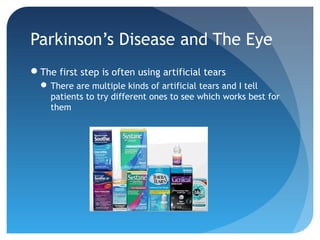
The first step is often using artificial tears
 There are multiple kinds of artificial tears and I tell
patients to try different ones to see which works best for
them
Parkinson’s Disease and The Eye
Normal preserved artificial tears can be used up to 5
times a day
If you need to use the tears more often, I recommend
using nonpreserved artificial tears
Parkinson’s Disease and The Eye
Some patients have trouble getting eye drops into their
eyes and often waste medication
Luckily there is a spray artificial tear drop
Parkinson’s Disease and The Eye
If artificial tears are not working I often place plugs in
the tear ducts
The tear ducts are the drain for the tears, not the
producer (this is the lacrimal gland)
Parkinson’s Disease and The Eye
The plugs go into the tear ducts
and slow the tears from leaving
the eye so rapidly, like a sponge
down the drain of your sink
I usually place collagen plugs
that dissolve in about 4-6
months
Parkinson’s Disease and The Eye
If plugs and or tears do not help there are other
medications
 Restasis
 Steroid Eye drops
 NSAIDs (ibuprofen for the eye)
 Fish oil (omega 3)
Parkinson’s Disease and The Eye
If medical therapy does not work there are some
surgical procedures that can help
These mainly involve tightening the lid or raising the
lower lid to better cover the eye
Parkinson’s Disease and The Eye
Double vision can be a very bothersome problem in
Parkinson's patients
True double vision is when the eyes are not focusing on
the same object and the brain sees two separate images
This can be very disturbing
Parkinson’s Disease and The Eye
Double vision that resolves with one eye closed is called
true or neurologic double vision and is due to a
misalignment of the eyes

If the double vision is still present with only one eye
open this is often due to a problem of the tear film,
cornea or cataract
Parkinson’s Disease and The Eye
True double vision can be from a eye muscle weakness
or from the brain having trouble lining up the 2 eyes
If there is a muscle weakness, the double vision is often
worse when looking towards that muscle, and better if
you look the other way
Parkinson’s Disease and The Eye
One of the most common causes of double vision in
Parkinson's patients is convergence insufficiency
People often complain of difficulty reading and seeing
objects at near
They can also notice blurred vision even at distance
Parkinson’s Disease and The Eye
Convergence insufficiency is when the the eyes do not
converge or turn in together

For us to see clearly at near the eyes have to turn in
slightly to focus

In convergence insufficiency the eyes stay rotated out
and the eyes do not focus together giving double vision
Parkinson’s Disease and The Eye
While convergence insufficiency can occur in many
settings we often see it in our Parkinson's population,
and people after concussions/closed head injuries

It is not known why convergence insufficiency is so
common in Parkinson's patients because we are not sure
exactly where in the brain the control for it occurs
Parkinson’s Disease and The Eye
Often times we can treat convergence insufficiency with
an exercise called “pencil pushups”
This is an easy exercise that can be done anywhere
without breaking a sweat
Parkinson’s Disease and The Eye
If this does not work we
can add prisms to the
glasses for near
I often find that
Parkinson's patients do
better with a pair of
glasses for near and
another for distance
No line bifocals often
cause problems for
patients with Parkinson’s
disease
Parkinson’s Disease and The Eye
Prisms, Botox, or even surgery
can be used to resolve double
vision if the cause is a specific
muscle weakness
That is why it is important to
get a good measurement of
the deviation of the eyes
Parkinson’s Disease and The Eye
Other eye motility problems can occur in Parkinson's
that can cause visual distortion and even problems with
mobility
Nystagmus is a rapid repetitive involuntary movement in
the eye
This constant motion of the eyes can cause problems
reading since you can not follow the lines or focus on
words
Parkinson’s Disease and The Eye
Nystagmus can be from medications or just changes in
the brain

If a medication is causing it, we try to remove or reduce
the amount of medication

If it is from changes in the brain, medications can be
used to help reduce the movement
Parkinson’s Disease and The Eye
Parkinson's patients can often have problems with just
normal movements of their eyes

It can lead to difficulty following objects or people,
especially in crowded situations (or even following the
golf ball)

If this is caused from a medication we try to limit or
eliminate the medication
Parkinson’s Disease and The Eye
Just recently we had a very lucky addition to the ability
to help our patients with vision problems such as
alignment of the eyes
Cindy Anderson here at SMH has started an outpatient
vision rehab program
Parkinson’s Disease and The Eye
She can now offer multiple areas of treatment for our
patients that can dramatically improve the movement
of their eyes and the brain’s ability to perceive it

Prior to her starting this program we were limited in
what we could offer patients, now there is multiple
areas of hope
Parkinson’s Disease and The Eye
Cataracts are not a direct effect of Parkinson’s disease
but can have accelerated formation with medications
and form just from natural aging
Cataracts are a clouding of the natural lens in the eye
Parkinson’s Disease and The Eye
When cataracts cause blurred vision that is not
correctable with glasses it is time to talk about cataract
surgery
Cataract surgery is the most common elective surgery
done today in the United States
Parkinson’s Disease and The Eye
Cataract surgery is done as an outpatient surgery, and
can be done with minimal anesthesia
Parkinson’s Disease and The Eye
In cataract surgery the natural lens is removed with an
ultra sound machine that breaks the lens up and sucks it
out all at the same time

Despite what is advertised, there is no true laser
cataract surgery, all techniques use the ultra sound to
break the lens up and remove it
Parkinson’s Disease and The Eye
Once the cataract material is removed, an artificial lens
is placed into the eye to help the patient see clearly
Parkinson’s Disease and The Eye
One of the big areas in cataract surgery today is the
new lenses that offer patients the ability to see near
and far without the use of glasses
While this might be a good option for some people, I
recommend not pursuing this in patients with neurologic
disease, especially Parkinson's
Parkinson’s Disease and The Eye
 Visual hallucinations can occur as
frequent as 1 in 5 patients, with the
number even higher if including
those with just non-bothersome
illusions
 These visual hallucinations (or false
images) are often nonthreatening in
nature, such as small people or
animals or loved ones who have died
 Threatening visual hallucinations are
less common
Parkinson’s Disease and The Eye
The cause of these hallucinations is related to the
increased levels of dopamine, as is created with
Parkinson's medications
Sleep disturbances and or stress increase the risk of
visual hallucinations
Also medications such as sedatives, sleeping
medication, pain meds and some urinary medications
can cause increased visual hallucinations
Parkinson’s Disease and The Eye
Some of the treatments to help include
 Reducing or changing the Parkinson's medication
 Antipsychotic medications, either Seroquel or Clonazapine
 Others are not recommended as they can worsen movement
problems

 Making sure there are no other contributing medical
conditions
 Like an underlying infection, possibly a urinary tract infection

 Improving sleep and stress
Parkinson’s Disease and The Eye
An important issue to remember through all of this is
while Parkinson’s disease can cause multiple ocular
issues, there are other problems that need to be
watched for also
Parkinson’s Disease and The Eye
Glaucoma is a disease of the optic nerve of the eye that
causes loss of the nerves

It is related to increased eye pressure

Glaucoma can cause slow permanent vision loss and
needs to be detected early
Parkinson’s Disease and The Eye
In years past glaucoma was followed by testing the
peripheral fields with a visual field machine
Parkinson’s Disease and The Eye
In patients with Parkinson’s disease these can be hard
test to do reliably

There is an older manual machine that can be easier for
patients to follow the glaucoma

A new technology is called OCT can follow the actual
nerve tissue thickness and help follow progression of the
disease
Parkinson’s Disease and The Eye
Macular degeneration is a leading cause of blindness in
patients over 60
This is from a breakdown on the layers of the retina
There are two types
 Wet
 Dry
Parkinson’s Disease and The Eye
There are now injections avaliable to treat the wet
macular degeneration

The dry type all we can offer are vitamins
Parkinson’s Disease and The Eye
Are there any questions?

Parkinson's disease and the effect on the Eye

  • 1.
    Eye Problems With Parkinson's JodyAbrams, MD Neuro-Ophthalmology/Oculoplastics Sarasota Retina Institute
  • 2.
    What is aNeuro-Ophthalmologist A neuro-ophthalmologist is either a neurologist or ophthalmologist who has spent a year or more after normal residency to learn more about the eye and brain interactions This includes eye muscle problems, optic nerve problems, blurred vision that is not explained by normal causes, and in, or between the eye and brain
  • 3.
    Parkinson’s Disease andThe Eye There are many eye problems that can be seen in Parkinson's patients These can vary from issues like dry eyes, to spasm of the eyelids to visual distortions While most are not sight threatening like macular degeneration they can be just as debilitating if not addressed
  • 4.
    Parkinson’s Disease andThe Eye • Blepharospasms are when the muscles around the eyes contract • These muscles are responsible for closing the eye so when they contract the eyes squeeze shut • The eyes look like they are blinking with a lot of force
  • 5.
    Parkinson’s Disease andThe Eye As you can imagine this can be very irritating The patients have hard time reading or watching TV and even doing a basic eye exam can be difficult (like following glaucoma pressures) The good news is that this condition has a nice and proven treatment  BOTOX
  • 6.
    Parkinson’s Disease andThe Eye Botox or botulinum toxin A has been around since the late 1970s It was brought to medical use by an ophthalmologist, Dr. Alan Scott, to use on patients with spasms of the face/eyelids and for eyes that cross
  • 7.
    Parkinson’s Disease andThe Eye It was in the early 90s that a dermatologist and ophthalmologist couple noticed that their patients treated with Botox had improvement of their wrinkles This was published and the legend of cosmetic Botox was born Today Botox for spasms is still the preferred treatment and is covered by most insurance plans
  • 8.
    Parkinson’s Disease andThe Eye Botox works by stopping the nerve from telling the muscle to contract This effect lasts about 3-4 months Prior to the use of Botox, blepharospams were treated with a very disfiguring extensive eyelid surgery
  • 9.
    Parkinson’s Disease andThe Eye The injections are done around the lower and upper eyelids Injections are also given between the eyebrows
  • 10.
    Parkinson’s Disease andThe Eye The injections are done in the office, often in the same exam chair we see you in The needle is a very tiny needle  Most patients report minimal, if any pain
  • 11.
    Parkinson’s Disease andThe Eye  Other issues that occur in patients’ eyelids with Parkinson's is ptosis or droopy eyelids  Is this from the disease, or from aging, is a question that can be debated, but often the two are seen together  Often times with care, patients with Parkinson’s disease can undergo lid surgery with good outcome
  • 12.
    Parkinson’s Disease andThe Eye The main goal of these procedures is not to make the patient look better, but to help the patient see better This is why it is covered by most medical plans including Medicare This is a functional not cosmetic surgery
  • 13.
    Parkinson’s Disease andThe Eye Just below the eyelid the next layer of the eye is the tear film
  • 14.
    Parkinson’s Disease andThe Eye The tear film is often overlooked but is a critical layer for the health of the eye and for good vision The first layer that light hits when entering the eye is the tear film. If this is defective, the light is scattered and the vision will be blurred This can be the reason that despite multiple glasses the vision is still blurred
  • 15.
    Parkinson’s Disease andThe Eye The tear film is made up of three layers  The front oil layer prevents evaporation  The middle water layer hydrates the eye  The inner mucus layer (against the cornea) coats the eye
  • 16.
    Parkinson’s Disease andThe Eye The tears are spread across the eye by eyelid blinking The average blinking rate is around 10 blinks a minute In patients with Parkinson’s disease there is a decreased blink rate  This has even been called a PARKINSON'S STARE since the rate can be severely decreased
  • 17.
    Parkinson’s Disease andThe Eye When the blink rate is decreased it allows more evaporation to occur so the tear film breaks down There is often a decreased tear film to start with (secondary to age and medications) so coupled with a decreased blink rate, the eye can become very dry!
  • 18.
    Parkinson’s Disease andThe Eye What are symptoms of dry eyes  Decreased vision  Burning eyes  Stinging eyes  Red eyes  Watery eyes  Gritty feeling eyes  Even double vision
  • 19.
    Parkinson’s Disease andThe Eye There are multiple ways to test for dry eyes  Schirmer’s test  Fluorescein Staining
  • 20.
    Parkinson’s Disease andThe Eye  Lissamine Green (My favorite and trademark look)  There are some new machines out that can test the tears and tell us about their makeup, how useful this information is, still is in debate
  • 21.
    Parkinson’s Disease andThe Eye Once dry eyes are diagnosed there are multiple ways to treat it and often they are used in combinations We usually start with the most simple treatment and increase as needed Also drink water!
  • 22.
    Parkinson’s Disease andThe Eye The first step is often using artificial tears  There are multiple kinds of artificial tears and I tell patients to try different ones to see which works best for them
  • 23.
    Parkinson’s Disease andThe Eye Normal preserved artificial tears can be used up to 5 times a day If you need to use the tears more often, I recommend using nonpreserved artificial tears
  • 24.
    Parkinson’s Disease andThe Eye Some patients have trouble getting eye drops into their eyes and often waste medication Luckily there is a spray artificial tear drop
  • 25.
    Parkinson’s Disease andThe Eye If artificial tears are not working I often place plugs in the tear ducts The tear ducts are the drain for the tears, not the producer (this is the lacrimal gland)
  • 26.
    Parkinson’s Disease andThe Eye The plugs go into the tear ducts and slow the tears from leaving the eye so rapidly, like a sponge down the drain of your sink I usually place collagen plugs that dissolve in about 4-6 months
  • 27.
    Parkinson’s Disease andThe Eye If plugs and or tears do not help there are other medications  Restasis  Steroid Eye drops  NSAIDs (ibuprofen for the eye)  Fish oil (omega 3)
  • 28.
    Parkinson’s Disease andThe Eye If medical therapy does not work there are some surgical procedures that can help These mainly involve tightening the lid or raising the lower lid to better cover the eye
  • 29.
    Parkinson’s Disease andThe Eye Double vision can be a very bothersome problem in Parkinson's patients True double vision is when the eyes are not focusing on the same object and the brain sees two separate images This can be very disturbing
  • 30.
    Parkinson’s Disease andThe Eye Double vision that resolves with one eye closed is called true or neurologic double vision and is due to a misalignment of the eyes If the double vision is still present with only one eye open this is often due to a problem of the tear film, cornea or cataract
  • 31.
    Parkinson’s Disease andThe Eye True double vision can be from a eye muscle weakness or from the brain having trouble lining up the 2 eyes If there is a muscle weakness, the double vision is often worse when looking towards that muscle, and better if you look the other way
  • 32.
    Parkinson’s Disease andThe Eye One of the most common causes of double vision in Parkinson's patients is convergence insufficiency People often complain of difficulty reading and seeing objects at near They can also notice blurred vision even at distance
  • 33.
    Parkinson’s Disease andThe Eye Convergence insufficiency is when the the eyes do not converge or turn in together For us to see clearly at near the eyes have to turn in slightly to focus In convergence insufficiency the eyes stay rotated out and the eyes do not focus together giving double vision
  • 34.
    Parkinson’s Disease andThe Eye While convergence insufficiency can occur in many settings we often see it in our Parkinson's population, and people after concussions/closed head injuries It is not known why convergence insufficiency is so common in Parkinson's patients because we are not sure exactly where in the brain the control for it occurs
  • 35.
    Parkinson’s Disease andThe Eye Often times we can treat convergence insufficiency with an exercise called “pencil pushups” This is an easy exercise that can be done anywhere without breaking a sweat
  • 36.
    Parkinson’s Disease andThe Eye If this does not work we can add prisms to the glasses for near I often find that Parkinson's patients do better with a pair of glasses for near and another for distance No line bifocals often cause problems for patients with Parkinson’s disease
  • 37.
    Parkinson’s Disease andThe Eye Prisms, Botox, or even surgery can be used to resolve double vision if the cause is a specific muscle weakness That is why it is important to get a good measurement of the deviation of the eyes
  • 38.
    Parkinson’s Disease andThe Eye Other eye motility problems can occur in Parkinson's that can cause visual distortion and even problems with mobility Nystagmus is a rapid repetitive involuntary movement in the eye This constant motion of the eyes can cause problems reading since you can not follow the lines or focus on words
  • 39.
    Parkinson’s Disease andThe Eye Nystagmus can be from medications or just changes in the brain If a medication is causing it, we try to remove or reduce the amount of medication If it is from changes in the brain, medications can be used to help reduce the movement
  • 40.
    Parkinson’s Disease andThe Eye Parkinson's patients can often have problems with just normal movements of their eyes It can lead to difficulty following objects or people, especially in crowded situations (or even following the golf ball) If this is caused from a medication we try to limit or eliminate the medication
  • 41.
    Parkinson’s Disease andThe Eye Just recently we had a very lucky addition to the ability to help our patients with vision problems such as alignment of the eyes Cindy Anderson here at SMH has started an outpatient vision rehab program
  • 42.
    Parkinson’s Disease andThe Eye She can now offer multiple areas of treatment for our patients that can dramatically improve the movement of their eyes and the brain’s ability to perceive it Prior to her starting this program we were limited in what we could offer patients, now there is multiple areas of hope
  • 43.
    Parkinson’s Disease andThe Eye Cataracts are not a direct effect of Parkinson’s disease but can have accelerated formation with medications and form just from natural aging Cataracts are a clouding of the natural lens in the eye
  • 44.
    Parkinson’s Disease andThe Eye When cataracts cause blurred vision that is not correctable with glasses it is time to talk about cataract surgery Cataract surgery is the most common elective surgery done today in the United States
  • 45.
    Parkinson’s Disease andThe Eye Cataract surgery is done as an outpatient surgery, and can be done with minimal anesthesia
  • 46.
    Parkinson’s Disease andThe Eye In cataract surgery the natural lens is removed with an ultra sound machine that breaks the lens up and sucks it out all at the same time Despite what is advertised, there is no true laser cataract surgery, all techniques use the ultra sound to break the lens up and remove it
  • 47.
    Parkinson’s Disease andThe Eye Once the cataract material is removed, an artificial lens is placed into the eye to help the patient see clearly
  • 48.
    Parkinson’s Disease andThe Eye One of the big areas in cataract surgery today is the new lenses that offer patients the ability to see near and far without the use of glasses While this might be a good option for some people, I recommend not pursuing this in patients with neurologic disease, especially Parkinson's
  • 49.
    Parkinson’s Disease andThe Eye  Visual hallucinations can occur as frequent as 1 in 5 patients, with the number even higher if including those with just non-bothersome illusions  These visual hallucinations (or false images) are often nonthreatening in nature, such as small people or animals or loved ones who have died  Threatening visual hallucinations are less common
  • 50.
    Parkinson’s Disease andThe Eye The cause of these hallucinations is related to the increased levels of dopamine, as is created with Parkinson's medications Sleep disturbances and or stress increase the risk of visual hallucinations Also medications such as sedatives, sleeping medication, pain meds and some urinary medications can cause increased visual hallucinations
  • 51.
    Parkinson’s Disease andThe Eye Some of the treatments to help include  Reducing or changing the Parkinson's medication  Antipsychotic medications, either Seroquel or Clonazapine  Others are not recommended as they can worsen movement problems  Making sure there are no other contributing medical conditions  Like an underlying infection, possibly a urinary tract infection  Improving sleep and stress
  • 52.
    Parkinson’s Disease andThe Eye An important issue to remember through all of this is while Parkinson’s disease can cause multiple ocular issues, there are other problems that need to be watched for also
  • 53.
    Parkinson’s Disease andThe Eye Glaucoma is a disease of the optic nerve of the eye that causes loss of the nerves It is related to increased eye pressure Glaucoma can cause slow permanent vision loss and needs to be detected early
  • 54.
    Parkinson’s Disease andThe Eye In years past glaucoma was followed by testing the peripheral fields with a visual field machine
  • 55.
    Parkinson’s Disease andThe Eye In patients with Parkinson’s disease these can be hard test to do reliably There is an older manual machine that can be easier for patients to follow the glaucoma A new technology is called OCT can follow the actual nerve tissue thickness and help follow progression of the disease
  • 56.
    Parkinson’s Disease andThe Eye Macular degeneration is a leading cause of blindness in patients over 60 This is from a breakdown on the layers of the retina There are two types  Wet  Dry
  • 57.
    Parkinson’s Disease andThe Eye There are now injections avaliable to treat the wet macular degeneration The dry type all we can offer are vitamins
  • 58.
    Parkinson’s Disease andThe Eye Are there any questions?

Editor's Notes