Thunderstorms and
Tornadoes

By Glenn McManaway
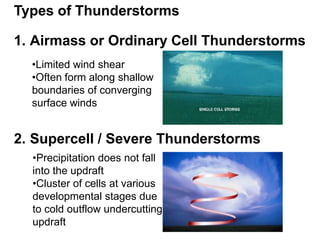
Types of Thunderstorms
1. Airmass or Ordinary Cell Thunderstorms
•Limited wind shear
•Often form along shallow
boundaries of converging
surface winds

2. Supercell / Severe Thunderstorms
•Precipitation does not fall
into the updraft
•Cluster of cells at various
developmental stages due
to cold outflow undercutting
updraft
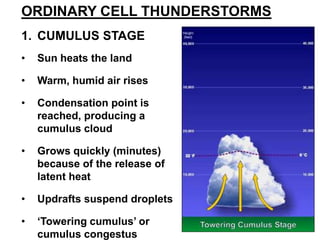
ORDINARY CELL THUNDERSTORMS
1. CUMULUS STAGE
•

Sun heats the land

•

Warm, humid air rises

•

Condensation point is
reached, producing a
cumulus cloud

•

Grows quickly (minutes)
because of the release of
latent heat

•

Updrafts suspend droplets

•

„Towering cumulus‟ or
cumulus congestus
2.

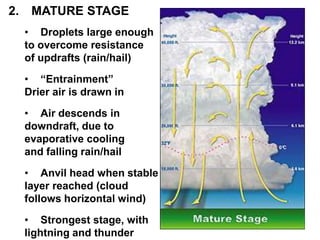
MATURE STAGE
• Droplets large enough
to overcome resistance
of updrafts (rain/hail)
• “Entrainment”
Drier air is drawn in
• Air descends in
downdraft, due to
evaporative cooling
and falling rain/hail
• Anvil head when stable
layer reached (cloud
follows horizontal wind)
• Strongest stage, with
lightning and thunder
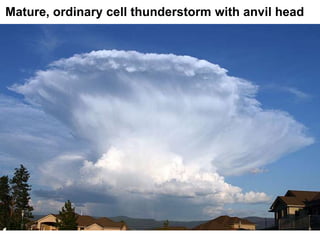
Mature, ordinary cell thunderstorm with anvil head
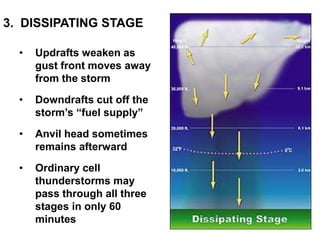
3. DISSIPATING STAGE
•

Updrafts weaken as
gust front moves away
from the storm

•

Downdrafts cut off the
storm‟s “fuel supply”

•

Anvil head sometimes
remains afterward

•

Ordinary cell
thunderstorms may
pass through all three
stages in only 60
minutes
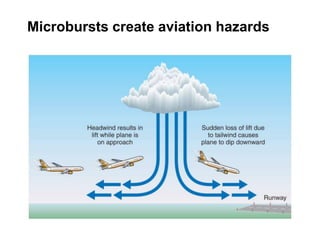
Microbursts create aviation hazards
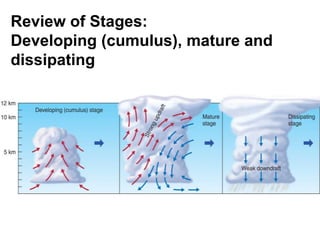
Review of Stages:
Developing (cumulus), mature and
dissipating
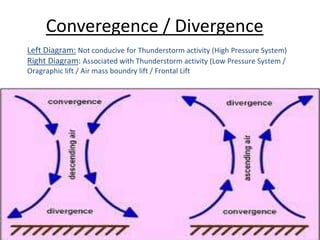
Converegence / Divergence
Left Diagram: Not conducive for Thunderstorm activity (High Pressure System)
Right Diagram: Associated with Thunderstorm activity (Low Pressure System /
Oragraphic lift / Air mass boundry lift / Frontal Lift
Thunderstorms
Typical conditions:
1.

Conditional instability

2.

Trigger Mechanism
(eg. front, sea-breeze front, mountains,
localized zones of excess surface heating,
shallow boundaries of converging surface
winds)
1.

External trigger mechanism forces air parcels
to rise to the lifted condensation level (LCL)
Clouds form and temperature follows MALR

2.

Parcel may reach level of free convection
(LFC). Parcel accelerates under own buoyancy.
Warmer than surroundings - explosive updrafts

3.

Saturated parcel continues to rise until
stable layer is reached
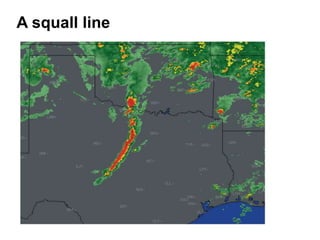
A squall line
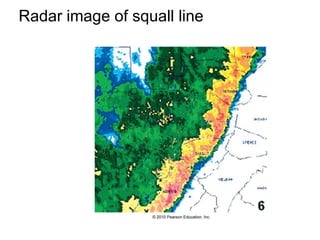
Radar image of squall line
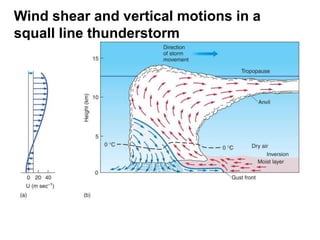
Wind shear and vertical motions in a
squall line thunderstorm
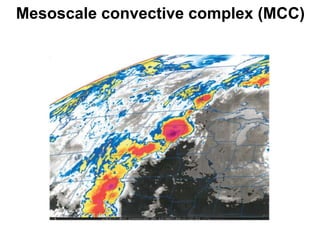
Mesoscale convective complex (MCC)
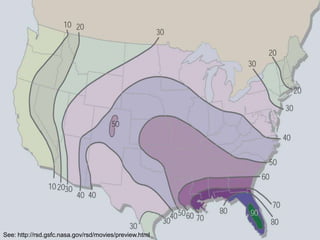
See: http://rsd.gsfc.nasa.gov/rsd/movies/preview.html
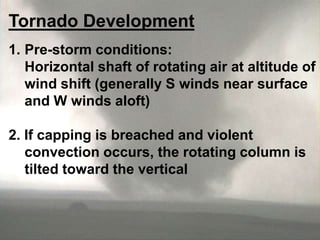
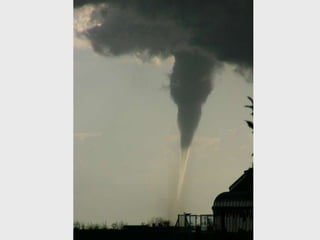
Tornado Development
1. Pre-storm conditions:
Horizontal shaft of rotating air at altitude of
wind shift (generally S winds near surface
and W winds aloft)

2. If capping is breached and violent
convection occurs, the rotating column is
tilted toward the vertical
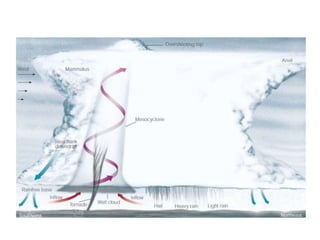
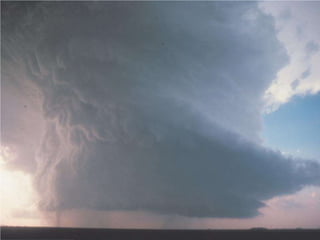
Supercell Thunderstorms
•Defined by mid-level rotation (mesocyclone)
Highest vorticity near updraft core
•Supercells form under the following conditions:
High CAPE, capping layer, cold air aloft, large
wind shear
Tornado producing supercell

[insert fig 11-29]
Global tornado frequency

[insert fig 11-32]
[insert table 112]
Lightning
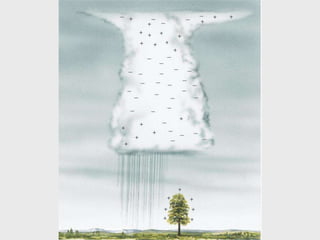
Source of lightning: the cumulonimbus cloud
•Collisions between supercooled cloud particles and
graupel (or hail) cause clouds to become charged

•Most of the base of the cumulonimbus cloud
becomes negatively charged – the rest becomes
positively charged (positive electric dipole)
•Net transfer of positive ions from warmer object to
colder object (hailstone gets negatively charged &
fall toward bottom - ice crystals get + charge)
•Many theories exist: open area of research
•Heats up to 50,000 Degrees F
Distribution of lightning strikes

[insert fig 11-23]
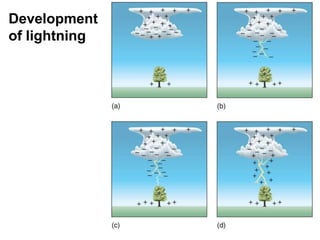
Development
of lightning
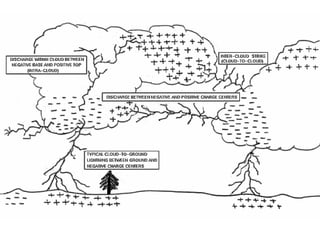
•Intracloud Discharges
•Cloud to Ground Discharges
- death and destruction of property
- disruption of power and communication
- ignition of forest fires

- Lightning is an excellent source of soil
nitrogen!

Thunderstorms and tornadoes

  • 1.
  • 3.
    Types of Thunderstorms 1.Airmass or Ordinary Cell Thunderstorms •Limited wind shear •Often form along shallow boundaries of converging surface winds 2. Supercell / Severe Thunderstorms •Precipitation does not fall into the updraft •Cluster of cells at various developmental stages due to cold outflow undercutting updraft
  • 4.
    ORDINARY CELL THUNDERSTORMS 1.CUMULUS STAGE • Sun heats the land • Warm, humid air rises • Condensation point is reached, producing a cumulus cloud • Grows quickly (minutes) because of the release of latent heat • Updrafts suspend droplets • „Towering cumulus‟ or cumulus congestus
  • 5.
    2. MATURE STAGE • Dropletslarge enough to overcome resistance of updrafts (rain/hail) • “Entrainment” Drier air is drawn in • Air descends in downdraft, due to evaporative cooling and falling rain/hail • Anvil head when stable layer reached (cloud follows horizontal wind) • Strongest stage, with lightning and thunder
  • 6.
    Mature, ordinary cellthunderstorm with anvil head
  • 7.
    3. DISSIPATING STAGE • Updraftsweaken as gust front moves away from the storm • Downdrafts cut off the storm‟s “fuel supply” • Anvil head sometimes remains afterward • Ordinary cell thunderstorms may pass through all three stages in only 60 minutes
  • 8.
  • 9.
    Review of Stages: Developing(cumulus), mature and dissipating
  • 10.
    Converegence / Divergence LeftDiagram: Not conducive for Thunderstorm activity (High Pressure System) Right Diagram: Associated with Thunderstorm activity (Low Pressure System / Oragraphic lift / Air mass boundry lift / Frontal Lift
  • 11.
    Thunderstorms Typical conditions: 1. Conditional instability 2. TriggerMechanism (eg. front, sea-breeze front, mountains, localized zones of excess surface heating, shallow boundaries of converging surface winds)
  • 12.
    1. External trigger mechanismforces air parcels to rise to the lifted condensation level (LCL) Clouds form and temperature follows MALR 2. Parcel may reach level of free convection (LFC). Parcel accelerates under own buoyancy. Warmer than surroundings - explosive updrafts 3. Saturated parcel continues to rise until stable layer is reached
  • 14.
  • 15.
    Radar image ofsquall line
  • 16.
    Wind shear andvertical motions in a squall line thunderstorm
  • 17.
  • 18.
  • 19.
    Tornado Development 1. Pre-stormconditions: Horizontal shaft of rotating air at altitude of wind shift (generally S winds near surface and W winds aloft) 2. If capping is breached and violent convection occurs, the rotating column is tilted toward the vertical
  • 20.
    Supercell Thunderstorms •Defined bymid-level rotation (mesocyclone) Highest vorticity near updraft core •Supercells form under the following conditions: High CAPE, capping layer, cold air aloft, large wind shear
  • 24.
  • 26.
  • 27.
  • 28.
    Lightning Source of lightning:the cumulonimbus cloud •Collisions between supercooled cloud particles and graupel (or hail) cause clouds to become charged •Most of the base of the cumulonimbus cloud becomes negatively charged – the rest becomes positively charged (positive electric dipole) •Net transfer of positive ions from warmer object to colder object (hailstone gets negatively charged & fall toward bottom - ice crystals get + charge) •Many theories exist: open area of research •Heats up to 50,000 Degrees F
  • 29.
    Distribution of lightningstrikes [insert fig 11-23]
  • 31.
  • 33.
    •Intracloud Discharges •Cloud toGround Discharges - death and destruction of property - disruption of power and communication - ignition of forest fires - Lightning is an excellent source of soil nitrogen!