
PHYSICS CCE
-Anushree K
7’A’
CONTENTS
 Introduction to Thunderstorms:
1. What are thunderstorms?
2. How they occur?
3. Different types of thunderstorms
4. Safety precautions
 Examples of thunderstorms:
1. 2010 Eastern Indian States
2. 1939 South California tropical storm
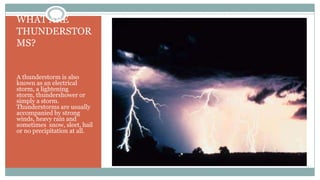
WHAT ARE
THUNDERSTOR
MS?
A thunderstorm is also
known as an electrical
storm, a lightening
storm, thundershower or
simply a storm.
Thunderstorms are usually
accompanied by strong
winds, heavy rain and
sometimes snow, sleet, hail
or no precipitation at all.
Thunderstorms result from the rapid upward movement of warm,
moist air. They can occur inside warm, moist air masses and at
fronts.
As the warm, moist air moves upward, it cools, condenses, and
forms cumulonimbus clouds that can reach heights of over
20 km. As the rising air reaches its dew point, water droplets and
ice form and begin falling the long distance through the clouds
towards the Earth's surface.
As the droplets fall, they collide with other droplets and become
larger. The falling droplets create a downdraft of air that spreads
out at the Earth's surface and causes strong winds associated
commonly with thunderstorms.
There are four types of thunderstorms:
1. Single-cell
2. Multicell cluster
3. Multicell lines
4. Supercells.
Supercell thunderstorms are the strongest and the most
associated with severe weather phenomena. Dry
thunderstorms, with no precipitation, can cause the
outbreak of wildfires with the heat generated from the cloud-
to-ground lightning that accompanies them.
Preparedness
 People should know the names of
local counties, cities, and towns,
as these are how warnings are
described.
 Monitor forecasts and know
whether thunderstorms are likely
in the area.
 Be alert for natural signs of an
approaching storm.
 Cancel or reschedule outdoor
events (to avoid being caught
outdoors when a storm hits).
 Avoid open areas like hilltops,
Safety
 Take action immediately upon
hearing thunder. Anyone close
enough to the storm to hear
thunder can be struck by lightning.
 Avoid electrical appliances,
including corded
telephones. Cordless and wireless
telephones are safe to use during a
thunderstorm.
 Close and stay away from windows
and doors, as glass can become a
serious hazard in high wind.
 Do not bathe or shower, as
2010 Eastern
Indian States
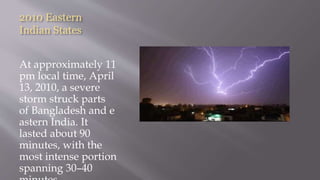
At approximately 11
pm local time, April
13, 2010, a severe
storm struck parts
of Bangladesh and e
astern India. It
lasted about 90
minutes, with the
most intense portion
spanning 30–40
2010 Eastern India States
. As of April 16, more than 140 deaths have been reported. At least
91 people died in the Indian state of Bihar, 44 in West Bengal and
4 in Assam.
In Bangladesh, five deaths and 200 injuries were reported. Most of
the deaths were women and children crushed when their huts
were destroyed. Over 91,000 dwellings were destroyed in India
and several thousand in Bangladesh; approximately 300,000
dwellings were at least partially damaged.
Nearly 500,000 people were left homeless or otherwise affected by
the storm. Rescue efforts have been inhibited as many roads,
were blocked by downed trees and telephone poles.
Medical personnel and supplies were quickly rushed to the affected
areas, and aid packages were announced. Aid workers began to
1939 California tropical storm
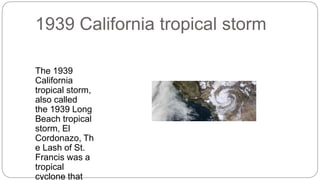
The 1939
California
tropical storm,
also called
the 1939 Long
Beach tropical
storm, El
Cordonazo, Th
e Lash of St.
Francis was a
tropical
cyclone that
. Formerly a hurricane, it was the only tropical storm to
make landfall in California in the twentieth century.
The storm caused heavy rain in most parts of the country and
also lead to floods. The flooding killed 45 in Southern
California, although some of these may be attributable to
the rain immediately before the tropical storm. At sea, 48
were killed.
The tropical storm was credited with at least one beneficial
effect: it ended a vicious heat wave that had lasted for
over a week and killed at least ninety people.
Out at sea, the Coast Guard and Navy conducted rescue
operations, saving dozens of people. Schools were closed
there as the wind had reached a mighty speed too.
People were advised not to use electrical appliances, not to
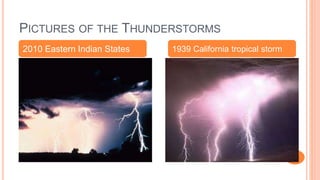
PICTURES OF THE THUNDERSTORMS
2010 Eastern Indian States 1939 California tropical storm
SOURCE
Information: Wikipedia
Pictures : Google images

Thunderstorms: A Case Study

  • 1.
  • 2.
    CONTENTS  Introduction toThunderstorms: 1. What are thunderstorms? 2. How they occur? 3. Different types of thunderstorms 4. Safety precautions  Examples of thunderstorms: 1. 2010 Eastern Indian States 2. 1939 South California tropical storm
  • 3.
    WHAT ARE THUNDERSTOR MS? A thunderstormis also known as an electrical storm, a lightening storm, thundershower or simply a storm. Thunderstorms are usually accompanied by strong winds, heavy rain and sometimes snow, sleet, hail or no precipitation at all.
  • 4.
    Thunderstorms result fromthe rapid upward movement of warm, moist air. They can occur inside warm, moist air masses and at fronts. As the warm, moist air moves upward, it cools, condenses, and forms cumulonimbus clouds that can reach heights of over 20 km. As the rising air reaches its dew point, water droplets and ice form and begin falling the long distance through the clouds towards the Earth's surface. As the droplets fall, they collide with other droplets and become larger. The falling droplets create a downdraft of air that spreads out at the Earth's surface and causes strong winds associated commonly with thunderstorms.
  • 5.
    There are fourtypes of thunderstorms: 1. Single-cell 2. Multicell cluster 3. Multicell lines 4. Supercells. Supercell thunderstorms are the strongest and the most associated with severe weather phenomena. Dry thunderstorms, with no precipitation, can cause the outbreak of wildfires with the heat generated from the cloud- to-ground lightning that accompanies them.
  • 6.
    Preparedness  People shouldknow the names of local counties, cities, and towns, as these are how warnings are described.  Monitor forecasts and know whether thunderstorms are likely in the area.  Be alert for natural signs of an approaching storm.  Cancel or reschedule outdoor events (to avoid being caught outdoors when a storm hits).  Avoid open areas like hilltops, Safety  Take action immediately upon hearing thunder. Anyone close enough to the storm to hear thunder can be struck by lightning.  Avoid electrical appliances, including corded telephones. Cordless and wireless telephones are safe to use during a thunderstorm.  Close and stay away from windows and doors, as glass can become a serious hazard in high wind.  Do not bathe or shower, as
  • 7.
    2010 Eastern Indian States Atapproximately 11 pm local time, April 13, 2010, a severe storm struck parts of Bangladesh and e astern India. It lasted about 90 minutes, with the most intense portion spanning 30–40
  • 8.
    2010 Eastern IndiaStates . As of April 16, more than 140 deaths have been reported. At least 91 people died in the Indian state of Bihar, 44 in West Bengal and 4 in Assam. In Bangladesh, five deaths and 200 injuries were reported. Most of the deaths were women and children crushed when their huts were destroyed. Over 91,000 dwellings were destroyed in India and several thousand in Bangladesh; approximately 300,000 dwellings were at least partially damaged. Nearly 500,000 people were left homeless or otherwise affected by the storm. Rescue efforts have been inhibited as many roads, were blocked by downed trees and telephone poles. Medical personnel and supplies were quickly rushed to the affected areas, and aid packages were announced. Aid workers began to
  • 9.
    1939 California tropicalstorm The 1939 California tropical storm, also called the 1939 Long Beach tropical storm, El Cordonazo, Th e Lash of St. Francis was a tropical cyclone that
  • 10.
    . Formerly ahurricane, it was the only tropical storm to make landfall in California in the twentieth century. The storm caused heavy rain in most parts of the country and also lead to floods. The flooding killed 45 in Southern California, although some of these may be attributable to the rain immediately before the tropical storm. At sea, 48 were killed. The tropical storm was credited with at least one beneficial effect: it ended a vicious heat wave that had lasted for over a week and killed at least ninety people. Out at sea, the Coast Guard and Navy conducted rescue operations, saving dozens of people. Schools were closed there as the wind had reached a mighty speed too. People were advised not to use electrical appliances, not to
  • 11.
    PICTURES OF THETHUNDERSTORMS 2010 Eastern Indian States 1939 California tropical storm
  • 12.