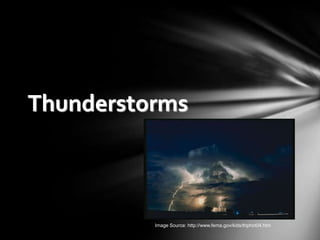
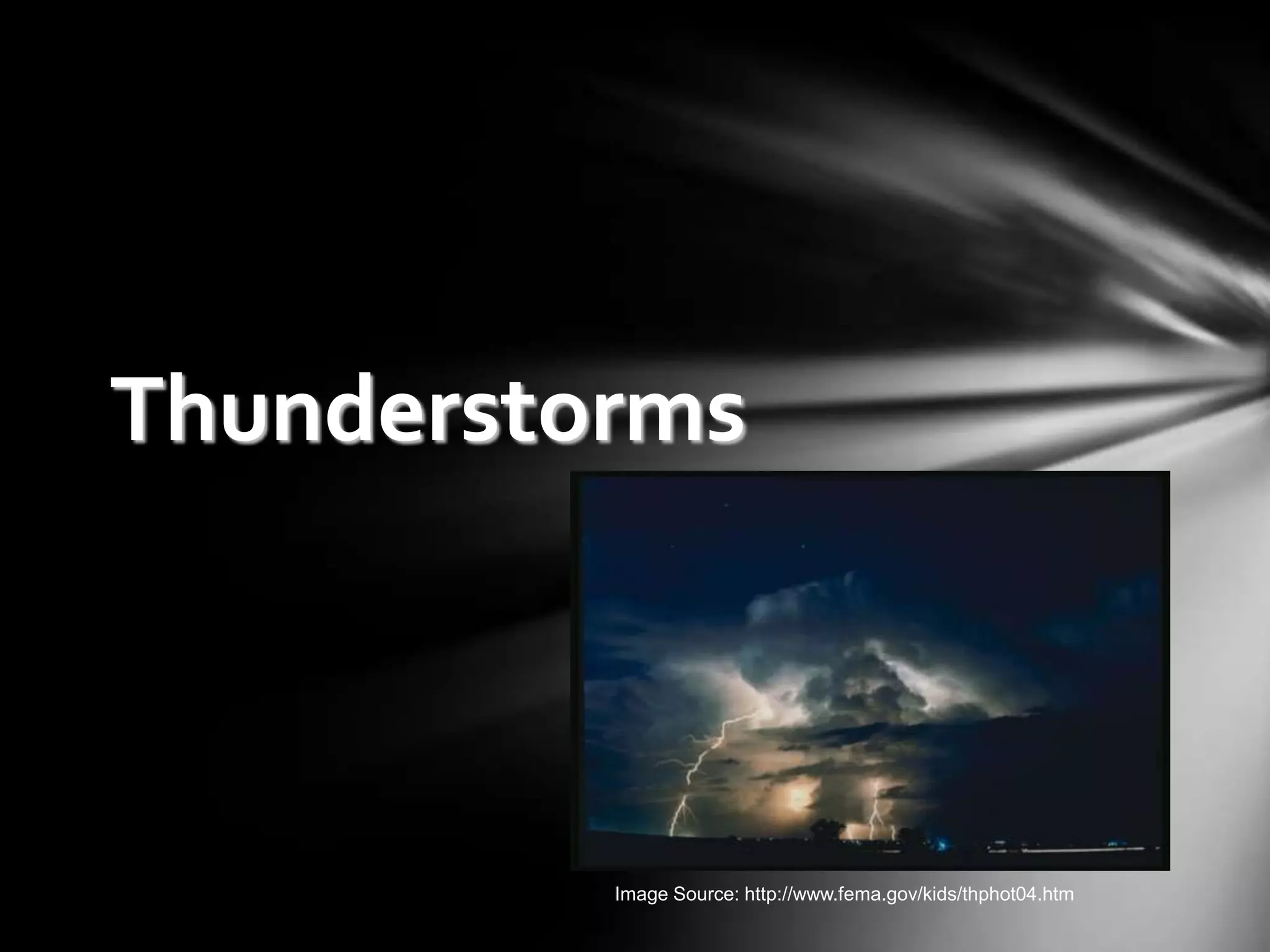
Thunderstorms


          Image Source: http://www.fema.gov/kids/thphot04.htm
Contents
   What is a thunderstorm?
   What are lightning and thunder?
   What should I do during a
    thunderstorm?
   Works Cited
   Reflection
What is a thunderstorm?
Webster’s Dictionary defines a thunderstorm as “a storm
  accompanied by lightning and thunder.” But what does that
  mean?
FEMA (Federal Emergency Management Agency) for Kids
  states that a thunderstorm needs three things to occur:
  Moisture, Unstable Air (Remember- warm air rises, and in a
  thunderstorm it rises fast) and Lift, which helps the air raise
  further.
Thunderstorms can be single cell, meaning one isolated storm,
  or multicell, meaning a group of storms together at different
  stages. The can also be supercells, which are dangerous for
  their strong winds. Each cell can last around 20 to 30
  minutes.
What is a thunderstorm? Continued.
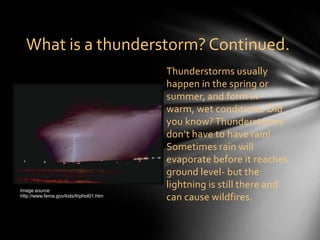
                                        Thunderstorms usually
                                        happen in the spring or
                                        summer, and form in
                                        warm, wet conditions. Did
                                        you know? Thunderstorms
                                        don’t have to have rain!
                                        Sometimes rain will
                                        evaporate before it reaches
                                        ground level- but the
Image source:
                                        lightning is still there and
http://www.fema.gov/kids/thphot01.htm
                                        can cause wildfires.
Quiz Time!
What three things does a thunderstorm need to occur?
Moisture, Unstable Air, and Lift
Why are supercells dangerous?
The have strong winds (Fact- this can cause a Tornado!)
What conditions do thunderstorms happen in?
Warm and Wet.
Do thunderstorms have to have rain?
No.
Good Job!


                                                  Back to Contents
What are lightning and thunder?
Lightning is an electrical discharge of positive and negative
charges in a storm interacting. It can be thought of as a big
version of a static shock- in fact, that’s exactly what it is!
Lightning is actually what causes thunder. When lighting
happens it sets off a sound wave, just like a cannon. Light
waves can move faster than sound waves, however, which is
why you see the lighting before you hear the thunder boom.
The chances of being struck by lightning is 1 in 600,000. Also,
lighting can stick the same place twice, or even more.
What are lightning and thunder?
     Continued.
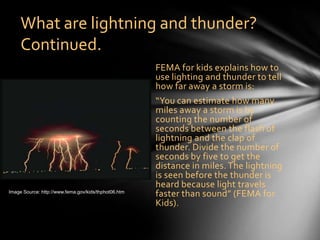
                                                      FEMA for kids explains how to
                                                      use lighting and thunder to tell
                                                      how far away a storm is:
                                                      “You can estimate how many
                                                      miles away a storm is by
                                                      counting the number of
                                                      seconds between the flash of
                                                      lightning and the clap of
                                                      thunder. Divide the number of
                                                      seconds by five to get the
                                                      distance in miles. The lightning
                                                      is seen before the thunder is
                                                      heard because light travels
Image Source: http://www.fema.gov/kids/thphot06.htm
                                                      faster than sound” (FEMA for
                                                      Kids).
Quiz Time!
What is lighting a result of?
Positive and negative charges interacting in a storm.
What causes thunder?
Lightning.
Can lightning strike the same place twice?
Yes.
What do you divide the number of seconds in between
lightning and thunder by to get the distance of the storm?
Five.
Good job!
                                               Back to Contents
What should I do during a
thunderstorm?
Thunderstorms are dangerous! Storms can cause lightning,
rain, strong winds, hail, flooding, even tornadoes! While
thunderstorms can be fun to watch it’s important to stay safe.
FEMA says: "If thunder roars, go indoors." Being outside is
not safe during a storm. If you are driving, stay in your car and
avoid touching any metal. If for some reason you are stuck
outside, get in a ditch and stay low! Lightning is attracted to
height.
If someone is ever struck by lightning it is OKAY to touch
them- you will not get shocked. Call 9-1-1 and provide help
immediately!
What should I do during a
     thunderstorm? Continued.
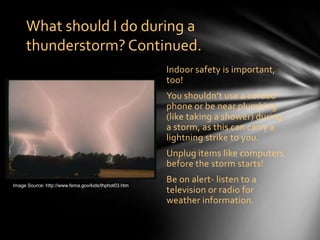
                                                      Indoor safety is important,
                                                      too!
                                                      You shouldn’t use a corded
                                                      phone or be near plumbing
                                                      (like taking a shower) during
                                                      a storm, as this can carry a
                                                      lightning strike to you.
                                                      Unplug items like computers
                                                      before the storm starts!

Image Source: http://www.fema.gov/kids/thphot03.htm
                                                      Be on alert- listen to a
                                                      television or radio for
                                                      weather information.
Quiz Time!
Complete the sentence. “If thunder roars…”
“…Go indoors!”
Where should you go if you are stuck outside in a thunderstorm?
Somewhere low, like a ditch.
Is it safe to help someone if they’ve been stuck by lightning?
Yes!
Why shouldn’t you take a shower during a thunderstorm?
Plumbing can conduct a lightning strike.
Good Job!


                                                    Back to Contents
Works Cited
FEMA. (2010, August 11). Thunderstorms and lightning. Retrieved from
http://www.fema.gov/hazard/thunderstorm/index.shtm
FEMA for Kids. (n.d.). Thunderstorms. Retrieved from
http://www.fema.gov/kids/thunder.htm (Images also from source)
Hatheway, B. (2010, May 27). Thunderstorms. Retrieved from
http://www.windows2universe.org/earth/Atmosphere/tstorm.html
National Severe Storms Library. (2006, October 15). Thunderstorm basics.
Retrieved from http://www.nssl.noaa.gov/primer/tstorm/tst_basics.html
Palmer, C. (n.d.). A look inside a thunderstorm. USA Today, Retrieved from
http://www.usatoday.com/weather/tg/wtsmwhat/wtsmwhat.htm
Thunderstrom. Merriam-webster. Retrieved January 28, 2011, from
http://www.merriam-webster.com/dictionary/thunderstorm


                                                       Back to Contents
Reflection
I enjoyed researching this because it reminded me of being a child and
    watching storms from my bedroom window. I loved learning about
    weather in school, and I realized why while researching- it’s exciting!
    There’s all kinds of wild things that can happen in a storm. Lightning is
    very impressive, especially to a kid.
I’ve used PowerPoint in the past, but this is my first time with the new
    program. I enjoyed exploring it and I found it’s even easier to use and to
    make things look professional. The interface is much better organized,
    too.
APA citation was hard for me because this is my first time using it- in the
  past, I’ve only used MLA. I like that it still includes the web url address,
  unlike MLA; it makes it easier to find the source again.


                                                                Back to Contents

Thunderstorms

  • 1.
    Thunderstorms Image Source: http://www.fema.gov/kids/thphot04.htm
  • 2.
    Contents  What is a thunderstorm?  What are lightning and thunder?  What should I do during a thunderstorm?  Works Cited  Reflection
  • 3.
    What is athunderstorm? Webster’s Dictionary defines a thunderstorm as “a storm accompanied by lightning and thunder.” But what does that mean? FEMA (Federal Emergency Management Agency) for Kids states that a thunderstorm needs three things to occur: Moisture, Unstable Air (Remember- warm air rises, and in a thunderstorm it rises fast) and Lift, which helps the air raise further. Thunderstorms can be single cell, meaning one isolated storm, or multicell, meaning a group of storms together at different stages. The can also be supercells, which are dangerous for their strong winds. Each cell can last around 20 to 30 minutes.
  • 4.
    What is athunderstorm? Continued. Thunderstorms usually happen in the spring or summer, and form in warm, wet conditions. Did you know? Thunderstorms don’t have to have rain! Sometimes rain will evaporate before it reaches ground level- but the Image source: lightning is still there and http://www.fema.gov/kids/thphot01.htm can cause wildfires.
  • 5.
    Quiz Time! What threethings does a thunderstorm need to occur? Moisture, Unstable Air, and Lift Why are supercells dangerous? The have strong winds (Fact- this can cause a Tornado!) What conditions do thunderstorms happen in? Warm and Wet. Do thunderstorms have to have rain? No. Good Job! Back to Contents
  • 6.
    What are lightningand thunder? Lightning is an electrical discharge of positive and negative charges in a storm interacting. It can be thought of as a big version of a static shock- in fact, that’s exactly what it is! Lightning is actually what causes thunder. When lighting happens it sets off a sound wave, just like a cannon. Light waves can move faster than sound waves, however, which is why you see the lighting before you hear the thunder boom. The chances of being struck by lightning is 1 in 600,000. Also, lighting can stick the same place twice, or even more.
  • 7.
    What are lightningand thunder? Continued. FEMA for kids explains how to use lighting and thunder to tell how far away a storm is: “You can estimate how many miles away a storm is by counting the number of seconds between the flash of lightning and the clap of thunder. Divide the number of seconds by five to get the distance in miles. The lightning is seen before the thunder is heard because light travels Image Source: http://www.fema.gov/kids/thphot06.htm faster than sound” (FEMA for Kids).
  • 8.
    Quiz Time! What islighting a result of? Positive and negative charges interacting in a storm. What causes thunder? Lightning. Can lightning strike the same place twice? Yes. What do you divide the number of seconds in between lightning and thunder by to get the distance of the storm? Five. Good job! Back to Contents
  • 9.
    What should Ido during a thunderstorm? Thunderstorms are dangerous! Storms can cause lightning, rain, strong winds, hail, flooding, even tornadoes! While thunderstorms can be fun to watch it’s important to stay safe. FEMA says: "If thunder roars, go indoors." Being outside is not safe during a storm. If you are driving, stay in your car and avoid touching any metal. If for some reason you are stuck outside, get in a ditch and stay low! Lightning is attracted to height. If someone is ever struck by lightning it is OKAY to touch them- you will not get shocked. Call 9-1-1 and provide help immediately!
  • 10.
    What should Ido during a thunderstorm? Continued. Indoor safety is important, too! You shouldn’t use a corded phone or be near plumbing (like taking a shower) during a storm, as this can carry a lightning strike to you. Unplug items like computers before the storm starts! Image Source: http://www.fema.gov/kids/thphot03.htm Be on alert- listen to a television or radio for weather information.
  • 11.
    Quiz Time! Complete thesentence. “If thunder roars…” “…Go indoors!” Where should you go if you are stuck outside in a thunderstorm? Somewhere low, like a ditch. Is it safe to help someone if they’ve been stuck by lightning? Yes! Why shouldn’t you take a shower during a thunderstorm? Plumbing can conduct a lightning strike. Good Job! Back to Contents
  • 12.
    Works Cited FEMA. (2010,August 11). Thunderstorms and lightning. Retrieved from http://www.fema.gov/hazard/thunderstorm/index.shtm FEMA for Kids. (n.d.). Thunderstorms. Retrieved from http://www.fema.gov/kids/thunder.htm (Images also from source) Hatheway, B. (2010, May 27). Thunderstorms. Retrieved from http://www.windows2universe.org/earth/Atmosphere/tstorm.html National Severe Storms Library. (2006, October 15). Thunderstorm basics. Retrieved from http://www.nssl.noaa.gov/primer/tstorm/tst_basics.html Palmer, C. (n.d.). A look inside a thunderstorm. USA Today, Retrieved from http://www.usatoday.com/weather/tg/wtsmwhat/wtsmwhat.htm Thunderstrom. Merriam-webster. Retrieved January 28, 2011, from http://www.merriam-webster.com/dictionary/thunderstorm Back to Contents
  • 13.
    Reflection I enjoyed researchingthis because it reminded me of being a child and watching storms from my bedroom window. I loved learning about weather in school, and I realized why while researching- it’s exciting! There’s all kinds of wild things that can happen in a storm. Lightning is very impressive, especially to a kid. I’ve used PowerPoint in the past, but this is my first time with the new program. I enjoyed exploring it and I found it’s even easier to use and to make things look professional. The interface is much better organized, too. APA citation was hard for me because this is my first time using it- in the past, I’ve only used MLA. I like that it still includes the web url address, unlike MLA; it makes it easier to find the source again. Back to Contents