LIGHTNING
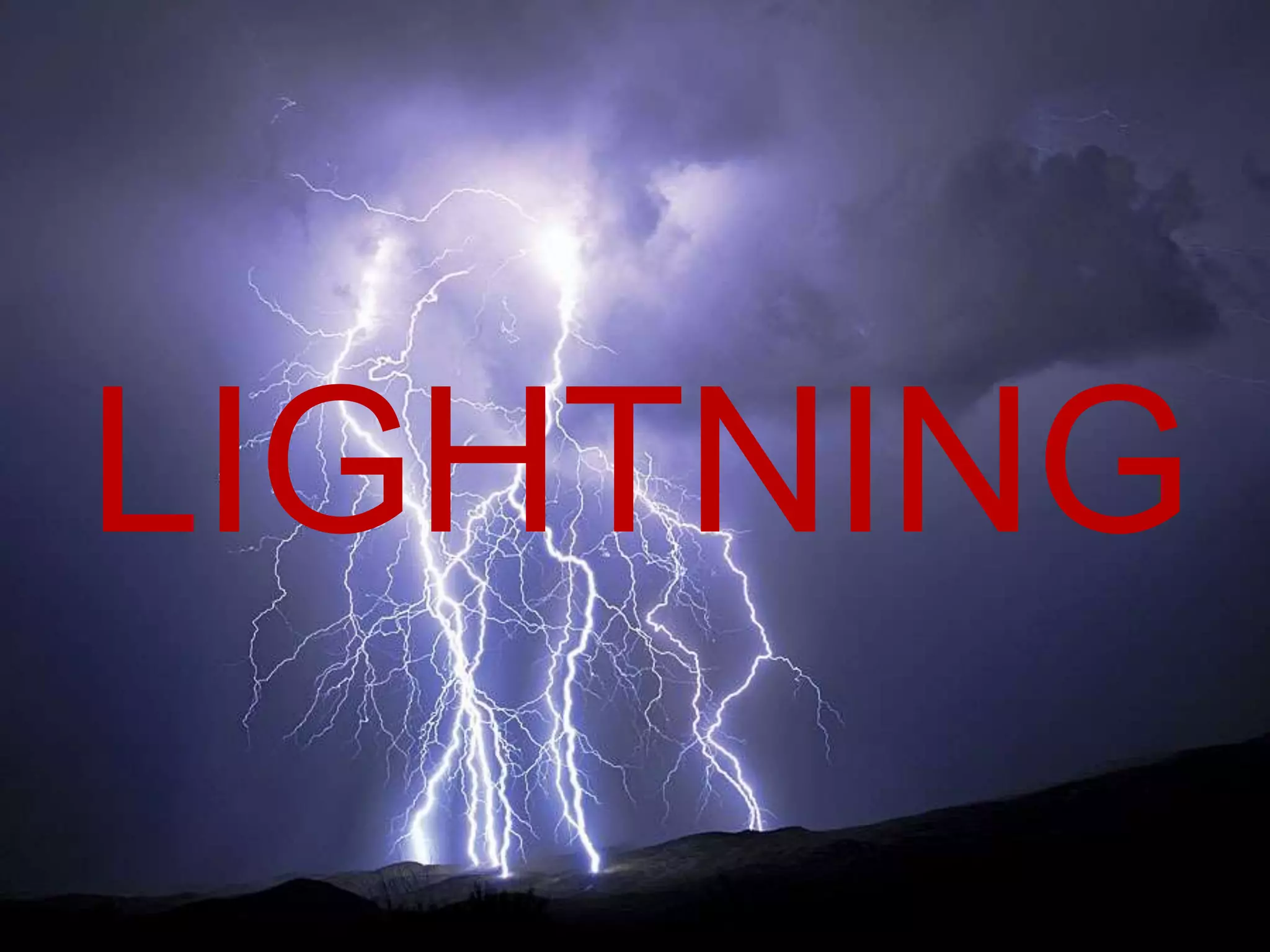
LIGHTNING
• Lightning is a sudden electrostatic discharge
that occurs typically during a thunderstorm.
This discharge occurs between electrically
charged regions of a cloud (called intra-cloud
lightning or IC), between two clouds (CC
lightning), or between a cloud and the
ground (CG lightning).
LIGHTNING
• The charged regions in the atmosphere temporarily
equalize themselves through this discharge referred to
as a flash. A lightning flash can also be a strike if it
involves an object on the ground. Lightning creates
light in the form of black body radiation from the very
hot plasma created by the electron flow, and sound in
the form of thunder. Lightning may be seen and not
heard when it occurs at a distance too great for the
sound to carry as far as the light from the strike or
flash.
TYPES OF LIGHTNING
• Based on the "ends" of a flash channel.
• Intracloud (IC), which occurs within a single thundercloud
unit
• Cloud to cloud (CC) , which starts and ends between two
different "functional" thundercloud units
• Cloud to ground (CG), that primarily originates in the
thundercloud and terminates on an Earth surface, but may
also occur in the reverse direction, that is ground to cloud
• There are variations of each type, such as
"positive" versus "negative" CG flashes, that
have different physical characteristics
common to each which can be measured.
Different common names used to describe a
particular lightning event may be attributed
to the same or different events.
INTRA CLOUD
• Lightning discharges may occur between areas of
cloud without contacting the ground. When it
occurs between areas of differing electric potential
within a single cloud it is known as intra-cloud
lightning. Intra-cloud lightning is the most
frequently occurring type.
INTRA CLOUD
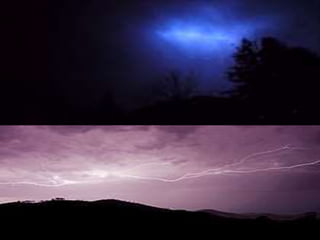
• Intra-cloud lightning most commonly occurs
between the upper portion and lower reaches of a
given thunderstorm. This lightning can sometimes
be observed at great distances at night as so-called
"sheet lightning". In such instances, the observer
may see only a flash of light without hearing any
thunder.
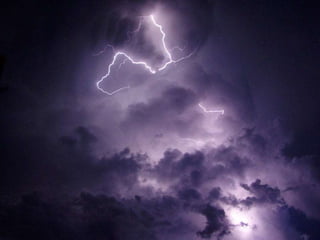
CLOUD TO CLOUD
• Lightning discharges may occur
between areas of cloud without
contacting the ground. When it occurs
between two separate clouds it is known
as inter-cloud lightning.
CLOUD-TO-GROUND LIGHTNING
– NEGATIVE
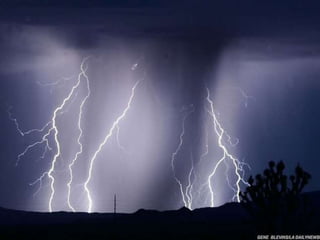
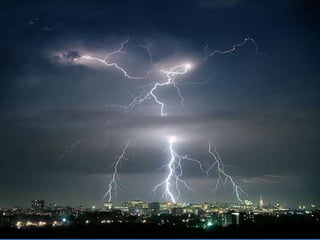
• A lightning discharge between cloud and ground
initiated by a downward-moving, negatively-
charged stepped leader. Abbreviated "-CG".
Negative CGs are more common than positive
CGs. Most of the lightning you can see striking the
ground in a storm is of the negative cloud-to-
ground variety. Negative cloud-to-ground lightning
strikes can be identified visually and in
photographs by their distinctive downward
branching .
Contd…
• Negative CGs commonly consists of
multiple "return strokes", which are
additional pulses of current that illuminate
the channel again and again. The first return
stroke of a negative CG is usually the only
branched one - the branches usually do not
illuminate again in subsequent return strokes.
CLOUD-TO-GROUND LIGHTNING
- POSITIVE
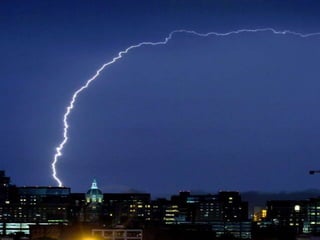
• A lightning discharge between cloud and ground
initiated by a downward-moving, positively-
charged leader. Abbreviated "+CG". Positive CGs
are less common than negative CGs, and usually
are associated with super cell thunderstorms and
trailing stratiform precipitation regions behind
squall lines. Positive cloud-to-ground lightning
strikes can be identified visually and in
photographs by their distinctive lack of branching.
Contd…
• Positive CGs occasionally will have branching at
higher altitudes, but rarely near the ground. Positive
CGs usually consists of only one return stroke,
which is typically very bright and intense relative to
other lightning activity in a storm. Thunder from a
positive CG is typically very loud, and many times
sounds like a series of deep, low-frequency sonic
sounds.
VARIOUS FORMS OF LIGHTING
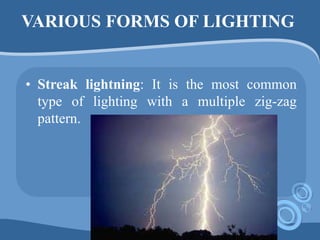
• Streak lightning: It is the most common
type of lighting with a multiple zig-zag
pattern.
FORKED LIGHTING
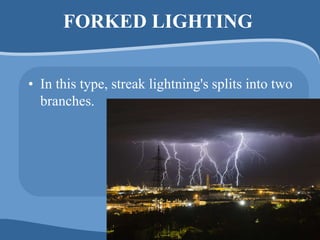
• In this type, streak lightning's splits into two
branches.
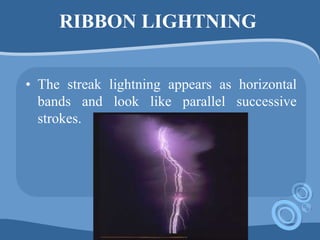
RIBBON LIGHTNING
• The streak lightning appears as horizontal
bands and look like parallel successive
strokes.
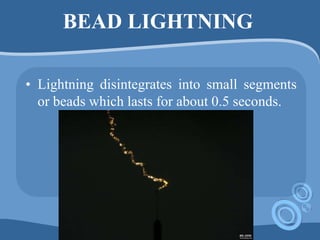
BEAD LIGHTNING
• Lightning disintegrates into small segments
or beads which lasts for about 0.5 seconds.
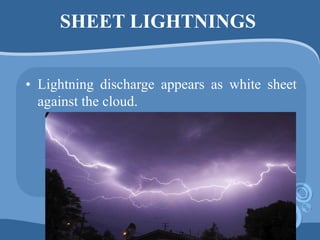
SHEET LIGHTNINGS
• Lightning discharge appears as white sheet
against the cloud.
HEAT LIGHTNINGS
• Heat lightning, sometimes known as silent
lightning, is a misnomer used for the faint flashes
of lightning on the horizon or other clouds from
distant thunderstorms that do not appear to have
accompanying sounds of thunder.
BALL LIGHTNINGS
• They look like balls of luminous, white or
colored spheres of the size of fruit, varying
in diameter from 4-8 inches.

Exogenous disasters lightning

  • 1.
  • 2.
    LIGHTNING • Lightning isa sudden electrostatic discharge that occurs typically during a thunderstorm. This discharge occurs between electrically charged regions of a cloud (called intra-cloud lightning or IC), between two clouds (CC lightning), or between a cloud and the ground (CG lightning).
  • 3.
    LIGHTNING • The chargedregions in the atmosphere temporarily equalize themselves through this discharge referred to as a flash. A lightning flash can also be a strike if it involves an object on the ground. Lightning creates light in the form of black body radiation from the very hot plasma created by the electron flow, and sound in the form of thunder. Lightning may be seen and not heard when it occurs at a distance too great for the sound to carry as far as the light from the strike or flash.
  • 4.
    TYPES OF LIGHTNING •Based on the "ends" of a flash channel. • Intracloud (IC), which occurs within a single thundercloud unit • Cloud to cloud (CC) , which starts and ends between two different "functional" thundercloud units • Cloud to ground (CG), that primarily originates in the thundercloud and terminates on an Earth surface, but may also occur in the reverse direction, that is ground to cloud
  • 5.
    • There arevariations of each type, such as "positive" versus "negative" CG flashes, that have different physical characteristics common to each which can be measured. Different common names used to describe a particular lightning event may be attributed to the same or different events.
  • 6.
    INTRA CLOUD • Lightningdischarges may occur between areas of cloud without contacting the ground. When it occurs between areas of differing electric potential within a single cloud it is known as intra-cloud lightning. Intra-cloud lightning is the most frequently occurring type.
  • 7.
    INTRA CLOUD • Intra-cloudlightning most commonly occurs between the upper portion and lower reaches of a given thunderstorm. This lightning can sometimes be observed at great distances at night as so-called "sheet lightning". In such instances, the observer may see only a flash of light without hearing any thunder.
  • 9.
    CLOUD TO CLOUD •Lightning discharges may occur between areas of cloud without contacting the ground. When it occurs between two separate clouds it is known as inter-cloud lightning.
  • 11.
    CLOUD-TO-GROUND LIGHTNING – NEGATIVE •A lightning discharge between cloud and ground initiated by a downward-moving, negatively- charged stepped leader. Abbreviated "-CG". Negative CGs are more common than positive CGs. Most of the lightning you can see striking the ground in a storm is of the negative cloud-to- ground variety. Negative cloud-to-ground lightning strikes can be identified visually and in photographs by their distinctive downward branching .
  • 12.
    Contd… • Negative CGscommonly consists of multiple "return strokes", which are additional pulses of current that illuminate the channel again and again. The first return stroke of a negative CG is usually the only branched one - the branches usually do not illuminate again in subsequent return strokes.
  • 15.
    CLOUD-TO-GROUND LIGHTNING - POSITIVE •A lightning discharge between cloud and ground initiated by a downward-moving, positively- charged leader. Abbreviated "+CG". Positive CGs are less common than negative CGs, and usually are associated with super cell thunderstorms and trailing stratiform precipitation regions behind squall lines. Positive cloud-to-ground lightning strikes can be identified visually and in photographs by their distinctive lack of branching.
  • 16.
    Contd… • Positive CGsoccasionally will have branching at higher altitudes, but rarely near the ground. Positive CGs usually consists of only one return stroke, which is typically very bright and intense relative to other lightning activity in a storm. Thunder from a positive CG is typically very loud, and many times sounds like a series of deep, low-frequency sonic sounds.
  • 18.
    VARIOUS FORMS OFLIGHTING • Streak lightning: It is the most common type of lighting with a multiple zig-zag pattern.
  • 19.
    FORKED LIGHTING • Inthis type, streak lightning's splits into two branches.
  • 20.
    RIBBON LIGHTNING • Thestreak lightning appears as horizontal bands and look like parallel successive strokes.
  • 21.
    BEAD LIGHTNING • Lightningdisintegrates into small segments or beads which lasts for about 0.5 seconds.
  • 22.
    SHEET LIGHTNINGS • Lightningdischarge appears as white sheet against the cloud.
  • 23.
    HEAT LIGHTNINGS • Heatlightning, sometimes known as silent lightning, is a misnomer used for the faint flashes of lightning on the horizon or other clouds from distant thunderstorms that do not appear to have accompanying sounds of thunder.
  • 24.
    BALL LIGHTNINGS • Theylook like balls of luminous, white or colored spheres of the size of fruit, varying in diameter from 4-8 inches.