Abhisek Pal
Department of Electrical Engineering
Indian School of Mines
Dhanbad-826004, India
E-mail: abhisekpal.ee@gmail.com
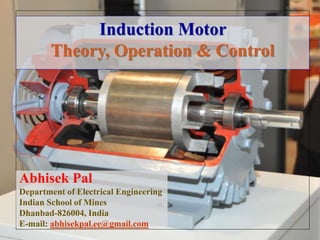
Induction Motor
Theory, Operation & Control
Presentation Outline
 Introduction
 Working Principles
 Characteristics
 Methods of starting
 Methods of speed control
 Basic principles of Thyristor controlled variable speed
drives
 Industrial application & control of electrical motors – A
brief review
11-04-2016 A. Pal, EE Dept., ISM Dhanbad 2
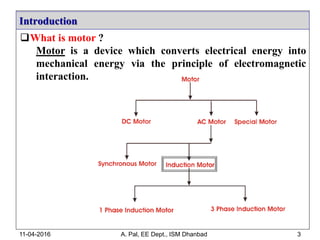
What is motor ?
Motor is a device which converts electrical energy into
mechanical energy via the principle of electromagnetic
interaction.
Introduction
11-04-2016 A. Pal, EE Dept., ISM Dhanbad 3
Introduction (contd…)
11-04-2016 A. Pal, EE Dept., ISM Dhanbad 4
 Induction Motor (IM)
Induction motor is also called asynchronous motor as it runs at a speed
other than the synchronous speed.
 Why Induction motor (IM) is so popular :
rugged,
compact,
easier to maintain ,
cost-effective,
 highly efficient and reliable.
 Applications of Induction Motor (80% of the Motors)
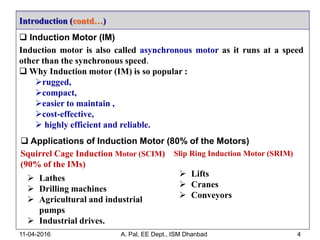
Squirrel Cage Induction Motor (SCIM)
(90% of the IMs)
 Lathes
 Drilling machines
 Agricultural and industrial
pumps
 Industrial drives.
Slip Ring Induction Motor (SRIM)
 Lifts
 Cranes
 Conveyors
Introduction (contd…)
11-04-2016 A. Pal, EE Dept., ISM Dhanbad 5
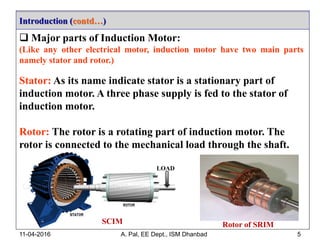
 Major parts of Induction Motor:
(Like any other electrical motor, induction motor have two main parts
namely stator and rotor.)
Stator: As its name indicate stator is a stationary part of
induction motor. A three phase supply is fed to the stator of
induction motor.
Rotor: The rotor is a rotating part of induction motor. The
rotor is connected to the mechanical load through the shaft.
LOAD
Rotor of SRIMSCIM
Introduction (contd…)
11-04-2016 A. Pal, EE Dept., ISM Dhanbad 6
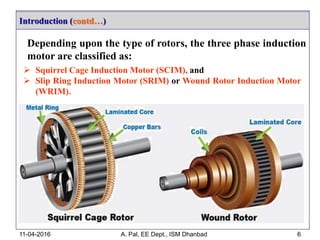
Depending upon the type of rotors, the three phase induction
motor are classified as:
 Squirrel Cage Induction Motor (SCIM), and
 Slip Ring Induction Motor (SRIM) or Wound Rotor Induction Motor
(WRIM).
Introduction (contd…)
11-04-2016 A. Pal, EE Dept., ISM Dhanbad 7
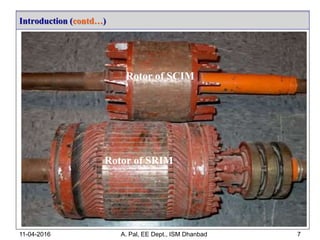
Rotor of SCIM
Rotor of SRIM
Working of Induction Motor
11-04-2016 A. Pal, EE Dept., ISM Dhanbad 8
a Fc
-93 10 113 216
-1.5
-1
-0.5
0
0.5
1
1.5
a’
c’
b’
b c
a
a’
c’ b’
b
c
a
a’
c’
b’
b c
a
a’
c’
b’
b c
Fb
Fb
FcFb
Fc Fc Fb
Space angle () in degrees
Fc
Fb
t = t0= t4
t = t1
t = t2 t = t3
t = t0= t4
RMF (Rotating Magnetic Field) [video link]
Working of Induction Motor
11-04-2016 A. Pal, EE Dept., ISM Dhanbad 9
RMF (Rotating Magnetic Field) [video link]
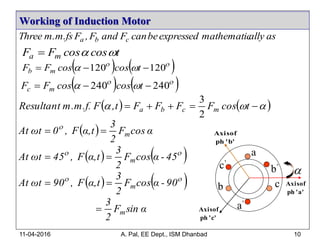
Working of Induction Motor
11-04-2016 A. Pal, EE Dept., ISM Dhanbad 10
tcoscosFF ma 
   
 120120  tcoscosFF mb
   
 240240  tcoscosFF mc
     tcosFFFFt,Fm.m.f.Resultant mcba
2
3
a’
c’
b’
b c
a

 
   
   
αsinF
2
3
90-αcosF
2
3
tα,F,90ωtAt
45-αcosF
2
3
tα,F,45ωtAt
αcosF
2
3
tα,F,0ωtAt
m
m
m
m







a''ph
ofAxis
b''ph
ofAxis
c''ph
ofAxis
asallymathematicexpressedbecanFandF,Fm.fsm.Three cba
Working of Induction Motor
11-04-2016 A. Pal, EE Dept., ISM Dhanbad 11
 
 



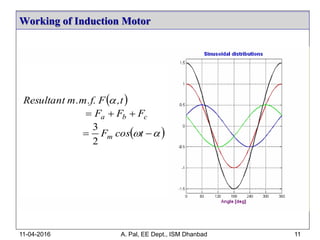
tcosF
FFF
t,Fm.m.f.Resultant
m
cba
2
3
Working of Induction Motor
11-04-2016 A. Pal, EE Dept., ISM Dhanbad 12
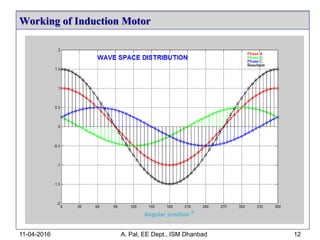
Working of Induction Motor
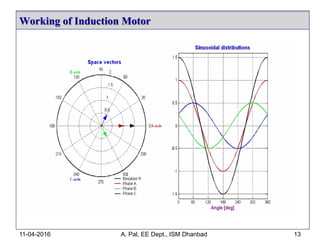
11-04-2016 A. Pal, EE Dept., ISM Dhanbad 13
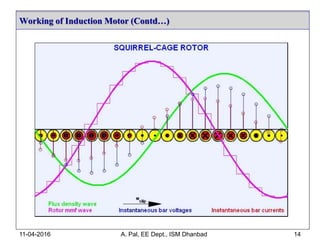
Working of Induction Motor (Contd…)
11-04-2016 A. Pal, EE Dept., ISM Dhanbad 14
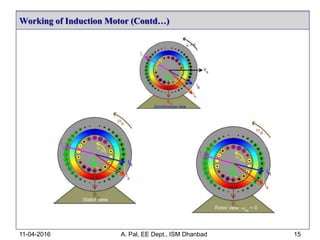
Working of Induction Motor (Contd…)
11-04-2016 A. Pal, EE Dept., ISM Dhanbad 15
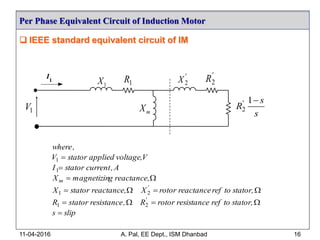
 IEEE standard equivalent circuit of IM
Per Phase Equivalent Circuit of Induction Motor
11-04-2016 A. Pal, EE Dept., ISM Dhanbad 16
I1
1R1X
mX
'
X2
'
R2
s
s
R
1'
21V
slips
stator,torefresistancerotorR,resistancetatorsR
stator,torefreactancerotorXreactance,statorX
reactance,gmagnetizinX
A,currentstatorI
V,voltageappliedstatorV
,where
'
'
m






21
21
1
1
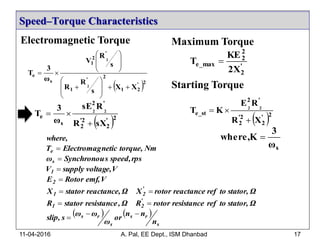
Electromagnetic Torque
Speed–Torque Characteristics
11-04-2016 A. Pal, EE Dept., ISM Dhanbad 17
 2'
2
'2
2
'2
s
e
sXR
RsE
ω
3
T 22


 2'
21
2
'
1
'
2
1
s
e
XX
s
R
R
s
R
V
ω
3
T
2
2



















   
s
rs
s
rs
'
21
'
21
2
1
s
e
n
nn
or
ω
ωω
sslip,
Ωstator,torefresistancerotorRΩ,resistancestatorR
Ωstator,torefreactancerotorXΩreactance,statorX
Vemf,RotorE
Vvoltage,supplyV
rpsspeed,sSynchronouω
Nmtorque,neticElectromagT
where,








'
2
2
2
e_max
2X
KE
T 
 2'
2
'2
2
'2
e_st
XR
RE
KT 22


sω
3
Kwhere, 
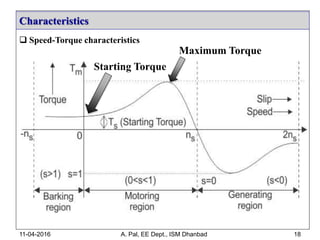
Maximum Torque
Starting Torque
 Speed-Torque characteristics
Characteristics
11-04-2016 A. Pal, EE Dept., ISM Dhanbad 18
Starting Torque
Maximum Torque
Power Flow Diagram
11-04-2016 A. Pal, EE Dept., ISM Dhanbad 19
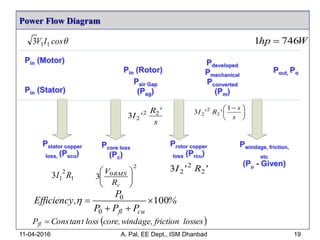
Pin (Motor)
Pin (Stator)
Pcore loss
(Pc)
Pair Gap
(Pag)
Pdeveloped
Pmechanical
Pconverted
(Pm)
Pout, Po
Pstator copper
loss, (Pscu)
Protor copper
loss (Prcu)
Pwindage, friction,
etc
(P - Given)
cosIV 113
s
'R
'I 22
23
2
0
3 







c
RMS
R
V 'R'I 2
2
23





 
s
s
'R'I
1
3 2
2
2
Whp 7461 
1
2
13 RI
Pin (Rotor)
%
PPP
P
,Efficiency
cufl
100
0
0



 lossesfrictionwindage,core,lossttanConsPfl 
Starting Methods of Induction Motor
11-04-2016 A. Pal, EE Dept., ISM Dhanbad 20
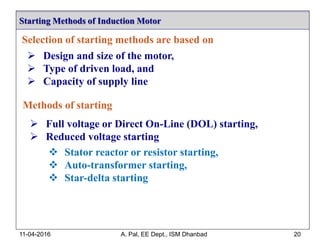
Selection of starting methods are based on
 Design and size of the motor,
 Type of driven load, and
 Capacity of supply line
Methods of starting
 Full voltage or Direct On-Line (DOL) starting,
 Reduced voltage starting
 Stator reactor or resistor starting,
 Auto-transformer starting,
 Star-delta starting
Starting Methods of Induction Motor
11-04-2016 A. Pal, EE Dept., ISM Dhanbad 21
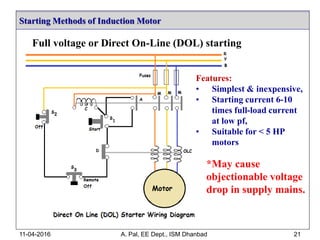
Full voltage or Direct On-Line (DOL) starting
Features:
• Simplest & inexpensive,
• Starting current 6-10
times full-load current
at low pf,
• Suitable for < 5 HP
motors
*May cause
objectionable voltage
drop in supply mains.
Starting Methods of Induction Motor
11-04-2016 A. Pal, EE Dept., ISM Dhanbad 22
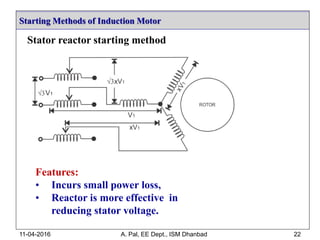
Stator reactor starting method
Features:
• Incurs small power loss,
• Reactor is more effective in
reducing stator voltage.
Starting Methods of Induction Motor
11-04-2016 A. Pal, EE Dept., ISM Dhanbad 23
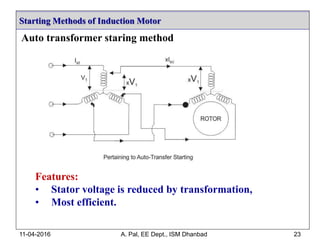
Auto transformer staring method
Features:
• Stator voltage is reduced by transformation,
• Most efficient.
Starting Methods of Induction Motor
11-04-2016 A. Pal, EE Dept., ISM Dhanbad 24
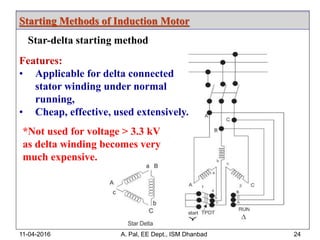
Star-delta starting method
Features:
• Applicable for delta connected
stator winding under normal
running,
• Cheap, effective, used extensively.
*Not used for voltage > 3.3 kV
as delta winding becomes very
much expensive.
Methods of Speed Control
11-04-2016 A. Pal, EE Dept., ISM Dhanbad 25
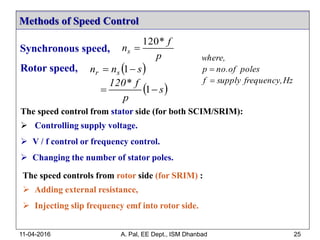
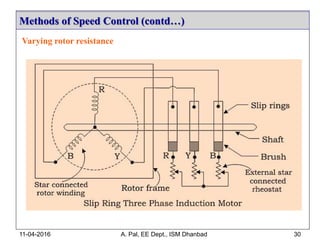
The speed controls from rotor side (for SRIM) :
 Adding external resistance,
 Injecting slip frequency emf into rotor side.
p
f*
ns
120

 
 s
p
f*120
snn sr


1
1
Hzfrequency,supplyf
polesofno.p
where,


Synchronous speed,
Rotor speed,
The speed control from stator side (for both SCIM/SRIM):
 Controlling supply voltage.
 V / f control or frequency control.
 Changing the number of stator poles.
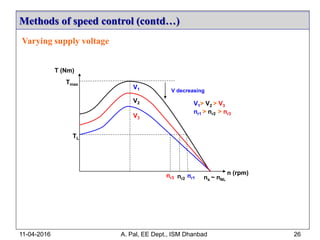
Varying supply voltage
Methods of speed control (contd…)
11-04-2016 A. Pal, EE Dept., ISM Dhanbad 26
T (Nm)
ns ~ nNL
TL
nr1nr2
nr3
n (rpm)
nr1 > nr2 > nr3
V1
V2
V3
V1> V2 > V3
V decreasing
Tmax
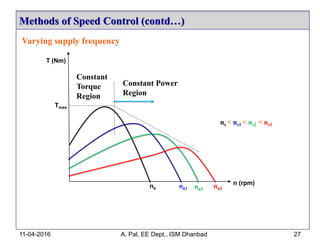
Varying supply frequency
Methods of Speed Control (contd…)
11-04-2016 A. Pal, EE Dept., ISM Dhanbad 27
ns ns1 ns3
ns < ns1 < ns2 < ns3
Tmax
T (Nm)
n (rpm)
ns3
Constant Power
Region
Constant
Torque
Region
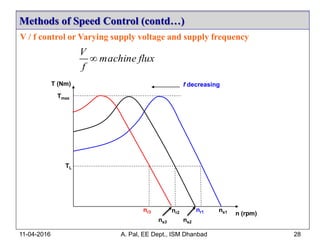
V / f control or Varying supply voltage and supply frequency
Methods of Speed Control (contd…)
11-04-2016 A. Pal, EE Dept., ISM Dhanbad 28
ns1nr1nr2
nr3
n (rpm)
f decreasing
ns2ns3
Tmax
TL
T (Nm)
fluxmachine
f
V

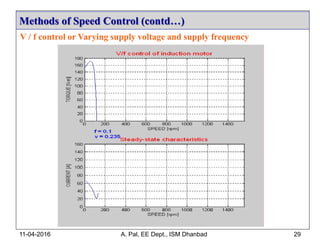
V / f control or Varying supply voltage and supply frequency
Methods of Speed Control (contd…)
11-04-2016 A. Pal, EE Dept., ISM Dhanbad 29
Varying rotor resistance
Methods of Speed Control (contd…)
11-04-2016 A. Pal, EE Dept., ISM Dhanbad 30
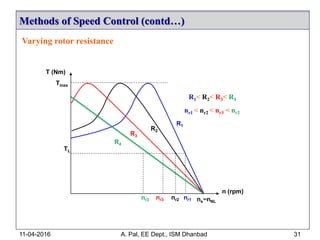
Varying rotor resistance
Methods of Speed Control (contd…)
11-04-2016 A. Pal, EE Dept., ISM Dhanbad 31
ns~nNL
TL
nr1nr2nr3
nr1 < nr2 < nr3 < nr2
R1
R2
R3
R1< R2< R3< R4
Tmax
T (Nm)
n (rpm)
nr3
R4
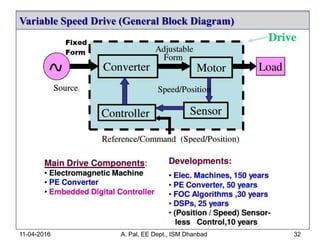
Variable Speed Drive (General Block Diagram)
11-04-2016 A. Pal, EE Dept., ISM Dhanbad 32
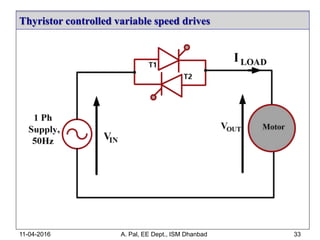
Thyristor controlled variable speed drives
11-04-2016 A. Pal, EE Dept., ISM Dhanbad 33
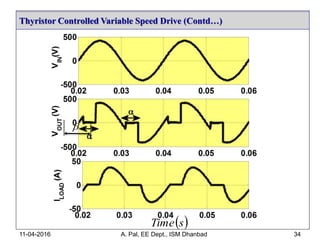
Thyristor Controlled Variable Speed Drive (Contd…)
11-04-2016 A. Pal, EE Dept., ISM Dhanbad 34
 sTime

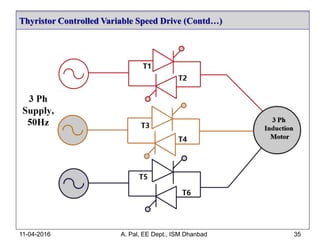
Thyristor Controlled Variable Speed Drive (Contd…)
11-04-2016 A. Pal, EE Dept., ISM Dhanbad 35
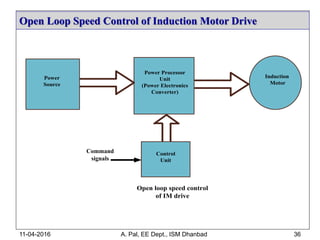
Open Loop Speed Control of Induction Motor Drive
11-04-2016 A. Pal, EE Dept., ISM Dhanbad 36
Induction
Motor
Power Processor
Unit
(Power Electronics
Converter)
Power
Source
Control
Unit
Open loop speed control
of IM drive
Command
signals
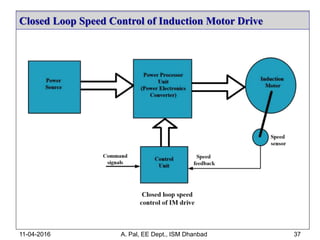
Closed Loop Speed Control of Induction Motor Drive
11-04-2016 A. Pal, EE Dept., ISM Dhanbad 37
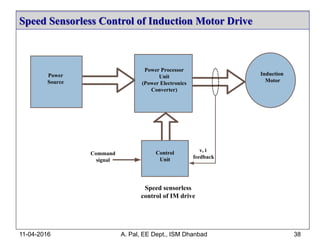
Speed Sensorless Control of Induction Motor Drive
11-04-2016 A. Pal, EE Dept., ISM Dhanbad 38
Induction
Motor
Power Processor
Unit
(Power Electronics
Converter)
Power
Source
Control
Unit
v, i
feedback
Speed sensorless
control of IM drive
Command
signal
Reference
[1] M. G. Say, Alternating current machines, Pitman, 4th Ed., 1976.
[2] D. P. Kothari and I. J. Nagrath, Electric machines, Tata McGraw Hill, 2010.
[3] P. S. Bimbhra, Electrical machinery, Kaanna Publishers, 2010.
[4] B. K. Bose, Modern power electronics and ac drives, Prentice Hall, 2002.
[5] Electrical4u.com, ‘Electrical Engineering and Technology’, 2016. [Online].
Available: http://www.electrical4u.com/working-principle-of-three-phase-
induction-motor. [Accessed: 15- March- 2016].
11-04-2016 A. Pal, EE Dept., ISM Dhanbad 39
Gratitude for your attention
Thank you
11-04-2016 A. Pal, EE Dept., ISM Dhanbad 40
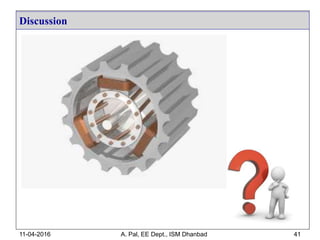
Discussion
11-04-2016 A. Pal, EE Dept., ISM Dhanbad 41
~ END ~
11-04-2016 A. Pal, EE Dept., ISM Dhanbad 42
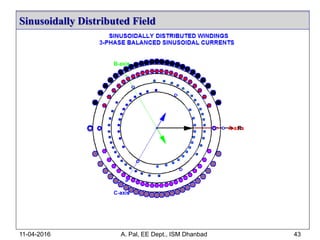
Sinusoidally Distributed Field
11-04-2016 A. Pal, EE Dept., ISM Dhanbad 43
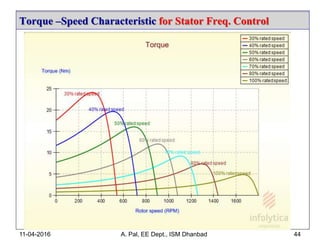
Torque –Speed Characteristic for Stator Freq. Control
11-04-2016 A. Pal, EE Dept., ISM Dhanbad 44
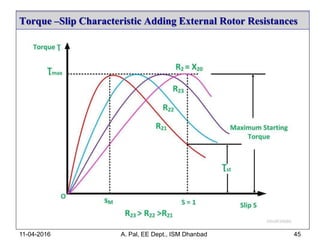
Torque –Slip Characteristic Adding External Rotor Resistances
11-04-2016 A. Pal, EE Dept., ISM Dhanbad 45
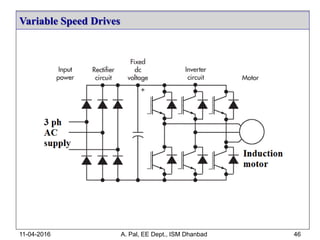
Variable Speed Drives
11-04-2016 A. Pal, EE Dept., ISM Dhanbad 46
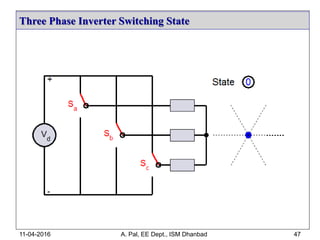
Three Phase Inverter Switching State
11-04-2016 A. Pal, EE Dept., ISM Dhanbad 47
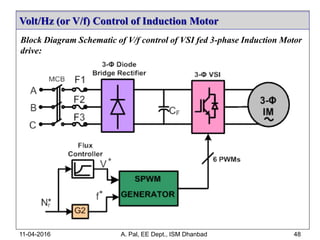
Volt/Hz (or V/f) Control of Induction Motor
11-04-2016 A. Pal, EE Dept., ISM Dhanbad 48
Block Diagram Schematic of V/f control of VSI fed 3-phase Induction Motor
drive:
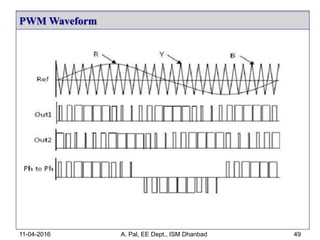
PWM Waveform
11-04-2016 A. Pal, EE Dept., ISM Dhanbad 49
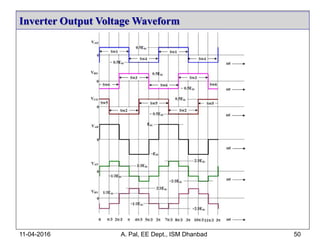
Inverter Output Voltage Waveform
11-04-2016 A. Pal, EE Dept., ISM Dhanbad 50
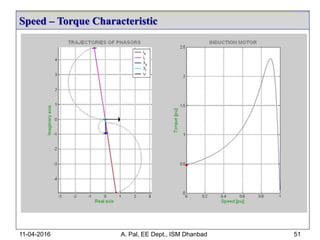
Speed – Torque Characteristic
11-04-2016 A. Pal, EE Dept., ISM Dhanbad 51
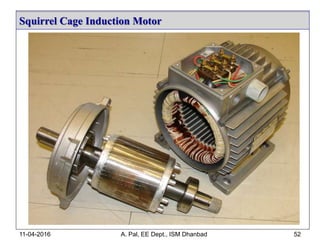
Squirrel Cage Induction Motor
11-04-2016 A. Pal, EE Dept., ISM Dhanbad 52
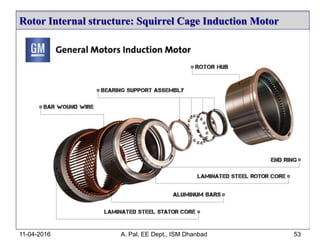
Rotor Internal structure: Squirrel Cage Induction Motor
11-04-2016 A. Pal, EE Dept., ISM Dhanbad 53
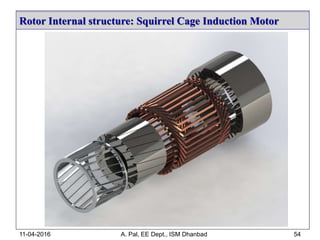
Rotor Internal structure: Squirrel Cage Induction Motor
11-04-2016 A. Pal, EE Dept., ISM Dhanbad 54
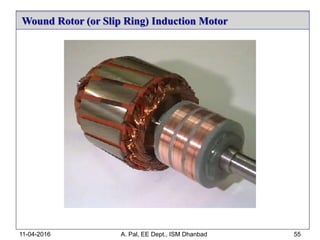
Wound Rotor (or Slip Ring) Induction Motor
11-04-2016 A. Pal, EE Dept., ISM Dhanbad 55
Wound Rotor Induction Motor
11-04-2016 A. Pal, EE Dept., ISM Dhanbad 56
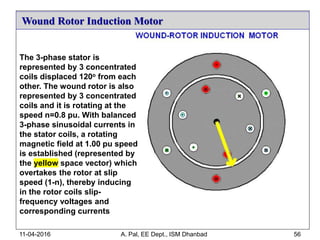
The 3-phase stator is
represented by 3 concentrated
coils displaced 120o from each
other. The wound rotor is also
represented by 3 concentrated
coils and it is rotating at the
speed n=0.8 pu. With balanced
3-phase sinusoidal currents in
the stator coils, a rotating
magnetic field at 1.00 pu speed
is established (represented by
the yellow space vector) which
overtakes the rotor at slip
speed (1-n), thereby inducing
in the rotor coils slip-
frequency voltages and
corresponding currents
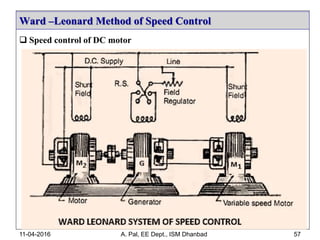
 Speed control of DC motor
Ward –Leonard Method of Speed Control
11-04-2016 A. Pal, EE Dept., ISM Dhanbad 57
 Advantages :
 It is a very smooth speed control system over a very wide range (from zero to
normal speed of the motor).
 The speed can be controlled in both the direction of rotation of the motor
easily.
 The motor can run with a uniform acceleration.
 Speed regulation of DC motor in this ward Leonard system is very good.
 Disadvantages :
˟ The system is very costly because two extra machines (motor-generator set)
are required.
˟ Overall efficiency of the system is not sufficient especially it is lightly loaded.
 Applications:
This Ward Leonard method of speed control system is used where a very wide
and very sensitive speed control is of a DC motor in both the direction of
rotation is required. This speed control system is mainly used in colliery
winders, cranes, electric excavators, mine hoists, elevators, steel rolling mills
and paper machines etc.
Ward –Leonard Method (contd…)
11-04-2016 A. Pal, EE Dept., ISM Dhanbad 58
~ END ~
11-04-2016 A. Pal, EE Dept., ISM Dhanbad 59

Induction Motor

  • 1.
    Abhisek Pal Department ofElectrical Engineering Indian School of Mines Dhanbad-826004, India E-mail: abhisekpal.ee@gmail.com Induction Motor Theory, Operation & Control
  • 2.
    Presentation Outline  Introduction Working Principles  Characteristics  Methods of starting  Methods of speed control  Basic principles of Thyristor controlled variable speed drives  Industrial application & control of electrical motors – A brief review 11-04-2016 A. Pal, EE Dept., ISM Dhanbad 2
  • 3.
    What is motor? Motor is a device which converts electrical energy into mechanical energy via the principle of electromagnetic interaction. Introduction 11-04-2016 A. Pal, EE Dept., ISM Dhanbad 3
  • 4.
    Introduction (contd…) 11-04-2016 A.Pal, EE Dept., ISM Dhanbad 4  Induction Motor (IM) Induction motor is also called asynchronous motor as it runs at a speed other than the synchronous speed.  Why Induction motor (IM) is so popular : rugged, compact, easier to maintain , cost-effective,  highly efficient and reliable.  Applications of Induction Motor (80% of the Motors) Squirrel Cage Induction Motor (SCIM) (90% of the IMs)  Lathes  Drilling machines  Agricultural and industrial pumps  Industrial drives. Slip Ring Induction Motor (SRIM)  Lifts  Cranes  Conveyors
  • 5.
    Introduction (contd…) 11-04-2016 A.Pal, EE Dept., ISM Dhanbad 5  Major parts of Induction Motor: (Like any other electrical motor, induction motor have two main parts namely stator and rotor.) Stator: As its name indicate stator is a stationary part of induction motor. A three phase supply is fed to the stator of induction motor. Rotor: The rotor is a rotating part of induction motor. The rotor is connected to the mechanical load through the shaft. LOAD Rotor of SRIMSCIM
  • 6.
    Introduction (contd…) 11-04-2016 A.Pal, EE Dept., ISM Dhanbad 6 Depending upon the type of rotors, the three phase induction motor are classified as:  Squirrel Cage Induction Motor (SCIM), and  Slip Ring Induction Motor (SRIM) or Wound Rotor Induction Motor (WRIM).
  • 7.
    Introduction (contd…) 11-04-2016 A.Pal, EE Dept., ISM Dhanbad 7 Rotor of SCIM Rotor of SRIM
  • 8.
    Working of InductionMotor 11-04-2016 A. Pal, EE Dept., ISM Dhanbad 8 a Fc -93 10 113 216 -1.5 -1 -0.5 0 0.5 1 1.5 a’ c’ b’ b c a a’ c’ b’ b c a a’ c’ b’ b c a a’ c’ b’ b c Fb Fb FcFb Fc Fc Fb Space angle () in degrees Fc Fb t = t0= t4 t = t1 t = t2 t = t3 t = t0= t4 RMF (Rotating Magnetic Field) [video link]
  • 9.
    Working of InductionMotor 11-04-2016 A. Pal, EE Dept., ISM Dhanbad 9 RMF (Rotating Magnetic Field) [video link]
  • 10.
    Working of InductionMotor 11-04-2016 A. Pal, EE Dept., ISM Dhanbad 10 tcoscosFF ma       120120  tcoscosFF mb      240240  tcoscosFF mc      tcosFFFFt,Fm.m.f.Resultant mcba 2 3 a’ c’ b’ b c a            αsinF 2 3 90-αcosF 2 3 tα,F,90ωtAt 45-αcosF 2 3 tα,F,45ωtAt αcosF 2 3 tα,F,0ωtAt m m m m        a''ph ofAxis b''ph ofAxis c''ph ofAxis asallymathematicexpressedbecanFandF,Fm.fsm.Three cba
  • 11.
    Working of InductionMotor 11-04-2016 A. Pal, EE Dept., ISM Dhanbad 11        tcosF FFF t,Fm.m.f.Resultant m cba 2 3
  • 12.
    Working of InductionMotor 11-04-2016 A. Pal, EE Dept., ISM Dhanbad 12
  • 13.
    Working of InductionMotor 11-04-2016 A. Pal, EE Dept., ISM Dhanbad 13
  • 14.
    Working of InductionMotor (Contd…) 11-04-2016 A. Pal, EE Dept., ISM Dhanbad 14
  • 15.
    Working of InductionMotor (Contd…) 11-04-2016 A. Pal, EE Dept., ISM Dhanbad 15
  • 16.
     IEEE standardequivalent circuit of IM Per Phase Equivalent Circuit of Induction Motor 11-04-2016 A. Pal, EE Dept., ISM Dhanbad 16 I1 1R1X mX ' X2 ' R2 s s R 1' 21V slips stator,torefresistancerotorR,resistancetatorsR stator,torefreactancerotorXreactance,statorX reactance,gmagnetizinX A,currentstatorI V,voltageappliedstatorV ,where ' ' m       21 21 1 1
  • 17.
    Electromagnetic Torque Speed–Torque Characteristics 11-04-2016A. Pal, EE Dept., ISM Dhanbad 17  2' 2 '2 2 '2 s e sXR RsE ω 3 T 22    2' 21 2 ' 1 ' 2 1 s e XX s R R s R V ω 3 T 2 2                        s rs s rs ' 21 ' 21 2 1 s e n nn or ω ωω sslip, Ωstator,torefresistancerotorRΩ,resistancestatorR Ωstator,torefreactancerotorXΩreactance,statorX Vemf,RotorE Vvoltage,supplyV rpsspeed,sSynchronouω Nmtorque,neticElectromagT where,         ' 2 2 2 e_max 2X KE T   2' 2 '2 2 '2 e_st XR RE KT 22   sω 3 Kwhere,  Maximum Torque Starting Torque
  • 18.
     Speed-Torque characteristics Characteristics 11-04-2016A. Pal, EE Dept., ISM Dhanbad 18 Starting Torque Maximum Torque
  • 19.
    Power Flow Diagram 11-04-2016A. Pal, EE Dept., ISM Dhanbad 19 Pin (Motor) Pin (Stator) Pcore loss (Pc) Pair Gap (Pag) Pdeveloped Pmechanical Pconverted (Pm) Pout, Po Pstator copper loss, (Pscu) Protor copper loss (Prcu) Pwindage, friction, etc (P - Given) cosIV 113 s 'R 'I 22 23 2 0 3         c RMS R V 'R'I 2 2 23        s s 'R'I 1 3 2 2 2 Whp 7461  1 2 13 RI Pin (Rotor) % PPP P ,Efficiency cufl 100 0 0     lossesfrictionwindage,core,lossttanConsPfl 
  • 20.
    Starting Methods ofInduction Motor 11-04-2016 A. Pal, EE Dept., ISM Dhanbad 20 Selection of starting methods are based on  Design and size of the motor,  Type of driven load, and  Capacity of supply line Methods of starting  Full voltage or Direct On-Line (DOL) starting,  Reduced voltage starting  Stator reactor or resistor starting,  Auto-transformer starting,  Star-delta starting
  • 21.
    Starting Methods ofInduction Motor 11-04-2016 A. Pal, EE Dept., ISM Dhanbad 21 Full voltage or Direct On-Line (DOL) starting Features: • Simplest & inexpensive, • Starting current 6-10 times full-load current at low pf, • Suitable for < 5 HP motors *May cause objectionable voltage drop in supply mains.
  • 22.
    Starting Methods ofInduction Motor 11-04-2016 A. Pal, EE Dept., ISM Dhanbad 22 Stator reactor starting method Features: • Incurs small power loss, • Reactor is more effective in reducing stator voltage.
  • 23.
    Starting Methods ofInduction Motor 11-04-2016 A. Pal, EE Dept., ISM Dhanbad 23 Auto transformer staring method Features: • Stator voltage is reduced by transformation, • Most efficient.
  • 24.
    Starting Methods ofInduction Motor 11-04-2016 A. Pal, EE Dept., ISM Dhanbad 24 Star-delta starting method Features: • Applicable for delta connected stator winding under normal running, • Cheap, effective, used extensively. *Not used for voltage > 3.3 kV as delta winding becomes very much expensive.
  • 25.
    Methods of SpeedControl 11-04-2016 A. Pal, EE Dept., ISM Dhanbad 25 The speed controls from rotor side (for SRIM) :  Adding external resistance,  Injecting slip frequency emf into rotor side. p f* ns 120     s p f*120 snn sr   1 1 Hzfrequency,supplyf polesofno.p where,   Synchronous speed, Rotor speed, The speed control from stator side (for both SCIM/SRIM):  Controlling supply voltage.  V / f control or frequency control.  Changing the number of stator poles.
  • 26.
    Varying supply voltage Methodsof speed control (contd…) 11-04-2016 A. Pal, EE Dept., ISM Dhanbad 26 T (Nm) ns ~ nNL TL nr1nr2 nr3 n (rpm) nr1 > nr2 > nr3 V1 V2 V3 V1> V2 > V3 V decreasing Tmax
  • 27.
    Varying supply frequency Methodsof Speed Control (contd…) 11-04-2016 A. Pal, EE Dept., ISM Dhanbad 27 ns ns1 ns3 ns < ns1 < ns2 < ns3 Tmax T (Nm) n (rpm) ns3 Constant Power Region Constant Torque Region
  • 28.
    V / fcontrol or Varying supply voltage and supply frequency Methods of Speed Control (contd…) 11-04-2016 A. Pal, EE Dept., ISM Dhanbad 28 ns1nr1nr2 nr3 n (rpm) f decreasing ns2ns3 Tmax TL T (Nm) fluxmachine f V 
  • 29.
    V / fcontrol or Varying supply voltage and supply frequency Methods of Speed Control (contd…) 11-04-2016 A. Pal, EE Dept., ISM Dhanbad 29
  • 30.
    Varying rotor resistance Methodsof Speed Control (contd…) 11-04-2016 A. Pal, EE Dept., ISM Dhanbad 30
  • 31.
    Varying rotor resistance Methodsof Speed Control (contd…) 11-04-2016 A. Pal, EE Dept., ISM Dhanbad 31 ns~nNL TL nr1nr2nr3 nr1 < nr2 < nr3 < nr2 R1 R2 R3 R1< R2< R3< R4 Tmax T (Nm) n (rpm) nr3 R4
  • 32.
    Variable Speed Drive(General Block Diagram) 11-04-2016 A. Pal, EE Dept., ISM Dhanbad 32
  • 33.
    Thyristor controlled variablespeed drives 11-04-2016 A. Pal, EE Dept., ISM Dhanbad 33
  • 34.
    Thyristor Controlled VariableSpeed Drive (Contd…) 11-04-2016 A. Pal, EE Dept., ISM Dhanbad 34  sTime 
  • 35.
    Thyristor Controlled VariableSpeed Drive (Contd…) 11-04-2016 A. Pal, EE Dept., ISM Dhanbad 35
  • 36.
    Open Loop SpeedControl of Induction Motor Drive 11-04-2016 A. Pal, EE Dept., ISM Dhanbad 36 Induction Motor Power Processor Unit (Power Electronics Converter) Power Source Control Unit Open loop speed control of IM drive Command signals
  • 37.
    Closed Loop SpeedControl of Induction Motor Drive 11-04-2016 A. Pal, EE Dept., ISM Dhanbad 37
  • 38.
    Speed Sensorless Controlof Induction Motor Drive 11-04-2016 A. Pal, EE Dept., ISM Dhanbad 38 Induction Motor Power Processor Unit (Power Electronics Converter) Power Source Control Unit v, i feedback Speed sensorless control of IM drive Command signal
  • 39.
    Reference [1] M. G.Say, Alternating current machines, Pitman, 4th Ed., 1976. [2] D. P. Kothari and I. J. Nagrath, Electric machines, Tata McGraw Hill, 2010. [3] P. S. Bimbhra, Electrical machinery, Kaanna Publishers, 2010. [4] B. K. Bose, Modern power electronics and ac drives, Prentice Hall, 2002. [5] Electrical4u.com, ‘Electrical Engineering and Technology’, 2016. [Online]. Available: http://www.electrical4u.com/working-principle-of-three-phase- induction-motor. [Accessed: 15- March- 2016]. 11-04-2016 A. Pal, EE Dept., ISM Dhanbad 39
  • 40.
    Gratitude for yourattention Thank you 11-04-2016 A. Pal, EE Dept., ISM Dhanbad 40
  • 41.
    Discussion 11-04-2016 A. Pal,EE Dept., ISM Dhanbad 41
  • 42.
    ~ END ~ 11-04-2016A. Pal, EE Dept., ISM Dhanbad 42
  • 43.
    Sinusoidally Distributed Field 11-04-2016A. Pal, EE Dept., ISM Dhanbad 43
  • 44.
    Torque –Speed Characteristicfor Stator Freq. Control 11-04-2016 A. Pal, EE Dept., ISM Dhanbad 44
  • 45.
    Torque –Slip CharacteristicAdding External Rotor Resistances 11-04-2016 A. Pal, EE Dept., ISM Dhanbad 45
  • 46.
    Variable Speed Drives 11-04-2016A. Pal, EE Dept., ISM Dhanbad 46
  • 47.
    Three Phase InverterSwitching State 11-04-2016 A. Pal, EE Dept., ISM Dhanbad 47
  • 48.
    Volt/Hz (or V/f)Control of Induction Motor 11-04-2016 A. Pal, EE Dept., ISM Dhanbad 48 Block Diagram Schematic of V/f control of VSI fed 3-phase Induction Motor drive:
  • 49.
    PWM Waveform 11-04-2016 A.Pal, EE Dept., ISM Dhanbad 49
  • 50.
    Inverter Output VoltageWaveform 11-04-2016 A. Pal, EE Dept., ISM Dhanbad 50
  • 51.
    Speed – TorqueCharacteristic 11-04-2016 A. Pal, EE Dept., ISM Dhanbad 51
  • 52.
    Squirrel Cage InductionMotor 11-04-2016 A. Pal, EE Dept., ISM Dhanbad 52
  • 53.
    Rotor Internal structure:Squirrel Cage Induction Motor 11-04-2016 A. Pal, EE Dept., ISM Dhanbad 53
  • 54.
    Rotor Internal structure:Squirrel Cage Induction Motor 11-04-2016 A. Pal, EE Dept., ISM Dhanbad 54
  • 55.
    Wound Rotor (orSlip Ring) Induction Motor 11-04-2016 A. Pal, EE Dept., ISM Dhanbad 55
  • 56.
    Wound Rotor InductionMotor 11-04-2016 A. Pal, EE Dept., ISM Dhanbad 56 The 3-phase stator is represented by 3 concentrated coils displaced 120o from each other. The wound rotor is also represented by 3 concentrated coils and it is rotating at the speed n=0.8 pu. With balanced 3-phase sinusoidal currents in the stator coils, a rotating magnetic field at 1.00 pu speed is established (represented by the yellow space vector) which overtakes the rotor at slip speed (1-n), thereby inducing in the rotor coils slip- frequency voltages and corresponding currents
  • 57.
     Speed controlof DC motor Ward –Leonard Method of Speed Control 11-04-2016 A. Pal, EE Dept., ISM Dhanbad 57
  • 58.
     Advantages : It is a very smooth speed control system over a very wide range (from zero to normal speed of the motor).  The speed can be controlled in both the direction of rotation of the motor easily.  The motor can run with a uniform acceleration.  Speed regulation of DC motor in this ward Leonard system is very good.  Disadvantages : ˟ The system is very costly because two extra machines (motor-generator set) are required. ˟ Overall efficiency of the system is not sufficient especially it is lightly loaded.  Applications: This Ward Leonard method of speed control system is used where a very wide and very sensitive speed control is of a DC motor in both the direction of rotation is required. This speed control system is mainly used in colliery winders, cranes, electric excavators, mine hoists, elevators, steel rolling mills and paper machines etc. Ward –Leonard Method (contd…) 11-04-2016 A. Pal, EE Dept., ISM Dhanbad 58
  • 59.
    ~ END ~ 11-04-2016A. Pal, EE Dept., ISM Dhanbad 59