EGYPTIAN CIVILIZATION
3000 B.C. – 30 B.C.
 Origin
 Government
 Society
 Religion
 Language and Writing
 Mathematics
 Astronomy
 Medicine
 Technology
Origin
 One of the world’s longest civilizations in
history.
 A “river civilization” like Mesopotamian.
 Concentrated along the middle and lower
reaches of the Nile River.
 At different times, extended to the southern
Levant, the Eastern desert, the Red Sea
coastline, the Sinai Peninsula and the Western
desert.
Origin
 The importance of the Nile - Egypt is known as
the “gift of the Nile”.
 The annual flooding of the Nile – fertile Nile
valley.
 The Nile also a unifying factor in Egyptian
history.
 As a major means for transportation and
communication.
Origin
 Ancient Egyptians – a merging of north and
East African as well as Southwest Asian
peoples.
 “Punt” or “Ta Neteru” (Land of the Gods) –
Eritrea and Ethiopian Highlands.
 Originally populated by tribes led by tribal
chieftains.
Government
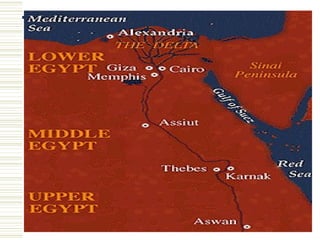
Egypt was divided into two:
 Upper Egypt (Ta Shemau)
 Lower Egypt (Ta Mehu)
 The history of ancient Egypt proper started
around 3000 BC – Egypt as a unified state.
 Centralized system of government.
 Menes, unified Upper and Lower Egypt, was
the first king.
Government
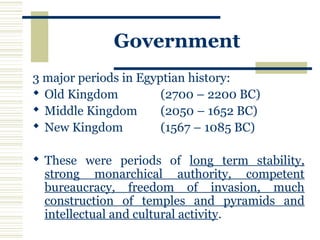
3 major periods in Egyptian history:
 Old Kingdom (2700 – 2200 BC)
 Middle Kingdom (2050 – 1652 BC)
 New Kingdom (1567 – 1085 BC)
 These were periods of long term stability,
strong monarchical authority, competent
bureaucracy, freedom of invasion, much
construction of temples and pyramids and
intellectual and cultural activity.
Government
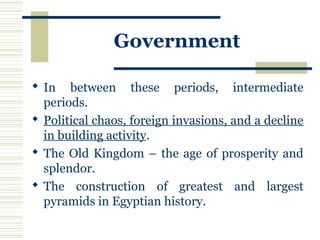
 In between these periods, intermediate
periods.
 Political chaos, foreign invasions, and a decline
in building activity.
 The Old Kingdom – the age of prosperity and
splendor.
 The construction of greatest and largest
pyramids in Egyptian history.
Government
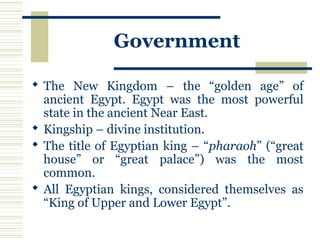
 The New Kingdom – the “golden age” of
ancient Egypt. Egypt was the most powerful
state in the ancient Near East.
 Kingship – divine institution.
 The title of Egyptian king – “pharaoh” (“great
house” or “great palace”) was the most
common.
 All Egyptian kings, considered themselves as
“King of Upper and Lower Egypt”.
Government
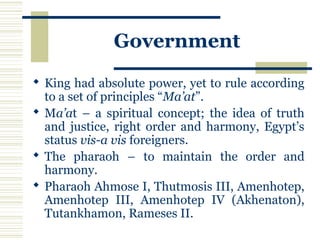
 King had absolute power, yet to rule according
to a set of principles “Ma’at”.
 Ma’at – a spiritual concept; the idea of truth
and justice, right order and harmony, Egypt’s
status vis-a vis foreigners.
 The pharaoh – to maintain the order and
harmony.
 Pharaoh Ahmose I, Thutmosis III, Amenhotep,
Amenhotep III, Amenhotep IV (Akhenaton),
Tutankhamon, Rameses II.
Government
 Centralized administration – the pharaoh ruled
with massive bureaucracy (e.g. vizier).
 Egypt was divided into nomes (provinces),
ruled by nomarch (governors).
 Collection of taxes.
 Scribes – to keep records. Craftsmen – royal
palaces / royal ceremonies.
 State-controlled workers – daily rations of food
and work.
Government
Factors that helped the unification of ancient
Egypt:
 1. Divine kingship.
 2. Writing system.
 3. The building of pyramids.
 4. River Nile.
Society
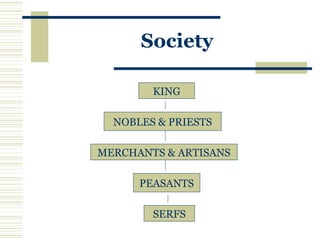
KING
NOBLES & PRIESTS
MERCHANTS & ARTISANS
PEASANTS
SERFS
Society
 Women – equal legal rights with men.
 Their property and inheritance remained in
their hands after marriage.
 Upper class women - as priestesses and a few
queen as pharaoh.
 E.g. Hatshepsut was addressed as ‘His
Majesty’.
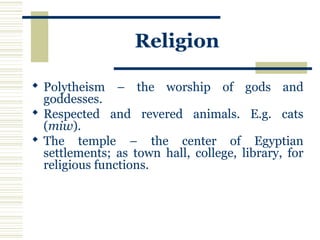
Religion
 Polytheism – the worship of gods and
goddesses.
 Respected and revered animals. E.g. cats
(miw).
 The temple – the center of Egyptian
settlements; as town hall, college, library, for
religious functions.
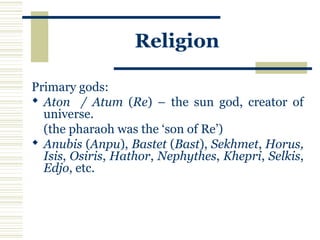
Religion
Primary gods:
 Aton / Atum (Re) – the sun god, creator of
universe.
(the pharaoh was the ‘son of Re’)
 Anubis (Anpu), Bastet (Bast), Sekhmet, Horus,
Isis, Osiris, Hathor, Nephythes, Khepri, Selkis,
Edjo, etc.
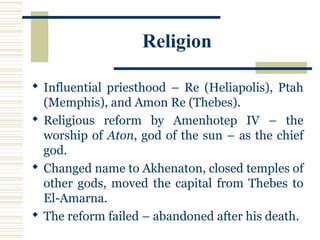
Religion
 Influential priesthood – Re (Heliapolis), Ptah
(Memphis), and Amon Re (Thebes).
 Religious reform by Amenhotep IV – the
worship of Aton, god of the sun – as the chief
god.
 Changed name to Akhenaton, closed temples of
other gods, moved the capital from Thebes to
El-Amarna.
 The reform failed – abandoned after his death.
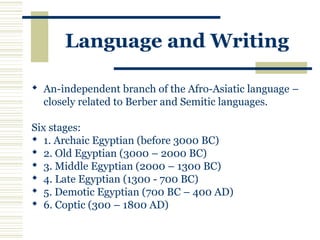
Language and Writing
 An-independent branch of the Afro-Asiatic language –
closely related to Berber and Semitic languages.
Six stages:
 1. Archaic Egyptian (before 3000 BC)
 2. Old Egyptian (3000 – 2000 BC)
 3. Middle Egyptian (2000 – 1300 BC)
 4. Late Egyptian (1300 - 700 BC)
 5. Demotic Egyptian (700 BC – 400 AD)
 6. Coptic (300 – 1800 AD)
Language and Writing
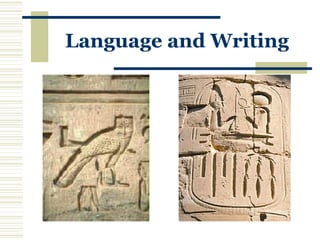
 Hieroglyphs – the world’s earliest known writing
system - partly syllabic and partly ideographic.
 Hieratic – a cursive form of hieroglyphs.
 Demotic – of the late Egyptian stage.
 “Hieroglyphs” – coined by Greeks to mean “priest-
carvings” or “sacred writing”.
 Usually found in temples and tombs – part of the
religious functions and rituals.
 Carved on stone, wooden tablets, written on papyrus.
Language and Writing
 2700 BC, Egyptians used pictograms to
represent vocal sounds (vowel & consonant).
 By 2000 BC, used 26 pictograms to represent
24 main vocal sounds – the world’s oldest
known alphabet.
 Ancient Egyptian literature, ‘Wisdom Text’ –
sound advice based on traditions and worldly
experience.
Mathematics
 Calculated numbers based on the power of 10.
 Used simple arithmetic of addition and
subtraction, multiplication and division.
 Used fractions and special signs for two-thirds,
three-quarters, four-fifths and five-sixths.
 Geometry.
 Used the skills to outline pyramid bases.
Astronomy
 Own calendar (lunar months) – based on a
year of 365 days, 12 months, 30 days each
month, and three seasons.
 The three seasons corresponded to the cycle of
the Nile river and crop harvest.
Medicine
 Had a highly advanced medical practice for
their time.
 Knowledge of anatomy and human body –
surgery, mummification and setting of bones.
 The first to use splints, bandages, compresses
and other surgical appliances.
 Had knowledge of pharmacopoeia; herbs e.g.
aloe vera, garlic, and honey.
 Also used animal dung, lizard blood, swine
teeth.
Engineering
 Pyramids, mastabas, sphinx, temples, palaces
and obelisk.
 Pyramids began during the Old Kingdom – ‘the
Great Pyramid of Cheops’ – the largest of the
three at Giza.
 As tombs for deceased kings – to aid the spirit
(ka) to ascend to heaven.
Engineering
 Mastabas – tombs surround the pyramids for
deceased courtiers and families of the kings.
 Temples e.g. Karnak and Luxor Temples.
Technology
 Invented hydraulic cement.
 Brick-making – mixture of mud, sand, straw
and water.
 Papyrus – writing material.
 AL-Fayyum Irrigation – the use of the natural
lake of the Fayyum as a reservoir to store
surpluses of water.
 Glass-making – glass beads, jars, ornaments,
etc.

C8 - Egyptian Civilization

  • 1.
  • 2.
     Origin  Government Society  Religion  Language and Writing  Mathematics  Astronomy  Medicine  Technology
  • 3.
    Origin  One ofthe world’s longest civilizations in history.  A “river civilization” like Mesopotamian.  Concentrated along the middle and lower reaches of the Nile River.  At different times, extended to the southern Levant, the Eastern desert, the Red Sea coastline, the Sinai Peninsula and the Western desert.
  • 4.
    Origin  The importanceof the Nile - Egypt is known as the “gift of the Nile”.  The annual flooding of the Nile – fertile Nile valley.  The Nile also a unifying factor in Egyptian history.  As a major means for transportation and communication.
  • 5.
    Origin  Ancient Egyptians– a merging of north and East African as well as Southwest Asian peoples.  “Punt” or “Ta Neteru” (Land of the Gods) – Eritrea and Ethiopian Highlands.  Originally populated by tribes led by tribal chieftains.
  • 6.
    Government Egypt was dividedinto two:  Upper Egypt (Ta Shemau)  Lower Egypt (Ta Mehu)  The history of ancient Egypt proper started around 3000 BC – Egypt as a unified state.  Centralized system of government.  Menes, unified Upper and Lower Egypt, was the first king.
  • 8.
    Government 3 major periodsin Egyptian history:  Old Kingdom (2700 – 2200 BC)  Middle Kingdom (2050 – 1652 BC)  New Kingdom (1567 – 1085 BC)  These were periods of long term stability, strong monarchical authority, competent bureaucracy, freedom of invasion, much construction of temples and pyramids and intellectual and cultural activity.
  • 9.
    Government  In betweenthese periods, intermediate periods.  Political chaos, foreign invasions, and a decline in building activity.  The Old Kingdom – the age of prosperity and splendor.  The construction of greatest and largest pyramids in Egyptian history.
  • 10.
    Government  The NewKingdom – the “golden age” of ancient Egypt. Egypt was the most powerful state in the ancient Near East.  Kingship – divine institution.  The title of Egyptian king – “pharaoh” (“great house” or “great palace”) was the most common.  All Egyptian kings, considered themselves as “King of Upper and Lower Egypt”.
  • 11.
    Government  King hadabsolute power, yet to rule according to a set of principles “Ma’at”.  Ma’at – a spiritual concept; the idea of truth and justice, right order and harmony, Egypt’s status vis-a vis foreigners.  The pharaoh – to maintain the order and harmony.  Pharaoh Ahmose I, Thutmosis III, Amenhotep, Amenhotep III, Amenhotep IV (Akhenaton), Tutankhamon, Rameses II.
  • 12.
    Government  Centralized administration– the pharaoh ruled with massive bureaucracy (e.g. vizier).  Egypt was divided into nomes (provinces), ruled by nomarch (governors).  Collection of taxes.  Scribes – to keep records. Craftsmen – royal palaces / royal ceremonies.  State-controlled workers – daily rations of food and work.
  • 13.
    Government Factors that helpedthe unification of ancient Egypt:  1. Divine kingship.  2. Writing system.  3. The building of pyramids.  4. River Nile.
  • 14.
    Society KING NOBLES & PRIESTS MERCHANTS& ARTISANS PEASANTS SERFS
  • 15.
    Society  Women –equal legal rights with men.  Their property and inheritance remained in their hands after marriage.  Upper class women - as priestesses and a few queen as pharaoh.  E.g. Hatshepsut was addressed as ‘His Majesty’.
  • 16.
    Religion  Polytheism –the worship of gods and goddesses.  Respected and revered animals. E.g. cats (miw).  The temple – the center of Egyptian settlements; as town hall, college, library, for religious functions.
  • 17.
    Religion Primary gods:  Aton/ Atum (Re) – the sun god, creator of universe. (the pharaoh was the ‘son of Re’)  Anubis (Anpu), Bastet (Bast), Sekhmet, Horus, Isis, Osiris, Hathor, Nephythes, Khepri, Selkis, Edjo, etc.
  • 18.
    Religion  Influential priesthood– Re (Heliapolis), Ptah (Memphis), and Amon Re (Thebes).  Religious reform by Amenhotep IV – the worship of Aton, god of the sun – as the chief god.  Changed name to Akhenaton, closed temples of other gods, moved the capital from Thebes to El-Amarna.  The reform failed – abandoned after his death.
  • 19.
    Language and Writing An-independent branch of the Afro-Asiatic language – closely related to Berber and Semitic languages. Six stages:  1. Archaic Egyptian (before 3000 BC)  2. Old Egyptian (3000 – 2000 BC)  3. Middle Egyptian (2000 – 1300 BC)  4. Late Egyptian (1300 - 700 BC)  5. Demotic Egyptian (700 BC – 400 AD)  6. Coptic (300 – 1800 AD)
  • 20.
  • 21.
    Language and Writing Hieroglyphs – the world’s earliest known writing system - partly syllabic and partly ideographic.  Hieratic – a cursive form of hieroglyphs.  Demotic – of the late Egyptian stage.  “Hieroglyphs” – coined by Greeks to mean “priest- carvings” or “sacred writing”.  Usually found in temples and tombs – part of the religious functions and rituals.  Carved on stone, wooden tablets, written on papyrus.
  • 22.
    Language and Writing 2700 BC, Egyptians used pictograms to represent vocal sounds (vowel & consonant).  By 2000 BC, used 26 pictograms to represent 24 main vocal sounds – the world’s oldest known alphabet.  Ancient Egyptian literature, ‘Wisdom Text’ – sound advice based on traditions and worldly experience.
  • 23.
    Mathematics  Calculated numbersbased on the power of 10.  Used simple arithmetic of addition and subtraction, multiplication and division.  Used fractions and special signs for two-thirds, three-quarters, four-fifths and five-sixths.  Geometry.  Used the skills to outline pyramid bases.
  • 24.
    Astronomy  Own calendar(lunar months) – based on a year of 365 days, 12 months, 30 days each month, and three seasons.  The three seasons corresponded to the cycle of the Nile river and crop harvest.
  • 25.
    Medicine  Had ahighly advanced medical practice for their time.  Knowledge of anatomy and human body – surgery, mummification and setting of bones.  The first to use splints, bandages, compresses and other surgical appliances.  Had knowledge of pharmacopoeia; herbs e.g. aloe vera, garlic, and honey.  Also used animal dung, lizard blood, swine teeth.
  • 26.
    Engineering  Pyramids, mastabas,sphinx, temples, palaces and obelisk.  Pyramids began during the Old Kingdom – ‘the Great Pyramid of Cheops’ – the largest of the three at Giza.  As tombs for deceased kings – to aid the spirit (ka) to ascend to heaven.
  • 27.
    Engineering  Mastabas –tombs surround the pyramids for deceased courtiers and families of the kings.  Temples e.g. Karnak and Luxor Temples.
  • 28.
    Technology  Invented hydrauliccement.  Brick-making – mixture of mud, sand, straw and water.  Papyrus – writing material.  AL-Fayyum Irrigation – the use of the natural lake of the Fayyum as a reservoir to store surpluses of water.  Glass-making – glass beads, jars, ornaments, etc.