Geometric
Designs
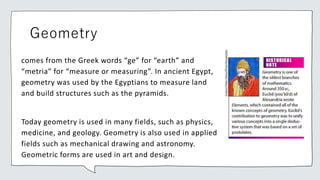
Geometry
comes from the Greek words “ge” for “earth” and
“metria” for “measure or measuring”. In ancient Egypt,
geometry was used by the Egyptians to measure land
and build structures such as the pyramids.
Today geometry is used in many fields, such as physics,
medicine, and geology. Geometry is also used in applied
fields such as mechanical drawing and astronomy.
Geometric forms are used in art and design.
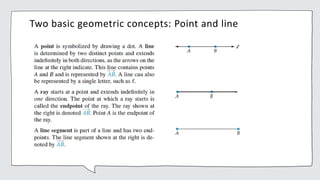
Two basic geometric concepts: Point and line
A plane is a flat surface with no thickness and no boundaries. It can be pictured as a desktop or
whiteboard that extends forever. Figures that lie in a plane are called plane figures.
Lines in a plane can be intersecting or parallel. Intersecting lines cross at a point in the plane.
Parallel lines never intersect. The distance between them is always the same.
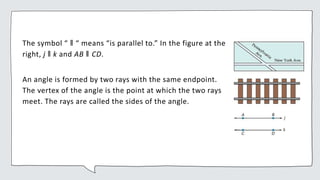
The symbol “ ǁ “ means “is parallel to.” In the figure at the
right, j ǁ k and AB ǁ CD.
An angle is formed by two rays with the same endpoint.
The vertex of the angle is the point at which the two rays
meet. The rays are called the sides of the angle.
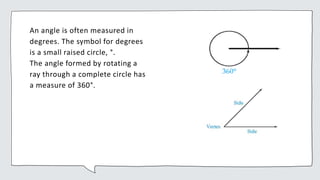
An angle is often measured in
degrees. The symbol for degrees
is a small raised circle, °.
The angle formed by rotating a
ray through a complete circle has
a measure of 360°.
Geometric Shapes
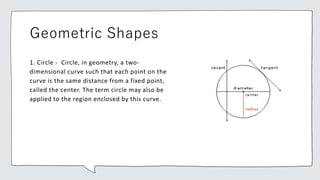
1. Circle - Circle, in geometry, a two-
dimensional curve such that each point on the
curve is the same distance from a fixed point,
called the center. The term circle may also be
applied to the region enclosed by this curve.
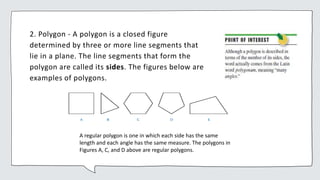
2. Polygon - A polygon is a closed figure
determined by three or more line segments that
lie in a plane. The line segments that form the
polygon are called its sides. The figures below are
examples of polygons.
A regular polygon is one in which each side has the same
length and each angle has the same measure. The polygons in
Figures A, C, and D above are regular polygons.
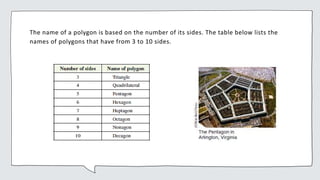
The name of a polygon is based on the number of its sides. The table below lists the
names of polygons that have from 3 to 10 sides.
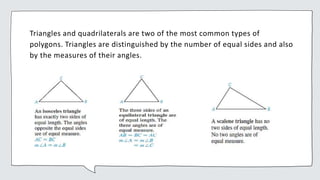
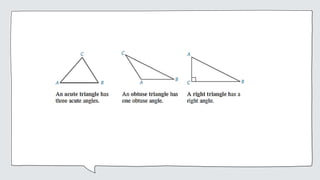
Triangles and quadrilaterals are two of the most common types of
polygons. Triangles are distinguished by the number of equal sides and also
by the measures of their angles.
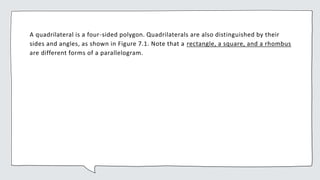
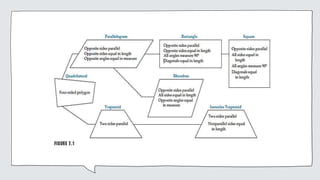
A quadrilateral is a four-sided polygon. Quadrilaterals are also distinguished by their
sides and angles, as shown in Figure 7.1. Note that a rectangle, a square, and a rhombus
are different forms of a parallelogram.
Geometric Solids
are three-dimensional shapes that are bounded by surfaces. Common
geometric solids include the rectangular solid, sphere, cylinder, cone, and
pyramid. Despite being called “solids,” these figures are actually hollow;
they do not include the points inside their surfaces.
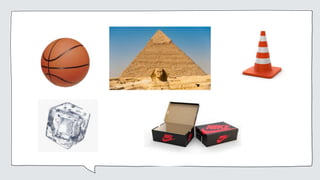
Five common geometric solids are rectangular solids, spheres, cylinders, cones, and pyramids.
A rectangular solid is one in which all six sides, called faces, are rectangles.
A cube is a special type of rectangular solid. Each of the six faces of a cube is a square.
A sphere is a solid in which all points are the same distance from a point O, called the center of
the sphere.
The most common cylinder, called a right circular cylinder, is one in which the bases are circles
and are perpendicular to the height of the cylinder.
A right circular cone is obtained when one base of a right circular cylinder is shrunk to a point,
called the vertex
The base of a regular pyramid is a regular polygon, and the sides are isosceles triangles (two sides
of the triangle are the same length).
Transformations, Geometric Pattern
and Design
Geometric transformation of shapes is a change of its size, orientation, or
position following certain techniques in mathematics. The original shape is called
object, and the new shape is called its image. Many objects around us are said
to be symmetrical, and this symmetry resulted from geometric transformation.
Some of the basic geometric transformations are as follows: Translation,
Rotation, Reflection, Glide reflection, and Dilation.
Geometric Transformation
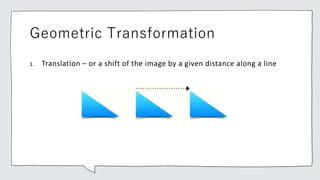
1. Translation – or a shift of the image by a given distance along a line
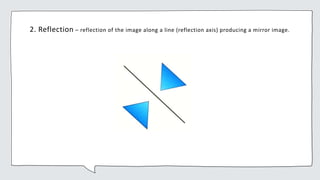
2. Reflection – reflection of the image along a line (reflection axis) producing a mirror image.
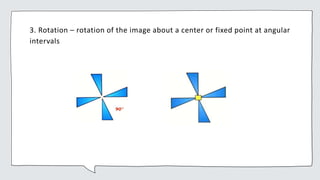
3. Rotation – rotation of the image about a center or fixed point at angular
intervals
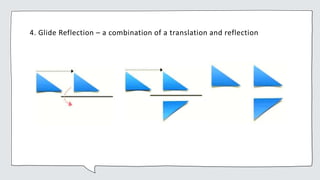
4. Glide Reflection – a combination of a translation and reflection
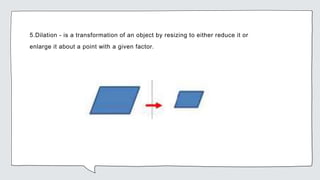
5.Dilation - is a transformation of an object by resizing to either reduce it or
enlarge it about a point with a given factor.
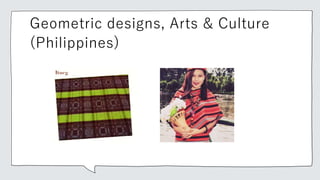
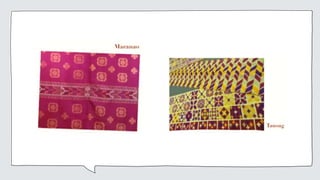
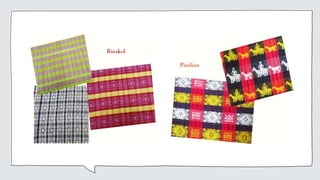
Geometric designs, Arts & Culture
(Philippines)
Geometric deisgns_new.pptx

Geometric deisgns_new.pptx

  • 1.
  • 2.
    Geometry comes from theGreek words “ge” for “earth” and “metria” for “measure or measuring”. In ancient Egypt, geometry was used by the Egyptians to measure land and build structures such as the pyramids. Today geometry is used in many fields, such as physics, medicine, and geology. Geometry is also used in applied fields such as mechanical drawing and astronomy. Geometric forms are used in art and design.
  • 3.
    Two basic geometricconcepts: Point and line
  • 4.
    A plane isa flat surface with no thickness and no boundaries. It can be pictured as a desktop or whiteboard that extends forever. Figures that lie in a plane are called plane figures. Lines in a plane can be intersecting or parallel. Intersecting lines cross at a point in the plane. Parallel lines never intersect. The distance between them is always the same.
  • 5.
    The symbol “ǁ “ means “is parallel to.” In the figure at the right, j ǁ k and AB ǁ CD. An angle is formed by two rays with the same endpoint. The vertex of the angle is the point at which the two rays meet. The rays are called the sides of the angle.
  • 6.
    An angle isoften measured in degrees. The symbol for degrees is a small raised circle, °. The angle formed by rotating a ray through a complete circle has a measure of 360°.
  • 7.
    Geometric Shapes 1. Circle- Circle, in geometry, a two- dimensional curve such that each point on the curve is the same distance from a fixed point, called the center. The term circle may also be applied to the region enclosed by this curve.
  • 8.
    2. Polygon -A polygon is a closed figure determined by three or more line segments that lie in a plane. The line segments that form the polygon are called its sides. The figures below are examples of polygons. A regular polygon is one in which each side has the same length and each angle has the same measure. The polygons in Figures A, C, and D above are regular polygons.
  • 9.
    The name ofa polygon is based on the number of its sides. The table below lists the names of polygons that have from 3 to 10 sides.
  • 10.
    Triangles and quadrilateralsare two of the most common types of polygons. Triangles are distinguished by the number of equal sides and also by the measures of their angles.
  • 12.
    A quadrilateral isa four-sided polygon. Quadrilaterals are also distinguished by their sides and angles, as shown in Figure 7.1. Note that a rectangle, a square, and a rhombus are different forms of a parallelogram.
  • 14.
    Geometric Solids are three-dimensionalshapes that are bounded by surfaces. Common geometric solids include the rectangular solid, sphere, cylinder, cone, and pyramid. Despite being called “solids,” these figures are actually hollow; they do not include the points inside their surfaces.
  • 15.
    Five common geometricsolids are rectangular solids, spheres, cylinders, cones, and pyramids. A rectangular solid is one in which all six sides, called faces, are rectangles. A cube is a special type of rectangular solid. Each of the six faces of a cube is a square. A sphere is a solid in which all points are the same distance from a point O, called the center of the sphere. The most common cylinder, called a right circular cylinder, is one in which the bases are circles and are perpendicular to the height of the cylinder. A right circular cone is obtained when one base of a right circular cylinder is shrunk to a point, called the vertex The base of a regular pyramid is a regular polygon, and the sides are isosceles triangles (two sides of the triangle are the same length).
  • 18.
    Transformations, Geometric Pattern andDesign Geometric transformation of shapes is a change of its size, orientation, or position following certain techniques in mathematics. The original shape is called object, and the new shape is called its image. Many objects around us are said to be symmetrical, and this symmetry resulted from geometric transformation. Some of the basic geometric transformations are as follows: Translation, Rotation, Reflection, Glide reflection, and Dilation.
  • 19.
    Geometric Transformation 1. Translation– or a shift of the image by a given distance along a line
  • 20.
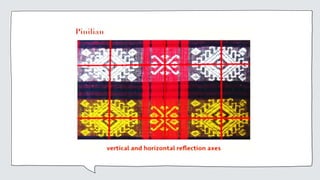
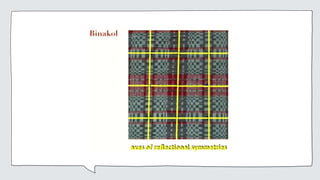
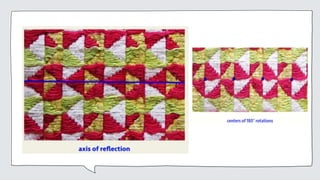
    2. Reflection –reflection of the image along a line (reflection axis) producing a mirror image.
  • 21.
    3. Rotation –rotation of the image about a center or fixed point at angular intervals
  • 22.
    4. Glide Reflection– a combination of a translation and reflection
  • 23.
    5.Dilation - isa transformation of an object by resizing to either reduce it or enlarge it about a point with a given factor.
  • 24.
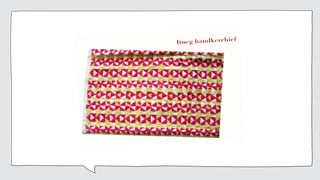
    Geometric designs, Arts& Culture (Philippines)