Third week of development
Dr Jyoti Chopra
Professor
KGMU, Lucknow
Week 3: Days 14-21
• Primitive streak forms
• Gastrulation forms tri-laminar embryo
• Neural induction
• Left-right asymmetry
• 0.4mm - 2.0mm
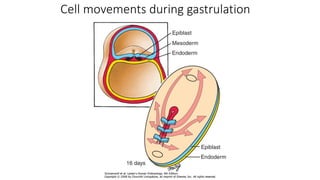
Gastrulation
• Formative process by which three primary embryonic germ layers and
axial orientation is established in embryo:
• Ectoderm: outside, surrounds other layers later in development, generates
skin and nervous tissue
• Mesoderm: middle layer, generates most of the muscle, blood and
connective tissues of the body and placenta
• Endoderm: eventually most interior of embryo, generates the epithelial lining
and associated glands of the gut, lung, and urogenital tracts
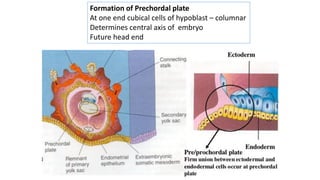
Formation of Prechordal plate
At one end cubical cells of hypoblast – columnar
Determines central axis of embryo
Future head end
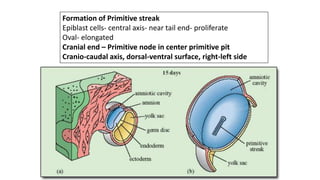
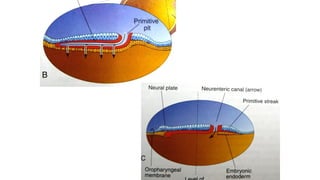
Formation of Primitive streak
Epiblast cells- central axis- near tail end- proliferate
Oval- elongated
Cranial end – Primitive node in center primitive pit
Cranio-caudal axis, dorsal-ventral surface, right-left side
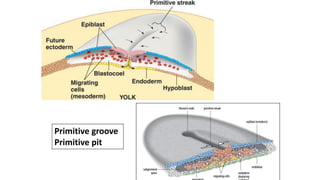
Primitive groove
Primitive pit
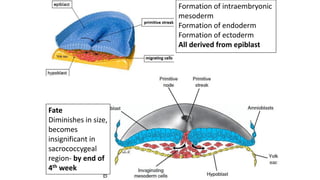
Formation of intraembryonic
mesoderm
Formation of endoderm
Formation of ectoderm
All derived from epiblast
Fate
Diminishes in size,
becomes
insignificant in
sacrococcygeal
region- by end of
4th week
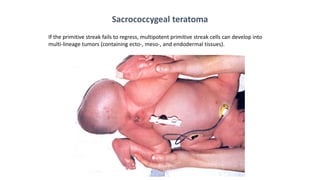
If the primitive streak fails to regress, multipotent primitive streak cells can develop into
multi-lineage tumors (containing ecto-, meso-, and endodermal tissues).
Sacrococcygeal teratoma
Cell movements during gastrulation
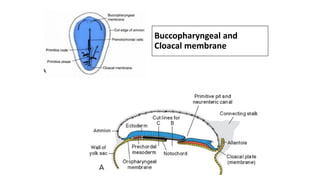
Buccopharyngeal and
Cloacal membrane
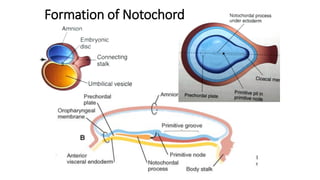
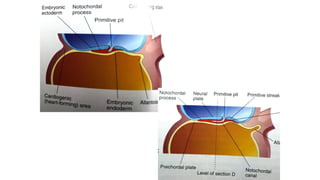
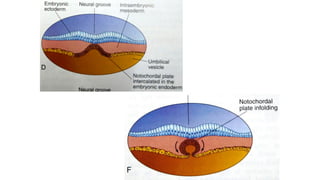
Formation of Notochord
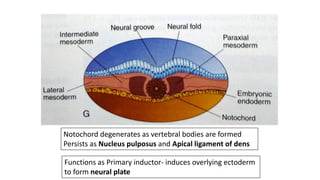
Notochord degenerates as vertebral bodies are formed
Persists as Nucleus pulposus and Apical ligament of dens
Functions as Primary inductor- induces overlying ectoderm
to form neural plate
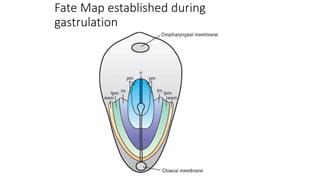
Fate Map established during
gastrulation

Third week of development

  • 1.
    Third week ofdevelopment Dr Jyoti Chopra Professor KGMU, Lucknow
  • 2.
    Week 3: Days14-21 • Primitive streak forms • Gastrulation forms tri-laminar embryo • Neural induction • Left-right asymmetry • 0.4mm - 2.0mm
  • 3.
    Gastrulation • Formative processby which three primary embryonic germ layers and axial orientation is established in embryo: • Ectoderm: outside, surrounds other layers later in development, generates skin and nervous tissue • Mesoderm: middle layer, generates most of the muscle, blood and connective tissues of the body and placenta • Endoderm: eventually most interior of embryo, generates the epithelial lining and associated glands of the gut, lung, and urogenital tracts
  • 4.
    Formation of Prechordalplate At one end cubical cells of hypoblast – columnar Determines central axis of embryo Future head end
  • 5.
    Formation of Primitivestreak Epiblast cells- central axis- near tail end- proliferate Oval- elongated Cranial end – Primitive node in center primitive pit Cranio-caudal axis, dorsal-ventral surface, right-left side
  • 6.
  • 7.
    Formation of intraembryonic mesoderm Formationof endoderm Formation of ectoderm All derived from epiblast Fate Diminishes in size, becomes insignificant in sacrococcygeal region- by end of 4th week
  • 8.
    If the primitivestreak fails to regress, multipotent primitive streak cells can develop into multi-lineage tumors (containing ecto-, meso-, and endodermal tissues). Sacrococcygeal teratoma
  • 9.
  • 10.
  • 11.
  • 15.
    Notochord degenerates asvertebral bodies are formed Persists as Nucleus pulposus and Apical ligament of dens Functions as Primary inductor- induces overlying ectoderm to form neural plate
  • 16.
    Fate Map establishedduring gastrulation