
Urinary System Chapter 9
Genitourinary (GU)  System Serves as the urinary organ system  Metabolic processes result in waste production - the GU serves as one of the hardest working systems Functions Removal of waste products Adjust water and electrolyte levels Maintains pH
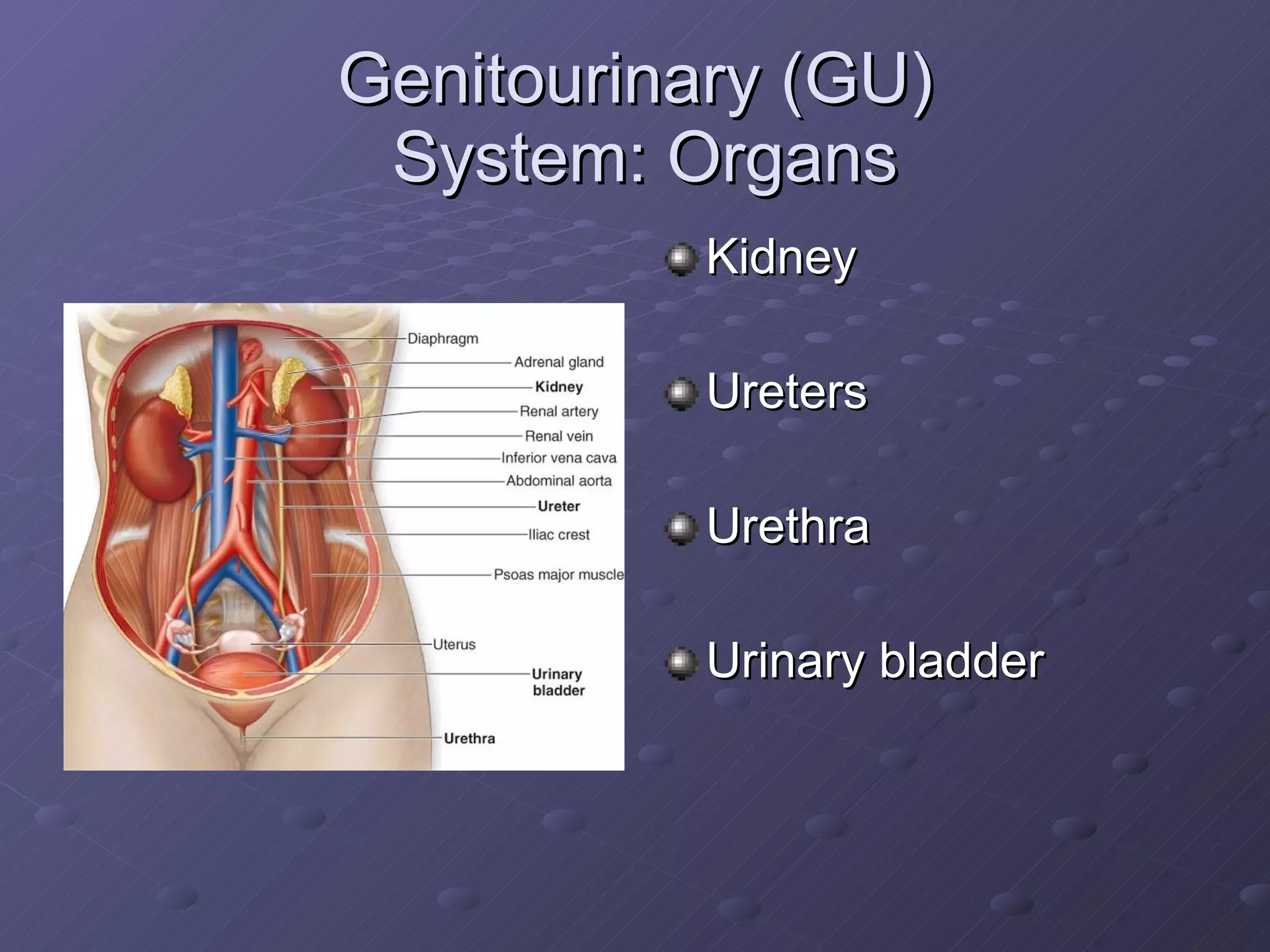
Genitourinary (GU)  System: Organs Kidney  Ureters Urethra Urinary bladder
Catheterization (cath) Urinary catheter is inserted into patient’s bladder via urethra  Maintains urine output for patients Used for treatment or diagnosis Urinary incontinence (leakage of urine or the inability to control when you urinate)  Urinary retention (being unable to empty the bladder when you need to)  Surgery that made a catheter necessary, such as prostate or gynecological surgery  Other medical conditions such as multiple sclerosis, spinal cord injury, or dementia
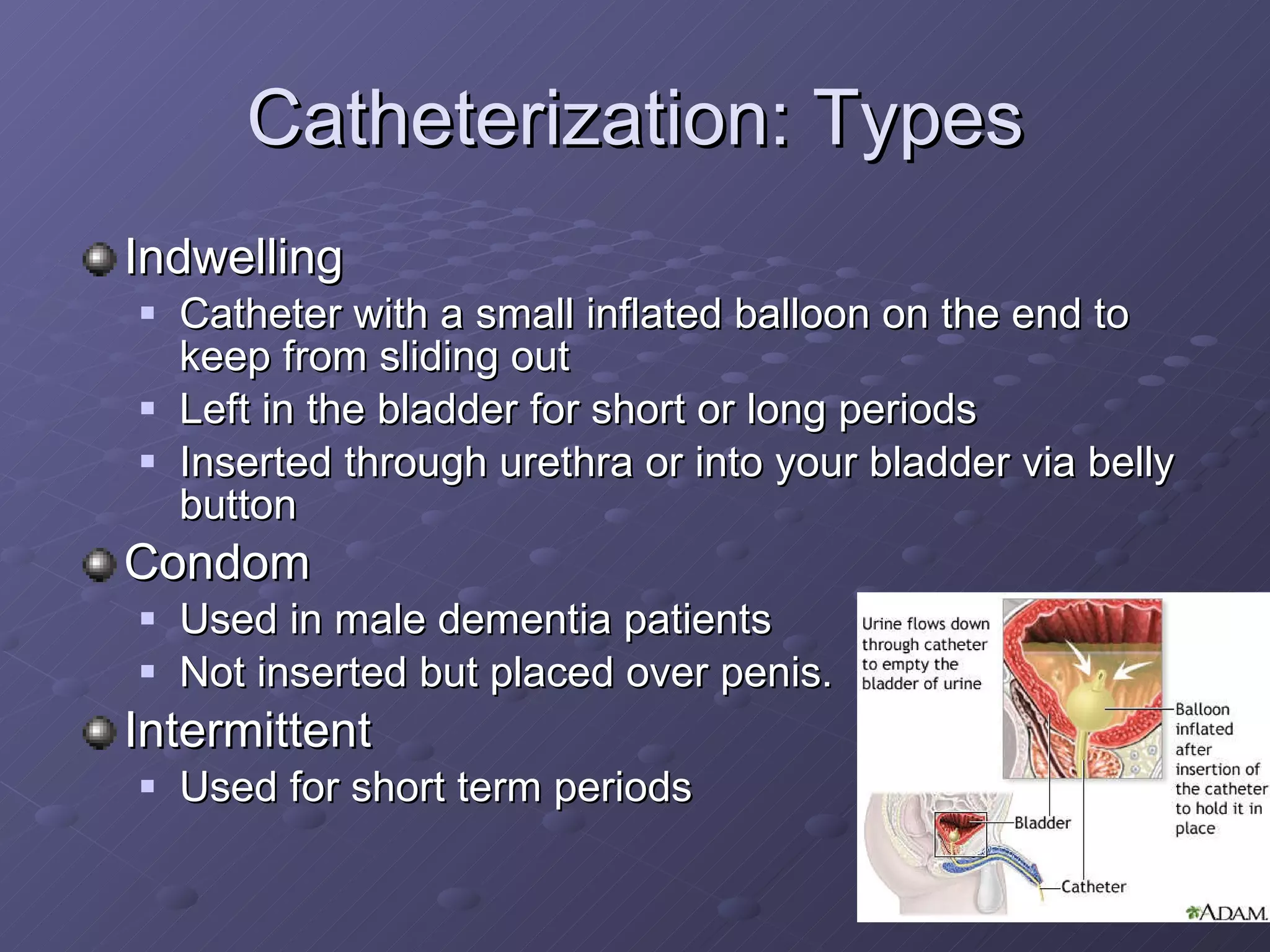
Catheterization: Types Indwelling Catheter with a small inflated balloon on the end to keep from sliding out Left in the bladder for short or long periods Inserted through urethra or into your bladder via belly button Condom Used in male dementia patients Not inserted but placed over penis. Intermittent Used for short term periods
Catheterization: Risks Bladder stones Blood infections Blood in urine Kidney damage Urethral injury Urinary tract (UTI) or kidney infections
Cystoscopy (cysto) Diagnostic procedure that uses a cystoscope to view the inside of the urinary tract Areas viewed include urethra, bladder and the two ureters  Detects abnormalities or as surgical procedure Evaluation of blood in the urine Evaluation and treatment of kidney stones Evaluation and treatment of bladder or ureteral tumors Prostate surgery Narrowing of urethral
Cystoscopy: Risks Serious risks are rare Perforation or tear along urinary tract Urethra, bladder or ureter Scar tissue development causing narrowing of the urethra  Epididymitis  Only occurs in men Inflammation or pain in the testicles Inability to urinate
Extracorporeal shock wave lithotripsy (ESWL)  Therapeutic procedure for kidney stones High- energy shock waves are used to break kidney stones into smaller pieces for easier travel On stones larger than 2.5cm a stent may be used Kidney stone fragments will pass through the urinary tract over the course of a few days Not appropriate procedure if pregnant, have bleeding disorder, kidney infection, urinary tract infection, or kidney cancer
Extracorporeal shock wave lithotripsy (ESWL): Risks Pain caused by the passage of stone fragments Blocked urine flow as a result of stone fragments becoming stuck in the urinary tract Fragments may need to be removed with a ureteroscope Urinary tract infection Bleeding around the outside of the kidney
Retrograde pyelogram (RP) Diagnostic X-ray procedure used with a cystoscopy to determine presence of kidney stones, tumors, or obstructions Endoscope is inserted through the urethra into the bladder Catheter is inserted into the ureters where a contrast dye is injected Retention of the dye is evaluated
References http://www.nlm.nih.gov http://www.emedicinehealth.com Medical Terminology: A living language, Bonnie F. Fregman and Suzanne S. Frucht

Urinary system

  • 1.
  • 2.
    Genitourinary (GU) System Serves as the urinary organ system Metabolic processes result in waste production - the GU serves as one of the hardest working systems Functions Removal of waste products Adjust water and electrolyte levels Maintains pH
  • 3.
    Genitourinary (GU) System: Organs Kidney Ureters Urethra Urinary bladder
  • 4.
    Catheterization (cath) Urinarycatheter is inserted into patient’s bladder via urethra Maintains urine output for patients Used for treatment or diagnosis Urinary incontinence (leakage of urine or the inability to control when you urinate) Urinary retention (being unable to empty the bladder when you need to) Surgery that made a catheter necessary, such as prostate or gynecological surgery Other medical conditions such as multiple sclerosis, spinal cord injury, or dementia
  • 5.
    Catheterization: Types IndwellingCatheter with a small inflated balloon on the end to keep from sliding out Left in the bladder for short or long periods Inserted through urethra or into your bladder via belly button Condom Used in male dementia patients Not inserted but placed over penis. Intermittent Used for short term periods
  • 6.
    Catheterization: Risks Bladderstones Blood infections Blood in urine Kidney damage Urethral injury Urinary tract (UTI) or kidney infections
  • 7.
    Cystoscopy (cysto) Diagnosticprocedure that uses a cystoscope to view the inside of the urinary tract Areas viewed include urethra, bladder and the two ureters Detects abnormalities or as surgical procedure Evaluation of blood in the urine Evaluation and treatment of kidney stones Evaluation and treatment of bladder or ureteral tumors Prostate surgery Narrowing of urethral
  • 8.
    Cystoscopy: Risks Seriousrisks are rare Perforation or tear along urinary tract Urethra, bladder or ureter Scar tissue development causing narrowing of the urethra Epididymitis Only occurs in men Inflammation or pain in the testicles Inability to urinate
  • 9.
    Extracorporeal shock wavelithotripsy (ESWL) Therapeutic procedure for kidney stones High- energy shock waves are used to break kidney stones into smaller pieces for easier travel On stones larger than 2.5cm a stent may be used Kidney stone fragments will pass through the urinary tract over the course of a few days Not appropriate procedure if pregnant, have bleeding disorder, kidney infection, urinary tract infection, or kidney cancer
  • 10.
    Extracorporeal shock wavelithotripsy (ESWL): Risks Pain caused by the passage of stone fragments Blocked urine flow as a result of stone fragments becoming stuck in the urinary tract Fragments may need to be removed with a ureteroscope Urinary tract infection Bleeding around the outside of the kidney
  • 11.
    Retrograde pyelogram (RP)Diagnostic X-ray procedure used with a cystoscopy to determine presence of kidney stones, tumors, or obstructions Endoscope is inserted through the urethra into the bladder Catheter is inserted into the ureters where a contrast dye is injected Retention of the dye is evaluated
  • 12.
    References http://www.nlm.nih.gov http://www.emedicinehealth.comMedical Terminology: A living language, Bonnie F. Fregman and Suzanne S. Frucht