Reproductive Anatomy &
      Physiology
  Ana H. Corona, MSN, FNP-C
       Nursing Instructor
         October 2007
        Medical Nursing/MD0921
Definitions
• Broad Ligaments. Two wing-like structures that
  extend from the lateral margins of the uterus to
  the pelvic walls and divide the pelvic cavity into
  an anterior and a posterior compartment.
• Corpus Luteum. The yellow mass found in the
  graafian follicle after the ovum has been
  expelled.
• Estrogen. The generic term for the female sex
  hormones. It is a steroid hormone produced
  primarily by the ovaries but also by the adrenal
  cortex.
• Fimbriae. Fringes; especially the finger-like
  ends of the fallopian tube.
Definitions
• Follicle. A pouch like depression or cavity.
• Follicle Stimulating Hormone. The follicle
  stimulating hormone (FSH) is a hormone
  produced by the anterior pituitary during the first
  half of the menstrual cycle. It stimulates
  development of the graafian follicle.
• Graafian Follicle. A mature, fully developed
  ovarian cyst containing the ripe ovum.
• Hormone. A chemical substance produced in an
  organ, which, being carried to an associated
  organ by the bloodstream excites in the latter
  organ, a functional activity
Definitions
• Lactation. The production of milk by the
  mammary glands.
• Luteinizing Hormone. A hormone produced by
  the anterior pituitary that stimulates ovulation and
  the development of the corpus luteum.
• Oocyte. A developing egg in one of two stages.
• Ovum. The female reproductive cell.
• Progesterone. The pure hormone contained in
  the corpora lutea whose function is to prepare the
  endometrium for the reception and development of
  the fertilized ovum.
• Reproduction. The process by which an offspring
  is formed.
The Female Reproductive System
The internal organs of the female consists of the
uterus, vagina, fallopian tubes, and the ovaries
The Uterus
• A hollow organ about the size and shape of a
  pear.
• It serves two important functions: it is the organ
  of menstruation and during pregnancy it
  receives the fertilized ovum, retains and
  nourishes it until it expels the fetus during labor.
• Location. The uterus is located between the
  urinary bladder and the rectum. It is suspended
  in the pelvis by broad ligaments.
The Uterus
• Divisions of the uterus. The uterus consists of
  the body or corpus, fundus, cervix, and the
  isthmus.
• The major portion of the uterus is called the
  body or corpus.
• The fundus is the superior, rounded region
  above the entrance of the fallopian tubes.
• The cervix is the narrow, inferior outlet that
  protrudes into the vagina.
• The isthmus is the slightly constricted portion
  that joins the corpus to the cervix.
The Walls of the Uterus

Thick and are composed of three layers: the
  endometrium, myometrium and perimetrium.
The Endometrium
• The endometrium is the inner layer or
  mucosa.
• A fertilized egg burrows into the
  endometrium (implantation) and resides
  there for the rest of its development.
• When the female is not pregnant, the
  endometrial lining sloughs off about every
  28 days in response to changes in levels
  of hormones in the blood.
• This process is called menses.
The Myometrium
•   The myometrium is the smooth muscle
    component of the wall.
•   These smooth muscle fibers are
    arranged. In longitudinal, circular, and
    spiral patterns, and are interlaced with
    connective tissues.
•   During the monthly female cycles and
    during pregnancy, these layers undergo
    extensive changes.
The Perimetrium
• The perimetrium is a strong, serous
  membrane that coats the entire
  uterine corpus except the lower one
  fourth and anterior surface where
  the bladder is attached.
The Vagina
• Location. The vagina is the thin in walled
  muscular tube about 6 inches long leading
  from the uterus to the external genitalia. It
  is located between the bladder and the
  rectum.
• Function. The vagina provides the
  passageway for childbirth and menstrual
  flow; it receives the penis and semen
  during sexual intercourse.
The Fallopian Tubes (two)
• Location. Each tube is about 4 inches long
  and extends medially from each ovary to
  empty into the superior region of the
  uterus.
• Function. The fallopian tubes transport
  ovum from the ovaries to the uterus.
• There is no contact of fallopian tubes with
  the ovaries.
Description of Fallopian Tubes
• The distal end of each fallopian tube is
  expanded and has finger-like projections called
  fimbriae, which partially surround each ovary.
• When an oocyte is expelled from the ovary,
  fimbriae create fluid currents that act to carry the
  oocyte into the fallopian tube.
• Oocyte is carried toward the uterus by
  combination of tube peristalsis and cilia, which
  propel the oocyte forward.
• The most desirable place for fertilization is the
  fallopian tube.
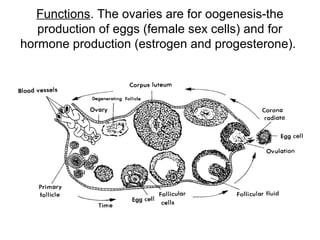
Functions. The ovaries are for oogenesis-the
   production of eggs (female sex cells) and for
hormone production (estrogen and progesterone).
Location and Gross Anatomy
• The ovaries are about the size and shape of almonds.
• They lie against the lateral walls of the pelvis, one on each
  side.
• They are enclosed and held in place by the broad
  ligament.
• There are compact like tissues on the ovaries, which are
  called ovarian follicles.
• The follicles are tiny sac-like structures that consist of an
  immature egg surrounded by one or more layers of follicle
  cells.
• As the developing egg begins to ripen or mature, follicle
  enlarges and develops a fluid filled central region.
• When the egg is matured, it is called a graafian follicle,
  and is ready to be ejected from the ovary.
Process of egg production--oogenesis
•   The total supply of eggs that a female can release
    has been determined by the time she is born.
•   The eggs are referred to as "oogonia" in the
    developing fetus.
•   At the time the female is born, oogonia have
    divided into primary oocytes, which contain 46
    chromosomes and are surrounded by a layer of
    follicle cells.
•   Primary oocytes remain in the state of suspended
    animation through childhood until the female
    reaches puberty (ages 10 to 14 years).
•   At puberty, the anterior pituitary gland secretes
    follicle-stimulating hormone (FSH), which
    stimulates a small number of primary follicles to
    mature each month.
The process of oogenesis.
oogenesis
• As a primary oocyte begins dividing, two
  different cells are produced, each containing 23
  unpaired chromosomes.
• One of the cells is called a secondary oocyte
  and the other is called the first polar body.
• The secondary oocyte is the larger cell and is
  capable of being fertilized.
• The first polar body is very small, is
  nonfunctional, and incapable of being fertilized.
oogenesis
• By the time follicles have matured to the
  graafian follicle stage, they contain secondary
  oocytes and can be seen bulging from the
  surface of the ovary.
• Follicle development to this stage takes about
  14 days.
• Ovulation (ejection of the mature egg from the
  ovary) occurs at this 14-day point in response to
  the luteinizing hormone (LH), which is released
  by the anterior pituitary gland.
Oogenesis
• The follicle at the proper stage of maturity
  when the LH is secreted will rupture and
  release its oocyte into the peritoneal
  cavity.
• The motion of the fimbriae draws the
  oocyte into the fallopian tube.
• The luteinizing hormone also causes the
  ruptured follicle to change into a granular
  structure called corpus luteum, which
  secretes estrogen and progesterone.
Oogenesis
• If the secondary oocyte is penetrated by a
  sperm, a secondary division occurs that
  produces another polar body and an
  ovum, which combines its 23
• chromosomes with those of the sperm to
  form the fertilized egg, which contains 46
  chromosomes.
Process of hormone production by the ovaries.
• Estrogen is produced by the follicle cells, which
  are responsible for secondary sex characteristics
  and for the maintenance of these traits.
• These secondary sex characteristics include the
  enlargement of fallopian tubes, uterus, vagina, and
  external genitals; breast development; increased
  deposits of fat in hips and breasts; widening of the
  pelvis; and onset of menses or menstrual cycle.
• (b) Progesterone is produced by the corpus
  luteum in presence of LH in the blood. It works
  with estrogen to produce a normal menstrual
  cycle.
• Progesterone is important during pregnancy and in
  preparing the breasts for milk production.
Female reproductive system
• The external organs of the female
  reproductive system include the mons
  pubis, labia majora, labia minora,
  vestibule, perineum, and the Bartholin's
  glands.
• As a group, these structures that surround
  the openings of the urethra and vagina
  compose the vulva, from the Latin word
  meaning covering.
The Female Reproductive Organs
Female reproductive organs
• Mons Pubis. This is the fatty rounded area
  overlying the symphysis pubis and covered
  with thick coarse hair.
• Labia Majora. The labia majora run
  posteriorly from the mons pubis. They are
  the 2 elongated hair covered skin folds. They
  enclose and protect other external
  reproductive organs.
• Labia Minora. The labia minora are 2
  smaller folds enclosed by the labia majora.
  They protect the opening of the vagina and
  urethra.
Female repro
• Vestibule. The vestibule consists of the clitoris,
  urethral meatus, and the vaginal introitus.
• The clitoris is a short erectile organ at the top of
  the vaginal vestibule whose function is sexual
  excitation.
• The urethral meatus is the mouth or opening of
  the urethra.
• The urethra is a small tubular structure that
  drains urine from the bladder.
• The vaginal introitus is the vaginal entrance
Female repro
• Perineum. This is the skin covered muscular
  area between the vaginal opening (introitus) and
  the anus.
• It aids in constricting the urinary, vaginal, and
  anal opening. It also helps support the pelvic
  contents.
• Bartholin's Glands (Vulvovaginal or
  Vestibular Glands). The Bartholin's glands lie
  on either side of the vaginal opening.
• They produce a mucoid substance, which
  provides lubrication for intercourse.
The Blood Supply
• The blood supply is derived from the uterine and
  ovarian arteries that extend from the internal
  iliac arteries and the aorta.
• The increased demands of pregnancy
  necessitate a rich supply of blood to the uterus.
• New, larger blood vessels develop to
  accommodate the need of the growing uterus.
• The venous circulation is accomplished via the
  internal iliac and common iliac vein.
Facts about the menstrual cycle

• Menstruation is the periodic discharge of
  blood, mucus, and epithelial cells from the
  uterus.
• It usually occurs at monthly intervals
  throughout the reproductive period, except
  during pregnancy and lactation, when it is
  usually suppressed.
Facts
• The menstrual cycle is controlled by the
  cyclic activity of follicle stimulating
  hormone (FSH) and LH from the anterior
  pituitary and progesterone and estrogen
  from
• the ovaries. In other words, FSH acts
  upon the ovary to stimulate the maturation
  of a follicle, and during this development,
  the follicular cells secrete increasing
  amounts of estrogen.
Menstrual Cycle
Hormonal interaction of the female cycle are
                 as follows:
• Days 1-5. This is known as the menses
  phase.
• A lack of signal from a fertilized egg
  influences the drop in estrogen and
  progesterone production.
• A drop in progesterone results in the
  sloughing off of the thick endometrial lining
  which is the menstrual flow.
• This occurs for 3 to 5 days.
Day 6-14
• This is known as the proliferative phase.
• A drop in progesterone and estrogen
  stimulates the release of FSH from the
  anterior pituitary.
• FSH stimulates the maturation of an ovum
  with graafian follicle.
• Near the end of this phase, the release of
  LH increases causing a sudden burst like
  release of the ovum, which is known as
  ovulation.
Day 15-28
• This is known as the secretory phase.
• High levels of LH cause the empty
  graafian follicle to develop into the corpus
  luteum.
• The corpus luteum releases progesterone,
  which increases the endometrial blood
  supply.
Continue
• Endometrial glands secrete nutrients into the
  uterine cavity, helping to prepare the lining for
  the arrival of the fertilized egg.
• If the egg is fertilized, the embryo produces
  human chorionic gonadotropin (HCG).
• The human chorionic gonadotropin signals the
  corpus luteum to continue to supply
  progesterone to maintain the uterine lining.
• Continuous levels of progesterone prevent the
  release of FSH and ovulation ceases
continue
• The length of the menstrual cycle is highly
  variable. It may be as short as 21 days or as
  long as 39 days.
• Only one interval is fairly constant in all females,
  the time from ovulation to the beginning of
  menses, which is almost always 14-15 days.
• The menstrual cycle usually ends when or
  before a woman reaches her fifties. This is
  known as menopause
Ovulation
• The release of an egg cell from a mature ovarian
  follicle.
• Is stimulated by hormones from the anterior
  pituitary gland, which apparently causes the
  mature follicle to swell rapidly and eventually
  rupture.
• The follicular fluid, accompanied by the egg cell,
  oozes outward from the surface of the ovary and
  enters the peritoneal cavity.
• After it is expelled from the ovary, the egg cell and
  one or two layers of follicular cells surrounding it
  are usually propelled to the opening of a nearby
  uterine tube.
• If the cell is not fertilized by union of a sperm cell
  within a relatively short time, it will degenerate.
Menopause
• Is the cessation of menstruation.
• This usually occurs in women between the ages
  of 45 and 50.
• Some women may reach menopause before the
  age of 45 and some after the age of 50.
• Ovulation may occur sporadically or may cease
  abruptly.
• Periods may end suddenly, may become scanty
  or irregular, or may be intermittently heavy
  before ceasing altogether.
• Markedly diminished ovarian activity, that is,
  significantly decreased estrogen production and
  cessation of ovulation, causes menopause.
Male Reproductive System
• The male reproductive tract consists of external
  genitals and internal organs.
• These organs are located in the pelvic cavity.
• The male's reproductive system begins to
  develop in response to testosterone during early
  fetal life.
• Essentially no testosterone is produced during
  childhood.
• Resumption of testosterone production at the
  onset of puberty stimulates growth and
  maturation of the male's reproductive structures
  and secondary sex characteristics.
• Testosterone is the male sex hormone secreted
  by the interstitial cells of the testes
Male Reproductive Organs
Male’s Reproductive System

• The primary function of the male's
  reproduction system is to produce male
  sex cells, which are called sperm cells.
• The primary organs of the male's
  reproduction system are the two testes in
  which the sperm cells are formed.
• The other structures are the duct system
  and the accessory glandular structure.
Testes
• The testes are two almond-shaped glands whose
  functions are for the production of sperm and
  testosterone.
• The testes are suspended in the scrotal sac
  outside the abdominopelvic cavity.
• It is believed that the testes lie outside the body
  cavity because they are very sensitive to heat and
  the higher temperature within the body is
  unfavorable to the production of sperm.
• Each testis is enclosed by a tough, white fibrous
  capsule called the tunica albuginea.
Testes
• Extension of the capsule divides it into a large
  number of lobes.
• Each lobe contains four tightly coiled
  seminiferous tubules (this is the location of
  actual sperm production).
• The seminiferous tubules empty sperm
• into the testicular network where they travel to
  the epididymis.
• The epididymis is located outside of the testis
Structures of the Testes
Duct System
• The duct system is the passageway for the
  sperm to exit the body. It contains the epididymis
  and the vas deferens.
• Epididymis. The epididymis is a coiled tube
  about 20 inches long.
• It caps the superior part of the testis and runs
  down its posterior side.
• It forms the first part of the duct system and
  provides a temporary storage site for immature
  sperm.
• When the male is sexually stimulated, the walls
  of the epididymis contract to expel sperm into
  the next part of the duct system.
Vas Deferens (ductus deferens)
• The sperm continue their journey through the
  vas deferens.
• The vas deferens runs upwards from the
  epididymis through the inguinal canal into the
  pelvic cavity and arches over the bladder.
• It is enclosed with blood vessels and nerves in a
  connective tissue sheath, which is called a
  spermatic cord.
• The vas deferens empties into the ejaculatory
  duct that carries the sperm through the process
  to empty into the urethra.
Accessory Glandular Structure
• The accessory glandular structure
  includes the seminal vesicles, prostate
  gland, Cowper's glands, and the penis.
• Seminal vesicles. The two seminal
  vesicles are pouches that store sperm.
• Sixty percent of fluid volume of semen
  (seminal fluid) is produced there.
• The secretion is rich in sugar (fructose),
  which nourishes and activates the sperm
  passing through the tract
Prostate Gland
• The prostate gland is a single gland about
  the size and shape of a chestnut.
• It encircles the upper area of the urethra
  just below the bladder.
• It secretes a milky alkaline fluid, which has
  the role in protecting the sperm against
  acid conditions of the vagina.
Cowper’s Glands
• The cowper's glands are tiny pea-sized
  glands inferior to the prostate.
• They form a thick, clear mucus, which
  drains into the urethra.
• The secretion is believed to serve
  primarily as a lubricant during sexual
  intercourse.
The Penis
• The penis is a cylinder-shaped organ located
  externally on the mons pubis, immediately above
  the scrotum.
• It is made of erectile tissue with cavern-like
  spaces in it.
• At the time of sexual excitement, blood fills these
  spaces, changing the soft, limp penis to an
  enlarged, rigid, erect organ.
• The smooth cap of the penis is called the glans
  penis and is covered by a fold of loose skin that
  forms the headlock foreskin.
• Surgical removal of this foreskin is called
  circumcision.
• Serves as part of the urinary tract in the male.
Spermatogenesis (sperm
            formation)
• Spermatogenesis begins during puberty
  and continues throughout life.
• Millions of sperm are produced in a 24-
  hour period.
• This occurs in the seminiferous tubules
Spermatogenis
Spermatogenis
• The process is begun by primitive stem
  cells, which are called spermatogonia and
  are found in the outer region of each
  tubules. FSH is secreted by the anterior
  pituitary beginning at puberty. FSH
  influences division of spermatogonia into
  primary spermatocytes.
Spermatogenis
• Each spermatocyte undergoes meiosis and
  produces four spermatids. All of the male's body
  cells contain the same 23 pairs of
  chromosomes.
• The spermatid contains one chromosome of
  each of the 23 pairs. The same chromosome
  configuration occurs in the ovum.
• When the sperm and egg unite, the normal
  number of chromosomes is reestablished--46
  chromosomes or 23 pairs.
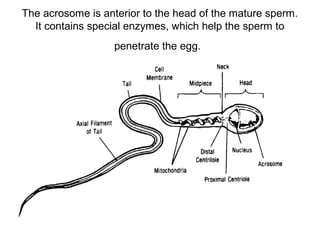
• The mature sperm contains three regions: the
  head, which contains deoxyribonucleic acid
  (DNA), the midpiece, and the tail.
The acrosome is anterior to the head of the mature sperm.
  It contains special enzymes, which help the sperm to
                   penetrate the egg.
The Process of Testosterone Production
• The interstitial cells, which lie between the
  seminiferous tubules, produce
  testosterone.
• These cells are activated during puberty by
  two hormones, FSH and LH, which is
  called interstitial cell stimulating hormone
  (ICSH).
Testosterone production
• A rise in testosterone production in the young
  male stimulates his reproductive organs to
  develop to their adult size and causes
  secondary sex characteristics to appear.
• These characteristics are:
• Deepening of the voice due to enlargement of
  the larynx.
• Increased hair growth especially on the face,
  axillary, and pubic regions.
• Enlargement of skeletal muscles.
• Increase in skeletal size.

Reproductive anatomy & physiology

  • 1.
    Reproductive Anatomy & Physiology Ana H. Corona, MSN, FNP-C Nursing Instructor October 2007 Medical Nursing/MD0921
  • 2.
    Definitions • Broad Ligaments.Two wing-like structures that extend from the lateral margins of the uterus to the pelvic walls and divide the pelvic cavity into an anterior and a posterior compartment. • Corpus Luteum. The yellow mass found in the graafian follicle after the ovum has been expelled. • Estrogen. The generic term for the female sex hormones. It is a steroid hormone produced primarily by the ovaries but also by the adrenal cortex. • Fimbriae. Fringes; especially the finger-like ends of the fallopian tube.
  • 3.
    Definitions • Follicle. Apouch like depression or cavity. • Follicle Stimulating Hormone. The follicle stimulating hormone (FSH) is a hormone produced by the anterior pituitary during the first half of the menstrual cycle. It stimulates development of the graafian follicle. • Graafian Follicle. A mature, fully developed ovarian cyst containing the ripe ovum. • Hormone. A chemical substance produced in an organ, which, being carried to an associated organ by the bloodstream excites in the latter organ, a functional activity
  • 4.
    Definitions • Lactation. Theproduction of milk by the mammary glands. • Luteinizing Hormone. A hormone produced by the anterior pituitary that stimulates ovulation and the development of the corpus luteum. • Oocyte. A developing egg in one of two stages. • Ovum. The female reproductive cell. • Progesterone. The pure hormone contained in the corpora lutea whose function is to prepare the endometrium for the reception and development of the fertilized ovum. • Reproduction. The process by which an offspring is formed.
  • 5.
  • 6.
    The internal organsof the female consists of the uterus, vagina, fallopian tubes, and the ovaries
  • 7.
    The Uterus • Ahollow organ about the size and shape of a pear. • It serves two important functions: it is the organ of menstruation and during pregnancy it receives the fertilized ovum, retains and nourishes it until it expels the fetus during labor. • Location. The uterus is located between the urinary bladder and the rectum. It is suspended in the pelvis by broad ligaments.
  • 8.
    The Uterus • Divisionsof the uterus. The uterus consists of the body or corpus, fundus, cervix, and the isthmus. • The major portion of the uterus is called the body or corpus. • The fundus is the superior, rounded region above the entrance of the fallopian tubes. • The cervix is the narrow, inferior outlet that protrudes into the vagina. • The isthmus is the slightly constricted portion that joins the corpus to the cervix.
  • 9.
    The Walls ofthe Uterus Thick and are composed of three layers: the endometrium, myometrium and perimetrium.
  • 10.
    The Endometrium • Theendometrium is the inner layer or mucosa. • A fertilized egg burrows into the endometrium (implantation) and resides there for the rest of its development. • When the female is not pregnant, the endometrial lining sloughs off about every 28 days in response to changes in levels of hormones in the blood. • This process is called menses.
  • 11.
    The Myometrium • The myometrium is the smooth muscle component of the wall. • These smooth muscle fibers are arranged. In longitudinal, circular, and spiral patterns, and are interlaced with connective tissues. • During the monthly female cycles and during pregnancy, these layers undergo extensive changes.
  • 12.
    The Perimetrium • Theperimetrium is a strong, serous membrane that coats the entire uterine corpus except the lower one fourth and anterior surface where the bladder is attached.
  • 13.
    The Vagina • Location.The vagina is the thin in walled muscular tube about 6 inches long leading from the uterus to the external genitalia. It is located between the bladder and the rectum. • Function. The vagina provides the passageway for childbirth and menstrual flow; it receives the penis and semen during sexual intercourse.
  • 14.
    The Fallopian Tubes(two) • Location. Each tube is about 4 inches long and extends medially from each ovary to empty into the superior region of the uterus. • Function. The fallopian tubes transport ovum from the ovaries to the uterus. • There is no contact of fallopian tubes with the ovaries.
  • 15.
    Description of FallopianTubes • The distal end of each fallopian tube is expanded and has finger-like projections called fimbriae, which partially surround each ovary. • When an oocyte is expelled from the ovary, fimbriae create fluid currents that act to carry the oocyte into the fallopian tube. • Oocyte is carried toward the uterus by combination of tube peristalsis and cilia, which propel the oocyte forward. • The most desirable place for fertilization is the fallopian tube.
  • 16.
    Functions. The ovariesare for oogenesis-the production of eggs (female sex cells) and for hormone production (estrogen and progesterone).
  • 17.
    Location and GrossAnatomy • The ovaries are about the size and shape of almonds. • They lie against the lateral walls of the pelvis, one on each side. • They are enclosed and held in place by the broad ligament. • There are compact like tissues on the ovaries, which are called ovarian follicles. • The follicles are tiny sac-like structures that consist of an immature egg surrounded by one or more layers of follicle cells. • As the developing egg begins to ripen or mature, follicle enlarges and develops a fluid filled central region. • When the egg is matured, it is called a graafian follicle, and is ready to be ejected from the ovary.
  • 18.
    Process of eggproduction--oogenesis • The total supply of eggs that a female can release has been determined by the time she is born. • The eggs are referred to as "oogonia" in the developing fetus. • At the time the female is born, oogonia have divided into primary oocytes, which contain 46 chromosomes and are surrounded by a layer of follicle cells. • Primary oocytes remain in the state of suspended animation through childhood until the female reaches puberty (ages 10 to 14 years). • At puberty, the anterior pituitary gland secretes follicle-stimulating hormone (FSH), which stimulates a small number of primary follicles to mature each month.
  • 19.
    The process ofoogenesis.
  • 20.
    oogenesis • As aprimary oocyte begins dividing, two different cells are produced, each containing 23 unpaired chromosomes. • One of the cells is called a secondary oocyte and the other is called the first polar body. • The secondary oocyte is the larger cell and is capable of being fertilized. • The first polar body is very small, is nonfunctional, and incapable of being fertilized.
  • 21.
    oogenesis • By thetime follicles have matured to the graafian follicle stage, they contain secondary oocytes and can be seen bulging from the surface of the ovary. • Follicle development to this stage takes about 14 days. • Ovulation (ejection of the mature egg from the ovary) occurs at this 14-day point in response to the luteinizing hormone (LH), which is released by the anterior pituitary gland.
  • 22.
    Oogenesis • The follicleat the proper stage of maturity when the LH is secreted will rupture and release its oocyte into the peritoneal cavity. • The motion of the fimbriae draws the oocyte into the fallopian tube. • The luteinizing hormone also causes the ruptured follicle to change into a granular structure called corpus luteum, which secretes estrogen and progesterone.
  • 23.
    Oogenesis • If thesecondary oocyte is penetrated by a sperm, a secondary division occurs that produces another polar body and an ovum, which combines its 23 • chromosomes with those of the sperm to form the fertilized egg, which contains 46 chromosomes.
  • 24.
    Process of hormoneproduction by the ovaries. • Estrogen is produced by the follicle cells, which are responsible for secondary sex characteristics and for the maintenance of these traits. • These secondary sex characteristics include the enlargement of fallopian tubes, uterus, vagina, and external genitals; breast development; increased deposits of fat in hips and breasts; widening of the pelvis; and onset of menses or menstrual cycle. • (b) Progesterone is produced by the corpus luteum in presence of LH in the blood. It works with estrogen to produce a normal menstrual cycle. • Progesterone is important during pregnancy and in preparing the breasts for milk production.
  • 25.
    Female reproductive system •The external organs of the female reproductive system include the mons pubis, labia majora, labia minora, vestibule, perineum, and the Bartholin's glands. • As a group, these structures that surround the openings of the urethra and vagina compose the vulva, from the Latin word meaning covering.
  • 26.
  • 27.
    Female reproductive organs •Mons Pubis. This is the fatty rounded area overlying the symphysis pubis and covered with thick coarse hair. • Labia Majora. The labia majora run posteriorly from the mons pubis. They are the 2 elongated hair covered skin folds. They enclose and protect other external reproductive organs. • Labia Minora. The labia minora are 2 smaller folds enclosed by the labia majora. They protect the opening of the vagina and urethra.
  • 28.
    Female repro • Vestibule.The vestibule consists of the clitoris, urethral meatus, and the vaginal introitus. • The clitoris is a short erectile organ at the top of the vaginal vestibule whose function is sexual excitation. • The urethral meatus is the mouth or opening of the urethra. • The urethra is a small tubular structure that drains urine from the bladder. • The vaginal introitus is the vaginal entrance
  • 29.
    Female repro • Perineum.This is the skin covered muscular area between the vaginal opening (introitus) and the anus. • It aids in constricting the urinary, vaginal, and anal opening. It also helps support the pelvic contents. • Bartholin's Glands (Vulvovaginal or Vestibular Glands). The Bartholin's glands lie on either side of the vaginal opening. • They produce a mucoid substance, which provides lubrication for intercourse.
  • 30.
    The Blood Supply •The blood supply is derived from the uterine and ovarian arteries that extend from the internal iliac arteries and the aorta. • The increased demands of pregnancy necessitate a rich supply of blood to the uterus. • New, larger blood vessels develop to accommodate the need of the growing uterus. • The venous circulation is accomplished via the internal iliac and common iliac vein.
  • 31.
    Facts about themenstrual cycle • Menstruation is the periodic discharge of blood, mucus, and epithelial cells from the uterus. • It usually occurs at monthly intervals throughout the reproductive period, except during pregnancy and lactation, when it is usually suppressed.
  • 32.
    Facts • The menstrualcycle is controlled by the cyclic activity of follicle stimulating hormone (FSH) and LH from the anterior pituitary and progesterone and estrogen from • the ovaries. In other words, FSH acts upon the ovary to stimulate the maturation of a follicle, and during this development, the follicular cells secrete increasing amounts of estrogen.
  • 33.
  • 34.
    Hormonal interaction ofthe female cycle are as follows: • Days 1-5. This is known as the menses phase. • A lack of signal from a fertilized egg influences the drop in estrogen and progesterone production. • A drop in progesterone results in the sloughing off of the thick endometrial lining which is the menstrual flow. • This occurs for 3 to 5 days.
  • 35.
    Day 6-14 • Thisis known as the proliferative phase. • A drop in progesterone and estrogen stimulates the release of FSH from the anterior pituitary. • FSH stimulates the maturation of an ovum with graafian follicle. • Near the end of this phase, the release of LH increases causing a sudden burst like release of the ovum, which is known as ovulation.
  • 36.
    Day 15-28 • Thisis known as the secretory phase. • High levels of LH cause the empty graafian follicle to develop into the corpus luteum. • The corpus luteum releases progesterone, which increases the endometrial blood supply.
  • 37.
    Continue • Endometrial glandssecrete nutrients into the uterine cavity, helping to prepare the lining for the arrival of the fertilized egg. • If the egg is fertilized, the embryo produces human chorionic gonadotropin (HCG). • The human chorionic gonadotropin signals the corpus luteum to continue to supply progesterone to maintain the uterine lining. • Continuous levels of progesterone prevent the release of FSH and ovulation ceases
  • 38.
    continue • The lengthof the menstrual cycle is highly variable. It may be as short as 21 days or as long as 39 days. • Only one interval is fairly constant in all females, the time from ovulation to the beginning of menses, which is almost always 14-15 days. • The menstrual cycle usually ends when or before a woman reaches her fifties. This is known as menopause
  • 39.
    Ovulation • The releaseof an egg cell from a mature ovarian follicle. • Is stimulated by hormones from the anterior pituitary gland, which apparently causes the mature follicle to swell rapidly and eventually rupture. • The follicular fluid, accompanied by the egg cell, oozes outward from the surface of the ovary and enters the peritoneal cavity. • After it is expelled from the ovary, the egg cell and one or two layers of follicular cells surrounding it are usually propelled to the opening of a nearby uterine tube. • If the cell is not fertilized by union of a sperm cell within a relatively short time, it will degenerate.
  • 40.
    Menopause • Is thecessation of menstruation. • This usually occurs in women between the ages of 45 and 50. • Some women may reach menopause before the age of 45 and some after the age of 50. • Ovulation may occur sporadically or may cease abruptly. • Periods may end suddenly, may become scanty or irregular, or may be intermittently heavy before ceasing altogether. • Markedly diminished ovarian activity, that is, significantly decreased estrogen production and cessation of ovulation, causes menopause.
  • 41.
    Male Reproductive System •The male reproductive tract consists of external genitals and internal organs. • These organs are located in the pelvic cavity. • The male's reproductive system begins to develop in response to testosterone during early fetal life. • Essentially no testosterone is produced during childhood. • Resumption of testosterone production at the onset of puberty stimulates growth and maturation of the male's reproductive structures and secondary sex characteristics. • Testosterone is the male sex hormone secreted by the interstitial cells of the testes
  • 42.
  • 43.
    Male’s Reproductive System •The primary function of the male's reproduction system is to produce male sex cells, which are called sperm cells. • The primary organs of the male's reproduction system are the two testes in which the sperm cells are formed. • The other structures are the duct system and the accessory glandular structure.
  • 44.
    Testes • The testesare two almond-shaped glands whose functions are for the production of sperm and testosterone. • The testes are suspended in the scrotal sac outside the abdominopelvic cavity. • It is believed that the testes lie outside the body cavity because they are very sensitive to heat and the higher temperature within the body is unfavorable to the production of sperm. • Each testis is enclosed by a tough, white fibrous capsule called the tunica albuginea.
  • 45.
    Testes • Extension ofthe capsule divides it into a large number of lobes. • Each lobe contains four tightly coiled seminiferous tubules (this is the location of actual sperm production). • The seminiferous tubules empty sperm • into the testicular network where they travel to the epididymis. • The epididymis is located outside of the testis
  • 46.
  • 47.
    Duct System • Theduct system is the passageway for the sperm to exit the body. It contains the epididymis and the vas deferens. • Epididymis. The epididymis is a coiled tube about 20 inches long. • It caps the superior part of the testis and runs down its posterior side. • It forms the first part of the duct system and provides a temporary storage site for immature sperm. • When the male is sexually stimulated, the walls of the epididymis contract to expel sperm into the next part of the duct system.
  • 48.
    Vas Deferens (ductusdeferens) • The sperm continue their journey through the vas deferens. • The vas deferens runs upwards from the epididymis through the inguinal canal into the pelvic cavity and arches over the bladder. • It is enclosed with blood vessels and nerves in a connective tissue sheath, which is called a spermatic cord. • The vas deferens empties into the ejaculatory duct that carries the sperm through the process to empty into the urethra.
  • 49.
    Accessory Glandular Structure •The accessory glandular structure includes the seminal vesicles, prostate gland, Cowper's glands, and the penis. • Seminal vesicles. The two seminal vesicles are pouches that store sperm. • Sixty percent of fluid volume of semen (seminal fluid) is produced there. • The secretion is rich in sugar (fructose), which nourishes and activates the sperm passing through the tract
  • 50.
    Prostate Gland • Theprostate gland is a single gland about the size and shape of a chestnut. • It encircles the upper area of the urethra just below the bladder. • It secretes a milky alkaline fluid, which has the role in protecting the sperm against acid conditions of the vagina.
  • 51.
    Cowper’s Glands • Thecowper's glands are tiny pea-sized glands inferior to the prostate. • They form a thick, clear mucus, which drains into the urethra. • The secretion is believed to serve primarily as a lubricant during sexual intercourse.
  • 52.
    The Penis • Thepenis is a cylinder-shaped organ located externally on the mons pubis, immediately above the scrotum. • It is made of erectile tissue with cavern-like spaces in it. • At the time of sexual excitement, blood fills these spaces, changing the soft, limp penis to an enlarged, rigid, erect organ. • The smooth cap of the penis is called the glans penis and is covered by a fold of loose skin that forms the headlock foreskin. • Surgical removal of this foreskin is called circumcision. • Serves as part of the urinary tract in the male.
  • 53.
    Spermatogenesis (sperm formation) • Spermatogenesis begins during puberty and continues throughout life. • Millions of sperm are produced in a 24- hour period. • This occurs in the seminiferous tubules
  • 54.
  • 55.
    Spermatogenis • The processis begun by primitive stem cells, which are called spermatogonia and are found in the outer region of each tubules. FSH is secreted by the anterior pituitary beginning at puberty. FSH influences division of spermatogonia into primary spermatocytes.
  • 56.
    Spermatogenis • Each spermatocyteundergoes meiosis and produces four spermatids. All of the male's body cells contain the same 23 pairs of chromosomes. • The spermatid contains one chromosome of each of the 23 pairs. The same chromosome configuration occurs in the ovum. • When the sperm and egg unite, the normal number of chromosomes is reestablished--46 chromosomes or 23 pairs. • The mature sperm contains three regions: the head, which contains deoxyribonucleic acid (DNA), the midpiece, and the tail.
  • 57.
    The acrosome isanterior to the head of the mature sperm. It contains special enzymes, which help the sperm to penetrate the egg.
  • 58.
    The Process ofTestosterone Production • The interstitial cells, which lie between the seminiferous tubules, produce testosterone. • These cells are activated during puberty by two hormones, FSH and LH, which is called interstitial cell stimulating hormone (ICSH).
  • 59.
    Testosterone production • Arise in testosterone production in the young male stimulates his reproductive organs to develop to their adult size and causes secondary sex characteristics to appear. • These characteristics are: • Deepening of the voice due to enlargement of the larynx. • Increased hair growth especially on the face, axillary, and pubic regions. • Enlargement of skeletal muscles. • Increase in skeletal size.