Continuity
Homeomorphism
Uniform continuity
Unit 3
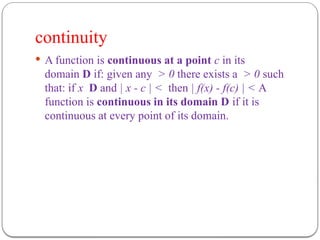
continuity
 A function is continuous at a point c in its
domain D if: given any > 0 there exists a > 0 such
that: if x D and | x - c | < then | f(x) - f(c) | < A
function is continuous in its domain D if it is
continuous at every point of its domain.
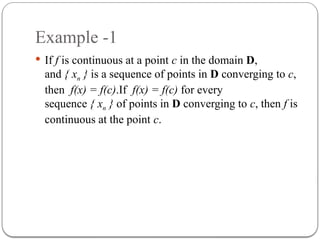
Example -1
 If f is continuous at a point c in the domain D,
and { xn } is a sequence of points in D converging to c,
then f(x) = f(c).If f(x) = f(c) for every
sequence { xn } of points in D converging to c, then f is
continuous at the point c.
Example -2
If f : (a, b) → R is defined on an open interval, then f
is continuous on (a, b) if and only if limx→c f(x) =
f(c) for every a < c < b since every point of (a, b) is an
accumulation point. Example 3.4. If f : [a, b] → R is
defined on a closed, bounded interval, then f is
continuous on [a, b] if and only if limx→c f(x) = f(c)
for every a < c < b, lim x→a+ f(x) = f(a), lim x→b−
f(x) = f(b2.4.
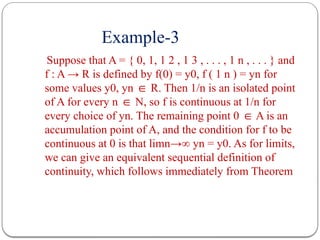
Example-3
Suppose that A = { 0, 1, 1 2 , 1 3 , . . . , 1 n , . . . } and
f : A → R is defined by f(0) = y0, f ( 1 n ) = yn for
some values y0, yn R. Then 1/n is an isolated point
∈
of A for every n N, so f is continuous at 1/n for
∈
every choice of yn. The remaining point 0 A is an
∈
accumulation point of A, and the condition for f to be
continuous at 0 is that limn→∞ yn = y0. As for limits,
we can give an equivalent sequential definition of
continuity, which follows immediately from Theorem
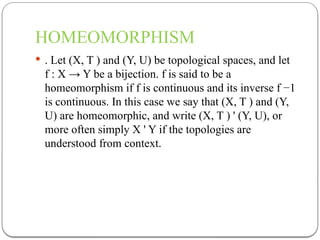
HOMEOMORPHISM
 . Let (X, T ) and (Y, U) be topological spaces, and let
f : X → Y be a bijection. f is said to be a
homeomorphism if f is continuous and its inverse f −1
is continuous. In this case we say that (X, T ) and (Y,
U) are homeomorphic, and write (X, T ) ' (Y, U), or
more often simply X ' Y if the topologies are
understood from context.
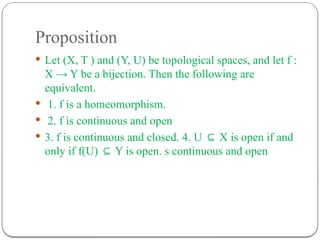
Proposition
 Let (X, T ) and (Y, U) be topological spaces, and let f :
X → Y be a bijection. Then the following are
equivalent.
 1. f is a homeomorphism.
 2. f is continuous and open
 3. f is continuous and closed. 4. U X is open if and
⊆
only if f(U) Y is open. s continuous and open
⊆
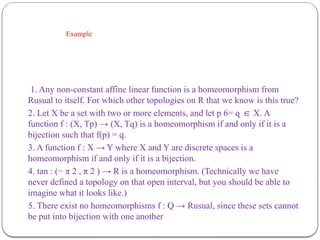
Example
1. Any non-constant affine linear function is a homeomorphism from
Rusual to itself. For which other topologies on R that we know is this true?
2. Let X be a set with two or more elements, and let p 6= q X. A
∈
function f : (X, Tp) → (X, Tq) is a homeomorphism if and only if it is a
bijection such that f(p) = q.
3. A function f : X → Y where X and Y are discrete spaces is a
homeomorphism if and only if it is a bijection.
4. tan : (− π 2 , π 2 ) → R is a homeomorphism. (Technically we have
never defined a topology on that open interval, but you should be able to
imagine what it looks like.)
5. There exist no homeomorphisms f : Q → Rusual, since these sets cannot
be put into bijection with one another
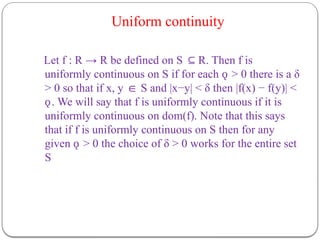
Uniform continuity
Let f : R → R be defined on S R. Then f is
⊆
uniformly continuous on S if for each > 0 there is a δ
ǫ
> 0 so that if x, y S and |x−y| < δ then |f(x) − f(y)| <
∈
. We will say that f is uniformly continuous if it is
ǫ
uniformly continuous on dom(f). Note that this says
that if f is uniformly continuous on S then for any
given > 0 the choice of δ > 0 works for the entire set
ǫ
S
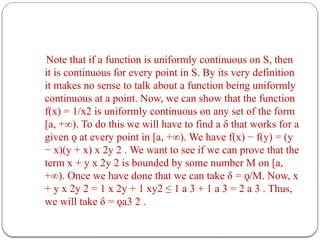
Note that if a function is uniformly continuous on S, then
it is continuous for every point in S. By its very definition
it makes no sense to talk about a function being uniformly
continuous at a point. Now, we can show that the function
f(x) = 1/x2 is uniformly continuous on any set of the form
[a, +∞). To do this we will have to find a δ that works for a
given at every point in [a, +∞). We have f(x) − f(y) = (y
ǫ
− x)(y + x) x 2y 2 . We want to see if we can prove that the
term x + y x 2y 2 is bounded by some number M on [a,
+∞). Once we have done that we can take δ = /M. Now, x
ǫ
+ y x 2y 2 = 1 x 2y + 1 xy2 ≤ 1 a 3 + 1 a 3 = 2 a 3 . Thus,
we will take δ = a3 2 .
ǫ
Theorem
If f is continuous on a closed interval [a, b], then f is
uniformly continuous on [a, b].
 Assume that f is not uniformly continuous on [a, b].
Then there is an > 0 such that for each
ǫ δ > 0 the
implication “|x − y| < δ implies |f(x) − f(y)| < ” fails.
ǫ
Therefore, for each δ > 0 there exists at least a pair of
points x, y [a, b] such that |x − y| <
∈ δ but |f(x) − f(y)|
≥ . Thus, for each n N there exist xn, yn [a, b] so
ǫ ∈ ∈
that |xn − yn| < 1 n but |f(x) − f(y)| > .
ǫ
 By the Bolzano-Weierstrauss Theorem (6.14) there
exists a subsequence {xnk } {xn} that converges.
⊂
Moreover, if x0 = limk→∞ xnk , then x0 [a, b].
∈
Clearly we will also have to have that x0 = limk→∞
ynk . Since f is continuous at x0 we have f(x0) = lim
k→∞ f(xnk ) = lim k→∞ f(ynk ), so lim k→∞ [f(xnk )
− f(ynk )] = 0.
 Since |f(xnk )−f(ynk )| ≥ for all k, we have a
ǫ
contradiction. This leads us to conclude that f is
uniformly continuous on [a, b]. Note that in view of
this theorem the following functions are uniformly
continuous on the indicated sets: x 45 on [a, b], √ x on
[0, a], and cos(x) on [a, b].
THANK YOU

CONTINUITY ,HOMEOMORPHISM ,UNIFORM CONTINUITY

  • 1.
  • 2.
    continuity  A functionis continuous at a point c in its domain D if: given any > 0 there exists a > 0 such that: if x D and | x - c | < then | f(x) - f(c) | < A function is continuous in its domain D if it is continuous at every point of its domain.
  • 3.
    Example -1  Iff is continuous at a point c in the domain D, and { xn } is a sequence of points in D converging to c, then f(x) = f(c).If f(x) = f(c) for every sequence { xn } of points in D converging to c, then f is continuous at the point c.
  • 4.
    Example -2 If f: (a, b) → R is defined on an open interval, then f is continuous on (a, b) if and only if limx→c f(x) = f(c) for every a < c < b since every point of (a, b) is an accumulation point. Example 3.4. If f : [a, b] → R is defined on a closed, bounded interval, then f is continuous on [a, b] if and only if limx→c f(x) = f(c) for every a < c < b, lim x→a+ f(x) = f(a), lim x→b− f(x) = f(b2.4.
  • 5.
    Example-3 Suppose that A= { 0, 1, 1 2 , 1 3 , . . . , 1 n , . . . } and f : A → R is defined by f(0) = y0, f ( 1 n ) = yn for some values y0, yn R. Then 1/n is an isolated point ∈ of A for every n N, so f is continuous at 1/n for ∈ every choice of yn. The remaining point 0 A is an ∈ accumulation point of A, and the condition for f to be continuous at 0 is that limn→∞ yn = y0. As for limits, we can give an equivalent sequential definition of continuity, which follows immediately from Theorem
  • 6.
    HOMEOMORPHISM  . Let(X, T ) and (Y, U) be topological spaces, and let f : X → Y be a bijection. f is said to be a homeomorphism if f is continuous and its inverse f −1 is continuous. In this case we say that (X, T ) and (Y, U) are homeomorphic, and write (X, T ) ' (Y, U), or more often simply X ' Y if the topologies are understood from context.
  • 7.
    Proposition  Let (X,T ) and (Y, U) be topological spaces, and let f : X → Y be a bijection. Then the following are equivalent.  1. f is a homeomorphism.  2. f is continuous and open  3. f is continuous and closed. 4. U X is open if and ⊆ only if f(U) Y is open. s continuous and open ⊆
  • 8.
    Example 1. Any non-constantaffine linear function is a homeomorphism from Rusual to itself. For which other topologies on R that we know is this true? 2. Let X be a set with two or more elements, and let p 6= q X. A ∈ function f : (X, Tp) → (X, Tq) is a homeomorphism if and only if it is a bijection such that f(p) = q. 3. A function f : X → Y where X and Y are discrete spaces is a homeomorphism if and only if it is a bijection. 4. tan : (− π 2 , π 2 ) → R is a homeomorphism. (Technically we have never defined a topology on that open interval, but you should be able to imagine what it looks like.) 5. There exist no homeomorphisms f : Q → Rusual, since these sets cannot be put into bijection with one another
  • 9.
    Uniform continuity Let f: R → R be defined on S R. Then f is ⊆ uniformly continuous on S if for each > 0 there is a δ ǫ > 0 so that if x, y S and |x−y| < δ then |f(x) − f(y)| < ∈ . We will say that f is uniformly continuous if it is ǫ uniformly continuous on dom(f). Note that this says that if f is uniformly continuous on S then for any given > 0 the choice of δ > 0 works for the entire set ǫ S
  • 10.
    Note that ifa function is uniformly continuous on S, then it is continuous for every point in S. By its very definition it makes no sense to talk about a function being uniformly continuous at a point. Now, we can show that the function f(x) = 1/x2 is uniformly continuous on any set of the form [a, +∞). To do this we will have to find a δ that works for a given at every point in [a, +∞). We have f(x) − f(y) = (y ǫ − x)(y + x) x 2y 2 . We want to see if we can prove that the term x + y x 2y 2 is bounded by some number M on [a, +∞). Once we have done that we can take δ = /M. Now, x ǫ + y x 2y 2 = 1 x 2y + 1 xy2 ≤ 1 a 3 + 1 a 3 = 2 a 3 . Thus, we will take δ = a3 2 . ǫ
  • 11.
    Theorem If f iscontinuous on a closed interval [a, b], then f is uniformly continuous on [a, b].
  • 12.
     Assume thatf is not uniformly continuous on [a, b]. Then there is an > 0 such that for each ǫ δ > 0 the implication “|x − y| < δ implies |f(x) − f(y)| < ” fails. ǫ Therefore, for each δ > 0 there exists at least a pair of points x, y [a, b] such that |x − y| < ∈ δ but |f(x) − f(y)| ≥ . Thus, for each n N there exist xn, yn [a, b] so ǫ ∈ ∈ that |xn − yn| < 1 n but |f(x) − f(y)| > . ǫ
  • 13.
     By theBolzano-Weierstrauss Theorem (6.14) there exists a subsequence {xnk } {xn} that converges. ⊂ Moreover, if x0 = limk→∞ xnk , then x0 [a, b]. ∈ Clearly we will also have to have that x0 = limk→∞ ynk . Since f is continuous at x0 we have f(x0) = lim k→∞ f(xnk ) = lim k→∞ f(ynk ), so lim k→∞ [f(xnk ) − f(ynk )] = 0.
  • 14.
     Since |f(xnk)−f(ynk )| ≥ for all k, we have a ǫ contradiction. This leads us to conclude that f is uniformly continuous on [a, b]. Note that in view of this theorem the following functions are uniformly continuous on the indicated sets: x 45 on [a, b], √ x on [0, a], and cos(x) on [a, b].
  • 15.