Mathematical Theory and Modeling                                                                         www.iiste.org
ISSN 2224-5804 (Paper) ISSN 2225-0522 (Online)
Vol.2, No.5, 2012


     Coincidence Points for Mappings under Generalized Contraction
                                                Ajay Gairola*and Mahesh C.Joshi
                        Department of Mathematics, D.S.B. Campus, Kumaun University, Nainital
                                   *Email of the corresponding author: ajjumath@gmail.com


Abstract
In this paper we establish some results on the existence of coincidence and fixed points for multi-valued and single
valued mappings extending the result of Feng and Liu [2] and Liu et.al [5]. It is also proved with counter example
that our results generalize and extend some well known results.
Key Words: common fixed point, Coincidence point, multi-valued mappings.


1.   Introduction and Preliminaries

Generalizing Banach Contraction Principle, Nadler [3] introduced the concept of multivalued contraction mapping.
Let (X, d) be a metric space. Following Nadler [3] and Liu et.al [5] we follow following notations throughout this
paper.
CB(X) (resp.CL(X)) denote the family of all closed and bounded (resp. closed) subsets of X. C(X) represents set of all
compact subsets of X. The Hausdorff distance for two subsets A, B of X is defined as:
H(A, B) = max ({sup d(a, B): a     A}, {sup d(A, b): b   B})
where d(a, B) = inf {d(a, b): b   B},
It is well known that CB(X) (resp. CL(X)) is a metric space with Hausdorff distance function.
Let T:X →CL(X). Using the concept of Hausdorff distance, Nadler [3] defined multivalued contraction as following,
H(Tx, Ty) ≤ αd(x, y) ∀ x, y ∈ X and α < 1.
Nadler proved that for a multivalued contraction in a complete metric space there exists a fixed point. Recently Feng
and Liu [2] and Liu et.al [5] generalized the Nadler’s result. Feng and Liu [2] gave an example to establish that if
the mapping T does not satisfy the above contractive condition even then it has a fixed point. Feng and Liu [2]
generalized the above contractive condition by considering the point y T(x) for any x X in place of x, y ∈ X and
proved the following result.
Theorem 1 [4]. Let (X, d) be a complete metric space, and let T be a multivalued mapping from X to CL(X). If there
exist constant b, c (0, 1), c < b, such that for any x X there is y T(x) satisfying,
                           bd(x, y) ≤ f(x),   f(y) ≤ cd(x, y)                                             (1.1)
then T has a fixed point in X provided the function f(x) = d(x, T(x)), x   X is lower semi continuous.
Generalizing above result and the result of Ciric [1], Liu et.al [5] relax the contractive condition by taking
and          in place of constant b and c, where


 :B           , :B     [0, 1) and B =                                                                    …(A)


In this paper we extend the result of [2] and [5] for the existence of coincidence points.


2.   Main Result
Let (X, d) be a metric space, T: X →CL(X) and f: X→X. An orbit of the multivalued map T at a point x0 in X is a


                                                            1
Mathematical Theory and Modeling                                                                                     www.iiste.org
ISSN 2224-5804 (Paper) ISSN 2225-0522 (Online)
Vol.2, No.5, 2012

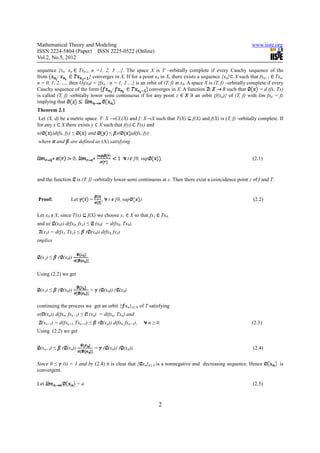
sequence {xn: xn Txn-1, n =1, 2, 3 ...}. The space X is T –orbitally complete if every Cauchy sequence of the
from                       } converges in X. If for a point x0 in X, there exists a sequence {xn} X such that fxn+1 Txn,
n = 0, 1, 2, …, then Of(x0) = {fxn : n = 1, 2 …} is an orbit of (T, f) at x0. A space X is (T, f) –orbitally complete if every
Cauchy sequence of the form                              converges in X. A function             R such that        = d (fx, Tx)
is called (T, f) -orbitally lower semi continuous if for any point z              an orbit {f(xn)} of (T, f) with lim fxn = fz
implying that                          .
Theorem 2.1
 Let (X, d) be a metric space. T: X →CL(X) and f: X→X such that T(X)                   f(X) and f(X) is (T, f) -orbitally complete. If
for any x X there exists y X such that f(y) T(x) and
α(        )d(fx, fy) ≤         and               ≤ ((       )d(fx, fy)
where       and    are defined as (A) satisfying


                         ,                                t∈ [0, sup            ,                                     (2.1)


and the function         is (T, f) -orbitally lower semi continuous at z. Then there exist a coincidence point z of f and T.


Proof:              Let         =         ,     t [0, sup         )                                                   (2.2)


Let x0 X, since T(x)           f(X) we choose x1            X so that fx1       Tx0,
and α( (x0)) d(fx0, fx1) ≤           (x0) = d(fx0, Tx0),
  (x1) = d(fx1, Tx1) ≤        ( (x0)) d(fx0, fx1)
implies


 (x1) ≤      ( (x0))             .


Using (2.2) we get


 (x1) ≤      ( (x0))            =        ( (x0)) ( (x0)


continuing the process we get an orbit { xn}n≥ 0 of T satisfying
α( (xn)) d(fxn, fxn+1) ≤       (xn) = d(fxn, Txn) and
  (xn+1) = d(fxn+1, Txn+1) ≤             ( (xn)) d(fxn, fxn+1),        n ≥ 0.                                        (2.3)
Using (2.2) we get


 (xn+1) ≤      ( (xn))               =        ( (xn)) ( (xn)).                                                        (2.4)


Since 0 ≤ (t) < 1 and by (2.4) it is clear that { xn}n≥ 0 is a nonnegative and decreasing sequence. Hence                           is
convergent.

Let                      =a                                                                                           (2.5)


                                                                            2
Mathematical Theory and Modeling                                                                         www.iiste.org
ISSN 2224-5804 (Paper) ISSN 2225-0522 (Online)
Vol.2, No.5, 2012

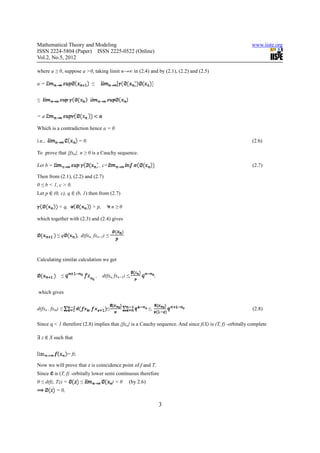
where a ≥ 0, suppose a >0, taking limit n→∞ in (2.4) and by (2.1), (2.2) and (2.5)

a=                               ≤


≤


=a

Which is a contradiction hence a = 0

i.e.,                     = 0.                                                                           (2.6)

To prove that {fxn}, n ≥ 0 is a Cauchy sequence.

Let b =                                  , c=                                                             (2.7)

Then from (2.1), (2.2) and (2.7)
0 ≤ b < 1, c > 0.
Let p     (0, c), q   (b, 1) then from (2.7)

            < q,                 > p,           n≥0

which together with (2.3) and (2.4) gives


           ≤q              d(fxn, fxn+1) ≤


Calculating similar calculation we get


             ≤                       ,    d(fxn, fxn+1) ≤,               .

which gives


d(fxn , fxm) ≤                              ≤                       ≤.                                    (2.8)

Since q < 1 therefore (2.8) implies that {fxn} is a Cauchy sequence. And since f(X) is (T, f) -orbitally complete

    z   X such that


                  = fz.

Now we will prove that z is coincidence point of f and T.
Since     is (T, f) -orbitally lower semi continuous therefore
0 ≤ d(fz, Tz) =           ≤                     )=0      (by 2.6)
           = 0,

                                                                             3
Mathematical Theory and Modeling                                                                                 www.iiste.org
ISSN 2224-5804 (Paper) ISSN 2225-0522 (Online)
Vol.2, No.5, 2012

      d(fz, Tz) = 0
      f(z)   T(z) i.e. f and T have a coincidence point .


          In Theorem 2.1, taking constants α and in place of α(            ) and ((      ) respectively we get following
result as a corollary. The following corollary is also serves as a generalization of Singh and Kulsrestha[4].
Corollary 2.1.
 Let (X, d) be a metric space. T: X →CL(X) and f: X→X are mappings such that T(X)                    f(X) and f(X) is    (T, f) -
orbitally complete. If for any x X there is y X such that f(y) T(x) satisfying

                             And            ≤ d(fx, fy)

where α,         (0, 1) and α <       and the function      is is lower semi continuous. Then T and f has a coincidence point in
X.


Proof
Let x0 X, since T(x)           f(X) we choose x1 X such that fx1 Tx0.
By the given contractive condition
     d(fx0, fx1) ≤ (x0) =      d(fx0, Tx0) and
    (x1) = d(fx1, Tx1) ≤ α d(fx0, fx1).
In similar way we choose xn+1              X such that f(xn+1)   T(xn) and
d(fxn+1, Txn+1) ≤ α d(fxn, fxn+1),          d(fxn, fxn+1) ≤ (xn) =   d(fxn, Txn)
which implies


d(fxn+1, Txn+1) ≤ d(fxn, Txn)


or d(fxn+1, fxn+2) ≤ d(fxn, fxn+1)


      d(fxn, Txn) ≤          d(fx0, Tx0)


Or d(fxn, fxn+1) ≤           d(fx0, fx1).                                                                        (2.9)


Using (2.9) for m, n         N, m>n,

d(fxm, fxn) ≤ d(fxm, fxm-1) + d(fxm-1, fxm-2)+ …+ d(fxn+1, fxn)

≤            d(fx0, fx1) +           d(fx0, fx1) +           d(fx0, fx1) +…+       d(fx0, fx1)


                                                                      4
Mathematical Theory and Modeling                                                                              www.iiste.org
ISSN 2224-5804 (Paper) ISSN 2225-0522 (Online)
Vol.2, No.5, 2012


≤        d(fx0, fx1)                                                                                         (2.10)


As n       ,


hence {fxn} is a Cauchy sequence. Since f(X) is (T, f) -orbitally complete there exists z      X such that

               converges to fz.

Now using the condition of (T, f) –orbitally lower semi continuity of            we can be easily prove that z is coincidence
point of f and T.
In theorem 2.1 taking C(X) in place of CL(X) we get we get following result as corollary.
Corollary 2.2
Let (X, d) be a metric space. T: X →C(X) and f: X→X such that T and f satisfy all conditions as in theorem 2.1 then
there exist a coincidence point z of f and T.
Proof.
Proof is same as of theorem 2.1.
In corollary 2.1 taking C(X) in place of CL(X) we get we get following result as corollary.


Corollary 2.3
Let (X, d) be a metric space. T: X →C(X) and f: X→X are mappings such that all conditions as in corollary 2.1 are
satisfied then T and f has a coincidence point in X.


Proof
Proof is same as of corollary 2.1.
Example
Let X = { 1 , 1 , ..., 1 , ...} U {0,1} , d(x, y) =   x − y , for x, y X; then X is complete metric space. Define mapping T:
                        n
          2 4         2
X→ CL(X) as
        1
                  
                          1                 
        2 n+ 2 ,1 , x = n , n = 0,1, 2,...
T(x) = 
                                           
        2              2                  
        1                                 
       0, 2  , x = 0                      
                                          

and f(x) = x2, x X.

Obviously, T and f does not satisfy hybrid contraction condition [4].

    1                 1   1     1            1       
H  T  2 n  , T ( 0 )  = ≥ 2 n = 2 n − 0 = d  2 n , 0  , n = 1, 2..
                      2                              
   2                     2 2                2        


                                                                      5
Mathematical Theory and Modeling                                                              www.iiste.org
ISSN 2224-5804 (Paper) ISSN 2225-0522 (Online)
Vol.2, No.5, 2012

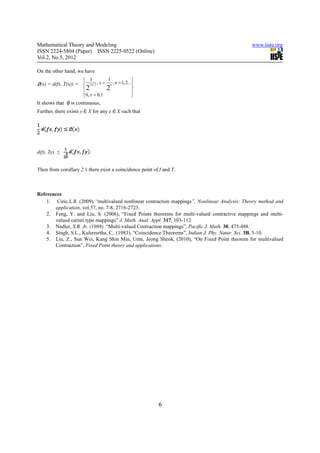
On the other hand, we have
                           1                1                    
∅(x) = d(fx, T(x)) =        2 n+ 2
                                      ,x =       n
                                                     , n = 1, 2...
                          2                 2                    
                          0, x = 0,1                             
                                                                 
It shows that ∅ is continuous,
Further, there exists y     X for any x                X such that


d(fy, Ty) ≤


Then from corollary 2.1 there exist a coincidence point of f and T.


References
    1. Ciric,L.B. (2009),“multivalued nonlinear contraction mappings”, Nonlinear Analysis: Theory method and
       application, vol.57, no. 7-8, 2716-2723.
    2. Feng, Y. and Liu, S. (2006), “Fixed Points theorems for multi-valued contractive mappings and multi-
       valued caristi type mappings” J. Math. Anal. Appl. 317, 103-112.
    3. Nadler, S.B. Jr. (1969), “Multi-valued Contraction mappings”, Pacific J. Math. 30, 475-488.
    4. Singh, S.L., Kulsresrtha, C., (1983), “Coincidence Theorems”, Indian J. Phy. Natur. Sci. 3B, 5-10.
    5. Liu, Z., Sun Wei, Kang Shin Min, Ume, Jeong Sheok, (2010), “On Fixed Point theorem for multivalued
       Contraction”, Fixed Point theory and applications.


                                                                      6
This academic article was published by The International Institute for Science,
Technology and Education (IISTE). The IISTE is a pioneer in the Open Access
Publishing service based in the U.S. and Europe. The aim of the institute is
Accelerating Global Knowledge Sharing.

More information about the publisher can be found in the IISTE’s homepage:
http://www.iiste.org


The IISTE is currently hosting more than 30 peer-reviewed academic journals and
collaborating with academic institutions around the world. Prospective authors of
IISTE journals can find the submission instruction on the following page:
http://www.iiste.org/Journals/

The IISTE editorial team promises to the review and publish all the qualified
submissions in a fast manner. All the journals articles are available online to the
readers all over the world without financial, legal, or technical barriers other than
those inseparable from gaining access to the internet itself. Printed version of the
journals is also available upon request of readers and authors.

IISTE Knowledge Sharing Partners

EBSCO, Index Copernicus, Ulrich's Periodicals Directory, JournalTOCS, PKP Open
Archives Harvester, Bielefeld Academic Search Engine, Elektronische
Zeitschriftenbibliothek EZB, Open J-Gate, OCLC WorldCat, Universe Digtial
Library , NewJour, Google Scholar

Coincidence points for mappings under generalized contraction

  • 1.
    Mathematical Theory andModeling www.iiste.org ISSN 2224-5804 (Paper) ISSN 2225-0522 (Online) Vol.2, No.5, 2012 Coincidence Points for Mappings under Generalized Contraction Ajay Gairola*and Mahesh C.Joshi Department of Mathematics, D.S.B. Campus, Kumaun University, Nainital *Email of the corresponding author: ajjumath@gmail.com Abstract In this paper we establish some results on the existence of coincidence and fixed points for multi-valued and single valued mappings extending the result of Feng and Liu [2] and Liu et.al [5]. It is also proved with counter example that our results generalize and extend some well known results. Key Words: common fixed point, Coincidence point, multi-valued mappings. 1. Introduction and Preliminaries Generalizing Banach Contraction Principle, Nadler [3] introduced the concept of multivalued contraction mapping. Let (X, d) be a metric space. Following Nadler [3] and Liu et.al [5] we follow following notations throughout this paper. CB(X) (resp.CL(X)) denote the family of all closed and bounded (resp. closed) subsets of X. C(X) represents set of all compact subsets of X. The Hausdorff distance for two subsets A, B of X is defined as: H(A, B) = max ({sup d(a, B): a A}, {sup d(A, b): b B}) where d(a, B) = inf {d(a, b): b B}, It is well known that CB(X) (resp. CL(X)) is a metric space with Hausdorff distance function. Let T:X →CL(X). Using the concept of Hausdorff distance, Nadler [3] defined multivalued contraction as following, H(Tx, Ty) ≤ αd(x, y) ∀ x, y ∈ X and α < 1. Nadler proved that for a multivalued contraction in a complete metric space there exists a fixed point. Recently Feng and Liu [2] and Liu et.al [5] generalized the Nadler’s result. Feng and Liu [2] gave an example to establish that if the mapping T does not satisfy the above contractive condition even then it has a fixed point. Feng and Liu [2] generalized the above contractive condition by considering the point y T(x) for any x X in place of x, y ∈ X and proved the following result. Theorem 1 [4]. Let (X, d) be a complete metric space, and let T be a multivalued mapping from X to CL(X). If there exist constant b, c (0, 1), c < b, such that for any x X there is y T(x) satisfying, bd(x, y) ≤ f(x), f(y) ≤ cd(x, y) (1.1) then T has a fixed point in X provided the function f(x) = d(x, T(x)), x X is lower semi continuous. Generalizing above result and the result of Ciric [1], Liu et.al [5] relax the contractive condition by taking and in place of constant b and c, where :B , :B [0, 1) and B = …(A) In this paper we extend the result of [2] and [5] for the existence of coincidence points. 2. Main Result Let (X, d) be a metric space, T: X →CL(X) and f: X→X. An orbit of the multivalued map T at a point x0 in X is a 1
  • 2.
    Mathematical Theory andModeling www.iiste.org ISSN 2224-5804 (Paper) ISSN 2225-0522 (Online) Vol.2, No.5, 2012 sequence {xn: xn Txn-1, n =1, 2, 3 ...}. The space X is T –orbitally complete if every Cauchy sequence of the from } converges in X. If for a point x0 in X, there exists a sequence {xn} X such that fxn+1 Txn, n = 0, 1, 2, …, then Of(x0) = {fxn : n = 1, 2 …} is an orbit of (T, f) at x0. A space X is (T, f) –orbitally complete if every Cauchy sequence of the form converges in X. A function R such that = d (fx, Tx) is called (T, f) -orbitally lower semi continuous if for any point z an orbit {f(xn)} of (T, f) with lim fxn = fz implying that . Theorem 2.1 Let (X, d) be a metric space. T: X →CL(X) and f: X→X such that T(X) f(X) and f(X) is (T, f) -orbitally complete. If for any x X there exists y X such that f(y) T(x) and α( )d(fx, fy) ≤ and ≤ (( )d(fx, fy) where and are defined as (A) satisfying , t∈ [0, sup , (2.1) and the function is (T, f) -orbitally lower semi continuous at z. Then there exist a coincidence point z of f and T. Proof: Let = , t [0, sup ) (2.2) Let x0 X, since T(x) f(X) we choose x1 X so that fx1 Tx0, and α( (x0)) d(fx0, fx1) ≤ (x0) = d(fx0, Tx0), (x1) = d(fx1, Tx1) ≤ ( (x0)) d(fx0, fx1) implies (x1) ≤ ( (x0)) . Using (2.2) we get (x1) ≤ ( (x0)) = ( (x0)) ( (x0) continuing the process we get an orbit { xn}n≥ 0 of T satisfying α( (xn)) d(fxn, fxn+1) ≤ (xn) = d(fxn, Txn) and (xn+1) = d(fxn+1, Txn+1) ≤ ( (xn)) d(fxn, fxn+1), n ≥ 0. (2.3) Using (2.2) we get (xn+1) ≤ ( (xn)) = ( (xn)) ( (xn)). (2.4) Since 0 ≤ (t) < 1 and by (2.4) it is clear that { xn}n≥ 0 is a nonnegative and decreasing sequence. Hence is convergent. Let =a (2.5) 2
  • 3.
    Mathematical Theory andModeling www.iiste.org ISSN 2224-5804 (Paper) ISSN 2225-0522 (Online) Vol.2, No.5, 2012 where a ≥ 0, suppose a >0, taking limit n→∞ in (2.4) and by (2.1), (2.2) and (2.5) a= ≤ ≤ =a Which is a contradiction hence a = 0 i.e., = 0. (2.6) To prove that {fxn}, n ≥ 0 is a Cauchy sequence. Let b = , c= (2.7) Then from (2.1), (2.2) and (2.7) 0 ≤ b < 1, c > 0. Let p (0, c), q (b, 1) then from (2.7) < q, > p, n≥0 which together with (2.3) and (2.4) gives ≤q d(fxn, fxn+1) ≤ Calculating similar calculation we get ≤ , d(fxn, fxn+1) ≤, . which gives d(fxn , fxm) ≤ ≤ ≤. (2.8) Since q < 1 therefore (2.8) implies that {fxn} is a Cauchy sequence. And since f(X) is (T, f) -orbitally complete z X such that = fz. Now we will prove that z is coincidence point of f and T. Since is (T, f) -orbitally lower semi continuous therefore 0 ≤ d(fz, Tz) = ≤ )=0 (by 2.6) = 0, 3
  • 4.
    Mathematical Theory andModeling www.iiste.org ISSN 2224-5804 (Paper) ISSN 2225-0522 (Online) Vol.2, No.5, 2012 d(fz, Tz) = 0 f(z) T(z) i.e. f and T have a coincidence point . In Theorem 2.1, taking constants α and in place of α( ) and (( ) respectively we get following result as a corollary. The following corollary is also serves as a generalization of Singh and Kulsrestha[4]. Corollary 2.1. Let (X, d) be a metric space. T: X →CL(X) and f: X→X are mappings such that T(X) f(X) and f(X) is (T, f) - orbitally complete. If for any x X there is y X such that f(y) T(x) satisfying And ≤ d(fx, fy) where α, (0, 1) and α < and the function is is lower semi continuous. Then T and f has a coincidence point in X. Proof Let x0 X, since T(x) f(X) we choose x1 X such that fx1 Tx0. By the given contractive condition d(fx0, fx1) ≤ (x0) = d(fx0, Tx0) and (x1) = d(fx1, Tx1) ≤ α d(fx0, fx1). In similar way we choose xn+1 X such that f(xn+1) T(xn) and d(fxn+1, Txn+1) ≤ α d(fxn, fxn+1), d(fxn, fxn+1) ≤ (xn) = d(fxn, Txn) which implies d(fxn+1, Txn+1) ≤ d(fxn, Txn) or d(fxn+1, fxn+2) ≤ d(fxn, fxn+1) d(fxn, Txn) ≤ d(fx0, Tx0) Or d(fxn, fxn+1) ≤ d(fx0, fx1). (2.9) Using (2.9) for m, n N, m>n, d(fxm, fxn) ≤ d(fxm, fxm-1) + d(fxm-1, fxm-2)+ …+ d(fxn+1, fxn) ≤ d(fx0, fx1) + d(fx0, fx1) + d(fx0, fx1) +…+ d(fx0, fx1) 4
  • 5.
    Mathematical Theory andModeling www.iiste.org ISSN 2224-5804 (Paper) ISSN 2225-0522 (Online) Vol.2, No.5, 2012 ≤ d(fx0, fx1) (2.10) As n , hence {fxn} is a Cauchy sequence. Since f(X) is (T, f) -orbitally complete there exists z X such that converges to fz. Now using the condition of (T, f) –orbitally lower semi continuity of we can be easily prove that z is coincidence point of f and T. In theorem 2.1 taking C(X) in place of CL(X) we get we get following result as corollary. Corollary 2.2 Let (X, d) be a metric space. T: X →C(X) and f: X→X such that T and f satisfy all conditions as in theorem 2.1 then there exist a coincidence point z of f and T. Proof. Proof is same as of theorem 2.1. In corollary 2.1 taking C(X) in place of CL(X) we get we get following result as corollary. Corollary 2.3 Let (X, d) be a metric space. T: X →C(X) and f: X→X are mappings such that all conditions as in corollary 2.1 are satisfied then T and f has a coincidence point in X. Proof Proof is same as of corollary 2.1. Example Let X = { 1 , 1 , ..., 1 , ...} U {0,1} , d(x, y) = x − y , for x, y X; then X is complete metric space. Define mapping T: n 2 4 2 X→ CL(X) as  1    1   2 n+ 2 ,1 , x = n , n = 0,1, 2,... T(x) =      2  2   1   0, 2  , x = 0     and f(x) = x2, x X. Obviously, T and f does not satisfy hybrid contraction condition [4].   1   1 1 1  1  H  T  2 n  , T ( 0 )  = ≥ 2 n = 2 n − 0 = d  2 n , 0  , n = 1, 2..     2    2   2 2 2  5
  • 6.
    Mathematical Theory andModeling www.iiste.org ISSN 2224-5804 (Paper) ISSN 2225-0522 (Online) Vol.2, No.5, 2012 On the other hand, we have  1 1  ∅(x) = d(fx, T(x)) =  2 n+ 2 ,x = n , n = 1, 2... 2 2  0, x = 0,1    It shows that ∅ is continuous, Further, there exists y X for any x X such that d(fy, Ty) ≤ Then from corollary 2.1 there exist a coincidence point of f and T. References 1. Ciric,L.B. (2009),“multivalued nonlinear contraction mappings”, Nonlinear Analysis: Theory method and application, vol.57, no. 7-8, 2716-2723. 2. Feng, Y. and Liu, S. (2006), “Fixed Points theorems for multi-valued contractive mappings and multi- valued caristi type mappings” J. Math. Anal. Appl. 317, 103-112. 3. Nadler, S.B. Jr. (1969), “Multi-valued Contraction mappings”, Pacific J. Math. 30, 475-488. 4. Singh, S.L., Kulsresrtha, C., (1983), “Coincidence Theorems”, Indian J. Phy. Natur. Sci. 3B, 5-10. 5. Liu, Z., Sun Wei, Kang Shin Min, Ume, Jeong Sheok, (2010), “On Fixed Point theorem for multivalued Contraction”, Fixed Point theory and applications. 6
  • 7.
    This academic articlewas published by The International Institute for Science, Technology and Education (IISTE). The IISTE is a pioneer in the Open Access Publishing service based in the U.S. and Europe. The aim of the institute is Accelerating Global Knowledge Sharing. More information about the publisher can be found in the IISTE’s homepage: http://www.iiste.org The IISTE is currently hosting more than 30 peer-reviewed academic journals and collaborating with academic institutions around the world. Prospective authors of IISTE journals can find the submission instruction on the following page: http://www.iiste.org/Journals/ The IISTE editorial team promises to the review and publish all the qualified submissions in a fast manner. All the journals articles are available online to the readers all over the world without financial, legal, or technical barriers other than those inseparable from gaining access to the internet itself. Printed version of the journals is also available upon request of readers and authors. IISTE Knowledge Sharing Partners EBSCO, Index Copernicus, Ulrich's Periodicals Directory, JournalTOCS, PKP Open Archives Harvester, Bielefeld Academic Search Engine, Elektronische Zeitschriftenbibliothek EZB, Open J-Gate, OCLC WorldCat, Universe Digtial Library , NewJour, Google Scholar