Math 441: Chapter III, Metric Spaces
Leonardo Di Giosia
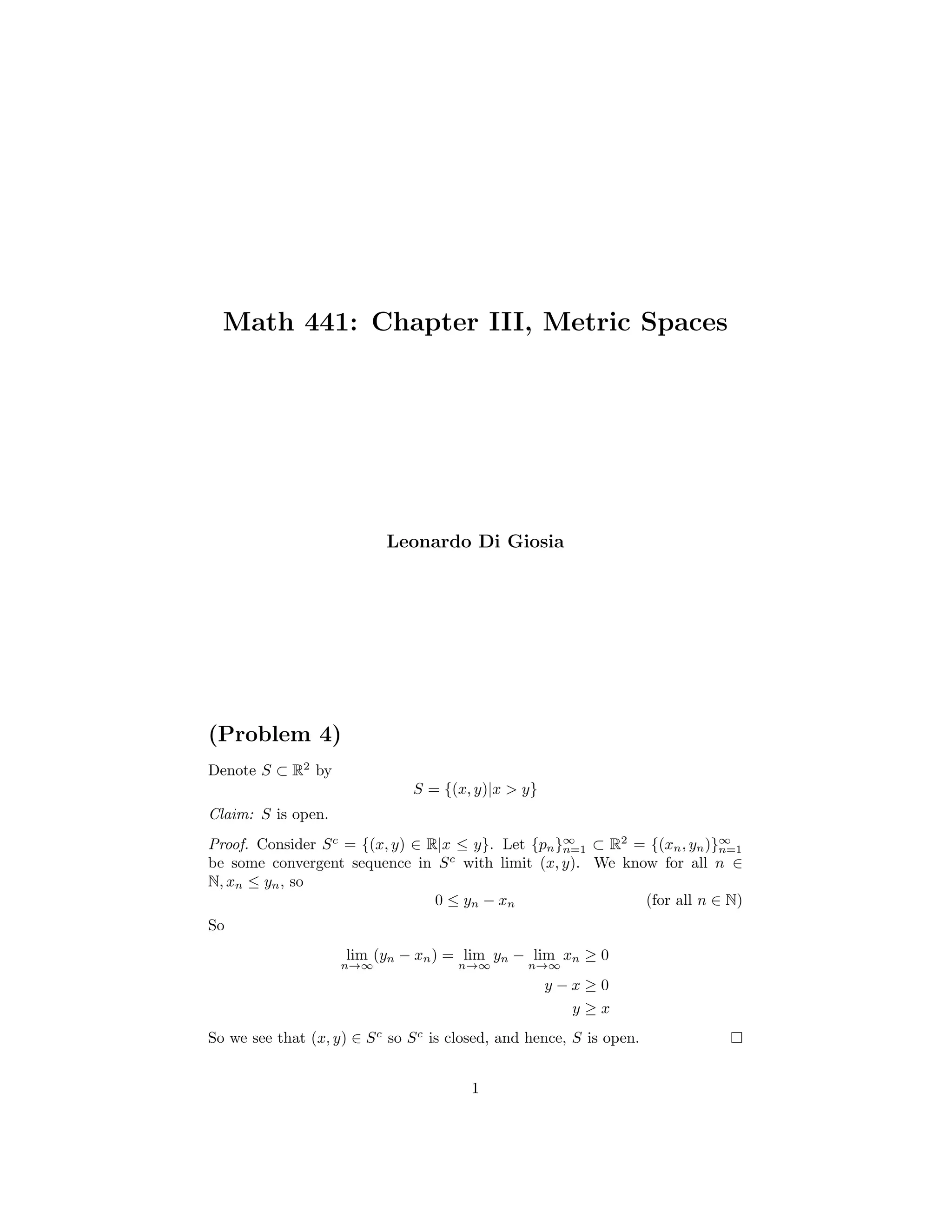
(Problem 4)
Denote S ⊂ R2
by
S = {(x, y)|x > y}
Claim: S is open.
Proof. Consider Sc
= {(x, y) ∈ R|x ≤ y}. Let {pn}∞
n=1 ⊂ R2
= {(xn, yn)}∞
n=1
be some convergent sequence in Sc
with limit (x, y). We know for all n ∈
N, xn ≤ yn, so
0 ≤ yn − xn (for all n ∈ N)
So
lim
n→∞
(yn − xn) = lim
n→∞
yn − lim
n→∞
xn ≥ 0
y − x ≥ 0
y ≥ x
So we see that (x, y) ∈ Sc
so Sc
is closed, and hence, S is open.
1
Chapter III Metric Spaces
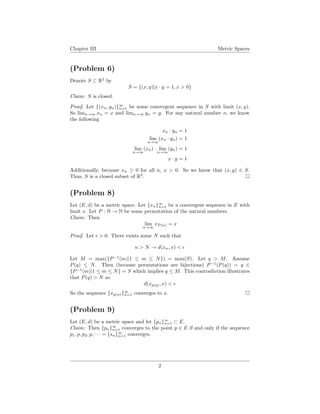
(Problem 6)
Denote S ⊂ R2
by
S = {(x, y)|x · y = 1, x > 0}
Claim: S is closed.
Proof. Let {(xn, yn)}∞
n=1 be some convergent sequence in S with limit (x, y).
So limn→∞ xn = x and limn→∞ yn = y. For any natural number n, we know
the following
xn · yn = 1
lim
n→∞
(xn · yn) = 1
lim
n→∞
(xn) · lim
n→∞
(yn) = 1
x · y = 1
Additionally, because xn ≥ 0 for all n, x > 0. So we know that (x, y) ∈ S.
Thus, S is a closed subset of R2
.
(Problem 8)
Let (E, d) be a metric space. Let {xn}∞
n=1 be a convergent sequence in E with
limit x. Let P : N → N be some permutation of the natural numbers.
Claim: Then
lim
n→∞
xP (n) = x
Proof. Let > 0. There exists some N such that
n > N → d(xn, x) <
Let M = max({P−1
(m)|1 ≤ m ≤ N}) = max(S). Let q > M. Assume
P(q) ≤ N. Then (because permutations are bijections) P−1
(P(q)) = q ∈
{P−1
(m)|1 ≤ m ≤ N} = S which implies q ≤ M. This contradiction illustrates
that P(q) > N so
d(xp(q), x) <
So the sequence {xp(n)}∞
n=1 converges to x.
(Problem 9)
Let (E, d) be a metric space and let {pn}∞
n=1 ⊂ E.
Claim: Then {pn}∞
n=1 converges to the point p ∈ E if and only if the sequence
p1, p, p2, p, · · · = {sn}∞
n=1 converges.
2
Chapter III Metric Spaces
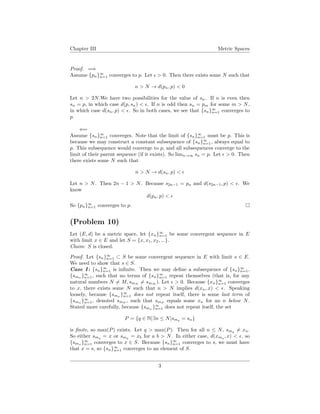
Proof. =⇒
Assume {pn}∞
n=1 converges to p. Let > 0. Then there exists some N such that
n > N → d(pn, p) < 0
Let n > 2N.We have two possibilities for the value of sn. If n is even then
sn = p, in which case d(p, sn) < . If n is odd then sn = pm for some m > N,
in which case d(sn, p) < . So in both cases, we see that {sn}∞
n=1 converges to
p.
⇐=
Assume {sn}∞
n=1 converges. Note that the limit of {sn}∞
n=1 must be p. This is
because we may construct a constant subsequence of {sn}∞
n=1, always equal to
p. This subsequence would converge to p, and all subsequences converge to the
limit of their parent sequence (if it exists). So limn→∞ sn = p. Let > 0. Then
there exists some N such that
n > N → d(sn, p) <
Let n > N. Then 2n − 1 > N. Because s2n−1 = pn and d(s2n−1, p) < . We
know
d(pn, p) <
So {pn}∞
n=1 converges to p.
(Problem 10)
Let (E, d) be a metric space, let {xn}∞
n=1 be some convergent sequence in E
with limit x ∈ E and let S = {x, x1, x2, ...}.
Claim: S is closed.
Proof. Let {sn}∞
n=1 ⊂ S be some convergent sequence in E with limit s ∈ E.
We need to show that s ∈ S.
Case I : {sn}∞
n=1 is infinite. Then we may define a subsequence of {sn}∞
n=1,
{smn }∞
n=1, such that no terms of {sn}∞
n=1 repeat themselves (that is, for any
natural numbers N = M, smN
= smM
). Let > 0. Because {xn}∞
n=1 converges
to x, there exists some N such that n > N implies d(xn, x) < . Speaking
loosely, because {smn
}∞
n=1 does not repeat itself, there is some last term of
{smn }∞
n=1, denoted smP
, such that smP
equals some xn for an n below N.
Stated more carefully, because {smn }∞
n=1 does not repeat itself, the set
P = {q ∈ N|∃n ≤ N|smq = sn}
is finite, so max(P) exists. Let q > max(P). Then for all n ≤ N, smq
= xn.
So either smq = x or smq = xb for a b > N. In either case, d(xmq , x) < , so
{smn }∞
n=1 converges to x ∈ S. Because {sn}∞
n=1 converges to s, we must have
that x = s, so {sn}∞
n=1 converges to an element of S.
3
Chapter III Metric Spaces
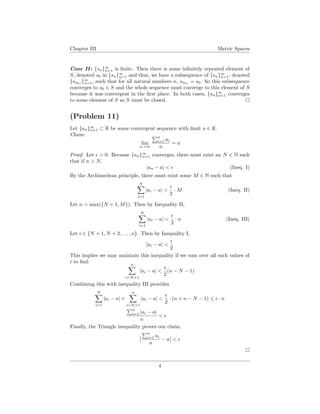
Case II : {sn}∞
n=1 is finite. Then there is some infinitely repeated element of
S, denoted s0 in {sn}∞
n=1 and thus, we have a subsequence of {sn}∞
n=1, denoted
{smn
}∞
n=1, such that for all natural numbers n, smn
= s0. So this subsequence
converges to s0 ∈ S and the whole sequence must converge to this element of S
because it was convergent in the first place. In both cases, {sn}∞
n=1 converges
to some element of S so S must be closed.
(Problem 11)
Let {an}∞
n=1 ⊂ R be some convergent sequence with limit a ∈ R.
Claim:
lim
n→∞
n
i=1 ai
n
= a
Proof. Let > 0. Because {an}∞
n=1 converges, there must exist an N ∈ N such
that if n > N.
|an − a| < (Ineq. I)
By the Archimedean principle, there must exist some M ∈ N such that
N
i=1
|ai − a| <
2
· M (Ineq. II)
Let n > max({N + 1, M}). Then by Inequality II,
N
i=1
|ai − a| <
2
· n (Ineq. III)
Let i ∈ {N + 1, N + 2, . . . , n}. Then by Inequality I,
|ai − a| <
2
This implies we may maintain this inequality if we sum over all such values of
i to find
n
i=N+1
|ai − a| <
2
(n − N − 1)
Combining this with inequality III provides
N
i=1
|ai − a| +
n
i=N+1
|ai − a| <
2
· (n + n − N − 1) ≤ · n
n
i=1 |ai − a|
n
<
Finally, the Triangle inequality proves our claim,
n
i=1 ai
n
− a <
4
Chapter III Metric Spaces
(Problem 12)
Denote {xn}∞
n=1 ⊂ R recursively by x1 = 1 and xn+1 = xn + 1
x2
n
for all n ∈ N.
Claim: Then {xn}∞
n=1 is unbounded (from above).
Proof. Assume it is bounded. Then, because it is monotonically increasing, we
see that it must be convergent with some limit x ∈ R. We know that for all
n ∈ N, xn ≥ 1 so x = 0. So we have
lim
n→∞
xn = x
lim
n→∞
xn+1 = x
x + lim
n→∞
1
x2
n
= x
1
x2
= 0
So our assumption was false and we must have that the sequence is unbounded
(from above).
(Problem 17)
Let (E, d) be a metric space and let S ⊂ E.
(a)
Claim:
E = interior(S) ∪ interior(Sc
) ∪ boundary(S)
Proof. Let x ∈ E. If x ∈ interior(S) ∪ interior(Sc
) then we have nothing to
show. So assume x is not in this set. So for all positive real numbers
∃α ∈ S|α /∈ b (x)
and
∃β ∈ Sc
|β /∈ b (x)
Define sequences {an}∞
n=1 and {bn}∞
n=1 by the following: For each n ∈ N, an is
the element of S such that an is not b 1
n
(x) and bn is that of Sc
not in b 1
n
(x). It is
apparent (and easily verifiable) that these sequences converge to x and are both
fully contained (respectively) by S and Sc
. So if C and K are any two closed
sets containing S and Sc
respectively, they must contain {an}∞
n=1 and {bn}∞
n=1,
respectively, in which case, x is an element of both C and K (because they are
closed). So x is in both closure of S and the closure of Sc
. So x ∈ boundary(S).
So in both cases, x is an element of the set on the right, implying
E ⊂ interior(S) ∪ interior(Sc
) ∪ boundary(S)
E = interior(S) ∪ interior(Sc
) ∪ boundary(S)
5
Chapter III Metric Spaces
(b)
Claim: S is closed if and only if it contains its boundary.
Proof. =⇒
Let S be a closed set. Let x ∈ boundary(S). Then x ∈ Si for any closed set Si
containing S, but necessarily, S is a closed set which contains S. So x ∈ S and
boundary(S) ⊂ S.
⇐=
Let boundary(S) ⊂ S. Let p be an adherent point of S. If x ∈ S then we
are done, so assume p ∈ Sc
. So p ∈ closure(Sc
). Additionally, because p is an
adherent point of S it will be an adherent point of any set containing S. So, it
will be an element of any closed set containing S. So p ∈ closure(S). Then p is
an element of any closed set containing Sc
. So p ∈ closure(Sc
). Thus,p is in the
intersection of the closures of S and Sc
, AKA boundary(S). So p ∈ S, breaking
our assumption, immediately proving that x ∈ S.. So S is closed.
(c)
Claim: S is open if and only if its boundary and S are disjoint.
Proof. =⇒
Let S be open. Then Sc
is closed and by the preceding result,
boundary(Sc
) ⊂ Sc
So if x ∈ boundary(S) = boundary(Sc
) then x ∈ Sc
so x /∈ S. If y ∈ S then
y /∈ Sc
so y /∈ boundary(S).
⇐=
Assume boundary(S) and S are disjoint. Let x ∈ boundary(Sc
). Then x ∈ Sc
.
So boundary(Sc
) ⊂ Sc
so Sc
is closed by the preceding result and S must be
open.
(Problem 18)
Let {an}∞
n=1 ⊂ R be bounded.
Claim: Then lim infn→∞ an ≤ lim supn→∞ with equality holding if and only if
the sequence converges.
Proof. We see by the definition of the lim supn→∞ an and lim infn→∞ an that
if x, y ∈ R such that x < lim infn→∞ an and lim supn→∞ an < y then there
exist a finite number of terms of {an}∞
n=1 both below x and above y. Assume
lim supn→∞ an < lim infn→∞ an. Denote
x =
lim supn→∞ an + lim infn→∞ an
2
6
Chapter III Metric Spaces
and
y =
x + lim infn→∞ an
2
Then lim supn→∞ < x < y < lim infn→∞. So there are a finite number of terms
of the sequence below y, implying there are an infinite number of terms above
y implying there are an infinite number of terms of the sequence above x. But
because x is greater than lim supn→∞ an we know that there should only be a
finite number of this quantity. So this contradiction illustrates
lim inf
n→∞
an ≤ lim sup
n→∞
Next, we turn our attention to the equality portion of the claim.
=⇒
Let lim infn→∞ an = lim supn→∞ an. Let > 0. Then lim supn→∞ an + >
lim supn→∞ an, so there are a finite number of terms of the sequence above
lim supn→∞ an + . Denote the last term of the sequence aN . So
n > N → an − lim sup
n→∞
< (implication I)
By symmetric reasoning, we see that there exists some M such that
n > M → lim inf
n→∞
an − an < (implication II)
So if n > max({N, M}) we have
|an − lim sup
n→∞
| <
So {an}∞
n=1 converges to lim supn→∞
⇐=
Let {an}∞
n=1 converge to some a ∈ R. Let x be any real number such that there
are an infinite number of terms of the sequence above x. We illustrate that x
cannot be strictly greater than a. This is because, if so, the number x−a would
be positive and we could find the last term of an (by convergence) such that
an − a ≥ x − a, which would imply there are a finite number of such terms,
violating our choice of x. So, because a is an upper bound of all such choices of
x, we must have that lim supn→∞ an ≤ a. Assume lim supn→∞ an < a. Then
denote z = lim supn→∞ an+a
2 . Then lim supn→∞ an < z < a. As we could again
show from a convergence argument, there are an infinite number of terms of
the sequence above z. But lim supn→∞ is an upper bound of the set of real
numbers which behave like z and hence, must be greater than or equal to z. So
our assumption was false and we must have that
a = lim sup
n→∞
an
By a similar argument, we may find that
a = lim inf
n→∞
an
7
Chapter III Metric Spaces
So
lim sup
n→∞
= lim inf
n→∞
(Problem 24)
Let (E, d) be a metric space and let S ⊂ E. Let S be complete.
Claim: Then S is closed.
Proof. Let {xn}∞
n=1 ⊂ S converge to some x ∈ E. In any metric space, a
convergent sequence is also Cauchy. So {xn}∞
n=1 is Cauchy in S. Because S is
complete, it must converge to some y ∈ S. But we knew that {xn}∞
n=1 converges
to x so x = y and x ∈ S so S is closed.
(Problem 25)
Claim: Rm
is a complete metric space.
Proof. Let {pn}∞
n=1 ⊂ Rm
be a Cauchy sequence where for all n ∈ N,
pn = (p(1)
n , p(2)
n , . . . , p(m)
n )
Let > 0. Then there exists some N such that n, q > N implies
d(pn, pq) <
But for all i ∈ {1, 2, . . . m} we know for any n, q:
|p(i)
n − p(i)
q | ≤ d(pn, pq) <
So for all such i, {p
(i)
n }∞
n=1 is a Cauchy sequence in R implying it is convergent
with some limit pi ∈ R. So for each such i, there exists some Ni such that
n > Ni implies
|p(i)
n − pi| <
m
So we have that if n > max({N1, N2, . . . , Nm}) then
|p(1)
n − p1| + |p(2)
n − p2| + · · · + |p(m)
n − pm| <
d(pn, (p1, p2, . . . , pm)) <
So we must have that the sequence {pn}∞
n=1 conveges in Rm
with limit
(p1, p2, . . . , pm). So Rm
is a complete metric space.
8
Chapter III Metric Spaces
(Problem 26)
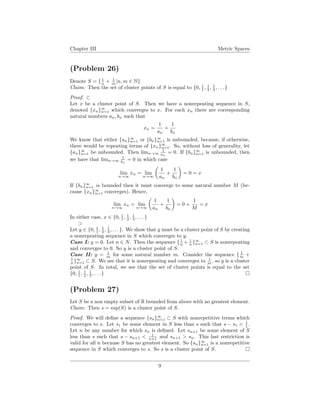
Denote S = { 1
n + 1
m |n, m ∈ N}
Claim: Then the set of cluster points of S is equal to {0, 1
1 , 1
2 , 1
3 , . . . }
Proof. ⊂
Let x be a cluster point of S. Then we have a nonrepeating sequence in S,
denoted {xn}∞
n=1 which converges to x. For each xn there are corresponding
natural numbers an, bn such that
xn =
1
an
+
1
bn
We know that either {an}∞
n=1 or {bn}∞
n=1 is unbounded, because, if otherwise,
there would be repeating terms of {xn}∞
n=1. So, without loss of generality, let
{an}∞
n=1 be unbounded. Then limn→∞
1
an
= 0. If {bn}∞
n=1 is unbounded, then
we have that limn→∞
1
bn
= 0 in which case
lim
n→∞
xn = lim
n→∞
1
an
+
1
bn
= 0 = x
If {bn}∞
n=1 is bounded then it must converge to some natural number M (be-
cause {xn}∞
n=1 converges). Hence,
lim
n→∞
xn = lim
n→∞
1
an
+
1
bn
= 0 +
1
M
= x
In either case, x ∈ {0, 1
1 , 1
2 , 1
3 , . . . }
⊃
Let y ∈ {0, 1
1 , 1
2 , 1
3 , . . . }. We show that y must be a cluster point of S by creating
a nonrepeating sequence in S which converges to y.
Case I: y = 0. Let n ∈ N. Then the sequence { 1
n + 1
n }∞
n=1 ⊂ S is nonrepeating
and converges to 0. So y is a cluster point of S.
Case II: y = 1
m for some natural number m. Consider the sequence { 1
m +
1
n }∞
n=1 ⊂ S. We see that it is nonrepeating and converges to 1
m , so y is a cluster
point of S. In total, we see that the set of cluster points is equal to the set
{0, 1
1 , 1
2 , 1
3 , . . . }
(Problem 27)
Let S be a non empty subset of R bounded from above with no greatest element.
Claim: Then s = sup(S) is a cluster point of S.
Proof. We will define a sequence {sn}∞
n=1 ⊂ S with nonrepetitive terms which
converges to s. Let s1 be some element in S less than s such that s − s1 < 1
1 .
Let n be any number for which sn is defined. Let sn+1 be some element of S
less than s such that s − sn+1 < 1
n+1 and sn+1 > sn. This last restriction is
valid for all n because S has no greatest element. So {sn}∞
n=1 is a nonrepetitive
sequence in S which converges to s. So s is a cluster point of S.
9
Chapter III Metric Spaces
(Problem 31)
Let a, b ∈ R, a < b.
Claim: Then [a, b] is compact.
Proof. Let {Ui|i ∈ I} be some collection of open sets whose union contains [a, b].
Denote S as the set of elements x ∈ (a, b] such that [a, x] may be contained in
the union of a finite number of these open sets Ui. We know that b must be an
upper bound on S implying that s = sup(S) exists. Any number in (a, s) is less
than s implying it is in S, implying (a, s) may be covered by a finite number of
these open sets, U1, U2, . . . , UN . But because s ∈ [a, b], there must exist some
open set U ∈ {Ui|i ∈ I} which contains s. So we have that
[a, s] ⊂
N
i=1
Ui U
At this point, assume s = b. Then s < b. We may find some real number c such
that c ∈ (s, b), [s, c] ⊂ U . Then we know
[a, s] ∪ [s, c] = [a, c] ⊂
N
i=1
Ui U
So because c ∈ [a, b], we know c ∈ S. But c > s. This contradiction illustrates
that s = b and we must have that [a, b] is contained in the union of a finite
number of elements of {Ui|i ∈ I},
N
i=1
Ui U
So [a, b] is compact.
(Problem 32)
Let (E, d) be a metric space. Let S1, S2, . . . Sn be n compact subsets of E.
Claim: Then
n
i=1
Si
is also compact.
Proof. Let {Ui|i ∈ I} be some collection of open sets whose union contains
∪n
i=1Si. For each j ∈ {1, 2, . . . n} there exist sets Uj
1 , Uj
2 . . . Uj
N(j) ∈ {Ui|i ∈ I}
such that
Sj ⊂
N(j)
i=1
Ui
10
Chapter III Metric Spaces
This implies that
n
i=1
Si ⊂
n
j=1
N(j)
i=1
Ui
Note that this right set is the union of a finite number of elements of {Ui|i ∈ I},
implying that ∪n
i=1Si is compact
(Problem 33)
Let (E, d) be a compact metric space. Let {Ui|i ∈ |} be some collection of open
sets whose union cover E.
Claim: Then there exists some 0 > 0 such that for any point p ∈ E, the closed
ball B 0
[p] is completely contained in an open set U ∈ {Ui|i ∈ I}.
Proof. Assume the opposite. Then for any natural number n there exists a point
of E, denoted pn such that the closed ball B 1
n
[pn] cannot be contained in only
one of the open sets Ui. So we have defined a sequence in E, {pn}∞
n=1. Because
E is compact, {pn}∞
n=1 had a convergent subsequence, denoted {pmn
}∞
n=1 with
limit p ∈ E. We know there must exist some U ∈ {Ui|i ∈ I} such that p ∈ U.
Because U is open, there exists some such that
B (p) ⊂ U
So Because 2 > 0, there exists some n such that d(pmn
, p) < 2 and mn ≥ n > 2
.
This second piece of information implies that 1
mn
< 2 . Let x ∈ b 1
mn
[pmn
]. Then
d(x, pmn
) ≤
2
So
d(x, p) ≤ d(x, pmn
) + d(pmn
, p) < 2 ·
2
=
So x ∈ B (p) so B 1
mn
[pmn ] ⊂ B (p) ⊂ U. So B 1
mn
[pmn ] may be completely
contained in the open set U ⊂ {Ui|i ∈ I}. But this violates our choice of pmn
and our assumption was incorrect. In total, this illustrates that there must exist
some 0 > 0 such that if p is any point of E, the closed ball B 0
[p] is completely
contained by some Ui where Ui ∈ {Ui|i ∈ I}
(Problem 36)
Let (E, d) be a metric space
Claim: E is totally bounded if and only if every sequence in E has a Cauchy
subsequence.
11
Chapter III Metric Spaces
Proof. =⇒
Let E be totally bounded and let {xn}∞
n=1 be some sequence in E.
Case I : {xn}∞
n=1 is infinite. Because E is totally bounded and 1
3 > 0, there
must exist points p1, p2, ...pn ∈ E such that
E =
n
i=1
B1
3
[pi]
There must exist some i ∈ {1, 2, ..., n} such that there are an infinite number
of terms of {xn}∞
n=1 in B1
3
[pi]. Denote this ball B1. Let n be some natural
number for which Bn is defined. Note that Bn is itself a totally bounded metric
space. Because 1
3(n+1) is a positive number, there exists (by reasoning exhibited
in the above line) some p in Bn such that B 1
3(n+1)
[p] is a subset of Bn and
contains an infinite number of points of {xn}∞
n=1. Denote this ball Bn+1. So we
have defined the sequence of balls {Bn}∞
n=1 such that for any natural number
n, Bn+1 ⊂ Bn, Bn features a radius of 1
3n , and there exist an infinite number
of terms of {xn}∞
n=1 in Bn.
Define a subsequence of {xn}∞
n=1, denoted {xmn }∞
n=1, by the following: xmn
is some term such that mn ≥ n and xmn ∈ Bn. We now demonstrate that
{xmn
}∞
n=1 is Cauchy.
Let > 0 and let M, N be two natural numbers greater than 1
. Without loss
of generality, assume M ≥ N, so BM ⊂ BN . Denote the centers of BM , BN by
M and N respectively. We have the following three inequalities:
xmM
∈ BM → d(xmM
, M ) <
1
3M
≤
1
3N
xmN
∈ BN → d(xmN
, N ) <
1
3N
M ∈ BM ⊂ BN → d(M , N ) ≤
1
3N
By combining the above three inequalities and applying the triangle inequality,
we find that d(xmM
, xmN
) < 1
N < . So {xmn
}∞
n=1 is Cauchy.
Case II : {xn}∞
n=1 is finite. Then there exists a convergent subsequence of
{xn}∞
n=1 which must be Cauchy.
Thus, any sequence in E has a Cauchy subsequence.
⇐=
Let any sequence in E have a Cauchy subsequence. Assume there exists some
> 0 such that no possible amount of closed balls of radius may completely
cover E. We must necessarily have that E is nonempty. So there exists some
element, denoted x1, of E. Let n be some natural number for which xn is
defined. By our assumption, no finite number of closed balls of radius may
contain E. So there exists some element of E not in ∪n
i=1B [xi]. Denote this
element xn+1.
So we have inductively defined the sequence {xn}∞
n=1 such that for all natural
numbers n, xn+1 is not in ∪n
i=1B [xi]. But we know {xn}∞
n=1 must have a
12
Chapter III Metric Spaces
Cauchy subsequence denoted {xmn }∞
n=1. Because > 0 we know there exists
some N such that if p, q are natural numbers greater than N, we have that
d(xmp
, xmq
) <
So let a > N. Then a + 1 > N. So
d(xma+1
, xma
) <
But
xma+1
/∈
a
i=1
B [xmi
]
so
x /∈ B [xma ]
so
d(xma+1
, xma
) >
We have found our contradiction, so we know that E must be totally bounded
and find that E is totally bounded if and only if every sequence in E has a
Cauchy subsequence.
(Problem 37)
Let (E, d) be a metric space.
Claim: Then the following statements are equivalent: (i) E is compact, (ii) E
is sequentially compact, (iii) E is totally bounded and complete.
Proof. (i) → (ii)
Let E be compact. Let {xn}∞
n=1 be some sequence in E.
Case I : {xn}∞
n=1 is infinite. Then {xn}∞
n=1 forms an infinite subset of E and
by a theorem in the textbook, {xn}∞
n=1 has a cluster point, denoted x ∈ E. Let
n be some natural number. Because x is a cluster point of {xn}∞
n=1, there exists
some element of {xn}∞
n=1, denoted xmn
such that d(xmn
, x) < 1
n . So, we have
defined the subsequence {xmn
}∞
n=1 such that {xmn
}∞
n=1 converges to x ∈ E.
Case II : {xn}∞
n=1 is finite. So there exists some s ∈ {xn}∞
n=1 such that
for an infinite number of natural numbers n, xn = s. Denote this constant
subsequence {xmn }∞
n=1. {xmn }∞
n=1 must converge to s.
So in both cases, {xn}∞
n=1 has a convergent subsequence, so E must be sequen-
tially compact.
(ii) → (iii)
Let E be sequentially compact. Let {xn}∞
n=1 be some sequence in E. It must
have some convergent subsequence {xmn }∞
n=1. Because {xmn }∞
n=1 is convergent,
it is Cauchy. So every sequence in E has a Cauchy subsequence, so by problem
36 in Chapter III, E must be totally bounded.
Let {sn}∞
n=1 be some Cauchy sequence in E. It must have some convergent
13
Chapter III Metric Spaces
subsequence, {smn }∞
n=1, with limit s ∈ E. Because any Cauchy sequence with
a convergent subsequence converges to the limit of the subsequence, we know
that {sn}∞
n=1 converges to s ∈ E. So E is complete.
(iii) → (i)
Let E be totally bounded and complete. Assume E is not compact. So there
exists some set of open sets, {Ui| ∈ I} such that
E =
i∈I
Ui
yet no amount of finite sets of {Ui|i ∈ I} can union to cover E. Because 1
3 is a
positive number, there exist points p1, p2, ...pm of E such that
E =
m
i=1
B1
3
[pi]
Because {Ui|i ∈ I} cannot finitely union to cover E, there exist some i ∈
{1, 2, ...m} such that B1
3
[pi] cannot be finitely covered by {Ui|i ∈ I}. Denote
this closed ball B1. Let n be some natural number for which Bn be defined
(a ball of radius 1
3n which cannot be covered by a finite number of sets from
{Ui|i ∈ I}). Then because 1
3(n+1) is a positive number, and because Bn ⊂ E,
there exists a point pj such that the closed ball of radius 1
3(n+1) centered at
pj is contained by Sn and cannot be covered by a finite number of sets from
{Ui|i ∈ I}. Denote this ball Bn+1. So this inductively defines a sequence of
closed balls in E, {Bn}∞
n=1 such that for any natural number n, Bn+1 ⊂ Bn, Bn
cannot be covered by a finite number of sets from {Ui|i ∈ I} and Bn features
a radius of 1
3n . We must have that each Bn is nonempty (otherwise, we would
have such a finite covering for some closed ball) so let sn ∈ Bn. So the sequence
{sn}∞
n=1 is defined. Let > 0. Let N > 1
. Let p and q be two natural numbers
greater than N. Without loss of generality, assume p ≤ q. Then Bq ⊂ Bp. Let
p and q denote the centers of Bp and Bq respectively. We have that
sp ∈ Bp → d(sp, p ) <
1
3p
sq ∈ Bq → d(sq, q ) <
1
3q
≤
1
3p
q ∈ Bq ⊂ Bp → d(q , p ) <
1
3p
In total,
d(sp, sq) <
1
p
<
1
N
<
So, {sn}∞
n=1 is Cauchy. Because E is complete, we know it must converge to
some s ∈ E. There must exist some U0 ∈ {Ui|i ∈ I} such that s ∈ U0. Because
U0 is open, there exists some η > 0 such that Bη(s) ⊂ U0. Let M > 1
η . We
14
Chapter III Metric Spaces
want to show that BM is completely contained by U0, which would contradict
our construction of BM which can never be contained by the union of a finite
number of sets from {Ui|i ∈ I}. So let t ∈ BM (again, if we can prove that
d(t, s) < η, we’re done). We know if M’ denotes the center of BM ,
d(t, M ) <
1
3M
We know that because {sn}∞
n=1 converges to s, there exists some natural number
n large enough such that Bn ⊂ BM and its distance from s is less that 1
3M . That
is,
d(sn, M ) <
1
3M
and
d(sn, s) <
1
3M
So, combining the above three inequalities and utilizing the triangle inequality
provides that
d(t, s) <
1
M
< η
So t ∈ Bη(s) ⊂ U0. Thus, SM ⊂ U0 so it may be covered with one element
of {Ui|i ∈ I}. But this is impossible by construction. So our assumption was
wrong and we must have that E is compact.
So (i), (ii), and (iii) are equivalent conditions.
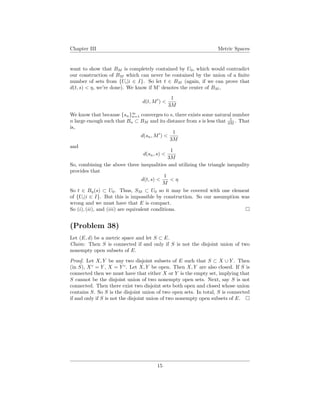
(Problem 38)
Let (E, d) be a metric space and let S ⊂ E.
Claim: Then S is connected if and only if S is not the disjoint union of two
nonempty open subsets of E.
Proof. Let X, Y be any two disjoint subsets of E such that S ⊂ X ∪ Y . Then
(in S), Xc
= Y , X = Y c
. Let X, Y be open. Then X, Y are also closed. If S is
connected then we must have that either X or Y is the empty set, implying that
S cannot be the disjoint union of two nonempty open sets. Next, say S is not
connected. Then there exist two disjoint sets both open and closed whose union
contains S. So S is the disjoint union of two open sets. In total, S is connected
if and only if S is not the disjoint union of two nonempty open subsets of E.
15

Analysis Solutions CIII

  • 1.
    Math 441: ChapterIII, Metric Spaces Leonardo Di Giosia (Problem 4) Denote S ⊂ R2 by S = {(x, y)|x > y} Claim: S is open. Proof. Consider Sc = {(x, y) ∈ R|x ≤ y}. Let {pn}∞ n=1 ⊂ R2 = {(xn, yn)}∞ n=1 be some convergent sequence in Sc with limit (x, y). We know for all n ∈ N, xn ≤ yn, so 0 ≤ yn − xn (for all n ∈ N) So lim n→∞ (yn − xn) = lim n→∞ yn − lim n→∞ xn ≥ 0 y − x ≥ 0 y ≥ x So we see that (x, y) ∈ Sc so Sc is closed, and hence, S is open. 1
  • 2.
    Chapter III MetricSpaces (Problem 6) Denote S ⊂ R2 by S = {(x, y)|x · y = 1, x > 0} Claim: S is closed. Proof. Let {(xn, yn)}∞ n=1 be some convergent sequence in S with limit (x, y). So limn→∞ xn = x and limn→∞ yn = y. For any natural number n, we know the following xn · yn = 1 lim n→∞ (xn · yn) = 1 lim n→∞ (xn) · lim n→∞ (yn) = 1 x · y = 1 Additionally, because xn ≥ 0 for all n, x > 0. So we know that (x, y) ∈ S. Thus, S is a closed subset of R2 . (Problem 8) Let (E, d) be a metric space. Let {xn}∞ n=1 be a convergent sequence in E with limit x. Let P : N → N be some permutation of the natural numbers. Claim: Then lim n→∞ xP (n) = x Proof. Let > 0. There exists some N such that n > N → d(xn, x) < Let M = max({P−1 (m)|1 ≤ m ≤ N}) = max(S). Let q > M. Assume P(q) ≤ N. Then (because permutations are bijections) P−1 (P(q)) = q ∈ {P−1 (m)|1 ≤ m ≤ N} = S which implies q ≤ M. This contradiction illustrates that P(q) > N so d(xp(q), x) < So the sequence {xp(n)}∞ n=1 converges to x. (Problem 9) Let (E, d) be a metric space and let {pn}∞ n=1 ⊂ E. Claim: Then {pn}∞ n=1 converges to the point p ∈ E if and only if the sequence p1, p, p2, p, · · · = {sn}∞ n=1 converges. 2
  • 3.
    Chapter III MetricSpaces Proof. =⇒ Assume {pn}∞ n=1 converges to p. Let > 0. Then there exists some N such that n > N → d(pn, p) < 0 Let n > 2N.We have two possibilities for the value of sn. If n is even then sn = p, in which case d(p, sn) < . If n is odd then sn = pm for some m > N, in which case d(sn, p) < . So in both cases, we see that {sn}∞ n=1 converges to p. ⇐= Assume {sn}∞ n=1 converges. Note that the limit of {sn}∞ n=1 must be p. This is because we may construct a constant subsequence of {sn}∞ n=1, always equal to p. This subsequence would converge to p, and all subsequences converge to the limit of their parent sequence (if it exists). So limn→∞ sn = p. Let > 0. Then there exists some N such that n > N → d(sn, p) < Let n > N. Then 2n − 1 > N. Because s2n−1 = pn and d(s2n−1, p) < . We know d(pn, p) < So {pn}∞ n=1 converges to p. (Problem 10) Let (E, d) be a metric space, let {xn}∞ n=1 be some convergent sequence in E with limit x ∈ E and let S = {x, x1, x2, ...}. Claim: S is closed. Proof. Let {sn}∞ n=1 ⊂ S be some convergent sequence in E with limit s ∈ E. We need to show that s ∈ S. Case I : {sn}∞ n=1 is infinite. Then we may define a subsequence of {sn}∞ n=1, {smn }∞ n=1, such that no terms of {sn}∞ n=1 repeat themselves (that is, for any natural numbers N = M, smN = smM ). Let > 0. Because {xn}∞ n=1 converges to x, there exists some N such that n > N implies d(xn, x) < . Speaking loosely, because {smn }∞ n=1 does not repeat itself, there is some last term of {smn }∞ n=1, denoted smP , such that smP equals some xn for an n below N. Stated more carefully, because {smn }∞ n=1 does not repeat itself, the set P = {q ∈ N|∃n ≤ N|smq = sn} is finite, so max(P) exists. Let q > max(P). Then for all n ≤ N, smq = xn. So either smq = x or smq = xb for a b > N. In either case, d(xmq , x) < , so {smn }∞ n=1 converges to x ∈ S. Because {sn}∞ n=1 converges to s, we must have that x = s, so {sn}∞ n=1 converges to an element of S. 3
  • 4.
    Chapter III MetricSpaces Case II : {sn}∞ n=1 is finite. Then there is some infinitely repeated element of S, denoted s0 in {sn}∞ n=1 and thus, we have a subsequence of {sn}∞ n=1, denoted {smn }∞ n=1, such that for all natural numbers n, smn = s0. So this subsequence converges to s0 ∈ S and the whole sequence must converge to this element of S because it was convergent in the first place. In both cases, {sn}∞ n=1 converges to some element of S so S must be closed. (Problem 11) Let {an}∞ n=1 ⊂ R be some convergent sequence with limit a ∈ R. Claim: lim n→∞ n i=1 ai n = a Proof. Let > 0. Because {an}∞ n=1 converges, there must exist an N ∈ N such that if n > N. |an − a| < (Ineq. I) By the Archimedean principle, there must exist some M ∈ N such that N i=1 |ai − a| < 2 · M (Ineq. II) Let n > max({N + 1, M}). Then by Inequality II, N i=1 |ai − a| < 2 · n (Ineq. III) Let i ∈ {N + 1, N + 2, . . . , n}. Then by Inequality I, |ai − a| < 2 This implies we may maintain this inequality if we sum over all such values of i to find n i=N+1 |ai − a| < 2 (n − N − 1) Combining this with inequality III provides N i=1 |ai − a| + n i=N+1 |ai − a| < 2 · (n + n − N − 1) ≤ · n n i=1 |ai − a| n < Finally, the Triangle inequality proves our claim, n i=1 ai n − a < 4
  • 5.
    Chapter III MetricSpaces (Problem 12) Denote {xn}∞ n=1 ⊂ R recursively by x1 = 1 and xn+1 = xn + 1 x2 n for all n ∈ N. Claim: Then {xn}∞ n=1 is unbounded (from above). Proof. Assume it is bounded. Then, because it is monotonically increasing, we see that it must be convergent with some limit x ∈ R. We know that for all n ∈ N, xn ≥ 1 so x = 0. So we have lim n→∞ xn = x lim n→∞ xn+1 = x x + lim n→∞ 1 x2 n = x 1 x2 = 0 So our assumption was false and we must have that the sequence is unbounded (from above). (Problem 17) Let (E, d) be a metric space and let S ⊂ E. (a) Claim: E = interior(S) ∪ interior(Sc ) ∪ boundary(S) Proof. Let x ∈ E. If x ∈ interior(S) ∪ interior(Sc ) then we have nothing to show. So assume x is not in this set. So for all positive real numbers ∃α ∈ S|α /∈ b (x) and ∃β ∈ Sc |β /∈ b (x) Define sequences {an}∞ n=1 and {bn}∞ n=1 by the following: For each n ∈ N, an is the element of S such that an is not b 1 n (x) and bn is that of Sc not in b 1 n (x). It is apparent (and easily verifiable) that these sequences converge to x and are both fully contained (respectively) by S and Sc . So if C and K are any two closed sets containing S and Sc respectively, they must contain {an}∞ n=1 and {bn}∞ n=1, respectively, in which case, x is an element of both C and K (because they are closed). So x is in both closure of S and the closure of Sc . So x ∈ boundary(S). So in both cases, x is an element of the set on the right, implying E ⊂ interior(S) ∪ interior(Sc ) ∪ boundary(S) E = interior(S) ∪ interior(Sc ) ∪ boundary(S) 5
  • 6.
    Chapter III MetricSpaces (b) Claim: S is closed if and only if it contains its boundary. Proof. =⇒ Let S be a closed set. Let x ∈ boundary(S). Then x ∈ Si for any closed set Si containing S, but necessarily, S is a closed set which contains S. So x ∈ S and boundary(S) ⊂ S. ⇐= Let boundary(S) ⊂ S. Let p be an adherent point of S. If x ∈ S then we are done, so assume p ∈ Sc . So p ∈ closure(Sc ). Additionally, because p is an adherent point of S it will be an adherent point of any set containing S. So, it will be an element of any closed set containing S. So p ∈ closure(S). Then p is an element of any closed set containing Sc . So p ∈ closure(Sc ). Thus,p is in the intersection of the closures of S and Sc , AKA boundary(S). So p ∈ S, breaking our assumption, immediately proving that x ∈ S.. So S is closed. (c) Claim: S is open if and only if its boundary and S are disjoint. Proof. =⇒ Let S be open. Then Sc is closed and by the preceding result, boundary(Sc ) ⊂ Sc So if x ∈ boundary(S) = boundary(Sc ) then x ∈ Sc so x /∈ S. If y ∈ S then y /∈ Sc so y /∈ boundary(S). ⇐= Assume boundary(S) and S are disjoint. Let x ∈ boundary(Sc ). Then x ∈ Sc . So boundary(Sc ) ⊂ Sc so Sc is closed by the preceding result and S must be open. (Problem 18) Let {an}∞ n=1 ⊂ R be bounded. Claim: Then lim infn→∞ an ≤ lim supn→∞ with equality holding if and only if the sequence converges. Proof. We see by the definition of the lim supn→∞ an and lim infn→∞ an that if x, y ∈ R such that x < lim infn→∞ an and lim supn→∞ an < y then there exist a finite number of terms of {an}∞ n=1 both below x and above y. Assume lim supn→∞ an < lim infn→∞ an. Denote x = lim supn→∞ an + lim infn→∞ an 2 6
  • 7.
    Chapter III MetricSpaces and y = x + lim infn→∞ an 2 Then lim supn→∞ < x < y < lim infn→∞. So there are a finite number of terms of the sequence below y, implying there are an infinite number of terms above y implying there are an infinite number of terms of the sequence above x. But because x is greater than lim supn→∞ an we know that there should only be a finite number of this quantity. So this contradiction illustrates lim inf n→∞ an ≤ lim sup n→∞ Next, we turn our attention to the equality portion of the claim. =⇒ Let lim infn→∞ an = lim supn→∞ an. Let > 0. Then lim supn→∞ an + > lim supn→∞ an, so there are a finite number of terms of the sequence above lim supn→∞ an + . Denote the last term of the sequence aN . So n > N → an − lim sup n→∞ < (implication I) By symmetric reasoning, we see that there exists some M such that n > M → lim inf n→∞ an − an < (implication II) So if n > max({N, M}) we have |an − lim sup n→∞ | < So {an}∞ n=1 converges to lim supn→∞ ⇐= Let {an}∞ n=1 converge to some a ∈ R. Let x be any real number such that there are an infinite number of terms of the sequence above x. We illustrate that x cannot be strictly greater than a. This is because, if so, the number x−a would be positive and we could find the last term of an (by convergence) such that an − a ≥ x − a, which would imply there are a finite number of such terms, violating our choice of x. So, because a is an upper bound of all such choices of x, we must have that lim supn→∞ an ≤ a. Assume lim supn→∞ an < a. Then denote z = lim supn→∞ an+a 2 . Then lim supn→∞ an < z < a. As we could again show from a convergence argument, there are an infinite number of terms of the sequence above z. But lim supn→∞ is an upper bound of the set of real numbers which behave like z and hence, must be greater than or equal to z. So our assumption was false and we must have that a = lim sup n→∞ an By a similar argument, we may find that a = lim inf n→∞ an 7
  • 8.
    Chapter III MetricSpaces So lim sup n→∞ = lim inf n→∞ (Problem 24) Let (E, d) be a metric space and let S ⊂ E. Let S be complete. Claim: Then S is closed. Proof. Let {xn}∞ n=1 ⊂ S converge to some x ∈ E. In any metric space, a convergent sequence is also Cauchy. So {xn}∞ n=1 is Cauchy in S. Because S is complete, it must converge to some y ∈ S. But we knew that {xn}∞ n=1 converges to x so x = y and x ∈ S so S is closed. (Problem 25) Claim: Rm is a complete metric space. Proof. Let {pn}∞ n=1 ⊂ Rm be a Cauchy sequence where for all n ∈ N, pn = (p(1) n , p(2) n , . . . , p(m) n ) Let > 0. Then there exists some N such that n, q > N implies d(pn, pq) < But for all i ∈ {1, 2, . . . m} we know for any n, q: |p(i) n − p(i) q | ≤ d(pn, pq) < So for all such i, {p (i) n }∞ n=1 is a Cauchy sequence in R implying it is convergent with some limit pi ∈ R. So for each such i, there exists some Ni such that n > Ni implies |p(i) n − pi| < m So we have that if n > max({N1, N2, . . . , Nm}) then |p(1) n − p1| + |p(2) n − p2| + · · · + |p(m) n − pm| < d(pn, (p1, p2, . . . , pm)) < So we must have that the sequence {pn}∞ n=1 conveges in Rm with limit (p1, p2, . . . , pm). So Rm is a complete metric space. 8
  • 9.
    Chapter III MetricSpaces (Problem 26) Denote S = { 1 n + 1 m |n, m ∈ N} Claim: Then the set of cluster points of S is equal to {0, 1 1 , 1 2 , 1 3 , . . . } Proof. ⊂ Let x be a cluster point of S. Then we have a nonrepeating sequence in S, denoted {xn}∞ n=1 which converges to x. For each xn there are corresponding natural numbers an, bn such that xn = 1 an + 1 bn We know that either {an}∞ n=1 or {bn}∞ n=1 is unbounded, because, if otherwise, there would be repeating terms of {xn}∞ n=1. So, without loss of generality, let {an}∞ n=1 be unbounded. Then limn→∞ 1 an = 0. If {bn}∞ n=1 is unbounded, then we have that limn→∞ 1 bn = 0 in which case lim n→∞ xn = lim n→∞ 1 an + 1 bn = 0 = x If {bn}∞ n=1 is bounded then it must converge to some natural number M (be- cause {xn}∞ n=1 converges). Hence, lim n→∞ xn = lim n→∞ 1 an + 1 bn = 0 + 1 M = x In either case, x ∈ {0, 1 1 , 1 2 , 1 3 , . . . } ⊃ Let y ∈ {0, 1 1 , 1 2 , 1 3 , . . . }. We show that y must be a cluster point of S by creating a nonrepeating sequence in S which converges to y. Case I: y = 0. Let n ∈ N. Then the sequence { 1 n + 1 n }∞ n=1 ⊂ S is nonrepeating and converges to 0. So y is a cluster point of S. Case II: y = 1 m for some natural number m. Consider the sequence { 1 m + 1 n }∞ n=1 ⊂ S. We see that it is nonrepeating and converges to 1 m , so y is a cluster point of S. In total, we see that the set of cluster points is equal to the set {0, 1 1 , 1 2 , 1 3 , . . . } (Problem 27) Let S be a non empty subset of R bounded from above with no greatest element. Claim: Then s = sup(S) is a cluster point of S. Proof. We will define a sequence {sn}∞ n=1 ⊂ S with nonrepetitive terms which converges to s. Let s1 be some element in S less than s such that s − s1 < 1 1 . Let n be any number for which sn is defined. Let sn+1 be some element of S less than s such that s − sn+1 < 1 n+1 and sn+1 > sn. This last restriction is valid for all n because S has no greatest element. So {sn}∞ n=1 is a nonrepetitive sequence in S which converges to s. So s is a cluster point of S. 9
  • 10.
    Chapter III MetricSpaces (Problem 31) Let a, b ∈ R, a < b. Claim: Then [a, b] is compact. Proof. Let {Ui|i ∈ I} be some collection of open sets whose union contains [a, b]. Denote S as the set of elements x ∈ (a, b] such that [a, x] may be contained in the union of a finite number of these open sets Ui. We know that b must be an upper bound on S implying that s = sup(S) exists. Any number in (a, s) is less than s implying it is in S, implying (a, s) may be covered by a finite number of these open sets, U1, U2, . . . , UN . But because s ∈ [a, b], there must exist some open set U ∈ {Ui|i ∈ I} which contains s. So we have that [a, s] ⊂ N i=1 Ui U At this point, assume s = b. Then s < b. We may find some real number c such that c ∈ (s, b), [s, c] ⊂ U . Then we know [a, s] ∪ [s, c] = [a, c] ⊂ N i=1 Ui U So because c ∈ [a, b], we know c ∈ S. But c > s. This contradiction illustrates that s = b and we must have that [a, b] is contained in the union of a finite number of elements of {Ui|i ∈ I}, N i=1 Ui U So [a, b] is compact. (Problem 32) Let (E, d) be a metric space. Let S1, S2, . . . Sn be n compact subsets of E. Claim: Then n i=1 Si is also compact. Proof. Let {Ui|i ∈ I} be some collection of open sets whose union contains ∪n i=1Si. For each j ∈ {1, 2, . . . n} there exist sets Uj 1 , Uj 2 . . . Uj N(j) ∈ {Ui|i ∈ I} such that Sj ⊂ N(j) i=1 Ui 10
  • 11.
    Chapter III MetricSpaces This implies that n i=1 Si ⊂ n j=1 N(j) i=1 Ui Note that this right set is the union of a finite number of elements of {Ui|i ∈ I}, implying that ∪n i=1Si is compact (Problem 33) Let (E, d) be a compact metric space. Let {Ui|i ∈ |} be some collection of open sets whose union cover E. Claim: Then there exists some 0 > 0 such that for any point p ∈ E, the closed ball B 0 [p] is completely contained in an open set U ∈ {Ui|i ∈ I}. Proof. Assume the opposite. Then for any natural number n there exists a point of E, denoted pn such that the closed ball B 1 n [pn] cannot be contained in only one of the open sets Ui. So we have defined a sequence in E, {pn}∞ n=1. Because E is compact, {pn}∞ n=1 had a convergent subsequence, denoted {pmn }∞ n=1 with limit p ∈ E. We know there must exist some U ∈ {Ui|i ∈ I} such that p ∈ U. Because U is open, there exists some such that B (p) ⊂ U So Because 2 > 0, there exists some n such that d(pmn , p) < 2 and mn ≥ n > 2 . This second piece of information implies that 1 mn < 2 . Let x ∈ b 1 mn [pmn ]. Then d(x, pmn ) ≤ 2 So d(x, p) ≤ d(x, pmn ) + d(pmn , p) < 2 · 2 = So x ∈ B (p) so B 1 mn [pmn ] ⊂ B (p) ⊂ U. So B 1 mn [pmn ] may be completely contained in the open set U ⊂ {Ui|i ∈ I}. But this violates our choice of pmn and our assumption was incorrect. In total, this illustrates that there must exist some 0 > 0 such that if p is any point of E, the closed ball B 0 [p] is completely contained by some Ui where Ui ∈ {Ui|i ∈ I} (Problem 36) Let (E, d) be a metric space Claim: E is totally bounded if and only if every sequence in E has a Cauchy subsequence. 11
  • 12.
    Chapter III MetricSpaces Proof. =⇒ Let E be totally bounded and let {xn}∞ n=1 be some sequence in E. Case I : {xn}∞ n=1 is infinite. Because E is totally bounded and 1 3 > 0, there must exist points p1, p2, ...pn ∈ E such that E = n i=1 B1 3 [pi] There must exist some i ∈ {1, 2, ..., n} such that there are an infinite number of terms of {xn}∞ n=1 in B1 3 [pi]. Denote this ball B1. Let n be some natural number for which Bn is defined. Note that Bn is itself a totally bounded metric space. Because 1 3(n+1) is a positive number, there exists (by reasoning exhibited in the above line) some p in Bn such that B 1 3(n+1) [p] is a subset of Bn and contains an infinite number of points of {xn}∞ n=1. Denote this ball Bn+1. So we have defined the sequence of balls {Bn}∞ n=1 such that for any natural number n, Bn+1 ⊂ Bn, Bn features a radius of 1 3n , and there exist an infinite number of terms of {xn}∞ n=1 in Bn. Define a subsequence of {xn}∞ n=1, denoted {xmn }∞ n=1, by the following: xmn is some term such that mn ≥ n and xmn ∈ Bn. We now demonstrate that {xmn }∞ n=1 is Cauchy. Let > 0 and let M, N be two natural numbers greater than 1 . Without loss of generality, assume M ≥ N, so BM ⊂ BN . Denote the centers of BM , BN by M and N respectively. We have the following three inequalities: xmM ∈ BM → d(xmM , M ) < 1 3M ≤ 1 3N xmN ∈ BN → d(xmN , N ) < 1 3N M ∈ BM ⊂ BN → d(M , N ) ≤ 1 3N By combining the above three inequalities and applying the triangle inequality, we find that d(xmM , xmN ) < 1 N < . So {xmn }∞ n=1 is Cauchy. Case II : {xn}∞ n=1 is finite. Then there exists a convergent subsequence of {xn}∞ n=1 which must be Cauchy. Thus, any sequence in E has a Cauchy subsequence. ⇐= Let any sequence in E have a Cauchy subsequence. Assume there exists some > 0 such that no possible amount of closed balls of radius may completely cover E. We must necessarily have that E is nonempty. So there exists some element, denoted x1, of E. Let n be some natural number for which xn is defined. By our assumption, no finite number of closed balls of radius may contain E. So there exists some element of E not in ∪n i=1B [xi]. Denote this element xn+1. So we have inductively defined the sequence {xn}∞ n=1 such that for all natural numbers n, xn+1 is not in ∪n i=1B [xi]. But we know {xn}∞ n=1 must have a 12
  • 13.
    Chapter III MetricSpaces Cauchy subsequence denoted {xmn }∞ n=1. Because > 0 we know there exists some N such that if p, q are natural numbers greater than N, we have that d(xmp , xmq ) < So let a > N. Then a + 1 > N. So d(xma+1 , xma ) < But xma+1 /∈ a i=1 B [xmi ] so x /∈ B [xma ] so d(xma+1 , xma ) > We have found our contradiction, so we know that E must be totally bounded and find that E is totally bounded if and only if every sequence in E has a Cauchy subsequence. (Problem 37) Let (E, d) be a metric space. Claim: Then the following statements are equivalent: (i) E is compact, (ii) E is sequentially compact, (iii) E is totally bounded and complete. Proof. (i) → (ii) Let E be compact. Let {xn}∞ n=1 be some sequence in E. Case I : {xn}∞ n=1 is infinite. Then {xn}∞ n=1 forms an infinite subset of E and by a theorem in the textbook, {xn}∞ n=1 has a cluster point, denoted x ∈ E. Let n be some natural number. Because x is a cluster point of {xn}∞ n=1, there exists some element of {xn}∞ n=1, denoted xmn such that d(xmn , x) < 1 n . So, we have defined the subsequence {xmn }∞ n=1 such that {xmn }∞ n=1 converges to x ∈ E. Case II : {xn}∞ n=1 is finite. So there exists some s ∈ {xn}∞ n=1 such that for an infinite number of natural numbers n, xn = s. Denote this constant subsequence {xmn }∞ n=1. {xmn }∞ n=1 must converge to s. So in both cases, {xn}∞ n=1 has a convergent subsequence, so E must be sequen- tially compact. (ii) → (iii) Let E be sequentially compact. Let {xn}∞ n=1 be some sequence in E. It must have some convergent subsequence {xmn }∞ n=1. Because {xmn }∞ n=1 is convergent, it is Cauchy. So every sequence in E has a Cauchy subsequence, so by problem 36 in Chapter III, E must be totally bounded. Let {sn}∞ n=1 be some Cauchy sequence in E. It must have some convergent 13
  • 14.
    Chapter III MetricSpaces subsequence, {smn }∞ n=1, with limit s ∈ E. Because any Cauchy sequence with a convergent subsequence converges to the limit of the subsequence, we know that {sn}∞ n=1 converges to s ∈ E. So E is complete. (iii) → (i) Let E be totally bounded and complete. Assume E is not compact. So there exists some set of open sets, {Ui| ∈ I} such that E = i∈I Ui yet no amount of finite sets of {Ui|i ∈ I} can union to cover E. Because 1 3 is a positive number, there exist points p1, p2, ...pm of E such that E = m i=1 B1 3 [pi] Because {Ui|i ∈ I} cannot finitely union to cover E, there exist some i ∈ {1, 2, ...m} such that B1 3 [pi] cannot be finitely covered by {Ui|i ∈ I}. Denote this closed ball B1. Let n be some natural number for which Bn be defined (a ball of radius 1 3n which cannot be covered by a finite number of sets from {Ui|i ∈ I}). Then because 1 3(n+1) is a positive number, and because Bn ⊂ E, there exists a point pj such that the closed ball of radius 1 3(n+1) centered at pj is contained by Sn and cannot be covered by a finite number of sets from {Ui|i ∈ I}. Denote this ball Bn+1. So this inductively defines a sequence of closed balls in E, {Bn}∞ n=1 such that for any natural number n, Bn+1 ⊂ Bn, Bn cannot be covered by a finite number of sets from {Ui|i ∈ I} and Bn features a radius of 1 3n . We must have that each Bn is nonempty (otherwise, we would have such a finite covering for some closed ball) so let sn ∈ Bn. So the sequence {sn}∞ n=1 is defined. Let > 0. Let N > 1 . Let p and q be two natural numbers greater than N. Without loss of generality, assume p ≤ q. Then Bq ⊂ Bp. Let p and q denote the centers of Bp and Bq respectively. We have that sp ∈ Bp → d(sp, p ) < 1 3p sq ∈ Bq → d(sq, q ) < 1 3q ≤ 1 3p q ∈ Bq ⊂ Bp → d(q , p ) < 1 3p In total, d(sp, sq) < 1 p < 1 N < So, {sn}∞ n=1 is Cauchy. Because E is complete, we know it must converge to some s ∈ E. There must exist some U0 ∈ {Ui|i ∈ I} such that s ∈ U0. Because U0 is open, there exists some η > 0 such that Bη(s) ⊂ U0. Let M > 1 η . We 14
  • 15.
    Chapter III MetricSpaces want to show that BM is completely contained by U0, which would contradict our construction of BM which can never be contained by the union of a finite number of sets from {Ui|i ∈ I}. So let t ∈ BM (again, if we can prove that d(t, s) < η, we’re done). We know if M’ denotes the center of BM , d(t, M ) < 1 3M We know that because {sn}∞ n=1 converges to s, there exists some natural number n large enough such that Bn ⊂ BM and its distance from s is less that 1 3M . That is, d(sn, M ) < 1 3M and d(sn, s) < 1 3M So, combining the above three inequalities and utilizing the triangle inequality provides that d(t, s) < 1 M < η So t ∈ Bη(s) ⊂ U0. Thus, SM ⊂ U0 so it may be covered with one element of {Ui|i ∈ I}. But this is impossible by construction. So our assumption was wrong and we must have that E is compact. So (i), (ii), and (iii) are equivalent conditions. (Problem 38) Let (E, d) be a metric space and let S ⊂ E. Claim: Then S is connected if and only if S is not the disjoint union of two nonempty open subsets of E. Proof. Let X, Y be any two disjoint subsets of E such that S ⊂ X ∪ Y . Then (in S), Xc = Y , X = Y c . Let X, Y be open. Then X, Y are also closed. If S is connected then we must have that either X or Y is the empty set, implying that S cannot be the disjoint union of two nonempty open sets. Next, say S is not connected. Then there exist two disjoint sets both open and closed whose union contains S. So S is the disjoint union of two open sets. In total, S is connected if and only if S is not the disjoint union of two nonempty open subsets of E. 15