Well Logging and Thermal Method
Asst. Lecturer: Amir Abdelaziz
Geology Department, Helwan University
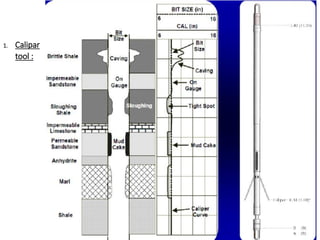
1. Calipar
tool :
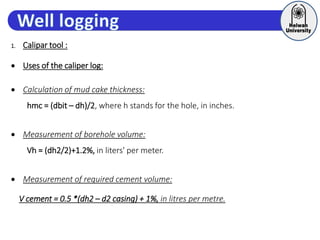
1. Calipar tool :
 Uses of the caliper log:
 Calculation of mud cake thickness:
hmc = (dbit – dh)/2, where h stands for the hole, in inches.
 Measurement of borehole volume:
Vh = (dh2/2)+1.2%, in liters' per meter.
 Measurement of required cement volume:
V cement = 0.5 *(dh2 – d2 casing) + 1%, in litres per metre.
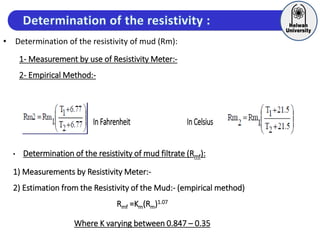
• Determination of the resistivity of mud (Rm):
1- Measurement by use of Resistivity Meter:-
2- Empirical Method:-
In Fahrenheit InCelsius
• Determination of the resistivity of mud filtrate (Rmf):
1) Measurements by Resistivity Meter:-
2) Estimation from the Resistivity of the Mud:- (empirical method)
Rmf =Km(Rm)1.07
Where K varying between 0.847 – 0.35
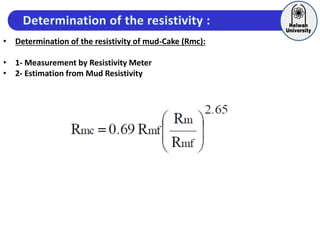
• Determination of the resistivity of mud-Cake (Rmc):
• 1- Measurement by Resistivity Meter
• 2- Estimation from Mud Resistivity
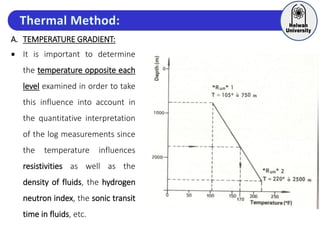
A. TEMPERATURE GRADIENT:
 It is important to determine
the temperature opposite each
level examined in order to take
this influence into account in
the quantitative interpretation
of the log measurements since
the temperature influences
resistivities as well as the
density of fluids, the hydrogen
neutron index, the sonic transit
time in fluids, etc.
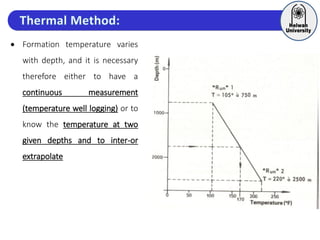
 Formation temperature varies
with depth, and it is necessary
therefore either to have a
continuous measurement
(temperature well logging) or to
know the temperature at two
given depths and to inter-or
extrapolate
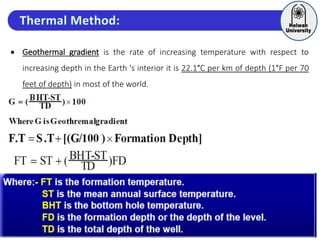
 Geothermal gradient is the rate of increasing temperature with respect to
increasing depth in the Earth 's interior it is 22.1°C per km of depth (1°F per 70
feet of depth) in most of the world.
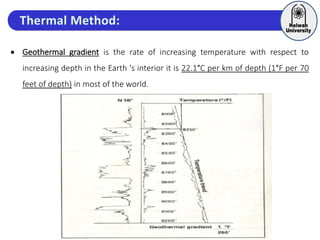
 Geothermal gradient is the rate of increasing temperature with respect to
increasing depth in the Earth 's interior it is 22.1°C per km of depth (1°F per 70
feet of depth) in most of the world.
 Effect of temperature in Hydrocarbon generation:
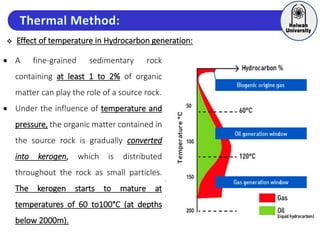
 A fine-grained sedimentary rock
containing at least 1 to 2% of organic
matter can play the role of a source rock.
 Under the influence of temperature and
pressure, the organic matter contained in
the source rock is gradually converted
into kerogen, which is distributed
throughout the rock as small particles.
The kerogen starts to mature at
temperatures of 60 to100°C (at depths
below 2000m).
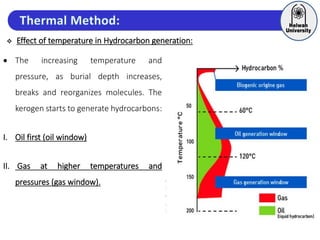
 Effect of temperature in Hydrocarbon generation:
 The increasing temperature and
pressure, as burial depth increases,
breaks and reorganizes molecules. The
kerogen starts to generate hydrocarbons:
I. Oil first (oil window)
II. Gas at higher temperatures and
pressures (gas window).
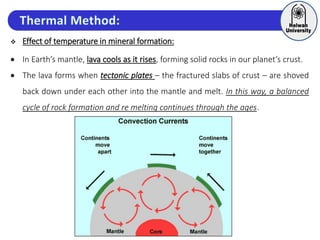
 Effect of temperature in mineral formation:
 In Earth’s mantle, lava cools as it rises, forming solid rocks in our planet’s crust.
 The lava forms when tectonic plates – the fractured slabs of crust – are shoved
back down under each other into the mantle and melt. In this way, a balanced
cycle of rock formation and re melting continues through the ages.
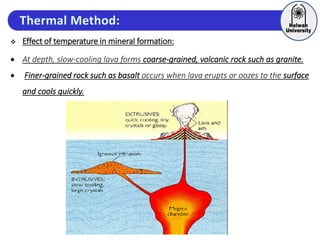
 Effect of temperature in mineral formation:
 At depth, slow-cooling lava forms coarse-grained, volcanic rock such as granite.
 Finer-grained rock such as basalt occurs when lava erupts or oozes to the surface
and cools quickly.
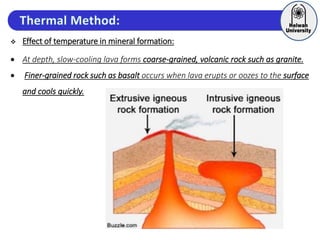
 Effect of temperature in mineral formation:
 At depth, slow-cooling lava forms coarse-grained, volcanic rock such as granite.
 Finer-grained rock such as basalt occurs when lava erupts or oozes to the surface
and cools quickly.
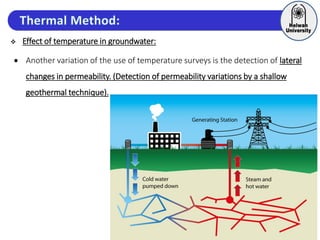
 Effect of temperature in groundwater:
 Another variation of the use of temperature surveys is the detection of lateral
changes in permeability. (Detection of permeability variations by a shallow
geothermal technique).
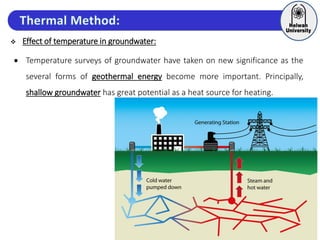
 Effect of temperature in groundwater:
 Temperature surveys of groundwater have taken on new significance as the
several forms of geothermal energy become more important. Principally,
shallow groundwater has great potential as a heat source for heating.
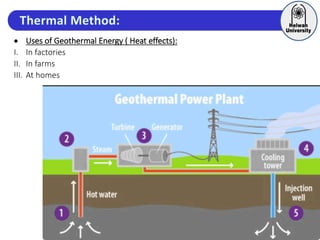
 Uses of Geothermal Energy ( Heat effects):
I. In factories
II. In farms
III. At homes
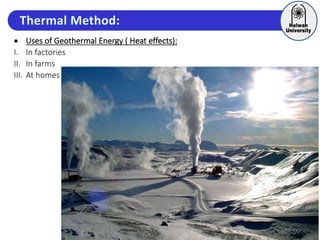
 Uses of Geothermal Energy ( Heat effects):
I. In factories
II. In farms
III. At homes
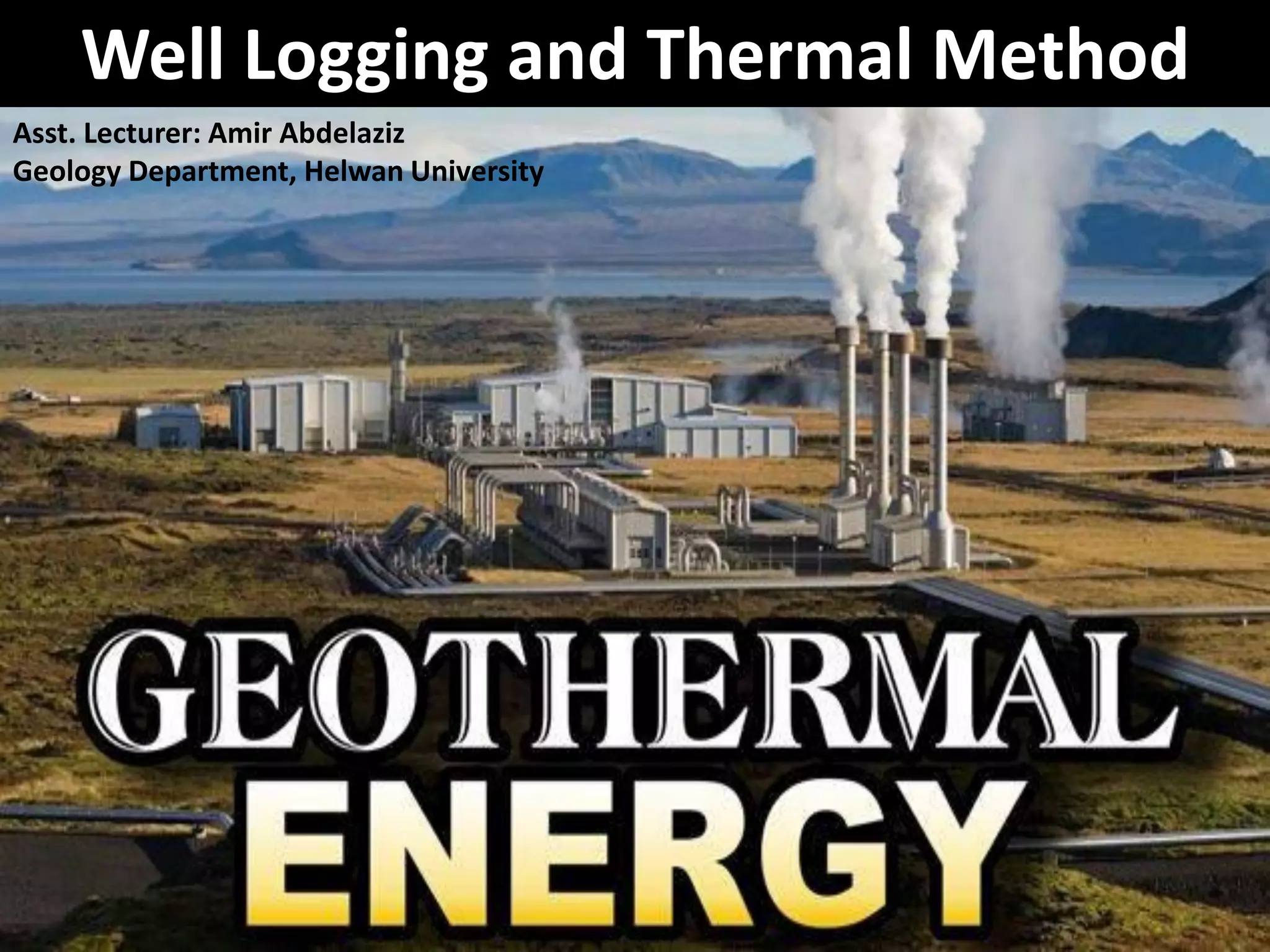
Thermal method in Well logging and Geothermal Energy

Thermal method in Well logging and Geothermal Energy

  • 1.
    Well Logging andThermal Method Asst. Lecturer: Amir Abdelaziz Geology Department, Helwan University
  • 2.
  • 3.
    1. Calipar tool:  Uses of the caliper log:  Calculation of mud cake thickness: hmc = (dbit – dh)/2, where h stands for the hole, in inches.  Measurement of borehole volume: Vh = (dh2/2)+1.2%, in liters' per meter.  Measurement of required cement volume: V cement = 0.5 *(dh2 – d2 casing) + 1%, in litres per metre.
  • 6.
    • Determination ofthe resistivity of mud (Rm): 1- Measurement by use of Resistivity Meter:- 2- Empirical Method:- In Fahrenheit InCelsius • Determination of the resistivity of mud filtrate (Rmf): 1) Measurements by Resistivity Meter:- 2) Estimation from the Resistivity of the Mud:- (empirical method) Rmf =Km(Rm)1.07 Where K varying between 0.847 – 0.35
  • 7.
    • Determination ofthe resistivity of mud-Cake (Rmc): • 1- Measurement by Resistivity Meter • 2- Estimation from Mud Resistivity
  • 8.
    A. TEMPERATURE GRADIENT: It is important to determine the temperature opposite each level examined in order to take this influence into account in the quantitative interpretation of the log measurements since the temperature influences resistivities as well as the density of fluids, the hydrogen neutron index, the sonic transit time in fluids, etc.
  • 9.
     Formation temperaturevaries with depth, and it is necessary therefore either to have a continuous measurement (temperature well logging) or to know the temperature at two given depths and to inter-or extrapolate
  • 10.
     Geothermal gradientis the rate of increasing temperature with respect to increasing depth in the Earth 's interior it is 22.1°C per km of depth (1°F per 70 feet of depth) in most of the world.
  • 11.
     Geothermal gradientis the rate of increasing temperature with respect to increasing depth in the Earth 's interior it is 22.1°C per km of depth (1°F per 70 feet of depth) in most of the world.
  • 12.
     Effect oftemperature in Hydrocarbon generation:  A fine-grained sedimentary rock containing at least 1 to 2% of organic matter can play the role of a source rock.  Under the influence of temperature and pressure, the organic matter contained in the source rock is gradually converted into kerogen, which is distributed throughout the rock as small particles. The kerogen starts to mature at temperatures of 60 to100°C (at depths below 2000m).
  • 13.
     Effect oftemperature in Hydrocarbon generation:  The increasing temperature and pressure, as burial depth increases, breaks and reorganizes molecules. The kerogen starts to generate hydrocarbons: I. Oil first (oil window) II. Gas at higher temperatures and pressures (gas window).
  • 14.
     Effect oftemperature in mineral formation:  In Earth’s mantle, lava cools as it rises, forming solid rocks in our planet’s crust.  The lava forms when tectonic plates – the fractured slabs of crust – are shoved back down under each other into the mantle and melt. In this way, a balanced cycle of rock formation and re melting continues through the ages.
  • 15.
     Effect oftemperature in mineral formation:  At depth, slow-cooling lava forms coarse-grained, volcanic rock such as granite.  Finer-grained rock such as basalt occurs when lava erupts or oozes to the surface and cools quickly.
  • 16.
     Effect oftemperature in mineral formation:  At depth, slow-cooling lava forms coarse-grained, volcanic rock such as granite.  Finer-grained rock such as basalt occurs when lava erupts or oozes to the surface and cools quickly.
  • 17.
     Effect oftemperature in groundwater:  Another variation of the use of temperature surveys is the detection of lateral changes in permeability. (Detection of permeability variations by a shallow geothermal technique).
  • 18.
     Effect oftemperature in groundwater:  Temperature surveys of groundwater have taken on new significance as the several forms of geothermal energy become more important. Principally, shallow groundwater has great potential as a heat source for heating.
  • 19.
     Uses ofGeothermal Energy ( Heat effects): I. In factories II. In farms III. At homes
  • 20.
     Uses ofGeothermal Energy ( Heat effects): I. In factories II. In farms III. At homes