CONDUCTION
CONDUCTION ???
WHAT IS
Conduction is the method of transfer of heat within a body
or from one body to the other due to the transfer of heat by
molecules vibrating at their mean positions.
The bodies through which the heat transfer must be in
contact with each other. There is no actual movement of
matter while transferring heat from one location to the
other.
eg.
on stove
conduc ion
MAT ER
t in
SOLIDS LIQUIDS GASES
Compact packing of
atoms
More intermolecular
distance
Molecules are farther
apart
Collision is more
frequent
Collision is moderately
frequent
Collision is less
frequent
More conductive Moderately conductive Less conductive
HEAT
Energy that is transferred from one body to another as the
result of a difference in temperature.
RATE OF HEAT FLOW
The rate of heat flow is the amount of heat that is transferred per
unit of time in some material, usually measured in watt (joules per
second). Formula => Q/t Q = amount of
heat
t = time
A little bit
A measure of the ability of a material to transfer heat.
It is the heat energy transferred per unit time and per unit
surface area, divided by the temperature difference.
THERMAL CONDUCTIVITY
Numerical value of the thermal conductivity indicates
how fast heat will flow.
AIM
To find the thermal conductivity of a material by the two slabs guarded hot
plate method.
Apparatus
physical virtual
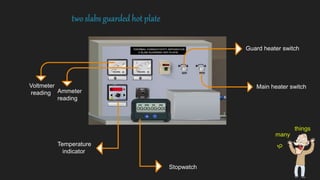
• two slabs guarded hot plate
• Stop watch
• water
vlab
Physical science
Heat & thermodynamics
Voltmeter
reading Ammeter
reading
Guard heater switch
Main heater switch
Temperature
indicator
Stopwatch
things
many
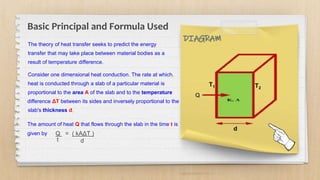
Basic Principal and Formula Used
The theory of heat transfer seeks to predict the energy
transfer that may take place between material bodies as a
result of temperature difference.
Consider one dimensional heat conduction. The rate at which.
heat is conducted through a slab of a particular material is
proportional to the area A of the slab and to the temperature
difference ΔT between its sides and inversely proportional to the
slab's thickness d.
The amount of heat Q that flows through the slab in the time t is
given by Q = ( kAΔT )
d
Q
T1 T2
d
DIAGRAM
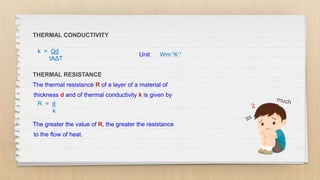
THERMAL CONDUCTIVITY
k = Qd
tAΔT
THERMAL RESISTANCE
The thermal resistance R of a layer of a material of
thickness d and of thermal conductivity k is given by
R = d
k
The greater the value of R, the greater the resistance
to the flow of heat.
Unit Wm-1K-1
OBSERVATION
TABLE
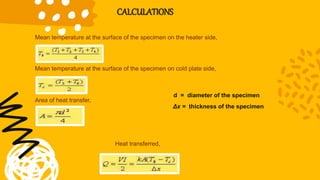
CALCULATIONS
Mean temperature at the surface of the specimen on the heater side,
Mean temperature at the surface of the specimen on cold plate side,
Area of heat transfer,
Heat transferred,
d = diameter of the specimen
Δx = thickness of the specimen
PRECAUTION
 Surrounding temperature should be kept
constant.
 Take readings at steady state condition.
 Use the knob gently.
NAME - ROLL. NO.
MALAY - 19001321029
LOKESH - 19001321027
AADARSH - 19001321001
AFTAB - 19001321003

HEAT TRANSFER BY CONDUCTION.pptx

  • 1.
  • 2.
    CONDUCTION ??? WHAT IS Conductionis the method of transfer of heat within a body or from one body to the other due to the transfer of heat by molecules vibrating at their mean positions. The bodies through which the heat transfer must be in contact with each other. There is no actual movement of matter while transferring heat from one location to the other. eg. on stove
  • 3.
    conduc ion MAT ER tin SOLIDS LIQUIDS GASES Compact packing of atoms More intermolecular distance Molecules are farther apart Collision is more frequent Collision is moderately frequent Collision is less frequent More conductive Moderately conductive Less conductive
  • 4.
    HEAT Energy that istransferred from one body to another as the result of a difference in temperature. RATE OF HEAT FLOW The rate of heat flow is the amount of heat that is transferred per unit of time in some material, usually measured in watt (joules per second). Formula => Q/t Q = amount of heat t = time
  • 5.
    A little bit Ameasure of the ability of a material to transfer heat. It is the heat energy transferred per unit time and per unit surface area, divided by the temperature difference. THERMAL CONDUCTIVITY Numerical value of the thermal conductivity indicates how fast heat will flow.
  • 6.
    AIM To find thethermal conductivity of a material by the two slabs guarded hot plate method.
  • 7.
    Apparatus physical virtual • twoslabs guarded hot plate • Stop watch • water vlab Physical science Heat & thermodynamics
  • 8.
    Voltmeter reading Ammeter reading Guard heaterswitch Main heater switch Temperature indicator Stopwatch things many
  • 9.
    Basic Principal andFormula Used The theory of heat transfer seeks to predict the energy transfer that may take place between material bodies as a result of temperature difference. Consider one dimensional heat conduction. The rate at which. heat is conducted through a slab of a particular material is proportional to the area A of the slab and to the temperature difference ΔT between its sides and inversely proportional to the slab's thickness d. The amount of heat Q that flows through the slab in the time t is given by Q = ( kAΔT ) d Q T1 T2 d DIAGRAM
  • 10.
    THERMAL CONDUCTIVITY k =Qd tAΔT THERMAL RESISTANCE The thermal resistance R of a layer of a material of thickness d and of thermal conductivity k is given by R = d k The greater the value of R, the greater the resistance to the flow of heat. Unit Wm-1K-1
  • 11.
  • 12.
    CALCULATIONS Mean temperature atthe surface of the specimen on the heater side, Mean temperature at the surface of the specimen on cold plate side, Area of heat transfer, Heat transferred, d = diameter of the specimen Δx = thickness of the specimen
  • 13.
    PRECAUTION  Surrounding temperatureshould be kept constant.  Take readings at steady state condition.  Use the knob gently.
  • 14.
    NAME - ROLL.NO. MALAY - 19001321029 LOKESH - 19001321027 AADARSH - 19001321001 AFTAB - 19001321003