Thermal Methods of Analysis
Theory, General Techniques
and Applications
Prof. Tarek A. Fayed
1- General introduction and theory:
Thermal analysis (TA) is a group of physical techniques
in which the chemical or physical properties of
a substance, a mixture of substances or a reaction
mixture are measured as a function of temperature or
time, while the substances are subjected to a controlled
temperature programmed heating or cooling rate.
The program may involve heating or cooling at a fixed
rate of temperature change, or holding the temperature
constant at different time spam. The graphical results
obtained are called the thermogram.
These methods are usually applied to solids, liquids and
gels to characterize the materials for quality control.
 The advantages of TA over other analytical techniques
can be summarized as follows:
(1) The samples can be studied over a wide temperature
range using various temperature programs.
(2) Almost any physical from of sample (solid, liquid or gel)
can be accommodated using a variety of sample vessels.
(3) A small amount of sample (0.1 µg – 10 mg) is required.
(4) The atmosphere of the sample can be standardized.
(5) The time required to complete an experiment ranges
from several minutes to hours.
2-Thermal analysis techniques
The general components of TA apparatus are; a physical
property sensor, a controlled temperature programmed
furnace and a recording device (x-y recorder or a micro-
computer).
According to the measured property, the following table
is a list of the main thermal analysis methods:
1: Thermogravimetric Analysis (TGA)
 Thermogravimetric analysis is the study of the changes
in weight of a sample as a function of temperature. The
technique is useful strictly for transformations involving
the absorption or evolution of gases from a specimen.
Suitable samples for TGA are solids that undergo one of
the two general of reactions:
Reactant(s)  Product(s) + Gas (a mass loss)
Gas + Reactant(s)  Product(s) (a mass gain)
 A plot of the changes of the mass versus temperature, is
called TGA thermogram.
 It permits studying of the thermal stabilities, rate of
reactions, reaction processes, and sample composition.
 Measurements of changes in sample mass with the
temperature are made using thermobalance. The
balance should be in a suitably enclosed system so that
the atmosphere can be controlled.
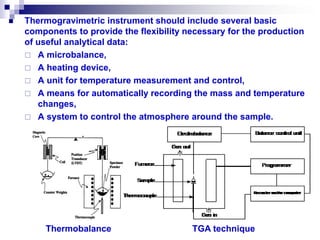
 Thermogravimetric instrument should include several basic
components to provide the flexibility necessary for the production
of useful analytical data:
 A microbalance,
 A heating device,
 A unit for temperature measurement and control,
 A means for automatically recording the mass and temperature
changes,
 A system to control the atmosphere around the sample.
TGA technique
Thermobalance
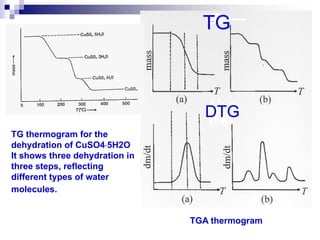
TGA thermogram
TG thermogram for the
dehydration of CuSO45H2O
It shows three dehydration in
three steps, reflecting
different types of water
molecules.
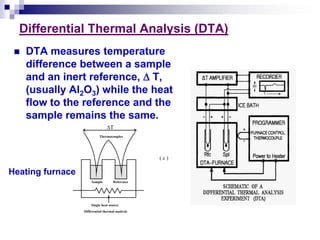
Differential Thermal Analysis (DTA)
 DTA measures temperature
difference between a sample
and an inert reference,  T,
(usually Al2O3) while the heat
flow to the reference and the
sample remains the same.
Heating furnace
DTA Thermogram
Exothermic change
Endothermic change
 In Exothermic
changes, as
crystallization, the
sample temperature
increases than the
reference.
 In endothermic
changes, as melting,
the sample
temperature
decreases than the
reference.
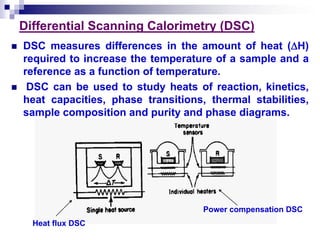
Differential Scanning Calorimetry (DSC)
 DSC measures differences in the amount of heat (H)
required to increase the temperature of a sample and a
reference as a function of temperature.
 DSC can be used to study heats of reaction, kinetics,
heat capacities, phase transitions, thermal stabilities,
sample composition and purity and phase diagrams.
Power compensation DSC
Heat flux DSC
Power
difference
H
DSC trace of poly(ethylene
terephthalate-co-p-oxbenzoate
DSC circuit
Common notes:
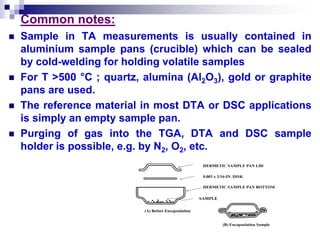
 Sample in TA measurements is usually contained in
aluminium sample pans (crucible) which can be sealed
by cold-welding for holding volatile samples
 For T >500 °C ; quartz, alumina (Al2O3), gold or graphite
pans are used.
 The reference material in most DTA or DSC applications
is simply an empty sample pan.
 Purging of gas into the TGA, DTA and DSC sample
holder is possible, e.g. by N2, O2, etc.
Variables affecting sensitivity of TA techniques
 1. The sample
The chemical description of the sample together with its source,
purity and pre-treatments, the particle size may alter the shape of
the TA curve, especially where a surface reaction is involved.
 2. The crucible
The material of the sample holder or crucible should be stated.
Sample holders should not interact with the sample during the
course of the experiment.
 3. The heating rate (dT/dt)
Experiments may be carried out at slow to very high rates. The
'normal' rate is about 10 K min–1. In order to approach equilibrium
conditions most closely, we should use a very small heating rate.
 4. The atmosphere
The atmosphere surrounding the sample and its products may
greatly affect the measurements. There may be a reaction between
the sample and the atmosphere.
 5. The mass of the sample
 The physical properties, amount and the packing of the sample can
affect the results obtained. Small samples are preferable and the
average is about 10 mg. Powdered samples or thin films may react
more readily than large crystals or lumps.
 Thermal decomposition
temperatures for CaCO3 in
different gas atmospheres.
 Measurement of the melting point of Di-
tert.-biphenyle at different heating rates.
 Effect of changing of
purity of pharmaceutical
products, e.g. phenacetin
on DSC thermogram
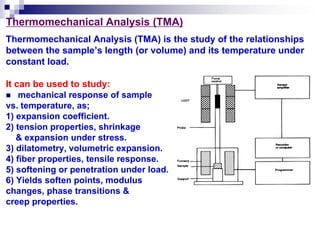
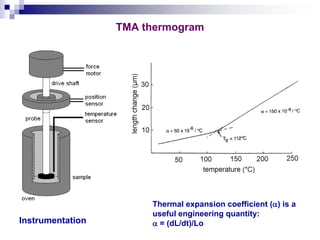
Thermomechanical Analysis (TMA)
Thermomechanical Analysis (TMA) is the study of the relationships
between the sample’s length (or volume) and its temperature under
constant load.
It can be used to study:
 mechanical response of sample
vs. temperature, as;
1) expansion coefficient.
2) tension properties, shrinkage
& expansion under stress.
3) dilatometry, volumetric expansion.
4) fiber properties, tensile response.
5) softening or penetration under load.
6) Yields soften points, modulus
changes, phase transitions &
creep properties.
TMA thermogram
Thermal expansion coefficient () is a
useful engineering quantity:
 = (dL/dt)/Lo
Instrumentation
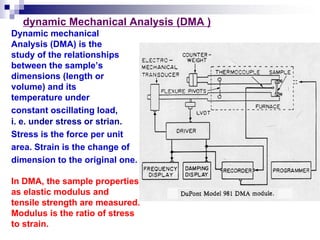
dynamic Mechanical Analysis (DMA )
Dynamic mechanical
Analysis (DMA) is the
study of the relationships
between the sample’s
dimensions (length or
volume) and its
temperature under
constant oscillating load,
i. e. under stress or strian.
Stress is the force per unit
area. Strain is the change of
dimension to the original one.
In DMA, the sample properties
as elastic modulus and
tensile strength are measured.
Modulus is the ratio of stress
to strain.
 Stress and strain wave
 DMA thermogram of
graphite / epoxy composite
TA often gives information impossible to be obtained by
other analytical methods. Often, for complex materials, as
polymer composites for development requirements and
control incoming of raw material of end use quality.
Generally, the important applications of thermal analysis
can be summarized as following:
1) Polymer industries and product reliability, include;
 Heat capacity and liquid crystal transitions.
 Cures and purity of polymers.
 The glass transition.
 Expansion coefficient and creep studies.
 Dynamic properties including viscoelastic
measurements, elastic, loss and shear modulus.
Applications TA
2) Chemical reactions
 Reaction kinetics and the desorption and adsorption
behavior of minerals are measured.
3) Pharmaceuticals industry
 Characterization and specification of active and inactive
ingredients.
 polymorphic modifications by annealing and purity are
studied.
 Solvent detection and quantification of additives.
 Expansion and decomposition of the polymers used to
encapsulate the drugs.
4) Ceramic / Glass / Building Materials
 Binder burnout and dehydration of ceramic
materials. Decomposition behavior of
inorganic building materials.
5) Food industry
 Provide rapid solutions to production and shelf-life of food stuffs.
 Characterization of fat and butter crystallinity.
 Quality control of fat and phase behaviour in frozen systems.
 Denaturation of vegetable and egg proteins.
 Gelatinization of starch.
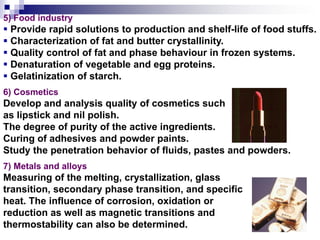
6) Cosmetics
Develop and analysis quality of cosmetics such
as lipstick and nil polish.
The degree of purity of the active ingredients.
Curing of adhesives and powder paints.
Study the penetration behavior of fluids, pastes and powders.
7) Metals and alloys
Measuring of the melting, crystallization, glass
transition, secondary phase transition, and specific
heat. The influence of corrosion, oxidation or
reduction as well as magnetic transitions and
thermostability can also be determined.

Lecture notes on therm analysis in PowerPoint

  • 1.
    Thermal Methods ofAnalysis Theory, General Techniques and Applications Prof. Tarek A. Fayed
  • 2.
    1- General introductionand theory: Thermal analysis (TA) is a group of physical techniques in which the chemical or physical properties of a substance, a mixture of substances or a reaction mixture are measured as a function of temperature or time, while the substances are subjected to a controlled temperature programmed heating or cooling rate. The program may involve heating or cooling at a fixed rate of temperature change, or holding the temperature constant at different time spam. The graphical results obtained are called the thermogram. These methods are usually applied to solids, liquids and gels to characterize the materials for quality control.
  • 3.
     The advantagesof TA over other analytical techniques can be summarized as follows: (1) The samples can be studied over a wide temperature range using various temperature programs. (2) Almost any physical from of sample (solid, liquid or gel) can be accommodated using a variety of sample vessels. (3) A small amount of sample (0.1 µg – 10 mg) is required. (4) The atmosphere of the sample can be standardized. (5) The time required to complete an experiment ranges from several minutes to hours. 2-Thermal analysis techniques The general components of TA apparatus are; a physical property sensor, a controlled temperature programmed furnace and a recording device (x-y recorder or a micro- computer).
  • 4.
    According to themeasured property, the following table is a list of the main thermal analysis methods:
  • 5.
    1: Thermogravimetric Analysis(TGA)  Thermogravimetric analysis is the study of the changes in weight of a sample as a function of temperature. The technique is useful strictly for transformations involving the absorption or evolution of gases from a specimen. Suitable samples for TGA are solids that undergo one of the two general of reactions: Reactant(s)  Product(s) + Gas (a mass loss) Gas + Reactant(s)  Product(s) (a mass gain)  A plot of the changes of the mass versus temperature, is called TGA thermogram.  It permits studying of the thermal stabilities, rate of reactions, reaction processes, and sample composition.  Measurements of changes in sample mass with the temperature are made using thermobalance. The balance should be in a suitably enclosed system so that the atmosphere can be controlled.
  • 6.
     Thermogravimetric instrumentshould include several basic components to provide the flexibility necessary for the production of useful analytical data:  A microbalance,  A heating device,  A unit for temperature measurement and control,  A means for automatically recording the mass and temperature changes,  A system to control the atmosphere around the sample. TGA technique Thermobalance
  • 7.
    TGA thermogram TG thermogramfor the dehydration of CuSO45H2O It shows three dehydration in three steps, reflecting different types of water molecules.
  • 8.
    Differential Thermal Analysis(DTA)  DTA measures temperature difference between a sample and an inert reference,  T, (usually Al2O3) while the heat flow to the reference and the sample remains the same. Heating furnace
  • 9.
    DTA Thermogram Exothermic change Endothermicchange  In Exothermic changes, as crystallization, the sample temperature increases than the reference.  In endothermic changes, as melting, the sample temperature decreases than the reference.
  • 10.
    Differential Scanning Calorimetry(DSC)  DSC measures differences in the amount of heat (H) required to increase the temperature of a sample and a reference as a function of temperature.  DSC can be used to study heats of reaction, kinetics, heat capacities, phase transitions, thermal stabilities, sample composition and purity and phase diagrams. Power compensation DSC Heat flux DSC
  • 11.
    Power difference H DSC trace ofpoly(ethylene terephthalate-co-p-oxbenzoate DSC circuit
  • 12.
    Common notes:  Samplein TA measurements is usually contained in aluminium sample pans (crucible) which can be sealed by cold-welding for holding volatile samples  For T >500 °C ; quartz, alumina (Al2O3), gold or graphite pans are used.  The reference material in most DTA or DSC applications is simply an empty sample pan.  Purging of gas into the TGA, DTA and DSC sample holder is possible, e.g. by N2, O2, etc.
  • 13.
    Variables affecting sensitivityof TA techniques  1. The sample The chemical description of the sample together with its source, purity and pre-treatments, the particle size may alter the shape of the TA curve, especially where a surface reaction is involved.  2. The crucible The material of the sample holder or crucible should be stated. Sample holders should not interact with the sample during the course of the experiment.  3. The heating rate (dT/dt) Experiments may be carried out at slow to very high rates. The 'normal' rate is about 10 K min–1. In order to approach equilibrium conditions most closely, we should use a very small heating rate.  4. The atmosphere The atmosphere surrounding the sample and its products may greatly affect the measurements. There may be a reaction between the sample and the atmosphere.  5. The mass of the sample  The physical properties, amount and the packing of the sample can affect the results obtained. Small samples are preferable and the average is about 10 mg. Powdered samples or thin films may react more readily than large crystals or lumps.
  • 14.
     Thermal decomposition temperaturesfor CaCO3 in different gas atmospheres.  Measurement of the melting point of Di- tert.-biphenyle at different heating rates.  Effect of changing of purity of pharmaceutical products, e.g. phenacetin on DSC thermogram
  • 15.
    Thermomechanical Analysis (TMA) ThermomechanicalAnalysis (TMA) is the study of the relationships between the sample’s length (or volume) and its temperature under constant load. It can be used to study:  mechanical response of sample vs. temperature, as; 1) expansion coefficient. 2) tension properties, shrinkage & expansion under stress. 3) dilatometry, volumetric expansion. 4) fiber properties, tensile response. 5) softening or penetration under load. 6) Yields soften points, modulus changes, phase transitions & creep properties.
  • 16.
    TMA thermogram Thermal expansioncoefficient () is a useful engineering quantity:  = (dL/dt)/Lo Instrumentation
  • 17.
    dynamic Mechanical Analysis(DMA ) Dynamic mechanical Analysis (DMA) is the study of the relationships between the sample’s dimensions (length or volume) and its temperature under constant oscillating load, i. e. under stress or strian. Stress is the force per unit area. Strain is the change of dimension to the original one. In DMA, the sample properties as elastic modulus and tensile strength are measured. Modulus is the ratio of stress to strain.
  • 18.
     Stress andstrain wave  DMA thermogram of graphite / epoxy composite
  • 19.
    TA often givesinformation impossible to be obtained by other analytical methods. Often, for complex materials, as polymer composites for development requirements and control incoming of raw material of end use quality. Generally, the important applications of thermal analysis can be summarized as following: 1) Polymer industries and product reliability, include;  Heat capacity and liquid crystal transitions.  Cures and purity of polymers.  The glass transition.  Expansion coefficient and creep studies.  Dynamic properties including viscoelastic measurements, elastic, loss and shear modulus. Applications TA
  • 20.
    2) Chemical reactions Reaction kinetics and the desorption and adsorption behavior of minerals are measured. 3) Pharmaceuticals industry  Characterization and specification of active and inactive ingredients.  polymorphic modifications by annealing and purity are studied.  Solvent detection and quantification of additives.  Expansion and decomposition of the polymers used to encapsulate the drugs. 4) Ceramic / Glass / Building Materials  Binder burnout and dehydration of ceramic materials. Decomposition behavior of inorganic building materials.
  • 21.
    5) Food industry Provide rapid solutions to production and shelf-life of food stuffs.  Characterization of fat and butter crystallinity.  Quality control of fat and phase behaviour in frozen systems.  Denaturation of vegetable and egg proteins.  Gelatinization of starch. 6) Cosmetics Develop and analysis quality of cosmetics such as lipstick and nil polish. The degree of purity of the active ingredients. Curing of adhesives and powder paints. Study the penetration behavior of fluids, pastes and powders. 7) Metals and alloys Measuring of the melting, crystallization, glass transition, secondary phase transition, and specific heat. The influence of corrosion, oxidation or reduction as well as magnetic transitions and thermostability can also be determined.