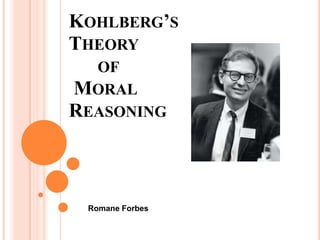
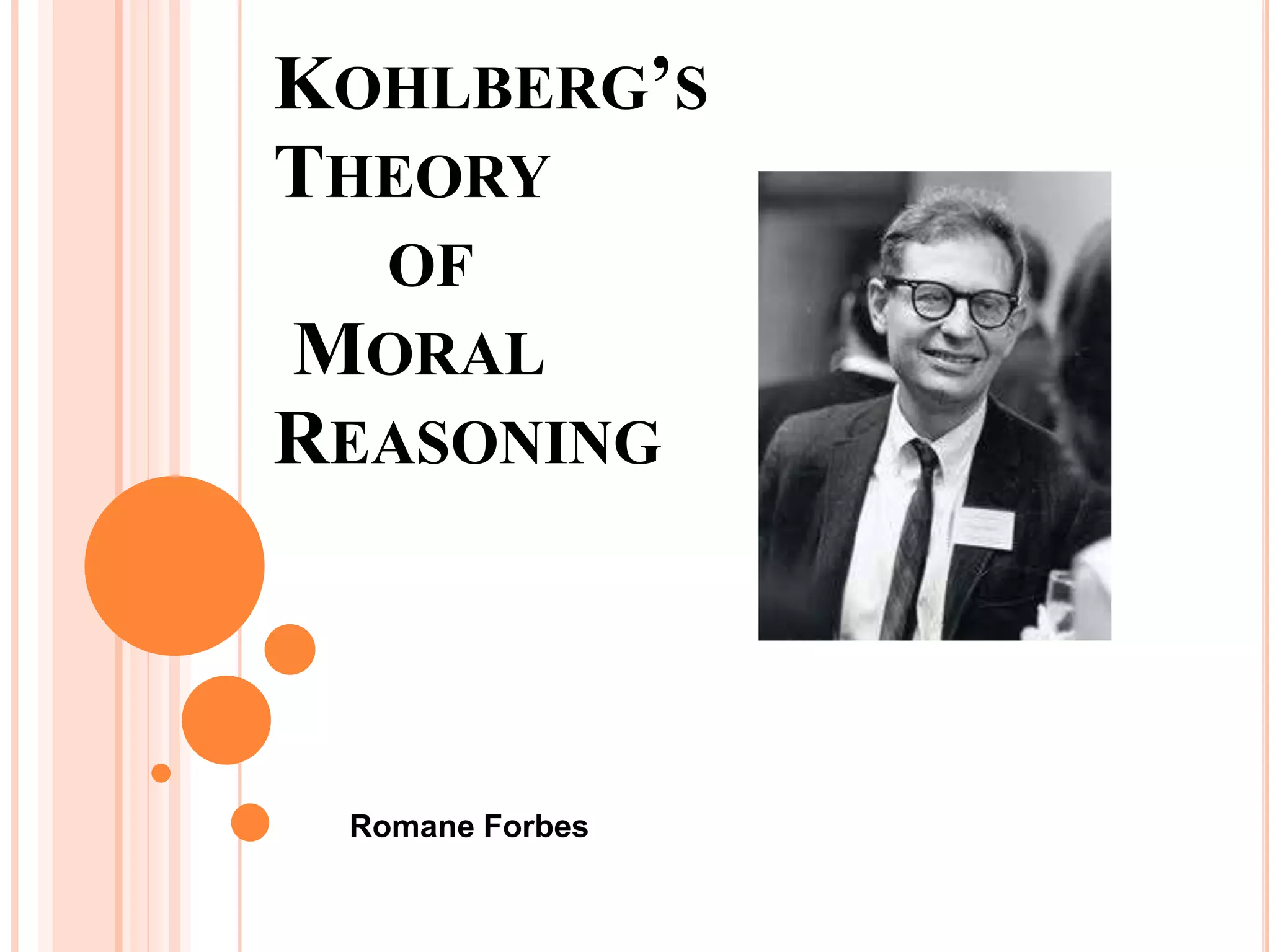
KOHLBERG’S
THEORY
  OF
MORAL
REASONING


 Romane Forbes
AT THE END OF THE PRESENTATION,
   THE LEARNER WILL…
 Gain basic background knowledge of
  Lawrence Kohlberg. (Timeline)
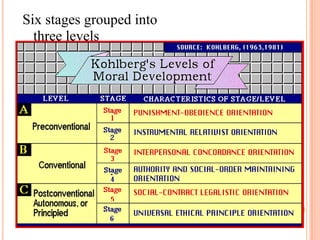
 Identify the three phases and six stages of
  Kohlberg’s theory of moral reasoning.
 Recognize reasoning of individuals in each
  stage of moral reasoning.
 Identify the impact of Kohlberg’s theory in
  Counselling.
LAWRENCE KOHLBERG
    TIMELINE
•   Born in 1927 and grew up in Bronxville, NY
•    Attended Andover Academy in Massachusetts
•   Enrolled in the University of Chicago in 1948 - he scored so
    high on the entrance exam that he only took a few courses
    before earning his Bachelor's degree
•   Stayed at the University of Chicago for his graduate degree in
    Psychology when he became interested in Piaget
•    His doctoral dissertation in 1958 was the first draft of his stage
    theory
•    Theory was influenced by Piaget and his observation of
    children's reaction to moral dilemmas
•   Contracted a parasite in Belize which caused tremendous pain
    and depression, leading to his suicide in 1987
Six stages grouped into
  three levels
LEVEL 1: PRECONVENTIONAL MORALITY
Stage 1: Punishment-avoidance and obedience

"It's against the law," or "It's bad to steal," as if this were all there
were to it. When asked to elaborate, the child usually responds in
terms of the consequences involved, explaining that stealing is bad
"because you'll get punished" (Kohlberg, 1981).

•   Similar to Piaget's first stage of moral thought
•   Child views adult's rules as unquestionable
•   Child generally says it is wrong for Heinz to steal the drug, disregarding
    his motives
•    Kohlberg calls stage 1 thinking "preconventional" because children do not
    yet speak as members of society. Instead, they see morality as something
    external to themselves, as that which the big people say they must do.
•    Children see punishment as an unavoidable consequence of disobeying
    rules
LEVEL 1: PRECONVENTIONAL MORALITY
Stage 2: Individualism and Exchange

 "Heinz," they might point out, "might think it's right to take the drug,
the druggist would not."

Maybe he had a family at home and without his wife nobody would be
home to watch them. But the druggist may have a family too and he
has to make money.

•    children realize individuals have differing opinions
•    children see punishment as something to be avoided if possible
•   everyone is free to pursue their own interests
•   still see people as individuals, not members of a larger group
LEVEL II: CONVENTIONAL MORALITY
Stage 3: Good interpersonal relationships

 It was really the druggist's fault, he was unfair, trying to overcharge
and letting someone die. Heinz loved his wife and wanted to save her. I
think anyone would. I don't think they would put him in jail. The judge
would look at all sides, and see that the druggist was charging too
much. (Kohlberg, 1981, p. 25)

• Adolescents see others both as individuals and as members of unit
  (society, family, culture, class, team)
• adolescents believe people should live up to their responsibilities
  within the family or community and behave in "good" ways
• being "good" means having empathy, compassion, honesty, and
  concern for others
LEVEL II: CONVENTIONAL MORALITY
Stage IV: Law and Order

 If everybody did as he wanted to do, set up his own beliefs as to right
and wrong, then I think you would have chaos. The only thing I think
we have in civilization nowadays is some sort of legal structure which
people are sort of bound to follow. [Society needs] a centralizing
framework.

•  Individuals are making decisions based on the implications on
  society, showing they now see themselves as members of a group
• emphasis is on maintaining social order through fulfilling
  responsibilities and obeying the law
LEVEL III: POST-CONVENTIONAL MORALITY
Stage V: Social Contract

 It is the husband's duty to save his wife. The fact that her life is in
danger transcends every other standard you might use to judge his
action. Life is more important than property.

•   Morals and rights are seen to be superior to certain laws
•   “Basically believe that a good society is best conceived as a social
    contract into which people freely enter to work toward the benefit
    of all They recognize that different social groups within a society
    will have different values, but they believe that all rational people
    would agree on two points. First they would all want certain basic
    rights, such as liberty and life, to be protected Second, they would
    want some democratic procedures for changing unfair law and for
    improving society."
LEVEL III: POST-CONVENTIONAL MORALITY
Stage VI: Universal Principles

•    Hypothetical ideal which few people ever achieve.
•   People adhere to a few abstract, universal principles
    (equality of all people, respect for human dignity,
    commitment to justice) that transcend specific norms and
    rules
•   People answer to a strong inner conscience and willingly
    disobey laws that violate their own ethical principles
KOHLBERG'S INFLUENCE ON EDUCATION
Kohlberg suggested to help children wrestle with moral dilemmas,
teachers should offer reasoning one stage above a child's current
stage

   o   Teenage boy is concerned primarily about gaining peer
       approval (stage 3) and often lets a popular cheerleader copy
       his homework. His teacher might present law-and-order
       logic (stage 4) suggesting that because homework
       assignments are designed to help students learn more
       effectively, all students should complete them without other's
       assistance.

   o    If teachers present arguments too much higher than
       children's current reasoning, children will have trouble
       understanding their logic and will benefit little.
KOHLBERG'S INFLUENCE ON COUNSELLING


•   Researchers have confirmed the idea that disequilibrium spurs
    moral development.

•   Classroom discussions of controversial topics and moral issues
    appear to promote increased perspective taking and the
    transition to more advanced reasoning .

•   Children’s moral reasoning is formed from their own
    experiences, not just from the values taught by adults
HOW DOES THE THEORY IMPACT HOW
YOU THINK ABOUT COUNSELLING?
   Allows insight to the challenges I will encounter, such as

    differing views on equality, race, money, personal

    achievement, collectivism, and independence.

   Allows me to view each student in a different light and

    realize the backgrounds they may come from can effect the

    way they progress through the moral development levels.
RESOURCES

Lawrence Kohlberg. (2011). Hutchinson's Biography
  Database, 1.

McDonough, G. P. (2005). Moral maturity and
 autonomy: appreciating the significance of
 Lawrence Kolhberg's Just Community. Journal Of
 Moral Education, 34(2), 199-213.

Reed, D. (2008). A model of moral stages. Journal Of
 Moral Education, 37(3), 357-376.

Lawrence Kohlberg

  • 1.
  • 2.
    AT THE ENDOF THE PRESENTATION, THE LEARNER WILL…  Gain basic background knowledge of Lawrence Kohlberg. (Timeline)  Identify the three phases and six stages of Kohlberg’s theory of moral reasoning.  Recognize reasoning of individuals in each stage of moral reasoning.  Identify the impact of Kohlberg’s theory in Counselling.
  • 3.
    LAWRENCE KOHLBERG TIMELINE • Born in 1927 and grew up in Bronxville, NY • Attended Andover Academy in Massachusetts • Enrolled in the University of Chicago in 1948 - he scored so high on the entrance exam that he only took a few courses before earning his Bachelor's degree • Stayed at the University of Chicago for his graduate degree in Psychology when he became interested in Piaget • His doctoral dissertation in 1958 was the first draft of his stage theory • Theory was influenced by Piaget and his observation of children's reaction to moral dilemmas • Contracted a parasite in Belize which caused tremendous pain and depression, leading to his suicide in 1987
  • 4.
    Six stages groupedinto three levels
  • 5.
    LEVEL 1: PRECONVENTIONALMORALITY Stage 1: Punishment-avoidance and obedience "It's against the law," or "It's bad to steal," as if this were all there were to it. When asked to elaborate, the child usually responds in terms of the consequences involved, explaining that stealing is bad "because you'll get punished" (Kohlberg, 1981). • Similar to Piaget's first stage of moral thought • Child views adult's rules as unquestionable • Child generally says it is wrong for Heinz to steal the drug, disregarding his motives • Kohlberg calls stage 1 thinking "preconventional" because children do not yet speak as members of society. Instead, they see morality as something external to themselves, as that which the big people say they must do. • Children see punishment as an unavoidable consequence of disobeying rules
  • 6.
    LEVEL 1: PRECONVENTIONALMORALITY Stage 2: Individualism and Exchange "Heinz," they might point out, "might think it's right to take the drug, the druggist would not." Maybe he had a family at home and without his wife nobody would be home to watch them. But the druggist may have a family too and he has to make money. • children realize individuals have differing opinions • children see punishment as something to be avoided if possible • everyone is free to pursue their own interests • still see people as individuals, not members of a larger group
  • 7.
    LEVEL II: CONVENTIONALMORALITY Stage 3: Good interpersonal relationships It was really the druggist's fault, he was unfair, trying to overcharge and letting someone die. Heinz loved his wife and wanted to save her. I think anyone would. I don't think they would put him in jail. The judge would look at all sides, and see that the druggist was charging too much. (Kohlberg, 1981, p. 25) • Adolescents see others both as individuals and as members of unit (society, family, culture, class, team) • adolescents believe people should live up to their responsibilities within the family or community and behave in "good" ways • being "good" means having empathy, compassion, honesty, and concern for others
  • 8.
    LEVEL II: CONVENTIONALMORALITY Stage IV: Law and Order If everybody did as he wanted to do, set up his own beliefs as to right and wrong, then I think you would have chaos. The only thing I think we have in civilization nowadays is some sort of legal structure which people are sort of bound to follow. [Society needs] a centralizing framework. • Individuals are making decisions based on the implications on society, showing they now see themselves as members of a group • emphasis is on maintaining social order through fulfilling responsibilities and obeying the law
  • 9.
    LEVEL III: POST-CONVENTIONALMORALITY Stage V: Social Contract It is the husband's duty to save his wife. The fact that her life is in danger transcends every other standard you might use to judge his action. Life is more important than property. • Morals and rights are seen to be superior to certain laws • “Basically believe that a good society is best conceived as a social contract into which people freely enter to work toward the benefit of all They recognize that different social groups within a society will have different values, but they believe that all rational people would agree on two points. First they would all want certain basic rights, such as liberty and life, to be protected Second, they would want some democratic procedures for changing unfair law and for improving society."
  • 10.
    LEVEL III: POST-CONVENTIONALMORALITY Stage VI: Universal Principles • Hypothetical ideal which few people ever achieve. • People adhere to a few abstract, universal principles (equality of all people, respect for human dignity, commitment to justice) that transcend specific norms and rules • People answer to a strong inner conscience and willingly disobey laws that violate their own ethical principles
  • 11.
    KOHLBERG'S INFLUENCE ONEDUCATION Kohlberg suggested to help children wrestle with moral dilemmas, teachers should offer reasoning one stage above a child's current stage o Teenage boy is concerned primarily about gaining peer approval (stage 3) and often lets a popular cheerleader copy his homework. His teacher might present law-and-order logic (stage 4) suggesting that because homework assignments are designed to help students learn more effectively, all students should complete them without other's assistance. o If teachers present arguments too much higher than children's current reasoning, children will have trouble understanding their logic and will benefit little.
  • 12.
    KOHLBERG'S INFLUENCE ONCOUNSELLING • Researchers have confirmed the idea that disequilibrium spurs moral development. • Classroom discussions of controversial topics and moral issues appear to promote increased perspective taking and the transition to more advanced reasoning . • Children’s moral reasoning is formed from their own experiences, not just from the values taught by adults
  • 13.
    HOW DOES THETHEORY IMPACT HOW YOU THINK ABOUT COUNSELLING?  Allows insight to the challenges I will encounter, such as differing views on equality, race, money, personal achievement, collectivism, and independence.  Allows me to view each student in a different light and realize the backgrounds they may come from can effect the way they progress through the moral development levels.
  • 14.
    RESOURCES Lawrence Kohlberg. (2011).Hutchinson's Biography Database, 1. McDonough, G. P. (2005). Moral maturity and autonomy: appreciating the significance of Lawrence Kolhberg's Just Community. Journal Of Moral Education, 34(2), 199-213. Reed, D. (2008). A model of moral stages. Journal Of Moral Education, 37(3), 357-376.