TABLE OF CONTENTS
1.	KEY PLAYERS, UP-AND-COMERS:
KNOW YOUR MARKET
(IN REAL TIME)
by Regina M Maxwell, MLIS
2.	HEALTHTECH INNOVATION
IN THE FACE OF CHANGE AND
UNCERTAINTY
by Eric Sugalski
3.	THE PLANNING PRESCRIPTION
4.	THE SARIAN GROUP INDEX
5.	MERGERS & ACQUISITIONS: HOW
TO MAKE THEM STICKY
by Brian Lee, Navigate
6.	PHILLY FUNDINGS
7.	SAVE THE DATE
Stay up to date on the pulse of the Philadelphia Life Science industry with our
Biotech Bulletin. This is a quarterly newsletter, with data and perspectives from
local leaders within the industry. Greg Sarian of The Sarian Group at High Tower
and Regina Maxwell of Maxwell Research Services, LLC are the co-authors of
the Biotech Bulletin. Each issue will include insight on the latest industry trends,
performance metrics on local biotech companies as well as current acquisitions
and IPO news in this area.
BIOTECH BULLETIN
SUMMER 2015
TRACKING THE PULSE OF THE PHILADELPHIA
LIFE SCIENCE INDUSTRY
KEY PLAYERS, UP-AND-COMERS:
KNOW YOUR MARKET
(IN REAL TIME)
by Regina M Maxwell, MLIS, Maxwell Research Services LLC
Whether exploring entering a market, building an additional franchise within a disease
area, or managing a broad product line across a therapeutic “center of excellence,”
it’s critical to stay on top of the key players’ strategies and goals, and to keep abreast
of “up-and-comers” with promising new science and technology. In doing so, this
empowers you to take advantage of opportunities, to constantly monitor and assess
risks, and to never be blindsided by the unexpected.
You may say, “My product is an oncology drug! How could I begin to sift through and
analyze the hundreds of companies engaged in this area?” For a snapshot in time,
you might start by purchasing a recent, high-quality market research report that is as
specific as possible to your area of research. However, these reports become dated
even before they are published.
In order to keep abreast of developments, it is wise to ask (and re-ask, on a regular
basis) a number of important questions related to your disease area:
•	 Which companies are currently conducting clinical trials?
•	 What is being studied in which populations?
•	 When are the trials expected to complete and readout?
•	 Are they on track with expected timelines?
•	 Who are the most prominent Key Opinion Leaders (KOLs)?
•	 Are they the Principle Investigators for the above companies’ trials?
•	 Which are the renowned academic/research institutions in the disease area?
•	 Which companies are collaborating with them for their research?
•	 Which companies are publishing the most in the peer-reviewed literature?
•	 Are the journals the prominent ones in the research area?
•	 Which companies are getting regulatory approvals?
•	 According to Tufts’ Center for the Study of Drug Development (2014), only
1 in 8 drugs (or 12%) that enter clinical trials is approved, however some
companies have much better track records than others. For the companies
in question, how often do they receive approval letters the first time around?
How often do they receive “complete response letters?” How often do they
fail to get approval?
GREGORY C. SARIAN
CPWA®
| CIMA®
| CFP®
| CHFC®
Managing Director & Partner
FOUNDER
REGINA M. MAXWELL, MLIS
Principal
GUEST CONTRIBUTOR
BIOTECH BULLETIN SUMMER 2015 — PAGE 2
•	 Which companies are getting expedited review status with FDA
and/or other regulatory bodies?
•	 Fast track, breakthrough therapy, accelerated approval and
priority review are regulatory pathways that FDA grants for
promising drugs that may represent new treatments for
serious diseases with significant unmet need. These drugs
may be the first available treatments for a disease, or have
significant advantages over existing treatments.
•	 Which companies have pipelines in the therapy area, in addition
to in-line drugs?
•	 How robust are they?
•	 What are the companies overtly stating about their pipelines
in their public statements?
•	 Have they announced a strategic change in their therapeutic
area plans for the future (that may no longer include the TA
of interest)?
•	 Which companies are most actively pursuing deals/acquisitions?
•	 Are they collaborating with known leaders or recognized
trailblazers in the disease area?
These questions represent a 35K’ approach to keeping abreast of the
key players and rising stars in a disease area. To discuss an in-depth
analysis of the players within your disease/therapy area, contact
Maxwell Research Services.
Regina Maxwell is Principal of Maxwell Research Services, a full-
service research firm specializing in research for start-ups, and small
to mid-size biotech firms. You can reach her at
regina@maxwellresearchservices.com or through the company
website at http://www.maxwellresearchservices.com.
KEY PLAYERS, UP-AND-COMERS: KNOW YOUR MARKET (IN REAL TIME) (CONT.D)
HEALTHTECH INNOVATION IN THE FACE OF
CHANGE AND UNCERTAINTY
by Eric Sugalski, President of Boston Device Development (BDD) and Managing Partner of PLEXUS Innovation Hub
Many medical device companies are immobilized due to the massive changes and uncertainties within the US healthcare system. FDA’s
unpredictability, changing hospital economics, reimbursement tightening, the medical device tax, and lack of investment capital have
created a “perfect storm” for our industry. These concerns are widespread among established companies, and they have created a
doom-and-gloom aura toward the medical device sector in recent years.
The good news - despite these changes and uncertainties, a new breed of healthtech companies has emerged and found success.
Rather than viewing these changes and uncertainties as barriers and limitations, these companies are exploiting new market
opportunities.
For example, payor refocus on preventative-based care has created new markets for wearables and other personal monitoring devices
in detecting events before they occur. Individuals with cardiac arrhythmia can capture ECG, heart rate, respiration rate, and activity
level through a patch that communicates these vital signs to smart phones (www.corventis.com). Smart garments for the elderly are in
development, which aim to detect falls and deploy airbag technology for preventing hip fractures (www.activeprotect.co).
Cost pressures within hospitals are shifting care into the home which in turn mandates new enabling technologies. Diabetic patients
can scan for foot ulcers simply by stepping on smart mats (www.podimetrics.com). Renal failure patients can receive dialysis treatments,
communicate with clinicians, and collect essential diagnostic information while watching Netflix on their living room couches
(www.nxstage.com).
BIOTECH BULLETIN SUMMER 2015 — PAGE 3
In addition to adapting to healthcare change, these innovative
companies are working smarter. They are using lean and agile processes
to rapidly derisk new technology. Rather than building a product from
start to finish, innovative companies are dividing the product into a series
of small experiments. Such experiments may inform the company about
key technical, usability, and even regulatory hurdles. Rather than waiting
until the product is manufactured and approved to acquire this valuable
data, innovative companies are developing fast and inexpensive methods
to quickly demonstrate proof of concept or alternatively “fail fast.”
Furthermore, these innovative companies are pulling on full-time talent
only as needed. Rather than building large teams and processes for
functions that may be unnecessary within a year, some companies are
leveraging contract resources for product development, regulatory
strategy, clinical studies, and manufacturing. These on-demand
resources provide instant expertise, quality procedures, and supply chains
that would take most companies years to build.
Lastly, healthtech innovators are surrounding themselves within clusters
of like-minded innovators under cost effective models. Industry focused
co-working spaces and innovation hubs are common launching pads
for these disruptive companies. Shared workspace provides flexibility,
scalability, shared access to key facilities, and most importantly access to
other innovative companies, collaborators, and investors.
Changes within our healthcare system are undeniable, and new models
of care delivery are rapidly evolving. Companies can opt to embrace
the changes and find the new opportunities created through them, or
they can continue along the path of business as usual. Hopefully, more
companies will take the road to healthtech innovation.
Eric Sugalski is the President of Boston Device Development (BDD) and
Managing Partner of PLEXUS Innovation Hub. BDD is a contract product
development firm focused on healthcare technology, with offices in
Boston and Philadelphia. PLEXUS is a health tech co-working space in
downtown Philadelphia. Eric has 16 years of experience in designing,
developing and manufacturing new healthtech innovations. He holds a
B.S. in Mechanical Engineering from the University of Colorado and an
M.B.A. from the Massachusetts Institute of Technology Sloan School of
Business.
HEALTHTECH INNOVATION IN THE FACE OF CHANGE AND UNCERTAINTY (CONT.D)
THE PLANNING PRESCRIPTION:
USE OF AN 83(B) ELECTION
The 83(b) election is a tax strategy for executives who receive stock in an early stage company, who believe the company will
experience significant appreciation. The election allows you to pay taxes upfront when you receive shares. The tax is usually ordinary
income based on the valuation of the stock less the amount paid for it. The goal is to pay the tax when the company has little or no
value so when the company grows, you can sell shares held more than a year at preferable capital growth rates. Even at the highest
marginal income tax rates, this is still a benefit.
BIOTECH BULLETIN SUMMER 2015 — PAGE 4
Dec-13 - Jun-15
90
100
110
120
130
140
150
160
170
Growthof$100
Dec-13 Feb-14 Apr-14 Jun-14 Aug-14 Oct-14 Dec-14 Feb-15 Apr-15 Jun-15
Total
SG BioTech Index
S&P 500 Index
iShares Nasdaq Biotechnology
Cumulative Performance: Growth of $100 on Equally Weighted Index, Rebalanced Monthly
Past performance does not guarantee or indicate future results. Analytics are presented for informational purposes only and do not constitute an offer or recommendation to buy or sell securities or to engage an
investment manager. Mutual fund results do not reflect the deduction of sales loads. Market Indices included are a general source of information and may not be the designated benchmark to evaluate an investment's performance.
© 2015 Markov Processes International LLC. All Rights Reserved. Neither MPI nor its content providers are responsible for any damages or losses arising from any use of this information.
Portfolio Holdings
Active Control Technology Inc Adaptimmune Therapeutics PLC Alcobra Ltd Advaxis Inc
Aerie Pharmaceuticals Inc Agile Therapeutics Inc Akers Biosciences Inc Alliqua BioMedical Inc
Amicus Therapeutics Inc Cancer Genetics Inc Celator Pharmaceuticals Inc Celgene Corp
Cyclacel Pharmaceuticals Inc Discovery Laboratories Inc Eagle Pharmaceuticals Inc Echo Therapeutics Inc
Egalet Corp Endo International PLC Enzon Pharmaceuticals Inc Fibrocell Science Inc
GlaxoSmithKline PLC Globus Medical Inc Immunomedics Inc Incyte Corp
Inovio Pharmaceuticals Inc Insmed Inc Johnson & Johnson Lannett Co Inc
Medgenics Inc The Medicines Company Merck & Co Inc Mylan NV
Onconova Therapeutics Inc Ophthotech Corp Pacira Pharmaceuticals Inc PhotoMedex Inc
ProPhase Labs Inc PTC Therapeutics Inc Tobira Therapeutics Inc Recro Pharma Inc
Safeguard Scientifics Inc Spark Therapeutics Inc TetraLogic Pharmaceuticals Corporation Vitae Pharmaceuticals Inc
Auxilium Pharmaceuticals Inc NPS Pharmaceuticals Inc
THE SARIAN GROUP INDEX
The Sarian Group Index started in January 2013 to track regionally located HealthCare oriented businesses whose stock
is traded above $1 a share against the S&P 500 and Nasdaq Biotechnology index. It is an equally weighted index of
publicly traded life sciences companies headquartered in PA, NJ and DE and is rebalanced monthly. Below is a look at
the performance pattern since December 2013 along with a list of the companies that are currently included. Also listed
are the Top Ten Companies who have had the largest gains and losses YTD within the index.
Eagle Pharmaceuticals Inc 421.68
Recro Pharma Inc 351.75
Advaxis Inc 153.81
Egalet Corp 153.60
Regado Biosciences Inc 109.91
Fibrocell Science Inc 103.47
Cancer Genetics Inc 76.05
Alcobra Ltd 75.34
Amicus Therapeutics Inc 70.07
Insmed Inc 57.85
TetraLogic Pharmaceuticals Corporation -51.45
Discovery Laboratories Inc -41.38
Aerie Pharmaceuticals Inc -39.53
Onconova Therapeutics Inc -27.96
Pacira Pharmaceuticals Inc -20.23
Immunomedics Inc -15.42
Vitae Pharmaceuticals Inc -13.46
Inovio Pharmaceuticals Inc -11.11
PhotoMedex Inc -11.11
ProPhase Labs Inc -7.53
Active Control Technology Inc Adaptimmune Therapeutics PLC Alcobra Ltd Advaxis Inc
Aerie Pharmaceuticals Inc Agile Therapeutics Inc Akers Biosciences Inc Alliqua BioMedical Inc
Amicus Therapeutics Inc Cancer Genetics Inc Celator Pharmaceuticals Inc Celgene Corp
Cyclacel Pharmaceuticals Inc Discovery Laboratories Inc Eagle Pharmaceuticals Inc Echo Therapeutics Inc
Egalet Corp Endo International PLC Enzon Pharmaceuticals Inc Fibrocell Science Inc
GlaxoSmithKline PLC Globus Medical Inc Immunomedics Inc Incyte Corp
Inovio Pharmaceuticals Inc Insmed Inc Johnson & Johnson Lannett Co Inc
Medgenics Inc The Medicines Company Merck & Co Inc Mylan NV
Onconova Therapeutics Inc Ophthotech Corp Pacira Pharmaceuticals Inc PhotoMedex Inc
ProPhase Labs Inc PTC Therapeutics Inc Tobira Therapeutics Inc Recro Pharma Inc
Safeguard Scientifics Inc Spark Therapeutics Inc TetraLogic Pharmaceuticals Corporation Vitae Pharmaceuticals Inc
Auxilium Pharmaceuticals Inc NPS Pharmaceuticals Inc
The Sarian Group is a group of investment professionals registered with HighTower Securities, LLC, member FINRA, MSRB and SIPC, and with HighTower Advisors, LLC, a registered investment advisor with the
SEC. Securities are offered through HighTower Securities, LLC; advisory services are offered through HighTower Advisors, LLC.
PORTFOLIO HOLDINGS
TOP TEN GAINERS —YTD 6/30/2015 TOP TEN DECLINERS — YTD 6/30/2015
BIOTECH BULLETIN SUMMER 2015 — PAGE 5
MERGERS & ACQUISITIONS:
HOW TO MAKE THEM STICKY
by Brian Lee, Navigate
During the Integration Planning & Execution phases, every aspect
of operations must be considered and addressed – from R&D and
Commercial, to Finance and IT. Still, without effective Program
and Change Management, the most thorough due diligence and
comprehensive integration plans will fall short.
PROGRAM MANAGEMENT
Oftentimes, resources are allocated to the facilitation,
management, and oversight of key integration activities through
an Integration Management Office (IMO). The IMO must be
accountable for the execution of the integration and report to
an Executive Steering Committee ideally comprised of top-level
executives from each of the merging organizations. Inadequate
Program Management can lead to incomplete workstreams,
increased risk, and even costly oversights. Time and time again
we hear of companies forced to operate under costly extensions
to their Transitional Services Agreements as a result of its lack of
preparation to operate as a unified business. Can this be avoided?
Absolutely.
Having an IMO in place ensures collaboration and coordination
across workstreams, and manages dependencies to prevent
delays or derailment of key integration tasks. It also provides
visibility across the entire program and serves as the lynchpin for
driving integration outcomes.
CHANGE MANAGEMENT
In major organizational changes, most, if not all of the resulting
benefits can be attributed to employees doing (and in some cases,
not doing) things differently. Yet, most of the energy and money
is spent on technical and operational alignment. The best ideas
and objectives are worthless if your employees aren’t willing and
enabled to be successful. In general, employees want to do the
right thing, but the impending changes related to a merger or
acquisition can create significant anxiety within an organization –
typically more than what’s perceived on the surface and, in many
cases, among the most valued employees (who tend to have
options such as to avoid the change and find a new job).
How do you identify and understand what each employee or
group of employees is thinking? How can you provide them with
an outlet to share feedback and address concerns? How do you
retain the best talent and create an even greater organization?
Sounds simple, but the exercise of listening to employees through
constant and consistent two-way communication uncovers
issues while reinforcing key employee messages.
In organizations going through a major change such as a merger
or acquisition, employee change agent networks help to enable
two-way direct communication with leadership, peers, and the
organization as a whole, serving as a channel to share feedback
as well as relevant updates and other information. The power
of the network is its ability to inject facts into the “water cooler
conversations” and allow employee concerns to quickly be
received, evaluated, and addressed by the leadership team. We
have seen that a robust change management plan tailored
for each employee group (e.g., supervisors, line employees,
contractors) supported by an employee change agent network
can markedly improve an organization’s chances of successfully
navigating through a Merger Integration event.
Merger Integration is one the of the largest “change” initiatives a
company can undertake, and its resulting impact should not be
taken lightly. In order to make any change “sticky,” leadership must
acknowledge the integral role of employees and fully support
them. Proper and deliberate planning, including formal Program
and Change Management programs, followed by well-resourced
execution and measurement will significantly increase the
likelihood of a successful outcome and achieved objectives.
Brian Lee is a Partner with Navigate, a regional management
consulting firm that specializes in solving strategic and operational
business challenges for companies in the Life Sciences industry.
Learn more about Navigate at navigatecorp.com, or contact Brian
directly at blee@navigatecorp.com
Company balance sheets are flush with cash, venture and
private equity firms have capital to deploy, and general corporate
optimism is improving. Is anyone surprised that we’re in a climate
of consolidation? And Life Sciences is likely seeing more merger
and acquisition activity than any other industry area. Astonishing
multiples are being achieved as medium and large pharmaceutical
companies compete for pre-clinical and clinical assets to bolster
their pipelines. With the fury of activity, leadership must remember
that what makes the transaction “sticky,” so to speak, is the people.
You can acquire the best product or technology on the market
but without the right people in place to execute on the vision and
strategy, the investment may not be sustainable.
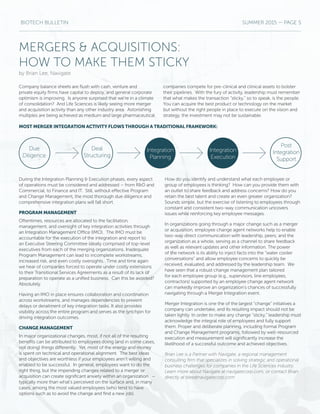
MOST MERGER INTEGRATION ACTIVITY FLOWS THROUGH A TRADITIONAL FRAMEWORK:
Due
Diligence
Deal
Structuring
Post
Integration
Support
Integration
Execution
Integration
Planning
BIOTECH BULLETIN SUMMER 2015 — PAGE 6
PHILLY FUNDINGS
The second quarter of 2015 was another strong period of
growth for our area. The following transactions represent
significant capital raises in our region.
NABRIVA THERAPEUTICS
Nabriva Therapeutics raised $120 million in a private stock
sale. The series B financing, the biggest investment in a local
life sciences company so far this year. The capital infusion will
enable Nabriva to get its lead new drug candidate, lefamulin, into
phase-III clinical testing as a potential treatment for community
acquired bacterial pneumonia.
EGALET
Egalet closed a $60 million financing deal. The company plans
to use the proceeds to fund the commercialization of its two
approved pain treatments: Oxaydo tablets and Sprix, a nasal
spray.
VENATORX PHARMACEUTICALS
VenatoRx received $3 million from National Institutes of Health
grants and other awards to advance its compounds being
developed to address biodefense-related infections.
ADAPTIMMUNE
Adaptimmune sold 11.25 million shares of common stock at
$17 per share, and estimates its net proceeds from the offering
will be about $175.7 million. Adaptimmune plans to use the
proceeds to advance and accelerate the clinical development
of its experimental immunotherapy candidates being studied
as a potential treatment for breast and lung cancer and as a
treatment for other solid tumors.
INTACT VASCULAR
Intact Vascular raised $38.9 million in a venture capital financing
and plans to use the proceeds to accelerate the development
of its Tack Endovascular System. This past March through a debt
financing, Intact Vascular raised $3 million.
CORTENDO
Cortendo raised $33.2 million in a private stock sale, a move that
follows its recent deal with Aspireo Pharmaceuticals of Israel to
acquire Somatoprim, an investigational compound being studied
for the treatment of acromegaly and other endocrine disorders.
ALEXAR THERAPEUTICS
Alexar Therapeutics received $5.4 million in a private stock sale.
The funds represent the second payment to Alexar under a $21.5
million series A financing the Malvern, Pennsylvania, specialty
pharmaceutical company’s secured early last year when it was
established.
SAVE THE DATE: PA BIO PEER TO PEER
FRIDAY OCT 2 — BREAKFAST MEETING
Location: Conshocken Marriott, 111 Crawford Ave, West Conshohocken, PA 19428
Topic: Keys to Implementing a successful business development campaign
Discussion Group facilitators: Denny Wilson, President and CEO Women’s Choice pharmaceuticals and Brian Mc Veigh VP
Worldwide Business Development GSK.
The Sarian Group is a group of investment professionals registered with HighTower Securities,
LLC, member FINRA, MSRB and SIPC, and with HighTower Advisors, LLC, a registered
investment advisor with the SEC. Securities are offered through HighTower Securities, LLC;
advisory services are offered through HighTower Advisors, LLC.
This is not an offer to buy or sell securities. No investment process is free of risk, and there is no
guarantee that the investment process or the investment opportunities referenced herein will
be profitable. Past performance is not indicative of current or future performance and is not a
guarantee. The investment opportunities referenced herein may not be suitable for all investors.
All data and information referenced herein are from sources believed to be reliable. Any
opinions, news, research, analyses, prices, or other information contained in this research is
provided as general market commentary, it does not constitute investment advice. The Sarian
Group and HighTower shall not in any way be liable for claims, and make no expressed or
implied representations or warranties as to the accuracy or completeness of the data and other
information, or for statements or errors contained in or omissions from the obtained data and
information referenced herein. The data and information are provided as of the date referenced.
Such data and information are subject to change without notice.
This document was created for informational purposes only; the opinions expressed are solely
those of Regina Maxwell, Brian Lee, Eric Sugalski, Greg Sarian, and The Sarian Group and do not
represent those of HighTower Advisors, LLC, or any of its affiliates.

Biotech Bulletin - Summer 2015

  • 1.
    TABLE OF CONTENTS 1. KEYPLAYERS, UP-AND-COMERS: KNOW YOUR MARKET (IN REAL TIME) by Regina M Maxwell, MLIS 2. HEALTHTECH INNOVATION IN THE FACE OF CHANGE AND UNCERTAINTY by Eric Sugalski 3. THE PLANNING PRESCRIPTION 4. THE SARIAN GROUP INDEX 5. MERGERS & ACQUISITIONS: HOW TO MAKE THEM STICKY by Brian Lee, Navigate 6. PHILLY FUNDINGS 7. SAVE THE DATE Stay up to date on the pulse of the Philadelphia Life Science industry with our Biotech Bulletin. This is a quarterly newsletter, with data and perspectives from local leaders within the industry. Greg Sarian of The Sarian Group at High Tower and Regina Maxwell of Maxwell Research Services, LLC are the co-authors of the Biotech Bulletin. Each issue will include insight on the latest industry trends, performance metrics on local biotech companies as well as current acquisitions and IPO news in this area. BIOTECH BULLETIN SUMMER 2015 TRACKING THE PULSE OF THE PHILADELPHIA LIFE SCIENCE INDUSTRY KEY PLAYERS, UP-AND-COMERS: KNOW YOUR MARKET (IN REAL TIME) by Regina M Maxwell, MLIS, Maxwell Research Services LLC Whether exploring entering a market, building an additional franchise within a disease area, or managing a broad product line across a therapeutic “center of excellence,” it’s critical to stay on top of the key players’ strategies and goals, and to keep abreast of “up-and-comers” with promising new science and technology. In doing so, this empowers you to take advantage of opportunities, to constantly monitor and assess risks, and to never be blindsided by the unexpected. You may say, “My product is an oncology drug! How could I begin to sift through and analyze the hundreds of companies engaged in this area?” For a snapshot in time, you might start by purchasing a recent, high-quality market research report that is as specific as possible to your area of research. However, these reports become dated even before they are published. In order to keep abreast of developments, it is wise to ask (and re-ask, on a regular basis) a number of important questions related to your disease area: • Which companies are currently conducting clinical trials? • What is being studied in which populations? • When are the trials expected to complete and readout? • Are they on track with expected timelines? • Who are the most prominent Key Opinion Leaders (KOLs)? • Are they the Principle Investigators for the above companies’ trials? • Which are the renowned academic/research institutions in the disease area? • Which companies are collaborating with them for their research? • Which companies are publishing the most in the peer-reviewed literature? • Are the journals the prominent ones in the research area? • Which companies are getting regulatory approvals? • According to Tufts’ Center for the Study of Drug Development (2014), only 1 in 8 drugs (or 12%) that enter clinical trials is approved, however some companies have much better track records than others. For the companies in question, how often do they receive approval letters the first time around? How often do they receive “complete response letters?” How often do they fail to get approval? GREGORY C. SARIAN CPWA® | CIMA® | CFP® | CHFC® Managing Director & Partner FOUNDER REGINA M. MAXWELL, MLIS Principal GUEST CONTRIBUTOR
  • 2.
    BIOTECH BULLETIN SUMMER2015 — PAGE 2 • Which companies are getting expedited review status with FDA and/or other regulatory bodies? • Fast track, breakthrough therapy, accelerated approval and priority review are regulatory pathways that FDA grants for promising drugs that may represent new treatments for serious diseases with significant unmet need. These drugs may be the first available treatments for a disease, or have significant advantages over existing treatments. • Which companies have pipelines in the therapy area, in addition to in-line drugs? • How robust are they? • What are the companies overtly stating about their pipelines in their public statements? • Have they announced a strategic change in their therapeutic area plans for the future (that may no longer include the TA of interest)? • Which companies are most actively pursuing deals/acquisitions? • Are they collaborating with known leaders or recognized trailblazers in the disease area? These questions represent a 35K’ approach to keeping abreast of the key players and rising stars in a disease area. To discuss an in-depth analysis of the players within your disease/therapy area, contact Maxwell Research Services. Regina Maxwell is Principal of Maxwell Research Services, a full- service research firm specializing in research for start-ups, and small to mid-size biotech firms. You can reach her at regina@maxwellresearchservices.com or through the company website at http://www.maxwellresearchservices.com. KEY PLAYERS, UP-AND-COMERS: KNOW YOUR MARKET (IN REAL TIME) (CONT.D) HEALTHTECH INNOVATION IN THE FACE OF CHANGE AND UNCERTAINTY by Eric Sugalski, President of Boston Device Development (BDD) and Managing Partner of PLEXUS Innovation Hub Many medical device companies are immobilized due to the massive changes and uncertainties within the US healthcare system. FDA’s unpredictability, changing hospital economics, reimbursement tightening, the medical device tax, and lack of investment capital have created a “perfect storm” for our industry. These concerns are widespread among established companies, and they have created a doom-and-gloom aura toward the medical device sector in recent years. The good news - despite these changes and uncertainties, a new breed of healthtech companies has emerged and found success. Rather than viewing these changes and uncertainties as barriers and limitations, these companies are exploiting new market opportunities. For example, payor refocus on preventative-based care has created new markets for wearables and other personal monitoring devices in detecting events before they occur. Individuals with cardiac arrhythmia can capture ECG, heart rate, respiration rate, and activity level through a patch that communicates these vital signs to smart phones (www.corventis.com). Smart garments for the elderly are in development, which aim to detect falls and deploy airbag technology for preventing hip fractures (www.activeprotect.co). Cost pressures within hospitals are shifting care into the home which in turn mandates new enabling technologies. Diabetic patients can scan for foot ulcers simply by stepping on smart mats (www.podimetrics.com). Renal failure patients can receive dialysis treatments, communicate with clinicians, and collect essential diagnostic information while watching Netflix on their living room couches (www.nxstage.com).
  • 3.
    BIOTECH BULLETIN SUMMER2015 — PAGE 3 In addition to adapting to healthcare change, these innovative companies are working smarter. They are using lean and agile processes to rapidly derisk new technology. Rather than building a product from start to finish, innovative companies are dividing the product into a series of small experiments. Such experiments may inform the company about key technical, usability, and even regulatory hurdles. Rather than waiting until the product is manufactured and approved to acquire this valuable data, innovative companies are developing fast and inexpensive methods to quickly demonstrate proof of concept or alternatively “fail fast.” Furthermore, these innovative companies are pulling on full-time talent only as needed. Rather than building large teams and processes for functions that may be unnecessary within a year, some companies are leveraging contract resources for product development, regulatory strategy, clinical studies, and manufacturing. These on-demand resources provide instant expertise, quality procedures, and supply chains that would take most companies years to build. Lastly, healthtech innovators are surrounding themselves within clusters of like-minded innovators under cost effective models. Industry focused co-working spaces and innovation hubs are common launching pads for these disruptive companies. Shared workspace provides flexibility, scalability, shared access to key facilities, and most importantly access to other innovative companies, collaborators, and investors. Changes within our healthcare system are undeniable, and new models of care delivery are rapidly evolving. Companies can opt to embrace the changes and find the new opportunities created through them, or they can continue along the path of business as usual. Hopefully, more companies will take the road to healthtech innovation. Eric Sugalski is the President of Boston Device Development (BDD) and Managing Partner of PLEXUS Innovation Hub. BDD is a contract product development firm focused on healthcare technology, with offices in Boston and Philadelphia. PLEXUS is a health tech co-working space in downtown Philadelphia. Eric has 16 years of experience in designing, developing and manufacturing new healthtech innovations. He holds a B.S. in Mechanical Engineering from the University of Colorado and an M.B.A. from the Massachusetts Institute of Technology Sloan School of Business. HEALTHTECH INNOVATION IN THE FACE OF CHANGE AND UNCERTAINTY (CONT.D) THE PLANNING PRESCRIPTION: USE OF AN 83(B) ELECTION The 83(b) election is a tax strategy for executives who receive stock in an early stage company, who believe the company will experience significant appreciation. The election allows you to pay taxes upfront when you receive shares. The tax is usually ordinary income based on the valuation of the stock less the amount paid for it. The goal is to pay the tax when the company has little or no value so when the company grows, you can sell shares held more than a year at preferable capital growth rates. Even at the highest marginal income tax rates, this is still a benefit.
  • 4.
    BIOTECH BULLETIN SUMMER2015 — PAGE 4 Dec-13 - Jun-15 90 100 110 120 130 140 150 160 170 Growthof$100 Dec-13 Feb-14 Apr-14 Jun-14 Aug-14 Oct-14 Dec-14 Feb-15 Apr-15 Jun-15 Total SG BioTech Index S&P 500 Index iShares Nasdaq Biotechnology Cumulative Performance: Growth of $100 on Equally Weighted Index, Rebalanced Monthly Past performance does not guarantee or indicate future results. Analytics are presented for informational purposes only and do not constitute an offer or recommendation to buy or sell securities or to engage an investment manager. Mutual fund results do not reflect the deduction of sales loads. Market Indices included are a general source of information and may not be the designated benchmark to evaluate an investment's performance. © 2015 Markov Processes International LLC. All Rights Reserved. Neither MPI nor its content providers are responsible for any damages or losses arising from any use of this information. Portfolio Holdings Active Control Technology Inc Adaptimmune Therapeutics PLC Alcobra Ltd Advaxis Inc Aerie Pharmaceuticals Inc Agile Therapeutics Inc Akers Biosciences Inc Alliqua BioMedical Inc Amicus Therapeutics Inc Cancer Genetics Inc Celator Pharmaceuticals Inc Celgene Corp Cyclacel Pharmaceuticals Inc Discovery Laboratories Inc Eagle Pharmaceuticals Inc Echo Therapeutics Inc Egalet Corp Endo International PLC Enzon Pharmaceuticals Inc Fibrocell Science Inc GlaxoSmithKline PLC Globus Medical Inc Immunomedics Inc Incyte Corp Inovio Pharmaceuticals Inc Insmed Inc Johnson & Johnson Lannett Co Inc Medgenics Inc The Medicines Company Merck & Co Inc Mylan NV Onconova Therapeutics Inc Ophthotech Corp Pacira Pharmaceuticals Inc PhotoMedex Inc ProPhase Labs Inc PTC Therapeutics Inc Tobira Therapeutics Inc Recro Pharma Inc Safeguard Scientifics Inc Spark Therapeutics Inc TetraLogic Pharmaceuticals Corporation Vitae Pharmaceuticals Inc Auxilium Pharmaceuticals Inc NPS Pharmaceuticals Inc THE SARIAN GROUP INDEX The Sarian Group Index started in January 2013 to track regionally located HealthCare oriented businesses whose stock is traded above $1 a share against the S&P 500 and Nasdaq Biotechnology index. It is an equally weighted index of publicly traded life sciences companies headquartered in PA, NJ and DE and is rebalanced monthly. Below is a look at the performance pattern since December 2013 along with a list of the companies that are currently included. Also listed are the Top Ten Companies who have had the largest gains and losses YTD within the index. Eagle Pharmaceuticals Inc 421.68 Recro Pharma Inc 351.75 Advaxis Inc 153.81 Egalet Corp 153.60 Regado Biosciences Inc 109.91 Fibrocell Science Inc 103.47 Cancer Genetics Inc 76.05 Alcobra Ltd 75.34 Amicus Therapeutics Inc 70.07 Insmed Inc 57.85 TetraLogic Pharmaceuticals Corporation -51.45 Discovery Laboratories Inc -41.38 Aerie Pharmaceuticals Inc -39.53 Onconova Therapeutics Inc -27.96 Pacira Pharmaceuticals Inc -20.23 Immunomedics Inc -15.42 Vitae Pharmaceuticals Inc -13.46 Inovio Pharmaceuticals Inc -11.11 PhotoMedex Inc -11.11 ProPhase Labs Inc -7.53 Active Control Technology Inc Adaptimmune Therapeutics PLC Alcobra Ltd Advaxis Inc Aerie Pharmaceuticals Inc Agile Therapeutics Inc Akers Biosciences Inc Alliqua BioMedical Inc Amicus Therapeutics Inc Cancer Genetics Inc Celator Pharmaceuticals Inc Celgene Corp Cyclacel Pharmaceuticals Inc Discovery Laboratories Inc Eagle Pharmaceuticals Inc Echo Therapeutics Inc Egalet Corp Endo International PLC Enzon Pharmaceuticals Inc Fibrocell Science Inc GlaxoSmithKline PLC Globus Medical Inc Immunomedics Inc Incyte Corp Inovio Pharmaceuticals Inc Insmed Inc Johnson & Johnson Lannett Co Inc Medgenics Inc The Medicines Company Merck & Co Inc Mylan NV Onconova Therapeutics Inc Ophthotech Corp Pacira Pharmaceuticals Inc PhotoMedex Inc ProPhase Labs Inc PTC Therapeutics Inc Tobira Therapeutics Inc Recro Pharma Inc Safeguard Scientifics Inc Spark Therapeutics Inc TetraLogic Pharmaceuticals Corporation Vitae Pharmaceuticals Inc Auxilium Pharmaceuticals Inc NPS Pharmaceuticals Inc The Sarian Group is a group of investment professionals registered with HighTower Securities, LLC, member FINRA, MSRB and SIPC, and with HighTower Advisors, LLC, a registered investment advisor with the SEC. Securities are offered through HighTower Securities, LLC; advisory services are offered through HighTower Advisors, LLC. PORTFOLIO HOLDINGS TOP TEN GAINERS —YTD 6/30/2015 TOP TEN DECLINERS — YTD 6/30/2015
  • 5.
    BIOTECH BULLETIN SUMMER2015 — PAGE 5 MERGERS & ACQUISITIONS: HOW TO MAKE THEM STICKY by Brian Lee, Navigate During the Integration Planning & Execution phases, every aspect of operations must be considered and addressed – from R&D and Commercial, to Finance and IT. Still, without effective Program and Change Management, the most thorough due diligence and comprehensive integration plans will fall short. PROGRAM MANAGEMENT Oftentimes, resources are allocated to the facilitation, management, and oversight of key integration activities through an Integration Management Office (IMO). The IMO must be accountable for the execution of the integration and report to an Executive Steering Committee ideally comprised of top-level executives from each of the merging organizations. Inadequate Program Management can lead to incomplete workstreams, increased risk, and even costly oversights. Time and time again we hear of companies forced to operate under costly extensions to their Transitional Services Agreements as a result of its lack of preparation to operate as a unified business. Can this be avoided? Absolutely. Having an IMO in place ensures collaboration and coordination across workstreams, and manages dependencies to prevent delays or derailment of key integration tasks. It also provides visibility across the entire program and serves as the lynchpin for driving integration outcomes. CHANGE MANAGEMENT In major organizational changes, most, if not all of the resulting benefits can be attributed to employees doing (and in some cases, not doing) things differently. Yet, most of the energy and money is spent on technical and operational alignment. The best ideas and objectives are worthless if your employees aren’t willing and enabled to be successful. In general, employees want to do the right thing, but the impending changes related to a merger or acquisition can create significant anxiety within an organization – typically more than what’s perceived on the surface and, in many cases, among the most valued employees (who tend to have options such as to avoid the change and find a new job). How do you identify and understand what each employee or group of employees is thinking? How can you provide them with an outlet to share feedback and address concerns? How do you retain the best talent and create an even greater organization? Sounds simple, but the exercise of listening to employees through constant and consistent two-way communication uncovers issues while reinforcing key employee messages. In organizations going through a major change such as a merger or acquisition, employee change agent networks help to enable two-way direct communication with leadership, peers, and the organization as a whole, serving as a channel to share feedback as well as relevant updates and other information. The power of the network is its ability to inject facts into the “water cooler conversations” and allow employee concerns to quickly be received, evaluated, and addressed by the leadership team. We have seen that a robust change management plan tailored for each employee group (e.g., supervisors, line employees, contractors) supported by an employee change agent network can markedly improve an organization’s chances of successfully navigating through a Merger Integration event. Merger Integration is one the of the largest “change” initiatives a company can undertake, and its resulting impact should not be taken lightly. In order to make any change “sticky,” leadership must acknowledge the integral role of employees and fully support them. Proper and deliberate planning, including formal Program and Change Management programs, followed by well-resourced execution and measurement will significantly increase the likelihood of a successful outcome and achieved objectives. Brian Lee is a Partner with Navigate, a regional management consulting firm that specializes in solving strategic and operational business challenges for companies in the Life Sciences industry. Learn more about Navigate at navigatecorp.com, or contact Brian directly at blee@navigatecorp.com Company balance sheets are flush with cash, venture and private equity firms have capital to deploy, and general corporate optimism is improving. Is anyone surprised that we’re in a climate of consolidation? And Life Sciences is likely seeing more merger and acquisition activity than any other industry area. Astonishing multiples are being achieved as medium and large pharmaceutical companies compete for pre-clinical and clinical assets to bolster their pipelines. With the fury of activity, leadership must remember that what makes the transaction “sticky,” so to speak, is the people. You can acquire the best product or technology on the market but without the right people in place to execute on the vision and strategy, the investment may not be sustainable. MOST MERGER INTEGRATION ACTIVITY FLOWS THROUGH A TRADITIONAL FRAMEWORK: Due Diligence Deal Structuring Post Integration Support Integration Execution Integration Planning
  • 6.
    BIOTECH BULLETIN SUMMER2015 — PAGE 6 PHILLY FUNDINGS The second quarter of 2015 was another strong period of growth for our area. The following transactions represent significant capital raises in our region. NABRIVA THERAPEUTICS Nabriva Therapeutics raised $120 million in a private stock sale. The series B financing, the biggest investment in a local life sciences company so far this year. The capital infusion will enable Nabriva to get its lead new drug candidate, lefamulin, into phase-III clinical testing as a potential treatment for community acquired bacterial pneumonia. EGALET Egalet closed a $60 million financing deal. The company plans to use the proceeds to fund the commercialization of its two approved pain treatments: Oxaydo tablets and Sprix, a nasal spray. VENATORX PHARMACEUTICALS VenatoRx received $3 million from National Institutes of Health grants and other awards to advance its compounds being developed to address biodefense-related infections. ADAPTIMMUNE Adaptimmune sold 11.25 million shares of common stock at $17 per share, and estimates its net proceeds from the offering will be about $175.7 million. Adaptimmune plans to use the proceeds to advance and accelerate the clinical development of its experimental immunotherapy candidates being studied as a potential treatment for breast and lung cancer and as a treatment for other solid tumors. INTACT VASCULAR Intact Vascular raised $38.9 million in a venture capital financing and plans to use the proceeds to accelerate the development of its Tack Endovascular System. This past March through a debt financing, Intact Vascular raised $3 million. CORTENDO Cortendo raised $33.2 million in a private stock sale, a move that follows its recent deal with Aspireo Pharmaceuticals of Israel to acquire Somatoprim, an investigational compound being studied for the treatment of acromegaly and other endocrine disorders. ALEXAR THERAPEUTICS Alexar Therapeutics received $5.4 million in a private stock sale. The funds represent the second payment to Alexar under a $21.5 million series A financing the Malvern, Pennsylvania, specialty pharmaceutical company’s secured early last year when it was established. SAVE THE DATE: PA BIO PEER TO PEER FRIDAY OCT 2 — BREAKFAST MEETING Location: Conshocken Marriott, 111 Crawford Ave, West Conshohocken, PA 19428 Topic: Keys to Implementing a successful business development campaign Discussion Group facilitators: Denny Wilson, President and CEO Women’s Choice pharmaceuticals and Brian Mc Veigh VP Worldwide Business Development GSK.
  • 7.
    The Sarian Groupis a group of investment professionals registered with HighTower Securities, LLC, member FINRA, MSRB and SIPC, and with HighTower Advisors, LLC, a registered investment advisor with the SEC. Securities are offered through HighTower Securities, LLC; advisory services are offered through HighTower Advisors, LLC. This is not an offer to buy or sell securities. No investment process is free of risk, and there is no guarantee that the investment process or the investment opportunities referenced herein will be profitable. Past performance is not indicative of current or future performance and is not a guarantee. The investment opportunities referenced herein may not be suitable for all investors. All data and information referenced herein are from sources believed to be reliable. Any opinions, news, research, analyses, prices, or other information contained in this research is provided as general market commentary, it does not constitute investment advice. The Sarian Group and HighTower shall not in any way be liable for claims, and make no expressed or implied representations or warranties as to the accuracy or completeness of the data and other information, or for statements or errors contained in or omissions from the obtained data and information referenced herein. The data and information are provided as of the date referenced. Such data and information are subject to change without notice. This document was created for informational purposes only; the opinions expressed are solely those of Regina Maxwell, Brian Lee, Eric Sugalski, Greg Sarian, and The Sarian Group and do not represent those of HighTower Advisors, LLC, or any of its affiliates.