
Historical Contexts Michelle Meyer, MA ECE 101, Chapter 2
 
Theory A theory is an organized set of ideas that tries to explain a phenomena.  A theory describes the set of ideas as carefully as possible, defining new terminology. The theory is tested by many, with results published in the public domain. A theory should give meaningful guidance for daily work for parents and educators. Gradually a theory either gains support or fades from the literature.
~  John W. Gardner  ~ I  am entirely certain that twenty years from now we will look back at education as it is practiced in most schools today and wonder that we could have tolerated anything so primitive.
Kinds of Theories Constructivist Born with positive tendencies, like curiosity Learning is social & collaborative Nature and nurture are both important We are active in our own development as we construct knowledge Development is stage-like and universal
Kinds of Theories Behavior/Learning People are inherently neither good nor bad People are passively shaped by the environment Development is gradual, not stages Early behavior may change if the environment changes Development can proceed in many directions, depending on life experiences
Kinds of Theories Humanistic Human nature is essentially good and unique Emphasis on potential for self-development Emphasis on becoming a better person Change occurs as a result of a person’s freedom to choose and be creative
What do you think? "If the child is not learning the way you are teaching, then you must teach in the way the child learns.” -  Rita Dunn
European Contributors Martin Luther King All towns should have schools Boys and girls should be educated Schools should foster intellectual, religious, physical, emotional and social development John Amos Comenius First years of life are crucial All children should be educated Pleasant environment
Jean Jacques Rousseau Negative education (not until age 12) Learning from nature Focus on sensory experiences Children choose their own learning experiences Childhood is a stage in development
Johann Pestalozzi Careful observation of children Recognizing potential in each child Importance of student-teacher relationships Strengthening peer relations Sensory learning Friedrich Froebel Studied Pestalozzi Coined the term “kindergarten” Benefits of play Benefits of singing Began circle time
Maria Montessori Interested in mental retardation, helped these children achieve Casa dei Bambini in the slums of Rome Margaret McMillan Concerned about health Open-air nursery  Facilitating emotional development Parent involvement Children's art
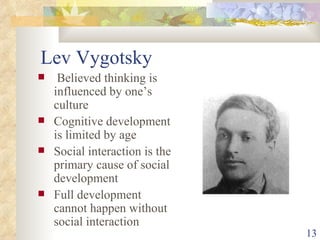
Lev Vygotsky Believed thinking is influenced by one’s culture Cognitive development is limited by age Social interaction is the primary cause of social development Full development cannot happen without social interaction
Zone of Proximal Development This is the difference between what a child can do on his own and what can be accomplished with assistance Older peers and adults can be of great value to the learner and help move him or her to the next level
Scaffolding Support students in the early phases of learning As students become more capable, supports are reduced and then withdrawn Well-designed instruction should be aimed slightly ahead of what the child is capable of understanding independently
Everything Happens Twice The child learns something from contact with another person The child then internalizes the knowledge or skill and and is able to use it independently
What do you think? Example is not the main thing in influencing others, it is the only thing. --Albert Einstein
Sigmund Freud Complex theory of psychoanalysis Stages Oral Anal Phallic Latency Genital
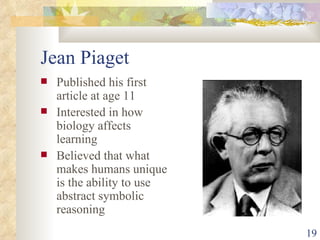
Jean Piaget Published his first article at age 11 Interested in how biology affects learning Believed that what makes humans unique is the ability to use abstract symbolic reasoning
Piaget Noticed that answers of younger children were qualitatively different than those of older children. Theorized that development was  qualitative  (changes in kind) rather than  quantitative  (changes in amount). Theorized that we are  active  in our own development as we “construct” further understanding of our world
Genetic Epistemology Acquiring knowledge How  we come to know something The  stages  we go through as we learn it are universal and predictable Intelligence  was defined as the ability to  adapt  to one’s environment Schemes  are mental maps of how the world works, organized patterns of behavior or thought
Two Sides of Adaptation Assimilation Applying an scheme to understand or use a new object Accommodation Changing an old scheme to include a new object Fundamentally biological processes We swing back and forth between assimilation and accommodation Maturation plays the biggest role
Equilibrium Balance between schemes and environment – the sense that our schema is a “good enough” model of how the world works  Everyone moves toward equilibrium through assimilation and accommodation Organisms move through predictable stages as they develop
Sensorimotor Stage Infancy Rely on sensory and motor capabilities as a means of understanding the environment  Gradual development of the ability to use symbols, as in language Development of object permanence Development of deferred imitation Simple problem solving
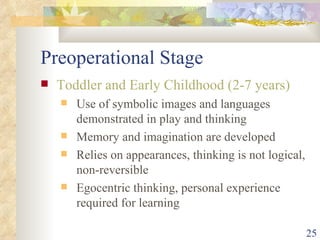
Preoperational Stage Toddler and Early Childhood (2-7 years) Use of symbolic images and languages demonstrated in play and thinking Memory and imagination are developed Relies on appearances, thinking is not logical, non-reversible Egocentric thinking, personal experience required for learning
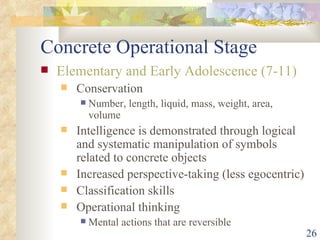
Concrete Operational Stage Elementary and Early Adolescence (7-11) Conservation Number, length, liquid, mass, weight, area, volume Intelligence is demonstrated through logical and systematic manipulation of symbols related to concrete objects Increased perspective-taking (less egocentric) Classification skills Operational thinking Mental actions that are reversible
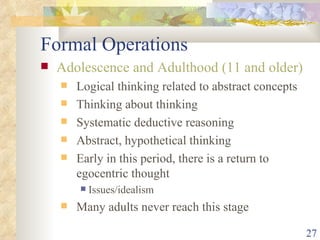
Formal Operations Adolescence and Adulthood (11 and older) Logical thinking related to abstract concepts Thinking about thinking Systematic deductive reasoning Abstract, hypothetical thinking Early in this period, there is a return to egocentric thought Issues/idealism Many adults never reach this stage
What do you think? " A teacher who is attempting to teach, without inspiring the pupil with a desire to learn, is hammering on a cold iron.“ - Horace Mann (1796-1859)
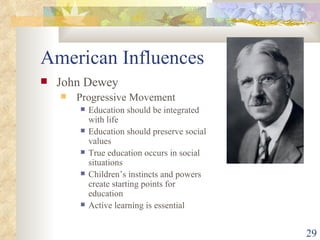
American Influences John Dewey Progressive Movement Education should be integrated with life Education should preserve social values True education occurs in social situations Children’s instincts and powers create starting points for education Active learning is essential
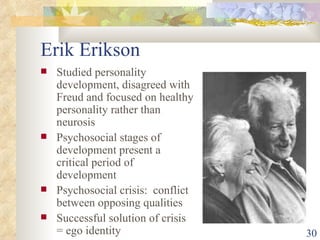
Erik Erikson Studied personality development, disagreed with Freud and focused on healthy personality rather than neurosis Psychosocial stages of development present a critical period of development Psychosocial crisis:  conflict between opposing qualities Successful solution of crisis = ego identity
Trust vs. Mistrust Birth – 1 year Infants learn from experiences and sensations, responses of caregivers If adults are reliable, offering physical comfort and meeting the needs, the infant develops sense of trust in others and the world If needs are not met, and the infant develops mistrust, the infant may withdraw
Autonomy vs. Shame & Doubt 1 - 3 years old Children develop muscular control.  Movement and toilet training are issues the child wants to handle independently Children who are guided toward successful independence develop a sense of autonomy, pride and self-control Children who are restrained or punished harshly may develop a sense of shame and doubt
Initiative vs. Guilt 3 - 6 years old Preschool children are learning skills quickly and are curious and energetic If the child is able to experience success and develop purposeful behavior, responsibility for his/her own behavior and body, and experience imaginative and creative thinking, s/he will be more focused and effective The child who does not develop a sense of responsibility or is made to feel anxious, will develop guilt
Industry vs. Inferiority  6-12 years old Children acquire and master social and academic skills Children who develop a sense of achievement and competence will feel self-assured and successful and will be able to persist in tasks Children who are unable to acquire important skills or achieve are in danger of developing a sense of inferiority.  Another danger is of valuing work and achievement above all else.
Identity vs. Role Confusion 12 – 20 years old Adolescents struggle with “Who am I?” If given support to figure out basic social and occupational identities, the adolescent will explore vocational, social, romantic, political, religious roles and decide Confusion persists until a sense of identity solidifies
Intimacy vs. Isolation 20 – 40 years old The primary task of this age group is to form strong relationships and to achieve a sense of love and companionship If no close relationships are formed, isolation results
Generativity vs. Stagnation 40 – 65 years old The major task is to become productive in work, raise a family, look after the next generation Failure to achieve these goals results in feeling that life has no meaning
Ego Integrity vs. Despair Old age Time when a person reviews his/her life’s accomplishments If the person feels their life was meaningful and productive, the person feels a sense of satisfaction If the person judges their life to be without meaning, despair results
What do you think? I hear and I forget. I see and I believe. I do and I understand. --Confucius
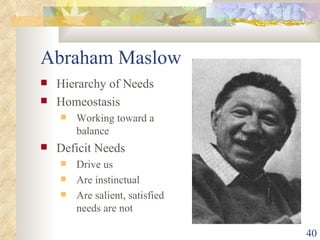
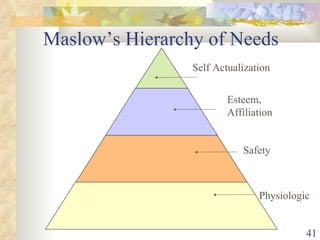
Abraham Maslow Hierarchy of Needs Homeostasis Working toward a balance Deficit Needs Drive us Are instinctual Are salient, satisfied needs are not
Maslow’s Hierarchy of Needs Self Actualization Esteem, Affiliation Safety Physiologic
What do you think? The secret in education lies in respecting the student. --Ralph Waldo Emerson
J McVicker Hunt Believed that IQ could be influenced by environment Early, quality experiences Benjamin Bloom Writings increased interest in early years Human intelligence influenced by environment Jerome Bruner Young children should be taught basic concepts and methods Discovery or inquiry method of learning
Arnold Gesell Medically trained, researched child development Identified observable changes in 10 areas Patty Smith Hill Blending several theorists’ work, she created a strong curriculum that is the foundation for kindergarten Lucy Sprague Mitchell Bank Street College of Education
Abigail Eliot Ruggles Street Nursery Child-sized equipment Comprehensive program (health care, whole child) Variety of materials Full-day program Work with parents
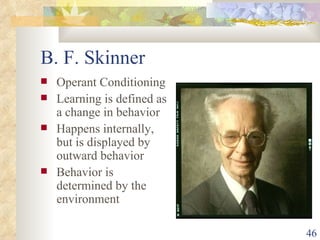
B. F. Skinner Operant Conditioning Learning is defined as a change in behavior Happens internally, but is displayed by outward behavior Behavior is determined by the environment
Classical Conditioning Pavlov’s work Stimulus = Response Begins with stimulus that creates an unconditioned response = reflex Pairs stimulus with neutral stimulus to gain the desired response
Operant Conditioning Behavior is influenced by the consequences Stimulus  –  Response   --  Consequence It is the consequence that determines whether the response will happen again If the consequence strengthens/increases the behavior, it is a reinforcement Punishment, positive reinforcement, negative reinforcement, shaping
What do you think? Why did the chicken cross the road? B.F. Skinner:   Because the external influences, which had pervaded its sensorium from birth, had caused it to develop in such a fashion that it would tend to cross roads, even while believing these actions to be of its own free will.
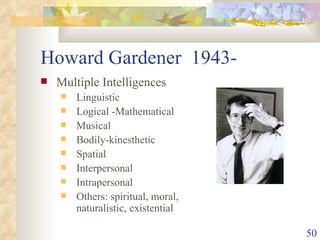
Howard Gardener  1943- Multiple Intelligences Linguistic Logical -Mathematical Musical Bodily-kinesthetic Spatial Interpersonal Intrapersonal Others: spiritual, moral, naturalistic, existential
Historical Events Child Study Movement (child dev info/lab schools) The Great Depression World War II The Launching of Sputnik The War on Poverty (Head Start) Federal Mandates (NCLB)
 
References Early Childhood Education, Birth to 8, Second Edition, Amy Driscoll & Nancy G Nagel An Introduction to Early Childhood Education, Preschool through Primary Grades, Jo Ann Brewer Introduction to Early Childhood Education, A Multidimensional Approach to Child-Centered Care and Learning, Francis Wardle Introduction to Early Childhood Education, 6 th  Edition, Verna Hildebrand Psychology Applied to Teaching, Jack Snowman & Robert Biehler
References http://tip.psychology.org/piaget.html http://tip.psychology.org/skinner.html http://tip.psychology.org/vygotsky.html http://www.ship.edu/~cgboeree/erikson.html http://www.ship.edu/~cgboeree/maslow.html

ECE 101 Historical Contexts

  • 1.
    Historical Contexts MichelleMeyer, MA ECE 101, Chapter 2
  • 2.
  • 3.
    Theory A theoryis an organized set of ideas that tries to explain a phenomena. A theory describes the set of ideas as carefully as possible, defining new terminology. The theory is tested by many, with results published in the public domain. A theory should give meaningful guidance for daily work for parents and educators. Gradually a theory either gains support or fades from the literature.
  • 4.
    ~ JohnW. Gardner ~ I am entirely certain that twenty years from now we will look back at education as it is practiced in most schools today and wonder that we could have tolerated anything so primitive.
  • 5.
    Kinds of TheoriesConstructivist Born with positive tendencies, like curiosity Learning is social & collaborative Nature and nurture are both important We are active in our own development as we construct knowledge Development is stage-like and universal
  • 6.
    Kinds of TheoriesBehavior/Learning People are inherently neither good nor bad People are passively shaped by the environment Development is gradual, not stages Early behavior may change if the environment changes Development can proceed in many directions, depending on life experiences
  • 7.
    Kinds of TheoriesHumanistic Human nature is essentially good and unique Emphasis on potential for self-development Emphasis on becoming a better person Change occurs as a result of a person’s freedom to choose and be creative
  • 8.
    What do youthink? "If the child is not learning the way you are teaching, then you must teach in the way the child learns.” - Rita Dunn
  • 9.
    European Contributors MartinLuther King All towns should have schools Boys and girls should be educated Schools should foster intellectual, religious, physical, emotional and social development John Amos Comenius First years of life are crucial All children should be educated Pleasant environment
  • 10.
    Jean Jacques RousseauNegative education (not until age 12) Learning from nature Focus on sensory experiences Children choose their own learning experiences Childhood is a stage in development
  • 11.
    Johann Pestalozzi Carefulobservation of children Recognizing potential in each child Importance of student-teacher relationships Strengthening peer relations Sensory learning Friedrich Froebel Studied Pestalozzi Coined the term “kindergarten” Benefits of play Benefits of singing Began circle time
  • 12.
    Maria Montessori Interestedin mental retardation, helped these children achieve Casa dei Bambini in the slums of Rome Margaret McMillan Concerned about health Open-air nursery Facilitating emotional development Parent involvement Children's art
  • 13.
    Lev Vygotsky Believedthinking is influenced by one’s culture Cognitive development is limited by age Social interaction is the primary cause of social development Full development cannot happen without social interaction
  • 14.
    Zone of ProximalDevelopment This is the difference between what a child can do on his own and what can be accomplished with assistance Older peers and adults can be of great value to the learner and help move him or her to the next level
  • 15.
    Scaffolding Support studentsin the early phases of learning As students become more capable, supports are reduced and then withdrawn Well-designed instruction should be aimed slightly ahead of what the child is capable of understanding independently
  • 16.
    Everything Happens TwiceThe child learns something from contact with another person The child then internalizes the knowledge or skill and and is able to use it independently
  • 17.
    What do youthink? Example is not the main thing in influencing others, it is the only thing. --Albert Einstein
  • 18.
    Sigmund Freud Complextheory of psychoanalysis Stages Oral Anal Phallic Latency Genital
  • 19.
    Jean Piaget Publishedhis first article at age 11 Interested in how biology affects learning Believed that what makes humans unique is the ability to use abstract symbolic reasoning
  • 20.
    Piaget Noticed thatanswers of younger children were qualitatively different than those of older children. Theorized that development was qualitative (changes in kind) rather than quantitative (changes in amount). Theorized that we are active in our own development as we “construct” further understanding of our world
  • 21.
    Genetic Epistemology Acquiringknowledge How we come to know something The stages we go through as we learn it are universal and predictable Intelligence was defined as the ability to adapt to one’s environment Schemes are mental maps of how the world works, organized patterns of behavior or thought
  • 22.
    Two Sides ofAdaptation Assimilation Applying an scheme to understand or use a new object Accommodation Changing an old scheme to include a new object Fundamentally biological processes We swing back and forth between assimilation and accommodation Maturation plays the biggest role
  • 23.
    Equilibrium Balance betweenschemes and environment – the sense that our schema is a “good enough” model of how the world works Everyone moves toward equilibrium through assimilation and accommodation Organisms move through predictable stages as they develop
  • 24.
    Sensorimotor Stage InfancyRely on sensory and motor capabilities as a means of understanding the environment Gradual development of the ability to use symbols, as in language Development of object permanence Development of deferred imitation Simple problem solving
  • 25.
    Preoperational Stage Toddlerand Early Childhood (2-7 years) Use of symbolic images and languages demonstrated in play and thinking Memory and imagination are developed Relies on appearances, thinking is not logical, non-reversible Egocentric thinking, personal experience required for learning
  • 26.
    Concrete Operational StageElementary and Early Adolescence (7-11) Conservation Number, length, liquid, mass, weight, area, volume Intelligence is demonstrated through logical and systematic manipulation of symbols related to concrete objects Increased perspective-taking (less egocentric) Classification skills Operational thinking Mental actions that are reversible
  • 27.
    Formal Operations Adolescenceand Adulthood (11 and older) Logical thinking related to abstract concepts Thinking about thinking Systematic deductive reasoning Abstract, hypothetical thinking Early in this period, there is a return to egocentric thought Issues/idealism Many adults never reach this stage
  • 28.
    What do youthink? " A teacher who is attempting to teach, without inspiring the pupil with a desire to learn, is hammering on a cold iron.“ - Horace Mann (1796-1859)
  • 29.
    American Influences JohnDewey Progressive Movement Education should be integrated with life Education should preserve social values True education occurs in social situations Children’s instincts and powers create starting points for education Active learning is essential
  • 30.
    Erik Erikson Studiedpersonality development, disagreed with Freud and focused on healthy personality rather than neurosis Psychosocial stages of development present a critical period of development Psychosocial crisis: conflict between opposing qualities Successful solution of crisis = ego identity
  • 31.
    Trust vs. MistrustBirth – 1 year Infants learn from experiences and sensations, responses of caregivers If adults are reliable, offering physical comfort and meeting the needs, the infant develops sense of trust in others and the world If needs are not met, and the infant develops mistrust, the infant may withdraw
  • 32.
    Autonomy vs. Shame& Doubt 1 - 3 years old Children develop muscular control. Movement and toilet training are issues the child wants to handle independently Children who are guided toward successful independence develop a sense of autonomy, pride and self-control Children who are restrained or punished harshly may develop a sense of shame and doubt
  • 33.
    Initiative vs. Guilt3 - 6 years old Preschool children are learning skills quickly and are curious and energetic If the child is able to experience success and develop purposeful behavior, responsibility for his/her own behavior and body, and experience imaginative and creative thinking, s/he will be more focused and effective The child who does not develop a sense of responsibility or is made to feel anxious, will develop guilt
  • 34.
    Industry vs. Inferiority 6-12 years old Children acquire and master social and academic skills Children who develop a sense of achievement and competence will feel self-assured and successful and will be able to persist in tasks Children who are unable to acquire important skills or achieve are in danger of developing a sense of inferiority. Another danger is of valuing work and achievement above all else.
  • 35.
    Identity vs. RoleConfusion 12 – 20 years old Adolescents struggle with “Who am I?” If given support to figure out basic social and occupational identities, the adolescent will explore vocational, social, romantic, political, religious roles and decide Confusion persists until a sense of identity solidifies
  • 36.
    Intimacy vs. Isolation20 – 40 years old The primary task of this age group is to form strong relationships and to achieve a sense of love and companionship If no close relationships are formed, isolation results
  • 37.
    Generativity vs. Stagnation40 – 65 years old The major task is to become productive in work, raise a family, look after the next generation Failure to achieve these goals results in feeling that life has no meaning
  • 38.
    Ego Integrity vs.Despair Old age Time when a person reviews his/her life’s accomplishments If the person feels their life was meaningful and productive, the person feels a sense of satisfaction If the person judges their life to be without meaning, despair results
  • 39.
    What do youthink? I hear and I forget. I see and I believe. I do and I understand. --Confucius
  • 40.
    Abraham Maslow Hierarchyof Needs Homeostasis Working toward a balance Deficit Needs Drive us Are instinctual Are salient, satisfied needs are not
  • 41.
    Maslow’s Hierarchy ofNeeds Self Actualization Esteem, Affiliation Safety Physiologic
  • 42.
    What do youthink? The secret in education lies in respecting the student. --Ralph Waldo Emerson
  • 43.
    J McVicker HuntBelieved that IQ could be influenced by environment Early, quality experiences Benjamin Bloom Writings increased interest in early years Human intelligence influenced by environment Jerome Bruner Young children should be taught basic concepts and methods Discovery or inquiry method of learning
  • 44.
    Arnold Gesell Medicallytrained, researched child development Identified observable changes in 10 areas Patty Smith Hill Blending several theorists’ work, she created a strong curriculum that is the foundation for kindergarten Lucy Sprague Mitchell Bank Street College of Education
  • 45.
    Abigail Eliot RugglesStreet Nursery Child-sized equipment Comprehensive program (health care, whole child) Variety of materials Full-day program Work with parents
  • 46.
    B. F. SkinnerOperant Conditioning Learning is defined as a change in behavior Happens internally, but is displayed by outward behavior Behavior is determined by the environment
  • 47.
    Classical Conditioning Pavlov’swork Stimulus = Response Begins with stimulus that creates an unconditioned response = reflex Pairs stimulus with neutral stimulus to gain the desired response
  • 48.
    Operant Conditioning Behavioris influenced by the consequences Stimulus – Response -- Consequence It is the consequence that determines whether the response will happen again If the consequence strengthens/increases the behavior, it is a reinforcement Punishment, positive reinforcement, negative reinforcement, shaping
  • 49.
    What do youthink? Why did the chicken cross the road? B.F. Skinner: Because the external influences, which had pervaded its sensorium from birth, had caused it to develop in such a fashion that it would tend to cross roads, even while believing these actions to be of its own free will.
  • 50.
    Howard Gardener 1943- Multiple Intelligences Linguistic Logical -Mathematical Musical Bodily-kinesthetic Spatial Interpersonal Intrapersonal Others: spiritual, moral, naturalistic, existential
  • 51.
    Historical Events ChildStudy Movement (child dev info/lab schools) The Great Depression World War II The Launching of Sputnik The War on Poverty (Head Start) Federal Mandates (NCLB)
  • 52.
  • 53.
    References Early ChildhoodEducation, Birth to 8, Second Edition, Amy Driscoll & Nancy G Nagel An Introduction to Early Childhood Education, Preschool through Primary Grades, Jo Ann Brewer Introduction to Early Childhood Education, A Multidimensional Approach to Child-Centered Care and Learning, Francis Wardle Introduction to Early Childhood Education, 6 th Edition, Verna Hildebrand Psychology Applied to Teaching, Jack Snowman & Robert Biehler
  • 54.
    References http://tip.psychology.org/piaget.html http://tip.psychology.org/skinner.htmlhttp://tip.psychology.org/vygotsky.html http://www.ship.edu/~cgboeree/erikson.html http://www.ship.edu/~cgboeree/maslow.html