TRINITY INSTITUTE OF PROFESSIONAL STUDIES
Sector – 9, Dwarka Institutional Area, New Delhi-75
Affiliated Institution of G.G.S.IP.U, Delhi
Development Communication
Theories and Paradigms of Development
Paper ID-24201
Paper code-BJMC201
TRINITY INSTITUTE OF PROFESSIONAL STUDIES
Sector – 9, Dwarka Institutional Area, New Delhi-75
Unit I
Topic - II
Theories and Paradigms of Development
TRINITY INSTITUTE OF PROFESSIONAL STUDIES
Sector – 9, Dwarka Institutional Area, New Delhi-75
Theories and Paradigms of
Development
3
• The central task of the development theory is to explain why
some countries are underdeveloped and how these countries
can develop.
• These theories have been grouped on the basis of vision and
direction of development, i.e. the world view of development,
visualized by these theories.
• These theories can be sub-divided on the basis of certain
shared analytical approaches, i.e. paradigms common to
these theories.
TRINITY INSTITUTE OF PROFESSIONAL STUDIES
Sector – 9, Dwarka Institutional Area, New Delhi-75
4
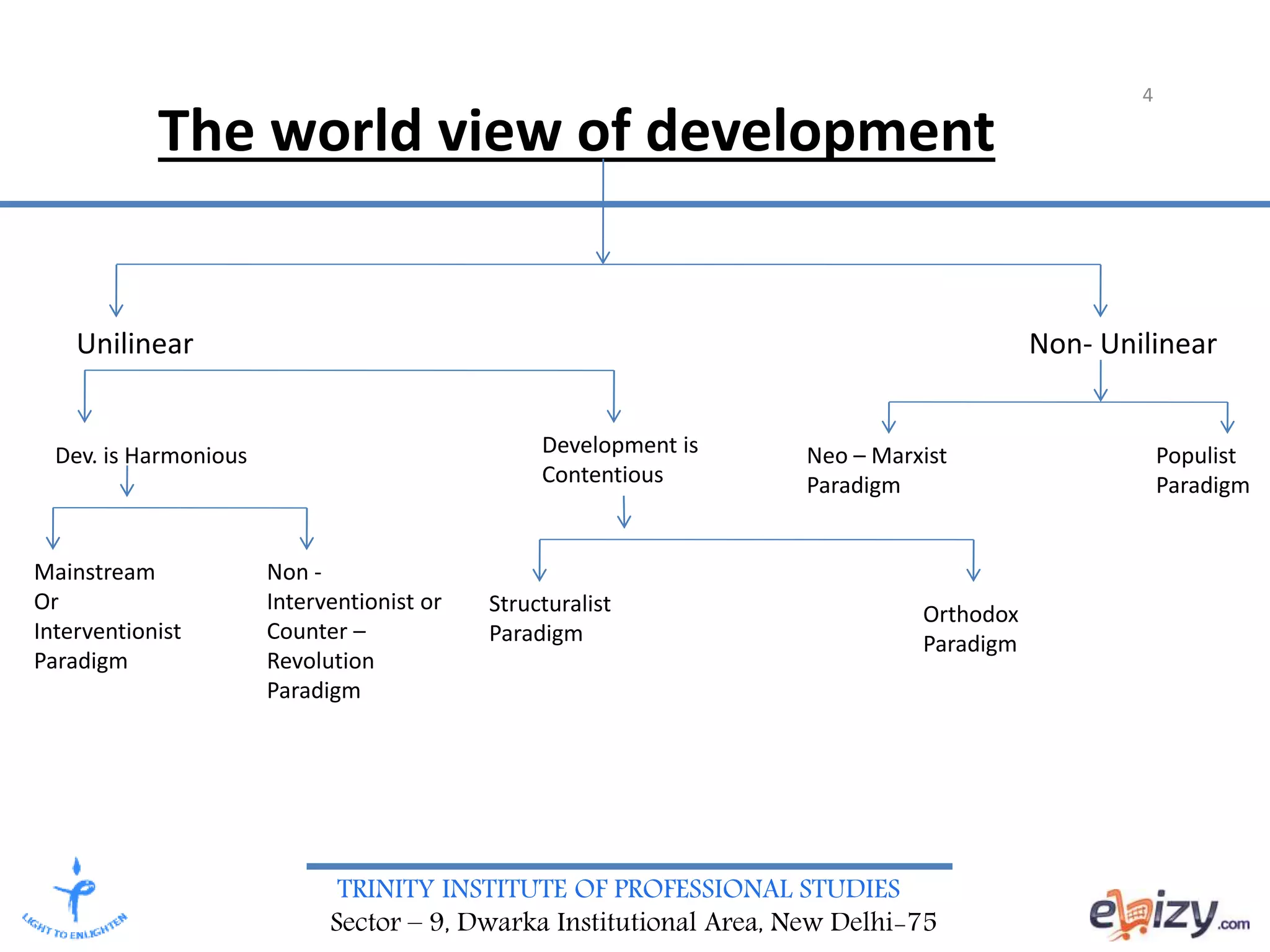
The world view of development
Dev. is Harmonious
Unilinear
Mainstream
Or
Interventionist
Paradigm
Development is
Contentious
Non -
Interventionist or
Counter –
Revolution
Paradigm
Structuralist
Paradigm
Orthodox
Paradigm
Non- Unilinear
Neo – Marxist
Paradigm
Populist
Paradigm
TRINITY INSTITUTE OF PROFESSIONAL STUDIES
Sector – 9, Dwarka Institutional Area, New Delhi-75
Unilinear Word view of Development
 It means that underdevelopment is a condition preceding
development.
 All developed countries are late comers to the process of
development, which had already taken place in the developed
West. The Western developed countries followed some kind of
processes, and, they have achieved a kind of standard of living.
 Due to these reasons, the Western Countries have become the role
models of development for the underdeveloped and developing
countries.
 Therefore, the development is becoming more like the West or like
the already developed countries.
TRINITY INSTITUTE OF PROFESSIONAL STUDIES
Sector – 9, Dwarka Institutional Area, New Delhi-75
Types of Unilinear Theories
Theories follow under the unilinear world view can be divided into two
categories: a) Development is Harmonious and non - contentious and b)
Development is contentious.
a) Dev. is Harmonious: According to this perspective, development
process benefits all rich as well as poor people, and rich as well as poor
countries. There is more harmony between different groups of people
and different countries.
b) Dev. is contentious: These theories refer to the rich exploiting the poor
as much as the rich countries exploiting the poor.
6
TRINITY INSTITUTE OF PROFESSIONAL STUDIES
Sector – 9, Dwarka Institutional Area, New Delhi-75
 Mainstream Paradigm: This perspective advocates state intervention
or active role of the Government as an essential requirement for
development. Most of the modern theories of development that
have emerged during the post war years come under this paradigm.
This may be called as the ‘Mainstream Paradigm’.
 Counter-Revolution Paradigm: It emphasizes on non-intervention by
the state or non involvement of the government, and advocates the
efficiency of market (the forces that determine demand, supple and
the cost, pricing, and production of goods, commodities and services)
in promoting development, which favours free market for
developments.
7
Types of Unilinear Theories
TRINITY INSTITUTE OF PROFESSIONAL STUDIES
Sector – 9, Dwarka Institutional Area, New Delhi-75
Types of Unilinear Theories
The Structuralist Paradigm: It suggests that under- development
is a consequence of the internal as well as the international
structure (system of production). Internally, the less
developed countries are totally dependent upon the
production and export of primary products (raw materials like
oil, sugar, tea, rubber etc.). On the international front,
developed countries (capitalist West) produce and export
“manufactured” goods.
• These theories suggest that if the less developed countries
want development, they are required to change the structure
(system) of production increasingly in favour of manufactured
goods through capital based technology and industrialization.
TRINITY INSTITUTE OF PROFESSIONAL STUDIES
Sector – 9, Dwarka Institutional Area, New Delhi-75
Types of Unilinear Theories
• The Orthodox Marxist Paradigm: It considers that conflict and
contradictions in the development of capitalism are
inevitable, and that these can only be resolved through a
revolution, which will then lead to the next phase of
development.
TRINITY INSTITUTE OF PROFESSIONAL STUDIES
Sector – 9, Dwarka Institutional Area, New Delhi-75
Types of Non-Unilinear theories
• Populist Paradigm: The theories under the “populist”
approach question either the need or possibility of the less
developed countries developed countries developing on the
lines of the already developed capitalist countries. The
Gandhian thinking on appropriate development for country
like India, and some contributions from some one like E.F.
Schumacher wrote Small is Beautiful, may be considered as
part of the ‘populist paradigm’.
Gandhi emphasized the importance of Gram Swaraj and said
that development in a country like India should make the
village as the centre, and provide employment and livelihood
through a network of cottage and village industries.
TRINITY INSTITUTE OF PROFESSIONAL STUDIES
Sector – 9, Dwarka Institutional Area, New Delhi-75
Types of Non-Unilinear theories
Neo – Marxist Paradigm: The essence of paradigm lies in the
fact that, at present, the less developed countries cannot
develop like the west. It stresses the interconnectedness of
development and under development, of traditional and
modern, and indeed many other social and political and
economic factors.
TRINITY INSTITUTE OF PROFESSIONAL STUDIES
Sector – 9, Dwarka Institutional Area, New Delhi-75
THANK YOU
By Shruti Chopra

Theories and paradigms of development

  • 1.
    TRINITY INSTITUTE OFPROFESSIONAL STUDIES Sector – 9, Dwarka Institutional Area, New Delhi-75 Affiliated Institution of G.G.S.IP.U, Delhi Development Communication Theories and Paradigms of Development Paper ID-24201 Paper code-BJMC201
  • 2.
    TRINITY INSTITUTE OFPROFESSIONAL STUDIES Sector – 9, Dwarka Institutional Area, New Delhi-75 Unit I Topic - II Theories and Paradigms of Development
  • 3.
    TRINITY INSTITUTE OFPROFESSIONAL STUDIES Sector – 9, Dwarka Institutional Area, New Delhi-75 Theories and Paradigms of Development 3 • The central task of the development theory is to explain why some countries are underdeveloped and how these countries can develop. • These theories have been grouped on the basis of vision and direction of development, i.e. the world view of development, visualized by these theories. • These theories can be sub-divided on the basis of certain shared analytical approaches, i.e. paradigms common to these theories.
  • 4.
    TRINITY INSTITUTE OFPROFESSIONAL STUDIES Sector – 9, Dwarka Institutional Area, New Delhi-75 4 The world view of development Dev. is Harmonious Unilinear Mainstream Or Interventionist Paradigm Development is Contentious Non - Interventionist or Counter – Revolution Paradigm Structuralist Paradigm Orthodox Paradigm Non- Unilinear Neo – Marxist Paradigm Populist Paradigm
  • 5.
    TRINITY INSTITUTE OFPROFESSIONAL STUDIES Sector – 9, Dwarka Institutional Area, New Delhi-75 Unilinear Word view of Development  It means that underdevelopment is a condition preceding development.  All developed countries are late comers to the process of development, which had already taken place in the developed West. The Western developed countries followed some kind of processes, and, they have achieved a kind of standard of living.  Due to these reasons, the Western Countries have become the role models of development for the underdeveloped and developing countries.  Therefore, the development is becoming more like the West or like the already developed countries.
  • 6.
    TRINITY INSTITUTE OFPROFESSIONAL STUDIES Sector – 9, Dwarka Institutional Area, New Delhi-75 Types of Unilinear Theories Theories follow under the unilinear world view can be divided into two categories: a) Development is Harmonious and non - contentious and b) Development is contentious. a) Dev. is Harmonious: According to this perspective, development process benefits all rich as well as poor people, and rich as well as poor countries. There is more harmony between different groups of people and different countries. b) Dev. is contentious: These theories refer to the rich exploiting the poor as much as the rich countries exploiting the poor. 6
  • 7.
    TRINITY INSTITUTE OFPROFESSIONAL STUDIES Sector – 9, Dwarka Institutional Area, New Delhi-75  Mainstream Paradigm: This perspective advocates state intervention or active role of the Government as an essential requirement for development. Most of the modern theories of development that have emerged during the post war years come under this paradigm. This may be called as the ‘Mainstream Paradigm’.  Counter-Revolution Paradigm: It emphasizes on non-intervention by the state or non involvement of the government, and advocates the efficiency of market (the forces that determine demand, supple and the cost, pricing, and production of goods, commodities and services) in promoting development, which favours free market for developments. 7 Types of Unilinear Theories
  • 8.
    TRINITY INSTITUTE OFPROFESSIONAL STUDIES Sector – 9, Dwarka Institutional Area, New Delhi-75 Types of Unilinear Theories The Structuralist Paradigm: It suggests that under- development is a consequence of the internal as well as the international structure (system of production). Internally, the less developed countries are totally dependent upon the production and export of primary products (raw materials like oil, sugar, tea, rubber etc.). On the international front, developed countries (capitalist West) produce and export “manufactured” goods. • These theories suggest that if the less developed countries want development, they are required to change the structure (system) of production increasingly in favour of manufactured goods through capital based technology and industrialization.
  • 9.
    TRINITY INSTITUTE OFPROFESSIONAL STUDIES Sector – 9, Dwarka Institutional Area, New Delhi-75 Types of Unilinear Theories • The Orthodox Marxist Paradigm: It considers that conflict and contradictions in the development of capitalism are inevitable, and that these can only be resolved through a revolution, which will then lead to the next phase of development.
  • 10.
    TRINITY INSTITUTE OFPROFESSIONAL STUDIES Sector – 9, Dwarka Institutional Area, New Delhi-75 Types of Non-Unilinear theories • Populist Paradigm: The theories under the “populist” approach question either the need or possibility of the less developed countries developed countries developing on the lines of the already developed capitalist countries. The Gandhian thinking on appropriate development for country like India, and some contributions from some one like E.F. Schumacher wrote Small is Beautiful, may be considered as part of the ‘populist paradigm’. Gandhi emphasized the importance of Gram Swaraj and said that development in a country like India should make the village as the centre, and provide employment and livelihood through a network of cottage and village industries.
  • 11.
    TRINITY INSTITUTE OFPROFESSIONAL STUDIES Sector – 9, Dwarka Institutional Area, New Delhi-75 Types of Non-Unilinear theories Neo – Marxist Paradigm: The essence of paradigm lies in the fact that, at present, the less developed countries cannot develop like the west. It stresses the interconnectedness of development and under development, of traditional and modern, and indeed many other social and political and economic factors.
  • 12.
    TRINITY INSTITUTE OFPROFESSIONAL STUDIES Sector – 9, Dwarka Institutional Area, New Delhi-75 THANK YOU By Shruti Chopra