THEORETICAL ISSUES
Theoretical Issues
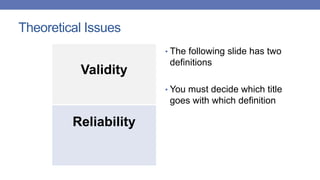
Validity
Reliability
• The following slide has two
definitions
• You must decide which title
goes with which definition
Theoretical Issues
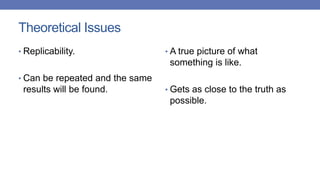
• A true picture of what
something is like.
• Gets as close to the truth as
possible.
• Replicability.
• Can be repeated and the same
results will be found.
Theoretical Issues
•Validity
• A true picture of what
something is like.
• Gets as close to the truth as
possible.
•Reliability
• Replicability.
• Can be repeated and the same
results will be found.
Answer the question at the bottom of
page 165
Representativeness
• Does the sample you are using for your research represent the population as
a whole?
• The characteristics of the subgroup/sample should be the same as the wider
group
Random sample
Define these sample types
Methodological Perspective
• A sociologist’s choice of method will be influenced by their methodological
perspective
• These perspectives can be split into two main perspectives
Positivism
Interpretivism
Two Different Approaches
to Collecting Data
Positivism Interpretivism
An Interpretivist
sociologist wants to
understand how people
give meaning to the
social world around them.
The data that is
collected is qualitative
– reporting the in-depth
experiences of those
being studied.
The data that is
collected is quantitative
– facts and numbers
that are precise.
A Positivist sociologist
wants to identify the
underlying causes of
peoples behaviour.
I’m Emile Durkheim
and as a Positivist
sociologist I’d choose
quantitative methods
that are reliable.
I’m Max Weber and
as an Interpretivist
sociologist I’d
choose qualitative
methods that are
valid.
Any method is
fine as long as
it involves the
systematic
collection of
evidence.
Any method is
fine as long as it
helps us to
understanding
peoples
motives and
feelings.
I’m Emile Durkheim and as
a Positivist sociologist I’d
choose research methods
that are reliable.
Any quantitative
method is fine
because they involve
the systematic
collection of
evidence.
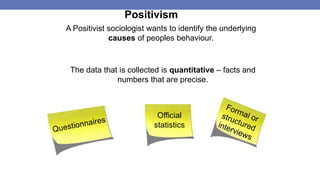
Positivism
The data that is collected is quantitative – facts and
numbers that are precise.
A Positivist sociologist wants to identify the underlying
causes of peoples behaviour.
Official
statistics
I’m Max Weber and
as an Interpretivist
sociologist I’d
choose methods
that are valid.
Any qualitative method is
fine because it helps us to
understand peoples
motives and feelings.
Interpretivism
An Interpretivist sociologist wants to
understand how people give meaning to the
social world around them.
The data that is collected is qualitative –
reporting the in-depth experiences of those
being studied.
Participant
observation
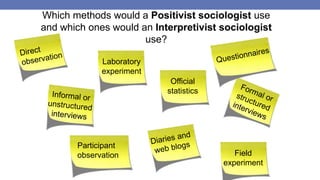
Which methods would a Positivist sociologist use
and which ones would an Interpretivist sociologist
use?
Laboratory
experiment
Field
experiment
Official
statistics
Participant
observation

Theoretical issues

  • 1.
  • 2.
    Theoretical Issues Validity Reliability • Thefollowing slide has two definitions • You must decide which title goes with which definition
  • 3.
    Theoretical Issues • Atrue picture of what something is like. • Gets as close to the truth as possible. • Replicability. • Can be repeated and the same results will be found.
  • 4.
    Theoretical Issues •Validity • Atrue picture of what something is like. • Gets as close to the truth as possible. •Reliability • Replicability. • Can be repeated and the same results will be found.
  • 5.
    Answer the questionat the bottom of page 165
  • 6.
    Representativeness • Does thesample you are using for your research represent the population as a whole? • The characteristics of the subgroup/sample should be the same as the wider group
  • 7.
  • 8.
    Methodological Perspective • Asociologist’s choice of method will be influenced by their methodological perspective • These perspectives can be split into two main perspectives Positivism Interpretivism
  • 9.
    Two Different Approaches toCollecting Data Positivism Interpretivism An Interpretivist sociologist wants to understand how people give meaning to the social world around them. The data that is collected is qualitative – reporting the in-depth experiences of those being studied. The data that is collected is quantitative – facts and numbers that are precise. A Positivist sociologist wants to identify the underlying causes of peoples behaviour.
  • 10.
    I’m Emile Durkheim andas a Positivist sociologist I’d choose quantitative methods that are reliable. I’m Max Weber and as an Interpretivist sociologist I’d choose qualitative methods that are valid. Any method is fine as long as it involves the systematic collection of evidence. Any method is fine as long as it helps us to understanding peoples motives and feelings.
  • 11.
    I’m Emile Durkheimand as a Positivist sociologist I’d choose research methods that are reliable. Any quantitative method is fine because they involve the systematic collection of evidence.
  • 12.
    Positivism The data thatis collected is quantitative – facts and numbers that are precise. A Positivist sociologist wants to identify the underlying causes of peoples behaviour. Official statistics
  • 13.
    I’m Max Weberand as an Interpretivist sociologist I’d choose methods that are valid. Any qualitative method is fine because it helps us to understand peoples motives and feelings.
  • 14.
    Interpretivism An Interpretivist sociologistwants to understand how people give meaning to the social world around them. The data that is collected is qualitative – reporting the in-depth experiences of those being studied. Participant observation
  • 15.
    Which methods woulda Positivist sociologist use and which ones would an Interpretivist sociologist use? Laboratory experiment Field experiment Official statistics Participant observation