
Positivism vs Interpretivism
Dr. Gopal Thapa
Tribhuvan University
Research Paradigm
 A research paradigm is a school of thought or
framework of thinking or set of assumption about
how research ought to be conducted to ascertain
truth.
 The word paradigm was popularized by Thomas
Kunn (1962) in his book “The structure of
Scientific Revolutions.”
12/3/2023 Copy right reserved 2
Research Paradigm
 Some researchers prefer to use numbers while
others prefer words to understand and convey the
realities of our social lives.
 In simple terms, it can be said that those who like
numbers are positivists and those who like words
are interpretivists..
12/3/2023 Copy right reserved 3
Positivism vs Interpretivism
 Positivism and interpretivism are two very
different perspectives on how we can obtain
knowledge about the world.
 The positivist approach was heavily endorsed by
early sociologists such as Auguste
Comte and Émile Durkheim.
 For positivists, the main aim of research is to
discover objective facts.

12/3/2023 Copy right reserved 4
Positivism
 Positivism is the perspective that the only way to
obtain information about the world is through
systematic, scientific methods.
 Knowledge is most valuable when it is observable
and presented as statistics.
 The underlying premise of positivism is that we
should learn about the world in the same way that
the natural sciences do so.
12/3/2023 Copy right reserved 5
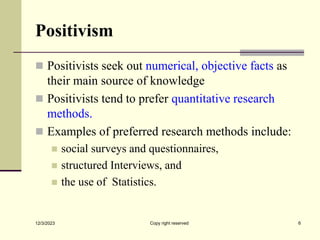
Positivism
 Positivists seek out numerical, objective facts as
their main source of knowledge
 Positivists tend to prefer quantitative research
methods.
 Examples of preferred research methods include:
 social surveys and questionnaires,
 structured Interviews, and
 the use of Statistics.
12/3/2023 Copy right reserved 6
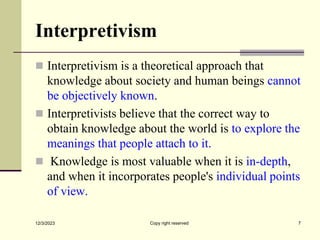
Interpretivism
 Interpretivism is a theoretical approach that
knowledge about society and human beings cannot
be objectively known.
 Interpretivists believe that the correct way to
obtain knowledge about the world is to explore the
meanings that people attach to it.
 Knowledge is most valuable when it is in-depth,
and when it incorporates people's individual points
of view.
12/3/2023 Copy right reserved 7
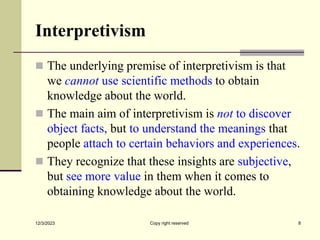
Interpretivism
 The underlying premise of interpretivism is that
we cannot use scientific methods to obtain
knowledge about the world.
 The main aim of interpretivism is not to discover
object facts, but to understand the meanings that
people attach to certain behaviors and experiences.
 They recognize that these insights are subjective,
but see more value in them when it comes to
obtaining knowledge about the world.
12/3/2023 Copy right reserved 8
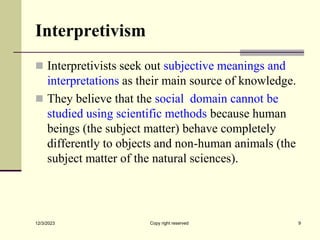
Interpretivism
 Interpretivists seek out subjective meanings and
interpretations as their main source of knowledge.
 They believe that the social domain cannot be
studied using scientific methods because human
beings (the subject matter) behave completely
differently to objects and non-human animals (the
subject matter of the natural sciences).
12/3/2023 Copy right reserved 9
Interpretivism
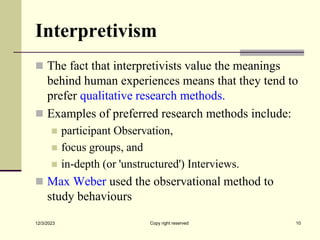
 The fact that interpretivists value the meanings
behind human experiences means that they tend to
prefer qualitative research methods.
 Examples of preferred research methods include:
 participant Observation,
 focus groups, and
 in-depth (or 'unstructured') Interviews.
 Max Weber used the observational method to
study behaviours
12/3/2023 Copy right reserved 10
Mixed-method
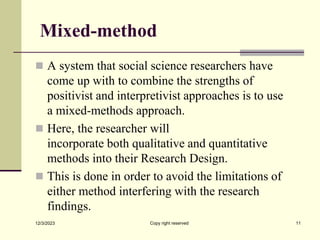
 A system that social science researchers have
come up with to combine the strengths of
positivist and interpretivist approaches is to use
a mixed-methods approach.
 Here, the researcher will
incorporate both qualitative and quantitative
methods into their Research Design.
 This is done in order to avoid the limitations of
either method interfering with the research
findings.
12/3/2023 Copy right reserved 11
Mixed-method
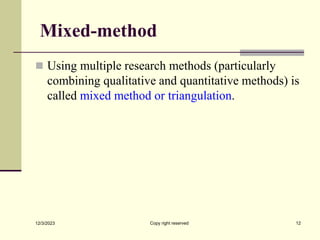
 Using multiple research methods (particularly
combining qualitative and quantitative methods) is
called mixed method or triangulation.
12/3/2023 Copy right reserved 12
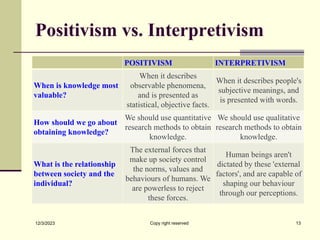
Positivism vs. Interpretivism
POSITIVISM INTERPRETIVISM
When is knowledge most
valuable?
When it describes
observable phenomena,
and is presented as
statistical, objective facts.
When it describes people's
subjective meanings, and
is presented with words.
How should we go about
obtaining knowledge?
We should use quantitative
research methods to obtain
knowledge.
We should use qualitative
research methods to obtain
knowledge.
What is the relationship
between society and the
individual?
The external forces that
make up society control
the norms, values and
behaviours of humans. We
are powerless to reject
these forces.
Human beings aren't
dictated by these 'external
factors', and are capable of
shaping our behaviour
through our perceptions.
12/3/2023 Copy right reserved 13
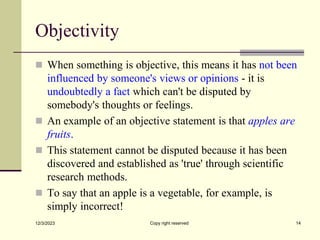
Objectivity
 When something is objective, this means it has not been
influenced by someone's views or opinions - it is
undoubtedly a fact which can't be disputed by
somebody's thoughts or feelings.
 An example of an objective statement is that apples are
fruits.
 This statement cannot be disputed because it has been
discovered and established as 'true' through scientific
research methods.
 To say that an apple is a vegetable, for example, is
simply incorrect!
12/3/2023 Copy right reserved 14
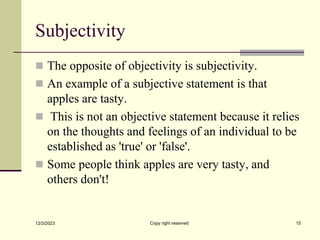
Subjectivity
 The opposite of objectivity is subjectivity.
 An example of a subjective statement is that
apples are tasty.
 This is not an objective statement because it relies
on the thoughts and feelings of an individual to be
established as 'true' or 'false'.
 Some people think apples are very tasty, and
others don't!
12/3/2023 Copy right reserved 15

Positivism.ppt

  • 1.
    Positivism vs Interpretivism Dr.Gopal Thapa Tribhuvan University
  • 2.
    Research Paradigm  Aresearch paradigm is a school of thought or framework of thinking or set of assumption about how research ought to be conducted to ascertain truth.  The word paradigm was popularized by Thomas Kunn (1962) in his book “The structure of Scientific Revolutions.” 12/3/2023 Copy right reserved 2
  • 3.
    Research Paradigm  Someresearchers prefer to use numbers while others prefer words to understand and convey the realities of our social lives.  In simple terms, it can be said that those who like numbers are positivists and those who like words are interpretivists.. 12/3/2023 Copy right reserved 3
  • 4.
    Positivism vs Interpretivism Positivism and interpretivism are two very different perspectives on how we can obtain knowledge about the world.  The positivist approach was heavily endorsed by early sociologists such as Auguste Comte and Émile Durkheim.  For positivists, the main aim of research is to discover objective facts.  12/3/2023 Copy right reserved 4
  • 5.
    Positivism  Positivism isthe perspective that the only way to obtain information about the world is through systematic, scientific methods.  Knowledge is most valuable when it is observable and presented as statistics.  The underlying premise of positivism is that we should learn about the world in the same way that the natural sciences do so. 12/3/2023 Copy right reserved 5
  • 6.
    Positivism  Positivists seekout numerical, objective facts as their main source of knowledge  Positivists tend to prefer quantitative research methods.  Examples of preferred research methods include:  social surveys and questionnaires,  structured Interviews, and  the use of Statistics. 12/3/2023 Copy right reserved 6
  • 7.
    Interpretivism  Interpretivism isa theoretical approach that knowledge about society and human beings cannot be objectively known.  Interpretivists believe that the correct way to obtain knowledge about the world is to explore the meanings that people attach to it.  Knowledge is most valuable when it is in-depth, and when it incorporates people's individual points of view. 12/3/2023 Copy right reserved 7
  • 8.
    Interpretivism  The underlyingpremise of interpretivism is that we cannot use scientific methods to obtain knowledge about the world.  The main aim of interpretivism is not to discover object facts, but to understand the meanings that people attach to certain behaviors and experiences.  They recognize that these insights are subjective, but see more value in them when it comes to obtaining knowledge about the world. 12/3/2023 Copy right reserved 8
  • 9.
    Interpretivism  Interpretivists seekout subjective meanings and interpretations as their main source of knowledge.  They believe that the social domain cannot be studied using scientific methods because human beings (the subject matter) behave completely differently to objects and non-human animals (the subject matter of the natural sciences). 12/3/2023 Copy right reserved 9
  • 10.
    Interpretivism  The factthat interpretivists value the meanings behind human experiences means that they tend to prefer qualitative research methods.  Examples of preferred research methods include:  participant Observation,  focus groups, and  in-depth (or 'unstructured') Interviews.  Max Weber used the observational method to study behaviours 12/3/2023 Copy right reserved 10
  • 11.
    Mixed-method  A systemthat social science researchers have come up with to combine the strengths of positivist and interpretivist approaches is to use a mixed-methods approach.  Here, the researcher will incorporate both qualitative and quantitative methods into their Research Design.  This is done in order to avoid the limitations of either method interfering with the research findings. 12/3/2023 Copy right reserved 11
  • 12.
    Mixed-method  Using multipleresearch methods (particularly combining qualitative and quantitative methods) is called mixed method or triangulation. 12/3/2023 Copy right reserved 12
  • 13.
    Positivism vs. Interpretivism POSITIVISMINTERPRETIVISM When is knowledge most valuable? When it describes observable phenomena, and is presented as statistical, objective facts. When it describes people's subjective meanings, and is presented with words. How should we go about obtaining knowledge? We should use quantitative research methods to obtain knowledge. We should use qualitative research methods to obtain knowledge. What is the relationship between society and the individual? The external forces that make up society control the norms, values and behaviours of humans. We are powerless to reject these forces. Human beings aren't dictated by these 'external factors', and are capable of shaping our behaviour through our perceptions. 12/3/2023 Copy right reserved 13
  • 14.
    Objectivity  When somethingis objective, this means it has not been influenced by someone's views or opinions - it is undoubtedly a fact which can't be disputed by somebody's thoughts or feelings.  An example of an objective statement is that apples are fruits.  This statement cannot be disputed because it has been discovered and established as 'true' through scientific research methods.  To say that an apple is a vegetable, for example, is simply incorrect! 12/3/2023 Copy right reserved 14
  • 15.
    Subjectivity  The oppositeof objectivity is subjectivity.  An example of a subjective statement is that apples are tasty.  This is not an objective statement because it relies on the thoughts and feelings of an individual to be established as 'true' or 'false'.  Some people think apples are very tasty, and others don't! 12/3/2023 Copy right reserved 15