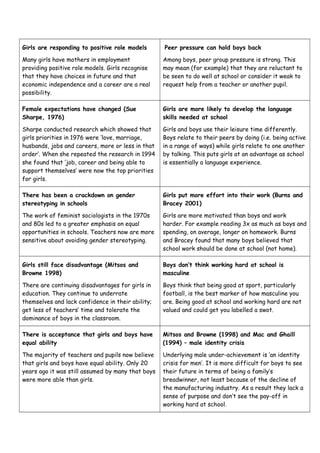
Girls are responding to positive role models

Peer pressure can hold boys back

Many girls have mothers in employment
providing positive role models. Girls recognise
that they have choices in future and that
economic independence and a career are a real
possibility.

Among boys, peer group pressure is strong. This
may mean (for example) that they are reluctant to
be seen to do well at school or consider it weak to
request help from a teacher or another pupil.

Female expectations have changed (Sue
Sharpe, 1976)

Girls are more likely to develop the language
skills needed at school

Sharpe conducted research which showed that
girls priorities in 1976 were ‘love, marriage,
husbands, jobs and careers, more or less in that
order’. When she repeated the research in 1994
she found that ‘job, career and being able to
support themselves’ were now the top priorities
for girls.

Girls and boys use their leisure time differently.
Boys relate to their peers by doing (i.e. being active
in a range of ways) while girls relate to one another
by talking. This puts girls at an advantage as school
is essentially a language experience.

There has been a crackdown on gender
stereotyping in schools

Girls put more effort into their work (Burns and
Bracey 2001)

The work of feminist sociologists in the 1970s
and 80s led to a greater emphasis on equal
opportunities in schools. Teachers now are more
sensitive about avoiding gender stereotyping.

Girls are more motivated than boys and work
harder. For example reading 3x as much as boys and
spending, on average, longer on homework. Burns
and Bracey found that many boys believed that
school work should be done at school (not home).

Girls still face disadvantage (Mitsos and
Browne 1998)

Boys don’t think working hard at school is
masculine

There are continuing disadvantages for girls in
education. They continue to underrate
themselves and lack confidence in their ability;
get less of teachers’ time and tolerate the
dominance of boys in the classroom.

Boys think that being good at sport, particularly
football, is the best marker of how masculine you
are. Being good at school and working hard are not
valued and could get you labelled a swot.

There is acceptance that girls and boys have
equal ability

Mitsos and Browne (1998) and Mac and Ghaill
(1994) – male identity crisis

The majority of teachers and pupils now believe
that girls and boys have equal ability. Only 20
years ago it was still assumed by many that boys
were more able than girls.

Underlying male under-achievement is ‘an identity
crisis for men’. It is more difficult for boys to see
their future in terms of being a family’s
breadwinner, not least because of the decline of
the manufacturing industry. As a result they lack a
sense of purpose and don’t see the pay-off in
working hard at school.
Gender and subject choice – Kelly 1987
Science is a masculine subject and boys
dominate the science classroom. Girls are less
likely to pursue science as a result. Since 1987
the National Curriculum has forced girls to take
traditionally male subjects such as science.

GCSEs include more coursework and this suits
girls better
Girls put more effort in and are better organised,
therefore doing well in coursework.

Textbooks and teaching resources have
changed and are now less likely to stereotype
girls into passive roles or traditional notions of
femininity.

Reading is seen by boys as ‘uncool’ or ‘girly’

Stanworth (1983) Classroom interactions
disadvantaged girls

Stereotypical views about girl’s future roles and
capabilities are no longer put across (e.g. that they
will go into secretarial work or become a nurse).
Girls have a sense of bigger possibilities and
opportunities to aim for.

In this early 80s study Stanworth revealed that
girls got less attention from teachers and were
often negatively labelled.

As a result they don’t develop important
communication skills.

Teachers have lower expectations of boys

Classrooms are gendered (Francis 2000)

Teachers are less critical of boys than girls and
have lower expectations of them. They are more
likely to expect work from boys to be rushed,
late, untidy and to expect boys to be disruptive.
This leads to a self-fulfilling prophecy (i.e. boys
do worse because teachers don’t expect more of
them)

Boys take up more space in the classroom and
playground and girls tend to draw less attention to
themselves than boys. Assumptions are still made
by some teachers – e.g. girls are better at
languages, boys are better at maths. Boys are
disciplined more harshly and frequently than girls.

Gender and subject choice

Working class boys form anti-school subcultures

When choosing subjects to study, females and
males are influenced by what they have learnt
about femininity and masculinity. For example
girls may avoid some subjects as they associate
them with male jobs – and vice versa for boys.

Paul Willis (1970s) conducted research which
showed how groups of lads can reject school by
forming an anti-school subculture where
achievement doesn’t matter but ‘having a laff’ does.

Spender (1983) Education was dominated by men
Spender argued in the 80s that education was controlled and
dominated by men. The curriculum was male-centred, boys
got more attention and were more likely to get away with
being disruptive. Other sociologists would suggest that
education has since become more feminised.

Policies such as the Equal Pay Act
and Sex Discrimination Act have
helped to create more equal
opportunities in society as a whole.
Gender and education ideas

Gender and education ideas

  • 1.
    Girls are respondingto positive role models Peer pressure can hold boys back Many girls have mothers in employment providing positive role models. Girls recognise that they have choices in future and that economic independence and a career are a real possibility. Among boys, peer group pressure is strong. This may mean (for example) that they are reluctant to be seen to do well at school or consider it weak to request help from a teacher or another pupil. Female expectations have changed (Sue Sharpe, 1976) Girls are more likely to develop the language skills needed at school Sharpe conducted research which showed that girls priorities in 1976 were ‘love, marriage, husbands, jobs and careers, more or less in that order’. When she repeated the research in 1994 she found that ‘job, career and being able to support themselves’ were now the top priorities for girls. Girls and boys use their leisure time differently. Boys relate to their peers by doing (i.e. being active in a range of ways) while girls relate to one another by talking. This puts girls at an advantage as school is essentially a language experience. There has been a crackdown on gender stereotyping in schools Girls put more effort into their work (Burns and Bracey 2001) The work of feminist sociologists in the 1970s and 80s led to a greater emphasis on equal opportunities in schools. Teachers now are more sensitive about avoiding gender stereotyping. Girls are more motivated than boys and work harder. For example reading 3x as much as boys and spending, on average, longer on homework. Burns and Bracey found that many boys believed that school work should be done at school (not home). Girls still face disadvantage (Mitsos and Browne 1998) Boys don’t think working hard at school is masculine There are continuing disadvantages for girls in education. They continue to underrate themselves and lack confidence in their ability; get less of teachers’ time and tolerate the dominance of boys in the classroom. Boys think that being good at sport, particularly football, is the best marker of how masculine you are. Being good at school and working hard are not valued and could get you labelled a swot. There is acceptance that girls and boys have equal ability Mitsos and Browne (1998) and Mac and Ghaill (1994) – male identity crisis The majority of teachers and pupils now believe that girls and boys have equal ability. Only 20 years ago it was still assumed by many that boys were more able than girls. Underlying male under-achievement is ‘an identity crisis for men’. It is more difficult for boys to see their future in terms of being a family’s breadwinner, not least because of the decline of the manufacturing industry. As a result they lack a sense of purpose and don’t see the pay-off in working hard at school.
  • 2.
    Gender and subjectchoice – Kelly 1987 Science is a masculine subject and boys dominate the science classroom. Girls are less likely to pursue science as a result. Since 1987 the National Curriculum has forced girls to take traditionally male subjects such as science. GCSEs include more coursework and this suits girls better Girls put more effort in and are better organised, therefore doing well in coursework. Textbooks and teaching resources have changed and are now less likely to stereotype girls into passive roles or traditional notions of femininity. Reading is seen by boys as ‘uncool’ or ‘girly’ Stanworth (1983) Classroom interactions disadvantaged girls Stereotypical views about girl’s future roles and capabilities are no longer put across (e.g. that they will go into secretarial work or become a nurse). Girls have a sense of bigger possibilities and opportunities to aim for. In this early 80s study Stanworth revealed that girls got less attention from teachers and were often negatively labelled. As a result they don’t develop important communication skills. Teachers have lower expectations of boys Classrooms are gendered (Francis 2000) Teachers are less critical of boys than girls and have lower expectations of them. They are more likely to expect work from boys to be rushed, late, untidy and to expect boys to be disruptive. This leads to a self-fulfilling prophecy (i.e. boys do worse because teachers don’t expect more of them) Boys take up more space in the classroom and playground and girls tend to draw less attention to themselves than boys. Assumptions are still made by some teachers – e.g. girls are better at languages, boys are better at maths. Boys are disciplined more harshly and frequently than girls. Gender and subject choice Working class boys form anti-school subcultures When choosing subjects to study, females and males are influenced by what they have learnt about femininity and masculinity. For example girls may avoid some subjects as they associate them with male jobs – and vice versa for boys. Paul Willis (1970s) conducted research which showed how groups of lads can reject school by forming an anti-school subculture where achievement doesn’t matter but ‘having a laff’ does. Spender (1983) Education was dominated by men Spender argued in the 80s that education was controlled and dominated by men. The curriculum was male-centred, boys got more attention and were more likely to get away with being disruptive. Other sociologists would suggest that education has since become more feminised. Policies such as the Equal Pay Act and Sex Discrimination Act have helped to create more equal opportunities in society as a whole.