Approaches to Methodology
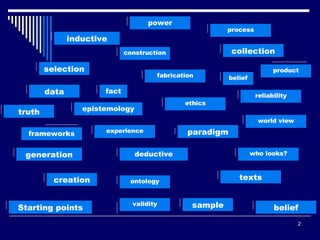
selection epistemology collection ethics power construction paradigm process frameworks truth fact fabrication belief inductive world view deductive generation texts ontology creation Starting points reliability validity who looks? belief data sample product experience
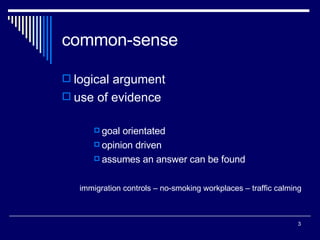
common-sense logical argument use of evidence goal orientated opinion driven assumes an answer can be found immigration controls – no-smoking workplaces – traffic calming
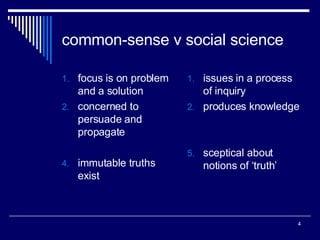
common-sense v social science focus is on problem and a solution concerned to persuade and propagate immutable truths exist issues in a process of inquiry produces knowledge sceptical about notions of ‘truth’
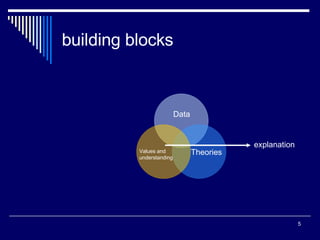
building blocks Theories Values and understanding Data explanation
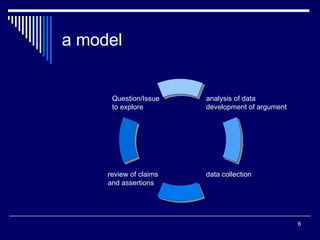
a model Question/Issue to explore analysis of data development of argument data collection review of claims and assertions
the process existing literature question or topic questions about data and  sources research design Data Collection Analysis writing up
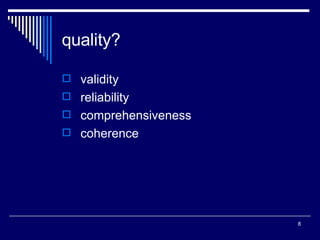
quality? validity reliability comprehensiveness coherence
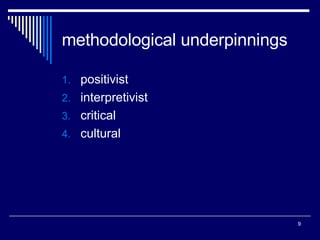
methodological underpinnings positivist interpretivist critical cultural
methodological underpinnings Positivist August Compte - social science is analogous to natural science. Its object is to uncover immutable laws of society. Emile Durkheim - ‘our method is objective. It is dominated entirely by the idea that social facts are things and must be treated as such’ (1966)
methodological underpinnings Positivist Scientific method = experiment or verifiable observation Motives, intentions, values and frameworks of understanding of the researcher are irrelevant = social fictions NOT social facts. Key method = statistical analysis combined with the comparative method
methodological underpinnings Interpretivist Making sense of the world involves understanding the thinking, meanings and intentions of those being researched. Quantifying social action is limiting. Meaning is contextual and co-created in social interaction Key method = interview (structured - unstructured)
methodological underpinnings Critical The Frankfurt School Researchers should foreground the social context within which research takes place i.e. power relations and structural inequalities of capitalism Feminist perspectives Focus on gender as the defining basis of inequality
methodological underpinnings Critical The aim is to provide a knowledge which engages the prevailing social structures which are understood as oppressive structures To free from oppression Include wider social and structural contexts Interrogate power structures in the articulating and presentation of research Acknowledges the significance of gendered relations (both positivists and interpretivists fail to see gender as a significant variable throughout the research process assuming that knowledge is gender-neutral)
methodological underpinnings Choosing methodologies How do we choose? Select appropriate to the problem Select according to the theoretical position of the researcher Select on the basis of expertise Select on the basis of methodological preference Theory and method are closely linked - mutually informing
methodological underpinnings Cultural What is the meaning of ‘valid’ and ‘reliable’ data for positivist and interpretivist research? Critical perspectives are reductionist. There is a need to focus on language, representation and discourse. Meanings are produced in language and other systems of representation Truth, reality and knowledge are problemmatic terms Key method textual (multi-modal) analysis
Methodology During the past two years you have encountered concepts in methodology in the various units you have studied on the programme. How do they correspond to the map that I have just drawn?
Methodology How are you going to write about methodology? Where does the methodology ‘sit’ in the final research report?
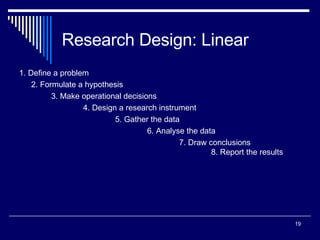
Research Design: Linear 1. Define a problem 2. Formulate a hypothesis 3. Make operational decisions 4. Design a research instrument 5. Gather the data 6. Analyse the data 7. Draw conclusions 8. Report the results
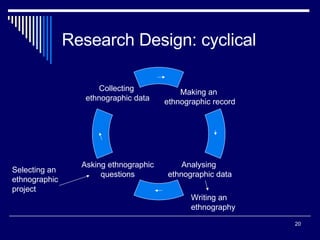
Research Design: cyclical Writing an  ethnography Selecting an  ethnographic project Making an  ethnographic record Asking ethnographic questions Collecting  ethnographic data Analysing  ethnographic data
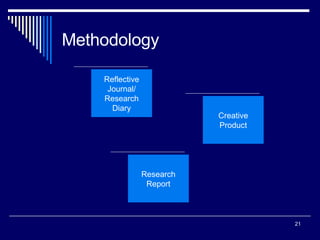
Methodology Reflective Journal/ Research Diary Research Report Creative Product
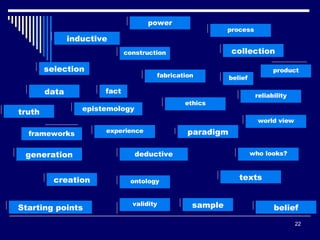
selection epistemology collection ethics power construction paradigm process frameworks truth fact fabrication belief inductive world view deductive generation texts ontology creation Starting points reliability validity who looks? belief data sample product experience
Next session From Methodology to Method Data Collection/Generation Facilitating shared networks and resources Keep returning to the Blog at http: //mmuspaces . blogspot .com

Methodology2

  • 1.
  • 2.
    selection epistemology collectionethics power construction paradigm process frameworks truth fact fabrication belief inductive world view deductive generation texts ontology creation Starting points reliability validity who looks? belief data sample product experience
  • 3.
    common-sense logical argumentuse of evidence goal orientated opinion driven assumes an answer can be found immigration controls – no-smoking workplaces – traffic calming
  • 4.
    common-sense v socialscience focus is on problem and a solution concerned to persuade and propagate immutable truths exist issues in a process of inquiry produces knowledge sceptical about notions of ‘truth’
  • 5.
    building blocks TheoriesValues and understanding Data explanation
  • 6.
    a model Question/Issueto explore analysis of data development of argument data collection review of claims and assertions
  • 7.
    the process existingliterature question or topic questions about data and sources research design Data Collection Analysis writing up
  • 8.
    quality? validity reliabilitycomprehensiveness coherence
  • 9.
    methodological underpinnings positivistinterpretivist critical cultural
  • 10.
    methodological underpinnings PositivistAugust Compte - social science is analogous to natural science. Its object is to uncover immutable laws of society. Emile Durkheim - ‘our method is objective. It is dominated entirely by the idea that social facts are things and must be treated as such’ (1966)
  • 11.
    methodological underpinnings PositivistScientific method = experiment or verifiable observation Motives, intentions, values and frameworks of understanding of the researcher are irrelevant = social fictions NOT social facts. Key method = statistical analysis combined with the comparative method
  • 12.
    methodological underpinnings InterpretivistMaking sense of the world involves understanding the thinking, meanings and intentions of those being researched. Quantifying social action is limiting. Meaning is contextual and co-created in social interaction Key method = interview (structured - unstructured)
  • 13.
    methodological underpinnings CriticalThe Frankfurt School Researchers should foreground the social context within which research takes place i.e. power relations and structural inequalities of capitalism Feminist perspectives Focus on gender as the defining basis of inequality
  • 14.
    methodological underpinnings CriticalThe aim is to provide a knowledge which engages the prevailing social structures which are understood as oppressive structures To free from oppression Include wider social and structural contexts Interrogate power structures in the articulating and presentation of research Acknowledges the significance of gendered relations (both positivists and interpretivists fail to see gender as a significant variable throughout the research process assuming that knowledge is gender-neutral)
  • 15.
    methodological underpinnings Choosingmethodologies How do we choose? Select appropriate to the problem Select according to the theoretical position of the researcher Select on the basis of expertise Select on the basis of methodological preference Theory and method are closely linked - mutually informing
  • 16.
    methodological underpinnings CulturalWhat is the meaning of ‘valid’ and ‘reliable’ data for positivist and interpretivist research? Critical perspectives are reductionist. There is a need to focus on language, representation and discourse. Meanings are produced in language and other systems of representation Truth, reality and knowledge are problemmatic terms Key method textual (multi-modal) analysis
  • 17.
    Methodology During thepast two years you have encountered concepts in methodology in the various units you have studied on the programme. How do they correspond to the map that I have just drawn?
  • 18.
    Methodology How areyou going to write about methodology? Where does the methodology ‘sit’ in the final research report?
  • 19.
    Research Design: Linear1. Define a problem 2. Formulate a hypothesis 3. Make operational decisions 4. Design a research instrument 5. Gather the data 6. Analyse the data 7. Draw conclusions 8. Report the results
  • 20.
    Research Design: cyclicalWriting an ethnography Selecting an ethnographic project Making an ethnographic record Asking ethnographic questions Collecting ethnographic data Analysing ethnographic data
  • 21.
    Methodology Reflective Journal/Research Diary Research Report Creative Product
  • 22.
    selection epistemology collectionethics power construction paradigm process frameworks truth fact fabrication belief inductive world view deductive generation texts ontology creation Starting points reliability validity who looks? belief data sample product experience
  • 23.
    Next session FromMethodology to Method Data Collection/Generation Facilitating shared networks and resources Keep returning to the Blog at http: //mmuspaces . blogspot .com