What is the first word which comes
into your head when you see these
images
What you have just done is an example
of LABELLING
• Stereotyping or tagging someone with a set of
characteristics based on biased perceptions

• This is important because labelling is a
powerful sociological explanation for
underachievement in education
Social Class And Educational
Attainment
• Remember research has consistently shown
that children from working-class backgrounds
overall do not perform as well in school as
those from middle and upper class
backgrounds.
• ‘there is a long standing statistical correlation
between social class and educational
achievement’
• To explain this we should consider BOTH
INTERNAL and EXTERNAL school factors
We have looked at many external factors
relating to class and educational attainment.
Now we will be examining factors within the
education system itself.
Labels
Can we think of some examples of labels that teachers
may give students?
By the end of today’s lesson you will
be able to
• Assess the impact of labelling on the
experience of students.
• Define interactionism and micro-sociology..
• Summarise the findings of at least one study
of labelling.
• Outline the self-fulfilling prophecy.
• Explain Rosenthal & Jacobson’s findings about
self-fulfilling prophecies
Schools: labelling - low/high expectations
• Teachers inevitably label students and it has been suggested
that working-class students are more likely to get negative
labels.
• Schools are by their nature middle class - teachers are middle
class because of their profession - so working-class students
do not fit in as easily.
• If their behaviour is seen as bad they are likely to be labelled
not only as badly behaved but also as not bright.
• Equally, well-behaved children are thought of as bright - and
are usually middle class.
Labelling
• How do schools and teachers label
students?
• Students may be typecast on the basis of
early impressions based on their
appearance, manners, speech, and where
they live
• Labelling a student as a ‘good trustworthy’
student is called the HALO EFFECT
Interactionism
Micro-sociology
Each group takes a different theorist and writes a brief note on
their findings. Come together to share info from each group.

• GROUP 1 Becker page 103
• GROUP 2 Cicourel & Kitsuse page 103
• GROUP 3 Ray Rist page 103
• GROUP 4 Sharp & Green page 103-4
• GROUP 5 Nell Keddie page 104
• GROUP 6 Gilbourn & Youdell page 104
Self-fulfilling Prophecy
Definition:
A self-fulfilling prophecy is a prediction that
directly or indirectly causes itself to become true,
by the very terms of the prophecy itself, due to
positive feedback between belief and behaviour.
W.I. Thomas (1909)
• argued that if people define social situations
as real, they become real in there
consequences.
• This has now become known as the ‘selffulfilling prophecy.’
• It suggests that the process of labelling and
stereotyping of individuals by others is taken
on board and becomes internalised resulting
in the given label becoming true.
SELF-FULFILLING PROPHECY
• When the prediction becomes the truth

• Teachers' expectations can have a real effect on how
students achieve.
• Students who have been told they are not good at a
subject are more likely to stop trying than to set out
to prove the teacher wrong.
• Teachers give more time and attention to those
students who they think will do better as a result.
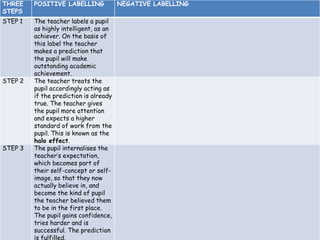
THREE
STEPS

POSITIVE LABELLING

STEP 1

The teacher labels a pupil
as highly intelligent, as an
achiever. On the basis of
this label the teacher
makes a prediction that
the pupil will make
outstanding academic
achievement.
The teacher treats the
pupil accordingly acting as
if the prediction is already
true. The teacher gives
the pupil more attention
and expects a higher
standard of work from the
pupil. This is known as the
halo effect.
The pupil internalises the
teacher’s expectation,
which becomes part of
their self-concept or selfimage, so that they now
actually believe in, and
become the kind of pupil
the teacher believed them
to be in the first place.
The pupil gains confidence,
tries harder and is
successful. The prediction
is fulfilled.

STEP 2

STEP 3

NEGATIVE LABELLING
Labelling theory and the self-fulfilling
prophecy
• Labelling means attaching a ‘tag’ to pupils e.g.
‘bright’, ‘lazy’ , ‘dumb’ etc
• self-fulfilling prophecy = ‘what teachers
believe about pupils, pupils achieve’
• Teachers labels kid bright
pupil
internalises label
pupil becomes more
enthusiastic, tries harder, ends up succeeding
• On other hand labelling as ‘thick’ can lead to
underachievement
Pygmalion
Pygmalion (1913) is a famous play

by George Bernard Shaw. It tells
the story of Henry Higgins, a
professor of phonetics (study of
speech) who makes a bet with his
friend Colonel Pickering that he
can successfully pass off a poor
working class Cockney flower girl,
Eliza Doolittle, as a refined
society lady by teaching her how
to speak with an upper class
accent and training her in
etiquette.
It was filmed as My Fair Lady
Rosenthal & Jacobson’s study of a
Californian Primary School
• The most famous research into labelling was an
experiment carried out by Rosenthal & Jacobson called
‘Pygmalion in the Classroom’.
• Teachers were told that certain pupils were high
achievers based on previous assessment
• In fact this was a lie, they were chosen at random.
• However one year later these pupils were achieving
high scores – teachers had taken greater interest in
them believing them to be brighter, so their motivation
and confidence were boosted.
By the end of today’s lesson you will
be able to
• Assess the impact of labelling on the
experience of students.
• Define interactionism and micro-sociology.
• Summarise the findings of at least one study
of labelling.
• Outline the self-fulfilling prophecy.
• Explain Rosenthal & Jacobson’s findings about
self-fulfilling prophecies

Labelling and self-fulfilling prophecy

  • 1.
    What is thefirst word which comes into your head when you see these images
  • 2.
    What you havejust done is an example of LABELLING • Stereotyping or tagging someone with a set of characteristics based on biased perceptions • This is important because labelling is a powerful sociological explanation for underachievement in education
  • 3.
    Social Class AndEducational Attainment • Remember research has consistently shown that children from working-class backgrounds overall do not perform as well in school as those from middle and upper class backgrounds. • ‘there is a long standing statistical correlation between social class and educational achievement’ • To explain this we should consider BOTH INTERNAL and EXTERNAL school factors
  • 4.
    We have lookedat many external factors relating to class and educational attainment. Now we will be examining factors within the education system itself.
  • 5.
    Labels Can we thinkof some examples of labels that teachers may give students?
  • 6.
    By the endof today’s lesson you will be able to • Assess the impact of labelling on the experience of students. • Define interactionism and micro-sociology.. • Summarise the findings of at least one study of labelling. • Outline the self-fulfilling prophecy. • Explain Rosenthal & Jacobson’s findings about self-fulfilling prophecies
  • 7.
    Schools: labelling -low/high expectations • Teachers inevitably label students and it has been suggested that working-class students are more likely to get negative labels. • Schools are by their nature middle class - teachers are middle class because of their profession - so working-class students do not fit in as easily. • If their behaviour is seen as bad they are likely to be labelled not only as badly behaved but also as not bright. • Equally, well-behaved children are thought of as bright - and are usually middle class.
  • 8.
    Labelling • How doschools and teachers label students? • Students may be typecast on the basis of early impressions based on their appearance, manners, speech, and where they live • Labelling a student as a ‘good trustworthy’ student is called the HALO EFFECT
  • 9.
  • 10.
    Each group takesa different theorist and writes a brief note on their findings. Come together to share info from each group. • GROUP 1 Becker page 103 • GROUP 2 Cicourel & Kitsuse page 103 • GROUP 3 Ray Rist page 103 • GROUP 4 Sharp & Green page 103-4 • GROUP 5 Nell Keddie page 104 • GROUP 6 Gilbourn & Youdell page 104
  • 11.
    Self-fulfilling Prophecy Definition: A self-fulfillingprophecy is a prediction that directly or indirectly causes itself to become true, by the very terms of the prophecy itself, due to positive feedback between belief and behaviour.
  • 12.
    W.I. Thomas (1909) •argued that if people define social situations as real, they become real in there consequences. • This has now become known as the ‘selffulfilling prophecy.’ • It suggests that the process of labelling and stereotyping of individuals by others is taken on board and becomes internalised resulting in the given label becoming true.
  • 13.
    SELF-FULFILLING PROPHECY • Whenthe prediction becomes the truth • Teachers' expectations can have a real effect on how students achieve. • Students who have been told they are not good at a subject are more likely to stop trying than to set out to prove the teacher wrong. • Teachers give more time and attention to those students who they think will do better as a result.
  • 14.
    THREE STEPS POSITIVE LABELLING STEP 1 Theteacher labels a pupil as highly intelligent, as an achiever. On the basis of this label the teacher makes a prediction that the pupil will make outstanding academic achievement. The teacher treats the pupil accordingly acting as if the prediction is already true. The teacher gives the pupil more attention and expects a higher standard of work from the pupil. This is known as the halo effect. The pupil internalises the teacher’s expectation, which becomes part of their self-concept or selfimage, so that they now actually believe in, and become the kind of pupil the teacher believed them to be in the first place. The pupil gains confidence, tries harder and is successful. The prediction is fulfilled. STEP 2 STEP 3 NEGATIVE LABELLING
  • 15.
    Labelling theory andthe self-fulfilling prophecy • Labelling means attaching a ‘tag’ to pupils e.g. ‘bright’, ‘lazy’ , ‘dumb’ etc • self-fulfilling prophecy = ‘what teachers believe about pupils, pupils achieve’ • Teachers labels kid bright pupil internalises label pupil becomes more enthusiastic, tries harder, ends up succeeding • On other hand labelling as ‘thick’ can lead to underachievement
  • 16.
    Pygmalion Pygmalion (1913) isa famous play by George Bernard Shaw. It tells the story of Henry Higgins, a professor of phonetics (study of speech) who makes a bet with his friend Colonel Pickering that he can successfully pass off a poor working class Cockney flower girl, Eliza Doolittle, as a refined society lady by teaching her how to speak with an upper class accent and training her in etiquette. It was filmed as My Fair Lady
  • 17.
    Rosenthal & Jacobson’sstudy of a Californian Primary School • The most famous research into labelling was an experiment carried out by Rosenthal & Jacobson called ‘Pygmalion in the Classroom’. • Teachers were told that certain pupils were high achievers based on previous assessment • In fact this was a lie, they were chosen at random. • However one year later these pupils were achieving high scores – teachers had taken greater interest in them believing them to be brighter, so their motivation and confidence were boosted.
  • 18.
    By the endof today’s lesson you will be able to • Assess the impact of labelling on the experience of students. • Define interactionism and micro-sociology. • Summarise the findings of at least one study of labelling. • Outline the self-fulfilling prophecy. • Explain Rosenthal & Jacobson’s findings about self-fulfilling prophecies