Doing Sociology: Research
1
Doing Sociology: Research
• Apply the sociological perspective (point of
view reveals curious patterns of behavior all
around us that call for further study).
• Be curious and ask questions.
• Objective - personally neutral in conducting
research.
• One way to limit distortion caused by personal
values is replication, repetition of research by
other investigators.
Types of truths
• People’s “truths” differ the world over, and we often encounter “facts”
at odds with our own.
• Saying that we “know” something can mean many things eg.
Believing in God
• From recognized experts. Eg: sick people seeking help from a doctor
• Based on simple agreement among ordinary people eg: sex among
kids is wrong
• Science represents a fourth way of knowing. Science is a logical
system that bases knowledge on direct, systematic observation.
Scientific knowledge rests on empirical evidence, that is,
information we can verify with our senses.
3
• “Poor people are far more likely than rich
people to break the law.”
• “Most poor people don’t want to work.”
4
3 ways to do sociology research
• Positivist sociology-is the study of society
based on systematic observation of social
behavior.
• interpretive sociology-the study of society
that focuses on the meanings people attach
to their social world.
• Critical sociology-is the study of society
that focuses on the need for social change.
5
Concept, Variables &
Measurement
• Concept- a mental construct that represents
some part of the world in a simplified form
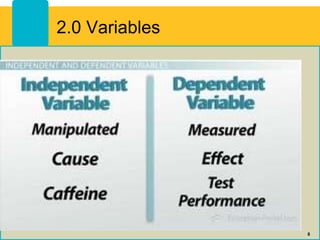
• Variable is a concept whose value changes
from case to case
• Measurement is a procedure for determining
the value of a variable in a specific case
• Operationalize a variable by specifying
exactly what is to be measured before
assigning a value to a variable.
6
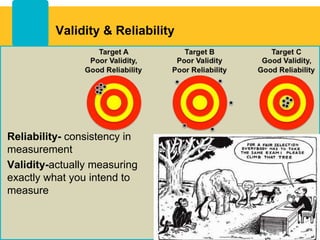
Validity & Reliability
Reliability- consistency in
measurement
Validity-actually measuring
exactly what you intend to
measure
7
2.0 Variables
8
Variables (con’t.)
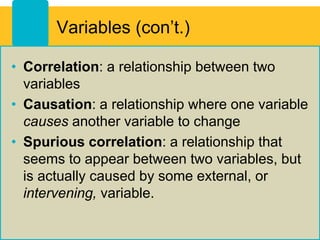
• Correlation: a relationship between two
variables
• Causation: a relationship where one variable
causes another variable to change
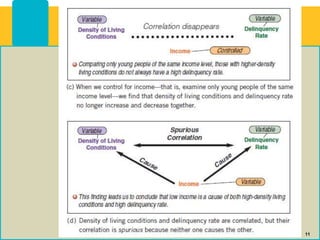
• Spurious correlation: a relationship that
seems to appear between two variables, but
is actually caused by some external, or
intervening, variable.
Relationship among Variables
10
11
3.0 The Scientific Approach
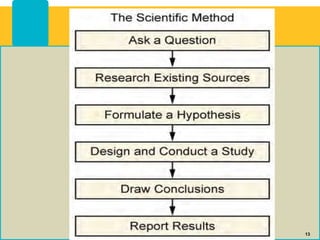
• The scientific method—a procedure for
acquiring knowledge that emphasizes
collecting data through observation and
experiment.
13
14
Scientific
Method for
Sociological
Research
Methods: How Do We Gather
Data?
• There are different ways to collect information
about a topic, but each method has benefits and
limitations.
• When beginning a research project, it is important
to consider which method will work best.
• population, the people who are the focus of
research.
• sample, a part of a population that represents the
whole
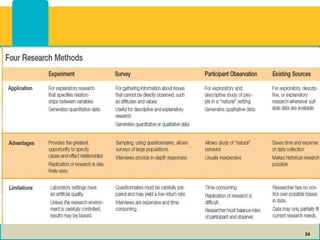
3.1 Participant Observation
• Participant Observation usually happens in
two steps:
• The researcher participates in and observes a
setting.
• Then the researcher makes a written account
(field notes) of what goes on there.
• In participant observation the researcher both
observes and becomes a member in a social
setting.
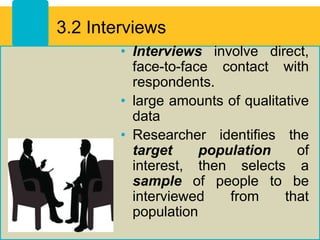
3.2 Interviews
• Interviews involve direct,
face-to-face contact with
respondents.
• large amounts of qualitative
data
• Researcher identifies the
target population of
interest, then selects a
sample of people to be
interviewed from that
population
Interviews (con’t.)
• Interviews can use open-ended
questions or closed-ended questions.
• Open-ended questions let respondents
talk as much as they’d like about the
question you asked
• Closed-ended questions give
respondents a choice of answers.
3.3 Surveys
• Surveys are
questionnaires that are
administered to a sample
of respondents selected
from a target population.
Survey research tends to
look at large-scale social
patterns and employs
statistics and other
mathematical means of
analysis.
3.4 Existing Sources
• Existing sources
refer to any data
that has already
been collected by
earlier
researchers and is
available for future
research.
3.5 Experimental Methods
• Experiments are formal tests of specific
variables and effects that are performed in a
setting where all aspects of the situation can
be controlled.
Experimental Methods (con’t.)
• Many experiments involve:
• An experimental group—participants that
receive the experimental treatment
• A control group—participants that continue
without intervention so they can be compared
with the experimental group
23
24
Objectivity
• Most sociologists believe that they should not
allow their personal beliefs to influence their
research.
• Max Weber coined the phrase value-free
sociology, stating that researchers should
identify facts without allowing their own
personal beliefs or biases to interfere.
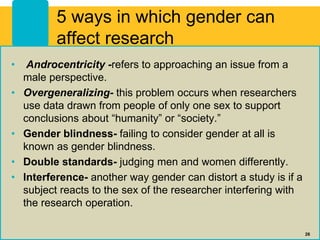
5 ways in which gender can
affect research
• Androcentricity -refers to approaching an issue from a
male perspective.
• Overgeneralizing- this problem occurs when researchers
use data drawn from people of only one sex to support
conclusions about “humanity” or “society.”
• Gender blindness- failing to consider gender at all is
known as gender blindness.
• Double standards- judging men and women differently.
• Interference- another way gender can distort a study is if a
subject reacts to the sex of the researcher interfering with
the research operation.
26
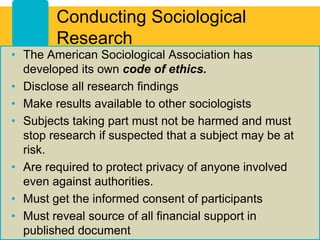
Conducting Sociological
Research
• The American Sociological Association has
developed its own code of ethics.
• Disclose all research findings
• Make results available to other sociologists
• Subjects taking part must not be harmed and must
stop research if suspected that a subject may be at
risk.
• Are required to protect privacy of anyone involved
even against authorities.
• Must get the informed consent of participants
• Must reveal source of all financial support in
published document
Conducting Sociological
Research (con’t.)
• Most universities where research is
conducted also have an institutional review
board, a group of scholars within a university
who meet regularly to review and approve
the research proposals of their colleagues
and make recommendations for how to
protect human subjects.
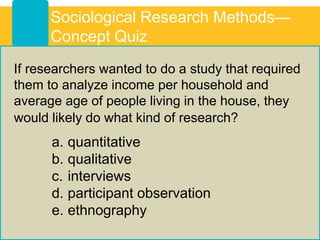
Sociological Research Methods—
Concept Quiz
If researchers wanted to do a study that required
them to analyze income per household and
average age of people living in the house, they
would likely do what kind of research?
a. quantitative
b. qualitative
c. interviews
d. participant observation
e. ethnography
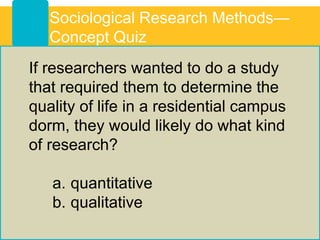
If researchers wanted to do a study
that required them to determine the
quality of life in a residential campus
dorm, they would likely do what kind
of research?
a. quantitative
b. qualitative
Sociological Research Methods—
Concept Quiz
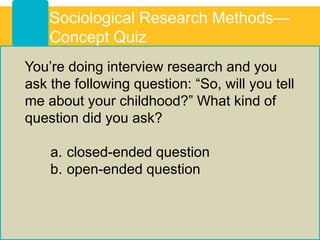
You’re doing interview research and you
ask the following question: “So, will you tell
me about your childhood?” What kind of
question did you ask?
a. closed-ended question
b. open-ended question
Sociological Research Methods—
Concept Quiz
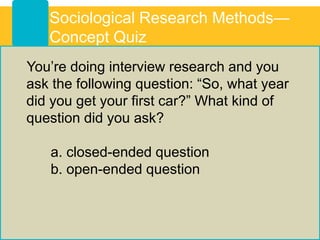
You’re doing interview research and you
ask the following question: “So, what year
did you get your first car?” What kind of
question did you ask?
a. closed-ended question
b. open-ended question
Sociological Research Methods—
Concept Quiz

Sociological Investigation.ppt

  • 1.
  • 2.
    Doing Sociology: Research •Apply the sociological perspective (point of view reveals curious patterns of behavior all around us that call for further study). • Be curious and ask questions. • Objective - personally neutral in conducting research. • One way to limit distortion caused by personal values is replication, repetition of research by other investigators.
  • 3.
    Types of truths •People’s “truths” differ the world over, and we often encounter “facts” at odds with our own. • Saying that we “know” something can mean many things eg. Believing in God • From recognized experts. Eg: sick people seeking help from a doctor • Based on simple agreement among ordinary people eg: sex among kids is wrong • Science represents a fourth way of knowing. Science is a logical system that bases knowledge on direct, systematic observation. Scientific knowledge rests on empirical evidence, that is, information we can verify with our senses. 3
  • 4.
    • “Poor peopleare far more likely than rich people to break the law.” • “Most poor people don’t want to work.” 4
  • 5.
    3 ways todo sociology research • Positivist sociology-is the study of society based on systematic observation of social behavior. • interpretive sociology-the study of society that focuses on the meanings people attach to their social world. • Critical sociology-is the study of society that focuses on the need for social change. 5
  • 6.
    Concept, Variables & Measurement •Concept- a mental construct that represents some part of the world in a simplified form • Variable is a concept whose value changes from case to case • Measurement is a procedure for determining the value of a variable in a specific case • Operationalize a variable by specifying exactly what is to be measured before assigning a value to a variable. 6
  • 7.
    Validity & Reliability Reliability-consistency in measurement Validity-actually measuring exactly what you intend to measure 7
  • 8.
  • 9.
    Variables (con’t.) • Correlation:a relationship between two variables • Causation: a relationship where one variable causes another variable to change • Spurious correlation: a relationship that seems to appear between two variables, but is actually caused by some external, or intervening, variable.
  • 10.
  • 11.
  • 12.
    3.0 The ScientificApproach • The scientific method—a procedure for acquiring knowledge that emphasizes collecting data through observation and experiment.
  • 13.
  • 14.
  • 15.
    Methods: How DoWe Gather Data? • There are different ways to collect information about a topic, but each method has benefits and limitations. • When beginning a research project, it is important to consider which method will work best. • population, the people who are the focus of research. • sample, a part of a population that represents the whole
  • 16.
    3.1 Participant Observation •Participant Observation usually happens in two steps: • The researcher participates in and observes a setting. • Then the researcher makes a written account (field notes) of what goes on there. • In participant observation the researcher both observes and becomes a member in a social setting.
  • 17.
    3.2 Interviews • Interviewsinvolve direct, face-to-face contact with respondents. • large amounts of qualitative data • Researcher identifies the target population of interest, then selects a sample of people to be interviewed from that population
  • 18.
    Interviews (con’t.) • Interviewscan use open-ended questions or closed-ended questions. • Open-ended questions let respondents talk as much as they’d like about the question you asked • Closed-ended questions give respondents a choice of answers.
  • 19.
    3.3 Surveys • Surveysare questionnaires that are administered to a sample of respondents selected from a target population. Survey research tends to look at large-scale social patterns and employs statistics and other mathematical means of analysis.
  • 20.
    3.4 Existing Sources •Existing sources refer to any data that has already been collected by earlier researchers and is available for future research.
  • 21.
    3.5 Experimental Methods •Experiments are formal tests of specific variables and effects that are performed in a setting where all aspects of the situation can be controlled.
  • 22.
    Experimental Methods (con’t.) •Many experiments involve: • An experimental group—participants that receive the experimental treatment • A control group—participants that continue without intervention so they can be compared with the experimental group
  • 23.
  • 24.
  • 25.
    Objectivity • Most sociologistsbelieve that they should not allow their personal beliefs to influence their research. • Max Weber coined the phrase value-free sociology, stating that researchers should identify facts without allowing their own personal beliefs or biases to interfere.
  • 26.
    5 ways inwhich gender can affect research • Androcentricity -refers to approaching an issue from a male perspective. • Overgeneralizing- this problem occurs when researchers use data drawn from people of only one sex to support conclusions about “humanity” or “society.” • Gender blindness- failing to consider gender at all is known as gender blindness. • Double standards- judging men and women differently. • Interference- another way gender can distort a study is if a subject reacts to the sex of the researcher interfering with the research operation. 26
  • 27.
    Conducting Sociological Research • TheAmerican Sociological Association has developed its own code of ethics. • Disclose all research findings • Make results available to other sociologists • Subjects taking part must not be harmed and must stop research if suspected that a subject may be at risk. • Are required to protect privacy of anyone involved even against authorities. • Must get the informed consent of participants • Must reveal source of all financial support in published document
  • 28.
    Conducting Sociological Research (con’t.) •Most universities where research is conducted also have an institutional review board, a group of scholars within a university who meet regularly to review and approve the research proposals of their colleagues and make recommendations for how to protect human subjects.
  • 29.
    Sociological Research Methods— ConceptQuiz If researchers wanted to do a study that required them to analyze income per household and average age of people living in the house, they would likely do what kind of research? a. quantitative b. qualitative c. interviews d. participant observation e. ethnography
  • 30.
    If researchers wantedto do a study that required them to determine the quality of life in a residential campus dorm, they would likely do what kind of research? a. quantitative b. qualitative Sociological Research Methods— Concept Quiz
  • 31.
    You’re doing interviewresearch and you ask the following question: “So, will you tell me about your childhood?” What kind of question did you ask? a. closed-ended question b. open-ended question Sociological Research Methods— Concept Quiz
  • 32.
    You’re doing interviewresearch and you ask the following question: “So, what year did you get your first car?” What kind of question did you ask? a. closed-ended question b. open-ended question Sociological Research Methods— Concept Quiz