JLIABG vol. 1, 17-37


                         Thematization, Topic, and Information Flow

                                               James D. Dvorak
         Associate Professor of Greek and New Testament, Oklahoma Christian University


Introduction
        It is important to begin this article by stating two formative presuppositions. The first has
to do with the nature of discourse itself, namely that it is a semantic notion—it is "language that
is functional."1 From the perspective of Systemic-Functional Linguistics (SFL)—the linguistic
model adopted in this study—discourse (a.k.a., "text") is a "metafunctional construct."2 Basically
this means that a discourse fulfills multiple meaningful functions at once. The two main
functions, according to Halliday are: (1) it provides the ability to construe the human experience
of reality (ideational metafunction)3 and (2) it provides a way to enact interpersonal relationships
(interpersonal metafunction).4
        The second presupposition has to do with the fact that when humans perceive that a
discourse "makes sense" to them, it generally means there is some thematic element which flows
through the discourse allowing them to recognize it as being cohesive rather than a jumble of
unrelated words and sentences.5 This cohesiveness and concomitant coherence is the result of the
work done by a third functional component of discourse, the textual metafunction. This function
provides the means by which the construal of experience (ideational function) and enactment of
relationships (interpersonal function) can be assembled into a coherent whole.6 When the three
types of function/meaning are realized they each map their own kind of structure on to each
clause in the discourse.7 The end result is an organization within a discourse that allows the
transmission of meaning to occur or "unfold"; generally this is classified under the concept of
"information systems."
        The purpose of this paper is to investigate further how the textual component of discourse
aids in creating the flow of information. More specifically, I will narrow my focus to a


1
  Halliday and Hasan, Language, Context, and Text, 10-2. See also Halliday, "Semantic Choice," 45.
2
  Halliday and Hasan, Language, Context, and Text, 48.
3
  The ideational metafunction is often referred to as the experiential metafunction. There is a fourth function given
by Halliday, the logical, which is usually taken together with experiential to form the "ideational" function (cf.
Halliday, "Semantic Choice," 23, 26-7). The logical function represents a small set of fundamental logical relations
(e.g., "if . . . then") which explain basic tactic relations (Halliday and Matthiessen, IFG, 29; Halliday and Hasan,
Language, Context, and Text, 21).
4
  Halliday and Matthiessen, IFG, 29-30; Halliday and Hasan, Language, Context, and Text, 16-23, 29.
5
  Jeffrey T. Reed, "Modern Linguistics," 251.
6
   Halliday and Matthiessen (IFG, 30) say that the textual metafunction may be regarded as an "enabling or
facilitating function, since both the others [the ideational and interpersonal functions] depend on being able to build
up sequences of discourse, organizing the discursive flow and creating cohesion and continuity as it moves along."
Cf. also Halliday, "Semantic Choice," 29: "[I]t is through the semantic options of the textual component that
language comes to be relevant to its environment . . . ."
7
  The clause is the "central processing unit in the lexicogrammar—in the specific sense that it is in the clause that
meanings of different kinds are mapped into an integrated grammatical structure" (Halliday and Matthiessen, IFG,
10).
JLIABG                                                                                                                18

discussion of thematization and topic. Following a model developed by Porter and O'Donnell,8 I
will endeavor to trace the thematic elements through a discourse from the bottom up (i.e.,
starting with the clause and working upwards to the clause complex and paragraph levels) in an
attempt to elucidate the topics of these larger chunks.9 I also want to show how this kind of
approach yields important information that can and should be used in the exegesis of biblical
discourse. To demonstrate this, I will use 1 Jn. 2:28—3:17 as the sample discourse for this study,
though I will not attempt a full exegesis of the text in this paper.10

I. Discourse Flow and Discourse Structure
        As mentioned above, the textual metafunction of language works to create discourse that
is structured or organized. The result of this compositional process is (in the case of the biblical
texts) a written discourse that "unfolds" in a linear progression. The linear nature of discourse is
described by Brown and Yule as a "problem,"11 which highlights the constraint this phenomenon
places on language use. Language users are not able to communicate all they want to "mean" at
once; they are restricted to the production of only one word at a time. They then have to organize
those words into clauses, clauses into clause complexes, and those complexes into larger
segments of text—all in a linear fashion. The constraint of linearization is perhaps most evident
in the fact that language users must organize their messages in such a way that the movement of
meaning proceeds in the direction that will meet their objectives as well as the expectations of
the recipient(s) of the discourse.12 Thus, a well-chosen starting point or "theme" is necessary,
because a poorly chosen theme may result in a misinterpretation, not only of a sentence, but
possibly of an entire discourse, as interpreters attempt to follow its "flow of thought."13 This
linear "unfolding" or "movement" of meaning through a discourse is encapsulated in the notion
of information or discourse flow.14
        The so-called "problem of linearization" is not limited to the clause or the clause
complex; it also constrains language use at higher levels (ranks), such as at the paragraph level.15
Discourse producers, particularly those producing written discourse, will often arrange smaller
chunks of the text in a certain order so as to give prominence to that chunk or to another chunk.
These chunks are composed of thematically related material.16 For example, it is not uncommon
for writers to begin with one discourse chunk made up of one or more broad propositions only to
8
   Porter and O'Donnell, Discourse Analysis, 54-77 (note that the page numbers referenced here are pre-publication
page numbers).
9
  In this paper, I will not attempt to analyze the entire discourse of 1 John and, thus, will not attempt to discover a
"topic" for the entire discourse (though I believe the approach represented here makes such analysis tenable).
10
    Cf. Cynthia Long Westfall, "Grouping in Discourse." Also, my analysis below makes extensive use of
OpenText.org.
11
    Brown and Yule, Discourse Analysis, 125; cf. Halliday, "Brief Sketch," 181. See also R. de Beaugrande,
"Linearity."
12
    Brown and Yule, Discourse Analysis, 125; cf. Porter and O'Donnell, Discourse Analysis, 54-5. See also Hoey,
Textual Interaction, 24.
13
   However, if in the process of interpreting a discourse something does not make sense in light of the preceding co-
text, people will usually re-read earlier portions of the discourse (or ask a clarifying question, if spoken discourse) in
an attempt to make sense of the new information. This is related to Grice's maxims, on which see Levinson,
Pragmatics, 100-66.
14
    Cf. Porter and O'Donnell, Discourse Analysis, 55; Brown and Yule, Discourse Analysis, 169-79; Halliday,
"Architecture," 7.
15
    Porter and O'Donnell refer to as the hierarchical nature of discourse. See esp. Brown and Yule, Discourse
Analysis, 133.
16
   Porter and O'Donnell, Discourse Analysis, 56.
Dvorak - Thematization, Topic, and Information Flow                                                                 19

follow that chunk with another (or series of others) that draws specific points from those
preceding propositions. This kind of organization is often referred to as thematization, though I
prefer to use the less technical term "staging."17 The important point here is that a certain
arrangement of information, whether it be words in a clause, clauses in a clause complex, clause
complexes in a paragraph, or paragraphs in a discourse will communicate a certain meaning. But,
if the arrangement of any one of those components is changed the meaning of the discourse
would change.18
        Given that linearization affects both the smaller and larger ranks of discourse (from the
clause up), then it stands to reason that one ought to be able to determine the thematic structure
at the discourse level by determining the thematization in each of its constituent parts. In other
words, each rank from clause upward contributes to a "developing, cumulative instruction which
tells us how to construct a coherent representation" of the "topic" of each chunk and ultimately
for an entire discourse.19

II. Terminology and Methodology
        Before proceeding to the thematic analysis in part three, it is necessary to define the terms
and method I will use to discuss thematization at each level of discourse, starting with the clause
level and moving upward to the paragraph level. Table 1 below introduces these terms and the
levels of discourse at which they are used.20

A. Prime and Subsequent
        As I noted in the introduction, the textual metafunction provides the means by which
language users create text. It enables the bringing together of ideational and interpersonal
meaning into a coherent whole. In doing so, it organizes the discursive flow and creates cohesion
and continuity and thereby carries the line of meaning through a text.21 This results in a structure
being mapped on to each clause in a discourse, which Halliday calls the "thematic structure."22
        Thematic structure, which constitutes the clause as message, is made up of two distinct
parts, Theme and Rheme, but I will follow Porter and O'Donnell and refer to these thematic
elements as Prime and Subsequent, reserving Theme and Rheme for the rank of the clause
complex.23 Prime may be defined as "the peg on which the message is hung,"24 or "the point of
departure for what the speaker is going to say."25 Subsequent may be classified as what the


17
   See Brown and Yule, Discourse Analysis, 134. Cotterell and Turner, Linguistics, 241: "Discourse is characterized
by staging, the orderly progression in a necessarily linear sequence."
18
   This reflects the saying, "Meaningfulness implies choice" (see Lyons, Theoretical Linguistics, 413f.). A discourse
producer particularly in written discourse will organize discourse to "lead" a reader to certain conclusions in order to
meet their communicative objectives. See Hoey, Textual Interaction, 52-3.
19
   Brown and Yule, Discourse Analysis, 134; cf. Porter and O'Donnell, Discourse Analysis, 56.
20
   Table 1 is adapted from Porter and O'Donnell, Discourse Analysis, 57; I am indebted to these two scholars for the
work they have produced and are producing related to discourse analysis of biblical texts, which the remainder of
this paper reflects. I am also grateful for the excellent resource made available by OpenText.org, which I have used
substantially in this and other projects.
21
   Cf. Halliday and Matthiessen, IFG, 30; also Halliday, "Language Structure," 190.
22
   Halliday and Matthiessen, IFG, 64.
23
   Porter and O'Donnell, Discourse Analysis, 57. O'Donnell, Porter, and Reed, "Clause Level Annotation."
24
   Halliday, "Language Structure," 190.
25
   Halliday and Matthiessen, IFG, 58, 64; cf. Brown and Yule, Discourse Analysis, 127. See Fries, "On Theme,"
229-30.
JLIABG                                                                                                            20

speaker says or writes about the Prime.26 Slightly less metaphorically, the Prime of a clause
provides a framework within which the Subsequent of that clause can be interpreted.27 Thus, the
Prime orients the reader to the message of the clause, telling them how to understand the "news"
conveyed by the clause; the Subsequent is the "news" (or "newsworthy") part of the clause—the
part that the writer wants the reader to remember.28


Level                 Function          Definition

                                        Who or what the clause is focused upon; provides the
                      Prime             framework within which the subsequent can be
Clause                                  interpreted.
                                        Development of the prime; that which the writer
                      Subsequent
                                        wants the reader to remember.

                      Theme             The change of participant as actor of process chain.
Clause
Complex                                 Additional process information for current actor
                      Rheme
                                        (extension of process chain)
                                        Establishment of a new semantic environment for the
                      Topic
                                        discourse.
Paragraph
                      Comment           Support information for the current topic.

Table 1 Thematic Elements in Discourse

        Every clause will have a Prime and will usually have a Subsequent, though it is possible
that a clause consists of a single group or word, in which case only a Prime would be present.29
For example, in 1 Jn 3:5, the Prime is a single word (a verbal group, οἴδατε (you know)) and no
subsequent exists. Identifying the Prime is relatively easy, since it is positioned at the front of the
clause, realized by the first group element, whether a nominal group, a verbal group, or an
adjunct.30 Prime may be a complex nominal or verbal group or embedded clause (see Table 3).31
The Subsequent, if present, is realized in the remaining group elements in the clause.32


26
   Brown and Yule, Discourse Analysis, 126-27: "everything else in that follows [the Theme] in the sentence which
consists of 'what the speaker states about, or in regard to, the starting point of the utterance'" (quoting Mathesius,
1942).
27
   Fries, "On Theme," 230.
28
   Fries, "On Theme," 234. See also the documentation on clause annotation on the OpenText.org site: O'Donnell,
Porter, and Reed, "Clause Level Annotation." Thompson (Introduction, 165) says the Rheme (Subsequent in our
terminology) is the "main information" the writer wants his audience to know.
29
   Porter and O'Donnell, Discourse Analysis, 58.
30
   Porter and O'Donnell, Discourse Analysis, 58.
31
   Porter and O'Donnell, Discourse Analysis, 60.
32
   Porter and O'Donnell, Discourse Analysis, 58.
Dvorak - Thematization, Topic, and Information Flow                                                          21

Conjunctions are not included in Prime-Subsequent analysis.33 See Tables 2 and 3, as well as
part three below for examples. Table 3 illustrates how an embedded clause can act as Prime
while having its own Prime and Subsequent structure,34 though in practice, embedded clauses are
not usually analyzed for Prime and Subsequent.

ποταπὴν ἀγάπην            έδωκεν ἡµῖν ὁ πατὴρ
(how great a love)        (the Father has given us)
Prime                     Subsequent
Table 2 Prime and Subsequent of 1 Jn 3:1 (clause 2)

       Two more points must be kept in mind when analyzing for Prime and Subsequent. First,
as mentioned, the Prime will not always be a nominal group. When a verbal group is the Prime,
the verbal process is highlighted and not the implied Actor.35 This leads to the second point:

ὁ ποιῶν              τὴν δικαιοσύνην          δίκαιός ἐστιν
(the one doing)      (righteousness)          (is righteous)
Prime                Subsequent
Prime                                         Subsequent
Table 3 Embedded Clause as Prime with Its Own Prime and Subsequent (1 Jn 3:7)

Prime-Subsequent analysis must be performed on the Greek text and not on a translation. I
mentioned above that the Prime in 1 Jn 3:5 is the verb οἴδατε (καί (and) is not included). If
Prime analysis was done on an English translation (“You know”), the Prime would be "you";
however, analysis of the Greek reveals that the process "know" is functioning as Prime.36 On this
point Porter and O'Donnell remind us:

        This recognizes the flexibility given to the writer of Greek to: (1) not specify a specific
        subject [i.e., chooses the unmarked option of leaving the subject implicit]; (2) specify the
        subject, but not place it in primary position [e.g., δέδωκεν ἡµῖν ὁ πατὴρ (the Father has
        given to us; 1 Jn 3:1), where Prime is δέδωκεν (has given)]; (3) specify the subject and
        place it in primary position in the clause.37

B. Theme and Rheme
        Analysis of Prime and Subsequent provides a means for determining the message of each
clause in the discourse, but thematic analysis must extend beyond the level of clause if one is to
grasp the discourse topic. The next rank up from the clause is that of clause complex. Given
SFL's predilection for focusing on the rank of clause, not much theoretical work has been done
regarding thematic structure and organization at this level. One exception is the work of Porter
and O'Donnell who suggest that in Greek changes in participant involvement may be the key to

33
   Porter and O'Donnell, Discourse Analysis, 60.
34
   O'Donnell, Porter, Reed, "Clause Level Annotation."
35
   Porter and O'Donnell, Discourse Analysis, 59. O'Donnell created a search algorithm to run on OpenText.org and
found that in 1 John the Predicator appears as Prime 87 times (primary and secondary clauses only).
36
   See Porter and O'Donnell, Discourse Analysis, 59.
37
   Porter and O'Donnell, Discourse Analysis, 60.
JLIABG                                                                                                           22

delimiting thematic elements in clause complexes.38 The main thematic elements at this level are
Theme and Rheme, and together these elements constitute a Thematic Unit.39
        Since analyzing Theme involves determining the Actor (subject, whether animate or
inanimate) of verbal processes, it is important to remember that in Greek verbs are monolectic.
In other words, the form of the verb not only contains information about the aspect, mood, and
voice of the process, but it also contains information about the Actor of the process.40 This means
an Actor does not have to be named explicitly in the clause to be understood; it may be inferred
from previous co-text or extra-textual context. However, to be considered as Theme in Theme-
Rheme analysis, the Actor must be explicitly stated in the text, and it will usually be indicated by
a nominal group, though an embedded clause may also act as Theme (e.g., 1 Jn 3:3–4a; see Table
4).41 Further, since primary clauses are responsible for creating the "flow" of information in a
discourse,42 the new Actor must be explicitly introduced in a primary clause.43 That which is
Theme remains Theme until there is a shift in participant involvement—that is, when a new
Actor is named and a new process chain begins (a series of verbal groups that all have the same
Actor). The Rheme is any "additional process information for the current actor" that serves to
extend the process chain.44 Rheme is analogous to Subsequent at the clause rank; whereas
Subsequent describes what is "newsworthy" about the Prime, Rheme describes the process(es) in
which the Thematic Actor is involved or is experiencing.
        Table 4 represents the two Thematic Units in 1 Jn 3:3–4a. In both units (labeled as
Thematic Unit1 and Thematic Unit2 respectively), an embedded clause serves as Theme.

Thematic Unit1
Theme1                                                   Rheme1
(…) [πᾶς ὁ ἔχων τὴν ἐλπίδα ταύτην ἐπ᾽
                                                         ἁγνίζει ἑαυτόν
αὐτῷ]
                                                         purify themselves
everyone who has this hope in him
PrimeA                                                   SubsequentA


38
   Porter and O'Donnell, Discourse Analysis, 63.
39
   Porter and O'Donnell, Discourse Analysis, 60-7. The authors understand the potential confusion that could be
caused by using "Theme" and "Rheme" at a level above the clause, since the two terms have historically been used
at that rank. Nevertheless, they argue that it is a risk worth taking. I will follow their terminology here, though I
hope to see in the future more thorough reasoning in support of their choice.
40
   See Porter, Idioms, 293.
41
   Porter and O'Donnell, Discourse Analysis, 63.
42
   See Matthew Brook O'Donnell, "OpenText.org."
43
   I follow the OpenText.org definitions of primary, secondary, and embedded clauses (see "Introduction to the
Annotation Model," [http://www.opentext.org/model/introduction.html]):
Clauses are divided into two levels: (1) primary clauses; and (2) secondary clauses. The primary and secondary
distinction has to do with the two possible types of logical dependency, dependence (hypotaxis) or equality
(parataxis). Primary clauses are connected to each other, while secondary clauses are connected to the primary
clause to which it is dependent. The majority of primary clauses consist of clauses with a finite verb. Secondary
clauses are typically distinguished by means of a subordinating conjunction. A second type of secondary clause, the
embedded clause, involves the phenomenon of rank-shifting—a linguistic element is embedded to a level of
grammar lower than the typical level at which it functions. The majority of secondary embedded clauses in Greek
are participial and infinitival clauses.
44
   Porter and O'Donnell, Discourse Analysis, 63.
Dvorak - Thematization, Topic, and Information Flow                                                           23


Thematic Unit1
Rheme1
(…) ἐκεῖνος                                            ἁγνός ἐστιν
that one                                               is pure
PrimeB                                                 SubsequentB

Thematic Unit2
Theme2                                                 Rheme2
[Πᾶς ὁ ποιῶν τὴν ἁµαρτίαν]                             καὶ τὴν ἀνοµίαν ποιεῖ
everyone who commits sin                               also commits lawlessness
Prime                                                  Subsequent
Table 4 Thematic Units of 1 John 3:3-4a

Note also that in each Thematic Unit in Table 4, the Theme appears as Prime, which begs the
question whether Prime/Subsequent and Theme/Rheme are redundant categories. There is a
relationship between Prime/Subsequent and Theme/Rheme, but it is one of markedness, which
eliminates the redundancy between them. In the case of 1 Jn 3:3–4a, the fact that the Theme also
appears as Prime in each Thematic Unit indicates that the Theme is marked. Other possible
combinations between Theme/Rheme and Prime/Subsequent include Theme in Subsequent and
Rheme in Prime. It is also possible to have a complex of clauses that is Rhematic material only,
if, for example, no new participant or process chain is introduced in that span.

C. Topic and Comment
         I noted above that the problem of linearization requires authors to organize and to arrange
chunks of discourse in such a way as to meet their communication goals.45 These chunks of
discourse, which I refer to as paragraphs,46 are made up of thematically related materials.
Modern writers have at their disposal certain conventions (e.g., indentation) that allow them to
indicate when one of these sections ends and another begins, though some conventions may be
used more for stylistic reasons than formal reasons.47 In addition to the common orthographic
conventions such as indentation and line spacing, an author may choose to use section and
paragraph headings containing thematic titles to provide a more overt break. UBS4 GNT does
this by adding titles for each paragraph based on what the editors think each segment is about.48
These devices are, in the words of Brown and Yule, "a particularly powerful thematisation
device,"49 so it is appropriate to question whether or not the supplied titles do, indeed,
encapsulate the topic of the paragraph—or even identify appropriate paragraph boundaries in the
first place.50

45
   Cf. Hoey, Textual Interaction, 52-3.
46
   The paragraph has been notoriously difficult to define. See Brown and Yule, Discourse Analysis, 95-100.
47
   Brown and Yule, Discourse Analysis, 95 (citing Longacre).
48
   While the UBS4 provides a section in its introduction regarding discourse segmentation, there is nothing
mentioned about the titles they chose to add to each paragraph.
49
   Brown and Yule, Discourse Analysis, 139. Cf. also Porter and O'Donnell, Discourse Analysis, 68.
50
   For example, the editors place a section break at 1 Jn 3:10 (creating a chunk from 2:28—3:10), a break that is
challenged by Westfall, "Grouping in Discourse," on solid linguistic and discourse sensitive grounds.
JLIABG                                                                                                           24

        A helpful approach to discourse at this level—though it is not without its challenges51—is
to search the discourse for places where new semantic environments are established.52 These
semantic boundaries, called "Topics," are signaled in many different ways, often by the use of
several types of signals at once. I will only discuss two of the major kinds of signals here.53 One
signal is the use of discourse markers. In their lexicon, Louw and Nida create an entire domain
specifically for discourse markers (domain 91). As Porter and O'Donnell note, domain 91 is a
good starting point, but is not without its shortcomings. For example, although they include καί
("and") and γάρ ("for") as "markers of a new sentence,"54 they fail to include δέ ("and/but")
anywhere in the domain, though δέ quite often provides this function.55 Nevertheless, exegetes
do well to be familiar with the lexical items within that domain.
        A second signal to be aware of is the disruption of cohesion. As mentioned in the
introduction to this paper, cohesion is one of the main features of discourse—texts "hang
together." Authors use grammatical and semantic features to create cohesion in a discourse; these
are usually related to the "paradigmatic features" of language like lexis, verbal aspect (and other
verbal features like voice and mood), person reference, the use of conjunctions, and the use of
deictic markers.56 So, where there are disruptions in cohesion because of shifts in grammar (e.g.,
changes in tense form, changes in person/participants, etc.) or semantics (e.g., breaking of
semantic chains), especially in conjunction with the use of discourse or deictic markers, the
author is likely signaling the establishment of a new Topic in the discourse. Everything between
Topic shifts is the Comment, which, analogous to Subsequent (clause level) and Rheme (clause
complex level), provides the supporting information for the current Topic.57 Together Topic and
Comment constitute the thematization functions at the paragraph and discourse levels.58
        Once the Topic has been identified, one can use the Prime-Subsequent and Theme-
Rheme analyses of the text to aid in illuminating and tracing Themes developed throughout the
paragraph that make up the Comment.59 This is done primarily by analyzing the thematic
participants as well as the process chains in which they are involved. In narrative, this process
will help the exegete determine the plot as well and discover how the author develops it
throughout the story. In non-narrative texts, such as letters like 1 John, this kind of analysis
should help reveal topics within the discourse and how those topics are used to develop the
author's argument. Though we will not attempt to describe the topic of the entire discourse of 1
John in this study, the basic idea of Topic and Comment analysis is to attempt the formulation of
topic "headers" up to the highest level of discourse.


51
   For example, different authors writing with different purposes utilizing different genres (e.g., narrative v. non-
narrative) will signal semantic shifts in different ways. Thus, there is no clear-cut, "one-size-fits-all" manner of
recognizing semantic shifts. Nevertheless, there are several signals that one can watch for, as noted in the body of
the paper.
52
   Porter and O'Donnell, Discourse Analysis, 69.
53
   Cf. Westfall, "Grouping in Discourse."
54
   LN 91.1.
55
   Cf. Porter and O'Donnell, Discourse Analysis, 69.
56
   Porter and O'Donnell, Discourse Analysis, 70. Cf. Porter, Idioms, 304-7. See especially Reed, "Cohesiveness,"
28–46; Reed, "Discourse Analysis," 189–217.
57
   Porter and O'Donnell, Discourse Analysis, 68.
58
   Porter and O'Donnell, Discourse Analysis, 68.
59
   Porter and O'Donnell, Discourse Analysis, 71.
Dvorak - Thematization, Topic, and Information Flow                                           25


III. Thematization in 1 John 2:28—3:17
       In this section, I will attempt a thematic analysis of 1 John 2:28—3:17. I will begin by
analyzing the text for Prime and Subsequent. Following that analysis, I will trace the Theme and
Rheme through the discourse chunk. Finally, I will attempt to identify the topic of the selected
discourse chunk.

A. Prime and Subsequent Analysis
        The Prime and Subsequent analysis of 1 Jn 2:28—3:17 reveals several things about the
textual makeup of the text (see Appendix 1 for a table showing Prime and Subsequent divisions
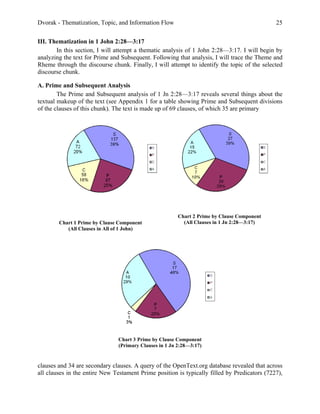
of the clauses of this chunk). The text is made up of 69 clauses, of which 35 are primary


                                                        Chart 2 Prime by Clause Component
        Chart 1 Prime by Clause Component                 (All Clauses in 1 Jn 2:28—3:17)
           (All Clauses in All of 1 John)


                               Chart 3 Prime by Clause Component
                               (Primary Clauses in 1 Jn 2:28—3:17)


clauses and 34 are secondary clauses. A query of the OpenText.org database revealed that across
all clauses in the entire New Testament Prime position is typically filled by Predicators (7227),
JLIABG                                                                                                          26

followed by Adjuncts (5767), Subjects (5354), and Complements (2634).60 The pattern in 1 John
(all clauses) follows the pattern Subject (137), Predicator (87), Adjunct (72), Complement (58).61
So it appears that the author shows a preference—at least in this letter—for Subject > Predicators
> Adjuncts > Complements in Prime. Narrowed to the discourse chunk analyzed in this paper,
across all clauses, the Subject component fills the Prime position 27 times, while the Predicator
component fills that slot 20 times. When narrowed further to just primary clauses in the analyzed
chunk, the Subject is Prime 17 times and the Predicator 7 times (compare Charts 1, 2 and 3).
        Rank-shifting (shifting a clause downward to function as a word group) manifests itself
in the form of embedded clauses 18 times in the chunk.62 Of those 18 embedded clauses, 12
appear in Prime position, leaving 6 in the Subsequent position. Of these 12 embedded clauses in
Prime position, nine appear in rather rapid succession beginning in 1 Jn 3:3 and subsiding in
3.10—that is nine rank-shifted clauses serving as Subject in Prime position, each in a primary
clause in a span of eight verses. This is a sign that John is "on about something" in this part of
the chunk. Further, although the whole chunk is heavy with lexis from domain 88 of the LN
lexicon63 (Moral and Ethical Qualities and Related Behavior), words from the domain occurred
22 times in these eight verses (in both Prime and Subsequent positions across all clauses).

Reference       Equative Clause
                δίκαιός ἐστιν
2:29
                ([he] is righteous)
                τέκνα θεοῦ ἐσµεν
3:2
                ([we] are children of God)
                ἐκεῖνος ἁγνός ἐστιν
3:3
                (that one is holy)
                ἡ ἁµαρτία ἐστὶν ἡ ἀνοµία
3:4
                (sin is lawlessness)
                ὁ ποιῶν τὴν δικαιοσύνην δίκαιός ἐστιν
                (the one who does righteousness is righteous)
3:7
                ἐκεῖνος δίκαιός ἐστιν
                (that one is righteous)
                ὁ ποιῶν τὴν ἁµαρτίαν ἐκ τοῦ διαβόλου ἐστίν
3:8
                (the one who does sin is of the devil)
                πᾶς ὁ µὴ ποιῶν δικαιοσύνην οὐκ ἔστιν ἐκ τοῦ θεοῦ
3:10
                (everyone who does not do righteousness is not of God)
                αὕτη ἐστὶν ἡ ἀγγελία ἣν ἠκούσατε ἀπ᾽ ἀρχῆς
3:11
                (this is the message which you have heard from the beginning)
                ὁ µισῶν τὸν ἀδελφὸν αὐτοῦ ἀνθρωποκτόνος ἐστίν
3:15
                (whoever hates his sibling is a murderer)
Table 5 Representative Sample of Equative Clauses in 1 John 2:28—3:17


60
   Vocatives/Address are in Prime position 327 times.
61
   Vocative/Address are Prime 11 times in 1 John.
62
   About 21% (96 embedded clauses out of 461 total clauses in 1 John) of 1 John's clauses show rank-shifting. See n.
57 for a definition of rank-shifting.
63
   A BibleWorks search revealed 30 hits in the whole chunk.
Dvorak - Thematization, Topic, and Information Flow                                            27

        In addition to the occurrence of vocabulary from domain 88 in the entire chunk, the
author also leans heavily upon lexis from domain 13, particularly the forms of εἰμί (I am), most
notably the form ἐστιν (is).64 There is nothing necessarily special about these terms per se (they
are very common), but in this section of the discourse chunk, the author uses them to move the
discourse along with equative clauses in the form of "this is that" (Table 5). The Prime-
Subsequent data could probably be mined for more meaningful patterns, but the sample provided
here allows us to move on to the Theme-Rheme analysis. In fact, as alluded to above and as will
become evident in the next section, Theme and Rheme analysis builds on the foundation created
by the Prime-Subsequent analysis.

B. Theme and Rheme Analysis
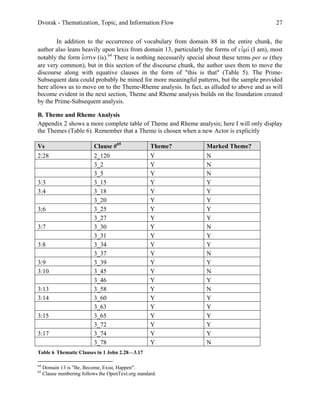
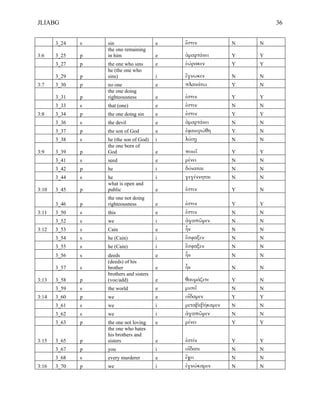
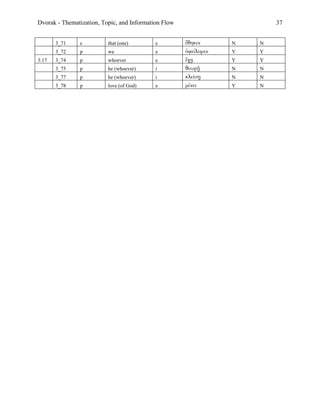
Appendix 2 shows a more complete table of Theme and Rheme analysis; here I will only display
the Themes (Table 6). Remember that a Theme is chosen when a new Actor is explicitly

Vs                          Clause #65               Theme?        Marked Theme?
2:28                        2_120                    Y             N
                            3_2                      Y             N
                            3_5                      Y             N
3:3                         3_15                     Y             Y
3:4                         3_18                     Y             Y
                            3_20                     Y             Y
3;6                         3_25                     Y             Y
                            3_27                     Y             Y
3:7                         3_30                     Y             N
                            3_31                     Y             Y
3:8                         3_34                     Y             Y
                            3_37                     Y             N
3:9                         3_39                     Y             Y
3:10                        3_45                     Y             N
                            3_46                     Y             Y
3:13                        3_58                     Y             N
3:14                        3_60                     Y             Y
                            3_63                     Y             Y
3:15                        3_65                     Y             Y
                            3_72                     Y             Y
3:17                        3_74                     Y             Y
                            3_78                     Y             N
Table 6 Thematic Clauses in 1 John 2.28—3.17

64
     Domain 13 is "Be, Become, Exist, Happen".
65
     Clause numbering follows the OpenText.org standard.
JLIABG                                                                                                        28

introduced in a primary clause. If the Theme appears in Prime position (determined in Prime-
Subsequent analysis), then the theme is marked.
         As might be expected in a non-narrative discourse, particularly in a relatively short letter,
the thematic units in this chunk of 1 John are relatively short. The longest Thematic Units occur
toward the beginning of the chunk. This seems to be the case because it appears that the author is
performing a bit of staging from 1 Jn 2.28 to 3.2. In that section, he makes the shift from the
previous chunk66 and sets up the main part of his argument in this chunk. The staging section
begins with the vocative τεκνία (children), serving as Theme, though it is not a marked Theme
(i.e., it does not appear in the Prime position [see Prime-Subsequent analysis]). The process
chain begun in 2.28 does not end until a new explicit Actor occurs as Subject in 3.1 ("the
Father"), so the first Thematic Unit is fairly long, spanning nine clauses in all, eight of which are
Rhematic and taken to be an extension or expansion on the idea of "remaining in him."
         The Thematic Unit beginning with ὁ πατὴρ (the Father) is neither marked nor very long,
but together with ἴδετε, which functions as a sort of discourse marker ("pay attention," "behold"
[see LN 30.45]), a new participant is introduced. It is interesting that the Theme not only appears
in the Subsequent, it also appears at the very end of the clause, appearing only after a
Complement (ποταπὴν ἀγάπην (how great a love)), the Predicator (δέδωκεν (he gave)), and a
second Complement (ἡµῖν (to us)). Though the Theme is not marked, what the Father gave
(ποταπὴν ἀγάπην (how great a love)) receives emphasis because it is fronted in the clause, and
the process (δέδωκεν (he gave)), because it is foregrounded by the choice of the stative aspect
(i.e., perfect tense), also receives emphasis.
         At this point in the text, "the world" is introduced into the discourse as a new participant.
Again, the Theme appears in the Subsequent and is not marked. This process chain is longer,
spanning nine clauses. The world is said not to know "us" because it does not know "him." By
the use of an orthographic convention (inserting significant whitespace), the NA27 GNT suggests
that a new break might occur at 3.2 with the term ἀγαπητοί (beloved), but the Theme-Rheme
analysis shows that a break is unlikely because ἀγαπητοί (beloved) is not introduced as an
Actor, nor is any other new participant explicitly introduced. Thus, the Rhematic material
following the introduction of "the world" (latter part of v. 1) to the end of v. 2 is related to that
Theme.
         The staging that occurs at the beginning of this chunk includes the ideas of remaining in
"him" (presumably Jesus, based on preceding co-text), which is expanded upon in terms of
having boldness and not being ashamed at his parousia, as well as knowing that "everyone who
does righteousness is born of him." In addition, the Father gave "great love" so that "we" might
be called children of God. Finally, "the world" does not know the believers and, although
believers are "now children of God," it has not been revealed to the believers what they will be
like at the parousia, but the author assures them that they will be "like him."

C. Topic and Comment Analysis
By tracing the Themes through our text, a composite picture of the topic of the chunk should
begin to take shape. The table in Appendix 2 traces the themes through the chunk we have been
analyzing; here is a trimmed down version of that table. Table 7 clearly shows that the author of
1 John relies heavily on the nonspecific, rank-shifted clauses to help
66
  Defining discourse chunks in 1 John is not an easy task, because there is usually some level of overlap between
chunks due to the high level of lexical cohesion. Cf. Westfall, "Grouping in Discourse."
Dvorak - Thematization, Topic, and Information Flow                                            29


Reference     Marked      Thematic Participant                Processes
2:28                      Children (you)                      remain [impv.]
3:1                       The Father                          gave great love
3:3           Y           Everyone having this hope           purifies him/herself
3:4           Y           Everyone doing sin                  does lawlessness
3:4           Y           Sin                                 is lawlessness
3:6           Y           Everyone remaining in him           does not sin
3:6           Y           Everyone who sins                   has not seen him or known him
3:7                       No one                              deceive you
3:7           Y           The one doing righteousness         is righteous
3:8           Y           The one doing sin                   is of the devil
3:8                       The son of God                      was revealed
3:9           Y           Everyone born of God                does not sin
3:10                      (That which is) clearly seen        is/are the children of God and the
                          (φανερά)                            children of the devil
3:10          Y           Everyone not doing righteousness    is not of God
3:13                      Brothers and sisters                (do not be) surprised [impv.]
3:14          Y           We                                  know
3:14          Y           The one not loving                  remains in death
3:15          Y           Everyone who hates his brothers     is a murderer
                          & sisters
3:16          Y           We                                  ought to lay down our lives
3:17          Y           Whoever                             has the "stuff" of life
3:17                      (How can) The love of God           remain in him
Table 7 Summary of Thematic Participants and Processes

create and sustain his argument. But it is not enough to say that this chunk is about "everyone
who"—such would not make much sense or be that helpful for exegesis. What is more helpful is
a look at the processes associated with each Thematic participant. What becomes clear, as
alluded to above, is nicely summarized by the author's own words in 3:10 (even though not a
marked theme): "clearly demarcated are the children of God and the children of the devil." Based
on what is thematized, and particularly on what are marked Themes, I might suggest that the
topic of this discourse chunk, though a bit verbose, is, "People demonstrate by their righteous or
sinful deeds whether or not they are children of God, and this is most especially demonstrated by
whether or not they love other people by 'laying their lives down' for them in the form of meeting
their physical needs."

Conclusion
        What I have attempted to do in this paper is describe a method of analyzing information
flow, especially related to thematization and topic. I began by describing Prime and Subsequent
analysis, which helps the exegete gain a sense of the basic textual makeup of the chunk (e.g.,
identification of primary, secondary, and embedded [rank-shifted] clauses; "leaping off" points).
Further, Prime-Subsequent analysis was shown to aid Theme-Rheme analysis, which is the next
step in the method.
JLIABG                                                                                             30

        In describing Theme-Rheme analysis, I showed how to discover Themes in a text by
identifying the explicit participants in the primary clauses of the text. I also indicated that
Themes appearing in Prime position (attesting to the need for Prime-Subsequent analysis) are
considered marked or highlighted. Further, as Appendix 2 demonstrates, Theme-Rheme analysis
involves not only identifying the thematic participants, but also the processes of which those
participants are Actors (subjects). Though not illustrated in the table in Appendix 2, this
procedure involves analyzing the verbal groups for aspect (perfective, imperfective, stative),
voice, mood, number, and polarity. Further, it requires an examination of the semantic domains
of the processes, so as to be able to identify shifts in semantic environment. Shifts in semantic
environments usually indicate that a new topic is being introduced; recognizing these shifts is the
purpose of Topic-Comment analysis. Finally, after these kinds of analyses, the exegete should be
able to assemble a composite representation of the topic of a discourse chunk.
        In the final part of this paper, I attempted an application—though only in a brief manner,
given constraints of this project—of the method to the text of 1 John. Based on the results of a
study on chunking discourse (applied to 1 John) by my colleague, Dr. Cynthia Long Westfall, I
chose the discourse chunk from 1 Jn 2:28—3:17. The results are outlined above, so I will not re-
hash them here. However, I will say that the method seems to have successfully identified some
very important features in the text, as well as many marked Themes, though, admittedly, the
method needs to be applied to the entire letter of 1 John to really get a solid sense for the author's
goals and how he tried to meet them. Nevertheless, from the data I collected, a composite picture
of the discourse chunk formed (again applying the method to the whole letter would be necessary
to validate the composite representation of this chunk gleaned here) which may be summed up in
the following statement: "People demonstrate by their righteous or sinful deeds whether or not
they are children of God, and this is most especially demonstrated by whether or not they love
other people by 'laying their lives down' for them in the form of meeting their physical needs." It
remains to be seen how this method might help develop a composite representation of an entire
discourse, particularly non-narrative discourses. I would recommend further study along these
lines.
Dvorak - Thematization, Topic, and Information Flow                                           31


                                        Bibliography


Brown, G., and G. Yule. Discourse Analysis. Cambridge Textbooks in Linguistics. Cambridge:
      Cambridge Univ. Press, 1983.

Cotterell, P., and M. Turner. Linguistics & Biblical Interpretation. Downers Grove: IVP, 1989.

de Beaugrande, R. "The Linearity of Text Production." In Text Production: Toward a Science of
       Composition. Advances in Discourse Processes 11. Edited by R. O. Freedle. Norwood,
       NJ: Ablex, 1984. Cited 20–Nov–2006. Online:
       http://www.beaugrande.com/text_production.htm.

Fries, P. H. "On Theme, Rheme and Discourse Goals." In Advances in Written Text Analysis,
        229–49. Edited by M. Coulthard. London: Routledge, 1994.

Halliday, M. A. K. "A Brief Sketch of Systemic Grammar." In On Language and Linguistics,
       180–4. Collected Works of M. A. K. Halliday 3. Edited by J. Webster. London:
       Continuum, 2003.

_____. "Introduction: On the 'Architecture' of Human Language." In On Language and
       Linguistics, 1–29. Complete Works of M. A. K. Halliday 3. Edited by J. Webster.
       London: Continuum, 2003.

_____. "Language Structure and Language Function." In On Grammar, 173–95. Complete
       Works of M. A. K. Halliday 1. Edited by J. Webster. London: Continuum, 2002.

_____. "Text as Semantic Choice in Social Contexts." In Linguistic Studies of Text and
       Discourse, 23–81. Complete Works of M. A. K. Halliday 3. Edited by J. Webster.
       London: Continuum, 2002.

Halliday, M. A. K., and C. M. I. M. Matthiessen. An Introduction to Functional Grammar. 3rd
       ed. London: Arnold, 2004.

Halliday, M. A. K., and R. Hasan, Language, Context, and Text. Oxford: Oxford University
       Press, 1989.

Hoey, M. Textual Interaction. London: Routledge, 2001.

Levinson, S. C. Pragmatics. Cambridge Textbooks in Linguistics. Cambridge: Cambridge Univ.
       Press, 1983.

Louw, J. P., and E. A. Nida. Greek-English Lexicon of the New Testament Based on Semantic
      Domains. 2nd ed. 2 vols. New York: UBS, 1989.

Lyons, J. Introduction to Theoretical Linguistics. Cambridge: Cambridge Univ. Press, 1968.
JLIABG                                                                                          32

O'Donnell, M. B. "Introducing the OpenText.org Syntactically Analyzed Greek New
      Testament." No pages. Cited 08-Nov-2006. Online:
      http://divinity.mcmaster.ca/OpenText/resources/articles/a8.

O'Donnell, M. B., S. E. Porter, and J. T. Reed, eds. "Clause Level Annotation." Cited 08-Nov-
      2006. Online: http://divinity.mcmaster.ca/OpenText/model/guidelines/clause/0-1.

Porter, S. E. Idioms of the Greek New Testament. 2nd ed.. Biblical Languages: Greek 2. Sheffield:
        Sheffield Academic Press, 1994; repr. 1999.

Porter, S. E. and M. B. O'Donnell. Discourse Analysis and the New Testament (in preparation).

Reed, J. T. "Discourse Analysis." In A Handbook to the Exegesis of the New Testament, 189–
       217. Edited by Stanley E. Porter. Leiden: Brill, 1997.

_____. "Modern Linguistics and the New Testament: A Basic Guide to Theory, Terminology,
       and Literature." In Approaches to New Testament Study, 222–65. Journal for the Study of
       the New Testament: Supplement Series 120. Edited by S. E. Porter and D. Tombs.
       Sheffield: Sheffield Academic Press, 1995.

_____. "The Cohesiveness of Discourse." In Discourse Analysis and the New Testament, 28–46.
       Journal for the Study of the New Testament: Supplement Series 170, Studies in New
       Testament Greek 4. Edited by S. E. Porter and J. T. Reed. Sheffield: Sheffield Academic
       Press, 1999.

Thompson, G. Introducing Functional Grammar. 2nd ed.. London: Arnold, 2004.

Westfall, C. L. "Grouping in Discourse." Paper presented at the annual meeting of the Society of
       Biblical Literature. Washington, D.C., 20–Nov–2006.
Dvorak - Thematization, Topic, and Information Flow                                                               33


         Appendix 1: Prime and Subsequent Analysis of 1 John 2:28—3:17

The following table displays the Prime and Subsequent analysis for each primary and secondary
clauses. Since connecting words are not included in the analysis of Prime and Subsequent, they
are placed in parentheses rather than removing them or replacing them with ellipsis marks.67
Further, embedded clauses are identified by square brackets ("[" and "]"), but their
Prime/Subsequent structure is not analyzed.

Vs         Clause        Prime                                         Subsequent
2:28       2_120         (Καὶ) νῦν                                     τεκνία µένετε ἐν αὐτῷ
           2_121         (ἵνα ἐὰν) φανερωθῇ                            –
           2_122         σχῶµεν                                        παρρησίαν
                                                                       µὴ αἰσχυνθῶµεν ἀπ᾽ αὐτοῦ ἐν τῇ
           2_123         (καὶ) µὴ
                                                                       παρουσίᾳ αὐτοῦ
2:29       2_124         (ἐὰν) εἰδῆτε                                  –
           2_125         (ὅτι) δίκαιός                                 ἐστιν
           2_126         γινώσκετε                                     –
                         (ὅτι καὶ) [πᾶς ὁ ποιῶν τὴν
           2_127                                                       ἐξ αὐτοῦ γεγέννηται
                         δικαιοσύνην]
3:1        3_1           ἴδετε                                         –
           3_2           ποταπὴν ἀγάπην                                δέδωκεν ἡµῖν ὁ πατὴρ
           3_3           (ἵνα) τέκνα θεοῦ                              κληθῶµεν
           3_4           (καὶ) ἐσµέν                                   –
           3_5           διὰ τοῦτο                                     ὁ κόσµος οὐ γινώσκει ἡµᾶς
           3_6           (ὅτι) οὐκ                                     ἔγνω αὐτόν
3:2        3_7           ἀγαπητοί                                      νῦν τέκνα θεοῦ ἐσµεν
           3_8           (καὶ) οὔπω                                    φανερώθη [τί ἐσόµεθα]
           3_10          οἴδαµεν                                       –
           3_11          (ὅτι ἐὰν) φανερωθῇ                            –
           3_12          ὅµοιοι αὐτῷ                                   ἐσόµεθα
           3_13          (ὅτι) ὀψόµεθα                                 αὐτὸν
           3_14          (καθώς) ἐστιν                                 –
                         (καὶ) [πᾶς ὁ ἔχων τὴν ἐλπίδα ταύτην
3:3        3_15                                                        ἁγνίζει ἑαυτόν
                         ἐπ᾽ αὐτῷ]
           3_17          (καθὼς) ἐκεῖνος                               ἁγνός ἐστιν
3:4        3_18          [Πᾶς ὁ ποιῶν τὴν ἁµαρτίαν]                    καὶ τὴν ἀνοµίαν ποιεῖ
           3_20          (καὶ) ἡ ἁµαρτία                               ἐστὶν ἡ ἀνοµία
3:5        3_21          (καὶ) οἴδατε                                  –
           3_22          (ὅτι) ἐκεῖνος                                 ἐφανερώθη
           3_23          (ἵνα) τὰς ἁµαρτίας                            ἄρῃ
           3_24          (καὶ) ἁµαρτία                                 ἐν αὐτῷ οὐκ ἔστιν
3:6        3_25          [πᾶς ὁ ἐν αὐτῷ µένων]                         οὐχ ἁµαρτάνει
           3_27          [ᾶς ὁ ἁµαρτάνων]                              οὐχ ἑώρακεν αὐτὸν
           3_29          οὐδὲ                                          ἔγνωκεν αὐτόν
3:7        3_30          Τεκνία                                        µηδεὶς πλανάτω ὑµᾶς

67
  I used the OpenText.org clause divisions in this analysis. The clause numbers in the table correlate with the clause
numbers on the OpenText.org site.
JLIABG                                                                                  34

         3_31   [ποιῶν τὴν δικαιοσύνην]            δίκαιός ἐστιν
         3_33   (καθὼς) ἐκεῖνος                    δίκαιός ἐστιν
3:8      3_34   [ὁ ποιῶν τὴν ἁµαρτίαν]             ἐκ τοῦ διαβόλου ἐστίν
         3_36   (ὅτι) ἀπ᾽ ἀρχῆς                    ὁ διάβολος ἁµαρτάνει
         3_37   εἰς τοῦτο                          ἐφανερώθη ὁ υἱὸς τοῦ θεοῦ
         3_38   (ἵνα) λύσῃ                         τὰ ἔργα τοῦ διαβόλου
3:9      3_39   [Πᾶς ὁ γεγεννηµένος ἐκ τοῦ θεοῦ]   ἁµαρτίαν οὐ ποιεῖ
         3_41   (ὅτι) σπέρµα αὐτοῦ                 ἐν αὐτῷ µένει
         3_42   (καὶ) οὐ                           δύναται [ἁµαρτάνειν]
         3_44   (ὅτι) ἐκ τοῦ θεοῦ                  γεγέννηται
                                                   φανερά ἐστιν τὰ τέκνα τοῦ θεοῦ καὶ
3:10     3_45   ἐν τούτῳ
                                                   τὰ τέκνα τοῦ διαβόλου
         3_46   [πᾶς ὁ µὴ ποιῶν δικαιοσύνην]       οὐκ ἔστιν ἐκ τοῦ θεου
                (καὶ) [ὁ µὴ ἀγαπῶν τὸν ἀδελφὸν
         3_48                                      –
                αὐτοῦ]
                                                   ἐστὶν ἡ ἀγγελία [ἣν ἠκούσατε ἀπ᾽
3:11     3_50   (ὅτι) αὕτη
                                                   ἀρχῆς]
         3_52   (ἵνα) ἀγαπῶµεν                     ἀλλήλους
3:12     3_53   οὐ                                 καθὼς Κάϊν ἐκ τοῦ πονηροῦ ἦν
         3_54   (καὶ) ἔσφαξεν                      τὸν ἀδελφὸν αὐτου
         3_55   (καὶ) χάριν τίνος                  ἔσφαξεν αὐτόν
         3_56   (ὅτι) τὰ ἔργα αὐτοῦ                πονηρὰ ἦν
         3_57   τὰ (δὲ) τοῦ ἀδελφοῦ αὐτοῦ          δίκαια
3:13     3_58   (καὶ) µὴ                           θαυµάζετε ἀδελφοί
         3_59   (εἰ) µισεῖ                         ὑµᾶς ὁ κόσµος
3:14     3_60   ἡµεῖς                              οἴδαµεν
         3_61   (ὅτι) µεταβεβήκαµεν                ἐκ τοῦ θανάτου εἰς τὴν ζωήν
         3_62   (ὅτι) ἀγαπῶµεν                     τοὺς ἀδελφούς
         3_63   [ὁ µὴ ἀγαπῶν]                      µένει ἐν τῷ θανάτῳ
3:15     3_65   [πᾶς ὁ µισῶν τὸν ἀδελφὸν αὐτοῦ]    ἀνθρωποκτόνος ἐστίν
         3_67   (καὶ) οἴδατε                       –
                                                   οὐκ ἔχει ζωὴν αἰώνιον [ἐν αὐτῷ
         3_68   (ὅτι) πᾶς ἀνθρωποκτόνος
                                                   µένουσαν]
3:16     3_70   ἐν τούτῳ                           ἐγνώκαµεν τὴν ἀγάπην
         3_71   (ὅτι) ἐκεῖνος                      ὑπὲρ ἡµῶν τὴν ψυχὴν αὐτοῦ ἔθηκεν
                                                   φείλοµεν ὑπὲρ τῶν ἀδελφῶν [τὰς
         3_72   (καὶ) ἡµεῖς
                                                   ψυχὰς θεῖναι]
3:17     3_74   ὃς                                 δ᾽ ἂν ἔχῃ τὸν βίον τοῦ κόσµου
         3_75   (καὶ) θεωρῇ                        τὸν ἀδελφὸν αὐτοῦ [χρείαν ἔχοντα]
         3_77   (καὶ) κλείσῃ                       τὰ σπλάγχνα αὐτοῦ ἀπ᾽ αὐτου
         3_78   πῶς                                ἡ ἀγάπη τοῦ θεοῦ µένει ἐν αὐτῷ
Dvorak - Thematization, Topic, and Information Flow                                              35


          Appendix 2: Theme and Rheme Analysis of 1 John 2:28—3:17

The following table displays the main components of Theme-Rheme analysis. In addition to
verse and clause references (first two columns), the clause type, Actor, implicitness or
explicitness of Actor, and process are displayed. The remaining two columns indicate whether or
not the clause is Thematic (i.e., Actor is stated explicitly in a primary clause), and if so whether
or not it is a marked Theme (i.e., Theme appears in Prime position [see Prime-Subsequent in
Appendix 1]).

                                                  Actor
                 Clause                                                                   Marked
Vs     Clause               Actor                 implicit or   Process        Theme?
                 Type                                                                     Theme?
                                                  explicit
2:28   2_120     p          children (voc/add)    e             µένετε         Y          N
       2_121     s          he                    i             φανερωθῇ       N          N
       2_122     s          we                    i             σχῶµεν         N          N
       2_123     s          we                    i             αἰσχυνθῶµεν    N          N
2:29   2_124     s          you                   i             εἰδῆτε         N          N
       2_125     s          he                    i             ἐστιν          N          N
       2_126     p          you                   i             γινώσκετε      N          N
                            the one doing
       2_127     s          righteousness         e             γεγέννηται     N          N
3:1    3_1       p          you                   i             ἴδετε          N          N
       3_2       p          the father            e             δέδωκεν        Y          N
       3_3       p          we                    i             κληθῶµεν       N          N
       3_4       p          we                    i             ἐσµέν          N          N
       3_5       p          the world             e             γινώσκει       Y          N
       3_6       s          the world             i             ἔγνω           N          N
3:2    3_7       s          we                    i             ἐσµέν          N          N
       3_8       p          he                    i             ἐφανερώθη      N          N
       3_10      p          we                    i             οἴδαµεν        N          N
       3_11      s          he                    i             φανερωθῇ       N          N
       3_12      s          we                    i             ἐσόµεθα        N          N
       3_13      s          we                    i             ὀψόµεθα        N          N
       3_14      s          he                    i             ἐστιν          N          N
                            the one having this
3:3    3_15      p          hope                  e             ἁγνίζει        Y          Y
       3_17      s          that (one)            e             ἐστιν          N          N
3:4    3_18      p          the one doing sin     e             ποιεῖ          Y          Y
       3_20      p          sin                   e             ἐστὶν          Y          Y
3:5    3_21      p          you                   i             οἴδατε         N          N
       3_22      s          that (one)            e             ἐφανερώθη      N          N
       3_23      s          he                    i             ἄρῃ            N          N
JLIABG                                                               36


       3_24   s   sin                    e   ἔστιν           N   N
                  the one remaining
3:6    3_25   p   in him                 e   ἁµαρτάνει       Y   Y
       3_27   p   the one who sins       e   ἑώρακεν         Y   Y
                  he (the one who
       3_29   p   sins)                  i   ἔγνωκεν         N   N
3:7    3_30   p   no one                 e   πλανάτω         Y   N
                  the one doing
       3_31   p   righteousness          e   ἐστιν           Y   Y
       3_33   s   that (one)             e   ἐστιν           N   N
3:8    3_34   p   the one doing sin      e   ἐστιν           Y   Y
       3_36   s   the devil              e   ἁµαρτάνει       N   N
       3_37   p   the son of God         e   ἐφανερώθη       Y   N
       3_38   s   he (the son of God)    i   λύσῃ            N   N
                  the one born of
3:9    3_39   p   God                    e   ποιεῖ           Y   Y
       3_41   s   seed                   e   µένει           N   N
       3_42   p   he                     i   δύναται         N   N
       3_44   s   he                     i   γεγέννηται      N   N
                  what is open and
3:10   3_45   p   public                 e   ἐστιν           Y   N
                  the one not doing
       3_46   p   righteousness          e   ἐστιν           Y   Y
3:11   3_50   s   this                   e   ἐστιν           N   N
       3_52   s   we                     i   ἀγαπῶµεν        N   N
3:12   3_53   s   Cain                   e   ἦν              N   N
       3_54   s   he (Cain)              i   ἔσφαξεν         N   N
       3_55   s   he (Cain)              i   ἔσφαξεν         N   N
       3_56   s   deeds                  e   ἦν              N   N
                  (deeds) of his
       3_57   s   brother                e   ἦν              N   N
                  brothers and sisters
3:13   3_58   p   (voc/add)              e   θαυµάζετε       Y   N
       3_59   s   the world              e   µισεῖ           N   N
3:14   3_60   p   we                     e   οἴδαµεν         Y   Y
       3_61   s   we                     i   µεταβεβήκαµεν   N   N
       3_62   s   we                     i   ἀγαπῶµεν        N   N
       3_63   p   the one not loving     e   µένει           Y   Y
                  the one who hates
                  his brothers and
3:15   3_65   p   sisters                e   ἐστίν           Y   Y
       3_67   p   you                    i   οἴδατε          N   N
       3_68   s   every murderer         e   ἔχει            N   N
3:16   3_70   p   we                     i   ἐγνώκαµεν       N   N
Dvorak - Thematization, Topic, and Information Flow                       37


       3_71    s          that (one)        e         ἔθηκεν      N   N
       3_72    p          we                e         ὀφείλοµεν   Y   Y
3:17   3_74    p          whoever           e         ἔχῃ         Y   Y
       3_75    p          he (whoever)      i         θεωρῇ       N   N
       3_77    p          he (whoever)      i         κλείσῃ      N   N
       3_78    p          love (of God)     e         µένει       Y   N

Thematization

  • 1.
    JLIABG vol. 1,17-37 Thematization, Topic, and Information Flow James D. Dvorak Associate Professor of Greek and New Testament, Oklahoma Christian University Introduction It is important to begin this article by stating two formative presuppositions. The first has to do with the nature of discourse itself, namely that it is a semantic notion—it is "language that is functional."1 From the perspective of Systemic-Functional Linguistics (SFL)—the linguistic model adopted in this study—discourse (a.k.a., "text") is a "metafunctional construct."2 Basically this means that a discourse fulfills multiple meaningful functions at once. The two main functions, according to Halliday are: (1) it provides the ability to construe the human experience of reality (ideational metafunction)3 and (2) it provides a way to enact interpersonal relationships (interpersonal metafunction).4 The second presupposition has to do with the fact that when humans perceive that a discourse "makes sense" to them, it generally means there is some thematic element which flows through the discourse allowing them to recognize it as being cohesive rather than a jumble of unrelated words and sentences.5 This cohesiveness and concomitant coherence is the result of the work done by a third functional component of discourse, the textual metafunction. This function provides the means by which the construal of experience (ideational function) and enactment of relationships (interpersonal function) can be assembled into a coherent whole.6 When the three types of function/meaning are realized they each map their own kind of structure on to each clause in the discourse.7 The end result is an organization within a discourse that allows the transmission of meaning to occur or "unfold"; generally this is classified under the concept of "information systems." The purpose of this paper is to investigate further how the textual component of discourse aids in creating the flow of information. More specifically, I will narrow my focus to a 1 Halliday and Hasan, Language, Context, and Text, 10-2. See also Halliday, "Semantic Choice," 45. 2 Halliday and Hasan, Language, Context, and Text, 48. 3 The ideational metafunction is often referred to as the experiential metafunction. There is a fourth function given by Halliday, the logical, which is usually taken together with experiential to form the "ideational" function (cf. Halliday, "Semantic Choice," 23, 26-7). The logical function represents a small set of fundamental logical relations (e.g., "if . . . then") which explain basic tactic relations (Halliday and Matthiessen, IFG, 29; Halliday and Hasan, Language, Context, and Text, 21). 4 Halliday and Matthiessen, IFG, 29-30; Halliday and Hasan, Language, Context, and Text, 16-23, 29. 5 Jeffrey T. Reed, "Modern Linguistics," 251. 6 Halliday and Matthiessen (IFG, 30) say that the textual metafunction may be regarded as an "enabling or facilitating function, since both the others [the ideational and interpersonal functions] depend on being able to build up sequences of discourse, organizing the discursive flow and creating cohesion and continuity as it moves along." Cf. also Halliday, "Semantic Choice," 29: "[I]t is through the semantic options of the textual component that language comes to be relevant to its environment . . . ." 7 The clause is the "central processing unit in the lexicogrammar—in the specific sense that it is in the clause that meanings of different kinds are mapped into an integrated grammatical structure" (Halliday and Matthiessen, IFG, 10).
  • 2.
    JLIABG 18 discussion of thematization and topic. Following a model developed by Porter and O'Donnell,8 I will endeavor to trace the thematic elements through a discourse from the bottom up (i.e., starting with the clause and working upwards to the clause complex and paragraph levels) in an attempt to elucidate the topics of these larger chunks.9 I also want to show how this kind of approach yields important information that can and should be used in the exegesis of biblical discourse. To demonstrate this, I will use 1 Jn. 2:28—3:17 as the sample discourse for this study, though I will not attempt a full exegesis of the text in this paper.10 I. Discourse Flow and Discourse Structure As mentioned above, the textual metafunction of language works to create discourse that is structured or organized. The result of this compositional process is (in the case of the biblical texts) a written discourse that "unfolds" in a linear progression. The linear nature of discourse is described by Brown and Yule as a "problem,"11 which highlights the constraint this phenomenon places on language use. Language users are not able to communicate all they want to "mean" at once; they are restricted to the production of only one word at a time. They then have to organize those words into clauses, clauses into clause complexes, and those complexes into larger segments of text—all in a linear fashion. The constraint of linearization is perhaps most evident in the fact that language users must organize their messages in such a way that the movement of meaning proceeds in the direction that will meet their objectives as well as the expectations of the recipient(s) of the discourse.12 Thus, a well-chosen starting point or "theme" is necessary, because a poorly chosen theme may result in a misinterpretation, not only of a sentence, but possibly of an entire discourse, as interpreters attempt to follow its "flow of thought."13 This linear "unfolding" or "movement" of meaning through a discourse is encapsulated in the notion of information or discourse flow.14 The so-called "problem of linearization" is not limited to the clause or the clause complex; it also constrains language use at higher levels (ranks), such as at the paragraph level.15 Discourse producers, particularly those producing written discourse, will often arrange smaller chunks of the text in a certain order so as to give prominence to that chunk or to another chunk. These chunks are composed of thematically related material.16 For example, it is not uncommon for writers to begin with one discourse chunk made up of one or more broad propositions only to 8 Porter and O'Donnell, Discourse Analysis, 54-77 (note that the page numbers referenced here are pre-publication page numbers). 9 In this paper, I will not attempt to analyze the entire discourse of 1 John and, thus, will not attempt to discover a "topic" for the entire discourse (though I believe the approach represented here makes such analysis tenable). 10 Cf. Cynthia Long Westfall, "Grouping in Discourse." Also, my analysis below makes extensive use of OpenText.org. 11 Brown and Yule, Discourse Analysis, 125; cf. Halliday, "Brief Sketch," 181. See also R. de Beaugrande, "Linearity." 12 Brown and Yule, Discourse Analysis, 125; cf. Porter and O'Donnell, Discourse Analysis, 54-5. See also Hoey, Textual Interaction, 24. 13 However, if in the process of interpreting a discourse something does not make sense in light of the preceding co- text, people will usually re-read earlier portions of the discourse (or ask a clarifying question, if spoken discourse) in an attempt to make sense of the new information. This is related to Grice's maxims, on which see Levinson, Pragmatics, 100-66. 14 Cf. Porter and O'Donnell, Discourse Analysis, 55; Brown and Yule, Discourse Analysis, 169-79; Halliday, "Architecture," 7. 15 Porter and O'Donnell refer to as the hierarchical nature of discourse. See esp. Brown and Yule, Discourse Analysis, 133. 16 Porter and O'Donnell, Discourse Analysis, 56.
  • 3.
    Dvorak - Thematization,Topic, and Information Flow 19 follow that chunk with another (or series of others) that draws specific points from those preceding propositions. This kind of organization is often referred to as thematization, though I prefer to use the less technical term "staging."17 The important point here is that a certain arrangement of information, whether it be words in a clause, clauses in a clause complex, clause complexes in a paragraph, or paragraphs in a discourse will communicate a certain meaning. But, if the arrangement of any one of those components is changed the meaning of the discourse would change.18 Given that linearization affects both the smaller and larger ranks of discourse (from the clause up), then it stands to reason that one ought to be able to determine the thematic structure at the discourse level by determining the thematization in each of its constituent parts. In other words, each rank from clause upward contributes to a "developing, cumulative instruction which tells us how to construct a coherent representation" of the "topic" of each chunk and ultimately for an entire discourse.19 II. Terminology and Methodology Before proceeding to the thematic analysis in part three, it is necessary to define the terms and method I will use to discuss thematization at each level of discourse, starting with the clause level and moving upward to the paragraph level. Table 1 below introduces these terms and the levels of discourse at which they are used.20 A. Prime and Subsequent As I noted in the introduction, the textual metafunction provides the means by which language users create text. It enables the bringing together of ideational and interpersonal meaning into a coherent whole. In doing so, it organizes the discursive flow and creates cohesion and continuity and thereby carries the line of meaning through a text.21 This results in a structure being mapped on to each clause in a discourse, which Halliday calls the "thematic structure."22 Thematic structure, which constitutes the clause as message, is made up of two distinct parts, Theme and Rheme, but I will follow Porter and O'Donnell and refer to these thematic elements as Prime and Subsequent, reserving Theme and Rheme for the rank of the clause complex.23 Prime may be defined as "the peg on which the message is hung,"24 or "the point of departure for what the speaker is going to say."25 Subsequent may be classified as what the 17 See Brown and Yule, Discourse Analysis, 134. Cotterell and Turner, Linguistics, 241: "Discourse is characterized by staging, the orderly progression in a necessarily linear sequence." 18 This reflects the saying, "Meaningfulness implies choice" (see Lyons, Theoretical Linguistics, 413f.). A discourse producer particularly in written discourse will organize discourse to "lead" a reader to certain conclusions in order to meet their communicative objectives. See Hoey, Textual Interaction, 52-3. 19 Brown and Yule, Discourse Analysis, 134; cf. Porter and O'Donnell, Discourse Analysis, 56. 20 Table 1 is adapted from Porter and O'Donnell, Discourse Analysis, 57; I am indebted to these two scholars for the work they have produced and are producing related to discourse analysis of biblical texts, which the remainder of this paper reflects. I am also grateful for the excellent resource made available by OpenText.org, which I have used substantially in this and other projects. 21 Cf. Halliday and Matthiessen, IFG, 30; also Halliday, "Language Structure," 190. 22 Halliday and Matthiessen, IFG, 64. 23 Porter and O'Donnell, Discourse Analysis, 57. O'Donnell, Porter, and Reed, "Clause Level Annotation." 24 Halliday, "Language Structure," 190. 25 Halliday and Matthiessen, IFG, 58, 64; cf. Brown and Yule, Discourse Analysis, 127. See Fries, "On Theme," 229-30.
  • 4.
    JLIABG 20 speaker says or writes about the Prime.26 Slightly less metaphorically, the Prime of a clause provides a framework within which the Subsequent of that clause can be interpreted.27 Thus, the Prime orients the reader to the message of the clause, telling them how to understand the "news" conveyed by the clause; the Subsequent is the "news" (or "newsworthy") part of the clause—the part that the writer wants the reader to remember.28 Level Function Definition Who or what the clause is focused upon; provides the Prime framework within which the subsequent can be Clause interpreted. Development of the prime; that which the writer Subsequent wants the reader to remember. Theme The change of participant as actor of process chain. Clause Complex Additional process information for current actor Rheme (extension of process chain) Establishment of a new semantic environment for the Topic discourse. Paragraph Comment Support information for the current topic. Table 1 Thematic Elements in Discourse Every clause will have a Prime and will usually have a Subsequent, though it is possible that a clause consists of a single group or word, in which case only a Prime would be present.29 For example, in 1 Jn 3:5, the Prime is a single word (a verbal group, οἴδατε (you know)) and no subsequent exists. Identifying the Prime is relatively easy, since it is positioned at the front of the clause, realized by the first group element, whether a nominal group, a verbal group, or an adjunct.30 Prime may be a complex nominal or verbal group or embedded clause (see Table 3).31 The Subsequent, if present, is realized in the remaining group elements in the clause.32 26 Brown and Yule, Discourse Analysis, 126-27: "everything else in that follows [the Theme] in the sentence which consists of 'what the speaker states about, or in regard to, the starting point of the utterance'" (quoting Mathesius, 1942). 27 Fries, "On Theme," 230. 28 Fries, "On Theme," 234. See also the documentation on clause annotation on the OpenText.org site: O'Donnell, Porter, and Reed, "Clause Level Annotation." Thompson (Introduction, 165) says the Rheme (Subsequent in our terminology) is the "main information" the writer wants his audience to know. 29 Porter and O'Donnell, Discourse Analysis, 58. 30 Porter and O'Donnell, Discourse Analysis, 58. 31 Porter and O'Donnell, Discourse Analysis, 60. 32 Porter and O'Donnell, Discourse Analysis, 58.
  • 5.
    Dvorak - Thematization,Topic, and Information Flow 21 Conjunctions are not included in Prime-Subsequent analysis.33 See Tables 2 and 3, as well as part three below for examples. Table 3 illustrates how an embedded clause can act as Prime while having its own Prime and Subsequent structure,34 though in practice, embedded clauses are not usually analyzed for Prime and Subsequent. ποταπὴν ἀγάπην έδωκεν ἡµῖν ὁ πατὴρ (how great a love) (the Father has given us) Prime Subsequent Table 2 Prime and Subsequent of 1 Jn 3:1 (clause 2) Two more points must be kept in mind when analyzing for Prime and Subsequent. First, as mentioned, the Prime will not always be a nominal group. When a verbal group is the Prime, the verbal process is highlighted and not the implied Actor.35 This leads to the second point: ὁ ποιῶν τὴν δικαιοσύνην δίκαιός ἐστιν (the one doing) (righteousness) (is righteous) Prime Subsequent Prime Subsequent Table 3 Embedded Clause as Prime with Its Own Prime and Subsequent (1 Jn 3:7) Prime-Subsequent analysis must be performed on the Greek text and not on a translation. I mentioned above that the Prime in 1 Jn 3:5 is the verb οἴδατε (καί (and) is not included). If Prime analysis was done on an English translation (“You know”), the Prime would be "you"; however, analysis of the Greek reveals that the process "know" is functioning as Prime.36 On this point Porter and O'Donnell remind us: This recognizes the flexibility given to the writer of Greek to: (1) not specify a specific subject [i.e., chooses the unmarked option of leaving the subject implicit]; (2) specify the subject, but not place it in primary position [e.g., δέδωκεν ἡµῖν ὁ πατὴρ (the Father has given to us; 1 Jn 3:1), where Prime is δέδωκεν (has given)]; (3) specify the subject and place it in primary position in the clause.37 B. Theme and Rheme Analysis of Prime and Subsequent provides a means for determining the message of each clause in the discourse, but thematic analysis must extend beyond the level of clause if one is to grasp the discourse topic. The next rank up from the clause is that of clause complex. Given SFL's predilection for focusing on the rank of clause, not much theoretical work has been done regarding thematic structure and organization at this level. One exception is the work of Porter and O'Donnell who suggest that in Greek changes in participant involvement may be the key to 33 Porter and O'Donnell, Discourse Analysis, 60. 34 O'Donnell, Porter, Reed, "Clause Level Annotation." 35 Porter and O'Donnell, Discourse Analysis, 59. O'Donnell created a search algorithm to run on OpenText.org and found that in 1 John the Predicator appears as Prime 87 times (primary and secondary clauses only). 36 See Porter and O'Donnell, Discourse Analysis, 59. 37 Porter and O'Donnell, Discourse Analysis, 60.
  • 6.
    JLIABG 22 delimiting thematic elements in clause complexes.38 The main thematic elements at this level are Theme and Rheme, and together these elements constitute a Thematic Unit.39 Since analyzing Theme involves determining the Actor (subject, whether animate or inanimate) of verbal processes, it is important to remember that in Greek verbs are monolectic. In other words, the form of the verb not only contains information about the aspect, mood, and voice of the process, but it also contains information about the Actor of the process.40 This means an Actor does not have to be named explicitly in the clause to be understood; it may be inferred from previous co-text or extra-textual context. However, to be considered as Theme in Theme- Rheme analysis, the Actor must be explicitly stated in the text, and it will usually be indicated by a nominal group, though an embedded clause may also act as Theme (e.g., 1 Jn 3:3–4a; see Table 4).41 Further, since primary clauses are responsible for creating the "flow" of information in a discourse,42 the new Actor must be explicitly introduced in a primary clause.43 That which is Theme remains Theme until there is a shift in participant involvement—that is, when a new Actor is named and a new process chain begins (a series of verbal groups that all have the same Actor). The Rheme is any "additional process information for the current actor" that serves to extend the process chain.44 Rheme is analogous to Subsequent at the clause rank; whereas Subsequent describes what is "newsworthy" about the Prime, Rheme describes the process(es) in which the Thematic Actor is involved or is experiencing. Table 4 represents the two Thematic Units in 1 Jn 3:3–4a. In both units (labeled as Thematic Unit1 and Thematic Unit2 respectively), an embedded clause serves as Theme. Thematic Unit1 Theme1 Rheme1 (…) [πᾶς ὁ ἔχων τὴν ἐλπίδα ταύτην ἐπ᾽ ἁγνίζει ἑαυτόν αὐτῷ] purify themselves everyone who has this hope in him PrimeA SubsequentA 38 Porter and O'Donnell, Discourse Analysis, 63. 39 Porter and O'Donnell, Discourse Analysis, 60-7. The authors understand the potential confusion that could be caused by using "Theme" and "Rheme" at a level above the clause, since the two terms have historically been used at that rank. Nevertheless, they argue that it is a risk worth taking. I will follow their terminology here, though I hope to see in the future more thorough reasoning in support of their choice. 40 See Porter, Idioms, 293. 41 Porter and O'Donnell, Discourse Analysis, 63. 42 See Matthew Brook O'Donnell, "OpenText.org." 43 I follow the OpenText.org definitions of primary, secondary, and embedded clauses (see "Introduction to the Annotation Model," [http://www.opentext.org/model/introduction.html]): Clauses are divided into two levels: (1) primary clauses; and (2) secondary clauses. The primary and secondary distinction has to do with the two possible types of logical dependency, dependence (hypotaxis) or equality (parataxis). Primary clauses are connected to each other, while secondary clauses are connected to the primary clause to which it is dependent. The majority of primary clauses consist of clauses with a finite verb. Secondary clauses are typically distinguished by means of a subordinating conjunction. A second type of secondary clause, the embedded clause, involves the phenomenon of rank-shifting—a linguistic element is embedded to a level of grammar lower than the typical level at which it functions. The majority of secondary embedded clauses in Greek are participial and infinitival clauses. 44 Porter and O'Donnell, Discourse Analysis, 63.
  • 7.
    Dvorak - Thematization,Topic, and Information Flow 23 Thematic Unit1 Rheme1 (…) ἐκεῖνος ἁγνός ἐστιν that one is pure PrimeB SubsequentB Thematic Unit2 Theme2 Rheme2 [Πᾶς ὁ ποιῶν τὴν ἁµαρτίαν] καὶ τὴν ἀνοµίαν ποιεῖ everyone who commits sin also commits lawlessness Prime Subsequent Table 4 Thematic Units of 1 John 3:3-4a Note also that in each Thematic Unit in Table 4, the Theme appears as Prime, which begs the question whether Prime/Subsequent and Theme/Rheme are redundant categories. There is a relationship between Prime/Subsequent and Theme/Rheme, but it is one of markedness, which eliminates the redundancy between them. In the case of 1 Jn 3:3–4a, the fact that the Theme also appears as Prime in each Thematic Unit indicates that the Theme is marked. Other possible combinations between Theme/Rheme and Prime/Subsequent include Theme in Subsequent and Rheme in Prime. It is also possible to have a complex of clauses that is Rhematic material only, if, for example, no new participant or process chain is introduced in that span. C. Topic and Comment I noted above that the problem of linearization requires authors to organize and to arrange chunks of discourse in such a way as to meet their communication goals.45 These chunks of discourse, which I refer to as paragraphs,46 are made up of thematically related materials. Modern writers have at their disposal certain conventions (e.g., indentation) that allow them to indicate when one of these sections ends and another begins, though some conventions may be used more for stylistic reasons than formal reasons.47 In addition to the common orthographic conventions such as indentation and line spacing, an author may choose to use section and paragraph headings containing thematic titles to provide a more overt break. UBS4 GNT does this by adding titles for each paragraph based on what the editors think each segment is about.48 These devices are, in the words of Brown and Yule, "a particularly powerful thematisation device,"49 so it is appropriate to question whether or not the supplied titles do, indeed, encapsulate the topic of the paragraph—or even identify appropriate paragraph boundaries in the first place.50 45 Cf. Hoey, Textual Interaction, 52-3. 46 The paragraph has been notoriously difficult to define. See Brown and Yule, Discourse Analysis, 95-100. 47 Brown and Yule, Discourse Analysis, 95 (citing Longacre). 48 While the UBS4 provides a section in its introduction regarding discourse segmentation, there is nothing mentioned about the titles they chose to add to each paragraph. 49 Brown and Yule, Discourse Analysis, 139. Cf. also Porter and O'Donnell, Discourse Analysis, 68. 50 For example, the editors place a section break at 1 Jn 3:10 (creating a chunk from 2:28—3:10), a break that is challenged by Westfall, "Grouping in Discourse," on solid linguistic and discourse sensitive grounds.
  • 8.
    JLIABG 24 A helpful approach to discourse at this level—though it is not without its challenges51—is to search the discourse for places where new semantic environments are established.52 These semantic boundaries, called "Topics," are signaled in many different ways, often by the use of several types of signals at once. I will only discuss two of the major kinds of signals here.53 One signal is the use of discourse markers. In their lexicon, Louw and Nida create an entire domain specifically for discourse markers (domain 91). As Porter and O'Donnell note, domain 91 is a good starting point, but is not without its shortcomings. For example, although they include καί ("and") and γάρ ("for") as "markers of a new sentence,"54 they fail to include δέ ("and/but") anywhere in the domain, though δέ quite often provides this function.55 Nevertheless, exegetes do well to be familiar with the lexical items within that domain. A second signal to be aware of is the disruption of cohesion. As mentioned in the introduction to this paper, cohesion is one of the main features of discourse—texts "hang together." Authors use grammatical and semantic features to create cohesion in a discourse; these are usually related to the "paradigmatic features" of language like lexis, verbal aspect (and other verbal features like voice and mood), person reference, the use of conjunctions, and the use of deictic markers.56 So, where there are disruptions in cohesion because of shifts in grammar (e.g., changes in tense form, changes in person/participants, etc.) or semantics (e.g., breaking of semantic chains), especially in conjunction with the use of discourse or deictic markers, the author is likely signaling the establishment of a new Topic in the discourse. Everything between Topic shifts is the Comment, which, analogous to Subsequent (clause level) and Rheme (clause complex level), provides the supporting information for the current Topic.57 Together Topic and Comment constitute the thematization functions at the paragraph and discourse levels.58 Once the Topic has been identified, one can use the Prime-Subsequent and Theme- Rheme analyses of the text to aid in illuminating and tracing Themes developed throughout the paragraph that make up the Comment.59 This is done primarily by analyzing the thematic participants as well as the process chains in which they are involved. In narrative, this process will help the exegete determine the plot as well and discover how the author develops it throughout the story. In non-narrative texts, such as letters like 1 John, this kind of analysis should help reveal topics within the discourse and how those topics are used to develop the author's argument. Though we will not attempt to describe the topic of the entire discourse of 1 John in this study, the basic idea of Topic and Comment analysis is to attempt the formulation of topic "headers" up to the highest level of discourse. 51 For example, different authors writing with different purposes utilizing different genres (e.g., narrative v. non- narrative) will signal semantic shifts in different ways. Thus, there is no clear-cut, "one-size-fits-all" manner of recognizing semantic shifts. Nevertheless, there are several signals that one can watch for, as noted in the body of the paper. 52 Porter and O'Donnell, Discourse Analysis, 69. 53 Cf. Westfall, "Grouping in Discourse." 54 LN 91.1. 55 Cf. Porter and O'Donnell, Discourse Analysis, 69. 56 Porter and O'Donnell, Discourse Analysis, 70. Cf. Porter, Idioms, 304-7. See especially Reed, "Cohesiveness," 28–46; Reed, "Discourse Analysis," 189–217. 57 Porter and O'Donnell, Discourse Analysis, 68. 58 Porter and O'Donnell, Discourse Analysis, 68. 59 Porter and O'Donnell, Discourse Analysis, 71.
  • 9.
    Dvorak - Thematization,Topic, and Information Flow 25 III. Thematization in 1 John 2:28—3:17 In this section, I will attempt a thematic analysis of 1 John 2:28—3:17. I will begin by analyzing the text for Prime and Subsequent. Following that analysis, I will trace the Theme and Rheme through the discourse chunk. Finally, I will attempt to identify the topic of the selected discourse chunk. A. Prime and Subsequent Analysis The Prime and Subsequent analysis of 1 Jn 2:28—3:17 reveals several things about the textual makeup of the text (see Appendix 1 for a table showing Prime and Subsequent divisions of the clauses of this chunk). The text is made up of 69 clauses, of which 35 are primary Chart 2 Prime by Clause Component Chart 1 Prime by Clause Component (All Clauses in 1 Jn 2:28—3:17) (All Clauses in All of 1 John) Chart 3 Prime by Clause Component (Primary Clauses in 1 Jn 2:28—3:17) clauses and 34 are secondary clauses. A query of the OpenText.org database revealed that across all clauses in the entire New Testament Prime position is typically filled by Predicators (7227),
  • 10.
    JLIABG 26 followed by Adjuncts (5767), Subjects (5354), and Complements (2634).60 The pattern in 1 John (all clauses) follows the pattern Subject (137), Predicator (87), Adjunct (72), Complement (58).61 So it appears that the author shows a preference—at least in this letter—for Subject > Predicators > Adjuncts > Complements in Prime. Narrowed to the discourse chunk analyzed in this paper, across all clauses, the Subject component fills the Prime position 27 times, while the Predicator component fills that slot 20 times. When narrowed further to just primary clauses in the analyzed chunk, the Subject is Prime 17 times and the Predicator 7 times (compare Charts 1, 2 and 3). Rank-shifting (shifting a clause downward to function as a word group) manifests itself in the form of embedded clauses 18 times in the chunk.62 Of those 18 embedded clauses, 12 appear in Prime position, leaving 6 in the Subsequent position. Of these 12 embedded clauses in Prime position, nine appear in rather rapid succession beginning in 1 Jn 3:3 and subsiding in 3.10—that is nine rank-shifted clauses serving as Subject in Prime position, each in a primary clause in a span of eight verses. This is a sign that John is "on about something" in this part of the chunk. Further, although the whole chunk is heavy with lexis from domain 88 of the LN lexicon63 (Moral and Ethical Qualities and Related Behavior), words from the domain occurred 22 times in these eight verses (in both Prime and Subsequent positions across all clauses). Reference Equative Clause δίκαιός ἐστιν 2:29 ([he] is righteous) τέκνα θεοῦ ἐσµεν 3:2 ([we] are children of God) ἐκεῖνος ἁγνός ἐστιν 3:3 (that one is holy) ἡ ἁµαρτία ἐστὶν ἡ ἀνοµία 3:4 (sin is lawlessness) ὁ ποιῶν τὴν δικαιοσύνην δίκαιός ἐστιν (the one who does righteousness is righteous) 3:7 ἐκεῖνος δίκαιός ἐστιν (that one is righteous) ὁ ποιῶν τὴν ἁµαρτίαν ἐκ τοῦ διαβόλου ἐστίν 3:8 (the one who does sin is of the devil) πᾶς ὁ µὴ ποιῶν δικαιοσύνην οὐκ ἔστιν ἐκ τοῦ θεοῦ 3:10 (everyone who does not do righteousness is not of God) αὕτη ἐστὶν ἡ ἀγγελία ἣν ἠκούσατε ἀπ᾽ ἀρχῆς 3:11 (this is the message which you have heard from the beginning) ὁ µισῶν τὸν ἀδελφὸν αὐτοῦ ἀνθρωποκτόνος ἐστίν 3:15 (whoever hates his sibling is a murderer) Table 5 Representative Sample of Equative Clauses in 1 John 2:28—3:17 60 Vocatives/Address are in Prime position 327 times. 61 Vocative/Address are Prime 11 times in 1 John. 62 About 21% (96 embedded clauses out of 461 total clauses in 1 John) of 1 John's clauses show rank-shifting. See n. 57 for a definition of rank-shifting. 63 A BibleWorks search revealed 30 hits in the whole chunk.
  • 11.
    Dvorak - Thematization,Topic, and Information Flow 27 In addition to the occurrence of vocabulary from domain 88 in the entire chunk, the author also leans heavily upon lexis from domain 13, particularly the forms of εἰμί (I am), most notably the form ἐστιν (is).64 There is nothing necessarily special about these terms per se (they are very common), but in this section of the discourse chunk, the author uses them to move the discourse along with equative clauses in the form of "this is that" (Table 5). The Prime- Subsequent data could probably be mined for more meaningful patterns, but the sample provided here allows us to move on to the Theme-Rheme analysis. In fact, as alluded to above and as will become evident in the next section, Theme and Rheme analysis builds on the foundation created by the Prime-Subsequent analysis. B. Theme and Rheme Analysis Appendix 2 shows a more complete table of Theme and Rheme analysis; here I will only display the Themes (Table 6). Remember that a Theme is chosen when a new Actor is explicitly Vs Clause #65 Theme? Marked Theme? 2:28 2_120 Y N 3_2 Y N 3_5 Y N 3:3 3_15 Y Y 3:4 3_18 Y Y 3_20 Y Y 3;6 3_25 Y Y 3_27 Y Y 3:7 3_30 Y N 3_31 Y Y 3:8 3_34 Y Y 3_37 Y N 3:9 3_39 Y Y 3:10 3_45 Y N 3_46 Y Y 3:13 3_58 Y N 3:14 3_60 Y Y 3_63 Y Y 3:15 3_65 Y Y 3_72 Y Y 3:17 3_74 Y Y 3_78 Y N Table 6 Thematic Clauses in 1 John 2.28—3.17 64 Domain 13 is "Be, Become, Exist, Happen". 65 Clause numbering follows the OpenText.org standard.
  • 12.
    JLIABG 28 introduced in a primary clause. If the Theme appears in Prime position (determined in Prime- Subsequent analysis), then the theme is marked. As might be expected in a non-narrative discourse, particularly in a relatively short letter, the thematic units in this chunk of 1 John are relatively short. The longest Thematic Units occur toward the beginning of the chunk. This seems to be the case because it appears that the author is performing a bit of staging from 1 Jn 2.28 to 3.2. In that section, he makes the shift from the previous chunk66 and sets up the main part of his argument in this chunk. The staging section begins with the vocative τεκνία (children), serving as Theme, though it is not a marked Theme (i.e., it does not appear in the Prime position [see Prime-Subsequent analysis]). The process chain begun in 2.28 does not end until a new explicit Actor occurs as Subject in 3.1 ("the Father"), so the first Thematic Unit is fairly long, spanning nine clauses in all, eight of which are Rhematic and taken to be an extension or expansion on the idea of "remaining in him." The Thematic Unit beginning with ὁ πατὴρ (the Father) is neither marked nor very long, but together with ἴδετε, which functions as a sort of discourse marker ("pay attention," "behold" [see LN 30.45]), a new participant is introduced. It is interesting that the Theme not only appears in the Subsequent, it also appears at the very end of the clause, appearing only after a Complement (ποταπὴν ἀγάπην (how great a love)), the Predicator (δέδωκεν (he gave)), and a second Complement (ἡµῖν (to us)). Though the Theme is not marked, what the Father gave (ποταπὴν ἀγάπην (how great a love)) receives emphasis because it is fronted in the clause, and the process (δέδωκεν (he gave)), because it is foregrounded by the choice of the stative aspect (i.e., perfect tense), also receives emphasis. At this point in the text, "the world" is introduced into the discourse as a new participant. Again, the Theme appears in the Subsequent and is not marked. This process chain is longer, spanning nine clauses. The world is said not to know "us" because it does not know "him." By the use of an orthographic convention (inserting significant whitespace), the NA27 GNT suggests that a new break might occur at 3.2 with the term ἀγαπητοί (beloved), but the Theme-Rheme analysis shows that a break is unlikely because ἀγαπητοί (beloved) is not introduced as an Actor, nor is any other new participant explicitly introduced. Thus, the Rhematic material following the introduction of "the world" (latter part of v. 1) to the end of v. 2 is related to that Theme. The staging that occurs at the beginning of this chunk includes the ideas of remaining in "him" (presumably Jesus, based on preceding co-text), which is expanded upon in terms of having boldness and not being ashamed at his parousia, as well as knowing that "everyone who does righteousness is born of him." In addition, the Father gave "great love" so that "we" might be called children of God. Finally, "the world" does not know the believers and, although believers are "now children of God," it has not been revealed to the believers what they will be like at the parousia, but the author assures them that they will be "like him." C. Topic and Comment Analysis By tracing the Themes through our text, a composite picture of the topic of the chunk should begin to take shape. The table in Appendix 2 traces the themes through the chunk we have been analyzing; here is a trimmed down version of that table. Table 7 clearly shows that the author of 1 John relies heavily on the nonspecific, rank-shifted clauses to help 66 Defining discourse chunks in 1 John is not an easy task, because there is usually some level of overlap between chunks due to the high level of lexical cohesion. Cf. Westfall, "Grouping in Discourse."
  • 13.
    Dvorak - Thematization,Topic, and Information Flow 29 Reference Marked Thematic Participant Processes 2:28 Children (you) remain [impv.] 3:1 The Father gave great love 3:3 Y Everyone having this hope purifies him/herself 3:4 Y Everyone doing sin does lawlessness 3:4 Y Sin is lawlessness 3:6 Y Everyone remaining in him does not sin 3:6 Y Everyone who sins has not seen him or known him 3:7 No one deceive you 3:7 Y The one doing righteousness is righteous 3:8 Y The one doing sin is of the devil 3:8 The son of God was revealed 3:9 Y Everyone born of God does not sin 3:10 (That which is) clearly seen is/are the children of God and the (φανερά) children of the devil 3:10 Y Everyone not doing righteousness is not of God 3:13 Brothers and sisters (do not be) surprised [impv.] 3:14 Y We know 3:14 Y The one not loving remains in death 3:15 Y Everyone who hates his brothers is a murderer & sisters 3:16 Y We ought to lay down our lives 3:17 Y Whoever has the "stuff" of life 3:17 (How can) The love of God remain in him Table 7 Summary of Thematic Participants and Processes create and sustain his argument. But it is not enough to say that this chunk is about "everyone who"—such would not make much sense or be that helpful for exegesis. What is more helpful is a look at the processes associated with each Thematic participant. What becomes clear, as alluded to above, is nicely summarized by the author's own words in 3:10 (even though not a marked theme): "clearly demarcated are the children of God and the children of the devil." Based on what is thematized, and particularly on what are marked Themes, I might suggest that the topic of this discourse chunk, though a bit verbose, is, "People demonstrate by their righteous or sinful deeds whether or not they are children of God, and this is most especially demonstrated by whether or not they love other people by 'laying their lives down' for them in the form of meeting their physical needs." Conclusion What I have attempted to do in this paper is describe a method of analyzing information flow, especially related to thematization and topic. I began by describing Prime and Subsequent analysis, which helps the exegete gain a sense of the basic textual makeup of the chunk (e.g., identification of primary, secondary, and embedded [rank-shifted] clauses; "leaping off" points). Further, Prime-Subsequent analysis was shown to aid Theme-Rheme analysis, which is the next step in the method.
  • 14.
    JLIABG 30 In describing Theme-Rheme analysis, I showed how to discover Themes in a text by identifying the explicit participants in the primary clauses of the text. I also indicated that Themes appearing in Prime position (attesting to the need for Prime-Subsequent analysis) are considered marked or highlighted. Further, as Appendix 2 demonstrates, Theme-Rheme analysis involves not only identifying the thematic participants, but also the processes of which those participants are Actors (subjects). Though not illustrated in the table in Appendix 2, this procedure involves analyzing the verbal groups for aspect (perfective, imperfective, stative), voice, mood, number, and polarity. Further, it requires an examination of the semantic domains of the processes, so as to be able to identify shifts in semantic environment. Shifts in semantic environments usually indicate that a new topic is being introduced; recognizing these shifts is the purpose of Topic-Comment analysis. Finally, after these kinds of analyses, the exegete should be able to assemble a composite representation of the topic of a discourse chunk. In the final part of this paper, I attempted an application—though only in a brief manner, given constraints of this project—of the method to the text of 1 John. Based on the results of a study on chunking discourse (applied to 1 John) by my colleague, Dr. Cynthia Long Westfall, I chose the discourse chunk from 1 Jn 2:28—3:17. The results are outlined above, so I will not re- hash them here. However, I will say that the method seems to have successfully identified some very important features in the text, as well as many marked Themes, though, admittedly, the method needs to be applied to the entire letter of 1 John to really get a solid sense for the author's goals and how he tried to meet them. Nevertheless, from the data I collected, a composite picture of the discourse chunk formed (again applying the method to the whole letter would be necessary to validate the composite representation of this chunk gleaned here) which may be summed up in the following statement: "People demonstrate by their righteous or sinful deeds whether or not they are children of God, and this is most especially demonstrated by whether or not they love other people by 'laying their lives down' for them in the form of meeting their physical needs." It remains to be seen how this method might help develop a composite representation of an entire discourse, particularly non-narrative discourses. I would recommend further study along these lines.
  • 15.
    Dvorak - Thematization,Topic, and Information Flow 31 Bibliography Brown, G., and G. Yule. Discourse Analysis. Cambridge Textbooks in Linguistics. Cambridge: Cambridge Univ. Press, 1983. Cotterell, P., and M. Turner. Linguistics & Biblical Interpretation. Downers Grove: IVP, 1989. de Beaugrande, R. "The Linearity of Text Production." In Text Production: Toward a Science of Composition. Advances in Discourse Processes 11. Edited by R. O. Freedle. Norwood, NJ: Ablex, 1984. Cited 20–Nov–2006. Online: http://www.beaugrande.com/text_production.htm. Fries, P. H. "On Theme, Rheme and Discourse Goals." In Advances in Written Text Analysis, 229–49. Edited by M. Coulthard. London: Routledge, 1994. Halliday, M. A. K. "A Brief Sketch of Systemic Grammar." In On Language and Linguistics, 180–4. Collected Works of M. A. K. Halliday 3. Edited by J. Webster. London: Continuum, 2003. _____. "Introduction: On the 'Architecture' of Human Language." In On Language and Linguistics, 1–29. Complete Works of M. A. K. Halliday 3. Edited by J. Webster. London: Continuum, 2003. _____. "Language Structure and Language Function." In On Grammar, 173–95. Complete Works of M. A. K. Halliday 1. Edited by J. Webster. London: Continuum, 2002. _____. "Text as Semantic Choice in Social Contexts." In Linguistic Studies of Text and Discourse, 23–81. Complete Works of M. A. K. Halliday 3. Edited by J. Webster. London: Continuum, 2002. Halliday, M. A. K., and C. M. I. M. Matthiessen. An Introduction to Functional Grammar. 3rd ed. London: Arnold, 2004. Halliday, M. A. K., and R. Hasan, Language, Context, and Text. Oxford: Oxford University Press, 1989. Hoey, M. Textual Interaction. London: Routledge, 2001. Levinson, S. C. Pragmatics. Cambridge Textbooks in Linguistics. Cambridge: Cambridge Univ. Press, 1983. Louw, J. P., and E. A. Nida. Greek-English Lexicon of the New Testament Based on Semantic Domains. 2nd ed. 2 vols. New York: UBS, 1989. Lyons, J. Introduction to Theoretical Linguistics. Cambridge: Cambridge Univ. Press, 1968.
  • 16.
    JLIABG 32 O'Donnell, M. B. "Introducing the OpenText.org Syntactically Analyzed Greek New Testament." No pages. Cited 08-Nov-2006. Online: http://divinity.mcmaster.ca/OpenText/resources/articles/a8. O'Donnell, M. B., S. E. Porter, and J. T. Reed, eds. "Clause Level Annotation." Cited 08-Nov- 2006. Online: http://divinity.mcmaster.ca/OpenText/model/guidelines/clause/0-1. Porter, S. E. Idioms of the Greek New Testament. 2nd ed.. Biblical Languages: Greek 2. Sheffield: Sheffield Academic Press, 1994; repr. 1999. Porter, S. E. and M. B. O'Donnell. Discourse Analysis and the New Testament (in preparation). Reed, J. T. "Discourse Analysis." In A Handbook to the Exegesis of the New Testament, 189– 217. Edited by Stanley E. Porter. Leiden: Brill, 1997. _____. "Modern Linguistics and the New Testament: A Basic Guide to Theory, Terminology, and Literature." In Approaches to New Testament Study, 222–65. Journal for the Study of the New Testament: Supplement Series 120. Edited by S. E. Porter and D. Tombs. Sheffield: Sheffield Academic Press, 1995. _____. "The Cohesiveness of Discourse." In Discourse Analysis and the New Testament, 28–46. Journal for the Study of the New Testament: Supplement Series 170, Studies in New Testament Greek 4. Edited by S. E. Porter and J. T. Reed. Sheffield: Sheffield Academic Press, 1999. Thompson, G. Introducing Functional Grammar. 2nd ed.. London: Arnold, 2004. Westfall, C. L. "Grouping in Discourse." Paper presented at the annual meeting of the Society of Biblical Literature. Washington, D.C., 20–Nov–2006.
  • 17.
    Dvorak - Thematization,Topic, and Information Flow 33 Appendix 1: Prime and Subsequent Analysis of 1 John 2:28—3:17 The following table displays the Prime and Subsequent analysis for each primary and secondary clauses. Since connecting words are not included in the analysis of Prime and Subsequent, they are placed in parentheses rather than removing them or replacing them with ellipsis marks.67 Further, embedded clauses are identified by square brackets ("[" and "]"), but their Prime/Subsequent structure is not analyzed. Vs Clause Prime Subsequent 2:28 2_120 (Καὶ) νῦν τεκνία µένετε ἐν αὐτῷ 2_121 (ἵνα ἐὰν) φανερωθῇ – 2_122 σχῶµεν παρρησίαν µὴ αἰσχυνθῶµεν ἀπ᾽ αὐτοῦ ἐν τῇ 2_123 (καὶ) µὴ παρουσίᾳ αὐτοῦ 2:29 2_124 (ἐὰν) εἰδῆτε – 2_125 (ὅτι) δίκαιός ἐστιν 2_126 γινώσκετε – (ὅτι καὶ) [πᾶς ὁ ποιῶν τὴν 2_127 ἐξ αὐτοῦ γεγέννηται δικαιοσύνην] 3:1 3_1 ἴδετε – 3_2 ποταπὴν ἀγάπην δέδωκεν ἡµῖν ὁ πατὴρ 3_3 (ἵνα) τέκνα θεοῦ κληθῶµεν 3_4 (καὶ) ἐσµέν – 3_5 διὰ τοῦτο ὁ κόσµος οὐ γινώσκει ἡµᾶς 3_6 (ὅτι) οὐκ ἔγνω αὐτόν 3:2 3_7 ἀγαπητοί νῦν τέκνα θεοῦ ἐσµεν 3_8 (καὶ) οὔπω φανερώθη [τί ἐσόµεθα] 3_10 οἴδαµεν – 3_11 (ὅτι ἐὰν) φανερωθῇ – 3_12 ὅµοιοι αὐτῷ ἐσόµεθα 3_13 (ὅτι) ὀψόµεθα αὐτὸν 3_14 (καθώς) ἐστιν – (καὶ) [πᾶς ὁ ἔχων τὴν ἐλπίδα ταύτην 3:3 3_15 ἁγνίζει ἑαυτόν ἐπ᾽ αὐτῷ] 3_17 (καθὼς) ἐκεῖνος ἁγνός ἐστιν 3:4 3_18 [Πᾶς ὁ ποιῶν τὴν ἁµαρτίαν] καὶ τὴν ἀνοµίαν ποιεῖ 3_20 (καὶ) ἡ ἁµαρτία ἐστὶν ἡ ἀνοµία 3:5 3_21 (καὶ) οἴδατε – 3_22 (ὅτι) ἐκεῖνος ἐφανερώθη 3_23 (ἵνα) τὰς ἁµαρτίας ἄρῃ 3_24 (καὶ) ἁµαρτία ἐν αὐτῷ οὐκ ἔστιν 3:6 3_25 [πᾶς ὁ ἐν αὐτῷ µένων] οὐχ ἁµαρτάνει 3_27 [ᾶς ὁ ἁµαρτάνων] οὐχ ἑώρακεν αὐτὸν 3_29 οὐδὲ ἔγνωκεν αὐτόν 3:7 3_30 Τεκνία µηδεὶς πλανάτω ὑµᾶς 67 I used the OpenText.org clause divisions in this analysis. The clause numbers in the table correlate with the clause numbers on the OpenText.org site.
  • 18.
    JLIABG 34 3_31 [ποιῶν τὴν δικαιοσύνην] δίκαιός ἐστιν 3_33 (καθὼς) ἐκεῖνος δίκαιός ἐστιν 3:8 3_34 [ὁ ποιῶν τὴν ἁµαρτίαν] ἐκ τοῦ διαβόλου ἐστίν 3_36 (ὅτι) ἀπ᾽ ἀρχῆς ὁ διάβολος ἁµαρτάνει 3_37 εἰς τοῦτο ἐφανερώθη ὁ υἱὸς τοῦ θεοῦ 3_38 (ἵνα) λύσῃ τὰ ἔργα τοῦ διαβόλου 3:9 3_39 [Πᾶς ὁ γεγεννηµένος ἐκ τοῦ θεοῦ] ἁµαρτίαν οὐ ποιεῖ 3_41 (ὅτι) σπέρµα αὐτοῦ ἐν αὐτῷ µένει 3_42 (καὶ) οὐ δύναται [ἁµαρτάνειν] 3_44 (ὅτι) ἐκ τοῦ θεοῦ γεγέννηται φανερά ἐστιν τὰ τέκνα τοῦ θεοῦ καὶ 3:10 3_45 ἐν τούτῳ τὰ τέκνα τοῦ διαβόλου 3_46 [πᾶς ὁ µὴ ποιῶν δικαιοσύνην] οὐκ ἔστιν ἐκ τοῦ θεου (καὶ) [ὁ µὴ ἀγαπῶν τὸν ἀδελφὸν 3_48 – αὐτοῦ] ἐστὶν ἡ ἀγγελία [ἣν ἠκούσατε ἀπ᾽ 3:11 3_50 (ὅτι) αὕτη ἀρχῆς] 3_52 (ἵνα) ἀγαπῶµεν ἀλλήλους 3:12 3_53 οὐ καθὼς Κάϊν ἐκ τοῦ πονηροῦ ἦν 3_54 (καὶ) ἔσφαξεν τὸν ἀδελφὸν αὐτου 3_55 (καὶ) χάριν τίνος ἔσφαξεν αὐτόν 3_56 (ὅτι) τὰ ἔργα αὐτοῦ πονηρὰ ἦν 3_57 τὰ (δὲ) τοῦ ἀδελφοῦ αὐτοῦ δίκαια 3:13 3_58 (καὶ) µὴ θαυµάζετε ἀδελφοί 3_59 (εἰ) µισεῖ ὑµᾶς ὁ κόσµος 3:14 3_60 ἡµεῖς οἴδαµεν 3_61 (ὅτι) µεταβεβήκαµεν ἐκ τοῦ θανάτου εἰς τὴν ζωήν 3_62 (ὅτι) ἀγαπῶµεν τοὺς ἀδελφούς 3_63 [ὁ µὴ ἀγαπῶν] µένει ἐν τῷ θανάτῳ 3:15 3_65 [πᾶς ὁ µισῶν τὸν ἀδελφὸν αὐτοῦ] ἀνθρωποκτόνος ἐστίν 3_67 (καὶ) οἴδατε – οὐκ ἔχει ζωὴν αἰώνιον [ἐν αὐτῷ 3_68 (ὅτι) πᾶς ἀνθρωποκτόνος µένουσαν] 3:16 3_70 ἐν τούτῳ ἐγνώκαµεν τὴν ἀγάπην 3_71 (ὅτι) ἐκεῖνος ὑπὲρ ἡµῶν τὴν ψυχὴν αὐτοῦ ἔθηκεν φείλοµεν ὑπὲρ τῶν ἀδελφῶν [τὰς 3_72 (καὶ) ἡµεῖς ψυχὰς θεῖναι] 3:17 3_74 ὃς δ᾽ ἂν ἔχῃ τὸν βίον τοῦ κόσµου 3_75 (καὶ) θεωρῇ τὸν ἀδελφὸν αὐτοῦ [χρείαν ἔχοντα] 3_77 (καὶ) κλείσῃ τὰ σπλάγχνα αὐτοῦ ἀπ᾽ αὐτου 3_78 πῶς ἡ ἀγάπη τοῦ θεοῦ µένει ἐν αὐτῷ
  • 19.
    Dvorak - Thematization,Topic, and Information Flow 35 Appendix 2: Theme and Rheme Analysis of 1 John 2:28—3:17 The following table displays the main components of Theme-Rheme analysis. In addition to verse and clause references (first two columns), the clause type, Actor, implicitness or explicitness of Actor, and process are displayed. The remaining two columns indicate whether or not the clause is Thematic (i.e., Actor is stated explicitly in a primary clause), and if so whether or not it is a marked Theme (i.e., Theme appears in Prime position [see Prime-Subsequent in Appendix 1]). Actor Clause Marked Vs Clause Actor implicit or Process Theme? Type Theme? explicit 2:28 2_120 p children (voc/add) e µένετε Y N 2_121 s he i φανερωθῇ N N 2_122 s we i σχῶµεν N N 2_123 s we i αἰσχυνθῶµεν N N 2:29 2_124 s you i εἰδῆτε N N 2_125 s he i ἐστιν N N 2_126 p you i γινώσκετε N N the one doing 2_127 s righteousness e γεγέννηται N N 3:1 3_1 p you i ἴδετε N N 3_2 p the father e δέδωκεν Y N 3_3 p we i κληθῶµεν N N 3_4 p we i ἐσµέν N N 3_5 p the world e γινώσκει Y N 3_6 s the world i ἔγνω N N 3:2 3_7 s we i ἐσµέν N N 3_8 p he i ἐφανερώθη N N 3_10 p we i οἴδαµεν N N 3_11 s he i φανερωθῇ N N 3_12 s we i ἐσόµεθα N N 3_13 s we i ὀψόµεθα N N 3_14 s he i ἐστιν N N the one having this 3:3 3_15 p hope e ἁγνίζει Y Y 3_17 s that (one) e ἐστιν N N 3:4 3_18 p the one doing sin e ποιεῖ Y Y 3_20 p sin e ἐστὶν Y Y 3:5 3_21 p you i οἴδατε N N 3_22 s that (one) e ἐφανερώθη N N 3_23 s he i ἄρῃ N N
  • 20.
    JLIABG 36 3_24 s sin e ἔστιν N N the one remaining 3:6 3_25 p in him e ἁµαρτάνει Y Y 3_27 p the one who sins e ἑώρακεν Y Y he (the one who 3_29 p sins) i ἔγνωκεν N N 3:7 3_30 p no one e πλανάτω Y N the one doing 3_31 p righteousness e ἐστιν Y Y 3_33 s that (one) e ἐστιν N N 3:8 3_34 p the one doing sin e ἐστιν Y Y 3_36 s the devil e ἁµαρτάνει N N 3_37 p the son of God e ἐφανερώθη Y N 3_38 s he (the son of God) i λύσῃ N N the one born of 3:9 3_39 p God e ποιεῖ Y Y 3_41 s seed e µένει N N 3_42 p he i δύναται N N 3_44 s he i γεγέννηται N N what is open and 3:10 3_45 p public e ἐστιν Y N the one not doing 3_46 p righteousness e ἐστιν Y Y 3:11 3_50 s this e ἐστιν N N 3_52 s we i ἀγαπῶµεν N N 3:12 3_53 s Cain e ἦν N N 3_54 s he (Cain) i ἔσφαξεν N N 3_55 s he (Cain) i ἔσφαξεν N N 3_56 s deeds e ἦν N N (deeds) of his 3_57 s brother e ἦν N N brothers and sisters 3:13 3_58 p (voc/add) e θαυµάζετε Y N 3_59 s the world e µισεῖ N N 3:14 3_60 p we e οἴδαµεν Y Y 3_61 s we i µεταβεβήκαµεν N N 3_62 s we i ἀγαπῶµεν N N 3_63 p the one not loving e µένει Y Y the one who hates his brothers and 3:15 3_65 p sisters e ἐστίν Y Y 3_67 p you i οἴδατε N N 3_68 s every murderer e ἔχει N N 3:16 3_70 p we i ἐγνώκαµεν N N
  • 21.
    Dvorak - Thematization,Topic, and Information Flow 37 3_71 s that (one) e ἔθηκεν N N 3_72 p we e ὀφείλοµεν Y Y 3:17 3_74 p whoever e ἔχῃ Y Y 3_75 p he (whoever) i θεωρῇ N N 3_77 p he (whoever) i κλείσῃ N N 3_78 p love (of God) e µένει Y N