• Citric acid cycle is the final stage in the breakdown of dietary
nutrients.
• It is also named Tricarboxylic acid cycle (TAC) or the Krebs cycle.
• This biochemical pathway uses acetyl-CoA molecules from the
bridge reactions to produce:
» hydrogen atoms
» ATP
» carbon dioxide.
• This set of reactions occurs in the matrix of the mitochondria.
7.6. The Citric Acid Cycle
• Under aerobic conditions, pyruvate passes by a special transporter
into mitochondria & completely oxidized to acetyl CoA.
• Pyruvic acid is converted to acetyl CoA in three main steps:
1. Decarboxylation:
• Carbon is removed from pyruvic acid
• Carbon dioxide is released
2. Oxidation:
• Hydrogen atoms are removed from pyruvic acid
• NAD+ is reduced to NADH + H+
3. Formation of acetyl CoA:
• the resultant acetic acid is combined with coenzyme A
7.6. The Citric Acid Cycle Con.t
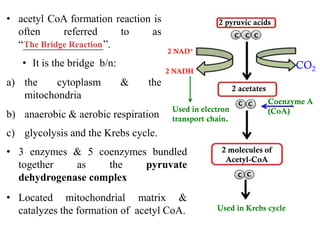
• acetyl CoA formation reaction is
often referred to as
“_______________”.
• It is the bridge b/n:
a) the cytoplasm & the
mitochondria
b) anaerobic & aerobic respiration
c) glycolysis and the Krebs cycle.
2 pyruvic acids
2 acetates
CO2
2 NAD+
2 NADH
Used in electron
transport chain.
Coenzyme A
(CoA)
2 molecules of
Acetyl-CoA
Used in Krebs cycle
The Bridge Reaction
• 3 enzymes & 5 coenzymes bundled
together as the pyruvate
dehydrogenase complex
• Located mitochondrial matrix &
catalyzes the formation of acetyl CoA.
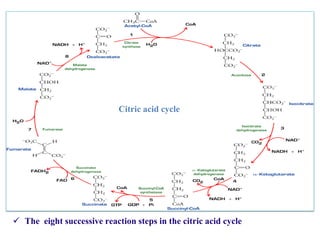
• Citric acid cycle comprises 8 successive enzymatic steps several of
which are allosterically controlled.
• Acetyl CoA formed from pyruvate or other compounds (such as
fatty acids or some amino acids) can be
» oxidized by the citric acid cycle.
» Acetyl CoA & oxaloacetate feed the citric acid cycle
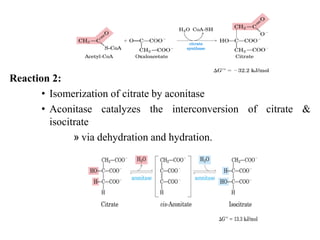
Reaction 1:
• Condensation of acetyl-CoA and oxaloacetate to form
» citrate by citrate synthase enzyme.
» This is committing step in TCA cycle
• highly exergonic, driven largely by cleavage of thiol ester
bond of acetyl CoA.
7.6.1 reactions of the Citric Acid Cycle
Reaction 2:
• Isomerization of citrate by aconitase
• Aconitase catalyzes the interconversion of citrate &
isocitrate
» via dehydration and hydration.
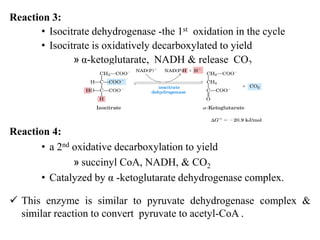
Reaction 3:
• Isocitrate dehydrogenase -the 1st oxidation in the cycle
• Isocitrate is oxidatively decarboxylated to yield
» α-ketoglutarate, NADH & release CO2
Reaction 4:
• a 2nd oxidative decarboxylation to yield
» succinyl CoA, NADH, & CO2
• Catalyzed by α -ketoglutarate dehydrogenase complex.
 This enzyme is similar to pyruvate dehydrogenase complex &
similar reaction to convert pyruvate to acetyl-CoA .
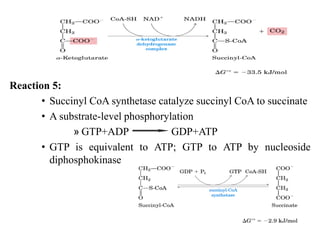
Reaction 5:
• Succinyl CoA synthetase catalyze succinyl CoA to succinate
• A substrate-level phosphorylation
» GTP+ADP GDP+ATP
• GTP is equivalent to ATP; GTP to ATP by nucleoside
diphosphokinase
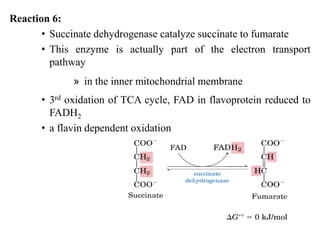
Reaction 6:
• Succinate dehydrogenase catalyze succinate to fumarate
• This enzyme is actually part of the electron transport
pathway
» in the inner mitochondrial membrane
• 3rd oxidation of TCA cycle, FAD in flavoprotein reduced to
FADH2
• a flavin dependent oxidation
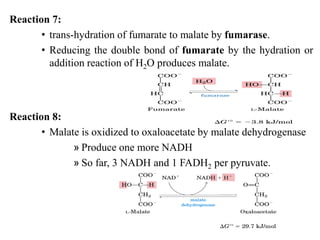
Reaction 7:
• trans-hydration of fumarate to malate by fumarase.
• Reducing the double bond of fumarate by the hydration or
addition reaction of H2O produces malate.
Reaction 8:
• Malate is oxidized to oxaloacetate by malate dehydrogenase
» Produce one more NADH
» So far, 3 NADH and 1 FADH2 per pyruvate.
 The eight successive reaction steps in the citric acid cycle
Citric acid cycle
• The citric acid cycle is regulated at four points:
1. Pyruvate Dehydrogenase:
• Activity of pyruvate dehydrogenase complex is regulated by
» allosteric and covalent mechanisms.
• inhibited by ATP, acetyl-CoA, and NADH &fatty acid.
• Activated by AMP, CoA, NAD+ and Ca2+.
2. Citrate Synthase:
» inhibited by ATP, NADH, succinyl-CoA & citrate.
» Activated by ADP.
7.6.2. Regulation of the Citric Acid Cycle
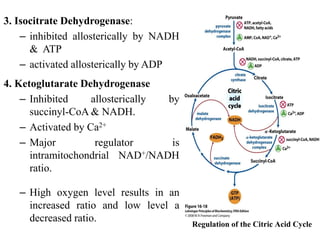
3. Isocitrate Dehydrogenase:
– inhibited allosterically by NADH
& ATP
– activated allosterically by ADP
4. Ketoglutarate Dehydrogenase
– Inhibited allosterically by
succinyl-CoA & NADH.
– Activated by Ca2+
– Major regulator is
intramitochondrial NAD+/NADH
ratio.
– High oxygen level results in an
increased ratio and low level a
decreased ratio.
Regulation of the Citric Acid Cycle
• Besides its role in the oxidative catabolism of carbohydrates, Fatty
acids & amino acids citric acid cycle also
» provide precursors for many biosynthetic pathways.
• This cycle is an amphibolic pathway that serves
» in both catabolic and anabolic processes.
Amphibolic pathway:
a. Transaminases:
• pyruvate & oxaloacetate can be converted into the
» amino acids alanine and aspartate, respectively.
7.6.3. TCA intermediates as precursors biosynthesis
• Oxaloacetate to PEP, aromatic aa., formation of 3-PG.,
gluconeogenesis.
• α-ketoglutarate transaminates to glutamate & other amino acids
» and also purine nucleotides.
b. Fatty acid biosynthesis
• Citrate can be transported out of the mitochondrion & used
as
» an acetyl CoA source for fatty acid synthesis
• citrate  acetyl CoA and oxaloacetate can build fatty acids
7.6.3. TCA intermediates as precursors biosynthesis Con.t
C. heme biosynthesis
• Succinyl CoA is the starting point for heme synthesis
» succinyl CoA + glycine  porphyrins
• It is a central intermediate in the synthesis of the porphyrin ring of
heme groups, which serve as
» oxygen carriers (in hemoglobin and myoglobin) &
» electron carriers (in cytochromes).
7.6.3. TCA intermediates as precursors biosynthesis Con.t
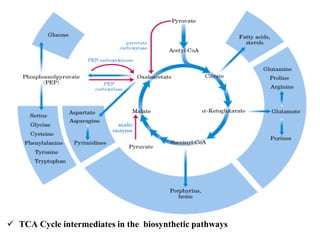
 TCA Cycle intermediates in the biosynthetic pathways
• The glyoxylate cycle has several intermediates in common with the
TCA cycle but,
• performs a specialized function in some plant cells & fungi.
• No net synthesis of carbohydrates & other intermediates from
acetate with TCA cycle.
• Glyoxylate cycle offers a solution for plants, some bacteria & algae.
• The CO2-evolving steps are bypassed and an extra acetate is
utilized
 isocitrate lyase & malate synthase are the two short-circuiting enzymes in
Glyoxylate but not in TCA.
7.5.4 The Glyoxylate Pathway
• The reaction ooccur in a specialized peroxisome called the
glyoxosome
• Plants store carbon in seeds as oil & the glyoxylate cycle allows
» plants to use acetyl-CoA derived from β-oxidation of
fatty acids for carbohydrate synthesis.
• Animals can not do this! Acetyl-CoA is totally oxidized to CO2.
• Converts one oxaloacetate and 2 acetyl-CoA to 2 oxaloacetate for
» carbohydrate synthesis.
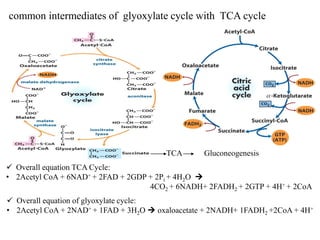
common intermediates of glyoxylate cycle with TCA cycle
TCA Gluconeogenesis
 Overall equation TCA Cycle:
• 2Acetyl CoA + 6NAD+ + 2FAD + 2GDP + 2Pi + 4H2O 
4CO2 + 6NADH+ 2FADH2 + 2GTP + 4H+ + 2CoA
 Overall equation of glyoxylate cycle:
• 2Acetyl CoA + 2NAD+ + 1FAD + 3H2O  oxaloacetate + 2NADH+ 1FADH2 +2CoA + 4H+
• Triglycerides account for ~83% of our stored energy
» More energy per gram than carbs (9 kcal/g vs 4
kcal/g for glycogen
• Mobilized slower than carbs and only aerobically
• Principal fuel for many organs (e.g., heart, liver)
• Dietary triacylglycerols must be broken down before being
absorbed by the intestines.
• Bile salts, which act as detergents, used to solublize the
triacylglycerols.
7.7. Fatty Acid catabolism
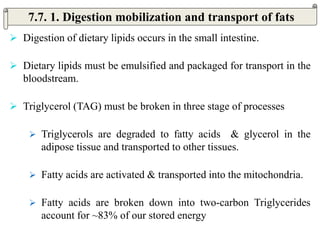
 Digestion of dietary lipids occurs in the small intestine.
 Dietary lipids must be emulsified and packaged for transport in the
bloodstream.
 Triglycerol (TAG) must be broken in three stage of processes
 Triglycerols are degraded to fatty acids & glycerol in the
adipose tissue and transported to other tissues.
 Fatty acids are activated & transported into the mitochondria.
 Fatty acids are broken down into two-carbon Triglycerides
account for ~83% of our stored energy
7.7. 1. Digestion mobilization and transport of fats
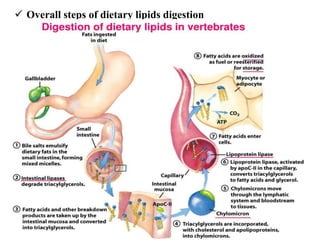
 Overall steps of dietary lipids digestion
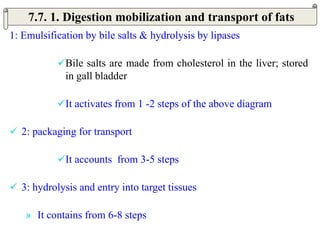
1: Emulsification by bile salts & hydrolysis by lipases
Bile salts are made from cholesterol in the liver; stored
in gall bladder
It activates from 1 -2 steps of the above diagram
 2: packaging for transport
It accounts from 3-5 steps
 3: hydrolysis and entry into target tissues
» It contains from 6-8 steps
7.7. 1. Digestion mobilization and transport of fats
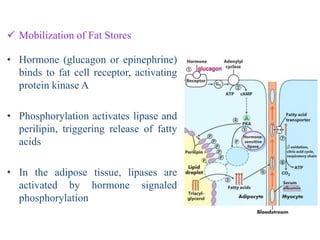
 Mobilization of Fat Stores
• Hormone (glucagon or epinephrine)
binds to fat cell receptor, activating
protein kinase A
• Phosphorylation activates lipase and
perilipin, triggering release of fatty
acids
• In the adipose tissue, lipases are
activated by hormone signaled
phosphorylation
25
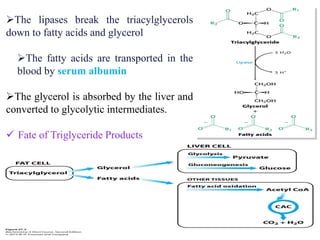
The lipases break the triacylglycerols
down to fatty acids and glycerol
The fatty acids are transported in the
blood by serum albumin
The glycerol is absorbed by the liver and
converted to glycolytic intermediates.
 Fate of Triglyceride Products
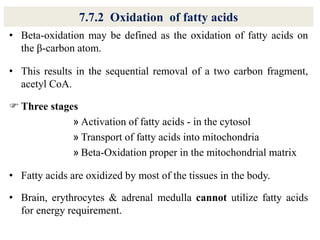
7.7.2 Oxidation of fatty acids
• Beta-oxidation may be defined as the oxidation of fatty acids on
the β-carbon atom.
• This results in the sequential removal of a two carbon fragment,
acetyl CoA.
 Three stages
» Activation of fatty acids - in the cytosol
» Transport of fatty acids into mitochondria
» Beta-Oxidation proper in the mitochondrial matrix
• Fatty acids are oxidized by most of the tissues in the body.
• Brain, erythrocytes & adrenal medulla cannot utilize fatty acids
for energy requirement.
27
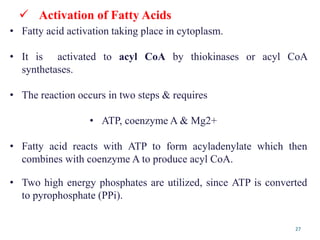
 Activation of Fatty Acids
• Fatty acid activation taking place in cytoplasm.
• It is activated to acyl CoA by thiokinases or acyl CoA
synthetases.
• The reaction occurs in two steps & requires
• ATP, coenzyme A & Mg2+
• Fatty acid reacts with ATP to form acyladenylate which then
combines with coenzyme A to produce acyl CoA.
• Two high energy phosphates are utilized, since ATP is converted
to pyrophosphate (PPi).
28
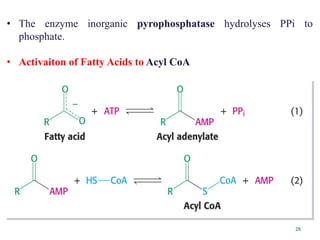
• The enzyme inorganic pyrophosphatase hydrolyses PPi to
phosphate.
• Activaiton of Fatty Acids to Acyl CoA
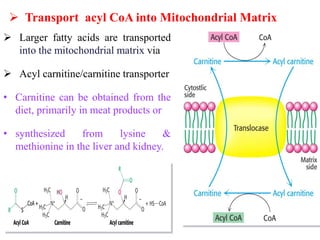
 Transport acyl CoA into Mitochondrial Matrix
 Larger fatty acids are transported
into the mitochondrial matrix via
 Acyl carnitine/carnitine transporter
• Carnitine can be obtained from the
diet, primarily in meat products or
• synthesized from lysine &
methionine in the liver and kidney.
 -Oxidation of Fat
• Process of converting FFAs to acetyl-CoA before entering Krebs
cycle
• Number of steps depends on number of carbons on FFA
• Each cycle of β –oxidation, liberating a two carbon unit-acetyl
CoA,
» occurs in a sequence of four reactions.
1. Oxidation
2. Hydration
3. Oxidation
4. Cleavage
 -Oxidation of Fat
31
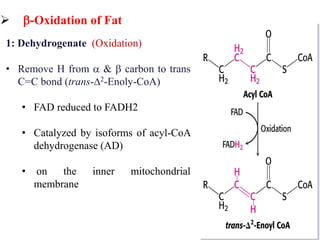
1: Dehydrogenate (Oxidation)
• Remove H from  &  carbon to trans
C=C bond (trans-∆2-Enoly-CoA)
• FAD reduced to FADH2
• Catalyzed by isoforms of acyl-CoA
dehydrogenase (AD)
• on the inner mitochondrial
membrane
 -Oxidation of Fat
32
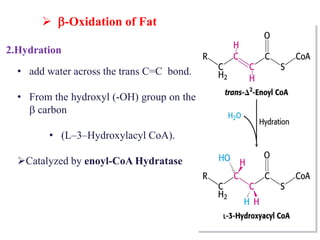
2.Hydration
• add water across the trans C=C bond.
• From the hydroxyl (-OH) group on the
 carbon
• (L–3–Hydroxylacyl CoA).
Catalyzed by enoyl-CoA Hydratase
 -Oxidation of Fat
33
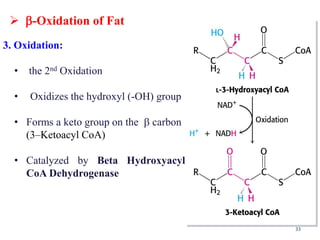
3. Oxidation:
• the 2nd Oxidation
• Oxidizes the hydroxyl (-OH) group
• Forms a keto group on the  carbon
(3–Ketoacyl CoA)
• Catalyzed by Beta Hydroxyacyl
CoA Dehydrogenase
34
4. Cleavage (Thiolysis):
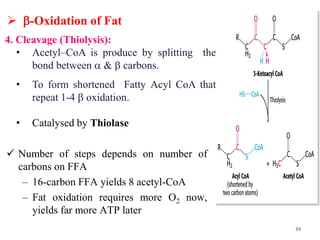
• Acetyl–CoA is produce by splitting the
bond between  &  carbons.
• To form shortened Fatty Acyl CoA that
repeat 1-4  oxidation.
• Catalysed by Thiolase
 Number of steps depends on number of
carbons on FFA
– 16-carbon FFA yields 8 acetyl-CoA
– Fat oxidation requires more O2 now,
yields far more ATP later
 -Oxidation of Fat
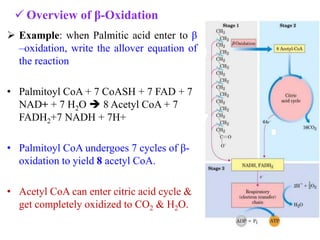
 Example: when Palmitic acid enter to β
–oxidation, write the allover equation of
the reaction
• Palmitoyl CoA + 7 CoASH + 7 FAD + 7
NAD+ + 7 H2O  8 Acetyl CoA + 7
FADH2+7 NADH + 7H+
• Palmitoyl CoA undergoes 7 cycles of β-
oxidation to yield 8 acetyl CoA.
• Acetyl CoA can enter citric acid cycle &
get completely oxidized to CO2 & H2O.
 Overview of β-Oxidation
Energetics of β- Oxidation
Mechanism ATP yield
I. β- Oxidation 7 cycles
7 FADH2 [Oxidized by Electron Transport Chain (ETC) each
FADH2 gives 2 ATP ]
7 NADH (Oxidized by ETC, each NADH
Liberate 3ATP)
14
21
II. From 8 Acetyl CoA
Oxidized by citric acid cycle, each acetyl CoA
provides 12
96
Total energy from one molecule of palmitoyl CoA
Energy utilized for activation
(Formation of palmitoyl Co A)
131
-2
Net yield of oxidation of one molecule of palmitate =129
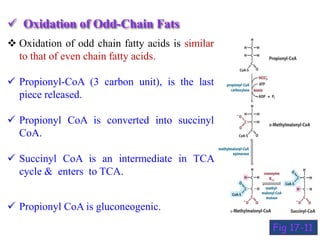
 Oxidation of Odd-Chain Fats
 Oxidation of odd chain fatty acids is similar
to that of even chain fatty acids.
 Propionyl-CoA (3 carbon unit), is the last
piece released.
 Propionyl CoA is converted into succinyl
CoA.
 Succinyl CoA is an intermediate in TCA
cycle & enters to TCA.
 Propionyl CoA is gluconeogenic.
Fig 17-11
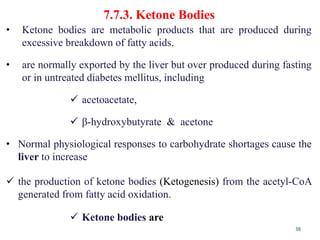
7.7.3. Ketone Bodies
38
• Ketone bodies are metabolic products that are produced during
excessive breakdown of fatty acids.
• are normally exported by the liver but over produced during fasting
or in untreated diabetes mellitus, including
 acetoacetate,
 β-hydroxybutyrate & acetone
• Normal physiological responses to carbohydrate shortages cause the
liver to increase
 the production of ketone bodies (Ketogenesis) from the acetyl-CoA
generated from fatty acid oxidation.
 Ketone bodies are
7.7.3. Ketone Bodies
» transported in the blood to the peripheral tissues
where they are reconverted to
» acetyl CoA (ketolysis) & oxidized by the TCA cycle
to produce energy.
• Ketone bodies replace glucose as the major source of energy for
many tissues especially the
• brain, heart & muscles during times of prolonged starvation
• Ketone bodies are not oxidized in the liver.
• Utilized in extrahepatic tissues such as brain, heart, skeletal
muscle and kidney
• Extrahepatic tissues can not form ketone bodies due to
absence of HMG CoA synthase enzyme.
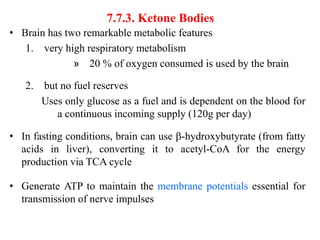
• Brain has two remarkable metabolic features
1. very high respiratory metabolism
» 20 % of oxygen consumed is used by the brain
2. but no fuel reserves
Uses only glucose as a fuel and is dependent on the blood for
a continuous incoming supply (120g per day)
• In fasting conditions, brain can use -hydroxybutyrate (from fatty
acids in liver), converting it to acetyl-CoA for the energy
production via TCA cycle
• Generate ATP to maintain the membrane potentials essential for
transmission of nerve impulses
7.7.3. Ketone Bodies
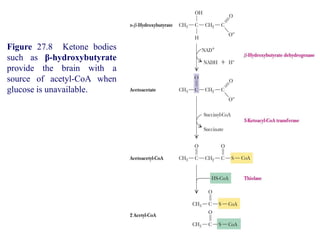
Figure 27.8 Ketone bodies
such as β-hydroxybutyrate
provide the brain with a
source of acetyl-CoA when
glucose is unavailable.
7.8. Amino Acid Oxidation
• Amino acids are transported to the liver during digestion and most
of the body's protein is synthesized here.
» So, liver is the principal site of amino acid
metabolism, but other tissues,
» such as kidney, small intestine, muscles, & adipose
tissue, take part.
• If protein is in excess, amino acids can be converted
» into fat & stored in fat depots, or
» into glucose for energy by gluconeogenesis which
has already been mentioned.
7.8. 1 Metabolic fate s of Amino Acid
 Metabolism of the 20 common amino acids is considered from the
origins and fates of their:
1. Nitrogen atoms
2. Carbon skeletons
 Amino acids cannot be stored.
» If there is an excess of aas or lack of other energy
sources,
» the body will use them for energy production.
• Amino acid degradation requires the removal of the amino group as
ammonium.
» Ammonium must then be disposed of as it is toxic to
the body.
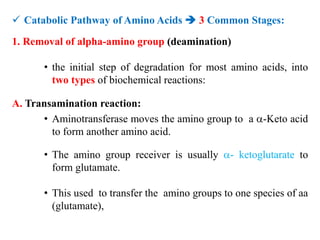
 Catabolic Pathway of Amino Acids  3 Common Stages:
1. Removal of alpha-amino group (deamination)
• the initial step of degradation for most amino acids, into
two types of biochemical reactions:
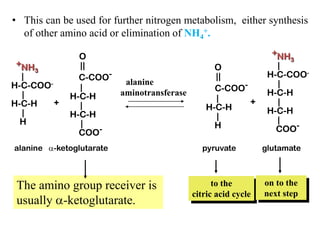
A. Transamination reaction:
• Aminotransferase moves the amino group to a -Keto acid
to form another amino acid.
• The amino group receiver is usually - ketoglutarate to
form glutamate.
• This used to transfer the amino groups to one species of aa
(glutamate),
• This can be used for further nitrogen metabolism, either synthesis
of other amino acid or elimination of NH4
+.
+NH3
|
H-C-COO-
|
H-C-H
|
H
O
||
C-COO-
|
H-C-H
|
H-C-H
|
COO-
O
||
C-COO-
|
H-C-H
|
H
+NH3
|
H-C-COO-
|
H-C-H
|
H-C-H
|
COO-
+ +
alanine -ketoglutarate pyruvate glutamate
to the
citric acid cycle
on to the
next step
The amino group receiver is
usually -ketoglutarate.
alanine
aminotransferase
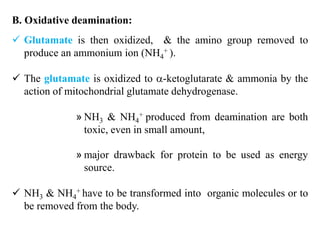
B. Oxidative deamination:
 Glutamate is then oxidized, & the amino group removed to
produce an ammonium ion (NH4
+ ).
 The glutamate is oxidized to -ketoglutarate & ammonia by the
action of mitochondrial glutamate dehydrogenase.
» NH3 & NH4
+ produced from deamination are both
toxic, even in small amount,
» major drawback for protein to be used as energy
source.
 NH3 & NH4
+ have to be transformed into organic molecules or to
be removed from the body.
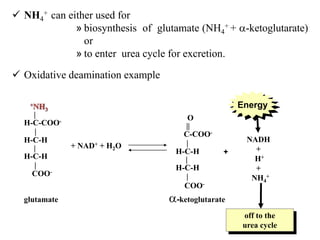
 NH4
+ can either used for
» biosynthesis of glutamate (NH4
+ + -ketoglutarate)
or
» to enter urea cycle for excretion.
 Oxidative deamination example
NADH
+
H+
+
NH4
+
+
off to the
urea cycle
O
||
C-COO-
|
H-C-H
|
H-C-H
|
COO-
+NH3
|
H-C-COO-
|
H-C-H
|
H-C-H
|
COO-
+ NAD+ + H2O
glutamate -ketoglutarate
Energy
7.8.2. Nitrogen excretion and the Urea Cycle
• Living organisms excrete excess nitrogen from metabolic
breakdown of amino acids in one of 3 ways:
» aquatic animals => ammonia.
 Where water is less plentiful other processes have evolved that
convert ammonia to less toxic waste products.
 this require less water for excretion.
» one such product is urea &
» other is uric acid.
 Accordingly, living organisms are classified as:
» ammonotelic (ammonia excreting),
» ureotelic (urea excreting) or
» uricotelic (uric acid excreting)
7.8.2. Nitrogen excretion and the Urea Cycle
• larger terrestrial & multicellular organisms eliminate NH4
+ through
the urea cycle that occurs in the liver.
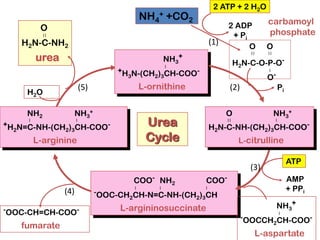
• Urea is formed from ammonia, CO2 & aspartate
 The urea cycle:
»Occurs in the hepatocytes (liver cells).
»Results in the formation of urea.
»Urea is eliminated by excretion (urine).
 Urea cycle consists of five sequential enzymatic reactions.
» First two reactions => mitochondria &
» remaining three reactions => cytosol
7.8.2. Nitrogen excretion and the Urea Cycle
• Urea cycle begins by formation of carbamoyl phosphate in
mitochondria.
» Substrates (NH4
+ & HCO3
-), catalyzed by
carbamoyl phosphate synthetase I (CPSI).
 2 molecules of ATP are required to drive this irreversible reaction:
» one to activate HCO3
- and
» the 2nd molecule => to phosphorylate carbamate.
 Carbamoyl phosphate combined with ornithine => citrulline which
passes into cytosol.
» Next three steps occur in cytosol
 1. Formation of argininosuccinate by ATP dependent reaction of
citrulline with aspartate.
7.8.2. Nitrogen excretion and the Urea Cycle
» (aspartate provides 2nd nitrogen that is ultimately
incorporated into urea).
» Citrulline + aspartate => arginosuccinate.
 2. Argininosuccinate => fumarate + arginine,
» fumarate from this reaction => critic acid cycle.
 3. The terminal two nitrogens & carbon are cleaved from arginine
for formation of urea and regeneration of ornithine.
 ornithine is transported back to the matrix for another round of
reactions.
 Net reaction of urea cycle :
 CO2 + NH4
+ + Aspartate + 3ATP + 2H2O  Urea + Fumarate + 2ADP + AMP
• i.e. four high energy phosphates are consumed in the synthesis of one
molecule of urea .
COO- NH2 COO-
| | |
-OOC-CH2CH-N=C-NH-(CH2)3CH
L-argininosuccinate
NH4
+ +CO2 carbamoyl
phosphate
O O
| | | |
H2N-C-O-P-O-
|
O-
O NH3
+
| | |
H2N-C-NH-(CH2)3CH-COO-
L-citrulline
NH3
+
|
-OOCCH2CH-COO-
L-aspartate
NH3
+
|
+H3N-(CH2)3CH-COO-
L-ornithine
-OOC-CH=CH-COO-
fumarate
NH2 NH3
+
| |
+H2N=C-NH-(CH2)3CH-COO-
L-arginine
O
| |
H2N-C-NH2
urea
ATP
AMP
+ PPi
H2O
Pi
2 ATP + 2 H2O
2 ADP
+ Pi
Urea
Cycle
(5)
(1)
(4)
(3)
(2)
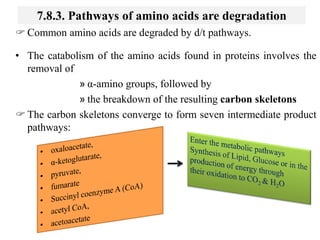
7.8.3. Pathways of amino acids are degradation
 Common amino acids are degraded by d/t pathways.
• The catabolism of the amino acids found in proteins involves the
removal of
» α-amino groups, followed by
» the breakdown of the resulting carbon skeletons
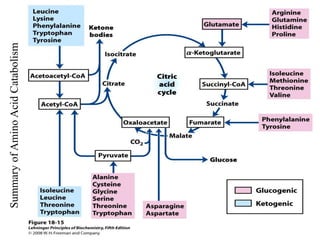
 The carbon skeletons converge to form seven intermediate product
pathways:
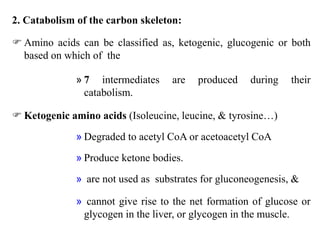
2. Catabolism of the carbon skeleton:
 Amino acids can be classified as, ketogenic, glucogenic or both
based on which of the
» 7 intermediates are produced during their
catabolism.
 Ketogenic amino acids (Isoleucine, leucine, & tyrosine…)
» Degraded to acetyl CoA or acetoacetyl CoA
» Produce ketone bodies.
» are not used as substrates for gluconeogenesis, &
» cannot give rise to the net formation of glucose or
glycogen in the liver, or glycogen in the muscle.
 Glucogenic amino acids (argenine, glutamate, valine aspartate…)
» Degraded to pyruvate, α-ketoglutarate, succinyl
CoA, fumarate or oxaloacetate.
» they can then be used for glucose synthesis.
• Isoleucine, leucine & valine share some steps in their catabolism.
• Transamination is catalyzed by branched-chain aminotransferase.
• - keto products are then decarboxylated via a complex similar to
the pyruvate dehydrogenase complex.
• Their catabolism then proceeds in different directions.
 Oxidative phosphorylation is the last stage of aerobic respiration,
NADH & + FADH2 will release hydrogen atoms, generating
energy to produce ATP.
» This energy is used to phsophorylate ADP.
 During this time energy is released when electrons are transported
from higher energy NADH/FADH2 to lower energy O2.
» or this is coupled to the exergonic transfer of
electrons from food to oxygen.
Oxidative phosphorylation is responsible for 90% of total ATP
synthesis in the cell.
7.9. Oxidative phosphorylation
• Oxidative phosphorylation occur, in the electron transport chain.
• The electron transport chain consists of a series of proteins that are
embedded in the
» inner membranes (cristae) of the mitochondria in
eukaryotic cells.
» In prokaryotic cells, the electron transport chain lies
along the cell membrane
• Matrix contains all of TCA cycle enzymes {except, succinate
dehydrogenase}
» which is located in the inner membrane.
7.9. Oxidative phosphorylation
• The chemiosmotic theory explains the mechanism of oxidative
phosphorylation.
 In 1961 Peter Mitchell proposed the Chemiosmotic theory
• The essential feature of the theory is that the:
» link b/n electron transport and ATP formation by
» the electrochemical potential across a membrane.
• The electrochemical potential is created by the pumping of protons
across a membrane as electrons are
» transferred through the respiratory complexes.
7.9.1. The Chemiosmotic Theory and the mechanism of
Protonmotive Force
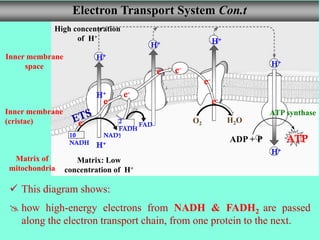
• free energy harvested during the ETC is used to pump protons out
of the mitochondrial matrix.
• This resulting uneven distribution of protons, generates a pH
gradient and
» a charge gradient across the inner mitochondrial
membrane.
• The electrochemical potential energy generated by these gradients
is called as Proton Motive Force.
7.9.1. The Chemiosmotic Theory and the mechanism of
Protonmotive Force
 Protonmotive Force (ΔP):
• is the energy of the proton concentration gradient
• Protons that are translocated into the intermembrane space
by electron transport,
• flow back of protons into the matrix via ATP synthase is
coupled to ATP synthesis
• H+ flow forms a circuit (similar to an electrical circuit)
• Analogy of electromotive and Protonmotive force, but in
mitochondria
7.9.1. The Chemiosmotic Theory and the mechanism of
Protonmotive Force
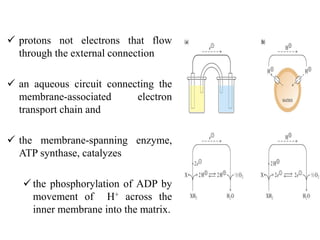
 protons not electrons that flow
through the external connection
 an aqueous circuit connecting the
membrane-associated electron
transport chain and
 the membrane-spanning enzyme,
ATP synthase, catalyzes
the phosphorylation of ADP by
movement of H+ across the
inner membrane into the matrix.
• Final stage in energy generation & most energy released here
• e- of NADH and FADH2 move through the ETC, moving to lower
energy level (in the direction of increasing reduction potentials).
NADH (strong reducing agent, Eo’ = -0.32 volts)
O2 (terminal oxidizing agent, Eo’ = +0.82 volts)
• ETC is a series of electron carriers in cristae of mitochondria
• Mobile coenzymes: ubiquinone (Q) and cytochrome c serve as links
between ETC complexes
• electron carriers accept & donate e- as they move down chain
7.9.2. Electron Transport system
• The movement of e- down the chain releases energy that used to
• pump H+ across the membrane from Matrix to the
Inner membrane space of mitochondria.
Creates an electrochemical gradient by altering the concentration of
H+ on either side of the membrane.
This forces H+ flow back to the matrix through ATP synthase
ATP synthase catalyzes the phosphorylation of ADP to ATP
 At the end of the electron transport chain,
 electrons & hydrogen will be combined with oxygen to
form water.
7.9.2. Electron Transport system
 Oxygen is the final electron acceptor & essential for getting rid
of: low energy electrons and hydrogen ions.
 O2 is reduced to water at complex IV
• The electron transport chain can be isolated in four complexes.
 Complex I:
• NADH-ubiquinone oxidoreductase (NADH dehydrogenase)
• Transfers electrons from NADH to Q
• NADH transfers a two electrons as a hydride ion to FMN
7.9.2. Electron Transport system
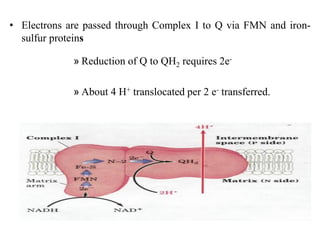
• Electrons are passed through Complex I to Q via FMN and iron-
sulfur proteins
» Reduction of Q to QH2 requires 2e-
» About 4 H+ translocated per 2 e- transferred.
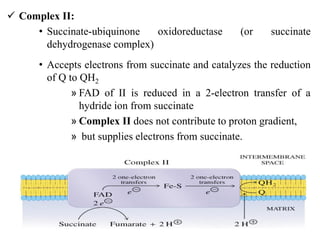
 Complex II:
• Succinate-ubiquinone oxidoreductase (or succinate
dehydrogenase complex)
• Accepts electrons from succinate and catalyzes the reduction
of Q to QH2
» FAD of II is reduced in a 2-electron transfer of a
hydride ion from succinate
» Complex II does not contribute to proton gradient,
» but supplies electrons from succinate.
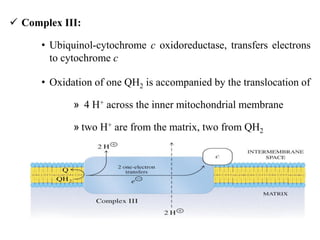
 Complex III:
• Ubiquinol-cytochrome c oxidoreductase, transfers electrons
to cytochrome c
• Oxidation of one QH2 is accompanied by the translocation of
» 4 H+ across the inner mitochondrial membrane
» two H+ are from the matrix, two from QH2
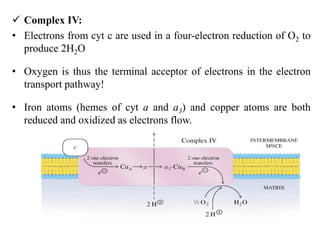
 Complex IV:
• Electrons from cyt c are used in a four-electron reduction of O2 to
produce 2H2O
• Oxygen is thus the terminal acceptor of electrons in the electron
transport pathway!
• Iron atoms (hemes of cyt a and a3) and copper atoms are both
reduced and oxidized as electrons flow.
 Complex IV contributes to the proton gradient and net effect is
» transfer of four H+ for each pair of e-
» O2 + 4 e- + 4H+ 2 H2O
1. Proton translocation of 2 H+ for each pair of electrons
transferred (each O atom reduced)
2. Formation of H2O removes 2H+ from the matrix contributes to
Δp even though no proton translocation occurs.
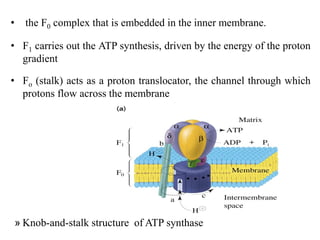
 Complex V: ATP Synthase
• F0F1 ATP Synthase uses the proton gradient energy for the
synthesis of ATP
• Composed of a “knob-and-stalk” structure
 The F1 (knob) complex is not directly membrane-bound, but is
attached to
• the F0 complex that is embedded in the inner membrane.
• F1 carries out the ATP synthesis, driven by the energy of the proton
gradient
• Fo (stalk) acts as a proton translocator, the channel through which
protons flow across the membrane
» Knob-and-stalk structure of ATP synthase
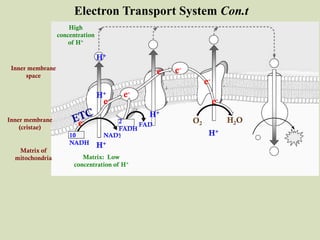
Inner membrane
(cristae)
Matrix of
mitochondria
Inner membrane
space
e-
e-
e-
e-
e-
e-
e-
10
NADH
2
FADH
2
NAD+
FAD
Matrix: Low
concentration of H+
High
concentration
of H+
H+
H+
H+
H+
H+
O2 H2O
Electron Transport System Con.t
Inner membrane
(cristae)
Matrix of
mitochondria
Inner membrane
space
e-
e-
e-
e-
e-
e-
e-
10
NADH
2
FADH
2
NAD+
FAD
Matrix: Low
concentration of H+
High concentration
of H+
H+
H+
H+
H+ H+
H+
ATP synthase
O2 H2O
H+
ADP + P ATP
Electron Transport System Con.t
 This diagram shows:
 how high-energy electrons from NADH & FADH2 are passed
along the electron transport chain, from one protein to the next.
Active Transport of ATP, ADP and Pi Across the
Mitochondrial Membrane
• ATP is synthesized in the mitochondrial matrix
• ATP must be transported to the cytosol, and ADP and Pi must enter
the matrix
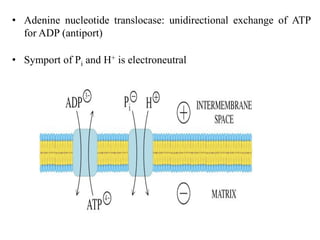
• ADP/ATP carrier, adenine nucleotide translocase, exchanges
» mitochondrial ATP4- for cytosolic ADP3-
• The exchange causes a net loss of -1 in the matrix
» draws some energy from the H+ gradient
• Adenine nucleotide translocase: unidirectional exchange of ATP
for ADP (antiport)
• Symport of Pi and H+ is electroneutral
The P/O Ratio
• Is the moles of ADP divided by the moles of O consumed while
phosphorylating the ADP. Or
• is the ratio of molecules phosphorylated to atoms of oxygen
reduced
• It takes two electrons to reduce a single atom of oxygen (1/2 O2).
• Translocation of 3H+ required by ATP synthase for each ATP
produced
• 1 H+ needed for transport of Pi
• Net: 4 H+ transported for each ATP synthesized
• 4 protons are translocated by complex I, 4 by complex III, and 2
by complex IV.
 Calculation of the P: O ratio:
• #H+ translocated/2e-, since 4 H+ are required for each ATP
synthesized:
• For NADH: 10 H+ translocated / O (2e-)
» P/O = (10 H+/ 4 H+) = 2.5 ATP/O
• For succinate substrate = 6 H+/ O (2e-)
• P/O = (6 H+/ 4 H+) = 1.5 ATP/O, since electrons contributed by
» succinate oxidation do not pass through complex I.
7.9.3. Regulation of Oxidative Phosphorylation
• Oxidative phosphorylation is regulated by cellular energy needs
• An inhibitory protein prevents ATP hydrolysis during Ischemia
• ATP-producing pathways are coordinately regulated
• The rate of respiration (O2 consumption) is generally limited by the
availability of ADP as a substrate for phosphorylation.
• In some animal tissues, the acceptor control ratio,
• the ratio of the maximal rate of ADP-induced O2 consumption to
the basal rate in the absence of ADP, is at least ten.
7.9.3. Regulation of Oxidative Phosphorylation
• the mass-action ratio of the ATP-ADP system ([ATP]/([ADP][Pi]).
• some energy-requiring process (eg. Protein synthesis) increases,
the rate of breakdown of ATP to ADP and Pi increases,
• lowering the mass-action ratio.
• With more ADP available for oxidative phosphorylation, the rate
of respiration increases, causing regeneration of ATP.
 An inhibitory protein (IF1) prevents ATP hydrolysis during
Ischemia.
• When a cell is ischemic (deprived of oxygen), as in a heart
attack or stroke,
3. Electron Transport System (ETS) Con.t
• electron transfer to oxygen ceases, and so does the pumping of
protons.
• The proton-motive force soon collapses.
• the ATP synthase operate in reverse, hydrolyzing ATP to pump
protons outward [ATP]↓
• protein inhibitor, IF1, a small (84 amino acids), binds to two ATP
synthase and inhibit their ATPase activity.
• IF1 is inhibitory only in its dimeric form, which is favored at pH
lower than 6.5.
3. Electron Transport System (ETS) Con.t
• In a cell starved for oxygen, the main source of ATP becomes
• glycolysis, and the pyruvic or lactic acid thus
• formed lowers the pH in the cytosol & the
mitochondrial matrix.
• This favors IF1 dimerization, leading to inhibition of the ATPase
 In aerobic metabolism resumes,
• slows the production of pyruvic acid,
• rises the cytosolic pH,
• IF1 dimer is destabilized, & inhibition of ATP
synthase is lifted.
3. Electron Transport System (ETS) Con.t
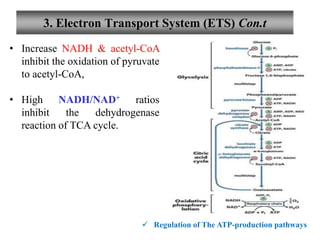
 Regulation of The ATP-production pathways
• ATP-producing pathways are coordinately regulated.
• Interlocking regulation of glycolysis, pyruvated oxidation, the
citric acid cycle ,and oxidation phosphorylation by
• the relative [ ] of ATP, ADP, and AMP, & by NADH.
• All 4 pathway are accelerate when the use of ATP & the formation
of ADP, AMP, and Pi increase.
• Interlocking of glycolysis & TCA cycle by citrate, inhibits
glycolysis,
• supplements the action of the adenine nucleotide system
3. Electron Transport System (ETS) Con.t
• Increase NADH & acetyl-CoA
inhibit the oxidation of pyruvate
to acetyl-CoA,
• High NADH/NAD+ ratios
inhibit the dehydrogenase
reaction of TCA cycle.
 Regulation of The ATP-production pathways

The_citric_acid_cycle[1].pdf

  • 1.
    • Citric acidcycle is the final stage in the breakdown of dietary nutrients. • It is also named Tricarboxylic acid cycle (TAC) or the Krebs cycle. • This biochemical pathway uses acetyl-CoA molecules from the bridge reactions to produce: » hydrogen atoms » ATP » carbon dioxide. • This set of reactions occurs in the matrix of the mitochondria. 7.6. The Citric Acid Cycle
  • 2.
    • Under aerobicconditions, pyruvate passes by a special transporter into mitochondria & completely oxidized to acetyl CoA. • Pyruvic acid is converted to acetyl CoA in three main steps: 1. Decarboxylation: • Carbon is removed from pyruvic acid • Carbon dioxide is released 2. Oxidation: • Hydrogen atoms are removed from pyruvic acid • NAD+ is reduced to NADH + H+ 3. Formation of acetyl CoA: • the resultant acetic acid is combined with coenzyme A 7.6. The Citric Acid Cycle Con.t
  • 3.
    • acetyl CoAformation reaction is often referred to as “_______________”. • It is the bridge b/n: a) the cytoplasm & the mitochondria b) anaerobic & aerobic respiration c) glycolysis and the Krebs cycle. 2 pyruvic acids 2 acetates CO2 2 NAD+ 2 NADH Used in electron transport chain. Coenzyme A (CoA) 2 molecules of Acetyl-CoA Used in Krebs cycle The Bridge Reaction • 3 enzymes & 5 coenzymes bundled together as the pyruvate dehydrogenase complex • Located mitochondrial matrix & catalyzes the formation of acetyl CoA.
  • 4.
    • Citric acidcycle comprises 8 successive enzymatic steps several of which are allosterically controlled. • Acetyl CoA formed from pyruvate or other compounds (such as fatty acids or some amino acids) can be » oxidized by the citric acid cycle. » Acetyl CoA & oxaloacetate feed the citric acid cycle Reaction 1: • Condensation of acetyl-CoA and oxaloacetate to form » citrate by citrate synthase enzyme. » This is committing step in TCA cycle • highly exergonic, driven largely by cleavage of thiol ester bond of acetyl CoA. 7.6.1 reactions of the Citric Acid Cycle
  • 5.
    Reaction 2: • Isomerizationof citrate by aconitase • Aconitase catalyzes the interconversion of citrate & isocitrate » via dehydration and hydration.
  • 6.
    Reaction 3: • Isocitratedehydrogenase -the 1st oxidation in the cycle • Isocitrate is oxidatively decarboxylated to yield » α-ketoglutarate, NADH & release CO2 Reaction 4: • a 2nd oxidative decarboxylation to yield » succinyl CoA, NADH, & CO2 • Catalyzed by α -ketoglutarate dehydrogenase complex.  This enzyme is similar to pyruvate dehydrogenase complex & similar reaction to convert pyruvate to acetyl-CoA .
  • 7.
    Reaction 5: • SuccinylCoA synthetase catalyze succinyl CoA to succinate • A substrate-level phosphorylation » GTP+ADP GDP+ATP • GTP is equivalent to ATP; GTP to ATP by nucleoside diphosphokinase
  • 8.
    Reaction 6: • Succinatedehydrogenase catalyze succinate to fumarate • This enzyme is actually part of the electron transport pathway » in the inner mitochondrial membrane • 3rd oxidation of TCA cycle, FAD in flavoprotein reduced to FADH2 • a flavin dependent oxidation
  • 9.
    Reaction 7: • trans-hydrationof fumarate to malate by fumarase. • Reducing the double bond of fumarate by the hydration or addition reaction of H2O produces malate. Reaction 8: • Malate is oxidized to oxaloacetate by malate dehydrogenase » Produce one more NADH » So far, 3 NADH and 1 FADH2 per pyruvate.
  • 10.
     The eightsuccessive reaction steps in the citric acid cycle Citric acid cycle
  • 11.
    • The citricacid cycle is regulated at four points: 1. Pyruvate Dehydrogenase: • Activity of pyruvate dehydrogenase complex is regulated by » allosteric and covalent mechanisms. • inhibited by ATP, acetyl-CoA, and NADH &fatty acid. • Activated by AMP, CoA, NAD+ and Ca2+. 2. Citrate Synthase: » inhibited by ATP, NADH, succinyl-CoA & citrate. » Activated by ADP. 7.6.2. Regulation of the Citric Acid Cycle
  • 12.
    3. Isocitrate Dehydrogenase: –inhibited allosterically by NADH & ATP – activated allosterically by ADP 4. Ketoglutarate Dehydrogenase – Inhibited allosterically by succinyl-CoA & NADH. – Activated by Ca2+ – Major regulator is intramitochondrial NAD+/NADH ratio. – High oxygen level results in an increased ratio and low level a decreased ratio. Regulation of the Citric Acid Cycle
  • 13.
    • Besides itsrole in the oxidative catabolism of carbohydrates, Fatty acids & amino acids citric acid cycle also » provide precursors for many biosynthetic pathways. • This cycle is an amphibolic pathway that serves » in both catabolic and anabolic processes. Amphibolic pathway: a. Transaminases: • pyruvate & oxaloacetate can be converted into the » amino acids alanine and aspartate, respectively. 7.6.3. TCA intermediates as precursors biosynthesis
  • 14.
    • Oxaloacetate toPEP, aromatic aa., formation of 3-PG., gluconeogenesis. • α-ketoglutarate transaminates to glutamate & other amino acids » and also purine nucleotides. b. Fatty acid biosynthesis • Citrate can be transported out of the mitochondrion & used as » an acetyl CoA source for fatty acid synthesis • citrate  acetyl CoA and oxaloacetate can build fatty acids 7.6.3. TCA intermediates as precursors biosynthesis Con.t
  • 15.
    C. heme biosynthesis •Succinyl CoA is the starting point for heme synthesis » succinyl CoA + glycine  porphyrins • It is a central intermediate in the synthesis of the porphyrin ring of heme groups, which serve as » oxygen carriers (in hemoglobin and myoglobin) & » electron carriers (in cytochromes). 7.6.3. TCA intermediates as precursors biosynthesis Con.t
  • 16.
     TCA Cycleintermediates in the biosynthetic pathways
  • 17.
    • The glyoxylatecycle has several intermediates in common with the TCA cycle but, • performs a specialized function in some plant cells & fungi. • No net synthesis of carbohydrates & other intermediates from acetate with TCA cycle. • Glyoxylate cycle offers a solution for plants, some bacteria & algae. • The CO2-evolving steps are bypassed and an extra acetate is utilized  isocitrate lyase & malate synthase are the two short-circuiting enzymes in Glyoxylate but not in TCA. 7.5.4 The Glyoxylate Pathway
  • 18.
    • The reactionooccur in a specialized peroxisome called the glyoxosome • Plants store carbon in seeds as oil & the glyoxylate cycle allows » plants to use acetyl-CoA derived from β-oxidation of fatty acids for carbohydrate synthesis. • Animals can not do this! Acetyl-CoA is totally oxidized to CO2. • Converts one oxaloacetate and 2 acetyl-CoA to 2 oxaloacetate for » carbohydrate synthesis.
  • 19.
    common intermediates ofglyoxylate cycle with TCA cycle TCA Gluconeogenesis  Overall equation TCA Cycle: • 2Acetyl CoA + 6NAD+ + 2FAD + 2GDP + 2Pi + 4H2O  4CO2 + 6NADH+ 2FADH2 + 2GTP + 4H+ + 2CoA  Overall equation of glyoxylate cycle: • 2Acetyl CoA + 2NAD+ + 1FAD + 3H2O  oxaloacetate + 2NADH+ 1FADH2 +2CoA + 4H+
  • 20.
    • Triglycerides accountfor ~83% of our stored energy » More energy per gram than carbs (9 kcal/g vs 4 kcal/g for glycogen • Mobilized slower than carbs and only aerobically • Principal fuel for many organs (e.g., heart, liver) • Dietary triacylglycerols must be broken down before being absorbed by the intestines. • Bile salts, which act as detergents, used to solublize the triacylglycerols. 7.7. Fatty Acid catabolism
  • 21.
     Digestion ofdietary lipids occurs in the small intestine.  Dietary lipids must be emulsified and packaged for transport in the bloodstream.  Triglycerol (TAG) must be broken in three stage of processes  Triglycerols are degraded to fatty acids & glycerol in the adipose tissue and transported to other tissues.  Fatty acids are activated & transported into the mitochondria.  Fatty acids are broken down into two-carbon Triglycerides account for ~83% of our stored energy 7.7. 1. Digestion mobilization and transport of fats
  • 22.
     Overall stepsof dietary lipids digestion
  • 23.
    1: Emulsification bybile salts & hydrolysis by lipases Bile salts are made from cholesterol in the liver; stored in gall bladder It activates from 1 -2 steps of the above diagram  2: packaging for transport It accounts from 3-5 steps  3: hydrolysis and entry into target tissues » It contains from 6-8 steps 7.7. 1. Digestion mobilization and transport of fats
  • 24.
     Mobilization ofFat Stores • Hormone (glucagon or epinephrine) binds to fat cell receptor, activating protein kinase A • Phosphorylation activates lipase and perilipin, triggering release of fatty acids • In the adipose tissue, lipases are activated by hormone signaled phosphorylation
  • 25.
    25 The lipases breakthe triacylglycerols down to fatty acids and glycerol The fatty acids are transported in the blood by serum albumin The glycerol is absorbed by the liver and converted to glycolytic intermediates.  Fate of Triglyceride Products
  • 26.
    7.7.2 Oxidation offatty acids • Beta-oxidation may be defined as the oxidation of fatty acids on the β-carbon atom. • This results in the sequential removal of a two carbon fragment, acetyl CoA.  Three stages » Activation of fatty acids - in the cytosol » Transport of fatty acids into mitochondria » Beta-Oxidation proper in the mitochondrial matrix • Fatty acids are oxidized by most of the tissues in the body. • Brain, erythrocytes & adrenal medulla cannot utilize fatty acids for energy requirement.
  • 27.
    27  Activation ofFatty Acids • Fatty acid activation taking place in cytoplasm. • It is activated to acyl CoA by thiokinases or acyl CoA synthetases. • The reaction occurs in two steps & requires • ATP, coenzyme A & Mg2+ • Fatty acid reacts with ATP to form acyladenylate which then combines with coenzyme A to produce acyl CoA. • Two high energy phosphates are utilized, since ATP is converted to pyrophosphate (PPi).
  • 28.
    28 • The enzymeinorganic pyrophosphatase hydrolyses PPi to phosphate. • Activaiton of Fatty Acids to Acyl CoA
  • 29.
     Transport acylCoA into Mitochondrial Matrix  Larger fatty acids are transported into the mitochondrial matrix via  Acyl carnitine/carnitine transporter • Carnitine can be obtained from the diet, primarily in meat products or • synthesized from lysine & methionine in the liver and kidney.
  • 30.
     -Oxidation ofFat • Process of converting FFAs to acetyl-CoA before entering Krebs cycle • Number of steps depends on number of carbons on FFA • Each cycle of β –oxidation, liberating a two carbon unit-acetyl CoA, » occurs in a sequence of four reactions. 1. Oxidation 2. Hydration 3. Oxidation 4. Cleavage
  • 31.
     -Oxidation ofFat 31 1: Dehydrogenate (Oxidation) • Remove H from  &  carbon to trans C=C bond (trans-∆2-Enoly-CoA) • FAD reduced to FADH2 • Catalyzed by isoforms of acyl-CoA dehydrogenase (AD) • on the inner mitochondrial membrane
  • 32.
     -Oxidation ofFat 32 2.Hydration • add water across the trans C=C bond. • From the hydroxyl (-OH) group on the  carbon • (L–3–Hydroxylacyl CoA). Catalyzed by enoyl-CoA Hydratase
  • 33.
     -Oxidation ofFat 33 3. Oxidation: • the 2nd Oxidation • Oxidizes the hydroxyl (-OH) group • Forms a keto group on the  carbon (3–Ketoacyl CoA) • Catalyzed by Beta Hydroxyacyl CoA Dehydrogenase
  • 34.
    34 4. Cleavage (Thiolysis): •Acetyl–CoA is produce by splitting the bond between  &  carbons. • To form shortened Fatty Acyl CoA that repeat 1-4  oxidation. • Catalysed by Thiolase  Number of steps depends on number of carbons on FFA – 16-carbon FFA yields 8 acetyl-CoA – Fat oxidation requires more O2 now, yields far more ATP later  -Oxidation of Fat
  • 35.
     Example: whenPalmitic acid enter to β –oxidation, write the allover equation of the reaction • Palmitoyl CoA + 7 CoASH + 7 FAD + 7 NAD+ + 7 H2O  8 Acetyl CoA + 7 FADH2+7 NADH + 7H+ • Palmitoyl CoA undergoes 7 cycles of β- oxidation to yield 8 acetyl CoA. • Acetyl CoA can enter citric acid cycle & get completely oxidized to CO2 & H2O.  Overview of β-Oxidation
  • 36.
    Energetics of β-Oxidation Mechanism ATP yield I. β- Oxidation 7 cycles 7 FADH2 [Oxidized by Electron Transport Chain (ETC) each FADH2 gives 2 ATP ] 7 NADH (Oxidized by ETC, each NADH Liberate 3ATP) 14 21 II. From 8 Acetyl CoA Oxidized by citric acid cycle, each acetyl CoA provides 12 96 Total energy from one molecule of palmitoyl CoA Energy utilized for activation (Formation of palmitoyl Co A) 131 -2 Net yield of oxidation of one molecule of palmitate =129
  • 37.
     Oxidation ofOdd-Chain Fats  Oxidation of odd chain fatty acids is similar to that of even chain fatty acids.  Propionyl-CoA (3 carbon unit), is the last piece released.  Propionyl CoA is converted into succinyl CoA.  Succinyl CoA is an intermediate in TCA cycle & enters to TCA.  Propionyl CoA is gluconeogenic. Fig 17-11
  • 38.
    7.7.3. Ketone Bodies 38 •Ketone bodies are metabolic products that are produced during excessive breakdown of fatty acids. • are normally exported by the liver but over produced during fasting or in untreated diabetes mellitus, including  acetoacetate,  β-hydroxybutyrate & acetone • Normal physiological responses to carbohydrate shortages cause the liver to increase  the production of ketone bodies (Ketogenesis) from the acetyl-CoA generated from fatty acid oxidation.  Ketone bodies are
  • 39.
    7.7.3. Ketone Bodies »transported in the blood to the peripheral tissues where they are reconverted to » acetyl CoA (ketolysis) & oxidized by the TCA cycle to produce energy. • Ketone bodies replace glucose as the major source of energy for many tissues especially the • brain, heart & muscles during times of prolonged starvation • Ketone bodies are not oxidized in the liver. • Utilized in extrahepatic tissues such as brain, heart, skeletal muscle and kidney • Extrahepatic tissues can not form ketone bodies due to absence of HMG CoA synthase enzyme.
  • 40.
    • Brain hastwo remarkable metabolic features 1. very high respiratory metabolism » 20 % of oxygen consumed is used by the brain 2. but no fuel reserves Uses only glucose as a fuel and is dependent on the blood for a continuous incoming supply (120g per day) • In fasting conditions, brain can use -hydroxybutyrate (from fatty acids in liver), converting it to acetyl-CoA for the energy production via TCA cycle • Generate ATP to maintain the membrane potentials essential for transmission of nerve impulses 7.7.3. Ketone Bodies
  • 41.
    Figure 27.8 Ketonebodies such as β-hydroxybutyrate provide the brain with a source of acetyl-CoA when glucose is unavailable.
  • 42.
    7.8. Amino AcidOxidation • Amino acids are transported to the liver during digestion and most of the body's protein is synthesized here. » So, liver is the principal site of amino acid metabolism, but other tissues, » such as kidney, small intestine, muscles, & adipose tissue, take part. • If protein is in excess, amino acids can be converted » into fat & stored in fat depots, or » into glucose for energy by gluconeogenesis which has already been mentioned.
  • 43.
    7.8. 1 Metabolicfate s of Amino Acid  Metabolism of the 20 common amino acids is considered from the origins and fates of their: 1. Nitrogen atoms 2. Carbon skeletons  Amino acids cannot be stored. » If there is an excess of aas or lack of other energy sources, » the body will use them for energy production. • Amino acid degradation requires the removal of the amino group as ammonium. » Ammonium must then be disposed of as it is toxic to the body.
  • 44.
     Catabolic Pathwayof Amino Acids  3 Common Stages: 1. Removal of alpha-amino group (deamination) • the initial step of degradation for most amino acids, into two types of biochemical reactions: A. Transamination reaction: • Aminotransferase moves the amino group to a -Keto acid to form another amino acid. • The amino group receiver is usually - ketoglutarate to form glutamate. • This used to transfer the amino groups to one species of aa (glutamate),
  • 45.
    • This canbe used for further nitrogen metabolism, either synthesis of other amino acid or elimination of NH4 +. +NH3 | H-C-COO- | H-C-H | H O || C-COO- | H-C-H | H-C-H | COO- O || C-COO- | H-C-H | H +NH3 | H-C-COO- | H-C-H | H-C-H | COO- + + alanine -ketoglutarate pyruvate glutamate to the citric acid cycle on to the next step The amino group receiver is usually -ketoglutarate. alanine aminotransferase
  • 46.
    B. Oxidative deamination: Glutamate is then oxidized, & the amino group removed to produce an ammonium ion (NH4 + ).  The glutamate is oxidized to -ketoglutarate & ammonia by the action of mitochondrial glutamate dehydrogenase. » NH3 & NH4 + produced from deamination are both toxic, even in small amount, » major drawback for protein to be used as energy source.  NH3 & NH4 + have to be transformed into organic molecules or to be removed from the body.
  • 47.
     NH4 + caneither used for » biosynthesis of glutamate (NH4 + + -ketoglutarate) or » to enter urea cycle for excretion.  Oxidative deamination example NADH + H+ + NH4 + + off to the urea cycle O || C-COO- | H-C-H | H-C-H | COO- +NH3 | H-C-COO- | H-C-H | H-C-H | COO- + NAD+ + H2O glutamate -ketoglutarate Energy
  • 48.
    7.8.2. Nitrogen excretionand the Urea Cycle • Living organisms excrete excess nitrogen from metabolic breakdown of amino acids in one of 3 ways: » aquatic animals => ammonia.  Where water is less plentiful other processes have evolved that convert ammonia to less toxic waste products.  this require less water for excretion. » one such product is urea & » other is uric acid.  Accordingly, living organisms are classified as: » ammonotelic (ammonia excreting), » ureotelic (urea excreting) or » uricotelic (uric acid excreting)
  • 49.
    7.8.2. Nitrogen excretionand the Urea Cycle • larger terrestrial & multicellular organisms eliminate NH4 + through the urea cycle that occurs in the liver. • Urea is formed from ammonia, CO2 & aspartate  The urea cycle: »Occurs in the hepatocytes (liver cells). »Results in the formation of urea. »Urea is eliminated by excretion (urine).  Urea cycle consists of five sequential enzymatic reactions. » First two reactions => mitochondria & » remaining three reactions => cytosol
  • 50.
    7.8.2. Nitrogen excretionand the Urea Cycle • Urea cycle begins by formation of carbamoyl phosphate in mitochondria. » Substrates (NH4 + & HCO3 -), catalyzed by carbamoyl phosphate synthetase I (CPSI).  2 molecules of ATP are required to drive this irreversible reaction: » one to activate HCO3 - and » the 2nd molecule => to phosphorylate carbamate.  Carbamoyl phosphate combined with ornithine => citrulline which passes into cytosol. » Next three steps occur in cytosol  1. Formation of argininosuccinate by ATP dependent reaction of citrulline with aspartate.
  • 51.
    7.8.2. Nitrogen excretionand the Urea Cycle » (aspartate provides 2nd nitrogen that is ultimately incorporated into urea). » Citrulline + aspartate => arginosuccinate.  2. Argininosuccinate => fumarate + arginine, » fumarate from this reaction => critic acid cycle.  3. The terminal two nitrogens & carbon are cleaved from arginine for formation of urea and regeneration of ornithine.  ornithine is transported back to the matrix for another round of reactions.  Net reaction of urea cycle :  CO2 + NH4 + + Aspartate + 3ATP + 2H2O  Urea + Fumarate + 2ADP + AMP • i.e. four high energy phosphates are consumed in the synthesis of one molecule of urea .
  • 52.
    COO- NH2 COO- || | -OOC-CH2CH-N=C-NH-(CH2)3CH L-argininosuccinate NH4 + +CO2 carbamoyl phosphate O O | | | | H2N-C-O-P-O- | O- O NH3 + | | | H2N-C-NH-(CH2)3CH-COO- L-citrulline NH3 + | -OOCCH2CH-COO- L-aspartate NH3 + | +H3N-(CH2)3CH-COO- L-ornithine -OOC-CH=CH-COO- fumarate NH2 NH3 + | | +H2N=C-NH-(CH2)3CH-COO- L-arginine O | | H2N-C-NH2 urea ATP AMP + PPi H2O Pi 2 ATP + 2 H2O 2 ADP + Pi Urea Cycle (5) (1) (4) (3) (2)
  • 53.
    7.8.3. Pathways ofamino acids are degradation  Common amino acids are degraded by d/t pathways. • The catabolism of the amino acids found in proteins involves the removal of » α-amino groups, followed by » the breakdown of the resulting carbon skeletons  The carbon skeletons converge to form seven intermediate product pathways:
  • 54.
    2. Catabolism ofthe carbon skeleton:  Amino acids can be classified as, ketogenic, glucogenic or both based on which of the » 7 intermediates are produced during their catabolism.  Ketogenic amino acids (Isoleucine, leucine, & tyrosine…) » Degraded to acetyl CoA or acetoacetyl CoA » Produce ketone bodies. » are not used as substrates for gluconeogenesis, & » cannot give rise to the net formation of glucose or glycogen in the liver, or glycogen in the muscle.
  • 55.
     Glucogenic aminoacids (argenine, glutamate, valine aspartate…) » Degraded to pyruvate, α-ketoglutarate, succinyl CoA, fumarate or oxaloacetate. » they can then be used for glucose synthesis. • Isoleucine, leucine & valine share some steps in their catabolism. • Transamination is catalyzed by branched-chain aminotransferase. • - keto products are then decarboxylated via a complex similar to the pyruvate dehydrogenase complex. • Their catabolism then proceeds in different directions.
  • 57.
     Oxidative phosphorylationis the last stage of aerobic respiration, NADH & + FADH2 will release hydrogen atoms, generating energy to produce ATP. » This energy is used to phsophorylate ADP.  During this time energy is released when electrons are transported from higher energy NADH/FADH2 to lower energy O2. » or this is coupled to the exergonic transfer of electrons from food to oxygen. Oxidative phosphorylation is responsible for 90% of total ATP synthesis in the cell. 7.9. Oxidative phosphorylation
  • 58.
    • Oxidative phosphorylationoccur, in the electron transport chain. • The electron transport chain consists of a series of proteins that are embedded in the » inner membranes (cristae) of the mitochondria in eukaryotic cells. » In prokaryotic cells, the electron transport chain lies along the cell membrane • Matrix contains all of TCA cycle enzymes {except, succinate dehydrogenase} » which is located in the inner membrane. 7.9. Oxidative phosphorylation
  • 59.
    • The chemiosmotictheory explains the mechanism of oxidative phosphorylation.  In 1961 Peter Mitchell proposed the Chemiosmotic theory • The essential feature of the theory is that the: » link b/n electron transport and ATP formation by » the electrochemical potential across a membrane. • The electrochemical potential is created by the pumping of protons across a membrane as electrons are » transferred through the respiratory complexes. 7.9.1. The Chemiosmotic Theory and the mechanism of Protonmotive Force
  • 60.
    • free energyharvested during the ETC is used to pump protons out of the mitochondrial matrix. • This resulting uneven distribution of protons, generates a pH gradient and » a charge gradient across the inner mitochondrial membrane. • The electrochemical potential energy generated by these gradients is called as Proton Motive Force. 7.9.1. The Chemiosmotic Theory and the mechanism of Protonmotive Force
  • 61.
     Protonmotive Force(ΔP): • is the energy of the proton concentration gradient • Protons that are translocated into the intermembrane space by electron transport, • flow back of protons into the matrix via ATP synthase is coupled to ATP synthesis • H+ flow forms a circuit (similar to an electrical circuit) • Analogy of electromotive and Protonmotive force, but in mitochondria 7.9.1. The Chemiosmotic Theory and the mechanism of Protonmotive Force
  • 62.
     protons notelectrons that flow through the external connection  an aqueous circuit connecting the membrane-associated electron transport chain and  the membrane-spanning enzyme, ATP synthase, catalyzes the phosphorylation of ADP by movement of H+ across the inner membrane into the matrix.
  • 63.
    • Final stagein energy generation & most energy released here • e- of NADH and FADH2 move through the ETC, moving to lower energy level (in the direction of increasing reduction potentials). NADH (strong reducing agent, Eo’ = -0.32 volts) O2 (terminal oxidizing agent, Eo’ = +0.82 volts) • ETC is a series of electron carriers in cristae of mitochondria • Mobile coenzymes: ubiquinone (Q) and cytochrome c serve as links between ETC complexes • electron carriers accept & donate e- as they move down chain 7.9.2. Electron Transport system
  • 64.
    • The movementof e- down the chain releases energy that used to • pump H+ across the membrane from Matrix to the Inner membrane space of mitochondria. Creates an electrochemical gradient by altering the concentration of H+ on either side of the membrane. This forces H+ flow back to the matrix through ATP synthase ATP synthase catalyzes the phosphorylation of ADP to ATP  At the end of the electron transport chain,  electrons & hydrogen will be combined with oxygen to form water. 7.9.2. Electron Transport system
  • 65.
     Oxygen isthe final electron acceptor & essential for getting rid of: low energy electrons and hydrogen ions.  O2 is reduced to water at complex IV • The electron transport chain can be isolated in four complexes.  Complex I: • NADH-ubiquinone oxidoreductase (NADH dehydrogenase) • Transfers electrons from NADH to Q • NADH transfers a two electrons as a hydride ion to FMN 7.9.2. Electron Transport system
  • 66.
    • Electrons arepassed through Complex I to Q via FMN and iron- sulfur proteins » Reduction of Q to QH2 requires 2e- » About 4 H+ translocated per 2 e- transferred.
  • 67.
     Complex II: •Succinate-ubiquinone oxidoreductase (or succinate dehydrogenase complex) • Accepts electrons from succinate and catalyzes the reduction of Q to QH2 » FAD of II is reduced in a 2-electron transfer of a hydride ion from succinate » Complex II does not contribute to proton gradient, » but supplies electrons from succinate.
  • 68.
     Complex III: •Ubiquinol-cytochrome c oxidoreductase, transfers electrons to cytochrome c • Oxidation of one QH2 is accompanied by the translocation of » 4 H+ across the inner mitochondrial membrane » two H+ are from the matrix, two from QH2
  • 69.
     Complex IV: •Electrons from cyt c are used in a four-electron reduction of O2 to produce 2H2O • Oxygen is thus the terminal acceptor of electrons in the electron transport pathway! • Iron atoms (hemes of cyt a and a3) and copper atoms are both reduced and oxidized as electrons flow.
  • 70.
     Complex IVcontributes to the proton gradient and net effect is » transfer of four H+ for each pair of e- » O2 + 4 e- + 4H+ 2 H2O 1. Proton translocation of 2 H+ for each pair of electrons transferred (each O atom reduced) 2. Formation of H2O removes 2H+ from the matrix contributes to Δp even though no proton translocation occurs.  Complex V: ATP Synthase • F0F1 ATP Synthase uses the proton gradient energy for the synthesis of ATP • Composed of a “knob-and-stalk” structure  The F1 (knob) complex is not directly membrane-bound, but is attached to
  • 71.
    • the F0complex that is embedded in the inner membrane. • F1 carries out the ATP synthesis, driven by the energy of the proton gradient • Fo (stalk) acts as a proton translocator, the channel through which protons flow across the membrane » Knob-and-stalk structure of ATP synthase
  • 72.
    Inner membrane (cristae) Matrix of mitochondria Innermembrane space e- e- e- e- e- e- e- 10 NADH 2 FADH 2 NAD+ FAD Matrix: Low concentration of H+ High concentration of H+ H+ H+ H+ H+ H+ O2 H2O Electron Transport System Con.t
  • 73.
    Inner membrane (cristae) Matrix of mitochondria Innermembrane space e- e- e- e- e- e- e- 10 NADH 2 FADH 2 NAD+ FAD Matrix: Low concentration of H+ High concentration of H+ H+ H+ H+ H+ H+ H+ ATP synthase O2 H2O H+ ADP + P ATP Electron Transport System Con.t  This diagram shows:  how high-energy electrons from NADH & FADH2 are passed along the electron transport chain, from one protein to the next.
  • 74.
    Active Transport ofATP, ADP and Pi Across the Mitochondrial Membrane • ATP is synthesized in the mitochondrial matrix • ATP must be transported to the cytosol, and ADP and Pi must enter the matrix • ADP/ATP carrier, adenine nucleotide translocase, exchanges » mitochondrial ATP4- for cytosolic ADP3- • The exchange causes a net loss of -1 in the matrix » draws some energy from the H+ gradient
  • 75.
    • Adenine nucleotidetranslocase: unidirectional exchange of ATP for ADP (antiport) • Symport of Pi and H+ is electroneutral
  • 76.
    The P/O Ratio •Is the moles of ADP divided by the moles of O consumed while phosphorylating the ADP. Or • is the ratio of molecules phosphorylated to atoms of oxygen reduced • It takes two electrons to reduce a single atom of oxygen (1/2 O2). • Translocation of 3H+ required by ATP synthase for each ATP produced • 1 H+ needed for transport of Pi • Net: 4 H+ transported for each ATP synthesized
  • 77.
    • 4 protonsare translocated by complex I, 4 by complex III, and 2 by complex IV.  Calculation of the P: O ratio: • #H+ translocated/2e-, since 4 H+ are required for each ATP synthesized: • For NADH: 10 H+ translocated / O (2e-) » P/O = (10 H+/ 4 H+) = 2.5 ATP/O • For succinate substrate = 6 H+/ O (2e-) • P/O = (6 H+/ 4 H+) = 1.5 ATP/O, since electrons contributed by » succinate oxidation do not pass through complex I.
  • 78.
    7.9.3. Regulation ofOxidative Phosphorylation • Oxidative phosphorylation is regulated by cellular energy needs • An inhibitory protein prevents ATP hydrolysis during Ischemia • ATP-producing pathways are coordinately regulated • The rate of respiration (O2 consumption) is generally limited by the availability of ADP as a substrate for phosphorylation. • In some animal tissues, the acceptor control ratio, • the ratio of the maximal rate of ADP-induced O2 consumption to the basal rate in the absence of ADP, is at least ten.
  • 79.
    7.9.3. Regulation ofOxidative Phosphorylation • the mass-action ratio of the ATP-ADP system ([ATP]/([ADP][Pi]). • some energy-requiring process (eg. Protein synthesis) increases, the rate of breakdown of ATP to ADP and Pi increases, • lowering the mass-action ratio. • With more ADP available for oxidative phosphorylation, the rate of respiration increases, causing regeneration of ATP.  An inhibitory protein (IF1) prevents ATP hydrolysis during Ischemia. • When a cell is ischemic (deprived of oxygen), as in a heart attack or stroke,
  • 80.
    3. Electron TransportSystem (ETS) Con.t • electron transfer to oxygen ceases, and so does the pumping of protons. • The proton-motive force soon collapses. • the ATP synthase operate in reverse, hydrolyzing ATP to pump protons outward [ATP]↓ • protein inhibitor, IF1, a small (84 amino acids), binds to two ATP synthase and inhibit their ATPase activity. • IF1 is inhibitory only in its dimeric form, which is favored at pH lower than 6.5.
  • 81.
    3. Electron TransportSystem (ETS) Con.t • In a cell starved for oxygen, the main source of ATP becomes • glycolysis, and the pyruvic or lactic acid thus • formed lowers the pH in the cytosol & the mitochondrial matrix. • This favors IF1 dimerization, leading to inhibition of the ATPase  In aerobic metabolism resumes, • slows the production of pyruvic acid, • rises the cytosolic pH, • IF1 dimer is destabilized, & inhibition of ATP synthase is lifted.
  • 82.
    3. Electron TransportSystem (ETS) Con.t  Regulation of The ATP-production pathways • ATP-producing pathways are coordinately regulated. • Interlocking regulation of glycolysis, pyruvated oxidation, the citric acid cycle ,and oxidation phosphorylation by • the relative [ ] of ATP, ADP, and AMP, & by NADH. • All 4 pathway are accelerate when the use of ATP & the formation of ADP, AMP, and Pi increase. • Interlocking of glycolysis & TCA cycle by citrate, inhibits glycolysis, • supplements the action of the adenine nucleotide system
  • 83.
    3. Electron TransportSystem (ETS) Con.t • Increase NADH & acetyl-CoA inhibit the oxidation of pyruvate to acetyl-CoA, • High NADH/NAD+ ratios inhibit the dehydrogenase reaction of TCA cycle.  Regulation of The ATP-production pathways