Net Yield of ATP from Glucose
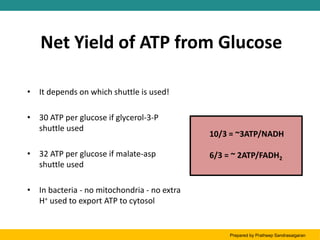
• It depends on which shuttle is used!
• 30 ATP per glucose if glycerol-3-P
shuttle used
• 32 ATP per glucose if malate-asp
shuttle used
• In bacteria - no mitochondria - no extra
H+ used to export ATP to cytosol
10/3 = ~3ATP/NADH
6/3 = ~ 2ATP/FADH2
Prepared by Pratheep Sandrasaigaran
Shuttle Systems for e -
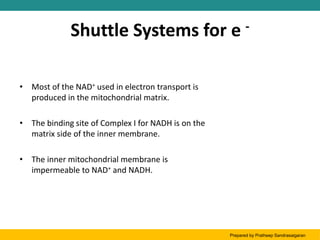
• Most of the NAD+ used in electron transport is
produced in the mitochondrial matrix.
• The binding site of Complex I for NADH is on the
matrix side of the inner membrane.
• The inner mitochondrial membrane is
impermeable to NAD+ and NADH.
Prepared by Pratheep Sandrasaigaran
Shuttle Systems for e -
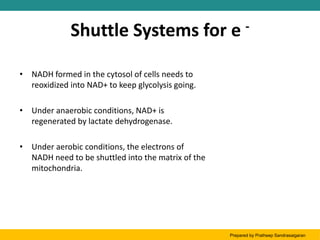
• NADH formed in the cytosol of cells needs to
reoxidized into NAD+ to keep glycolysis going.
• Under anaerobic conditions, NAD+ is
regenerated by lactate dehydrogenase.
• Under aerobic conditions, the electrons of
NADH need to be shuttled into the matrix of the
mitochondria.
Prepared by Pratheep Sandrasaigaran
Shuttle Systems for e -
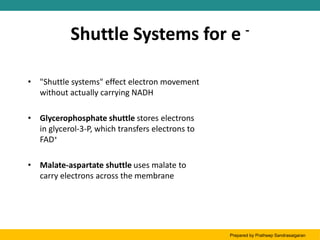
• "Shuttle systems" effect electron movement
without actually carrying NADH
• Glycerophosphate shuttle stores electrons
in glycerol-3-P, which transfers electrons to
FAD+
• Malate-aspartate shuttle uses malate to
carry electrons across the membrane
Prepared by Pratheep Sandrasaigaran
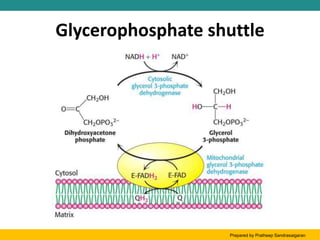
Glycerophosphate shuttle
Prepared by Pratheep Sandrasaigaran
Glycerophosphate shuttle
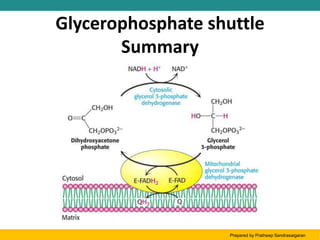
• This shuttle system uses two distinct glycerol 3-
phosphate dehydrogenases.
• The first is found in the cytoplasm, the other is found on
the intermembrane side of the inner mitochondrial
membrane.
Prepared by Pratheep Sandrasaigaran
Glycerophosphate shuttle
• In the first step, NADH produced in the cytosol transfers
its electrons to dihydroxyacetone phosphate to form
glycerol-3-phosphate.
• Glycerol-3-phosphate enters the intermitochondrial
space through a porin.
• Glycerol-3-phosphate is then reoxidized into
dihydroxyacetone phosphate by an FAD dependent
mitochondrial membrane glycerol 3-phosphate
dehydrogenase.
Prepared by Pratheep Sandrasaigaran
Glycerophosphate shuttle
• Electrons of NADH are transferred to FAD to form FADH2.
• The two electrons bound by the FADH2 are transferred
directly to coenzyme Q forming QH2.
• QH2 carries the electrons to complex III.
• The result of this shuttle is 1.5 ATP/NADH and this
shuttle is essentially irreversible
Prepared by Pratheep Sandrasaigaran
Glycerophosphate shuttle
Summary
Prepared by Pratheep Sandrasaigaran
Malate-aspartate shuttle
Prepared by Pratheep Sandrasaigaran
Malate-aspartate shuttle
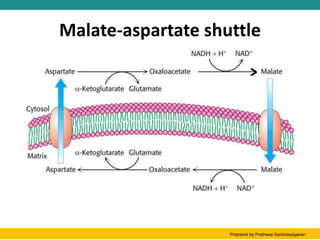
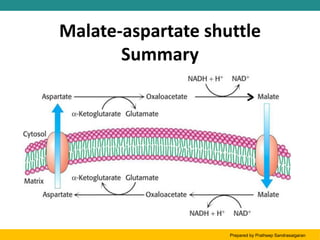
• In the cytosol, oxaloacetate is reduced to malate by
malate dehydrogenase which uses NADH as the
reductant.
• Malate is transported across the inner
mitochondrial membrane by the dicarboxylic acid or
tricarboxylic acid carrier.
• Now in the matrix, the malate is reoxidized by
malate dehydrogenase to generate oxaloacetate
and NADH which can now transfer its electrons to
Complex I.
Prepared by Pratheep Sandrasaigaran
Malate-aspartate shuttle
• The oxaloacetate is transaminated by glutamine to
form aspartate and α-ketoglutarate.
• Aspartate can be transported across the inner
mitochondrial membrane by the dicarboxylic acid
carrier.
• In the cytosol aspartate transaminates α-
ketoglutarate to reform oxaloacetate completing
the cycle.
• This shuttle system generates 2.5 ATP/NADH and is
completely reversible.
Prepared by Pratheep Sandrasaigaran
Malate-aspartate shuttle
Summary
Prepared by Pratheep Sandrasaigaran

Oxydative phosphorylations

  • 1.
    Net Yield ofATP from Glucose • It depends on which shuttle is used! • 30 ATP per glucose if glycerol-3-P shuttle used • 32 ATP per glucose if malate-asp shuttle used • In bacteria - no mitochondria - no extra H+ used to export ATP to cytosol 10/3 = ~3ATP/NADH 6/3 = ~ 2ATP/FADH2 Prepared by Pratheep Sandrasaigaran
  • 2.
    Shuttle Systems fore - • Most of the NAD+ used in electron transport is produced in the mitochondrial matrix. • The binding site of Complex I for NADH is on the matrix side of the inner membrane. • The inner mitochondrial membrane is impermeable to NAD+ and NADH. Prepared by Pratheep Sandrasaigaran
  • 3.
    Shuttle Systems fore - • NADH formed in the cytosol of cells needs to reoxidized into NAD+ to keep glycolysis going. • Under anaerobic conditions, NAD+ is regenerated by lactate dehydrogenase. • Under aerobic conditions, the electrons of NADH need to be shuttled into the matrix of the mitochondria. Prepared by Pratheep Sandrasaigaran
  • 4.
    Shuttle Systems fore - • "Shuttle systems" effect electron movement without actually carrying NADH • Glycerophosphate shuttle stores electrons in glycerol-3-P, which transfers electrons to FAD+ • Malate-aspartate shuttle uses malate to carry electrons across the membrane Prepared by Pratheep Sandrasaigaran
  • 5.
    Glycerophosphate shuttle Prepared byPratheep Sandrasaigaran
  • 6.
    Glycerophosphate shuttle • Thisshuttle system uses two distinct glycerol 3- phosphate dehydrogenases. • The first is found in the cytoplasm, the other is found on the intermembrane side of the inner mitochondrial membrane. Prepared by Pratheep Sandrasaigaran
  • 7.
    Glycerophosphate shuttle • Inthe first step, NADH produced in the cytosol transfers its electrons to dihydroxyacetone phosphate to form glycerol-3-phosphate. • Glycerol-3-phosphate enters the intermitochondrial space through a porin. • Glycerol-3-phosphate is then reoxidized into dihydroxyacetone phosphate by an FAD dependent mitochondrial membrane glycerol 3-phosphate dehydrogenase. Prepared by Pratheep Sandrasaigaran
  • 8.
    Glycerophosphate shuttle • Electronsof NADH are transferred to FAD to form FADH2. • The two electrons bound by the FADH2 are transferred directly to coenzyme Q forming QH2. • QH2 carries the electrons to complex III. • The result of this shuttle is 1.5 ATP/NADH and this shuttle is essentially irreversible Prepared by Pratheep Sandrasaigaran
  • 9.
  • 10.
    Malate-aspartate shuttle Prepared byPratheep Sandrasaigaran
  • 11.
    Malate-aspartate shuttle • Inthe cytosol, oxaloacetate is reduced to malate by malate dehydrogenase which uses NADH as the reductant. • Malate is transported across the inner mitochondrial membrane by the dicarboxylic acid or tricarboxylic acid carrier. • Now in the matrix, the malate is reoxidized by malate dehydrogenase to generate oxaloacetate and NADH which can now transfer its electrons to Complex I. Prepared by Pratheep Sandrasaigaran
  • 12.
    Malate-aspartate shuttle • Theoxaloacetate is transaminated by glutamine to form aspartate and α-ketoglutarate. • Aspartate can be transported across the inner mitochondrial membrane by the dicarboxylic acid carrier. • In the cytosol aspartate transaminates α- ketoglutarate to reform oxaloacetate completing the cycle. • This shuttle system generates 2.5 ATP/NADH and is completely reversible. Prepared by Pratheep Sandrasaigaran
  • 13.