T R I C A R B O X Y L I C A C I D | C I T R I C A C I D C Y C L E
KREB’S CYCLE
OVERVIEW
• Involves the oxidation of acetyl coenzyme A (acetyl
CoA) along with the reduction of coenzymes, which
are subsequently reoxidized to produce ATP.
• Occurs in the mitochondria of the cell. All enzymes
are present in the matrix of the mitochondria
except for succinate dehydrogenase.
REACTIONS OF THE CITRIC
ACID CYCLE
8 REACTIONS
MOLECULES & ENZYMES
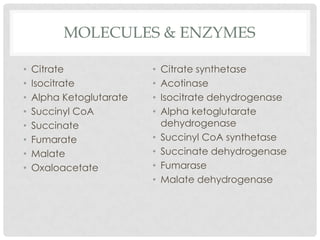
• Citrate
• Isocitrate
• Alpha Ketoglutarate
• Succinyl CoA
• Succinate
• Fumarate
• Malate
• Oxaloacetate
• Citrate synthetase
• Acotinase
• Isocitrate dehydrogenase
• Alpha ketoglutarate
dehydrogenase
• Succinyl CoA synthetase
• Succinate dehydrogenase
• Fumarase
• Malate dehydrogenase
STEP 1
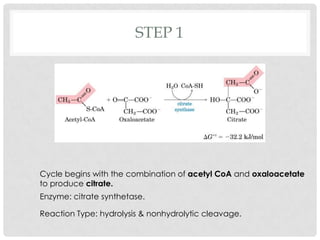
Cycle begins with the combination of acetyl CoA and oxaloacetate
to produce citrate.
Enzyme: citrate synthetase.
Reaction Type: hydrolysis & nonhydrolytic cleavage.
STEP 2
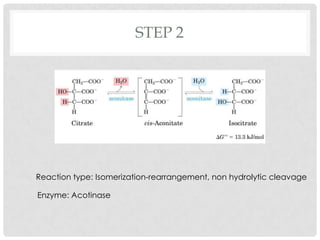
Reaction type: Isomerization-rearrangement, non hydrolytic cleavage
Enzyme: Acotinase
STEP 3
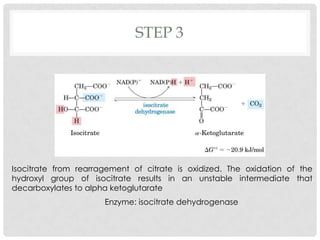
Isocitrate from rearragement of citrate is oxidized. The oxidation of the
hydroxyl group of isocitrate results in an unstable intermediate that
decarboxylates to alpha ketoglutarate
Enzyme: isocitrate dehydrogenase
STEP 4
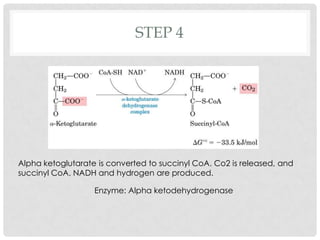
Alpha ketoglutarate is converted to succinyl CoA. Co2 is released, and
succinyl CoA, NADH and hydrogen are produced.
Enzyme: Alpha ketodehydrogenase
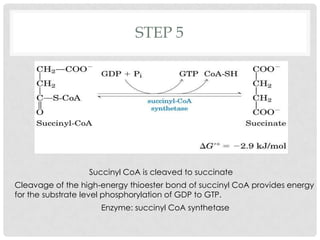
STEP 5
Succinyl CoA is cleaved to succinate
Cleavage of the high-energy thioester bond of succinyl CoA provides energy
for the substrate level phosphorylation of GDP to GTP.
Enzyme: succinyl CoA synthetase
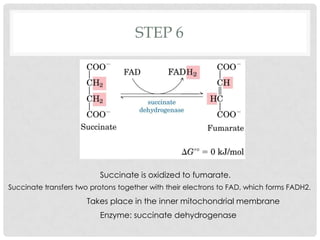
STEP 6
Succinate is oxidized to fumarate.
Succinate transfers two protons together with their electrons to FAD, which forms FADH2.
Enzyme: succinate dehydrogenase
Takes place in the inner mitochondrial membrane
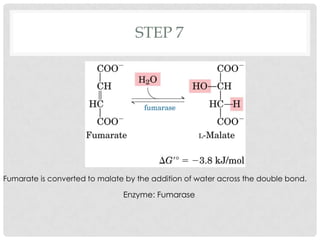
STEP 7
Fumarate is converted to malate by the addition of water across the double bond.
Enzyme: Fumarase
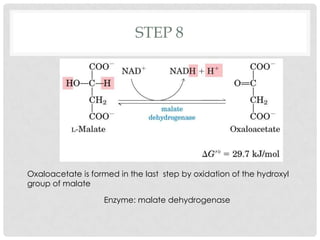
STEP 8
Oxaloacetate is formed in the last step by oxidation of the hydroxyl
group of malate
Enzyme: malate dehydrogenase
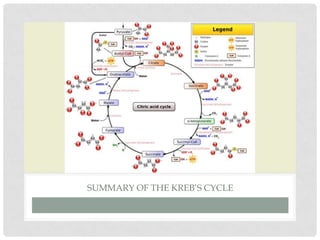
SUMMARY OF THE KREB’S CYCLE
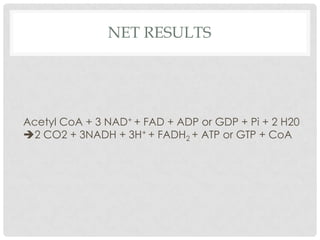
NET RESULTS
Acetyl CoA + 3 NAD+ + FAD + ADP or GDP + Pi + 2 H20
2 CO2 + 3NADH + 3H+ + FADH2 + ATP or GTP + CoA
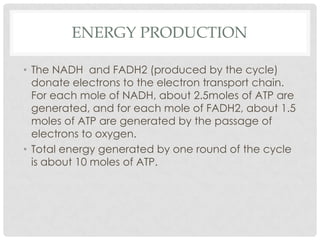
ENERGY PRODUCTION
• The NADH and FADH2 (produced by the cycle)
donate electrons to the electron transport chain.
For each mole of NADH, about 2.5moles of ATP are
generated, and for each mole of FADH2, about 1.5
moles of ATP are generated by the passage of
electrons to oxygen.
• Total energy generated by one round of the cycle
is about 10 moles of ATP.

Kreb's cycle

  • 1.
    T R IC A R B O X Y L I C A C I D | C I T R I C A C I D C Y C L E KREB’S CYCLE
  • 2.
    OVERVIEW • Involves theoxidation of acetyl coenzyme A (acetyl CoA) along with the reduction of coenzymes, which are subsequently reoxidized to produce ATP. • Occurs in the mitochondria of the cell. All enzymes are present in the matrix of the mitochondria except for succinate dehydrogenase.
  • 3.
    REACTIONS OF THECITRIC ACID CYCLE 8 REACTIONS
  • 4.
    MOLECULES & ENZYMES •Citrate • Isocitrate • Alpha Ketoglutarate • Succinyl CoA • Succinate • Fumarate • Malate • Oxaloacetate • Citrate synthetase • Acotinase • Isocitrate dehydrogenase • Alpha ketoglutarate dehydrogenase • Succinyl CoA synthetase • Succinate dehydrogenase • Fumarase • Malate dehydrogenase
  • 5.
    STEP 1 Cycle beginswith the combination of acetyl CoA and oxaloacetate to produce citrate. Enzyme: citrate synthetase. Reaction Type: hydrolysis & nonhydrolytic cleavage.
  • 6.
    STEP 2 Reaction type:Isomerization-rearrangement, non hydrolytic cleavage Enzyme: Acotinase
  • 7.
    STEP 3 Isocitrate fromrearragement of citrate is oxidized. The oxidation of the hydroxyl group of isocitrate results in an unstable intermediate that decarboxylates to alpha ketoglutarate Enzyme: isocitrate dehydrogenase
  • 8.
    STEP 4 Alpha ketoglutarateis converted to succinyl CoA. Co2 is released, and succinyl CoA, NADH and hydrogen are produced. Enzyme: Alpha ketodehydrogenase
  • 9.
    STEP 5 Succinyl CoAis cleaved to succinate Cleavage of the high-energy thioester bond of succinyl CoA provides energy for the substrate level phosphorylation of GDP to GTP. Enzyme: succinyl CoA synthetase
  • 10.
    STEP 6 Succinate isoxidized to fumarate. Succinate transfers two protons together with their electrons to FAD, which forms FADH2. Enzyme: succinate dehydrogenase Takes place in the inner mitochondrial membrane
  • 11.
    STEP 7 Fumarate isconverted to malate by the addition of water across the double bond. Enzyme: Fumarase
  • 12.
    STEP 8 Oxaloacetate isformed in the last step by oxidation of the hydroxyl group of malate Enzyme: malate dehydrogenase
  • 13.
    SUMMARY OF THEKREB’S CYCLE
  • 14.
    NET RESULTS Acetyl CoA+ 3 NAD+ + FAD + ADP or GDP + Pi + 2 H20 2 CO2 + 3NADH + 3H+ + FADH2 + ATP or GTP + CoA
  • 15.
    ENERGY PRODUCTION • TheNADH and FADH2 (produced by the cycle) donate electrons to the electron transport chain. For each mole of NADH, about 2.5moles of ATP are generated, and for each mole of FADH2, about 1.5 moles of ATP are generated by the passage of electrons to oxygen. • Total energy generated by one round of the cycle is about 10 moles of ATP.